seamus dubhghaill

Promoting Irish Culture and History from Little Rock, Arkansas, USA


Leave a comment

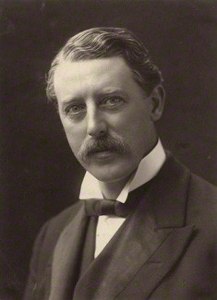
Birth of Henry Grattan Guinness, Evangelist & Author

henry-grattan-guinness

Henry Grattan Guinness, Irish Protestant Christian preacher, evangelist, and author, is born in Kingstown in Taney Parish, Dublin, on August 11, 1835. He is the great evangelist of the Evangelical awakening and preaches during the Ulster Revival of 1859 which draws thousands to hear him. He is responsible for training and sending hundreds of “faith missionaries” all over the world.

Guinness begins preaching in 1855. He offers to join the China Inland Mission founded by James Hudson Taylor in 1865 but takes Taylor’s advice to continue his work in London.

In September 1866, while in Keighley, Yorkshire, Guinness sees a notice advertising a series of lectures by the freethinker and communist Harriet Law. For a week he holds a series of meetings at the same time to try to counteract her influence. He is appalled at the “scoffing unbelief” of such speakers. With the help of Professor John Couch Adams, some astronomical tables, and examination of the scriptures, Guinness works out the prophetic chronology of the bible in terms of a series of “solilunar cycles.” This proves to him that he is living at the end of the sixth unsabbatic day of creation, 6,000 years from Adam, and that the “redemption Sabbath” will soon arrive. This revelation becomes the subject of many of his books and sermons.

In March 1873, Henry and his wife Fanny start the famous East London Missionary Training Institute, also known as Harley College, at Harley House in Bromley-by-Bow, East End of London with just six students. The renowned Dr. Thomas John Barnardo is co-director with Dr. Guinness and is greatly influenced by him. The school trains 1,330 missionaries for 30 societies of 30 denominations.

Harley College becomes so successful that it needs a larger home. In 1883, Elizabeth Hulme offers Guinness Cliff House near Calver, Derbyshire. Harley College is renamed Hulme Cliff College. Now known as Cliff College it continues to this day training and equipping Christians for mission and evangelism.

In 1873, Guinness founds the East London Institute for Home and Foreign Missions, the root of the Regions Beyond Missionary Union. In 1877, he founds the Livingstone Inland Mission. His son, Dr. Henry Grattan Guinness, founds the Congo-Balolo Mission in 1888 and co-founds the Congo Reform Association in 1904.

Guinness dies in Bath, Somerset, England, on June 21, 1910, at 75 years of age.


Leave a comment

The Second Battle of Athenry

athenry-castle

The Second Battle of Athenry takes place on August 10, 1316. The English Colonists defeat the Irish in a very bloody battle. This is one of the most decisive battles of the Bruce campaign in Ireland (1315-1318).

The numbers involved are unknown and can only be estimated. The royal army is believed to have been as much as a few thousand, while that of Athenry is probably several hundred less. While it is doubtful that there are any more than seven thousand, the list of participants on the Irish side alone indicates that an overall figure of at least three to four thousand are involved. The English claim that they take some 1,100 heads from the Irish on that day.

Unlike the First Battle of Athenry in 1249, no account is given of the battle itself in any surviving account. Even the site of the battle itself is uncertain.

Fedlim Ó Conchobair, the King of Connacht, leads a coalition of the Gaels to stop the return of William Liath de Burgh, the Anglo-Irish Lord of Connacht. He has come back from Scotland to try and regain his lost lands in the western province. He gathers together a large and well-equipped army from the colonists of Connacht and Meath. Rickard de Bermingham leads the English of Meath. Ó Conchobair also puts together a formidable army drawn from north Munster, south Connacht, and the kingdoms of Breifne and Meath.

Although details of the battle are very sketchy at best, the Irish certainly meet with catastrophe. Fedlim Ó Conchobair and Tadhg Ó Cellaigh, King of Uí Maine, are among those who are killed along with numerous other kings and chieftains of the Gaels.

(Pictured: Athenry Castle)


Leave a comment

The Siege of Limerick

cittie-of-limerick

Siege of Limerick commences on August 9, 1690, when William of Orange and his army of 25,000 men reach Limerick and occupy Ireton’s fort and Cromwell’s fort outside the city. His siege cannons are still making their way from Dublin with a light escort so all he has available is his field artillery. The siege train is intercepted by Patrick Sarsfield’s cavalry at Ballyneety in County Limerick and destroyed, along with the Williamites‘ siege guns and ammunition. This forces William to wait another ten days before he can start bombarding Limerick in earnest while another siege train is brought up from Waterford.

By this time, it is late August. Winter is approaching and William wants to finish the war in Ireland so he can return to the Netherlands and proceed with the main business of the War of the Grand Alliance against the French. For this reason, he decides on an all-out assault on Limerick.

His siege guns blast a breach in the walls of the “Irish town” section of the city and William launches his assault on August 27. The breach is stormed by Danish grenadiers, but the Jacobite’s French officer Boisseleau has built an earthwork or coupure inside the walls and has erected barricades in the streets, impeding the attackers. The Danish grenadiers, and the eight regiments who follow them into the breach, suffer terribly from musketry and cannon fire at point blank range. Jacobite soldiers without arms and the civilian population, including women, line the walls and throw stones and bottles at the attackers. A regiment of Jacobite dragoons also make a sortie and attack the Williamites in the breach from the outside. After three and a half hours of fighting, William finally calls off the assault.

William’s men suffer about 3,000 casualties, including many of their best Dutch, Danish, German, and Huguenot troops. The Jacobites lose only 400 men in the battle. Due to the worsening weather, William calls off the siege and puts his troops into winter quarters, where another 2,000 of them die of disease. William himself leaves Ireland shortly afterwards, returning to London. He subsequently leaves London to take command of Allied forces fighting in Flanders and leaves Godert de Ginkell to command in Ireland. The following year Ginkell wins a significant victory at the Battle of Aughrim.

Limerick is to remain a Jacobite stronghold until it surrenders after another Williamite siege the following year. Following the loss of this last major stronghold, Patrick Sarsfield leads the army into exile in the Flight of the Wild Geese to the Continent, where they continue to serve the cause of James II and his successors.


Leave a comment

Birth of U2’s The Edge, David Howell Evans

the-edge

David Howell Evans, British-born Irish musician and songwriter best known by his stage name The Edge and as the lead guitarist, keyboardist, and backing vocalist of the rock band U2, is born at the Maternity Hospital in Barking, Essex, England on August 8, 1961. A member of U2 since its inception, he has recorded 13 studio albums with the band as well as one solo record.

The Edge is raised in Ireland after the Evans family relocates there while he is still an infant. He receives his initial formal education at St. Andrew’s National School in Dublin. As a child he also receives piano and guitar lessons, and practises music with his elder brother Richard. In 1976, at Mount Temple Comprehensive School, he goes to a meeting in response to an advert posted by another pupil, Larry Mullen Jr., on the school’s noticeboard seeking musicians to form a new band with him. Among the other pupils who respond to the note are Paul Hewson (Bono) and Adam Clayton. The band goes through a number of versions before becoming known as U2 in March 1978.

U2 begins its public performance life in small venues in Dublin, occasionally playing at other venues elsewhere in Ireland. In December 1979 they perform their first concerts outside Ireland, in London, and in 1980 begin extensive touring across the British Isles. Their debut album Boy is released in 1980.

In 1981, leading up to the October Tour, Evans comes very close to leaving U2 for religious reasons, but he decides to stay. During this period, he becomes involved with a group called Shalom Tigers, in which bandmates Bono and Larry Mullen Jr. are also involved. Shortly after deciding to remain with the band, he writes a piece of music that later becomes Sunday Bloody Sunday.

U2 eventually becomes one of the most popular acts in popular music, with successful albums such as 1987’s The Joshua Tree and 1991’s Achtung Baby. Over the years, the Edge has experimented with various guitar effects and introduced influences from several genres of music into his own style, including American roots music, industrial music, and alternative rock. With U2, the Edge also plays keyboards, co-produced their 1993 record Zooropa, and occasionally contributes lyrics.

In addition to his regular role within U2, The Edge has also recorded with such artists as Johnny Cash, B. B. King, Tina Turner, Ronnie Wood, Jah Wobble, Holger Czukay, Jay-Z, and Rihanna. He has collaborated with U2 bandmate Bono on several projects, including the soundtracks to the musical Spider-Man: Turn Off the Dark and the Royal Shakespeare Company‘s London stage adaptation of A Clockwork Orange.

The Edge, Bob Ezrin, and Henry Juszkiewicz co-found Music Rising in 2005, a charity that helps provide replacement instruments for those that were lost in Hurricane Katrina. The instruments are originally only replaced for professional musicians, but they soon realise the community churches and schools need instruments as well. The charity’s slogan is “Rebuilding the Gulf Region note by note” and has helped over a hundred musicians who were affected by the hurricane. The Edge also serves on the board of The Angiogenesis Foundation, a 501(c)(3) nonprofit organisation dedicated to improving global health by advancing angiogenesis-based medicine, diets, and lifestyle.

In 2011, Rolling Stone magazine places him at number 38 on its list of “The 100 Greatest Guitarists of All Time.” In 2012, Spin ranks him 13th on their own list.


3 Comments

Birth of Flying Ace Thomas Falcon Hazell

thomas-falcon-hazell

Thomas Falcon Hazell, fighter pilot with the Royal Flying Corps and later the Royal Air Force during World War I, is born in Roundstone, County Galway, on August 7, 1892. Hazell scores 43 victories in 1917–1918 making him the fifth most successful British “flying ace” of the war, the third most successful Irish-born pilot behind Edward Mannock and George McElroy, and the only pilot to survive the war from both groups.

Upon the outbreak of the war in August 1914, Hazell volunteers for service as a private with the South Irish Horse. On October 10 he is commissioned as second lieutenant in the 7th Battalion, Royal Inniskilling Fusiliers. As part of the 49th Brigade in the 16th (Irish) Division, the 7th Inniskillings are initially based at Tipperary, where Hazell is promoted to lieutenant on June 4, 1915. The regiment lands in France in February 1916.

Soon afterwards Hazell transfers to the Royal Flying Corps. In April and May he is assigned to No. 5 Reserve Squadron, based at Castle Bromwich. He is appointed a flying officer on June 5 and survives a severe crash before completing his training. He eventually joins No. 1 Squadron on the Western Front. Flying Nieuport 17 Scouts, he shoots down 20 enemy aircraft between March and August 1917, being appointed a flight commander with the acting rank of captain on May 25, and is awarded the Military Cross on July 26.

After serving as an instructor at the Central Flying School in 1918, he takes command of “A” Flight, No. 24 Squadron, flying the S.E.5a. On August 22, 1918, Hazell shoots down an observation balloon despite its escort of seven Fokker D.VIIs. The escort is led by German ace Ernst Udet, who attacks and riddles Hazell’s petrol tank, propeller, and two longerons with bullets. In spite of this Hazell fights his way back, eyes full of petrol, and lands safely. Udet thinks he has forced the British pilot to crash and actually claims him as his 60th victory. Hazell finishes the war with 43 confirmed kills, the top British surviving ace of the war (excluding Dominion airmen). Hazell is twice awarded the Distinguished Flying Cross. On June 11, 1927, he returns to the RAF Depot at Uxbridge and is placed on the retired list on July 20, 1927, at his own request.

In 1944, at the age of 52, Hazell becomes the commander of “D” Company, 24th (Tettenhall) Battalion, South Staffordshire Home Guard during the later part of World War II.

Hazell dies in Newport, County Mayo, on September 4, 1946, and is buried at the Burrishoole Church of Ireland Cemetery there. In 2014 his grave, which had been largely forgotten and neglected, is restored, repaired, and re-dedicated in a ceremony on August 4, 2014, the 100th anniversary of the declaration of World War I.


Leave a comment

Birth of the Liberator, Daniel O’Connell

daniel-oconnell

Daniel O’Connell, Irish political leader often referred to as The Liberator or The Emancipator, is born on August 6, 1775, at Carhan near Cahersiveen, County Kerry, to the O’Connells of Derrynane, a once-wealthy Roman Catholic family, that has been dispossessed of its lands.

Raised by his uncle, Daniel learns the Irish language and Irish lore in Kerry. O’Connell does part of his schooling in France during the revolution. On May 19, 1798, O’Connell is called to the Irish Bar and becomes a barrister. Four days later, the United Irishmen stage their rebellion which is put down by the British with great bloodshed. O’Connell does not support the rebellion. He believes that the Irish need to assert themselves politically rather than by force. The violent excesses he witnesses in France, the slaughter of the 1798 Rising, and finally his own killing of a man in a duel in 1815 leads him to renounce violence forever.

Moving into politics, O’Connell founds the Catholic Association in 1823, creating one of the first massive political movements in Europe or the Americas. The Catholic Association embraces other aims to better Irish Catholics, such as electoral reform, reform of the Church of Ireland, tenants’ rights, and economic development.

When he is elected to Parliament in 1828, he is unable to take his seat as members of parliament have to take the Oath of Supremacy, which is incompatible with Catholicism.  Fear of the reaction of his millions of followers leads to the passage of the Roman Catholic Relief Act 1829. O’Connell works for Home Rule for Ireland for the rest of his days but never achieves it. The British ban his mass Repeal of the Union rallies in 1843 and jail him for a time. The movement loses momentum at that point and the long years of hard work wear “The Liberator” down.

O’Connell dies at the age of 71 of cerebral softening on May15, 1847, in Genoa, Italy, while on a pilgrimage to Rome. His time in prison seriously weakens him and the appallingly cold weather he has to endure on his journey is likely the final blow. According to his dying wish, his heart is buried in Rome at Sant’Agata dei Goti, then the chapel of the Irish College, and the remainder of his body in Glasnevin Cemetery in Dublin, beneath a round tower.


Leave a comment

Death of General Philip Henry Sheridan

philip-sheridan

Irish American General Philip Henry Sheridan, career United States Army officer and a Union general in the American Civil War, dies of heart disease in Dartmouth, Massachusetts, on August 5, 1888.

Sheridan is born in Albany, New York, the third child of six by John and Mary Meenagh Sheridan, immigrants from the parish of Killinkere, County Cavan. Fully grown, he reaches only 5 feet 5 inches in height, a stature that leads to the nickname “Little Phil.” Abraham Lincoln describes his appearance in a famous anecdote, “A brown, chunky little chap, with a long body, short legs, not enough neck to hang him, and such long arms that if his ankles itch, he can scratch them without stooping.”

Sheridan’s career is noted for his rapid rise to major general and his close association with General-in-chief Ulysses S. Grant, who transfers Sheridan from command of an infantry division in the Western Theater to lead the Cavalry Corps of the Army of the Potomac in the East. In 1864, he defeats Confederate forces in the Shenandoah Valley and his destruction of the economic infrastructure of the Valley, called “The Burning” by residents, is one of the first uses of scorched earth tactics in the war. In 1865, his cavalry pursues General Robert E. Lee and is instrumental in forcing his surrender at Appomattox Court House.

In later years, Sheridan fights in the Indian Wars of the Great Plains. Comanche Chief Tosahwi reputedly tells Sheridan in 1869, “Me, Tosahwi; me good Injun,” to which Sheridan supposedly replies, “The only good Indians I ever saw were dead.” Sheridan denies he had ever made the statement. Biographer Roy Morris Jr. states that, nevertheless, popular history credits Sheridan with saying “The only good Indian is a dead Indian.” This variation “has been used by friends and enemies ever since to characterize and castigate his Indian-fighting career.” In Bury My Heart at Wounded Knee, Dee Brown attributes the quote to Sheridan but does not provide documentation to support his contention, so the quote may be more apocryphal than real.

Both as a soldier and private citizen, Sheridan is instrumental in the development and protection of Yellowstone National Park. The protection of the Yellowstone area is Sheridan’s personal crusade. He authorizes Lieutenant Gustavus Doane to escort the Washburn Expedition in 1870 and for Captain John W. Barlow to escort the Hayden Expedition in 1871. Barlow names Mount Sheridan, a peak overlooking Heart Lake in Yellowstone, for the general in 1871. As early as 1875, Sheridan promotes military control of the area to prevent the destruction of natural formations and wildlife.

In 1883, Sheridan is appointed general-in-chief of the U.S. Army, and in 1888 he is promoted to the rank of General of the Army during the term of President Grover Cleveland. Sheridan serves as the ninth president of the National Rifle Association.

Sheridan suffers a series of massive heart attacks two months after sending his memoirs to the publisher. After his first heart attack, the U.S. Congress quickly passes legislation to promote him to general and he receives the news from a congressional delegation with joy, despite his pain. His family moves him from the heat of Washington, D.C. and he dies of heart failure in his summer cottage in the Nonquitt section of Dartmouth, Massachusetts.

His body is returned to Washington, and he is buried on a hillside facing the capital city near Arlington House in Arlington National Cemetery. The burial helps elevate Arlington to national prominence.


1 Comment

Birth of Irish Folk Singer Moya Brennan

moya-brennan

Moya Brennan, born Máire Ní Bhraonáin, Irish folk singer, songwriter, harpist, and philanthropist, is born in Dublin on August 4, 1952.

After leaving secondary school, Brennan spends a few years at the Royal Irish Academy of Music in Dublin studying the harp, the piano, and singing. She has also taught music at Holy Cross College in Falcarragh, County Donegal.

In 1970 Brennan joins her two brothers, Pól and Ciarán, and their mother’s twin brothers, Noel and Pádraig Ó Dúgáin, and form the band Clannad. They are identified and introduced to television by Tony MacMahon. After enjoying a decade of being among the world’s foremost Irish musical groups, Clannad graduates to chart success in 1982 with the album Magical Ring. Brennan is at the forefront of the group’s success and her voice suddenly becomes synonymous with Celtic music and Irish music at the time. Brennan records 17 albums with Clannad and wins a Grammy Award, a BAFTA, and an Ivor Novello award with the quintet. Her sister, Eithne Ní Bhraonáin, who spends some time with Clannad, continues to pursue a very successful solo career under the name Enya.

Brennan releases her first solo album in 1992, Máire, on Atlantic Records. Misty Eyed Adventures on BGM follows three years later. In 1998, Brennan signs with Word Records and releases Perfect Time, and Whisper to the Wild Water a year later. The album is nominated for the Grammy Award for Best New Age Album in 2001.

Brennan’s autobiography, The Other Side of the Rainbow, is published in 2000 and she performs her song Perfect Time live at World Youth Day in Rome in front of crowds of pilgrims and Pope John Paul II. There are 2.1 million people present, making it the largest crowd ever gathered in the Northern Hemisphere.

In film, Brennan is a featured vocalist on King Arthur (2004), co-writing the title theme Tell Me Now (What You See) with Hans Zimmer. She also writes an additional music score for To End All Wars (2001). In 1995, she duets with Shane MacGowan on You’re the One for the movie Circle of Friends. Brennan has collaborated with many other musicians, including Chicane, Alan Parsons, Bono, Robert Plant, Van Morrison, Michael McDonald from the Doobie Brothers, Bruce Hornsby, Joe Elliott, The Chieftains, Paul Young, Paul Brady, Michael Crawford, Joe Jackson, and Ronan Keating.

In total Brennan has recorded 25 albums, and has sold 20 million records. Brennan and Clannad are credited with the creation of contemporary Celtic music and are held in high esteem for their vast contribution to bringing new life to old Irish songs. They have been compared to Seán Ó Riada, in that they brought the Irish language into popular culture through their music. One critic said, “Clannad’s music offers a terrific fusion between traditional and modern influences.” U2 front man Bono says of her voice, “I think Máire has one of the greatest voices the human ear has ever experienced.”


Leave a comment

Roger Casement Hanged for Treason

roger-casement

Sir Roger David Casement, Irish diplomat who is knighted by King George V in 1911, is executed on August 3, 1916, for his role in the 1916 Easter Rising.

Casement is an Irish Protestant who serves as a British diplomat during the early part of the 20th century. He wins international acclaim after exposing the illegal practice of slavery in the Congo and parts of South America. Despite his Ulster Protestant roots, he becomes an ardent supporter of the Irish independence movement and, after the outbreak of World War I, travels to the United States and then to Germany to secure aid for an Irish uprising against the British.

Germany, which is at war with Great Britain, promises limited aid, and Casement is transported back to Ireland in a German submarine. On April 21, 1916, just a few days before the outbreak of the Easter Rising in Dublin, he lands in County Kerry and is picked up by British authorities almost immediately. By the end of the month, the Easter Rising has been suppressed and a majority of its leaders executed.

Casement is tried separately because of his illustrious past but nevertheless is found guilty of treason on June 29. On August 3, he is hanged by John Ellis and his assistants at Pentonville Prison in London. Casement is the last to be executed as a result of the Easter Rebellion.


Leave a comment

The Sinking of John F. Kennedy’s PT-109

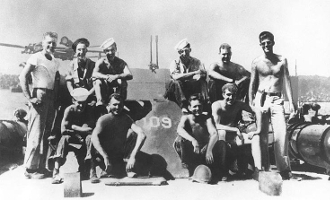
pt-109-crew

In the early morning hours of August 2, 1943, three small American torpedo boats are moving just west of New Georgia in the Solomon Islands. In command of PT-109 is a young Irish American destined to one day be the first Catholic president of the United States, Lieutenant John Fitzgerald Kennedy.

On a moonless night, Kennedy’s boat is idling on one engine to avoid detection of her wake by Japanese aircraft when the crew realizes they are in the path of the Japanese destroyer Amagiri, which is returning to Rabaul from Vila, Kolombangara, after offloading supplies and 900 soldiers. Amagiri is traveling at a relatively high speed of between 23 and 40 knots in order to reach harbor by dawn, when Allied air patrols are likely to appear.

The crew of PT-109 has less than ten seconds to get the engines up to speed. The commander of the Amagiri, Kohai Hanami, spots the tiny ship but it is too close to fire upon. Instead, Hanami decides to ram it. PT-109 is cut in half and bursts into flames. Seamen Andrew Jackson Kirksey and Harold W. Marney are killed, and two other members of the crew are badly injured. PT-109 is gravely damaged, with watertight compartments keeping only the forward hull afloat in a sea of flames.

PT-169 launches two torpedoes that miss the destroyer and PT-162‘s torpedoes fail to fire at all. Both boats then turn away from the scene of the action and return to base without checking for survivors.

The eleven survivors cling to PT-109’s bow section as it drifts slowly south. By about 2:00 PM, it is apparent that the hull is taking on water and will soon sink, so the men decide to abandon it and swim for land. Since there are Japanese camps on all the nearby large islands, they choose the tiny deserted Plum Pudding Island, southwest of Kolombangara. They place their lantern, shoes, and non-swimmers on one of the timbers used as a gun mount and begin kicking together to propel it. Kennedy, who had been on the Harvard University swim team, uses a life jacket strap clenched between his teeth to tow his badly burned senior enlisted machinist mate, MM1 Patrick McMahon. It takes four hours to cover the 3.5 miles to their destination, which they reach without confrontation by sharks or crocodiles.

The island is only 100 yards in diameter and has no food or water. The crew has to hide from passing Japanese barges. Kennedy swims to Naru and Olasana islands, a round trip of about 2.5 miles, in search of help and food. He then leads his men to Olasana Island, which has coconut trees and drinkable water.

The explosion of PT-109 is spotted by an Australian coastwatcher, Sub-lieutenant Arthur Reginald Evans, who mans a secret observation post at the top of the Mount Veve volcano on Kolombangara, where more than 10,000 Japanese troops are garrisoned below on the southeast portion. Evans dispatches islanders Biuku Gasa and Eroni Kumana in a dugout canoe to look for possible survivors after decoding news that the explosion he had witnessed was likely from the lost PT-109.

Kennedy and his men survive for six days on coconuts before they are found by the scouts. The small canoe is not big enough for passengers. Kennedy quickly carves a note on a coconut for Gasa and Kumana to deliver to Evans. Evans gets word back to the U.S. Navy and, on the night of August 8, all eleven survivors of PT-109 are rescued by PT-157.

John F. Kennedy keeps that carved coconut on his desk in the Oval Office at the White House until the day he is assassinated.