seamus dubhghaill

Promoting Irish Culture and History from Little Rock, Arkansas, USA


Leave a comment

Birth of Actor David Kelly

David Kelly, Irish actor who has regular roles in several film and television works from the 1950s onwards, is born in Dublin on July 11, 1929. One of the most recognisable voices and faces of Irish stage and screen, Kelly is known to Irish audiences for his role as Rashers Tierney in Strumpet City, to British audiences for his roles as Cousin Enda in Me Mammy and as the builder Mr. O’Reilly in Fawlty Towers, and to American audiences for his role as Grandpa Joe in the film Charlie and the Chocolate Factory. Another notable role is as Michael O’Sullivan in Waking Ned.

Kelly is educated at Dublin’s Synge Street CBS Christian Brothers school. He begins acting at the age of eight at the city’s Gaiety Theatre, and trains at The Abbey School of Acting. As a backup career, he additionally trains as a draughtsman and calligrapher, and also learns watercolor painting. He appears onstage in the original production of Brendan Behan‘s The Quare Fellow, and gains his first major career attention in Samuel Beckett‘s Krapp’s Last Tape at the Dublin’s Abbey Theatre in 1959. By then he has made his screen debut in a small part in director John Pomeroy’s 1958 film noir Dublin Nightmare.

He becomes a familiar face on British television beginning in the 1960s with the BBC comedy Me Mammy, opposite Milo O’Shea and Anna Manahan. He goes on to often-memorable guest roles on such series as Oh Father!, Never Mind the Quality, Feel the Width, and On the Buses, and particularly during the 1970s with a long-running role as the one-armed dishwasher Albert Riddle in the Man About the House spin-off Robin’s Nest. He also has a regular long running role alongside Bruce Forsyth in both series of the comedy Slingers Day from 1986 to 1987.

He gains some of his greatest recognition in 1975, playing inept builder Mr. O’Reilly on the second episode of Fawlty Towers. He is in the voice cast of The Light Princess, a partly animated, hour-long family fantasy that airs on the BBC in 1978.

In Ireland, he may be most famous for his portrayal of the character “Rashers” Tierney in the 1980 RTÉ miniseries Strumpet City, which stars Peter O’Toole, Cyril Cusack and Peter Ustinov. He goes on to have starring roles in television shows such as Emmerdale Farm in the 1980s and Glenroe in the 1990s, as well as playing the grandfather in Mike Newell‘s film Into the West (1992).

Following his appearance as Michael O’Sullivan in the 1998 film Waking Ned, Kelly plays roles in such films as Tim Burton‘s Charlie and the Chocolate Factory, in which he plays Grandpa Joe and Agent Cody Banks 2: Destination London. He plays title character Frank Kovak in the mystery film The Kovak Box, in a rare villainous role. Stardust, released in 2007, is his final film. He also does extensive radio work, including a guest appearance on the BBC Radio 4 series Baldi.

Kelly wins a 1991 Helen Hayes Award for Outstanding Supporting Performer, Non-Resident Production, for a Kennedy Center revival of The Playboy of the Western World. As well, he earns a Screen Actors Guild Award nomination for the 1998 film Waking Ned. In 2005, he wins the Irish Film & Television Academy‘s Lifetime Achievement Award, in addition to earning a nomination for Best Supporting Actor for the film Charlie and the Chocolate Factory.

David Kelly dies after a short illness on February 12, 2012 at age of 82. The Irish Times refers to him as the “grand old man of Irish acting.” A Catholic funeral mass takes place on February 16, 2012 at the Church of the Miraculous Medal, in his hometown of Dublin. He is cremated at Mount Jerome Cemetery and Crematorium.


Leave a comment

Belfast’s Bloody Sunday

Bloody Sunday or Belfast’s Bloody Sunday is a day of violence in Belfast, Ireland (present-day Northern Ireland) on July 10, 1921, during the Irish War of Independence.

Belfast sees almost 500 people die in political violence between 1920 and 1922. Violence in the city breaks out in the summer of 1920 in response to the Irish Republican Army (IRA) killing of Royal Irish Constabulary Detective Oswald Swanzy after Sunday services outside a Protestant church in nearby Lisburn. Seven thousand Catholics and some Protestant trade unionists are driven from their jobs in the Belfast shipyards and over 50 people are killed in rioting between Catholics and Protestants.

Violence in Belfast wanes until the following summer of 1921. At the time, Irish republican and British authorities are negotiating a truce to end the war but fighting flares up in Belfast. On June 10, an IRA gunman, Jack Donaghy, ambushes three RIC constables on the Falls Road, fatally wounding one, Thomas Conlon, a Roman Catholic from County Roscommon, who, ironically, is viewed as “sympathetic” to the local nationalists. Over the following three days, at least 14 people lose their lives and 14 are wounded in fighting in the city, including three Catholics who are taken from their homes and killed by uniformed police.

Low-level attacks continue in the city over the next month until another major outbreak of violence that leads to “Bloody Sunday.” On July 8, the RIC attempt to carry out searches in the mainly Catholic and republican enclave around Union Street and Stanhope Street. However, they are confronted by about fifteen IRA volunteers in an hour-long firefight.

On July 9, a truce to suspend the war is agreed in Dublin between representatives of the Irish Republic and the British government, to come into effect at noon on July 11. Many Protestants/unionists condemn the truce as a “sell-out” to republicans.

On the night of July 9/10, hours after the truce is announced, the RIC attempt to launch a raid in the Lower Falls district of west Belfast. Scouts alert the IRA of the raid by blowing whistles, banging dustbin lids and flashing a red light. On Raglan Street, a unit of about fourteen IRA volunteers ambush an armoured police truck, killing one officer and wounding at least two others.

This sparks an outbreak of ferocious fighting between Catholics and Protestants in west Belfast the following day, Sunday July 10, in which 16 civilians lose their lives and up to 200 houses are destroyed. Of the houses destroyed, 150 are owned by Catholics. Most of the dead are civilians and at least four of the Catholic victims are ex-World War I servicemen.

Protestants, fearful of absorption into a Catholic Ireland and blindly angered by the presence of heresy and treason in their midst, strike at the Catholic community while vengeful Catholics strike back with counter-terror. Gun battles rage all day along the sectarian “boundary” between the Catholic Falls and Protestant Shankill districts and rival gunmen use rifles, machine guns and grenades in the clashes. Gunmen are seen firing from windows, rooftops and street corners. A loyalist mob, several thousand strong, attempt to storm the Falls district, carrying petrol and other flammable materials.

A tram travelling from the Falls into the city centre is struck by snipers’ bullets, and the service has to be suspended. Catholics and republicans claim that police, mostly from the Ulster Special Constabulary (USC), drive through Catholic enclaves in armoured cars firing indiscriminately at houses and bystanders. The police return to their barracks late on Sunday night, allegedly after a ceasefire has been agreed by telephone between a senior RIC officer and the commander of the IRA’s Belfast Brigade, Roger McCorley.

The truce is due to come into effect at midday on Monday, July 11, but violence resumes that morning. Three people are shot dead that day, including an IRA volunteer who is shot minutes before midday. In the north the official truce does not end the fighting. While the IRA is involved in the violence, it does not control the actions of the Catholic community. Tuesday July 12 sees the Orange Order‘s annual Twelfth marches pass off peacefully and there are no serious disturbances in the city. However, sporadic violence resumes on Wednesday, and by the end of the week 28 people in all have been killed or fatally wounded in Belfast.

The violence of the period in Belfast is cyclical, and the events of July 1921 are followed by a lull until a three-day period beginning on August 29, when another 20 lives are lost in the west and north of the city. The conflict in Belfast between the IRA and Crown forces and between Catholics and Protestants continues until the following summer, when the northern IRA is left isolated by the outbreak of the Irish Civil War in the south and weakened by the rigorous enforcement of internment in Northern Ireland.

At the time the day is referred to as “Belfast’s Bloody Sunday.” However, the title of “Bloody Sunday” is now more commonly given in Ireland to events in Dublin in November 1920 or Derry in January 1972.


Leave a comment

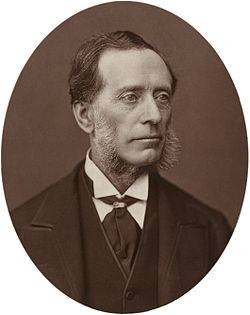
Death of Statesman Edmund Burke

Edmund Burke, statesman born in Dublin, dies on July 9, 1797, in Beaconsfield, Buckinghamshire, England. He is also known as an author, orator, political theorist, and philosopher who, after moving to London, served as a member of parliament (MP) for many years in the House of Commons with the Whig Party.

Burke receives his early education at a Quaker school in Ballitore, County Kildare. In 1744, he enters Trinity College, Dublin, a Protestant establishment, which up until 1793, did not permit Catholics to take degrees. He graduates from Trinity in 1748. Burke’s father wants him to read Law, and with this in mind he goes to London in 1750, where he enters the Middle Temple, before soon giving up legal study to travel in Continental Europe. After eschewing the Law, he pursues a livelihood through writing.

Burke criticizes British treatment of the American colonies, including through its taxation policies. He also supports the American Revolution, believing both that it could not affect British or European stability and would be an innovative experiment in political development since the Americas are so far away from Europe and thus could have little impact on England.

Burke is remembered for his support for Catholic emancipation, the impeachment of Warren Hastings from the East India Company, and for his later opposition to the French Revolution. In his Reflections on the Revolution in France, he claims that the revolution is destroying the fabric of good society and condemned the persecution of the Catholic Church that results from it. This leads to his becoming the leading figure within the conservative faction of the Whig Party, which he dubs the “Old Whigs,” as opposed to the pro–French Revolution “New Whigs” led by Charles James Fox.

For more than a year prior to his death, Burke realizes that his “stomach” is “irrecoverably ruind.” Edmund Burke dies in Beaconsfield, Buckinghamshire, on July 9, 1797, and is buried there alongside his son and brother. His wife, Mary Jane Nugent, survives him by nearly fifteen years.

In the nineteenth century Burke is praised by both conservatives and liberals. Subsequently, in the twentieth century, he becomes widely regarded as the philosophical founder of modern conservatism.


Leave a comment

Birth of Admiral Sir Francis Leopold McClintock

Admiral Sir Francis Leopold McClintock, Irish explorer in the British Royal Navy who is known for his discoveries in the Canadian Arctic Archipelago, is born on July 8, 1819 in Dundalk, County Louth.

McClintock is the eldest son of Henry McClintock, formerly of the 3rd Dragoon Guards, by his wife Elizabeth Melesina, daughter of the Ven. George Fleury, D.D., archdeacon of Waterford. His uncle is John McClintock (1770–1855) of Drumcar House.

In 1835 McClintock becomes a member of the Royal Navy as a gentleman volunteer, and joins a series of searches for Sir John Franklin between 1848 and 1859. He masters traveling by using human hauled sleds, which remain the status quo in Royal Navy Arctic and Antarctic overland travel until the death of Captain Robert Falcon Scott RN in his bid to reach the South Pole. In 1848-49, McClintock accompanies James Clark Ross on his survey of Somerset Island. As part of Capt. Henry Kellett‘s expedition 1852 to 1854, McClintock travels 1,400 miles by sled and discovers 800 miles of previously unknown coastline.

In 1854 the explorer John Rae travels west from Repulse Bay, Nunavut and learns from the Inuit that a ship has been abandoned somewhere to the west. Previous expeditions have not searched the area because they believe it to be ice-blocked. In April 1857 McClintock agrees to take command of the Fox, which belongs to Lady Franklin, and searches for her husband in the area west of Repulse Bay. At Disko Bay he hires thirty sled dogs and an Inuit driver. It is a bad year for ice and from September he is frozen in for eight months. The following year, 1858, is another bad year and he does not reach Beechey Island until August. He enters Peel Sound, finds it blocked by ice, backs up, enters Prince Regent Inlet in the hope of passing Bellot Strait. He is glad to extricate himself from this narrow passage and finds winter quarters near its entrance.

In February 1859, when sledging becomes practical, he goes south to the North Magnetic Pole which had been found by James Clark Ross in 1831. Here he meets some Inuit who tell him that a ship has been crushed by ice off King William Island, the crew has landed safely and that some white people have starved to death on an island. In April he goes south again and on the east coast of King William Island meets other Inuit who sell him artifacts from Franklin’s expedition. William Hobson, who has separated from him, finds the only written record left by Franklin on the northwest corner of the island. They also find a skeleton with European clothes and a ships boat on runners containing two corpses. They get as far south as Montreal Island and the mouth of the Back River.

McClintock returns to England in September 1859 and is knighted. The officers and men of the Fox share a £5,000 parliamentary reward. The tale is published in The Voyage of the ‘Fox’ in the Arctic Seas: A Narrative of the Discovery of the Fate of Sir John Franklin and His Companions. London, 1859.

In 1872–1877 McClintock is Admiral-Superintendent of Portsmouth Dockyard. In 1879 he is appointed Commander-in-Chief, North America and West Indies Station with the flagship HMS Northampton. McClintock leaves the Royal Navy in 1884 as a Rear Admiral. He dies on November 17, 1907. He is buried in Kensington Cemetery, Hanwell, Middlesex.

On October 29, 2009 a special service of thanksgiving is held in the chapel at the Old Royal Naval College in Greenwich, to accompany the rededication of the national monument to Sir John Franklin there. It also marks the 150th anniversary of Sir Francis Leopold McClintock’s voyage aboard the yacht Fox.

Admiral Sir Frances Leopold McClintock has several portraits in the National Portrait Gallery, London.


Leave a comment

Death of Richard Brinsley Sheridan, Playwright & Satirist

Richard Brinsley Butler Sheridan, Irish satirist, playwright, poet, and long-term owner of London‘s Theatre Royal, Drury Lane, dies on July 7, 1816, at 14 Savile Row, London.

Sheridan is born on October 30, 1751, in Dublin, where his family has a house on then fashionable Dorset Street. While in Dublin Sheridan attends the English Grammar School in Grafton Street. The family moves permanently to England in 1758 where he is a pupil at Harrow School from 1762 to 1768. After his period in Harrow School, his father employs a private tutor to directs his studies.

In 1775, Sheridan’s first play, The Rivals, is produced at London’s Covent Garden Theatre. It is a failure on its first night. He casts a more capable actor in the lead for its second performance, and it is a smash which immediately establishes the young playwright’s reputation and the favour of fashionable London. It has gone on to become a standard of English literature.

Shortly after the success of The Rivals, Sheridan and his father-in-law, Thomas Linley the Elder, a successful composer, produce the opera, The Duenna. This piece is accorded such a warm reception that it plays for seventy-five performances.

The following year, Sheridan, his father-in-law, and one other partner purchase a half-interest in the Drury Lane theatre and, two years later, buy out the other half. Sheridan is the manager of the theatre for many years and later becomes sole owner with no managerial role.

His most famous play, The School for Scandal (Drury Lane, May 8, 1777), is considered one of the greatest comedies of manners in English. It is followed by The Critic (1779), an updating of the satirical Restoration comedy The Rehearsal. He has a rivalry with his fellow playwright Richard Cumberland and includes a parody of Cumberland in The Critic. In 1778, Sheridan writes The Camp, which comments on the ongoing threat of a French invasion of Britain.

In 1780, Sheridan entered Parliament as the ally of Charles James Fox on the side of the American Colonials in the political debate of that year. He remains in Parliament for 32 years.

On February 24, 1809, despite the much-vaunted fire safety precautions of 1794, the theatre burns down. On being encountered drinking a glass of wine in the street while watching the fire, Sheridan is famously reported to have said, “A man may surely be allowed to take a glass of wine by his own fireside.”

When he fails to be re-elected to Parliament in 1812, his creditors close in on him and his last years are harassed by debt and disappointment. On hearing of his debts, the United States Congress offers Sheridan £20,000 in recognition of his efforts to prevent the American Revolutionary War. The offer is refused.

In December 1815 Sheridan becomes ill and is largely confined to bed. He dies in poverty on July 7, 1816, and is buried in the Poets’ Corner of Westminster Abbey. His funeral is attended by dukes, earls, lords, viscounts, the Lord Mayor of London, and other notables.


Leave a comment

Death of Samuel Lover, Songwriter & Painter

Samuel Lover, Irish songwriter, composer, novelist, and a painter of portraits, chiefly miniatures, dies on July 6, 1868. He was the grandfather of composer, cellist, and conductor Victor Herbert.

Lover is born at number 60 Grafton Street, Dublin and goes to school at Samuel Whyte’s at 79 Grafton Street, now home to Bewley’s, an Irish hot beverage company. By 1830 he is secretary of the Royal Hibernian Academy and lives at number 9 D’Olier Street. In 1835 he moves to London and begins composing music for a series of comic stage works. To some of them, like the operetta Il Paddy Whack in Italia (1841), he contributes both words and music, for others he merely contributes a few songs.

Lover produces a number of Irish songs, of which several – including The Angel’s Whisper, Molly Bawn, and The Four-leaved Shamrock – attain great popularity. He also writes novels, of which Rory O’Moore and Handy Andy are the best known, and short Irish sketches which, with his songs, he combines into a popular entertainment called Irish Nights or Irish Evenings. With the latter, he tours North America between 1846 and 1848. He joins with Charles Dickens in founding Bentley’s Magazine.

Lover’s grandson is composer Victor Herbert whose mother is Lover’s daughter Fanny. Irish-born and German-raised, Herbert is best known for his many successful musicals and operettas that premiere on Broadway. As a child he stays with the Lovers in a musical environment following the death of his father.

Samuel Lover dies on July 6, 1868, in Saint Helier on Jersey. A memorial in St. Patrick’s Cathedral, Dublin summarises his achievements:

Poet, painter, novelist and composer, who, in the exercise of a genius as distinguished in its versatility as in its power, by his pen and pencil illustrated so happily the characteristics of the peasantry of his country that his name will ever be honourably identified with Ireland.


Leave a comment

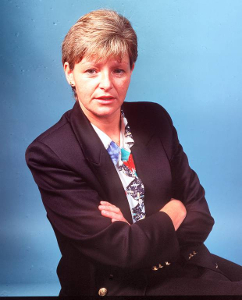
Birth of Crime Reporter Veronica Guerin

Veronica Guerin, Irish crime reporter, is born in Artane, Dublin, on July 5, 1958. Guerin attends Catholic school where she excels in athletics and later studies accountancy at Trinity College, Dublin. She plays for both the Ireland women’s national basketball team and Republic of Ireland women’s national football team, representing the latter in a match against England at Dalymount Park in May 1981.

After she graduates, her father employs her at his company but, following his death three years later, she changes professions and starts a public relations firm in 1983, which she runs for seven years. In 1983–84, she serves as secretary to the Fianna Fáil group at the New Ireland Forum. She serves as Charles Haughey‘s personal assistant, and becomes a family friend, taking holidays with his children. In 1987 she serves as election agent and party treasurer in Dublin North for Seán Haughey.

In 1990, she changes careers again, switching to journalism as a reporter with The Sunday Business Post and Sunday Tribune, working under editor Damien Kiberd. Craving first-hand information, she pursues a story directly to the source with little regard for her personal safety, to engage those she deems central to a story. This allows her to build close relationships with both the legitimate authorities, such as the Garda Síochána, and the criminals, with both sides respecting her diligence by providing highly detailed information. She also reports on Irish Republican Army activities in the Republic of Ireland.

From 1994 onwards, she begins to write about criminals for the Sunday Independent. Using her accountancy knowledge to trace the proceeds of illegal activity, she uses street names or pseudonyms for organized crime figures to avoid Irish libel laws.

When she begins to cover drug dealers, and gains information from convicted drugs criminal John Traynor, she receives numerous death threats. The first violence against her occurs in October 1994, when two shots are fired into her home after her story on murdered crime kingpin Martin Cahill is published. Guerin dismisses the “warning.” The day after writing an article on Gerry “The Monk” Hutch, on January 30, 1995, she answers her doorbell to a man pointing a revolver at her head. The gunman misses and shoots her in the leg. Regardless, she vows to continue her investigations.

On September 13, 1995, convicted criminal John Gilligan, Traynor’s boss, attacks her when she confronts him about his lavish lifestyle with no source of income. He later calls her at home and threatens to kidnap and rape her son and kill her if she writes anything about him.

On the evening of June 25, 1996, Gilligan drug gang members Charles Bowden, Brian Meehan, Kieran ‘Muscles’ Concannon, Peter Mitchell and Paul Ward meet at their distribution premises on the Greenmount Industrial Estate. The following day, while driving her red Opel Calibra, Guerin stops at a red traffic light on the Naas Dual Carriageway near Newlands Cross, on the outskirts of Dublin, unaware she is being followed. She is shot six times, fatally, by one of two men sitting on a motorcycle.

About an hour after Guerin is murdered, a meeting takes place in Moore Street, Dublin, between Bowden, Meehan, and Mitchell. Bowden later denies under oath in court that the purpose of the meeting is the disposal of the weapon but rather that it was an excuse to appear in a public setting to place them away from the incident.

At the time of her murder, Traynor is seeking a High Court order against Guerin to prevent her from publishing a book about his involvement in organised crime. Guerin is killed two days before she is due to speak at a Freedom Forum conference in London.

Guerin’s funeral is attended by Ireland’s Taoiseach John Bruton, and the head of the armed forces. It is covered live by Raidió Teilifís Éireann. On July 4, labour unions across Ireland call for a moment of silence in her memory, which is duly observed by people around the country. Guerin is buried in Dardistown Cemetery, County Dublin.


Leave a comment

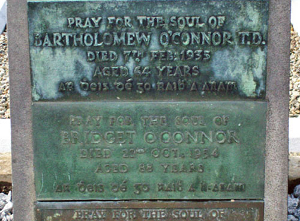
Birth of Bartholomew “Batt” O’Connor

Bartholomew “Batt” O’Connor, Cumann na nGaedheal and Fine Gael politician, is born in Brosna, County Kerry, on July 4, 1870. He serves as a Teachta Dála (TD) for Dublin County from 1924 to 1935.

At seventeen O’Connor leaves school to become a stonemason. In October 1893, at the age of 23, he goes to Boston, where he stays five years. On his return to Ireland, he moves to Dublin, where he soon establishes himself as a “speculative builder” constructing houses in Anglesea Road, Dolphin’s Barn, Eglington Road, Brendan Road, and Donnybrook.

O’Connor joins the Gaelic League in 1900, through which he comes into contact with many of the future leaders of the Independence movement, including Tom Clarke and Seán Mac Diarmada. He is sworn into the Irish Republican Brotherhood (IRB) in 1909 and enrolls in the Irish Volunteers in 1913, the same night as Éamon de Valera.

While not directly involved during the Easter Rising, O’Connor is recognised and arrested on his return to Dublin and sent to Kilmainham Gaol, then to Richmond Barracks, Wandsworth Prison, and finally to Frongoch internment camp, in North Wales.

On his release in September 1916, O’Connor re-establishes his business and takes up his political activities. He reconnects with members of the Keating Branch of the Gaelic League at 46 Parnell Square and takes part in the re-organising of the fragmented IRB. He canvasses for by-elections in Kilkenny and Armagh on behalf of Sinn Féin candidates W. T. Cosgrave and Patrick McCartan.

O’Connor is involved with the revolutionary Sinn Féin party during the time of the First Dáil, handling money and hiding documents for Michael Collins. He purchases 76 Harcourt Street for Michael Collins, following a raid on the Sinn Féin Office at No. 6. There he installs a secret recess for private papers and means of escape through the skylight. When the recess escapes discovery following a raid, he goes on to construct hiding places in many of the other houses used by the movement. He is one of the shareholders of the National Land Bank which is set up in March 1920 at 68 Lower Leeson Street.

O’Connor plays a role in the “National Loan,” raised by Collins to fund the fledgling Dáil Éireann. The loan, which had been declared illegal, is lodged in the individual bank accounts of the trustees. The gold is kept under the floor of O’Connor’s house until 1922.

O’Connor takes the pro-Treaty side during the subsequent split over the Anglo-Irish Treaty. He is an unsuccessful candidate for Dáil Éireann at the 1923 Irish general election, in the Dublin County constituency.

After the death in November 1923 of Cumann na nGaedheal TD Michael Derham, O’Connor is the Cumann na nGaedheal candidate at the Dublin County by-election on March 19, 1924, when he is elected to the 4th Dáil ahead of Seán MacEntee. He retains his seat at the next four general elections, joining Fine Gael when Cumann na nGaedheal merges in 1933 with the National Centre Party and the Blueshirts. He serves as a Trustee of Cumann na nGaedheal.

After his death on February 7, 1935, the 1935 Dublin County by-election is won by Cecil Lavery of Fine Gael.


Leave a comment

Pickett’s Charge

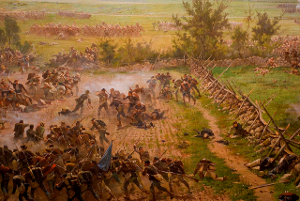
On July 3, 1863, at Gettysburg, Pennsylvania, as the sun rises behind the men of Colonel Dennis O’Kane’s Irish 69th Pennsylvania Volunteer Infantry on Cemetery Ridge, the most famous assault of the American Civil War is being prepared across the mile of open field in front of them. The 69th Pennsylvania will be at the very vortex of that assault, now known to posterity as Pickett’s Charge.

Pickett’s Charge is an infantry assault ordered by Confederate General Robert E. Lee against Major General George G. Meade‘s Union positions on the last day of the Battle of Gettysburg during the American Civil War. Its futility is predicted by the charge’s commander, Lt. General James Longstreet, and it is arguably an avoidable mistake from which the Southern war effort never fully recovers militarily or psychologically. The farthest point reached by the attack has been referred to as the high-water mark of the Confederacy.  The charge is named after Maj. General George Pickett, one of three Confederate generals who lead the assault under Longstreet.

Pickett’s charge is part of Lee’s “general plan” to take Cemetery Hill and the network of roads it commands. On the night of July 2, Meade correctly predicts at a council of war that Lee will attack the center of his lines the following morning.

At 1:00 PM on July 3, a massive artillery bombardment by the Confederate guns sails mostly over the heads of the 69th. The bombardment is meant to soften up the Union defense and silence its artillery but is largely ineffective. About 3:00 PM the barrage slackens, and the rebel infantrymen begin their assault. “And let your work this day be for victory or to the death,” Colonel Dennis O’Kane tells his men as the furious rebel onslaught approaches. Approximately 12,500 men in nine infantry brigades advance over open fields for three-quarters of a mile under heavy Union artillery and rifle fire.

Soon the 69th is forced to refuse both flanks as the Confederate tide rolls up to them and laps around both sides. While many around them run, the 69th stands fast. Although some Confederates are able to breach the low stone wall that shields many of the Union defenders, they cannot maintain their hold and are repulsed with over 50% casualties. The regiment’s tenacious stand in front of the famous copse of trees is a pivotal part of the crucial Union victory and a decisive defeat for the Confederacy that ends the three-day battle and Lee’s campaign into Pennsylvania.

Good to his word, Colonel O’Kane is killed and, lying dead near the 69th’s position, wearing gray lay Pvt. Willie Mitchel of the 1st Virginia Infantry, son of Irish patriot John Mitchel. At the most crucial battle of America’s Civil War, Irish are killing Irish on a foreign field once again.

Years later, when asked why his charge at Gettysburg failed, Pickett replies, “I’ve always thought the Yankees had something to do with it.”


2 Comments

The Ramble Inn Attack

The Ramble Inn attack is a mass shooting that takes place at a rural pub on July 2, 1976, near Antrim, County Antrim, Northern Ireland. It is believed to have been carried out by the Ulster Volunteer Force (UVF), a loyalist paramilitary organisation. Six civilians, five Protestants and one Catholic, are killed in the attack and three others are wounded.

The mid-1970s is one of the deadliest periods of the Troubles. From February 1975 until February 1976, the Provisional Irish Republican Army (IRA) and British Government observe a truce. This, however, marks a rise in sectarian tit-for-tat killings. Ulster loyalist paramilitaries, fearing they are about to be forsaken by the British Government and forced into a united Ireland, increase their attacks on Irish Catholics and nationalists. Under orders not to engage British forces, some IRA units concentrate on tackling the loyalists. The fall-off of regular operations causes serious problems of internal discipline and some IRA members also engage in revenge attacks. The tit-for-tat killings continue after the truce ends. On June 5, 1976, the UVF shoots dead three Catholics and two Protestants in an attack on the Chlorane Bar. This is claimed as revenge for the killing of two Protestants in a pub earlier that day.

On June 25, 1976, gunmen open fire inside a Protestant-owned pub in Templepatrick, County Antrim. Three Protestant civilians die. The attack is claimed by the “Republican Action Force“, which is believed to be a cover name used by some members of the IRA.

The Ramble Inn lies just outside Antrim, on the main A26 Antrim to Ballymena dual carriageway, near the village of Kells. The pub is owned by Catholics but in a rural area of County Antrim which is mostly Protestant. Most of its customers are Protestants from the surrounding area.

On the night of Friday July 2, 1976, a three-man UVF unit consisting of a driver and two gunmen steal a car from a couple parked in nearby Tardree Forest. The couple are gagged and bound before the men make off in the car. At about 11:00 PM, just before closing time, two masked gunmen in boilersuits enter the pub and open fire with machine guns, hitting nine people. Three die at the scene and a further three die later. The victims are Frank Scott (75), Ernest Moore (40), James McCallion (35), Joseph Ellis (27) and James Francey (50), all Protestants, and Oliver Woulahan (20), a Catholic.

On July 3 at 12:30 PM, an anonymous caller to the News Letter claims the attack is in retaliation for the earlier attack in Templepatrick. It is widely believed that the UVF are responsible for the Ramble Inn attack. In the weeks that follow, a number of people are interviewed by police in relation to the shooting but are subsequently released without charge. To date, no one has been convicted of the attack.

In 2012 the Historical Enquiries Team (HET), a body which has been set up in Northern Ireland to re-investigate unsolved murders of the Troubles, meets with the family of James McCallion to deliver their findings. The probe concludes that the then Northern Ireland police force, the Royal Ulster Constabulary (RUC), had conducted a thorough investigation and the detectives working on the case did their best to bring the killers to justice.