seamus dubhghaill

Promoting Irish Culture and History from Little Rock, Arkansas, USA


Leave a comment

The Execution of Tom Williams, IRA Volunteer

File source: http://en.wikipedia.org/wiki/File:Vol._Tom_Williams.jpg

Thomas Joseph Williams, a volunteer in C Company, 2nd Battalion of the Belfast Brigade in the Irish Republican Army (IRA), is hanged in the Crumlin Road Gaol on September 2, 1942, for his involvement in the killing of Royal Ulster Constabulary (RUC) police officer Patrick Murphy during the Northern campaign.

Williams is born in the Beechmount area of Belfast on May 12, 1923. He is the third child in a family of six. After the death of his mother, he and his brother go to live with their grandmother at 46 Bombay Street in the Clonard area of Belfast. The Williams family has to leave the small Catholic enclave in the Shore Road area of Belfast after their house is attacked and burned.

As a child, Williams suffers from asthma and as a result is often very ill. He attends St. Gall’s Primary School but leaves at an early age to obtain work, which at the time is difficult due to discrimination. His work therefore consists of labouring and as a delivery boy.

As soon as Williams is old enough, he joins Na Fianna Éireann, the republican Scout Organisation founded by Constance Markievicz in 1909, becoming a member of the Con Colbert slua in the Clonard area. Alfie Hannaway, a friend of Williams, is his OC in Na Fianna, and assigns him to the rank of Quartermaster for the company. He takes his role in Na Fianna very seriously and all who came to know him are struck by his dedication and maturity, even at this early age.

At the age of 17, Williams is old enough to become a volunteer and joins C Company of the IRA in the Clonard area where he lives. Due to his “dedication and his remarkable ability” he is appointed to the role of Adjutant of C Company.

At Easter 1942 the government of Northern Ireland bans all parades to commemorate the anniversary of the Easter Rising. An IRA unit of six men and two women stage a diversionary action against the RUC to allow three parades to take place in West Belfast, but in this clash a RUC officer is killed, and the six IRA men are captured. The RUC officer, Constable Patrick Murphy, a father of nine children, from the Falls Road area of Belfast, is one of a minority of Catholics serving in the RUC.

There is debate over the years about who actually fired the fatal shot. The six IRA members are convicted and sentenced to death for murder under the law of common purpose. Five have their sentences commuted. The sentence of Williams, who acknowledges that he is the leader of the IRA unit involved and takes full responsibility for the actions of his men, is not commuted.

Williams is hanged in Crumlin Road Gaol in Belfast on the morning of September 2, 1942. The executioner is the official English hangman Thomas Pierrepoint, assisted by his nephew Albert Pierrepoint. Afterwards Williams’ body is interred in unhallowed ground in an unmarked grave within the grounds of the prison. His remains are only released in January 2000 after the closure of the prison in 1996 and a lengthy campaign by the National Graves Association, Belfast.

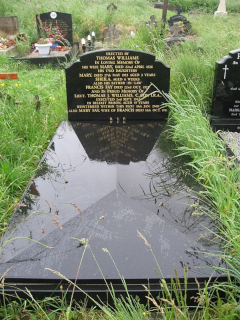
Williams’s funeral is held on January 19, 2000, and is attended by thousands, with burial at Milltown Cemetery. Joe Cahill, Williams’s cell mate, and John Oliver, sentenced to death with Williams but later reprieved, as well as Madge McConville, who had been arrested with Williams, Greta McGlone, Billy McKee, Eddie Keenan and perhaps least known, Nell Morgan, Williams’s girlfriend at the time of his death, are all present. Six senior Sinn Féin members including Gerry Adams are also present in St. Paul’s Church on the Lower Falls Road for the Mass.

Williams is remembered in a ballad Tom Williams. Various recordings have been made, most notably by the Flying Column and Éire Óg, who preamble their version with the story of the campaign to release his body. The now disbanded, Volunteer Tom Williams Republican Flute Band from Glasgow, Scotland is named in his memory as is the Tom Williams Camogie Club in Belfast.

(Pictured: Tom Williams’ headstone at Milltown Cemetery after being reinterred)

Leave a comment

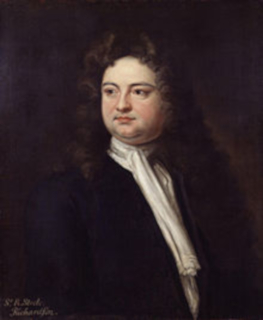
Death of Sir Richard Steele, Writer, Playwright & Politician

richard-steele

Sir Richard Steele, writer, playwright, and politician, remembered as co-founder, with his friend Joseph Addison, of the magazine Tatler, dies in Carmarthen, Wales on September 1, 1729.

Steele is born in Dublin on March 12, 1672, to Richard Steele, an attorney, and Elinor Symes (née Sheyles). He is largely raised by his uncle and aunt, Henry Gascoigne and Lady Katherine Mildmay. A member of the Protestant gentry, he is educated at Charterhouse School, where he first meets Addison. After starting at Christ Church, Oxford, he goes on to Merton College, Oxford, then joins the Life Guards of the Household Cavalry in order to support King William‘s wars against France. He is commissioned in 1697 and rises to the rank of captain within two years. He leaves the army in 1705, perhaps due to the death of the 34th Foot’s commanding officer, Robert Lucas, 3rd Baron Lucas, which limits his opportunities of promotion.

Steele is a member of the Kit-Kat Club. Both Steele and Addison become closely associated with Child’s Coffee-house in St. Paul’s Churchyard.

Steele’s first published work, The Christian Hero (1701), attempts to point out the differences between perceived and actual masculinity. Written while he is serving in the army, it expresses his idea of a pamphlet of moral instruction.

Steele writes a comedy that same year titled The Funeral. This play meets with wide success and is performed at Theatre Royal, Drury Lane, bringing him to the attention of the King and the Whig party. Next, he writes The Lying Lover, one of the first sentimental comedies, but a failure on stage. In 1705, he writes The Tender Husband with contributions from Addison, and later that year writes the prologue to The Mistake, by John Vanbrugh, also an important member of the Whig Kit-Kat Club with Addison and Steele.

In 1706 Steele is appointed to a position in the household of Prince George of Denmark, consort of Anne, Queen of Great Britain. He also gains the favour of Robert Harley, 1st Earl of Oxford and Earl Mortimer.

The Tatler, Steele’s first journal, first appears on April 12, 1709, and appears three times a week. He writes this periodical under the pseudonym Isaac Bickerstaff and gives Bickerstaff an entire, fully developed personality. The Tatler is closed down to avoid the complications of running a Whig publication that had come under Tory attack.

Steele becomes a Whig Member of Parliament in 1713, for Stockbridge. He is soon expelled for issuing a pamphlet in favor of the Hanoverian succession. When George I of Great Britain comes to the throne in the following year, Steele is knighted and given responsibility for the Theatre Royal, Drury Lane in London. He returns to parliament in 1715, for Boroughbridge.

While at Drury Lane, Steele writes and directs the sentimental comedy The Conscious Lovers, which is an immediate hit. However, he falls out with Addison and with the administration over the Peerage Bill (1719), and in 1724 he retires to his second wife’s homeland of Wales. He remains in Carmarthen after his wife’s death, dying there on September 1, 1729. He is buried there at St. Peter’s Church. During restoration of the church in 2000, his skull is discovered in a lead casket, having previously been accidentally disinterred during the 1870s.

(Pictured: Portrait of Sir Richard Steele by Jonathan Richardson)


Leave a comment

Birth of Henry Joy McCracken, Irish Republican

henry-joy-mccracken

Henry Joy McCracken, Irish Republican and industrialist, is born in Belfast on August 31, 1767. He is a founding member of the Society of the United Irishmen.

McCracken is born into two of the city’s most prominent Presbyterian industrial families. He was the son of a shipowner, Captain John McCracken and Ann Joy, daughter of Francis Joy, of French Huguenot descent. The Joy family made their money in linen manufacture and founded the Belfast News Letter. He is the older brother of political activist and social reformer Mary Ann McCracken, with whom he shares an interest in Irish traditional culture.

In 1792, McCracken helps organise the Belfast Harp Festival which gathers aged harpists from around Ireland and helps preserve the Irish airs by having them transcribed by Edward Bunting. Bunting, who lodges in the McCracken’s Rosemary Lane home, is a classically trained musician.

McCracken becomes interested in republican politics from an early age and along with other Protestants forms the Society of the United Irishmen in 1795 which quickly makes him a target of the authorities. He regularly travels throughout the country using his business as a cover for organising other United Irish societies but is arrested in October 1796 and imprisoned in Kilmainham Gaol in Dublin. While imprisoned with other leaders of the United Irishmen, he falls seriously ill and is released on bail in December 1797.

Following the outbreak of the Irish Rebellion of 1798 in Leinster in May 1798, the County Antrim organisation meets on 3 June to decide on their response. The meeting ends inconclusively with a vote to wait for French aid being passed by a narrow margin. A new meeting of delegates is held in Templepatrick on June 5 where McCracken is elected general for Antrim, and he quickly begins planning military operations.

McCracken formulates a plan for all small towns in Antrim to be seized after which rebels will converge upon Antrim town on June 7 where the county’s magistrates are to hold a crisis meeting. Although the plan meets initial success and McCracken leads the rebels in the attack on Antrim, the Catholic Defenders group whom he expects assistance from are conspicuous by their absence. The mainly Ulster Scots rebels led by McCracken are defeated by the English forces and his army melts away.

Although McCracken initially escapes with James Hope, James Orr, and James Dickey and is supported in his month-long period of hiding by his sister Mary Ann, a chance encounter with men who recognize him from his cotton business leads to his arrest. He is offered clemency if he testifies against other United Irishmen leaders, but he refuses to turn on his compatriots.

McCracken is court martialed and hanged at Corn Market, Belfast, on land his grandfather had donated to the city, on July 17, 1798. According to historian Guy Beiner, his corpse is spared the indignity of decapitation in order not to provoke renewed agitation. He is buried in the Parish Church of St. George in Belfast, but a few years later the grave is demolished.

McCracken’s remains are believed to have been re-interred by Francis Joseph Bigger in 1909 at Clifton Street Cemetery, Belfast, alongside his sister Mary Ann. His illegitimate daughter Maria, whose mother is speculated to have been Mary Bodell, is raised by her aunt Mary Ann McCracken.


Leave a comment

OHCHR Mary Robinson Criticises U.S. for Violating Human Rights

mary-robinson

On August 30, 2002, the United Nations High Commissioner for Human Rights, Mary Robinson, criticises the United States for violating human rights in its war on terrorism and of trying to scale back plans to save the world’s poorest people.

Robinson becomes the United Nations High Commissioner for Human Rights on September 12, 1997, following her nomination to the post by Secretary-General of the United Nations Kofi Annan and the endorsement of the General Assembly.

She assumes responsibility for the UN human rights programme at the time when the Office of the High Commissioner and the Centre for Human Rights are consolidated into a single Office of the High Commissioner for Human Rights (OHCHR).

As High Commissioner, Robinson gives priority to implementing the Secretary-General’s reform proposal to integrate human rights into all the activities of the United Nations. During her first year as High Commissioner, she travels to Rwanda, South Africa, Colombia and Cambodia, among other countries. In September 1998, she becomes the first High Commissioner to visit China and signs an agreement with the Government for OHCHR to undertake a wide-ranging technical-cooperation programme to improve human rights in that country. She also strengthens human rights monitoring in such conflict areas as Kosovo in the Federal Republic of Yugoslavia. Her term of office expires in 2002 after sustained pressure from the United States leads her to declare she is no longer able to continue her work.

Robinson comes to the United Nations after a distinguished, seven-year tenure as President of Ireland. She is the first Head of State to visit Rwanda in the aftermath of the 1994 genocide there. She is also the first Head of State to visit Somalia following the crisis there in 1992, and receives the CARE Humanitarian Award in recognition of her efforts for that country.

Before she is elected President of Ireland in 1990, Robinson serves as Senator for 20 years. Born on May 21, 1944 in Ballina, County Mayo, she is called to the bar in 1967 and two years later becomes the youngest Reid Professor of Constitutional Law at Trinity College, Dublin. In 1973, she becomes a member of the English Bar (Middle Temple). She becomes a Senior Counsel in 1980, and serves as a member of the Advisory Commission of Inter-Rights (1984-1990) and as a member of the International Commission of Jurists (1987-1990).

Educated at Trinity College, Robinson holds law degrees from the King’s Inns in Dublin and from Harvard University. She has been awarded numerous honorary degrees, medals and prizes from universities and humanitarian organizations around the world. In July 2009, she is awarded the Presidential Medal of Freedom, the highest civilian honour awarded by the United States, by U.S. President Barack Obama.


Leave a comment

General Patrick Cleburne Wounded at Battle of Richmond

Major General Patrick Cleburne, by Louis Guillaume

Irish-born Confederate Brigadier General Patrick Cleburne commands a division at the Battle of Richmond in Kentucky on August 29-30, 1862, where he is wounded.

The battle is a stunning Confederate victory by Major General Edmund Kirby Smith against Union Major General William “Bull” Nelson‘s forces. It is the first major battle in the Confederate Heartland Offensive. The battle takes place on and around what is now the grounds of the Blue Grass Army Depot, outside Richmond, Kentucky.

In the fall of 1862, two Confederate armies move on separate paths into Kentucky, hoping to put the shadow Confederate government of Kentucky of that state into power, threaten Union cities along the Ohio River, and recruit men to join the army. First to move is Kirby Smith, departing Knoxville on August 13, leading the Confederate Army of Kentucky, whose ideas provide the initiative for the offensive. General Braxton Bragg, commanding the Army of Mississippi, leaves Chattanooga on August 27 and moves on a roughly parallel track to the west.

Brigadier General Patrick Cleburne leads Smith’s advance with Colonel John S. Scott’s cavalry out in front. The Confederate cavalry, while moving north from Big Hill on the road to Richmond, Kentucky, on August 29, encounters Union troopers and begin skirmishing. After noon, Union artillery and infantry join the fray, forcing the Confederate cavalry to retreat to Big Hill.

At that time, Brigadier General Mahlon Dickerson Manson, who commands Union forces in the area, orders a brigade to march to Rogersville, toward the rebels. Fighting for the day stops after pursuing Union forces briefly skirmish with Cleburne’s men in the late afternoon. That night, Manson informs his superior, Bull Nelson, of his situation, and he orders another brigade to be ready to march in support, when required.

Kirby Smith orders Cleburne to attack in the morning and promises to hurry reinforcements. Cleburne starts early, marching north, passes through Kingston, disperses Union skirmishers, and approaches Manson’s battle line near Zion Church. As the day progresses, additional troops join both sides. Following an artillery duel, the battle begins, and after a concerted Confederate attack on the Union right, the Union troops give way. Retreating into Rogersville, they make another futile stand at their old bivouac.

By this time, Smith and Nelson arrive and take command of their respective armies. Nelson rallies some troops in the cemetery outside Richmond, but they are routed.

Nelson and some of his men escape, but the Confederates capture over 4,300 Union troops. Total casualties are 5,353 (206 killed, 844 wounded, and 4,303 captured or missing) on the Union side, 451 (78 killed, 372 wounded, and one missing) for the Confederates. The way north towards Lexington and Frankfort is open.

During the battle Cleburne is wounded in the face when a Minié ball pierces his left cheek, smashes several teeth, and exits through his mouth. He recovers in time to re-join Bragg and William Joseph Hardee and participate in the Battle of Perryville.

The Civil War Trust, a division of the American Battlefield Trust, and its partners have acquired and preserved 365 acres of the Richmond Battlefield. The Mt. Zion Christian Church, which served as a hospital during the battle and has cannonballs embedded in its brick walls, is listed on the National Register of Historic Places. Two discontinuous areas totaling 214 acres are listed on the National Register of Historic Places as Battle of Richmond Historic Areas in 1996.

(Pictured: Major General Patrick Ronayne Cleburne, courtesy of Library of Congress)


Leave a comment

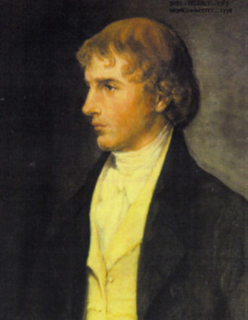
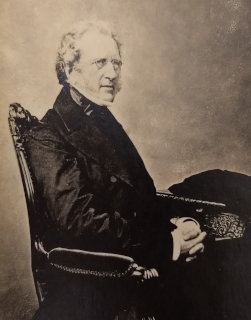
Birth of Sir Aubrey (Hunt) de Vere

aubrey-hunt-de-vere

Sir Aubrey (Hunt) de Vere, 2nd Baronet, Anglo-Irish poet and landowner, is born on August 28, 1788.

De Vere is the son of Sir Vere Hunt, 1st Baronet and Eleanor Pery, daughter of William Pery, 1st Baron Glentworth. He is educated at Harrow School, where he is a childhood friend of Lord Byron, and Trinity College, Dublin. He marries Mary Spring Rice, the daughter of Stephen Edward Rice and Catherine Spring, and sister of Thomas Spring Rice, 1st Baron Monteagle of Brandon, in 1807. He succeeds to his father’s title in 1818.

The Hunt/de Vere family estate of 300 years (1657–1957), including the period of the de Vere Baronetcy of Curragh, is the present day Curraghchase Forest Park, in County Limerick. De Vere spends most of his life on the estate and is closely involved in its management. He suffers much trouble from his ownership of the island of Lundy, which his father, who was not much of a businessman, had unwisely purchased in 1802, and which becomes a heavy drain on the family’s finances. Sir Vere is never able to find a purchaser for Lundy, and it takes his son until 1834 to dispose of it.

De Vere stands for election in the 1820 General Election and comes in third with 2,921 votes.

De Vere changes his surname from Hunt to de Vere in 1832, in reference to his Earl of Oxford ancestors, dating back to Aubrey de Vere I, a tenant-in-chief in England of William the Conqueror in 1086. He serves as High Sheriff of County Limerick in 1811.

De Vere is a poet. William Wordsworth calls his sonnets the most perfect of the age. These and his drama, Mary Tudor: An Historical Drama, are published by his son, the poet Aubrey Thomas de Vere, in 1875 and 1884.

De Vere produces numerous works over his lifetime. The most notable are Ode to the Duchess of Angouleme (1815), Julian the Apostate: A Dramatic Poem (1822), The Duke of Mercia: An Historical Drama [with] The Lamentation of Ireland, and Other Poems (1823), A Song of Faith: Devout Exercises and Sonnets and his most famous work, Mary Tudor: An Historical Drama.

Sir Aubrey de Vere dies on July 5, 1846.


Leave a comment

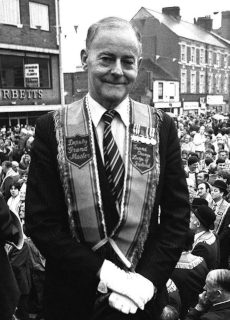
Birth of James Molyneaux, Northern Irish Politician

james-molyneaux

James Henry Molyneaux, Baron Molyneaux of Killead, Northern Irish unionist politician and leader of the Ulster Unionist Party (UUP) from 1979 to 1995, is born in Killead, County Antrim on August 27, 1920. He is a leading member and sometime Vice-President of the Conservative Monday Club. An Orangeman, he is also Sovereign Grand Master of the Royal Black Institution from 1971 to 1995. He is an unrelenting though peaceful supporter of the Protestant cause during the factional conflict that divides Northern Ireland from the 1960s until the early 21st century.

Molyneaux is educated at nearby Aldergrove School. Although he is raised an Anglican, as a child he briefly attends a local Catholic primary school. He leaves school at age 15 and works on his father’s poultry farm. When a Catholic church near his home is burned down by Ulster loyalist arsonists in the late 1990s, he helps to raise funds for its rebuilding.

In World War II Molyneaux serves in the Royal Air Force between 1941 and 1946. He participates in the D-Day landings in FranceFrance and in the liberation of the Belsen-Belsen concentration camp, and occasionally gives interviews about what he sees there. On April 1, 1947, he is promoted to flying officer.

After demobilization Molyneaux establishes a printing business with his uncle, and in 1946 he joins the UUP. He is first elected to local government in 1964 and enters Parliament six years later. He staunchly opposes all power-sharing deals, notably the Anglo-Irish Agreement (1985) between British Prime Minister Margaret Thatcher and Irish Taoiseach Garret FitzGerald, which gives Dublin an official consultative role in the affairs of Northern Ireland and paves the way for devolution.

Molyneaux lacks the firebrand public image of his longtime rival Ian Paisley, who in 1971 breaks with the UUP to form the Democratic Unionist Party (DUP). He never acquiesces to the Good Friday Agreement, which calls for the devolution of Northern Ireland’s government from London to Belfast, however, unlike Paisley and David Trimble, who in 1997 succeeds Molyneaux as the UUP leader and in April 1998 signs the devolution accord.

On retiring as UUP leader, Molyneaux is knighted as a Knight Commander of the Order of the British Empire (KBE) in 1996. The following year, after standing down as an MP at the 1997 general election, he is created a life peer on June 10, 1997, as Baron Molyneaux of Killead, of Killead in the County of Antrim.

James Molyneaux dies at the age of 94 in Antrim, County Antrim, Northern Ireland on March 9, 2015, Commonwealth Day.


Leave a comment

German Bombing of the Shelburne Co-op

campile-bombing

German aircraft bomb a creamery at Campile, County Wexford, a small village located fourteen kilometres outside the town of New Ross, on August 26, 1940 killing three women.

Ireland remains officially neutral during World War II. However, on August 26, 1940, the German Luftwaffe bombs Campile in daylight. Three women are killed – Mary Ellen Kent (30), her sister Catherine Kent (26), both from Terrerath, and Kathleen Hurley (27) from Garryduff. Four German bombs are dropped on the creamery and restaurant sections of Shelburne Co-op on that day. The railway is also targeted by the bombers. The 20-minute ordeal terrorises the peaceful village and leaves behind a trail of devastation. The attack has never been fully explained, although there are numerous theories as to why the bombing occurred.

One theory is that the German pilots were lost and had mistaken the southeast coast of Wexford for Wales. It is also suggested that butter boxes emblazoned with the Shelburne Co-op name were discovered by the Nazis a few months earlier following the evacuation of Dunkirk and that the bombing was in retaliation for supplying foodstuffs to the Allied armies.

However, Campile historian John Flynn, who wrote a book to mark the 70th anniversary of the disaster, argues that the bombing was a message from Adolf Hitler to Taoiseach Éamon de Valera warning him to keep his promise on Ireland’s neutrality.

On the occasion of the 50th anniversary of the bombing, a plaque is erected on the co-op walls in memory of the three women.

The local Harts bar and lounge contains many artifacts relating to the bombing. The description and history related to each artifact can be found in an old leather-bound book kept underneath the counter in the adjoining sweet shop.


Leave a comment

The Capture of Robert Emmet

robert-emmet

Robert Emmet, one of the most famous revolutionaries in Irish history, is captured by the British at the home of a Mrs. Palmer in Harold’s Cross, outside Dublin on August 25, 1803.

Emmet is born at 109 St. Stephen’s Green in Dublin on March 4, 1778. He is the youngest son of Dr. Robert Emmet, a court physician, and his wife Elizabeth Mason. He attends Oswald’s school in Dopping’s-court, off Golden-lane and enters Trinity College, Dublin, in October 1793 at the age of fifteen. In December 1797, he joins the College Historical Society, a debating society.

While he is in college, his brother Thomas and some of his friends become involved in political activism. Emmet becomes secretary of a secret United Irish Committee in college and is expelled in April 1798 as a result. That same year he flees to France to avoid the many British arrests of nationalists that are taking place in Ireland. While in France, he garners the support of Napoleon, who promises to lend support when the upcoming revolution starts.

After the Irish Rebellion of 1798, Emmet is involved in reorganising the defeated Society of United Irishmen. In April 1799, a warrant is issued for his arrest. He escapes and soon after travels to the continent in the hope of securing French military aid. His efforts are unsuccessful, as Napoleon is concentrating his efforts on invading England. He returns to Ireland in October 1802.

In March of the following year, Emmet begins to prepare a new rebellion, with fellow Anglo-Irish revolutionaries Thomas Russell and James Hope. The revolutionaries conceal their preparations, but a premature explosion at one of Emmet’s arms depots kills a man, forcing Emmet to advance the date of the rising before the authorities’ suspicions are aroused.

Despite being unable to secure help from Michael Dwyer‘s Wicklow rebels and many rebels from Kildare turning back due to the scarcity of firearms, the rising begins in Dublin on the evening of July 23, 1803. Failing to seize the lightly defended Dublin Castle, the rising amounts to a large-scale disturbance in the Thomas Street area. Emmet witnesses a dragoon being pulled from his horse and piked to death, the sight of which prompts him to call off the rising to avoid further bloodshed. However, sporadic clashes continue into the night until finally quelled by British military forces.

Emmet flees into hiding, moving from Rathfarnham to Harold’s Cross so that he can be near his sweetheart, Sarah Curran. He is captured on August 25 and taken to Dublin Castle, then later removed to Kilmainham Gaol. Vigorous but ineffectual efforts are made to procure his escape.

Emmet is tried for and found guilty of high treason on September 19, 1803. Chief Justice John Toler, 1st Earl of Norbury sentences Emmet to be hanged, drawn, and quartered, as is customary for conviction of treason. The following day, Emmet is executed in Thomas Street near St. Catherine’s Church. He is hanged and beheaded after his death. Out of fear of being arrested, no one comes forward to claim his remains.

Emmet’s remains are first delivered to Newgate Prison and then returned to Kilmainham Gaol, where the jailer is under instructions to be bury the remains in a nearby hospital’s burial grounds if no one claims them. No remains have been found there and though not confirmed, it appears that he was secretly removed and reinterred in St. Michan’s Church, a Dublin church with strong United Irish associations. There is also speculation that the remains are buried secretly in the vault of a Dublin Anglican church. When inspected in the 1950s, a headless corpse is found in the vault but cannot be identified. The widely accepted theory is that Emmet’s remains are transferred to St. Peter’s Church in Aungier St. under cover of the burial of his sister in 1804. In the 1980s the church is deconsecrated, and all the coffins are removed from the vaults. The church has since been demolished.


Leave a comment

Brian Keenan Released by Islamic Jihad

brian-keenan

Brian Keenan, Northern Irish writer, is released by the Islamic Jihad Organization on August 24, 1990 after having spent 52 months as a hostage in Beirut, Lebanon. His works include the book An Evil Cradling, an account of the four and a half years he spends as a hostage.

Keenan is born into a working-class family in East Belfast on September 28, 1950. He leaves Orangefield High School early and begins work as a heating engineer. However, he continues an interest in literature by attending night classes and in 1970 gains a place at the University of Ulster in Coleraine. Other writers there at the time included Gerald Dawe and Brendan Hamill. In the mid 1980s he returns to the Magee College campus of the university for postgraduate study. Afterwards he accepts a teaching position at the American University of Beirut, where he works for about four months.

On the morning of April 11, 1986 Keenan is kidnapped by the Islamic Jihad Organization. After spending two months in isolation, he is moved to a cell shared with the British journalist John McCarthy. He is kept blindfolded throughout most of his ordeal, and is chained by hand and foot when he is taken out of solitary.

The British and American governments at the time have a policy that they will not negotiate with terrorists and Keenan is considered by some to have been ignored. Because he is travelling on both Irish and British passports, the Irish government makes numerous diplomatic representations for his release, working closely with the Iranian government. Throughout the kidnap they also provide support to his two sisters, Elaine Spence and Brenda Gillham, who are spearheading the campaign for his release. He is released from captivity to Syrian military forces on August 24, 1990 and is driven to Damascus. There he is handed over by the Syrian Foreign Ministry to the care of Irish Ambassador, Declan Connolly. His sisters are flown by Irish Government executive jet to Damascus to meet him and bring him home to Northern Ireland.

An Evil Cradling is an autobiographical book by Keenan about his four years as a hostage in Beirut. The book revolves heavily around the great friendship he experiences with fellow hostage John McCarthy, and the brutality that is inflicted upon them by their captors. It is the 1991 winner of The Irish Times Literature Prize for Non-fiction and the Christopher Ewart-Biggs Memorial Prize.

Keenan returns to Beirut in 2007 for the first time since his release 17 years earlier, and describes “falling in love” with the city.

Brian Keenan now lives in Dublin.