O’Brien is educated in Dublin where she wins prizes in the international competitions of London‘s Royal Drawing Society. At age 17 she spends a year in West Cornwall with Stanhope Alexander Forbes and at age 18 she takes part in her first exhibition at the Royal Hibernian Academy (RHA). It becomes difficult to study internationally with the outbreak of the World War II, and she takes the opportunity to use her skills for the war effort and turns to mechanical drawing. However, it is as a botanical illustrator she is best known.
O’Brien’s studio in Limerick is always called the piggery and is where she brings in the plants from her garden to arrange for her work. She continues to exhibit on a regular basis both with the RHA and private exhibitions around Ireland. On occasion she uses her art to raise funds for charities like Friends of St. Luke’s Hospital in Rathgar.
O’Brien marries David Coote Hely Hutchinson on September 25, 1948 with whom she has one daughter. In 2003 they live at Parteen, a village close to Limerick City. She dies in St. Martha’s Nursing Home, Charleville, County Cork on July 3, 2014.
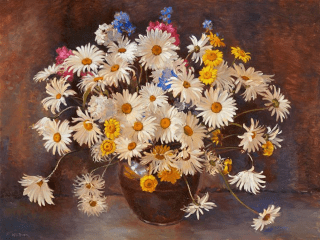
(Pictured: “Still Life with Flowers,” oil on canvas by Geraldine M. O’Brien)
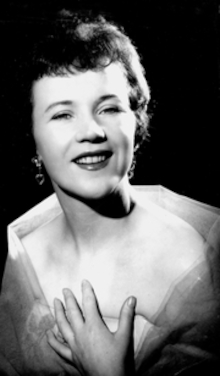
Bridget “Bridie” Gallagher, Irish singer affectionately known as “The Girl from Donegal,” reaches No. 1 in the Irish Singles Chart with “The Boys From The County Armagh” on July 2, 1957. She is widely regarded as “Ireland’s first international pop star.”
Gallagher is born on September 7, 1924 in Creeslough, County Donegal. She starts her singing in the Creeslough Hall with a local Céilí band started by Bill Gallagher. The Creeslough Hall is owned by Jim McCaffrey and Bridie makes many more visits to the Creeslough Hall in her home town throughout her long and successful career. Her talent is soon spotted in the 1950s by Billy Livingstone who is a talent scout for Decca Records. She goes to Belfast, which becomes her base, where she marries Robert (Bob) Livingstone (no relation to Billy Livingstone) and has two boys, Jim and Peter. Peter dies in a motor accident in 1976 and Jim later goes on to tour with her.
Gallagher shoots to fame in 1956 with her recording of “A Mother’s Love’s A Blessing” and achieves international acclaim with her legendary rendition of “The Boys From County Armagh.” During her career, which spans over six decades, she appears in many leading venues across the globe. She also makes songs such as “The Homes of Donegal” famous.
Gallagher holds the record for the largest number of people in attendance in the Royal Albert Hall in London, with over 7,500 people, a record that is never equaled as it goes on to become an all-seater venue. She becomes world-famous and travels all over the world, United States, Canada, Europe, Australia and is known as “The Girl from Donegal.” She plays in many of the world’s best known theatres, including London’s Royal Albert Hall, Sydney Opera House and Carnegie Hall in New York City. She sings mainly ballads or as they later became known as Country and Irish. One of her best known songs is “The Boys From The County Armagh,” which sells over 250,000 copies, the biggest-selling Irish single at that time.
Gallagher lives in Belfast for most of her life. She is honoured by the people of Creeslough on July 10, 2000 with an event to celebrate her career. Members of her family from Creeslough and Donegal attend the event along with her two sisters and their families who travel from Glasgow to be there along with an estimated crowd of 2,500 fans. A plaque paying tribute to her is unveiled. The following day she is honoured by Donegal County Council when they hold a Civic Reception for her. “Bridie blazed the trail for many artists who followed after her and I’m sure that many of them looked upon her as a role model as they started their careers in the music world,” council chairman Charlie Bennett says at the ceremony.
Gallagher dies at her home in Belfast on January 9, 2012 at the age of 87. Her burial takes place in her native Creeslough.
Plunkett is born on November 1, 1625 (earlier biographers give his date of birth as November 1, 1629, but 1625 has been the consensus since the 1930s) in Loughcrew, County Meath, to well-to-do parents with Hiberno-Norman ancestors. A grandson of James Plunket, 8th Baron Killeen (c. 1542-1595), he is related by birth to a number of landed families, such as the recently ennobled Earls of Roscommon, as well as the long-established Earls of Fingall, Lords Louth, and Lords Dunsany. Until his sixteenth year, his education is entrusted to his cousin Patrick Plunkett, Abbot of St. Mary’s, Dublin, and brother of Luke Plunket, 1st Earl of Fingall, who later becomes successively Bishop of Ardagh and of Meath.
As an aspirant to the priesthood, Plunkett sets out for Rome in 1647, under the care of Father Pierfrancesco Scarampi of the Roman Oratory. At this time the Irish Confederate Wars are raging in Ireland. These are essentially conflicts between native Irish Catholics, English and Irish Anglicans and Nonconformists. Scarampi is the Papal envoy to the Catholic movement known as the Confederation of Ireland. Many of Plunkett’s relatives are involved in this organisation.
Plunkett is admitted to the Pontifical Irish College in Rome and proves to be an able pupil. He is ordained a priest in 1654 and deputed by the Irish bishops to act as their representative in Rome. Meanwhile, the Cromwellian conquest of Ireland (1649–53) had defeated the Catholic cause in Ireland. In the aftermath the public practice of Catholicism is banned, and Catholic clergy are executed. As a result, it is impossible for Plunkett to return to Ireland for many years. He petitions to remain in Rome and, in 1657, becomes a professor of theology. Throughout the period of the Commonwealth and the first years of Charles II‘s reign, he successfully pleads the cause of the Irish Catholic Church and also serves as theological professor at the College of Propaganda Fide. At the Congregation of Propaganda Fide on July 9, 1669, he is appointed Archbishop of Armagh, the Irish primatial see, and is consecrated on November 30 at Ghent by the Bishop of Ghent, Eugeen-Albert, count d’Allamont. He eventually sets foot on Irish soil again on March 7, 1670, as the Stuart Restoration of 1660 had begun on a basis of toleration. The pallium is granted him in the Consistory of July 28, 1670.
After arriving back in Ireland, Plunkett tackles drunkenness among the clergy, writing, “Let us remove this defect from an Irish priest, and he will be a saint.” The Penal Laws had been relaxed in line with the Declaration of Breda in 1660 and he is able to establish a Jesuit College in Drogheda in 1670. A year later 150 students attend the college, no fewer than 40 of whom are Protestant, making this college the first integrated school in Ireland. His ministry is a successful one and he is said to have confirmed 48,000 Catholics over a four-year period. The government in Dublin, especially under the Lord Lieutenant of Ireland, James Butler, 1st Duke of Ormond (the Protestant son of Catholic parents), extend a generous measure of toleration to the Catholic hierarchy until the mid-1670s.
On the enactment of the Test Act in 1673, to which Plunkett does not agree for doctrinal reasons, the college is closed and demolished. He goes into hiding, travelling only in disguise, and refuses a government edict to register at a seaport to await passage into exile. For the next few years, he is largely left in peace since the Dublin government, except when put under pressure from the English government in London, prefer to leave the Catholic bishops alone.
In 1678 the so-called Popish Plot, concocted in England by clergyman Titus Oates, leads to further anti-Catholic action. Archbishop of DublinPeter Talbot is arrested, and Plunkett again goes into hiding. Despite being on the run and with a price on his head, he refuses to leave his flock. He is arrested in Dublin on December 6, 1679, and imprisoned in Dublin Castle, where he gives absolution to the dying Talbot. He is tried at Dundalk for conspiring against the state by allegedly plotting to bring 20,000 French soldiers into the country, and for levying a tax on his clergy to support 70,000 men for rebellion. Though this is unproven, some in government circles are worried about the possibility that a repetition of the Irish Rebellion of 1641 is being planned and, in any case, this is a convenient excuse for proceeding against Plunkett.
Plunkett is found guilty of high treason in June 1681 “for promoting the Roman faith,” and is condemned to death. Numerous pleas for mercy are made but Charles II, although himself a reputed crypto-Catholic, thinks it too politically dangerous to spare Plunkett.
Plunkett is hanged, drawn and quartered at Tyburn on July 1, 1681, the last Catholic martyr to die in England. His body is initially buried in two tin boxes, next to five Jesuits who had died previously, in the courtyard of St. Giles in the Fields church. The remains are exhumed in 1683 and moved to the Benedictine monastery at Lamspringe, near Hildesheim in Germany. The head is brought to Rome, and from there to Armagh, and eventually to Drogheda where since June 29, 1921, it has rested in St. Peter’s Roman Catholic Church. Most of the body is brought to Downside Abbey, England, where the major part is located today, with some parts remaining at Lamspringe. On the occasion of his canonization in 1975 his casket is opened, and some parts of his body given to the St. Peter’s Church in Drogheda.
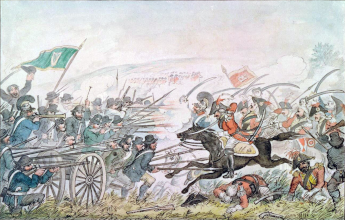
The Battle of Ballyellis, a clash during the Irish Rebellion of 1798, takes place on June 30, 1798. The battle is between a surviving column of the dispersed Wexford rebel army and pursuing British forces. It is the last Irish victory in the most violent Irish rebellion in modern history with at least 10,000 killed in a campaign that sees appalling atrocities inflicted by English and Irish.
The British victory at the Battle of Vinegar Hill on June 21 had denied the rebels static bases of operation but had not finished the rebellion and at least three major columns of rebels are operating throughout the southeast, moving outwards from County Wexford in an effort to spread and revive the rebellion.
One such column, numbering about 1,000 but accompanied by a number of women and juveniles, is mobile in north County Wexford, continually altering course to elude combined movements of pursuing British forces. The column is led by Joseph Holt, and under his command Denis Taaffe. It heads in the direction of Carnew, County Wicklow, toward the security offered by its mountain ranges when one of its foraging parties is intercepted and destroyed by a cavalry patrol. It quickly becomes evident to the British authorities that this party is a detachment from the main body of rebels. A mounted force of 200 troops consisting of Ancient Britons, dragoons, and three yeomanry corps, assemble near the neighbourhood of Monaseed to begin a pursuit of the rebels.
However, the approaching British are spotted and a force of rebels then moves ahead of the main force to prepare an ambush at the townland of Ballyellis. The spot chosen is behind a curve in the road flanked by high ditches and estate walls. Wagons are placed on the road and access points cut into the ditches. The main force arrives and deploys itself behind the wagons, on the wall and ditches with a small force left to stand on the road ahead of the barricades standing to face and lure in the approaching soldiers.
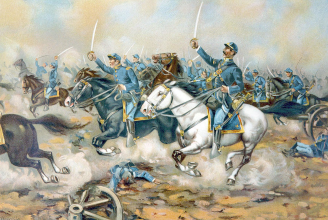
Upon spotting the small force standing on the road, the pursuing British quicken their pace and charge forward, assuming that they are facing only the rearguard of the fleeing column. Upon reaching the turn, they are met by a barrage of gunfire and are hemmed in by the rebels on three sides. As more mounted troops arrive they press their comrades further into the trap making effective manoeuvre impossible and many are easily picked off by the long pikes of the rebels.
The rear-ranks quickly flee with a few more soldiers escaping by jumping their mounts over the ditch. The rebels organise a relentless pursuit of the soldiers who are tracked and killed through the adjoining fields. At the end of the action about 120 troops, including a French émigré, and two officers are killed with no rebel casualties.
The news of this rebel victory comes as a shock to the authorities in Dublin Castle who had assumed that the offensive capabilities of the rebels had been finished at the Battle of Vinegar Hill. Reports of the defeat are downplayed and the scale of losses withheld from the general public, but the military now recognises Wicklow as the main theatre of rebel operations and begins to transfer troops there in anticipation of a new anti-insurgency campaign.
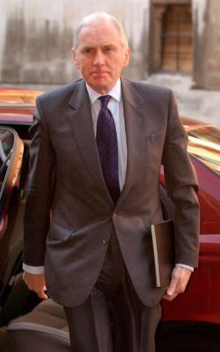
Hutton becomes a Queen’s Counsel in 1970. From 1979 to 1989, as Sir Brian Hutton, he is a High Court judge. In 1989, he becomes Lord Chief Justice of Northern Ireland, becoming a member of the Privy Council of Northern Ireland, before moving to England to become a Lord of Appeal in Ordinary on January 6, 1997. He is consequently granted a life peerage as Baron Hutton, of Bresagh in the County of Down.
On March 30, 1994, as Lord Chief Justice of Northern Ireland, Hutton dismisses Private Lee Clegg‘s appeal against his controversial murder conviction. On March 21, 2002 he is one of four Law Lords to reject David Shayler‘s application to use a “public interest” defence as defined in section 1 of the Official Secrets Act 1989 at his trial.
Hutton represents the Ministry of Defence at the inquest into the killing of civil rights marchers on “Bloody Sunday.” Later, he publicly reprimands Major Hubert O’Neil, the coroner presiding over the inquest, when the coroner accuses the British Army of murder, as this contradicts the findings of the Widgery Tribunal.
Hutton also comes to public attention in 1999 during the extradition proceedings of former Chilean dictator General Augusto Pinochet. Pinochet had been arrested in London on torture allegations by request of a Spanish judge. Five Law Lords, the UK’s highest court, decide by a 3-2 majority that Pinochet is to be extradited to Spain. The verdict is then overturned by a panel of seven Law Lords, including Hutton, on the grounds that Lord Lennie Hoffmann, one of the five Law Lords, has links to human rights group Amnesty International which had campaigned for Pinochet’s extradition.
In 1978, Hutton defends the UK at the European Court of Human Rights in the case of Ireland v United Kingdom, when the court decides that the interrogation techniques used were “inhuman and degrading” and breached the European Convention on Human Rights, but do not amount to “torture.” The court also finds that the practice of internment in Northern Ireland had not breached the Convention. He sentences ten men to 1,001 years in prison on the word of “supergrass” informer Robert Quigley, who is granted immunity in 1984.
Hutton is appointed by Tony Blair‘s government to chair the inquiry on the circumstances surrounding the death of scientist David Kelly. The inquiry commences on August 11, 2003. Many observers are surprised when he delivers his report on January 28, 2004 and clears the British Government in large part. His criticism of the BBC is regarded by some as unduly harsh with one critic commenting that Hutton had given the “benefit of judgement to virtually everyone in the government and no-one in the BBC.” In response to the verdict, the front page of The Independent newspaper consists of one word, “Whitewash?”
Peter Oborne writes in The Spectator in January 2004: “Legal opinion in Northern Ireland, where Lord Hutton practised for most of his career, emphasises the caution of his judgments. He is said to have been habitually chary of making precedents. But few people seriously doubt Hutton’s fairness or independence. Though [he is] a dour Presbyterian, there were spectacular acquittals of some very grisly IRA terrorist suspects when he was a judge in the Diplock era.”
Hutton retires as a Law Lord on January 11, 2004. He remains a member of the House of Lords until retiring under the House of Lords Reform Act 2014 on April 23, 2018.
The Irish Citizen Army also becomes involved in the battle, supporting the anti-Treaty IRA in the O’Connell Street area. The fighting begins with an assault by Provisional Government forces on the Four Courts building and ends in a decisive victory for the Provisional Government.
On April 14, 1922, about 200 Anti-Treaty IRA militants, with Rory O’Connor as their spokesman, occupy the Four Courts in Dublin, resulting in a tense stand-off. They want to spark a new armed confrontation with the British, which they hope will bring down the Anglo-Irish Treaty, unite the two factions of the IRA against their former common enemy and restart the fight to create an all-Ireland Irish Republic. At the time the British Army still has thousands of soldiers concentrated in Dublin, awaiting evacuation.
Winston Churchill and the British cabinet have been applying pressure on the Provisional Government to dislodge the rebels in the Four Courts, as they consider their presence a violation of the Treaty. Such pressure falls heaviest on Michael Collins, President of the Provisional Government Cabinet and effective head of the regular National Army. Collins, a chief IRA strategist during the War of Independence from Britain, has resisted giving open battle to the anti-Treaty militants since they occupied Four Courts in April. His colleagues in the Provisional Government Cabinet, including Arthur Griffith, agree that Collins must mount decisive military action against them.
In June 1922 the Provisional Government engages in intense negotiations with the British Cabinet over a draft Constitution that seeks to avert the impending civil war. They particularly seek to remove the requirement of an oath to the British Crown by all members of the Dublin government, a key point of contention with anti-Treaty partisans. However, the conservative British Cabinet refuses to cooperate. The pro-treaty element of Sinn Féin wins the elections on June 16.
Following the assassination of Sir Henry Wilson in London on June 22, 1922, and the arrest by Four Courts troops of National Army Deputy Chief of Staff Gen. J. J. “Ginger” O’Connell, British pressure on the Provisional Government intensifies. The British now threaten to invade and re-occupy all of Ireland. On June 27 the Provisional Government Cabinet agrees on an ultimatum to the Four Courts garrison to evacuate or face immediate military action.
Churchill offers a loan of British artillery for use by the National Army, along with 200 shells from their store of 10,000 at Kilmainham, three miles away. It is possible that some British special troops are also covertly loaned. Two 18-pounder field guns are placed on Bridge Street and Winetavern Street, across the River Liffey from the Four Courts complex. After an ultimatum is delivered to the anti-Treaty garrison in the early hours of June 28, the National Army commences the bombardment of Four Courts.
No authoritative record exists regarding the order to commence bombardment. Historians tend to attribute the order to Collins, but some biographers dispute this. Anti-Treaty survivors allege that they are preparing for an 8:00 a.m. evacuation when the bombardment begins at 4:00 a.m.
Inside the building are 12 members of the Irish Republican Army Executive, including Chief of StaffJoe McKelvey, Director of Engineering Rory O’Connor, Quartermaster General Liam Mellows and Director of Operations Ernie O’Malley. The garrison consists of roughly 180 men drawn from the 1st and 2nd Battalions of the IRA’s 1st Dublin Brigade, commanded by Commandant Paddy O’Brien, armed for the most part only with small arms apart from one captured armoured car, which they name “The Mutineer.” The members of the IRA Army Executive are the political leaders of the garrison but serve as common soldiers under the command of O’Brien. The Anti-Treaty side fortifies the Four Courts to some extent, planting mines around the complex and barricading the doors and windows, but their leadership orders them not to fire first, in order to retain the moral high ground, and so the Free State troops are allowed to surround the Four Courts.
After the first day’s bombardment proves ineffective, the British give the Free State two more 18-pounder cannon and proffer 60-pounder howitzers along with an offer to bomb the Four Courts from the air. Collins turns down the latter two offers because of the risk of causing heavy civilian casualties. On June 29, Free State troops storm the eastern wing of the Four Courts, losing three killed and 14 wounded and taking 33 prisoners. The republicans’ armoured car is disabled and abandoned by its crew. Early the next day O’Brien is injured by shrapnel and O’Malley takes over military command in the Four Courts. By this time the shelling has caused the Four Courts to catch fire. In addition, orders arrive from Oscar Traynor, the anti-treaty IRA commander in Dublin, for the Four Courts garrison to surrender, as he cannot reach their position to help them. O’Malley rules this order invalid, as the Four Courts is a GHQ operation. However, in view of the rapidly deteriorating situation, at 3:30 p.m. on June 30, O’Malley surrenders the Four Courts to Brigadier GeneralPaddy Daly of the Free State’s Dublin Guard unit. Three of the republican garrison die in the siege.
Several hours before the surrender, the Public Record Office of Ireland (PRO) block located in the western block of the Four Courts, which is used as an ammunition store by the Four Courts garrison, is the centre of a huge explosion, destroying Irish state records going back to the Anglo-Norman conquest. Forty advancing Free State troops are badly injured. Assigning blame for the explosion remains controversial. It is alleged by the National Army Headquarters that the Anti-treaty forces deliberately booby-trapped the PRO to kill advancing Free State troops. Tim Healy, a government supporter, later claims that the explosion is the result of land mines laid before the surrender, which explode after the surrender. However, a study of the battle concludes that the explosion is caused by fires ignited by the shelling of the Four Courts, which eventually reach two truckloads of gelignite in the munitions factory. A towering mushroom cloud rises 200 feet over the Four Courts.
At this stage in the battle troops on each side still have a sense of kinship with the other, as most of them had fought together in the Irish Republican Army during the Irish War of Independence. By appealing to friends on the Free State side, several anti-Treaty leaders among the Four Courts garrison, notably Ernie O’Malley and Seán Lemass, escape from captivity to continue the fight.
Despite the Free State force’s success in taking the Four Courts, fighting continues in Dublin until July 5. On June 29 anti-Treaty IRA units from the Dublin Brigade led by Oscar Traynor have occupied O’Connell Street, part of Parnell Square, York Street and some of other locations to try to distract Free State attention from their attack on the Four Courts. Not all the IRA units in the capital are prepared to fight against the new Irish government, however, and their numbers are probably about 500 throughout the city. Their numbers are supplemented by about 150 Citizen Army men and women who bring with them arms and ammunition dumped since the insurrection of Easter 1916.
The republicans occupy the northeastern part of O’Connell Street, with their strong point at “the block,” a group of buildings that the Anti-Treatyites had connected by tunneling through the walls. They had also taken over the adjoining Gresham, Crown, Granville and Hammam hotels. Their only position on the western side of the street is in the YMCA building. Additionally, they have an outpost south of the River Liffey at the Swan Pub on Aungier Street. Oscar Traynor apparently hopes to receive reinforcements from the rest of the country, but only Anti-Treaty units in Belfast and Tipperary reply and both of them arrive too late to take part in the fighting.
The Provisional Government troops, commanded by General Tom Ennis, start by clearing out the outlying anti-treaty garrisons, which is accomplished by July 1. They then draw a tighter cordon around O’Connell Street. Artillery is used to drive the Anti-Treaty fighters out of positions on Parnell Street and Gardiner Street, which gives the Free State troops a clear field of fire down O’Connell Street.
The republican outpost in the YMCA is eliminated when Free State troops tunnel underneath it and detonate a bomb. Traynor’s men in “the block” hold out until artillery is brought up, under the cover of armored cars, to bombard them at point-blank range. Incendiary bombs are also planted in the buildings. Traynor and most of his force make their escape when the buildings they are occupying catch fire. They mingle with civilian crowds and make their way to Blessington.
Left behind is Republican leader Cathal Brugha and a rear guard of 15 men, who stay behind in the Hammam Hotel after Traynor, and most other IRA men have left. At 5:00 p.m. on July 5, when the fires make the hotel untenable, Brugha orderes his men to surrender. He, however, stays behind, only to emerge from the building alone, armed with a revolver. He is shot in the thigh by Free State troops and dies later from blood loss. There are some further sporadic incidents of fighting around the city as Free State troops disperse anti-treaty IRA groups.
Cathal Brugha is the last casualty in the Battle of Dublin, which costs the lives of at least 80 people (15 anti-Treaty IRA Volunteers, 29 National Army soldiers, one British Royal Air Force serviceman and 35 civilians) and over 280 wounded. In addition, the Free State takes over 450 Republican prisoners. The high civilian casualties are doubtless the result of the use of heavy weapons, especially artillery, in a densely populated urban area.
When the fighting in Dublin dies down, the Free State government is left firmly in control of the Irish capital and the anti-treaty forces disperse around the country. Roundups after the fighting result in more Republican prisoners and the death of prominent anti-Treaty activist Harry Boland who is shot dead in Skerries, Dublin, on July 31.
Oscar Traynor, Ernie O’Malley and the other anti-Treaty fighters who escape the fighting in Dublin regroup in Blessington, around 30 km southwest of the city. An anti-Treaty IRA force from County Tipperary had arrived there but too late to participate in the Dublin fighting. Instead, this force heads south and takes a string of towns, including Enniscorthy and Carlow, but quickly abandons them when faced with superior Free State forces. Most of the Republicans then retreat further south to the so-called Munster Republic, territory southwest of a line running from Limerick to Waterford. This in turn is taken by the Free State in an offensive from July to August 1922.
Four of the Republican leaders captured in the Four Courts, Rory O’Connor, Liam Mellows, Joe McKelvey and Richard Barrett, are later executed by the government in reprisal for the Anti-Treaty side’s killing of TDSeán Hales. The street where Cathal Brugha is killed is later renamed Cathal Brugha Street in his honour.
Following the inconclusive Battle of Beaver Dam Creek (Mechanicsville) the previous day, ConfederateGeneralRobert E. Lee renews his attacks against the right flank of the Union Army, relatively isolated on the northern side of the Chickahominy River. There, Brigadier GeneralFitz John Porter‘s V Corps establishes a strong defensive line behind Boatswain’s Swamp. Lee’s force is destined to launch the largest Confederate attack of the war, about 57,000 men in six divisions.
Porter’s reinforced V Corps holds fast for the afternoon as the Confederates attack in a disjointed manner, first with the division of Major GeneralA. P. Hill, then Major General Richard S. Ewell, suffering heavy casualties. Put into an exposed, forward position near the bridge over Powhite Creek, the 9th Massachusetts sustains heavy casualties while delaying the advance of A.P. Hill’s division, allowing other Federal forces to improve their defenses. Among the Confederates attacking the 9th’s position are the Irishmen of Company K, 1st South Carolina Rifle Regiment.
After pulling back to the main Federal line, the 9th Massachusetts regiment is hotly engaged again later in the day. Numerous attacks by Hill’s Confederates are repulsed through the day, and the 9th also helps cover the retreat of their brigade. The 9th Massachusetts is one of the last regiments of the V Corps remaining on the field as General Thomas Francis Meagher and his Irish Brigade rush into line to relieve the beleaguered remnant of the brave Massachusetts regiment. The arrival of Major General Stonewall Jackson‘s command is delayed, preventing the full concentration of Confederate force before Porter receives some reinforcements from the VI Corps.
Seeing the green flags of the Irish Brigade coming to the aid of the 9th Massachusetts, Lieutenant Colonel Patrick Guiney, who had been watching his regiment shrink in number all day, shakes the hand of Meagher and exclaims, “Thank God, we are saved.”
At dusk, the Confederates finally mount a coordinated assault that breaks Porter’s line and drives his men back toward the Chickahominy River. The Federals retreat across the river during the night. The Confederates are too disorganized to pursue the main Union force. Gaines’ Mill saves Richmond for the Confederacy in 1862. The tactical defeat there convinces Army of the Potomac commander Major General George B. McClellan to abandon his advance on Richmond and begin a retreat to the James River. The 9th Massachusetts’ loses for the day are 82 killed and 167 wounded.
The battle occurs in almost the same location as the Battle of Cold Harbor nearly two years later.
O’Rorke is born as William Francis Breffni O’Rorke at 2 Esplande Villas in Dollymount, and baptised at Clontarf Parish Church on August 1, 1889. His father, Frederick O’Rorke, is a cork merchant, and his mother, Jane Caroline O’Rorke (née Morgan), is an actress. He has an older brother, Frederick, who is twelve years older than him.
O’Rorke begins studying acting with his mother and makes his professional début in 1912 at the Gaiety Theatre, Dublin, in a production of George Bernard Shaw‘s John Bull’s Other Island. In 1916, while still living in Dublin, he meets and marries Alice Cole, a chorus-girl turned actress, who had divorced her first husband and immigrated from South Africa with her young son. Thus O’Rorke becomes the stepfather of Cyril Cusack. Other theatre roles include the title role in Finn Varra Maa (1917), a musical “pantomime” or light opera written by Thomas Henry Nally with music by Geoffrey Molyneux Palmer.
National Television starts in October 1936, initially broadcast just two hours a day. The station stops broadcasting at the start of World War II, and does not restart until 1946. Plays, like everything else, can last just one hour maximum, but some are only 25 minutes long. Also, there is no recording possible, so any repeat is really a new broadcast, as in The Advantages of Paternity.
In 1939 O’Rorke appears in several broadcasts in the new fledgling BBC television, including a play by Irish playwrightTeresa Deevy called The King of Spain’s Daughter, produced by Denis Johnston.
O’Rorke is a busy character actor up to his death on November 11, 1946, and his legacy lay not only in several memorable performances but also, to some extent, in the subsequent success of his stepson. From the late 1940s thru the 1980s, Cyril Cusack is one of the most renowned stage actors of his generation, as well as an acclaimed film actor, and he founds an acting dynasty to rival that of the Redgrave family through his actress daughters.
Ó Súilleabháin is born on the Great Blasket Island on February 19, 1904. Following the death of his mother when he is six months old, he is raised in an institution in Dingle, County Kerry. At the age of eight, he returns to the Great Blasket Island to live with his father, grandfather and the rest of his siblings, and learns the native language.
Ó Súilleabháin is persuaded to write his memoirs by George Derwent Thomson, a linguist and professor of Greek who had come to the island to hear and learn the Irish language. It is Thomson who encourages him to join Garda Síochána in Dublin in 1927 rather than emigrate to the United States as do most of the young people. He is stationed in the Gaeltacht area of Connemara, where he maintains contact with Thomson.
Fiche Blian ag Fás is published in Irish and English in 1933. As one of the last areas of Ireland in which the old Irish language and culture has continued unchanged, the Great Blasket Island is a place of enormous interest to those seeking traditional Irish narratives. Thomson edits and assembles the memoir, and arranges for its translation into English with the help of Moya Llewelyn Davies.
While Fiche Blian ag Fás is received with tremendous enthusiasm by critics, including E. M. Forster, their praise at times has a condescending tone. Forster describes the book as a document of a surviving “Neolithic” culture. Such interest is tied up with romantic notions of the Irish primitive, and thus when Ó Súilleabháin tries to find a publisher for his second book, Fiche Bliain faoi Bhláth (in English, Twenty Years a-Flowering), there is little interest, as this narrative necessarily departs from the romantic realm of turf fires and pipe-smoking wise-women.
In 1934, Ó Súilleabháin leaves the Guards and settles in Connemara. He marries Cáit ní Chatháin of Carraroe on July 10, 1934. They have one daughter, Máirín, and one son, Eoin, a dramatist and writer.
Ó Súilleabháin drowns on June 25, 1950, while swimming off the Connemara coast. He is buried at Barr an Doire near Carraroe. Dylan Thomas commences, but does not finish, a film script of Twenty Years a-Growing. The partially completed film script is published in 1964.
O’Farrelly is one of five daughters and three sons of Peter Dominic Farrelly and Ann Farrelly (née Sheridan), a family with a traditional interest in the Irish language. After her articles Glimpses of Breffni and Meath are published in The Anglo-Celt in 1895, the editor, E. T. O’Hanlon, encourages her to study literature. Graduating from the Royal University of Ireland (BA 1899, MA 1900), she is appointed a lecturer in Irish at Alexandra College and Loreto College. A founder member in 1902, along with Mary Hayden, of the Irish Association of Women Graduates and Candidate Graduates, to promote equal opportunity in university education, she gives evidence to the Robertson (1902) and Fry (1906) commissions on Irish university education, arguing successfully for full co-education at UCD. Appointed lecturer in modern Irish at UCD in 1909, she is also a member of the first UCD governing body and the National University of Ireland (NUI) senate (1914–49). In 1932, on the retirement of Douglas Hyde, she is appointed professor of modern Irish at UCD, holding the position until her retirement in 1947. She is also president of the Irish Federation of University Women (1937–39) and of the National University Women Graduates’ Association (NUWGA) (1943–47).
One of the most prominent women in the Gaelic League, a member of its coiste gnótha (executive committee) and a director of the Gaelic press An Cló-Chumann Ltd, O’Farrelly is a close friend of most of its leading figures, especially Douglas Hyde, Kuno Meyer, and Eoin MacNeill. One of Hyde’s allies in his battle to avoid politicising the league, she is so close to him that students at UCD enjoy speculating about the nature of their friendship. She advocates pan-Celticism, but does not get involved in disputes on the matter within the league. A founder member, and subsequently principal for many years, of the Ulster College of Irish, Cloghaneely, County Donegal, she is also associated with the Leinster and Connacht colleges and serves as chairperson of the Federation of Irish Language Summer Schools.
Having presided at the inaugural meeting of Cumann na mBan in 1914, espousing its subordinate role in relation to the Irish Volunteers, O’Farrelly leaves the organisation soon afterwards because of her support for recruitment to the British Army during World War I. A close friend of Roger Casement, in 1916, along with Col. Maurice Moore she gathers a petition that seeks a reprieve of his death sentence. She is a member of a committee of women which negotiate unsuccessfully with Irish Republican Army (IRA) leaders to avoid civil war in 1922, and is heavily defeated as an independent candidate for the NUI constituency in the general elections of 1923 and June 1927. In 1937 she is actively involved in the National University Women Graduates’ Association’s campaign against the constitution, seeking deletion of articles perceived as discriminating against women.
Popular among students at UCD, O’Farrelly has a reputation as a social figure and entertains frequently at her homes in Dublin and the Donegal Gaeltacht. A founder member (1914) and president (1914–51) of the UCD camogie club, she persuades William Gibson, 2nd Baron Ashbourne, to donate the Ashbourne Cup for the camogie intervarsities. She is also president of the Camogie Association of Ireland in 1941–42. A supporter of native Irish industry, she is president of the Irish Industrial Development Association and the Homespun Society, and administrator of the John Connor Magee Trust for the development of Gaeltacht industry. A poet and writer in both Irish and English, often using the pseudonym ‘Uan Uladh’, her principal publications in prose are The reign of humbug (1900), Leabhar an Athar Eoghan (1903), Filidheacht Segháin Uí Neachtáin (1911), and her novel Grádh agus crádh (1901); and in poetry Out of the depths (1921) and Áille an domhain (1927).




 seamus dubhghaill