Tibble sees Quinn fleeing from the police after he has been noticed acting suspiciously near a house in which Quinn and fellow members of the Balcombe Street Gang are later found to have been preparing bombs. Tibble chases Quinn on his motorbike and, while attempting to stop him, is fatally shot twice in the chest.
Quinn escapes to Dublin in the aftermath of the shooting and serves a short prison sentence after his arrest for assaulting a police officer there. After his release in 1978 he returns to his hometown of San Francisco but is arrested in 1981 and later extradited to England in February 1988 where he is convicted of murder and jailed for life with a recommended minimum term of 35 years.
Quinn serves eleven years before he is released in April 1999, aged 51, along with the rest of the Balcombe Street Gang, under the terms of the Good Friday Agreement. While with the IRA, Quinn adopts an Irish accent and is tagged with the nickname “Yankee Joe” because of his American origins.
Ervine is born into a Protestant working-class family in east Belfast on July 21, 1953. He leaves Orangefield High School at age 14 and joins the Orange Order at age 18, however his membership does not last long. The following year he joins the Ulster Volunteer Force (UVF), believing this to be the only way to ensure the defence of the Protestant community after the events of Bloody Friday.
Ervine is arrested in November 1974, while an active member of the UVF. He is driving a stolen car containing five pounds of commercial explosives, a detonator and fuse wire. After seven months on remand in Crumlin Road Gaol he is found guilty of possession of explosives with intent to endanger life. He is sentenced to 11 years and imprisoned in The Maze.
While in prison, Ervine comes under the influence of Gusty Spence who makes him question what his struggle is about and unquestionably changes Ervine’s direction. After much study and self-analysis, he emerges with the view that change through politics is the only option. He also becomes friends with Billy Hutchinson while in prison.
Ervine is released from prison in 1980 and takes up full-time politics several years later. He stands in local council elections as a Progressive Unionist Party (PUP) candidate in 1985 Northern Ireland local elections. In 1996 he is elected to the Northern Ireland Forum from the regional list, having been an unsuccessful candidate in the Belfast East constituency. In 1998, he is elected to the Northern Ireland Assembly to represent Belfast East and is re-elected in 2003. He is also a member of Belfast City Council from 1997.
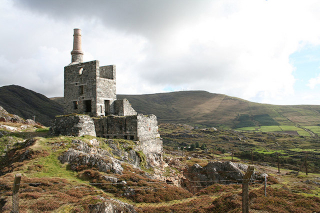
On January 7, 2000, experts underline the important heritage value of a 19th Century relic that stands on the site of a disused copper mine. A conservation appeal is launched to safeguard a unique engine house at a mountain mine in the Beara peninsula. A rare surviving symbol of Cornish type mining technology, the structure is the primary surviving embodiment of a once thriving copper mining industry in Allihies, County Cork.
The industrial mines in Allihies date back to 1812, when they are first opened by John Puxley. Mining activity reaches its peak there in 1845, when the mines employ around 1,600 people, after which the mines suffer with the local area during the Great Famine. The mines are operational until 1962, when they are finally closed. Large Cornish engine houses are constructed around the mining site, ruins of which survive today. These are used to pump out water to allow for deeper mining, and to transport miners and equipment down shafts that go below sea level. The site still contains a number of engine houses, mining shafts and a church. These are constructed by and for the Cornish miners who are brought to the area in the 1800s to mine copper ore. Once the mine becomes unprofitable, many of the miners emigrate to Butte, Montana.
The Allihies Copper Mine Museum (ACMM) is housed in a renovated Methodist church dating from 1845. It is officially opened by PresidentMary McAleese on September 13, 2007, after ten years of work by the Allihies Mines Co-op, a group that is formed to preserve the history of the area and mining heritage in the Allihies area, supported by the Mining Heritage Trust of Ireland.
The exhibitions cover all aspects of the history of copper mining in the area, from prehistoric times all the way up to the nineteenth century and the Industrial Revolution. The displays also cover the local geology and the social history of the mining heritage. The collections contain examples of mining equipment and tools from the various eras of activity. The exhibition space is also used to display artworks, with local artists such as Charles Tyrrell, Cormac Boydell, Rachel Parry and Tim Goulding exhibiting there.
(Pictured: Engine House, Allihies by John Gibson, view of the 1862 house for the 36″-cylinder beam engine that powered the man-engine and winder on Mountain Mine)
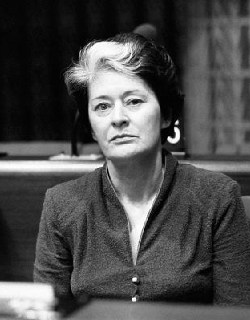
Desmond is born in Kinsale, County Cork on December 29, 1932. She is educated locally at the Convent of Mercy in Kinsale, where she is one of only two girls in her class to sit the Leaving Certificate examination. Before entering politics, she works as a civil servant with the Department of Posts and Telegraphs. She marries Dan Desmond in 1958.
Desmond is elected to the European Parliament at the 1979 European Parliament election for the Munster constituency. However, her time in Europe is short-lived, as she returns to domestic politics when she is offered a position as Minister and the chance to impact upon national legislation. At the 1981 general election she switches her constituency to Cork South-Central. A Fine Gael–Labour Party coalition comes to power, and she is appointed Minister for Health and Social Welfare.
Desmond’s cabinet appointment is historic, as she is only the second woman to be a member of cabinet since the foundation of the state in 1922, and the first in any Fine Gael or Labour Party cabinet. Countess Markievicz had held the cabinet post of Minister for Labour in the revolutionary First Dáil in 1919, but only one woman had held cabinet office after the foundation of the state, Máire Geoghegan-Quinn of Fianna Fáil who was appointed as Minister for the Gaeltacht in 1979.
Desmond retires from full-time politics at the 1987 general election for health reasons. She dies suddenly in Cork, County Cork on January 6, 2005. Her funeral Mass takes place at Our Lady and St. John’s Church, Carrigaline with burial following in Crosshaven Cemetery.
Power is born Jane O’Toole in Baltinglass, County Wicklow on May 1, 1858. In the 1880s she joins the Ladies’ Land League and finds herself immersed in their activities during the Land War. She compiles lists of those evicted from their homes and also organises the Land League in Wicklow and Carlow. In 1883 she marries John Wyse Power, a journalist who shares her political beliefs and is a member of the Irish Republican Brotherhood (IRB). They have four children together, a fact that does not interfere with her political work.
Power helps set up the Irish Women’s Franchise League and is also a founding member of Inghinidhe na hÉireann and Sinn Féin becoming Vice-President of both organisations. She is later on the Provisional Committee that sets up Cumann na mBan. She rises in the ranks to become one of the most important women of the revolution. In October 1914, she is elected the first President of Cumann na mBan. She is a successful businesswoman owning four branches of her Irish Farm Produce Company. The 1916 Proclamation of the Irish Republic is written in her home at 21 Henry Street, and she always maintains that the Military Council signed the proclamation in no particular order; they just signed as it was passed to each of the signatories, though, with James Connolly being eager to be the first to sign. Even the identity of the head of the Provisional Government was not altogether clear.
During the 1916 Easter Rising she supplies food to the Irish Volunteers. After the Rising she and her daughter, Nancy, help re-organise Cumann na mBan and distribute funds to families suffering hardships, as well as the Prisoners Dependants Fund. These funds had been sent by Clan na Gael in the United States. She is subsequently elected as one of five women members onto Dublin Corporation in 1920 for the Inns Quay – Rotunda District.
Power supports the Anglo-Irish Treaty and by the end of 1921, she is convinced that in doing so, will mean the need to leave Cumann na mBan to form a separate organisation. She helps set up Cumann na Saoirse (The League for Freedom), the pro-Treaty women’s organisation and becomes its Vice-President. She is a Free State Senator from 1922 until 1936 and is also a member of Cumann na nGaedheal.
Jennie Wyse Power dies on January 5, 1941, aged 82, at her home in Dublin. She is interred in Glasnevin Cemetery with her husband and daughter, Máire (who predeceased her). Her funeral is attended by many from both sides of the Dáil and the former revolutionary movement.
Cashman is born in Midleton, County Cork, one of two daughters of Patrick and Frances “Fanny” (Cronin) Cashman. Along with her sister, she is brought to the United States around 1850 by her mother, first settling in Boston. As an adolescent, she works as a bellhop in a Boston hotel. In 1865 she and her family migrate to San Francisco, California.
Of the thousands lured by the gold rush fever of the 19th century, few had the staying power or generous spirit of Cashman. She follows gold miners into British Columbia, where, during the early 1870s, she operates a boarding house while learning elementary mining techniques and geology. For the next 50 years, the precious metal leads her to Arizona, Nevada, Mexico, the Canadian Yukon, and north of the Arctic Circle in Alaska. In addition to successfully prospecting and running mines, one time owning 11 mines in the Koyukuk District of Alaska, she operates boarding houses, restaurants, and supply depots.
The quality that truly establishes Cashman’s place in mining lore is her charity, which earns her the titles “Angel of Tombstone” and “Saint of the Sourdoughs” while sometimes obscuring her career as a successful miner. As early as 1874, while visiting Victoria, she leads a dangerous rescue effort to free a group of miners trapped by a severe winter storm. Later, during the glory days of Tombstone, Arizona, she helps establish the town’s first hospital and Sacred Heart Church, its first Roman Catholic church. Although she is known to be tough and aggressive in defending her claims, she is also big-hearted. Upon the deaths of her sister and brother-in-law, she takes in her nieces and nephews and raises them as her own.
Around 1889, Cashman is active in the gold camp at Harqua Hala, Arizona, and comes close to marrying Mike Sullivan, one of the original discoverers of gold in that area. Along with mining, she contributes a number of excellent articles to Tucson‘s Arizona Daily Star, in which she discusses history, techniques, types of claims, and personalities in the field.
Cashman spends the last 20 years of her life on Nolan Creek, in the Koyukuk River Basin of Alaska, then the farthest north of any mining camp in the world. She is among about eight women who join a group of approximately 200 miners to brave the harsh environment and isolation in hopes of striking the “big bonanza.” Once a year, she leaves for supplies and equipment, traveling hundreds of miles to Fairbanks, by sled, boat, or wagon. Her spirit of adventure apparently never dies. In 1921, during one of her trips to the outside, she is interviewed for Sunset, a California publication. Then 76, Cashman tells the writer that, although she loves Alaska, she is not so tied to it that she would not pull up stakes if something turned up elsewhere.
Nellie Cashman dies on January 4, 1925, in Sisters of St. Anne hospital in Victoria, one of the hospitals she had helped fund some 40 years earlier. The United States Postal Service honors her with a stamp on October 18, 1994, as part of its “Legends of the West” series.
Potter is educated at St. Mary’s school in Fairview. She has a long career in Irish theatre, mainly as Ireland’s première comedienne, but also as a straight actress. She first appears professionally with Jimmy O’Dea in pantomime and appears frequently on television and in cabaret. She is a regular performer at the Gaiety Theatre in Dublin and for many years stars in Christmas pantomime. She becomes the first star to have a bronze cast of her handprints outside the theatre. She marries Jack O’Leary in 1959, an Irish army officer whom she had first met in 1943, and he writes most of her comedic material.
Among Potter’s many dramatic roles in the theatre is that of Maisie Madigan in Juno and the Paycock. While still a teenager, she tours abroad before World War II as a singer and dancer with Jack Hylton and his orchestra. On a tour of Germany, they once perform in front of Adolf Hitler and other Nazis. She plays the role of Dante Riordan in Joseph Strick‘s film, A Portrait of the Artist as a Young Man (1977). In September 1938, she appears on the BBC Television Service with Jack Hylton and his band. Film of her performance is held by the Alexandra Palace Television Society. In 2001, the Archivist of the Alexandra Palace Television Society gives Potter a copy of her 1938 television appearance.
Potter is conferred with the Freedom of the City of Dublin in 1984, and is later awarded an honorary degree from Trinity College, Dublin. She dies in her sleep at her home in Clontarf on April 7, 2004, at the age of 79. She is survived by her husband Jack O’Leary, and her sons John and Hugh.
David Fulton, the fourth and final mayor of the Town of Little Rock, Arkansas, before it is incorporated, is born in the Parish of Templemore, County Donegal on January 2, 1771. He serves as mayor from January 1835 through November 1835, his term cut short by the transition of Little Rock from town to city status. Once that occurs in November 1835, a new election has to be held.
Fulton is also proprietor of the Tan Yard, a tanning operation in Little Rock. He later serves as a judge and is appointed as Surveyor General of Public Lands in Arkansas by U.S. PresidentMartin Van Buren in 1838.
Fulton marries Elizabeth Savin in June 1795 in Maryland. She dies in November 1829, while they reside in Alabama. One of their children, William Savin Fulton (for whom Fulton County, Arkansas is named), serves as the fourth Territorial Governor of Arkansas in 1835 and 1836 and is one of Arkansas’ first United States Senators upon statehood in 1836. Fulton is serving as Mayor at the same time his son is Governor.
Fulton comes to Little Rock in 1833. His daughter, Jane Juliet Shall, and her four children come to Little Rock as well. The family makes the move to be nearer to the future governor. The Fultons and Shalls rent the Hinderliter House, now part of Historic Arkansas Museum, in 1834. One of his descendants, Louise Loughborough, is the person who saves the Hinderliter House from destruction and is founder of what is now Historic Arkansas Museum.
In addition to serving as Mayor, Fulton is president of the Anti-Gambling Society and a Pulaski CountyJustice of the Peace. From 1836 until 1838, he is County Judge of Pulaski County.
David Fulton dies in Little Rock on August 7, 1843 and is buried at Mount Holly Cemetery as are several other members of his family.
(From: “Little Rock Look Back: David Fulton, LR’s 4th Mayor” by Scott Whiteley Carter, Little Rock Culture Vulture blog, January 2, 2019)
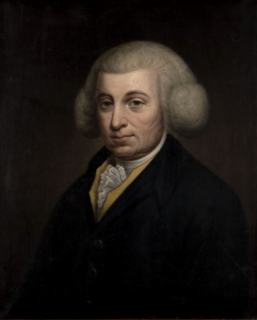
Charles O’Conor, Irish writer and antiquarian who is enormously influential as a protagonist for the preservation of Irish culture and history in the eighteenth century, is born on January 1, 1710 in Killintrany, County Sligo. He combines an encyclopaedic knowledge of Irish manuscripts and Gaelic culture in demolishing many specious theories and suppositions concerning Irish history.
O’Conor is born into a cadet branch of the land-owning family of O’Conor Don and is sent for his education to Father Walter Skelton’s school in Dublin. He grows up in an environment that celebrates Gaelic culture and heritage. He begins collecting and studying ancient manuscripts at an early age.
His marriage brings him financial stability so that he can devote himself to his writing, but he is widowed in 1750, within a year of his father’s death. When his eldest son Denis marries in 1760, he gives up the residence at Bellanagare to him and moves into a small cottage that he had built on the estate. He devotes the remainder of his life to the collection and study of Irish manuscripts, to the publication of dissertations, and especially to the cause of Irish and Catholic emancipation.
O’Conor is well known in Ireland from his youth as a civil-tongued, but adamant, advocate of Gaelic culture and history. He garners fame outside Ireland through his Dissertations on the ancient history of Ireland (1753), which is generally well received. When Samuel Johnson is made aware of it, he is moved to write a letter to O’Conor in 1755, complimenting the book, complimenting the Irish people, and urging O’Conor to write on the topic of Celtic languages.
The book is less well received in some Scottish circles, where there exists a movement to write Celtic history based upon Scottish origins. When James Macpherson publishes a spurious story in 1761 about having found an ancient Gaelic (and Scottish) cycle of poems by a certain “Ossian“, among the critics who rejects it as false is O’Conor, as an inclusion in the 1766 rewrite of his 1753 work. While the issue was laid to public rest by others, notably Samuel Johnson, the issue is laid to intellectual rest by O’Conor in 1775, with the publication of his Dissertation on the origin and antiquities of the antient Scots. The fact that the issue occurs provides O’Conor the opportunity to establish Ireland as the source of Gaelic culture in the minds of the non-Irish general public.
O’Conor’s later life is that of the respected dean of Irish historians. He continues to write as always in favour of ideas that he favours and are consistent with the historical record, and against any and all ideas that are inconsistent with the historical record, including those of other Irish historians. Such is his esteemed reputation that even those whom he challenges would include his challenges in the next edition of their own books. He continues to collect, study, and annotate Irish manuscripts. Upon his death in Bellanagare, County Roscommon on July 1, 1791, his collection becomes the first part of the Annals of the Four Masters at the Stowe Library. In 1883 these are returned to the Royal Irish Academy library.
His unfinished History of Ireland, that Johnson had encouraged in 1777, is destroyed on his instructions at his death.
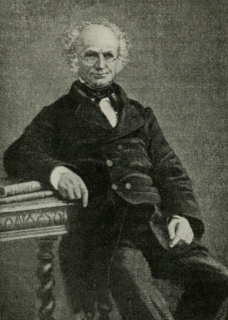
Mahony is born to Martin Mahony and Mary Reynolds. He is educated at the JesuitClongowes Wood College, in County Kildare, and later in the Abbey of Saint-Acheul, a similar school in Amiens, France and then at Rue de Sèvres, Paris, and later in Rome. He begins teaching at the Jesuit school of Clongowes as master of rhetoric but is soon after expelled. He then goes to London and becomes a leading contributor to Fraser’s Magazine, under the signature of “Father Prout” (the original Father Prout, whom Mahony knew in his youth, born in 1757, was parish priest of Watergrasshill, County Cork). At one point he is director of this magazine.
Mahony is witty and learned in many languages. One form which his humour takes is the professed discovery of the originals in Latin, Greek, or mediaeval French of popular modern poems and songs. Many of these jeux d’esprit are collected as Reliques of Father Prout. He pretends that these poems had been found in Fr. Prout’s trunk after his death. He wittily describes himself as “an Irish potato seasoned with Attic salt.” Later he acts as foreign correspondent to various newspapers, and during the last eight years of his life his articles form a main attraction of The Globe.
In his native Cork Mahoney is best remembered for his poem “The Bells of Shandon” and his penname is synonymous with the city and the Church of St. Anne, Shandon.
Mahony spends the last two years of his life in a monastery and dies on May 18, 1866, in Paris reconciled to the Church.
The Reliques of Father Prout originally appear in two volumes in 1836 with illustrations by Maclise. They are reissued in Henry George Bohn‘s Bohn’s Libraries in 1860. Another volume, Final Reliques, is edited by Douglas Jerrold and published in 1876. The Works of Father Prout, edited by Charles Kent, is published in 1881. Facts and Figures from Italy (1847) is made from his Rome letters to London’s The Daily News.