Cairbre is renamed Slats and is trained by Volney Phifer. Slats is used on all black-and-white MGM films between 1924 and 1928. The original logo is designed by Howard Dietz and used by the Goldwyn Pictures Corporation studio from 1916 to 1924. Goldwyn Pictures is ultimately absorbed into the partnership that forms MGM, and the first MGM film that uses the logo is He Who Gets Slapped (1924). Dietz states that he decided to use a lion as the company’s mascot as a tribute to his alma mater Columbia University, whose athletic teams’ nickname is The Lions. He further adds that Columbia’s fight song, “Roar, Lion, Roar“, inspired him to make the lion roar.
Ironically, unlike his successors, Slats does nothing but look around in the logo making him the only MGM lion not to roar, although it is rumored that Volney Phifer trains the lion to growl on cue, despite the fact that synchronized sound is not officially used in motion pictures until 1927.
George Brent, Irish-born American stage, film, and television actor in American cinema, is born on March 15, 1904 in Ballinasloe, County Galway.
Brent was born George Patrick Nolan to John J. and Mary (née McGuinness) Nolan. His mother is a native of Clonfad, Moore, County Roscommon. During the Irish War of Independence, Brent is part of the Irish Republican Army (IRA). He flees Ireland with a bounty set on his head by the British government, although he later claims only to have been a courier for guerrilla leader and tactician Michael Collins.
He eventually moves to Hollywood, and makes his first film, Under Suspicion, in 1930. Over the next two years, he appears in a number of minor films produced by Universal Studios and 20th Century Fox, before being signed to contract by Warner Bros. in 1932. He remains at Warner Bros. for the next 20 years, carving out a successful career as a top-flight leading man during the late 1930s and 1940s.
Brent drifts into “B” pictures from the late 1940s and retires from film in 1953. He continues to appear on television until 1960, having appeared on the religion anthology series, Crossroads. He is cast in the lead in the 1956 television series, Wire Service. In 1978, he makes one last film, the made-for-television production Born Again.
George Brent receives two stars on the Hollywood Walk of Fame, the first, at 1709 Vine St., for his film contributions, the second star, at 1614 Vine St., for his work in television.
Brent is married five times: Helen Louise Campbell (1925–1927), Ruth Chatterton (1932–1934), Constance Worth (1937), Ann Sheridan (1942–1943), and Janet Michaels (1947-1974). His final marriage to Janet Michaels, a former model and dress designer, lasts 27 years until her death in 1974. They have a son and a daughter.
Brent also carries on a lengthy relationship with his frequent Warner Bros. co-star, actress Bette Davis, who describes her last meeting with Brent after many years of estrangement. He is suffering from advanced emphysema, and she expresses great sadness at his ill health and deterioration. George Brent dies on May 26, 1979 in Solana Beach, California.
Jordan is educated at St. Paul’s College, Raheny. Later, Jordan attends University College Dublin, where he studies Irish history and English literature. He is raised a Catholic and is quite religious during the early stages of his life. Regarding his current beliefs, he states that “God is the greatest imaginary being of all time. Along with Einstein‘s General Theory of Relativity, the invention of God is probably the greatest creation of human thought.”
When John Boorman is filming Excalibur in Ireland, he recruits Jordan as a “creative associate.” A year later Boorman is executive producer on Jordan’s first feature, Angel, a tale of a musician caught up in the Troubles, starring Stephen Rea who subsequently appears in almost all of Jordan’s films to date. During the 1980s, he directs films that win him acclaim, including The Company of Wolves and Mona Lisa, both made in England. The Company of Wolves becomes a cult favorite.
As a writer/director, Jordan has a highly idiosyncratic body of work, ranging from mainstream hits like Interview with the Vampire to commercial failures like We’re No Angels to a variety of more personal, low-budget arthouse pictures. He is also the driving force behind the cable TV series The Borgias.
Unconventional sexual relationships are a recurring theme in Jordan’s work, and he often finds a sympathetic side to characters that audiences would traditionally consider deviant or downright horrifying. His film The Miracle, for instance, follows two characters who struggle to resist a strong, incestuous attraction, while The Crying Game makes complicated, likable characters out of an IRA volunteer and a transgender woman. Interview with the Vampire, like the Anne Rice book it is based on, focuses on the intense, intimate interpersonal relationship of two undead men who murder humans nightly, accompanied by an equally lusty vampire woman who is eternally trapped in the body of a little girl. While Lestat (Tom Cruise) is depicted in an attractive but villainous manner, his partner Louis (Brad Pitt) and the child vampire Claudia (Kirsten Dunst) are meant to capture the audience’s sympathy despite their predatory nature.
In addition to the unusual sexuality of Jordan’s films, he frequently returns to the Troubles of Northern Ireland. The Crying Game and Breakfast on Pluto both concern a transgender character, both concern the Troubles, and both feature frequent Jordan leading man Stephen Rea. The two films, however, are very different, with The Crying Game being a realistic thriller/romance and Breakfast on Pluto a much more episodic, stylized, darkly comic biography. Jordan also frequently tells stories about children or young people, such as The Miracle and The Butcher Boy. While his pictures are most often grounded in reality, he occasionally directs more fantastic or dreamlike films, such as The Company of Wolves, High Spirits, Interview with the Vampire, and In Dreams.
The critical success of Jordan’s early pictures leads him to Hollywood, where he directs High Spirits and We’re No Angels. Both are critical and financial disasters. He later returns home to make the more personal The Crying Game, which is nominated for six Academy Awards. Jordan wins the Academy Award for Best Original Screenplay for the film. Its unexpected success leads him back to American studio filmmaking, where he directs Interview with the Vampire. He also directs the crime drama The Brave One starring Jodie Foster.
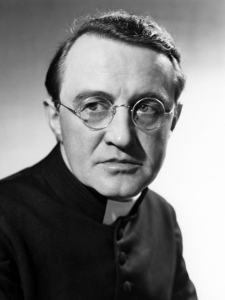
Arthur Shields, Irish actor on television, stage, and film, is born on February 15, 1896, into an Irish Protestant family in Portobello, Dublin. Shields starts acting in the Abbey Theatre when he is 17 years old. He is the younger brother of Oscar-winning actor Barry Fitzgerald. They are the sons of Adolphus Shields, who is well-known in Dublin as a labor organizer although the 1901 census lists his occupation as “press reader,” and Fanny Sophia Sheilds.
Shields returns to the Abbey Theatre and has a varied career there from 1914-1939 as actor, assistant director, director, and stage manager. He appears in more than 300 roles in 350 plays while he is at the Abbey. Three of the productions he appears in are by Irish playwright Teresa Deevy – The Reapers, Temporal Powers, and Katie Roche. Three times he brings the Abbey Company to the United States.
Shields dies of complications related to emphysema on April 27, 1970, in Santa Barbara, California. He is survived by his wife, actress Laurie Bailey, a daughter, a son, and four great-grandchildren. His body is cremated, with the ashes taken to Dublin, where a burial with full military honors takes place.
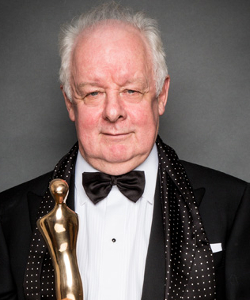
Jim Sheridan, Irish playwright, screenwriter, film director, and film producer, is born in Dublin on February 6, 1949. In the few years from 1989 to 1993, Sheridan makes three acclaimed films set in Ireland (My Left Foot, The Field, and In the Name of the Father) that between them receive a remarkable 13 Academy Award nominations. Sheridan has personally received six Academy Award nominations. In addition to the above-mentioned films, he is also known for the films The Boxer and In America.
Sheridan is born to Anna and Peter Sheridan Snr and raised in the inner city of Dublin. He is the brother of playwright Peter Sheridan. The family runs a lodging house, while Anna Sheridan works at a hotel and Peter Sheridan Snr is a railway clerk with CIÉ. Sheridan’s early education is at a Christian Brothers school. In 1969 he attends University College Dublin to study English and History. He becomes involved in student theater there, where he meets Neil Jordan, who also is later to become an important Irish film director. After graduating from UCD in 1972, Sheridan and his brother begin writing and staging plays, and together found the Project Theatre Company.
Sheridan returns to Ireland in the late 1980s. In 1989, he directs My Left Foot, which becomes a critical and commercial success and wins Daniel Day-Lewis and Brenda Fricker Academy Awards. He follows that with The Field starring Richard Harris in 1990, then with In the Name of the Father in 1993, a fictionalized re-telling of the case of the Guildford Four. The film wins the Golden Bear at the 44th Berlin International Film Festival.
In 1996 he co-writes Some Mother’s Son with Terry George. The Boxer, with Daniel Day-Lewis, is nominated for a Golden Globe Award for best film drama in 1997. In 2003, he releases the semi-autobiographical In America, which tells the story of a family of Irish immigrants trying to succeed in New York. The film receives positive reviews and earns Samantha Morton and Djimon Hounsou Academy Award nominations. In 2005 he releases Get Rich or Die Tryin’, a film starring rap star 50 Cent. He is connected with the upcoming film adaptation of Artemis Fowl and is rumoured to have written the screenplay and been asked to direct it.
Sheridan has a wife, Fran, and three daughters, Naomi Sheridan, Kirsten Sheridan, and Tess Sheridan, with whom he has collaborated, most notably with Naomi and Kirsten on the screenplay for In America.
Patrick “Pat” Kenny, veteran Irish broadcaster, is born in Dublin on January 29, 1948. Kenny currently hosts the daily radio show The Pat Kenny Show on Newstalk and the current affairs show Pat Kenny Tonight on TV3.
Kenny has a 41-year high-profile career at RTÉ, in which he is their highest paid presenter for several years. He presents the radio show Today with Pat Kenny on RTÉ Radio 1 each weekday morning between 10:00 and midday until 2013. He hosts The Late Late Show from September 1999 until May 2009, however, returns as a stand-in host in January 2013. He presents the current affairs programme, The Frontline, each Monday night from 2009 until its cancellation in 2013.
Kenny is the co-host of Eurovision Song Contest 1988, as well as numerous other television shows, including Today Tonight, Saturday Live, and Kenny Live, and works for both RTÉ Radio 1 and RTÉ 2fm, sometimes simultaneously, in a career that has spanned five decades. He is the holder of a Jacob’s Award and is perennially cited as the highest paid employee in RTÉ’s possession. He is named 23rd most influential person of 2009 by the magazine Village.
Eamonn Andrews, radio and television presenter considered to be Ireland’s first media superstar, is born in Synge Street, Dublin, on December 19, 1922.
Andrews is educated at Synge Street CBS and begans his career as a clerk in an insurance office. He is a keen amateur boxer and wins the Irish junior middleweight title in 1944.
In 1946, he becomes a full-time freelance sports commentator, working for Radio Éireann, Ireland’s national broadcaster. In 1950, he begins presenting programmes for the BBC, being particularly well known for boxing commentaries, and soon becomes one of television’s most popular presenters. He begins hosting the game show What’s My Line? in 1951.
Throughout the 1950s, he commentates on the major British heavyweight fights on the BBC Light Programme, with inter-round summaries by W. Barrington Dalby. On January 20, 1956, he reaches No. 18 in the UK Singles Chart with a “spoken narrative” recording named “The Shifting Whispering Sands (Parts 1 & 2),” which is produced by George Martin with musical backing by the Ron Goodwin Orchestra. The song later reappears on Kenny Everett‘s compilation album The World’s Worst Record Show, which is released in June 1978.
Between 1955 and 1964, Andrews presents the long-running Sports Report on BBC’s Light Programme, now Radio 2. In 1965, he leaves the BBC to join the ITV contractor ABC, where he pioneers the talk show format in the UK. He hosts a chat show on ITV, The Eamonn Andrews Show, for five years. He is known for coming up with off-the-cuff linkings that do not work such as, “Speaking of cheese sandwiches, have you come far?” This is parodied by the character Seamus Android on Round the Horne in the 1960s, performed by Bill Pertwee. In the 1960s he presents Thames Television‘s Today news magazine programme.
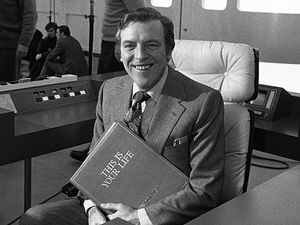
Andrews is probably best known as the presenter of the UK’s version of This Is Your Life, between its inception in 1955 and his death in 1987, when he is succeeded by Michael Aspel, who had also succeeded Andrews as host of Crackerjack more than two decades earlier. Andrews becomes the very first This Is Your Life subject on British television when he is surprised by the show’s creator, Ralph Edwards. Andrews also creates a long-running panel game called Whose Baby? that originally runs on the BBC and later on ITV. He is a regular presenter of the early Miss World pageants.
Andrews’ chairs the Radio Éireann Authority, now the RTÉ Board, between 1960 and 1964, overseeing the introduction of State television to Ireland and establishing the Irish State broadcaster as an independent semi-state body. About this time, he also acquires a number of business interests in Ireland, including recording studios and a dance hall.
After months of illness during 1987, originally caused by a virus contracted during an airline flight, but which is not recognised at the time, he dies from heart failure on November 5, 1987, at the age of 64, at Cromwell Hospital, London. He had recorded his last edition of This Is Your Life six days previously on October 30, 1987, surprising Crossroads actress Jane Rossington. After his death, the show, and two others that have yet to be broadcast, are postponed until, with his widow’s permission, they are broadcast in January 1988. His widow, Gráinne, whom he married in 1951, dies 18 months later. They had three adopted children.
Harris is schooled by the Jesuits at Crescent College. He is a talented rugby player; however, his athletic career is cut short when he comes down with tuberculosis in his teens. After recovering from tuberculosis, Harris moves to Britain, wanting to become a director. Unable to find any suitable training courses, he enrolls in the London Academy of Music and Dramatic Art (LAMDA) to learn acting.
Harris performs the role of King Arthur in the film adaptation of the musical play Camelot (1967). He continues to appear on stage in this role for many years, including a successful Broadway run in 1981–1982. In 1970 British exhibitors vote him the 9th most popular star at the UK box office.
Other film performances follow, among them a role as a reluctant police informant in the coal-mining tale The Molly Maguires (1970), also starring Sean Connery. Harris stars in Cromwell (1970), a film based on the life of Oliver Cromwell who leads the Parliamentary forces during the English Civil War and, as Lord Protector, ruled Great Britain and Ireland in the 1650s.
Harris’ film career collapses after the late 1970s and in the next decade he is rarely seen on screen, although he continues to act on stage. During his career Harris appears in two films which win the Academy Award for Best Picture. First, as the gunfighter “English Bob” in the Western Unforgiven (1992); second, as the Roman EmperorMarcus Aurelius in Ridley Scott‘s Gladiator (2000).
Harris is diagnosed with Hodgkin’s disease in August 2002, reportedly after being hospitalised with pneumonia. He dies at University College Hospital in Fitzrovia, London on October 25, 2002, at the age of 72. He was in a coma in his final three days. Harris’ body is cremated, and his ashes are scattered in the Bahamas, where he had owned a home.
Maria Josephine Doyle Kennedy, singer, songwriter, and television/film actress, is born in Clontarf, Dublin, on September 25, 1964. With a singing career that has spanned nearly thirty years and an acting career that has spanned twenty-five, she has established herself as one of Ireland’s most prolific artists and entertainers.
Although Doyle Kennedy exhibits a love for singing at an early age, she never considers a formal career in singing until after she graduates from Trinity College, Dublin with a joint honours degree in political science and business. She never considers becoming an actress until after she establishes herself as a singer.
Doyle Kennedy joins a band while still in college in the mid-80s, performing with Hothouse Flowers during the band’s early years. She leaves the band in order to join The Black Velvet Band with her future husband, Kieran Kennedy. The band releases their first album, When Justice Came, in 1989 which reaches number 4 on the Irish charts and is ranked among the best Irish albums of the late 1980s. Doyle Kennedy leaves the group to pursue a career in solo music and, in 2001, releases music on Mermaid Records, a label she founds herself in 2000.
After the release of her alternative folk album Mütter in 2007, Hot Press states that Doyle Kennedy “is one of the finest voices this country has ever produced.” She is subsequently nominated in the Best Irish Female category at the 2008 Meteor Awards.
In 2007 and 2008, Doyle Kennedy receives widespread recognition for her role as Catherine of Aragon on the British historical fiction television series The Tudors. In 2011 she joins the cast of ITV‘s period drama Downton Abbey, appearing as Vera Bates, estranged wife of the Earl of Grantham’s valet, one of her most recognizable roles within the United Kingdom. In the same year, she also plays a small role as a maid in the film Albert Nobbs, alongside American actress Glenn Close.
Her debut album, The Water is Wide, is released in Europe in 2000 and in North America in 2006. In 2005, she is featured on The Duggans album Rubicon along with peers Moya Brennan and other members of Clannad.
In 2004, Fallon sends a demo offer to composer David Downes, who is then working on the concept of Celtic Woman. Due to her unique vocal abilities, Downes contacts Fallon and asks if she would like to be a part of Celtic Woman, at the time envisaged to be only a one-night show. Fallon agrees, and becomes one of the founding members of the group. In some songs, such as Isle of Innisfree and Carrickfergus, Fallon plays the harp as well as sings. She also plays the harp in fellow Celtic Woman member Chloë Agnew‘s performance of Guun’s Ave Maria.
Fallon is featured in the self-titled debut album Celtic Woman, Celtic Woman: A Christmas Celebration, and Celtic Woman: A New Journey, as well as in the tie-in PBS television specials and DVDs filmed in 2004, 2007, and 2006 respectively. She also tours with the group in 2005 on the inaugural North American Tour, the 2006-2007 A New Journey tour, and again in 2007-2008 on the second A New Journey tour.
In 2009, Fallon announces that she is leaving Celtic Woman to have a full break and spend time with her family. She is replaced by actress and vocalist Alex Sharpe.
In 2009, Fallon appears as a guest vocalist on Jim Brickman‘s It’s a Beautiful World tour and PBS special, and releases her second album Distant Shore in September of that year. This is followed in March 2010 with her third album Music of Ireland: Welcome Home. Fallon’s first Christmas album, Winter, Fire & Snow: A Celtic Christmas Collection, is released in September 2010. In December 2010, Fallon releases a PBS Celtic Christmas special and tie-in CD, titled Órla Fallon’s Celtic Christmas, the first time any former Celtic Woman member has starred in their own PBS special.
In March 2011, Fallon releases another album, Órla Fallon: My Land, which ties in with another PBS special. Another solo album, Lullaby Time, is released in 2012.