seamus dubhghaill

Promoting Irish Culture and History from Little Rock, Arkansas, USA


Leave a comment

Inaugural Meeting of the Irish Management Institute

irish-management-institute-logo

The Irish Management Institute, an educational institute in Dublin that offers Postgraduate Diplomas, Master’s Degrees, executive education programs and short courses in Business and Management, holds its inaugural meeting on December 9, 1952. In its role as a membership organisation it connects businesses around its mission of improving the practice of management in Ireland.

The idea for the institute originates from a committee set up by Michael Dargan, T.P. Hogan and other businessmen. The motivation is to establish an organisation that will further the science and practice of business management in Ireland. Those involved are inspired primarily by the American Management Association and The Conference Board. At the same time the then Minister for Industry and Commerce, Seán Lemass, has prompted a separate group of leading semi-state and private bosses into investigating a similar idea. Both groups merge and the inaugural meeting of the Irish Management Institute is held on December 9, 1952, in the Gresham Hotel. The founding chairman is Sir Charles Harvey.

The objective of the institute is to raise the standard of management in Ireland. Originally it does this through corporate and personal memberships, regular lectures and conferences, a journal called Irish Management, research and the establishment of a member’s library. After its first decade the institute becomes involved in management training courses.

Part of IMI’s original brief has been to encourage the universities to develop management education. In the early 1960s both University College Dublin (UCD) and Trinity College Dublin introduce master’s degrees in management. This is an indication of management’s growing stature as an academic discipline. In turn IMI creates the Sir Charles Harvey Award for exceptional graduates of these courses. The first recipient is Patrick J. Murphy.

IMI later goes on to become a provider of education. Its popular Certificate in Supervisory Management (CISM) is the first academic course run by IMI and is the institute’s first progression into all-island distance learning. In 1973 IMI partners with Trinity for the Master of Science in Management (MSc). The MSc epitomises IMI’s teaching philosophy and is notable for being the first management degree in the world to be based on action learning. Related courses follow over the next three decades. Other affiliations with Irish universities include a master’s in information technology development with NUI Galway and a research alliance with the University of Limerick. In 2003 IMI launches their support and delivery of the Flexible Executive Henley MBA programme.

An alliance between University College Cork and the Irish Management Institute is announced in June 2011 by Taoiseach Enda Kenny. The IMI and UCC had been collaborating since 2009. As of 2014, the majority of the degrees offered by the IMI are accredited by UCC. UCC controversially purchases the IMI and it is merged into UCC.

Leave a comment

Birth of American-Irish Writer Morgan Llywelyn

morgan-llywelyn

Morgan Llywelyn, American-Irish historical fantasy, historical fiction, and historical non-fiction writer, is born Sally Snyder in New York City on December 3, 1937. Her fiction has received several awards and has sold more than 40 million copies, and she herself is recipient of the 1999 Exceptional Celtic Woman of the Year Award from Celtic Women International.

In her teens, Llywelyn moves to the Dallas area, where she develops a love of horses. By the age of 16, she is competing in professional horse shows across the United States. By age 18, she models for Neiman Marcus and Arthur Murray. After 15 years of experience as a horse trainer and instructor, she tries out for and narrowly misses making the 1976 United States Olympic Team in Dressage. She is instead shortlisted, missing the cut off score by .05 percent.

With her mother’s encouragement and a successfully published article on horse training, she refocuses her efforts in tracing the Llywelyn family history and eventually makes a career out of writing historical novels that allow the exploration of her Celtic roots. In reference to this career change, Llywelyn has this to say:

“I have a strong strain of Welsh on my mother’s side, which does indeed go back to Llywelyn ap Iorwerth. And Llywelyn the Great! (We have the proven genealogy from the College of Heralds.) She was very proud of her royal Welsh connection. That is why she was so interested in genealogy in the first place, and inspired me to get involved as well … leading in turn to “The Wind from Hastings.” But both my parents were predominantly Irish – my father totally so – and I spent half the years of my childhood here. So I have always been much more interested in Ireland and its history and legends.”

Llywelyn has received several awards for her works. She receives the Novel of the Year Award from the National League of American Pen Women for her novel, The Horse Goddess, as well as the Woman of the Year Award from the Irish-American Heritage Committee for Bard: The Odyssey of the Irish. The latter award is presented to her by Ed Koch, then-mayor of New York City.

Although Llywelyn’s grandparents have their roots in Ireland, it is only after the death of her parents and her husband in 1985 that she relocates to Ireland. Llywelyn now lives outside Dublin and has become an Irish citizen.

In 1990, Llywelyn begins her focus on writing books geared for younger readers. These works start with Brian Boru: Emperor of the Irish, for which she wins an Irish Children’s Book Trust Bisto Award in 1991, and includes other titles, such as Strongbow: The Story of Richard and Aoife, for which she wins a Bisto Award in the Historical Fiction category, 1993 and the Reading Association of Ireland Award, 1993, and Star Dancer which departs from her usual Celtic topic and is centered on her experiences with Dressage. Further works include The Vikings in Ireland, an exploration of when the Norsemen arrived in Ireland and Pirate Queen, a younger reader’s version of the story of Grace O’Malley, told through letters from Granuaile to her beloved son.


Leave a comment

Death of Jim Mitchell, Fine Gael Politician

jim-mitchell

Jim Mitchell, senior Irish politician who serves in the cabinets of Taoiseach Garret FitzGerald, loses his three-year battle with cancer in Dublin on December 2, 2002.

Mitchell begins his political involvement when he supports Seán MacBride, leader of the radical republican Clann na Poblachta in the 1957 general election. He joins Fine Gael in 1967, becoming that party’s unsuccessful candidate in a by-election in 1970. He seeks a party nomination to run in the 1973 Irish general election. However, he agrees not to contest the seat to allow Declan Costello, a senior figure in his party and son of former Taoiseach John A. Costello, to be elected. Costello goes on to serve as Attorney General of Ireland in the 1973-1977 National Coalition of Fine Gael and the Labour Party.

Mitchell is elected to Dublin Corporation in 1974. In 1976, at the age of 29, he becomes the youngest ever Lord Mayor of Dublin. He is an unsuccessful candidate for Dáil Éireann in the 1973 general election in Dublin South-West and loses again in the 1976 by-election in the same constituency, to Labour’s Brendan Halligan.

In the 1977 general election he is elected to the 21st Dáil for the new constituency of Dublin Ballyfermot. With the party’s loss of power in 1977, the new leader, Garret FitzGerald appoints Mitchell to the Party’s Front Bench as spokesman on Labour. At the 1981 general election Mitchell is elected for the Dublin West and Fine Gael dramatically increases its number of seats, forming a coalition government with the Labour Party. On his appointment as Taoiseach, Garret FitzGerald causes some surprise by excluding some of the older conservative ex-ministers from his cabinet. Instead, young liberals like Mitchell are appointed, with Mitchell receiving the high-profile post of Minister for Justice, taking responsibility for policing, criminal and civil law reform, penal justice, etc. The Fine Gael-Labour government collapses in January 1982 but regains power in December of that year. Mitchell again is included in a FitzGerald cabinet, as Minister for Transport.

As Minister for Transport, Mitchell grants the aviation license to a fledgling airline called Ryanair on November 29, 1985. This is granted despite strong opposition by Ireland’s national carrier Aer Lingus. The issue of the license breaks Aer Lingus’ stranglehold on flights to London from the Republic of Ireland.

Mitchell, who is seen as being on the social liberal wing of Fine Gael, is out of favour with John Bruton when he becomes Fine Gael leader in 1990. When Bruton forms the Rainbow Coalition in December 1994, Mitchell is not appointed to any cabinet post.

Mitchell contests and wins Dáil elections in 1977, 1981, (February and November) 1982, 1987, 1989, 1992, 1997. He runs for his party as its candidate to become a member of the European Parliament in the 1994 and 1998 elections. He also is director of elections for Austin Currie, the Fine Gael candidate, in the 1990 presidential election.

In 2001, Bruton is deposed as Fine Gael leader and replaced by Michael Noonan. Mitchell serves as his deputy from 2001 to 2002. He also chairs the key Oireachtas Public Accounts Committee. The Committee’s work under his chairmanship is widely praised for its inquiry into allegations of corruption and wide-scale tax evasion in the banking sector.

Though regarded in politics as one of Fine Gael’s “survivors,” who holds onto his seat amid major boundary changes, constituency changes and by attracting working class votes in a party whose appeal is primarily middle class, Mitchell loses his Dublin Central seat in the 2002 general election. That election witnesses a large-scale collapse in the Fine Gael vote, with the party dropping from 54 to 31 seats in Dáil Éireann. Although Mitchell suffers from the swing against Fine Gael in Dublin, he is not aided by the fact that Inchicore, which is considered his base in the constituency has been moved to Dublin South-Central. He chooses not to run in that constituency as his brother, Gay, is a sitting Teachta Dála (TD) running for re-election for that constituency.

Mitchell earlier has a liver transplant in an attempt to beat a rare form of cancer which had cost the lives of a number of his siblings. Though the operation is successful, the cancer returns. Although he appears to be making a recovery, Jim Mitchell ultimately dies of the disease on December 2, 2002.

His former constituency colleague and rival, Taoiseach Bertie Ahern, describes Jim Mitchell as having made an “outstanding contribution to Irish politics.”


Leave a comment

Cork Hurling Team Strike

cork-hurling

Hurling in Cork is thrown into chaos after the county’s senior squad goes on strike on November 29, 2002.

When the Cork hurling team paraded before the National League final the previous May with socks down and jerseys hanging out it seemed a petty protest. Any discontent, said the county board officials, would be quickly forgotten come the championship.

Instead it is Cork’s championship that is quickly forgotten, and the protest is merely the start of the deepest crisis ever to hit the state of hurling in the county. The players throw down their hurleys, leaving the split with the county board as a gaping chasm.

Details of the fallout start to appear from the players after their exit from the championship at the hands of Galway. Goalkeeper Donal Óg Cusack and the 1999 All-Ireland winning captain Mark Landers begin a series of revelations that come as a shock not just in Cork, but to hurlers all over the country.

The players, who are seeking better conditions, refuse to play or train with the county again until the dispute with the county board is resolved. Central to the crisis is what the players perceive to be the poor treatment from the county board. The players demands include having their own doctor at all Championship and League games, resolving disputes over travel arrangements and providing players with free gymnasium access. There are also complaints about the warnings sent to younger players that joining the Gaelic Players Association will jeopardise their chances of playing with the senior team.

Running parallel to the dispute is the search for a new Cork manager. Bertie Óg Murphy announces that he is stepping down in late September after one year in charge, although he refuses to get drawn into the controversy over the treatment of players.

At the same time, the unrest of the players is compounded by the decision of the Cork selectors not to follow Murphy’s suit. Three of the four selectors, Pat McDonnell, PJ Murphy and John Meyler, remain in place as they are half-way through a two-year term while county champions Blackrock have yet to officially reaffirm county secretary Frank Murphy as their nomination to the selection committee.

The players previously state, however, that they never saw it as their right or function to interfere with the choosing or workings of selectors or managers for hurling in Cork.

The strike is eventually resolved and all the demands are met.

(From “Cork hurling in deep state of crisis” by Ian O’Riordan, The Irish Times, November 30, 2002)


Leave a comment

Assassination of Ross McWhirter

ross-mcwhirter

Alan Ross McWhirter, co-founder of The Guinness Book of Records and a contributor to Record Breakers, is murdered by the Provisional Irish Republican Army (IRA) on November 27, 1975.

McWhirter is the youngest son of William McWhirter, editor of the Sunday Pictorial, and Margaret “Bunty” Williamson. He is born at Winchmore Hill, Middlesex, England on August 12, 1925. Like his two brothers, he is educated at Marlborough College and Trinity College, Oxford. Between 1943 and 1946 he serves as a sub-lieutenant with the Royal Naval Volunteer Reserve on board a minesweeper in the Mediterranean Sea.

Ross and his twin brother Norris become sports journalists in 1950. In 1951, they found an agency to provide facts and figures to Fleet Street, setting out, in Norris McWhirter’s words “to supply facts and figures to newspapers, yearbooks, encyclopaedias and advertisers.” In the same year they publish Get to Your Marks.

While building up their accounts, they both work as sports journalists. One of the athletes they know and cover is runner Christopher Chataway, an employee at Guinness who recommends them to Hugh Beaver. After an interview in 1954 in which the Guinness directors enjoy testing the twins’ knowledge of records and unusual facts, the brothers agree to start work on the book that becomes The Guinness Book of Records. In August 1955, the first 198-page green volume is at the bookstalls, and in four more months it is the UK’s number one non-fiction best-seller. Both brothers are regulars on the BBC show Record Breakers. They are noted for their encyclopedic memories, enabling them to provide detailed answers to questions from the audience about entries in The Guinness Book of Records. Norris continues on the programme after Ross’s death.

In the early 1960s, McWhirter is a Conservative Party activist and seeks, unsuccessfully, the seat of Edmonton in the 1964 general election. Following his killing, his brother and others found the National Association for Freedom (later The Freedom Association).

McWhirter advocates various restrictions on the freedom of the Irish community in Britain, such as making it compulsory for all of them to register with the local police and to provide signed photographs of themselves when renting flats or booking into hotels and hostels. In addition, he offers a £50,000 reward for information leading to a conviction for several recent high-profile bombings in England that were publicly claimed by the Provisional Irish Republican Army (IRA). In doing so, he recognises that he might then be a target himself. This is considered a “bounty” by the IRA Army Council, a view that leads directly to the events that follow, although the idea is not originally his, but that of John Gouriet.

At 6:45 PM on November 27, 1975, McWhirter is shot and killed by two IRA volunteers, Harry Duggan and Hugh Doherty, both of whom are members of what becomes known as the Balcombe Street Gang, the group for whose capture McWhirter had offered the reward. He is shot with a .357 Magnum revolver at close range in the head and chest outside his home in Village Road, Bush Hill Park. He is taken to Chase Farm Hospital but dies soon after being admitted. His killers are captured and charged with his and nine other murders. They are sentenced to life imprisonment but freed in 1999 under the terms of the Good Friday Agreement.


Leave a comment

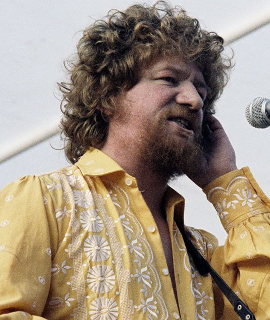
Birth of Luke Kelly, Founding Member of The Dubliners

luke-kelly

Luke Kelly, singer, folk musician and actor, is born into a working-class family in Lattimore Cottages at 1 Sheriff Street, Dublin on November 17, 1940. He is noted as a founding member of the band The Dubliners.

After Dublin Corporation demolished Lattimore Cottages in 1942, the Kellys become the first family to move into the St. Laurence O’Toole flats, where Luke spends the bulk of his childhood, although the family is forced to move by a fire in 1953 and settles in the Whitehall area.

Kelly is interested in music during his teenage years and regularly attends cèilidh with his sister Mona and listens to American vocalists including Fats Domino, Al Jolson, Frank Sinatra and Perry Como. He also has an interest in theatre and musicals, being involved with the staging of plays by Dublin’s Marian Arts Society. The first folk club he comes across is in the Bridge Hotel, Newcastle upon Tyne in early 1960. Having already acquired the use of a banjo, he starts memorising songs.

Kelly befriends Sean Mulready in Birmingham and lives in his home for a period. Mulready is a teacher who is forced from his job in Dublin because of his communist beliefs. Mulready’s brother-in-law, Ned Stapleton, teaches Kelly “Rocky Road to Dublin.” During this period he studies literature and politics under the tutelage of Mulready, his wife Mollie, and Marxist classicist George Derwent Thomson.

In 1961 there is a folk music revival or “ballad boom,” as it is later termed, in waiting in Ireland. Kelly returns to Dublin in 1962. A concert John Molloy organises in the Hibernian Hotel leads to his “Ballad Tour of Ireland” with the Ronnie Drew Ballad Group. This tour leads to the Abbey Tavern and the Royal Marine Hotel and then to jam-packed sessions in the Embankment, Tallaght. Ciarán Bourke joins the group, followed later by John Sheahan. They rename themselves The Dubliners at Kelly’s suggestion, as he is reading James Joyce‘s book of short stories, entitled Dubliners, at the time. Kelly is the leading vocalist for the group’s eponymous debut album in 1964, which includes his rendition of “Rocky Road to Dublin.”

In 1964 Kelly leaves the group for nearly two years and is replaced by Bob Lynch and John Sheahan. Kelly goes with Deirdre O’Connell, founder of the Focus Theatre, to whom he marries the following year, back to London and becomes involved in Ewan MacColl‘s “gathering.”

When Bob Lynch leaves The Dubliners, John Sheahan and Kelly rejoin. The ballad boom in Ireland is becoming increasingly commercialised with bar and pub owners building ever larger venues for pay-in performances. Ewan MacColl and Peggy Seeger on a visit to Dublin express concern to Kelly about his drinking.

The arrival of a new manager for The Dubliners, Derry composer Phil Coulter, results in a collaboration that produces three of Kelly’s most notable performances: “The Town I Loved So Well”, “Hand Me Down My Bible“, and “Scorn Not His Simplicity”, a song about Phil’s son who had Down Syndrome. Kelly remains a politically engaged musician, becoming a supporter of the movement against South African apartheid and performing at benefit concerts for the Irish Travellers community.

Kelly’s health deteriorates in the 1970s. During a concert in the Cork Opera House on June 30, 1980 he collapses on the stage. He had already suffered for some time from migraines and forgetfulness which had been ascribed to his intense schedule, alcohol consumption, and “party lifestyle.” A brain tumor is diagnosed. Although he tours with the Dubliners after enduring an operation, his health deteriorates further. He forgets lyrics, has to take longer breaks in concerts due to weakness and becomes more withdrawn. In the autumn of 1983 he has to leave the stage in Traun, Austria and again in Mannheim, Germany. Shortly after this, he has to cancel the tour of southern Germany and, after a short stay in hospital in Heidelberg, he is flown back to Dublin.

After another operation Kelly spends Christmas with his family but is taken to hospital again in the New Year, where he dies on January 30, 1984. His funeral in Whitehall attracts thousands of mourners from across Ireland. His gravestone in Glasnevin Cemetery, Dublin, bears the inscription: Luke Kelly – Dubliner.


Leave a comment

Birth of Father Leonard Eugene Boyle

leonard-eugene-boyle

Leonard Eugene Boyle, Irish and Canadian scholar in medieval studies and palaeography, is born in Ballintra, County Donegal on November 13, 1923. He is the first Irish and North American Prefect of the Vatican Library in Rome from 1984 to 1997.

Boyle spends some years in Tralee, County Kerry, following the July 1940 death of his older brother John, who is a member of Garda Síochána and drowns while on holiday in Ballybunion, County Kerry. He is educated in the Irish language and enters the Dominican Order in 1943. He is ordained a priest in 1949 having received his doctorate in Oxford.

Boyle frequently visits Tralee, where a number of his family still reside, and is involved in many projects in the town. His immense knowledge and expertise in historical and archaeological issues is freely given in order to enhance the town. Of particular concern is his hope that the site of the original Dominican Priory at the centre of the town be conserved for future archaeological excavation.

After moving to Toronto, Boyle teaches at the Pontifical Institute of Mediaeval Studies and at the Centre for Medieval Studies at the University of Toronto from 1961 to 1984. He also serves as Professor of Latin Palaeography and History of Medieval Theology at the Pontifical University of St. Thomas Aquinas in Rome from 1956 to 1961.

In 1984 Boyle is appointed Prefect of the Vatican Library by Pope John Paul II. This appointment takes him by surprise but appears to be a recognition of his immense scholarship, expertise in antiquity and renowned interest in learning as a whole. In an effort to modernise the Vatican Library, he sets about the digitisation of the library’s many thousands of manuscripts that date from hundreds of years BC, which leads to their greater availability to scholars around the world. He also extends the opening hours of the library and employs women for the first time as part of the library’s staff. In 1987, he is made an Officer of the Order of Canada. In 1997, he is ousted as Prefect after his dealings with some American fund-raising associates result in lawsuits involving the Vatican.

Known for his wit and independence of mind and spirit, Boyle is once asked of his interest in being a Cardinal given the fact that all of his predecessors have gone on to be Cardinals. His reply is in the negative saying “nothing but the papacy” would do him.

Father Boyle dies on October 25, 1999. He is buried in his beloved Basilica di San Clemente, in 2000, a year after his death, following official desire to give him the honour of interment in the vaults of San Clemente — one of Rome’s holiest and most historical shrines.


2 Comments

Death of Boston Politician James Michael Curley

james-michael-curley

James Michael Curley, American Democratic Party politician and one of the best known and most colourful big-city Democratic bosses, dies in Boston, Massachusetts on November 12, 1958. He dominated Boston politics throughout the first half of the 20th century.

Curley’s father, Michael Curley, a juvenile petty criminal, leaves Oughterard, County Galway, at the age of fourteen. He settles in Roxbury, an Irish immigrant neighborhood in Boston.

Curley never forgets the needs of new immigrants, and he owes much of his political success to serving those needs in exchange for votes. He enters politics in 1899, winning a seat on the Boston common council. In 1904 he is imprisoned briefly for impersonating a friend at a civil service examination.

Curley serves in a succession of elective capacities—as a state legislator, alderman, city councilman, and U.S. representative—before winning the mayoralty in 1914, resigning his congressional seat to assume the municipal office.

Curley centralizes the powers of patronage in his own hands and distributes public-works jobs in such a way as to retain the loyalty and support of his working-class electoral base. As mayor, he nearly brings the city to bankruptcy by spending enormous sums on parks and hospitals to satisfy his various constituencies. He is a gifted orator and a resourceful political campaigner. He loses his bid for reelection in 1918, wins in 1922, loses in 1926, and wins again in 1930.

Unable to win a seat in the Massachusetts delegation to the 1932 Democratic National Convention in 1932, Curley contrives by means he never explains to be elected a delegate from Puerto Rico. He supports the presidency of Franklin D. Roosevelt, but national party leaders look upon the controversial Curley as something of an embarrassment. As governor of Massachusetts from 1935 to 1937, he spends New Deal funds lavishly on roads, bridges, and other public works programs. He is out of elective office from 1938 to 1942, during which period he loses bids for the United States Senate, mayor, and governor. He wins a seat in the United States House of Representatives in 1942, however, and is reelected two years later. He follows with another tenure as mayor of Boston (1947–50) but spends five months of his term in federal prison following a conviction for mail fraud. President Harry S. Truman secures his release and, in 1950, grants him a full pardon.

Curley, who has foiled an attempt by the Republican Party to have him replaced while he is in prison, retires from politics after losing reelection bids in 1950 and 1954. His career inspires Edwin O’Connor’s popular novel The Last Hurrah (1956), and the next year Curley’s best-selling autobiography, I’d Do It Again, is published.

James Curley dies in Boston, Massachusetts on November 12, 1958. His death is followed by one of the largest funerals in the city’s history. He is interred in Old Calvary Cemetery.


Leave a comment

Birth of Hugh Leonard, Dramatist, Writer & Essayist

hugh-leonard

Hugh Leonard, Irish dramatist, television writer and essayist, is born in Dublin on November 9, 1926. In a career that spans 50 years, he writes nearly 30 full-length plays, 10 one-act plays, three volumes of essays, two autobiographies, three novels and numerous screenplays and teleplays, as well as writing a regular newspaper column.

After birth, Leonard is put up for adoption. Raised in Dalkey, a suburb of Dublin, by Nicholas and Margaret Keyes, he changes his name to John Keyes Byrne. For the rest of his life, despite the pen name of “Hugh Leonard” which he later adopts and becomes well known by, he invites close friends to call him “Jack.”

Leonard is educated at the Harold Boys’ National School, Dalkey, and Presentation College, Glasthule, winning a scholarship to the latter. He works as a civil servant for fourteen years. During that time, he both acts in and writes plays for community theatre groups. His first play to be professionally produced is The Big Birthday, which is mounted by the Abbey Theatre in Dublin in 1956. His career with the Abbey Theatre continues until 1994. After that his plays are produced regularly by Dublin’s theatres.

Leonard moves to Manchester for a while, working for Granada Television before returning to Ireland in 1970. There he settles in Dalkey.

During the 1960s and 1970s, Leonard is the first major Irish writer to establish a reputation in television, writing extensively for television including original plays, comedies, thrillers and adaptations of classic novels for British television. He is commissioned by RTÉ to write Insurrection, a 50th anniversary dramatic reconstruction of the Easter Rising of 1916. His Silent Song, adapted for the BBC from a short story by Frank O’Connor, wins the Prix Italia in 1967. He writes the script for the RTÉ adaptation of Strumpet City by James Plunkett.

Three of Leonard’s plays have been presented on Broadway: The Au Pair Man (1973), which stars Charles Durning and Julie Harris, Da (1978) and A Life (1980). Of these, Da, which originates off-off-Broadway at the Hudson Guild theatre before transferring to the Morosco Theatre, is the most successful, running for 20 months and 697 performances, then touring the United States for ten months. It earns Leonard both a Tony Award and a Drama Desk Award for Best Play. It is made into a film in 1988, starring Martin Sheen and Barnard Hughes, who reprises his Tony Award-winning Broadway performance.

Leonard writes two volumes of autobiography, Home Before Night (1979) and Out After Dark (1989). Some of his essays and journalism are collected in Leonard’s Last Book (1978) and A Peculiar People and Other Foibles (1979). In 1992 the Selected Plays of Hugh Leonard is published. Until 2006 he writes a humorous weekly column, “The Curmudgeon,” for the Irish Sunday Independent newspaper. He has a passion for cats and restaurants, and an abhorrence of broadcaster Gay Byrne.

Even after retiring as a Sunday Independent columnist, Leonard displays an acerbic humour. In an interview with Brendan O’Connor, he is asked if it galls him that Gay Byrne is now writing his old column. His reply is, “It would gall me more if he was any good at it.” He is a patron of the Dublin Theatre Festival.

In 1994, Leonard appears in a televised interview with Gerry Adams, president of Sinn Féin, an Irish political party associated with the Provisional Irish Republican Army. He has long been an opponent of political violence and a critic of the IRA. However, on the show and afterwards he is criticised for being “sanctimonious and theatrical” towards Adams. At one point he refers to Sinn Féin as “dogs.”

Hugh Leonard – Odd Man In, a film on his life and work is shown on RTÉ in March 2009. Leonard’s final play, Magicality, is not performed during his lifetime. A rehearsed reading of the second act is staged at the Dalkey Castle and Heritage Centre in June 2012.

Hugh Leonard dies after a long illness on February 12, 2009, in his hometown of Dalkey at the age of 82, leaving €1.5 million in his will.


Leave a comment

Death of Eamonn Andrews, Radio & Television Presenter

eamonn-andrews

Eamonn Andrews, Irish radio and television presenter employed primarily in the United Kingdom from the 1950s to the 1980s, dies in London, England on November 5, 1987. From 1960 to 1964 he chairs the Radio Éireann Authority, which oversees the introduction of a state television service to the Republic of Ireland.

Andrews is born in Synge Street, Dublin, and educated at Synge Street CBS. He begins his career as a clerk in an insurance office. He is a keen amateur boxer and wins the Irish junior middleweight title in 1944.

In 1946 Andrews becomes a full-time freelance sports commentator, working for Radio Éireann, Ireland’s state broadcaster. In 1950, he begins presenting programmes for the BBC, being particularly well known for boxing commentaries, and soon becomes one of television’s most popular presenters. The following year, the game show What’s My Line? begins and Andrews is the host.

Throughout the 1950s, Andrews commentates on the major British heavyweight fights on the BBC Light Programme, with inter-round summaries by W. Barrington Dalby. On January 20 , 1956, he reaches No. 18 in the UK Singles Chart with a “spoken narrative” recording named “The Shifting Whispering Sands (Parts 1 & 2),” which is produced by George Martin with musical backing by the Ron Goodwin Orchestra, released by Parlophone as catalogue number R 4106, a double-sided 78rpm record. The song later reappears on Kenny Everett‘s compilation album The World’s Worst Record Show, which is released in June 1978.

Between 1955 and 1964, Andrews presents the long-running Sports Report on BBC’s Light Programme. In 1965, he leaves the BBC to join the ITV contractor ABC, where he pioneers the talk show format in the UK. He hosts a chat show on ITV, The Eamonn Andrews Show, for five years. He is known for coming up with off-the-cuff linkings that do not work, such as: “Speaking of cheese sandwiches, have you come far?” This is parodied by the character Seamus Android on Round the Horne in the 1960s, performed by Bill Pertwee. In the 1960s and 1970s he presents Thames Television‘s Today news magazine programme.

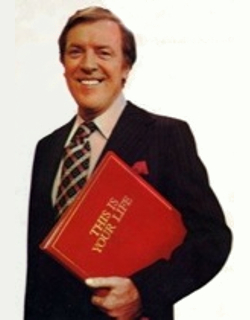
Andrews is probably best known as the presenter of the UK version of This Is Your Life, between its inception in 1955 and his death in 1987, when he is succeeded by Michael Aspel, who had also succeeded Andrews as the host of Crackerjack! more than twenty years earlier. Andrews is the first This Is Your Life subject on British television when he is surprised by the show’s creator, Ralph Edwards. He also creates a long-running panel game called Whose Baby? that originally runs on the BBC and later on ITV. He is a regular presenter of the early Miss World pageants.

Andrews’ chairs the Radio Éireann Authority between 1960 and 1964, overseeing the introduction of state television to the Republic of Ireland and establishing the broadcaster as an independent semi-state body. About this time, he also acquires a number of business interests in Ireland, including recording studios and a dance hall. He steps down from the RTE Authority amidst a bitter political storm started by the Catholic Church hierarchy over what is seen as the controversial content of The Late Late Show. Before leaving RTÉ, he defends the show as “freedom of expression.”

After months of illness during 1987, originally caused by a virus contracted during a plane journey but which is not recognised at the time, Andrews dies from heart failure on November 5, 1987 at the Cromwell Hospital in London. A funeral service is held at St. Anne’s Church in Portmarnock, where he had his home, and his body is buried in Balgriffin Cemetery to the north of Dublin. A memorial mass is held for him in Westminster Cathedral.

Andrews had recorded his last edition of This Is Your Life six days previously on October 30, 1987. After his death, the show, and two others that had yet to be broadcast, are postponed until, with his widow’s permission, they are broadcast in January 1988.