Clancy graduates in 1904 and finds a position teaching the Irish language at Clongowes Wood College and is active in the Gaelic Athletic Association. Due to ill health he has to return to his home at Grange. In 1908 he comes to Limerick to teach Irish. In 1913 he joins the Irish Volunteers. In 1915 he marries Máire Killeen, a teacher. After the 1916 Easter Rising, he is arrested and imprisoned in Cork, but is released before he comes to trial following a hunger strike.
Clancy helps in Éamon de Valera‘s election campaign in East Clare. He nearly dies of Spanish flu during the 1918 epidemic but recovers and, in January 1921, he is elected Sinn Féin Mayor of Limerick.
On the night of March 6, 1921, three Auxiliaries come to Clancy’s house and one of them shoots him, injuring him fatally. His wife is also injured in the attack. The previous Mayor, Michael O’Callaghan, is also murdered on the same night by the same group.
Suspicion immediately falls upon members of the Black and Tans, but a British inquiry into the murder, like most such inquiries through the years, absolve Crown forces of any blame. One of Clancy’s killers is later said to be George Nathan who dies in the Spanish Civil War in July 1937.
The Irish general election is that part of the 1918 United Kingdom general election which takes place in Ireland. The election is now seen as a key moment in modern Irish history because it sees the overwhelming defeat of the moderate nationalistIrish Parliamentary Party (IPP), which had dominated the Irish political landscape since the 1880s, and a landslide victory for the radical Sinn Féin party. The party had never stood in a general election but had won six seats in by-elections in 1917–1918. Sinn Féin vows in its manifesto to establish an independent Irish Republic. In Ulster, however, the Unionist Party is the most successful party.
The election is held in the aftermath of World War I, the Easter Rising and the Conscription Crisis. It is the first general election to be held after the Representation of the People Act 1918. It is thus the first election in which women over the age of 30, and all men over the age of 21, can vote. Previously, all women and most working-class men had been excluded from voting.
In the aftermath of the elections, Sinn Féin’s elected members refuse to attend the British Parliament in Westminster. Instead, they form a parliament in Dublin, the First Dáil Éireann, which declares Irish independence as a republic. The Irish War of Independence is conducted under this revolutionary government which seeks international recognition and sets about the process of state-building.
The Representation of the People Act 1918, passed on February 6, 1918, extends the franchise in parliamentary elections, also known as the right to vote, to women aged 30 and over who reside in the constituency or occupied land or premises with a rateable value above £5, or whose husbands do.
In March 1918, the Liberal Party MP for Keighley dies, causing a by-election on April 26. There is doubt as to whether women are eligible to stand for parliament. Nina Boyle makes known her intention to stand as a candidate for the Women’s Freedom League at Keighley and, if refused, to take the matter to the courts for a definitive ruling. After some consideration, the returning officer states that he is prepared to accept her nomination, thus establishing a precedent for women candidates. However, he rules her nomination papers invalid on other grounds: one of the signatories to her nomination is not on the electoral roll and another lives outside the constituency. The Lords of Appeal in Ordinary are asked to consider the matter and conclude that the Great Reform Act 1832 had specifically banned women from standing as parliamentary candidates and the Representation of the People Act had not changed that.
Parliament hurriedly passes the Parliament (Qualification of Women) Act in time to enable women to stand in the general election of December 1918. The act consists of only 27 operative words: “A woman shall not be disqualified by sex or marriage for being elected to or sitting or voting as a Member of the Commons House of Parliament.”
The first woman to take her seat in the House of Commons is Nancy Astor on December 1, 1919. She is elected as a Coalition Conservative MP for Plymouth Sutton on November 28, 1919, taking the seat her husband had vacated.
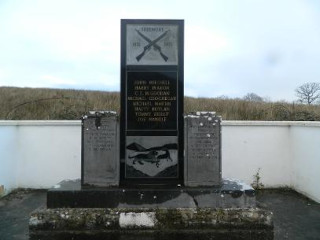
Approximately fifty men of 3rd Battalion East Limerick IRA parade at 5:00 AM on the cold bleak morning of November 8. They are armed with 21 rifles and 21 shotguns, plus a small quantity of explosives. It has been decided to ambush a convoy at Grange Bridge, a point about eight miles from Limerick and about four miles from Bruff. They set out and occupy positions around John O’Neill’s house. The ambush site is about four miles from the big British garrison at Bruff to the south. The IRA expects two British lorries around 9:00 AM, however, in the end eight lorries and two armoured cars arrive at noon.
It is a joint action involving the flying columns of both the 3rd Battalion East Limerick Brigade and the 4th Battalion Mid Limerick Brigade, supported by men from the local companies of Bruff, Grange and Holy Cross in the East Limerick Brigade and from the Fedamore and Ballybricken Companies of the Mid Limerick Brigade. Donnchadha O’Hannigan has overall command of the combined columns and most of the ambushers are placed in houses and behind walls on both sides of the road. Among the IRA men who take part in the action is their chaplain, the Curate at Fedamore, Fr. William Joseph Carroll, who had been awarded the Military Cross for bravery in 1918 by the British Army. Also among the attackers is Maurice Meade, who had been a member of Roger Casement‘s Irish Brigade in Germany.
Something makes the British suspicious and they send one lorry ahead as a decoy. It is bombed by the IRA and raked with small arms fire. At this point, a British armoured car appears, with an officer mounted on the running board firing a revolver and its machine gun firing at the IRA at close range. The IRA account names the officer on the running board as Lt. Watling and they believe that they wounded him and he died in the hospital at Bruff that night.
More British reinforcements appear and the IRA realises that they are up against a vastly larger force than they had anticipated, so they retreat. Apart from one minor wounded man, they have no casualties.
The Royal Fusiliers‘ account says while escorting a Royal Air Force convoy from Fermoy to Oranmore, Lieutenant Allan and thirty other ranks are ambushed at Grange, near Bruff. The rebels, however, are speedily dealt with, and a quantity of arms, ammunition and two prisoners are taken. Unfortunately, Flying Officer Watling and Bandsman Bailey are wounded, the latter seriously. The only other casualty is Private French, who is shot at when a sentry at Galbally, and has the back luck of losing his arm.
Although he is a fierce advocate of his homeland, Cruise O’Brien is a strong critic of Irish Republican Army violence and of what he considers the romanticized desire for reunification with Northern Ireland. His collection of essays Maria Cross: Imaginative Patterns in a Group of Modern Catholic Writers (1952; written under the pseudonym Donat O’Donnell) impresses UN Secretary-GeneralDag Hammarskjöld, who in 1961 appoints him UN special representative in the Congo, later the Democratic Republic of the Congo. He orders UN peacekeeping forces into the breakaway Katanga province, and the resulting scandal forces him out of office. Despite UN objections, he writes To Katanga and Back (1963) to explain his actions.
After serving as vice-chancellor of the University of Ghana (1962–65) and Albert Schweitzer Professor of Humanities at New York University (1965–69), Cruise O’Brien enters Irish politics. He holds a Labour Party seat in Dáil Éireann from 1969 to 1977 and then in the Senate from 1977 to 1979, representing Trinity College, of which he is pro-chancellor (1973–2008).
In 1979 Cruise O’Brien is named editor in chief of the British Sunday newspaper The Observer, but he leaves after three tumultuous years. He remains an active newspaper columnist, especially for the Irish Independent until 2007. His books include States of Ireland (1972) and On the Eve of the Millennium (1995), as well as perceptive studies of Charles Stewart Parnell, Edmund Burke, and Thomas Jefferson.
Conor Cruise O’Brien dies at the age of 91 on December 18, 2008, in Howth, Dublin.
Molyneaux is educated at nearby Aldergrove School. Although he is raised an Anglican, as a child he briefly attends a local Catholic primary school. He leaves school at age 15 and works on his father’s poultry farm. When a Catholic church near his home is burned down by Ulster loyalist arsonists in the late 1990s, he helps to raise funds for its rebuilding.
After demobilization Molyneaux establishes a printing business with his uncle, and in 1946 he joins the UUP. He is first elected to local government in 1964 and enters Parliament six years later. He staunchly opposes all power-sharing deals, notably the Anglo-Irish Agreement (1985) between British Prime MinisterMargaret Thatcher and Irish TaoiseachGarret FitzGerald, which gives Dublin an official consultative role in the affairs of Northern Ireland and paves the way for devolution.
Molyneaux lacks the firebrand public image of his longtime rival Ian Paisley, who in 1971 breaks with the UUP to form the Democratic Unionist Party (DUP). He never acquiesces to the Good Friday Agreement, which calls for the devolution of Northern Ireland’s government from London to Belfast, however, unlike Paisley and David Trimble, who in 1997 succeeds Molyneaux as the UUP leader and in April 1998 signs the devolution accord.
On retiring as UUP leader, Molyneaux is knighted as a Knight Commander of the Order of the British Empire (KBE) in 1996. The following year, after standing down as an MP at the 1997 general election, he is created a life peer on June 10, 1997, as Baron Molyneaux of Killead, of Killead in the County of Antrim.
Holland, the second of four siblings, all boys, is born on February 24, 1841 in a coastguard cottage in Liscannor, County Clare, where his father, John Philip Holland, Sr., is a member of the British Coastguard Service. His mother, a native Irish speaker from Liscannor, Máire Ní Scannláin, is John Holland’s second wife. His first wife, Anne Foley Holland, believed to be a native of Kilkee, dies in 1835. The area is heavily Irish-speaking and Holland learns English properly only when he attends the local English-speaking St. Macreehy’s National School, and from 1858, in the Christian Brothers in Ennistymon.
Holland joins the Irish Christian Brothers in Limerick and teaches in CBS Sexton Street in Limerick and many other centres in the country, including North Monastery CBS in Cork, St. Joseph’s CBS in Drogheda, and as the first Mathematics teacher in Coláiste Rís in Dundalk. Due to ill health, he leaves the Christian Brothers in 1873 and emigrates to the United States. Initially working for an engineering firm, he returns to teaching again for an additional six years in St. John’s Catholic school in Paterson, New Jersey.
While a teacher in Cork, Holland reads an account of the battle between the ironclads USS Monitor and USS Merrimack in the Battle of Hampton Roads during the American Civil War. He realizes that the best way to attack such ships would be through an attack beneath the waterline. He draws a design, but when he attempts to obtain funding, he is turned away. After his arrival in the United States, Holland slips and falls on an icy Boston street and breaks a leg. While recuperating from the injury in a hospital, he uses his time to refine his submarine designs and is encouraged by a priest, Isaac Whelan.
In 1875, his first submarine designs are submitted for consideration by the U.S. Navy, but are turned down as unworkable. The Fenians, however, continue to fund Holland’s research and development expenses at a level that allows him to resign from his teaching post. In 1881, Fenian Ram is launched, but soon after, Holland and the Fenians part company on bad terms over the issue of payment within the Fenian organization, and between the Fenians and Holland. The submarine is now preserved at Paterson Museum in New Jersey.
Holland continues to improve his designs and works on several experimental boats, prior to his successful efforts with a privately built type, launched on May 17, 1897. This is the first submarine having power to run submerged for any considerable distance, and the first to combine electric motors for submerged travel and gasoline engines for use on the surface. The submarine is purchased by the U.S. Navy on April 11, 1900, after rigorous tests and is commissioned on October 12, 1900 as USS Holland (SS-1). Six more of her type are ordered and built at the Crescent Shipyard in Elizabeth, New Jersey. The company that emerges from under these developments is called The Electric Boat Company, founded on February 7, 1899. Isaac Leopold Rice becomes the company’s first President with Elihu B. Frost acting as vice president and chief financial officer. The company eventually evolves into the major defense contractor General Dynamics.
The USS Holland design is also adopted by others, including the Royal Navy in developing the Holland-class submarine. The Imperial Japanese Navy employs a modified version of the basic design for their first five submarines, although these submarines are at least 10 feet longer at about 63 feet. These submarines are also developed at the Fore River Ship and Engine Company in Quincy, Massachusetts. Holland also designs the Holland II and Holland III prototypes. The Royal Navy ‘Holland 1’ is on display at the Submarine Museum in Gosport, England.
O’Neil of the Glen, the first production released by the Film Company of Ireland (FCOI), premieres at Dublin’s Bohemian Picture Theatre on August 7, 1916. The film is adapted by W.J. Lysaght from a book by the acclaimed Irish novelist, Mrs. M. T. Pender. The film is a romantic tale which features two well-known Abbey Theatre members, as well as a host of rising stars.
Formed in March 1916 by James Mark Sullivan and Henry Fitzgibbon, the FCOI becomes the most important indigenous fiction film producer of the 1910s.
On 29 June, FCOI announces a “trial exhibition,” or what would now be called a test screening, of their first completed production, O’Neil of the Glen, at Dublin’s Carlton Cinema. Addressing a lunch for the press at the Gresham Hotel following the screening, Fitzgibbon claims that FCOI “had started an industry which would eventually be a source of great revenue in Ireland.” For his part, Sullivan argues that the film showed that Irish productions – taking advantage of Irish “imagination, ideals, and artistic temperament and beautiful scenery” – could compete with those anywhere.
The Bohemian is one of Dublin’s biggest and most luxurious cinemas, and Frederick A. Sparling’s commitment to a run that is twice the usual three days “speaks well for the film and the undoubted drawing powers such a production will have for Irish audiences.” In the event, Sparling also includes an unplanned Sunday show to take advantage of the phenomenal level of interest.
In the following weeks and months, O’Neil of the Glen is exhibited around the country. Following substantial runs in Dublin and Belfast it is announced for a three-day runs at Galway’s Victoria Cinema Theatre on September 11-13 and Cork’s Coliseum Theatre on September 14-16.
Marie Kean, actress of stage and screen whose career spanned over 40 years, is born in the village of Rush, County Dublin on June 27, 1918. The Stage calls her one of Ireland’s most impressive actresses, and “an artist of considerable emotional depth and theatrical command.”
Kean grows up in Rush and is educated at Loreto College, North Great George’s Street, Dublin. She learns her craft at the Gaiety School of Acting and is part of the Abbey Theatre company until 1961.
Kean’s leading role as the kindly matriarch, Mrs. Kennedy, in the RTÉ Radio serial drama, The Kennedys of Castleross, makes her famous throughout Ireland. She stars in the programme for the duration of its 18-year run.
In 1968, Kean wins a Jacob’s Award for her performance as Winnie in RTÉ television’s production of Samuel Beckett‘s play Happy Days, a role she had previously performed on stage and which she describes later as her favourite part. Among her other television roles is that of Mrs. Conn Brickley, Bridget’s mother, in an episode of The Irish R.M. called “The Boat’s Share.”
Kean’s many stage appearances include performances in the plays of John Millington Synge, Seán O’Casey and Brian Friel. She takes the lead role of Maggie Polpin in the 1969 world première of John B. Keane‘s play Big Maggie at the Cork Opera House. In 1978 she wins the State of New York best actress award for her performance in what has become Keane’s most successful play.
Arguably her most memorable film role is as Barry’s scheming mother in Stanley Kubrick‘s Barry Lyndon. She also plays a bigoted Irish shopkeeper in David Lean‘s Ryan’s Daughter. Her final movie appearance is in John Huston‘s The Dead (1987), in which she plays the part of Mrs. Malins.
Marie Kean dies in Donnybrook, Dublin at the age of 75 on December 30, 1993. Her husband, William Mulvey, predeceases her in 1977.
When World War I breaks out in 1914 Lea-Wilson joins the British army where he reaches the rank of captain in the 18th Royal Irish Regiment. An injury during the war forces him back to Ireland where he is stationed in Dublin, just in time for the Easter Rising in 1916.
When the weeklong rising ends, the rebels who had fought in the Four Courts and the GPO are marched to the Rotunda Hospital where they are kept overnight under the glare of British troops. Among those detained are leaders of the rebellion such as Sean Mac Diarmada and Tom Clarke. Clarke is singled out and subjected to public humiliation by 28-year-old British army Captain Percival Lea-Wilson.
Lea-Wilson and his soldiers walk among the captured rebels, and he picks the 58-year-old Clarke out of the group. He marches Clarke to the steps of the hospital where he orders soldiers to strip him bare as nurses look on in horror from the windows above. Clarke is beaten and left there overnight in his tattered clothes. One of the prisoners, Michael Collins, who witnesses Clarke’s mistreatment at the hands of the British captain vows vengeance.
In the years following the Easter Rising, Lea-Wilson settles in Wexford where he attains the role of RIC district inspector.
On the morning of June 15, 1920, Lea-Wilson is walking back home after paying a visit to the RIC barracks in Gorey. Dressed in his civilian clothes, he stops at the local railway station where he purchases a newspaper and meets Constable Alexander O’Donnell, who accompanies him on part of his walk home.
O’Donnell and Lea-Wilson part company at the railway bridge on Ballycanew Road while further up that very same stretch of road there is a number of men standing around a parked car with its hood raised. Michael Collins had sent Liam Tobin and Frank Thornton from Dublin to meet with Joe McMahon, Michael McGrath and Michael Sinnott in Enniscorthy. They were then driven by Jack Whelan to Ballycanew Road to carry out the assassination of Lea-Wilson.
Unaware of his assassins lying in wait, Lea-Wilson is reading his paper while strolling along the road. The men by the parked car pull out revolvers when their target comes into range and two bullets strike him down. He manages to quickly get back on his feet and attempts to make an escape, but his six assassins run after him and finally bring him down in a hail of bullets. A coroner’s report later states that Lea-Wilson had been shot seven times.
When the shooting ends, one of Lea-Wilson’s executioners calmly walks up to the body to make sure he is dead. He then picks up the newspaper from the ground and takes it with him. Later that evening Michael Collins is in the Wicklow Hotel in Dublin when word reaches him from Wexford of the shooting death of Lea-Wilson. Collins greets the news with glee and mentions to one of his comrades, “Well we finally got him!”
Percival Lea-Wilson is buried in Putney Vale Cemetery in southwest London. His grave is marked by a plaque which mentions his assassination in Gorey in 1920, a death which has its roots in the Easter Rising four years previously.