seamus dubhghaill

Promoting Irish Culture and History from Little Rock, Arkansas, USA


1 Comment

Death of Harpist & Composer Turlough O’Carolan

turlough-ocarolan

Turlough O’Carolan, a blind early Irish harper, composer and singer whose great fame is due to his gift for melodic composition, dies in Ballyfarnon, County Roscommon on March 25, 1738.

Although not a composer in the classical sense, O’Carolan is considered by many to be Ireland’s first great composer. Harpers in the old Irish tradition are still living as late as 1792, and ten, including Arthur O’Neill, Patrick Quin and Donnchadh Ó hAmhsaigh, attend the Belfast Harp Festival. Ó hAmhsaigh plays some of O’Carolan’s music but dislikes it for being too modern. Some of O’Carolan’s own compositions show influences of the style of continental classical music, whereas others such as O’Carolan’s Farewell to Music reflect a much older style of “Gaelic Harping.”

O’Carolan is born in 1670 in Nobber, County Meath, where his father is a blacksmith. The family moves from Meath to Ballyfarnon in 1684. In Roscommon, his father takes a job with the MacDermott Roe family of Alderford House. Mrs. MacDermott Roe gives Turlough an education, and he shows talent in poetry. After being blinded by smallpox at the age of eighteen O’Carolan is apprenticed by Mrs. MacDermott Roe to a good harper. At the age of twenty-one, being given a horse and a guide, he sets out to travel Ireland and compose songs for patrons.

For almost fifty years, O’Carolan journeys from one end of Ireland to the other, composing and performing his tunes. One of his earliest compositions is about Brigid Cruise, with whom he is infatuated. Brigid is the teenage daughter of the schoolmaster at the school for the blind attended by O’Carolan in Cruisetown. In 1720, at age 50, O’Carolan marries Mary Maguire. Their first family home is a cottage on a parcel of land near the town of Manachain, now Mohill, in County Leitrim, where they settle. They have seven children, six daughters and one son. Mary dies in 1733.

Turlough O’Carolan dies at Alderford House on March 25, 1738. He is buried in the MacDermott Roe family crypt in Kilronan Burial Ground near Ballyfarnon, County Roscommon. The annual O’Carolan Harp Festival and Summer School commemorates his life and work in Keadue, County Roscommon.

A bronze monument by sculptor Oisín Kelly depicting Turlough O’Carolan playing his harp is erected on a plinth at the Market Square, Mohill, on August 10, 1986, and is unveiled by Patrick Hillery, President of Ireland.

A statue is erected to him at his place of birth in 2002, during the Annual O’Carolan Harp Festival, the first of which is held in Nobber in 1988.


Leave a comment

Birth of Boxer Jack McAuliffe

jack-mcauliffe

Jack McAuliffe, Irish American boxer who fights mostly out of Williamsburg, Brooklyn, is born in Cork, County Cork, on March 24, 1866. Nicknamed “The Napoleon of the Ring,” he is one of only fifteen world boxing champions to retire without a loss. He is the World Lightweight champion from 1886 to 1893. He is posthumously inducted into The Ring magazine Hall of Fame in 1954 and the International Boxing Hall of Fame in 1995.

McAuliffe’s parents are Cornelius McAuliffe and Jane Bailey, who are living at 5 Christ Church Lane, Cork, at the time of Jack’s birth. He emigrates to the United States in 1871, where he spends his early years in Bangor, Maine.

McAuliffe makes his first appearance as an amateur boxer in 1883. He turns professional soon after, fighting Jem Carney 78 rounds to a draw at Revere Beach, Massachusetts. He fights Billy Dacey for the lightweight championship and a $5,000 purse in 1888, knocking him out in eleven rounds. He is known as a strong two-handed fighter with “cat-like” reflexes.

McAuliffe is married twice, both times to stage actresses. His first wife is Katie Hart, who plays in farce comedies. After her death, he marries Catherine Rowe in 1894, whose stage name is Pearl Inman, of the song and dance team The Inman Sisters. Between marriages he dates a third actress, Sadie McDonald. McAuliffe and Rowe move back to Bangor, Maine, in 1894, where he undertakes preliminary training for a fight later that year at the Seaside Athletic Club on Coney Island.

McAuliffe retires in 1897. According to the International Boxing Hall of Fame, he has 36 professional fights. He finishes his career with 30 victories with 22 by knockout, five draws and one no decision.

Jack McAuliffe dies on November 5, 1937, at his home on Austin Street in Forest Hills, Queens.


Leave a comment

Birth of Production Designer Cedric Gibbons

cedric-gibbons

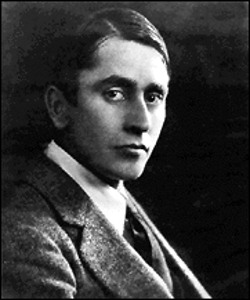
Austin Cedric Gibbons, Irish American art director and production designer for the film industry, is born in Dublin on March 23, 1893. He also makes a significant contribution to motion picture theater architecture from the 1930s to 1950s.

Gibbons was born to architect Austin P. Gibbons and Veronica Fitzpatrick Simmons. He is privately tutored and studies at the Art Students League of New York. In 1911 he begins working in his father’s office as a junior draftsman. From 1915 he serves as art director at Edison Studios in New Jersey and then serves in the United States Navy during World War I. He then joins Goldwyn Studios and begins a long career with Metro-Goldwyn-Mayer in 1924, the year the studio is founded.

Gibbons is one of the original 36 founding members of the Academy of Motion Picture Arts and Sciences and oversees the design of the Academy Awards statuette in 1928, a trophy for which he himself would be nominated 38 times for Best Production Design, winning eleven.

In 1930, Gibbons marries actress Dolores del Río and co-designs their house in Santa Monica, an intricate Art Deco residence influenced by Rudolf Schindler. They divorce in 1941. Three years later he marries actress Hazel Brooks, with whom he remains until his death.

Gibbons’s set designs, particularly those in such films as Born to Dance (1936) and Rosalie (1937), heavily inspire motion picture theater architecture in the late 1930s through 1950s. The style is found very clearly in the theaters that are managed by the Skouras brothers, whose designer Carl G. Moeller uses the sweeping scroll-like details in his creations. Among the more classic examples are the Loma Theater in San Diego, The Crest in Long Beach and Fresno, and the Culver Theater in Culver City. The style is sometimes referred to as Art Deco and Art Moderne.

Gibbons retires in 1956 with about 1,500 films credited to him, however, his contract with MGM dictates that he receives credit as art director for every MGM film released in the United States, even though other designers might do the bulk of the work. Even so, his actual hands-on art direction is believed to be about 150 films.

Gibbons’ second cousin, Frederick Gibbons, a musician, orchestra conductor, and entertainer who works with him at MGM, is the father of Billy Gibbons of the rock band ZZ Top.

Cedric Gibbons dies in Los Angeles on July 26, 1960, at the age of 67. He is buried in the Calvary Cemetery, East Los Angeles.


3 Comments

Birth of Melesina Trench, Writer, Poet & Diarist

melesina-trench

Melesina Trench (née Chenevix), Irish writer, poet and diarist, is born in Dublin on March 22, 1768. During her lifetime she is known more for her beauty than her writing. It is not until her son, Richard Chenevix Trench, publishes her diaries posthumously in 1861 that her work receives notice.

Melesina Chenevix is born to Philip Chenevix and Mary Elizabeth Gervais. She is orphaned before her fourth birthday and is brought up by her paternal grandfather, Richard Chenevix (1698–1779), the Anglican Bishop of Waterford and Lismore. The family is of Huguenot extraction.

After the death of Richard Chenevix she goes to live with her other grandfather, the Archdeacon Gervais. On October 31, 1786, she marries Colonel Richard St. George, who dies only four years later in Portugal, leaving one son, Charles Manners St. George, who becomes a diplomat.

Between 1799 and 1800, Melesina travels around Europe, especially Germany. It is during these travels that she meets Lord Horatio Nelson, Lady Hamilton and the cream of European society, including Antoine de Rivarol, Lucien Bonaparte, and John Quincy Adams while living in Germany. She later recounts anecdotes of these meetings in her memoirs.

On March 3, 1803, in Paris she marries her second husband, Richard Trench, who is the sixth son of Frederick Trench and brother of Frederick Trench, 1st Baron Ashtown.

After the breakdown of the Peace of Amiens, Richard Trench is detained in France by Napoleon‘s armies, and in August 1805 Melesina takes it upon herself to petition Napoleon in person and pleads for her husband’s release. Her husband is released in 1807, and the couple settles at Elm Lodge in Bursledon, Hampshire, England.

Their son, Francis Chenevix Trench, is born in 1805. In 1807, when they are on holiday in Dublin, their son Richard Chenevix Trench is born. He goes on to be the Archbishop of Dublin, renowned poet and contemporary of Alfred, Lord Tennyson. Her only daughter dies a few years later at the age of four.

Trench corresponds with, amongst others, Mary Leadbeater, with whom she works to improve the lot of the peasantry at her estate at Ballybarney. She dies at the age of 59 in Malvern, Worcestershire on May 27, 1827.

Melesina Trench’s diaries and letters are compiled posthumously by Richard Chenevix Trench as The remains of the late Mrs. Richard Trench in 1861 with an engraving of her taken from a painting by George Romney. Another oil painting, The Evening Star by Sir Thomas Lawrence, has her as a subject, and she is reproduced in portrait miniatures – one in Paris by Jean-Baptiste Isabey and another by Hamilton that is copied by the engraver Francis Engleheart.

Copies of a number of her works are held at Chawton House Library.

(Pictured: “Melesina Chenevix, Mrs. George, later Mrs. Trench,” attributed to George Romney (British, 1734–1802), oil on canvas)


Leave a comment

The Headford Ambush

headford-ambush

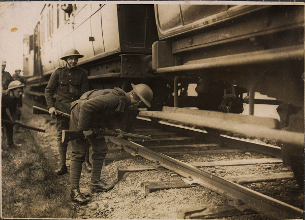
The Headford Ambush is carried out by the Irish Republican Army (IRA) on March 21, 1921, during the Irish War of Independence. The battle lasts almost an hour and fourteen people are killed – nine British soldiers, two IRA volunteers and three civilians.

The guerrilla war in County Kerry escalates rapidly in the spring of 1921. The county is occupied by the British Army, Auxiliary Division and Black and Tans paramilitary police, as well as the Royal Irish Constabulary (RIC). For the previous several months they have been burning suspected Republicans’ property and shooting suspected IRA sympathisers. By early 1921, they have begun rounding up male inhabitants of nearby towns and villages and searching for IRA suspects.

On January 23, in response to the IRA’s assassination of RIC District Inspector Sullivan, 1,000 soldiers and armed police surround Ballymacelligott, arrest 240 men and march them to Tralee for questioning. British forces, especially the Auxiliaries, also carry out a number of reprisal shootings of local civilians. The IRA sets up full-time guerrilla units, known as flying columns, to avoid arrest and to assemble units capable of taking on British patrols. IRA GHQ in Dublin also sends an organizer, Andy Cooney, to Kerry to oversee the setting up of flying columns. On March 2, under Cooney’s direction, the 2nd Kerry Brigade sets up its own flying column under Dan Allman and Tom McEllistrim. On March 5, McEllistrim leads 20 volunteers from the column to a successful ambush at Clonbanin, in which they co-operate with Cork IRA units, killing four British soldiers including Brigadier General Hanway Robert Cumming. Buoyed by their success in Cork, the 2nd Kerry Brigade tries on a number of occasions to ambush British forces in Kerry itself.

On March 21, an IRA party of the 2nd Kerry Brigade is billeted about four miles from the Headford railway junction when they hear that British troops are returning by train from Kenmare to Tralee. As the train does not go directly to Tralee, the British have to change trains at Headford, making them vulnerable to ambush. Allman, commanding 30 volunteers, reaches the junction only 12 minutes before the train, which is carrying 30 soldiers of the 1st Royal Fusiliers. The railway staff just has time to flee before the train pulls into the platform, where its passengers have to change trains for Tralee. Alongside the soldiers, the train is packed with cattle and pig farmers on their way back from the market in Kenmare. Most of the civilians have already got off when the British soldiers begin to disembark. Allman himself tries to disarm a Fusilier but shoots him when he resists. This is the signal for the IRA to open fire on the British troops.

One of the first British casualties is Lieutenant CE Adams DCM, who is shot dead when he appears at the carriage door, as are several other soldiers who are standing in front of the engine. The surviving British troops open fire from the train while those who have got off scramble underneath it for cover. In the ensuing close-quarter firefight, conducted at a range of just 20 yards, three civilians and two IRA volunteers, including Allman, are killed. Two-thirds of the British force is estimated to have been killed or wounded. Most of those killed are hit in the initial firing. Afterwards, the IRA gunmen have no direct field of fire into the troops who are hidden under the train.

MacEllistrim calls on the survivors to surrender and when they refuse, the IRA begins to move in to finish off those who keep shooting by throwing hand grenades under the train. Just as they are doing so, another train pulls into the junction carrying another party of British troops. The IRA column has used most of its ammunition and is forced to retreat, escaping toward the hills in the south.

(Pictured: British soldiers searching a train in County Kerry, 1921)


Leave a comment

The Assassination of Tomás Mac Curtain

Tomas-mac-curtain

Tomás Mac Curtain, Sinn Féin Lord Mayor of Cork, is assassinated in Cork, County Cork on March 20, 1920, which is also his 36th birthday.

Thomas Curtin is born at Ballyknockane, Mourne Abbey, County Cork, on March 20, 1884, the son of Patrick Curtin, a farmer, and Julia Sheehan. He attends Burnfort National School. In 1897 the family moves to Cork City, where he attends the North Monastery school.

Mac Curtain, as he later becomes known, is active in a number of cultural and political movements beginning around the turn of the 20th century. He joins the Blackpool, Cork branch of Conradh na Gaeilge, becoming its secretary in 1902. He has interests in music, poetry, history, archaeology and Irish history. He works in his early career as a clerk, and in his free time teaches Irish. In 1911 he joins Fianna Éireann and is a member of the Irish Volunteers.

He meets Elizabeth Walsh (Eibhlís Breathnach) at a Gaelic League meeting, and they marry on June 28, 1908. They have six children, five of whom survive into adulthood. The family lives over 40 Thomas Davis Street, where Mac Curtain runs a small clothing and rainwear factory.

In April 1916, at the outset of the Easter Rising, Mac Curtain commands a force of up to 1,000 men of the Irish Volunteers who assemble at various locations around County Cork. From the volunteer’s headquarters at Sheares Street in the city, Mac Curtain and his officers await orders from the volunteer leadership in Dublin, but conflicting instructions and confusion prevail and as a result the Cork volunteers never enter the fray. A tense stand-off develops when British forces surround the volunteer hall and continued for a week until a negotiated agreement leads to the surrender of the volunteers’ arms to the then Lord Mayor of Cork Thomas Butterfield on the understanding that they will be returned at a later date. This does not happen however, and Mac Curtain is jailed in Wakefield Prison, in the Frongoch internment camp in Wales, and in Reading Gaol. After the general amnesty of participants in the Rising 18 months later, Mac Curtain returns to active duty as a Commandant of what is now the Irish Republican Army.

By 1918 Mac Curtain is a brigade commander, the highest and most important rank in the IRA. During the Conscription Crisis of 1918, he actively encourages the hiring of the women of Cumann na mBan to cater for Volunteers. He is personally involved with Michael CollinsSquad that, along with a Cork battalion, attempt to assassinate Lord John French, whose car is missed as the convoy passes through the ambush positions. Despite the setback he remains brigadier of No.1 Cork when he is elected Lord Mayor. He is elected in the January 1920 council elections as the Sinn Féin councillor for NW Ward No. 3 of Cork and is chosen by his fellow councillors to be the Lord Mayor. He begins a process of political reform within the city.

In January 1919, the Irish War of Independence starts, and Mac Curtain becomes an officer in the IRA. On March 20, 1920, his 36th birthday, Mac Curtain is shot dead in front of his wife and son by a group of men with blackened faces, who are found to be members of the Auxilaries along with unknown members of the Royal Irish Constabulary (RIC) by the official inquest into the event. In the wake of the killing, which is in revenge for the shooting of a policeman, Mac Curtain’s house in Blackpool is ransacked.

The killing causes widespread public outrage. The coroner’s inquest passes a verdict of willful murder against British Prime Minister David Lloyd George and against certain members of the RIC. Michael Collins later orders his squad of assassins to uncover and assassinate the police officers involved in the attack. RIC District Inspector Oswald Swanzy, who had ordered the attack, is fatally shot, with Mac Curtain’s own revolver, while leaving a Protestant church in Lisburn, County Antrim on August 22, 1920, sparking what is described by Tim Pat Coogan as a “pogrom” against the Catholic residents of the town.

Tomás Mac Curtain is buried in St. Finbarr’s Cemetery, Cork.


Leave a comment

The Crossbarry Ambush

SAMSUNG DIGITAL CAMERA

During the Irish War of Independence, Tom Barry and the West Cork Flying Column of the Irish Republican Army (IRA) rout a superior force from the Essex Regiment of the British Army at Crossbarry, County Cork on March 19, 1921.

A force of one hundred IRA members under the leadership of Barry are involved in a major skirmish with up to 1,000 British troops at Crossbarry. English intelligence has determined that Barry’s West Cork Brigade is based near Crossbarry and plans a major encirclement and assault. Poor planning and timing ensures that the British forces get separated before attacking Barry’s men. Barry is a brilliant guerrilla fighter and strategist who directs an attack against an initial force of approximately 140 men, before he orders his men to break out.

Charlie Hurley, one of the Brigade commanders who is injured during the Upton train ambush, is staying in a house with a pro-republican family, where he is recuperating from serious wounds he had received at Upton a month earlier. When he realises that he is surrounded by the British forces, he flees the house, as Tom Barry comments in his book, to reduce the danger to those in the house. He is shot dead by the pursuing troops. Barry remarks that Hurley “went to meet his death like a true Irishman.” A ballad exists that commemorates him. In addition, the Gaelic Athletic Association (GAA) grounds in Bandon, County Cork are named after him.

Reports as to casualties differ. The IRA claims that over thirty British are killed while official British figures are ten killed and six IRA men killed. Whatever the numbers, it is probably the largest single military engagement in the Irish War of Independence as the IRA knew major battles with British troops would be a disaster for them and rarely got involved in full frontal action. While the casualties may not seem that large, Crossbarry is a major morale victory for the IRA who had “defeated” a British force of over one thousand. Prime Minister David Lloyd George states that the Crossbarry and Kilmichael ambushes convinced him of the need for a truce and a treaty with the Irish rebels.

(Pictured: Crossbarry Ambush Memorial, Crossbarry, County Cork)


Leave a comment

The Funeral of Hugh Coveney

hugh-coveney

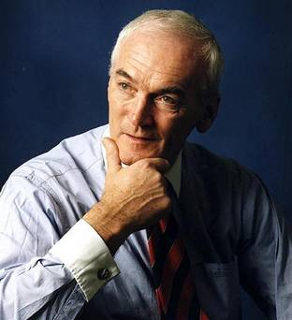
The funeral of Hugh Coveney, politician and former Lord Mayor of Cork, takes place at St. Michael’s Church in Blackrock, Cork on March 18, 1998.

Coveney is born into one of Cork‘s prosperous “merchant prince” families on July 20, 1935. He is educated at Christian Brothers College, Cork, Clongowes Wood College and the Royal Institute of Chartered Surveyors. He works as a chartered quantity surveyor before entering politics.

Coveney is interested in yachting throughout most of his adult life. His yacht Golden Apple of The Sun, designed by Cork-based designer Ron Holland, is a successful competitor in the Admiral’s Cup in the 1970s. A later 50-foot yacht, Golden Apple, is used by the family for the “Sail Chernobyl” project. The family sails around the world to raise €650,000 for Chernobyl Children’s Project International, a charity which offers assistance to children affected by the 1986 Chernobyl disaster.

Coveney is Lord Mayor of Cork from 1982 to 1983. He is first elected to Dáil Éireann as a Fine Gael Teachta Dála (TD) for Cork South–Central constituency at the 1981 general election. He loses his seat in the first general election of 1982 but regains it in the second election in the same year. He loses his seat again in the 1987 general election and does not contest the 1992 general election. He is elected to the Dáil again in 1994 in a by-election.

Coveney is first appointed to the Cabinet in 1994 under John Bruton. He is appointed Minister for Defence and Minister for the Marine. However, he is demoted to a junior ministry the following year after allegations of improper contact with businessmen.

In March 1998 it becomes publicly known that the Moriarty Tribunal has questioned Coveney about whether he had a secret offshore account with Ansbacher Bank, a bank which had become notorious for facilitating tax evasion. Ten days later, on March 13, 1998, Coveney visits his solicitor to change his will. The following day, he dies in a fall from a seaside cliff while out walking alone. His son, Simon Coveney, insists that his father had never held an Ansbacher account. It later emerges that Hugh Coveney had $175,000 on deposit in the secret Cayman Islands-based bank. The account was closed in 1979.

Simon Coveney is later elected to succeed his father in the resulting by-election on November 3, 1998.


Leave a comment

Birth of Artist & Illustrator Harry Clarke

harry-clarke

Henry Patrick (Harry) Clarke, Irish stained-glass artist and book illustrator, is born in Dublin on March 17, 1889. He is a leading figure in the Irish Arts and Crafts movement.

Clarke is the younger son and third child of Joshua Clarke and Brigid Clarke (née MacGonigal). Church decorator Joshua Clarke moves to Dublin from Leeds in 1877 and starts a decorating business, Joshua Clarke & Sons, which later incorporates a stained-glass division. Through his work with his father, Clarke is exposed to many schools of art but Art Nouveau in particular.

Clarke is educated at the Model School in Marlborough Street, Dublin and Belvedere College, which he leaves in 1905. After his mother’s death in 1903, he is apprenticed into his father’s studio and attends evening classes in the Metropolitan College of Art and Design. His The Consecration of St. Mel, Bishop of Longford, by St. Patrick wins the gold medal for stained glass work in the 1910 Board of Education National Competition. At the art school in Dublin, he meets fellow artist and teacher Margaret Crilley. They marry on October 31, 1914.

Clarke moves to London to seek work as a book illustrator. Picked up by London publisher George G. Harrap and Co., he starts with two commissions which are never completed. Difficulties with these projects makes Fairy Tales by Hans Christian Andersen his first printed work, in 1916. It includes 16 colour plates and more than 24 halftone illustrations. This is followed by illustrations for an edition of Edgar Allan Poe‘s Tales of Mystery and Imagination, the second version of which, published in 1923, makes his reputation as a book illustrator. His work can be compared to that of Aubrey Beardsley, Kay Nielsen, and Edmund Dulac. His final book, Selected Poems of Algernon Charles Swinburne, is published in 1928.

Clarke also continues to work in stained-glass, producing more than 130 windows. His glass is distinguished by the finesse of its drawing and his use of rich colours. He is especially fond of deep blues. His use of heavy lines in his black-and-white book illustrations echoes his glass techniques.

Clarke’s stained-glass work includes many religious windows, including the windows of the Honan Chapel in University College Cork. He also produces much secular stained glass such as a window illustrating John KeatsThe Eve of St. Agnes (now in the Hugh Lane Gallery in Dublin) and the Geneva Window, (now in the Wolfsonian Museum, Miami Beach, Florida). Perhaps his most seen works are the windows he creates for Bewley’s on Dublin’s Grafton Street.

Clarke is plagued with ill health, in particular respiratory problems. He is diagnosed with tuberculosis in 1929 and goes to a sanatorium in Davos, Switzerland. Fearing that he will die abroad, he begins his journey back to Dublin in 1931, but dies on this journey on January 6, 1931, in Chur where he is buried. A headstone is erected but local law requires that the family pledge to maintain the grave 15 years after the death. This is not explained to the Clarke family and Harry Clarke’s remains are disinterred in 1946 and reburied in a communal grave.


Leave a comment

Birth of William Reeves, Bishop of Down, Connor & Dromore

bishop-william-reeves

William Reeves, Irish antiquarian and the Church of Ireland Bishop of Down, Connor and Dromore from 1886 until his death, is born on March 16, 1815. He is the last private keeper of the Book of Armagh and at the time of his death is President of the Royal Irish Academy.

Reeves is born at Charleville, County Cork, the eldest child of Boles D’Arcy Reeves, an attorney, whose wife Mary is a daughter of Captain Jonathan Bruce Roberts, land agent to the Edmund Boyle, 8th Earl of Cork. This grandfather had fought at the Battle of Bunker’s Hill, and Reeves is born at his house in Charleville.

From 1823, Reeves is educated at the school of John Browne in Leeson Street, Dublin, and after that at a school kept by the Rev. Edward Geoghegan. In October 1830, he enters Trinity College, Dublin, where he quickly gains a prize for Hebrew. In his third year, he becomes a scholar and goes on to graduate BA in 1835. He proceeds to read medicine, wins the Berkeley Medal, and graduates MB in 1837. His object in taking his second degree is that he intends to become a clergyman and to practice the medical profession among the poor of his parish.

In 1838, Reeves is appointed Master of the diocesan school in Ballymena, County Antrim, and is ordained a deacon of Hillsborough, County Down. The following year, he is ordained a priest of the Church of Ireland at Derry.

In 1844, Reeves rediscovers the lost site of Nendrum Monastery when he visits Mahee Island in Strangford Lough, County Down, searching for churches recorded in 1306, and recognises the remains of a round tower. By 1845, he is corresponding with the Irish scholar John O’Donovan, and an archive of their letters between 1845 and 1860 is preserved at University College, Dublin. In July 1845, Reeves visits London.

Reeves resides in Ballymena from 1841 to 1858, when he is appointed vicar of Lusk following the success of his edition of Adomnán‘s Life of Saint Columba (1857), for which the Royal Irish Academy awards him their Cunningham Medal in 1858. In 1853, he purchases from the Brownlow family the important 9th-century manuscript known as the Book of Armagh, paying three hundred pounds for it. He sells the book for the same sum to Archbishop Beresford, who has agreed to present it to Trinity College, Dublin.

In 1875 Reeves is appointed Dean of Armagh, a position he holds until 1886 when he is appointed as Bishop of Down, Connor and Dromore. In 1891 he is elected as President of the Royal Irish Academy. As bishop, he resides at Conway House, Dunmurry, County Antrim, and signs his name “Wm. Down and Connor.”

William Reeves dies in Dublin on January 12, 1892, while still President of the Academy. At the time of his death, he is working on a diplomatic edition of the Book of Armagh, by then in the Trinity College Library. The work is completed by Dr. John Gwynn and published in 1913.