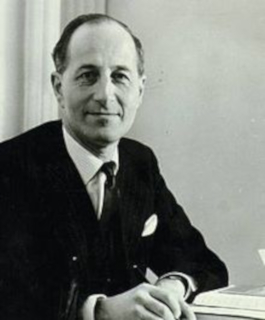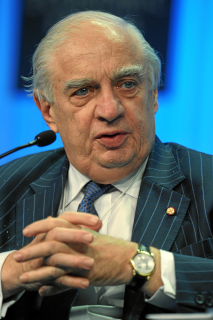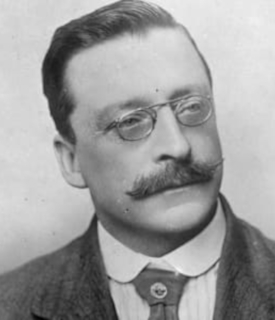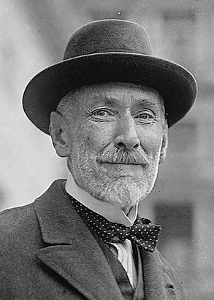
Threatened by lung trouble in 1879, Plunkett goes to the United States and spends ten years as a cattle rancher in the Bighorn Mountains of Wyoming. He returns to Ireland in 1889 and devotes himself to the agricultural cooperative movement, first organizing creameries and then, in 1894, the Irish Agricultural Organisation Society, a forerunner of similar societies in England, Wales, and Scotland. A moderate Unionist member of Parliament for South County Dublin from 1892 to 1900, he becomes vice president (1899–1907) of the new Department of Agriculture and Technical Instruction for Ireland, which he has been instrumental in creating.
Plunkett’s later experience convinces him of the need for the independence of an Ireland without partition inside the Commonwealth, and he fights strongly for this goal, as chairman of the Irish Convention (1917–18) and, in 1919, as founder of the Irish Dominion League and of the Plunkett Foundation for Cooperative Studies, an agricultural research and information centre. He is appointed to the first Senate of the Irish Free State (1922–23). His house in Dublin is bombed and burned during in the Irish Civil War and he lives in England thereafter. In 1924 the Plunkett Foundation also moves to England. In 1924 he presides over a conference in London on agricultural co-operation in the British Commonwealth and in 1925 he visits South Africa to help the movement there.
Agar is the second son of Henry Agar, a former MP for Gowran, and Anne Ellis, and is probably born at Gowran Castle in County Kilkenny. On March 20, 1760, he marries Lucia Martin, widow of Henry Boyle-Walsingham. Together they have three children: Henry-Welbore Agar-Ellis (b. January 22, 1761), John Ellis (b. December 31, 1763), and Charles-Bagnell (b. August 13, 1765).
In addition to being a Member of Parliament (MP) for Gowran, for which he sits three times, from 1753 to 1761, again from 1768 to 1769 and finally from 1776 to 1777, Agar controls three other borough seats through the strength of his family holdings. He represents Kilkenny County between 1761 and 1776 and Thomastown between 1768 and 1769. He holds the post of joint Postmaster General of Ireland with William Ponsonby, 1st Baron Ponsonby between 1784 and 1789.
James Agar dies on January 1, 1789. His eldest son, Henry-Welbore Agar-Ellis, becomes 2nd Viscount Clifden and Baron Mendip.
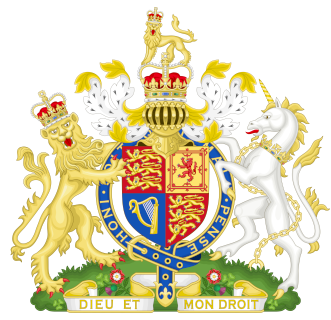
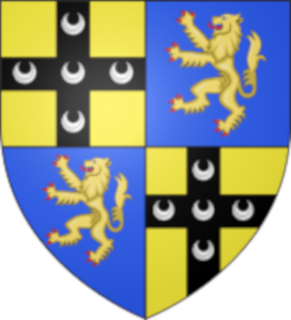
(Pictured: Arms of Agar-Ellis: 1st and 4th quarter: a cross sable charged with five crescents argent for Ellis; 2nd and 3rd quarter: azure with a lion rampant for Agar)
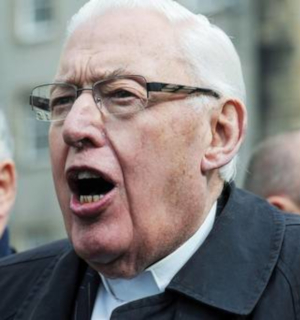
On March 23, 2011, Ian Paisley calls for a new era of sharing and reconciliation in an emotional farewell at his final sitting of the power-sharing Assembly he helped to create at Stormont. Dr. Paisley continues his political career in the House of Lords.
Protestant and Catholic leaders in Northern Ireland‘s unity government celebrate their first full four-year term in power and lauded Paisley, the unlikely peacemaker who made it possible, on his effective retirement day.
Paisley, a stern anti-Catholic evangelist who spent decades rallying pro-British Protestants against compromise, stuns the world in 2007 by agreeing to forge a coalition alongside senior Irish Republican Army (IRA) veterans. Their polar-opposite combination governs Northern Ireland with surprising harmony for the four years leading up to his retirement.
The Northern Ireland Assembly that elects the administration is dissolved on March 14, 2011, in preparation for a May 5 election in the British territory. The 84-year-old Paisley makes his last debate in an elected chamber on March 6, 2011, noting that this local government is not ending in chaos and acrimony, as 1999-2002 attempts at power-sharing repeatedly had done.
At this point, Paisley has already stepped down as a member of the British and European parliaments and as leader of the Democratic Unionists, a party of hard-line Protestant protesters that he founded in 1970 and watched grow over the previous decade into the most popular in Northern Ireland.
Those lauding him include Peter Robinson, who succeeded him in 2008 as leader of both the government and the Democratic Unionists and Sinn Féin‘s Martin McGuinness, the senior Catholic politician who spends decades as a commander of Paisley’s archenemy, the IRA.
The IRA kills nearly 1,800 people in a failed 1970-1997 effort to force Northern Ireland out of the United Kingdom. Northern Ireland remains part of the United Kingdom when the overwhelmingly Catholic rest of Ireland gains its independence in 1922. The outlawed IRA formally renounces violence and disarms in 2005, clearing the way for its allied Sinn Féin party to recognize the legal authority of Northern Ireland and its police.
Still, few observers expected Paisley to agree to a pact so quickly after the IRA-Sinn Féin peace moves or to get along so warmly with McGuinness during their year in partnership.
McGuinness, whose organization once considered Paisley a prime target for assassination, addressing his remarks to the stooped, silver-haired Paisley across the chamber, notes that Ulster wits had christened the two of them “the Chuckle Brothers.” He adds, “And I would like to think that we showed leadership. I think my relationship with him will undoubtedly go down in the history books.”
(From: “Northern Ireland power-sharing marks 1st full term,” the Associated Press and CTV News, March 23, 2011)
Grace is born on May 10, 1832, in Ireland in Riverstown near the Cove of Cork to James Grace and Eleanor May Russell (née Ellen) while the family is away from home. He is raised on Grace property at Ballylinan in Queens County, now County Laois, near the town of Athy. He is a member of a prominent and well-to-do family. In 1846, he sails for New York against the wishes of his father and works as a printer’s devil and a shoemaker’s helper before returning to Ireland in 1848.
His nephew, Cecil Grace, attempts a crossing of the English Channel in December 1910 in an airplane, flying from Dover to Calais. However, in coming back he becomes disoriented and over Dover flies northeast over the Goodwin Sands toward the North Sea and is lost.
Grace and his father travel to Callao, Peru, in 1851, seeking to establish an Irish agricultural community. While his father returns home, William remains and begins work with the firm of John Bryce and Co., as a ship chandler. In 1854, the company is renamed Bryce, Grace & Company, in 1865, to Grace Brothers & Co., and ultimately to W. R. Grace and Company.
On September 11, 1859, Grace is married to Lillius Gilchrist, the daughter of George W. Gilchrist, a prominent ship builder of Thomaston, Maine, and Mary Jane (née Smalley) Gilchrest. Together, they have eleven children.
Opposing the famous Tammany Hall, Grace is elected as the first Irish American Catholic mayor of New York City in 1880. He conducts a reform administration attacking police scandals, patronage and organized vice, reduces the tax rate, and breaks up the Louisiana State Lottery Company. Defeated in the following election, he is re-elected in 1884 on an Independent ticket but loses again at the following election. During his second term, he receives the Statue of Liberty as a gift from France.
William R. Grace dies on March 21, 1904, at his residence, 31 East 79th Street, in New York City. His funeral is held at St. Francis Xavier Church on West 16th Street, and he is buried at the Holy Cross Cemetery in Brooklyn. At the time of his death his estate is valued at $25,000,000.
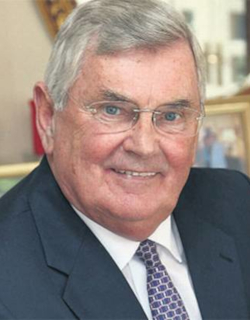
In 1948, when the first inter-party government replaces Éamon de Valera’s Fianna Fáil regime, which had been in power for the previous 16 years, Cosgrave becomes parliamentary secretary to the Taoiseach and to the Minister for Industry and Commerce. It is a short-lived administration, going out of power in 1951 after three years of rule. But in a second inter-party government (1954–57), he becomes Minister for External Affairs and leads the first Irish delegation to the United Nations General Assembly in 1956.
Cosgrave succeeds James Dillon as leader of the Fine Gael party in 1965. Eight years later, as leader of a coalition government in which Fine Gael combines forces with the Labour Party, he becomes Taoiseach. He and British Prime MinisterEdward Heath are the main participants in the intergovernmental conference at Sunningdale in December 1973 that gives birth to Northern Ireland’s first, though short-lived, power-sharing executive (1973–74).
A devout Roman Catholic, Cosgrave is intensely conservative on social issues and shocks his cabinet colleagues by voting against his own government’s bill on liberalizing the sale of contraceptives in 1974. The National Coalition is defeated in the general election of June 1977, largely on the economic issues of inflation and unemployment.
In 1981, Cosgrave retires as Dáil Deputy for Dún Laoghaire to be replaced by his son, Liam T. Cosgrave. He reduces his involvement in public life, but he makes occasional appearances and speeches. In October 2010 he attends the launch of The Reluctant Taoiseach, a book about former Taoiseach John A. Costello written by David McCullagh. He also appears in public for the Centenary of the Easter Rising in 2016, watching from a car as the military parade marches through Dublin. On May 8, 2016, in a joint appearance with the grandsons of Éamonn Ceannt and Cathal Brugha, he unveils a plaque commemorating the 1916 Rising at St. James’s Hospital, the former site of the South Dublin Union.
Liam Cosgrave dies on October 4, 2017, at the age of 97 of natural causes. He had been at Tallaght Hospital for several months prior to his death there. His funeral is held on October 7, 2017, after which he is interred alongside his father at Inchicore‘s Goldenbridge Cemetery.
Taoiseach Leo Varadkar says “Liam Cosgrave was someone who devoted his life to public service; a grateful country thanks and honours him for that and for always putting the nation first. Throughout his life he worked to protect and defend the democratic institutions of our State and showed great courage and determination in doing so. He always believed in peaceful co-operation as the only way of achieving a genuine union between the people on this island, and in the 1970s he celebrated that this country had embarked, in his own words, ‘on a new career of progress and development in the context of Europe’. I had the honour on a few occasions to meet and be in the presence of Liam Cosgrave, and I was always struck by his commanding presence and great humility, which in him were complementary characteristics.”
Childers is born to Erskine Hamilton Childers (Ireland’s fourth President) and his first wife Ruth Ellen Dow. He grows up in a multi-cultural atmosphere which influences his whole life. From an early age, he has an obvious fascination with history and world affairs. He studies at Newtown School, Waterford and much later on at Trinity College, Dublin and Stanford University. At Stanford he is actively involved with the National Student Association and rises to Vice-President of the organisation by 1949.
By 1960, Childers is in London working for the BBC in both radio and television. His broadcasts from the BBC World Service range on varying topics from the Suez Crisis and Palestine to the John F. Kennedy assassination in 1963. He is one of the first presenters at the start of the BBC TV show The Money Programme in 1966. The Suez Canal and Palestine issues later form the basis of his writing on the subjects.
Childers is distinguished as one of the first mainstream writers in the West to systematically challenge the contention that Palestinian Arab refugees of the 1947–1948 Civil War in Mandatory Palestine and the 1948 Arab–Israeli War fled their homes primarily from Arab broadcast evacuation orders, rather than from the use of force and terror by armed forces of the newly forming state of Israel.
Childers specialises in UN issues, even serving as a periodic consultant including a special mission in the Congo for Secretary-GeneralU Thant. In 1967, under the leadership of Henry Richardson Labouisse, Jr., he is hired to lead a United Nations, UNICEF and United Nations Development Programme (UNDP) programme called Development Support Communication. In 1968 he co-authors a paper with United Nations colleague Mallica Vajrathon called “Project Support Communication,” later published in an important anthology about social change.
From 1975 to 1988, Childers is based in New York as Director of Information for UNDP. By his retirement in 1989 after 22 years of service as Senior Advisor to the UN Director General for Development and International Economic Co-operation, Childers had worked with most of the organisations of the UN system, at all levels and in all regions.
After his retirement, Childers continues to strive relentlessly for the ideals for which he had worked so hard. He co-authors several notable books for the Ford Foundation and the Dag Hammarskjöld Foundation on the reform of the United Nations with his colleague and equally devoted United Nations civil servant, Sir Brian Urquhart. The best known of these publications is A World in Need of Leadership. He continues writing on United Nations matters while traveling constantly and lecturing on the Organisation and the many challenges confronting it, such as globalisation and democracy, conflict prevention and peacekeeping, humanitarian assistance, human rights, famine, ageing and development, health, financial arrangement of the United Nations, citizen’s rights, female participation, design and perceptions, education, the North South divide and world economy. In 1995 he co-authors a paper with his international law colleague Marjolijn Snippe called The Agenda for Peace and the Law of the Sea, for Pacem in Maribus XXIII, the Annual Conference of the International Ocean Institute, that is held in Costa Rica, December 1995.
Sterling’s post in Ireland ends on March 7, 1934, when he becomes U.S. minister to Bulgaria, a position he remains in until 1936. In 1937, he is appointed to minister roles for both Latvia and Estonia, however he does not accept the post. In 1938, he becomes U.S. minister to Sweden and remains in that role until 1941.
Lewis is born in County Donegal to Colonel John Lewis and his wife Margaret Lynn. In 1732 John Lewis, having killed his landlord in an altercation, flees to Virginia with his sons Andrew and Thomas. They become among the first settlers in western Augusta County.
Lewis receives a basic education and learns the skills of a surveyor. He spends at least fifteen years farming and working as a surveyor in southwestern Virginia. He also serves as county lieutenant and later captain in the Augusta County militia.
Early in the 1740s Lewis marries Elizabeth Givens, daughter of Samuel and Sarah (Cathey) Givens, formerly of County Antrim. They establish their own home, called Richfield, in what later becomes Roanoke County near Salem.
The Virginia frontier becomes a battleground in the French and Indian War, as do the frontiers of the more northerly colonies of Pennsylvania and Maryland. Virginia organizes a militia to defend settlers subject to attacks by Indians upset at encroachments into their territories. Lewis becomes a captain in George Washington‘s regiment. However, after the loss at the Battle of Fort Necessity in 1754, Washington is forced to surrender to the French. Lewis retreats across the Appalachian Mountains.
Washington proposes a series of frontier fortifications to protect settlers east of the Appalachians. Lewis initially serves to build Fort Dinwiddie on the Jackson River of present-day Bath County and is relieved of his command September 21, 1755. The Virginia assembly approves Lewis’ promotion to major and assigns him to oversee the region along the Greenbrier River. On February 18, 1756, he leads the Big Sandy expedition from Fort Frederick with a mixed force of militiamen and Cherokees to raid the Shawnee towns along the Big Sandy and Ohio rivers to retaliate for Shawnee attacks. He leads several expeditions against both Indian settlements and French outposts. During the Forbes Expedition, he is captured during Major James Grant‘s attack on Fort Duquesne during the Battle of Fort Duquesne in September 1758. Taken to Quebec, he remains a prisoner until late 1759.
Upon the formation of Botetourt County from Augusta County in 1769, Lewis is elected to the House of Burgesses and reelected several times until 1780, though the American Revolution precludes much attendance in later years.
When the American Revolution begins, Governor Dunmore suspends Virginia’s legislature. The Whigs form a provisional congress, which includes both Lewis and his brother Thomas as delegates. When the Continental Congress creates a Continental Army in 1775 and makes George Washington its commander, he asks that Lewis be made a brigadier general. However, initially the Continental Congress had decided there should be only one general from each state, and Charles Lee is the first Virginian commissioned as Brigadier General.
On March 1, 1776, Lewis becomes a brigadier general, overseeing Virginia’s defense and raising men for the Continental Army. Virginia’s Committee of Safety calls on Lewis to stop Governor Dunmore’s raids along the coast from his last stronghold, a fortified position on Gwynn’s Island in the Chesapeake Bay. On July 9, 1776, he leads Virginia’s forces which capture the island as Lord Dunmore escapes by sea, sailing to the Caribbean, never to return.
On April 15, 1777, Lewis resigns his commission, alleging poor health. However, he also faces discontent among his men and the army as a whole. Moreover, he is bypassed when promotions are announced for Major General in early 1777. George Washington, in need of every able officer, expresses his disappointment to Lewis.
Lewis remains active in the legislature, and in 1780, Governor Thomas Jefferson appoints him to the Executive Council. The following year, he falls ill while returning home from a council meeting. He dies of fever in Bedford County on September 26, 1781. He is buried in the family plot at his home. His gravesite is not marked. Colonel Elijah McClanahan, who marries Lewis’ granddaughter, Agatha Lewis McClanahan, attended his funeral as a young man, and later identifies his grave to Roanoke County’s Clerk of the Court. In 1887 General Lewis’ remains are re-interred in the East Hill Cemetery at Salem, Virginia.
(Pictured: Statue of General Andrew Lewis outside the Salem Civic Center)
As EU delegates discuss the Union’s budget and Europe‘s farming subsidies, the two prime ministers vow to battle on with the peace deal’s outstanding problems.
“We’re very clear on what we have to do in the Good Friday agreement … we have just got to keep pushing the thing forward as well as we possibly can,” says Blair.
Both Ahern and Blair say the way forward on the outstanding deadlocked issue of paramilitary disarmament is through the official decommissioning commission. Chaired by former Canadian General John de Chastelain, the international commission is working to take arms out of the province’s political arena.
The republican party Sinn Féin insists it is fully cooperating with the commission, which is implementing the final deadline for the handover of arms in May 2000. But some Ulster Unionists oppose further peace moves because of the Irish Republican Army‘s (IRA) failure to begin disarming.
According to Ahern and Blair, the following few weeks will be a key time to try and finalise disarmament issues.
“During the month of March … we can conclude the central aspects,” says Blair.
However, in a separate development on February 26, the chairman of the IRA’s political wing, Sinn Féin’s Mitchel McLaughlin, warns that pressure on disarmament could cause irreparable damage to the fragile peace process. He adds that disarmament should not become a litmus test for progress.
“Those who are now demanding prior decommissioning before we move to setting up the executive are reneging on the Good Friday Agreement,” says McLaughlin in an interview with BBC Radio.
(From BBC News Online Network, Friday, February 26, 1999 | Pictured: Bertie Ahern with Tony Blair at the signing of the Good Friday Agreement in April 1998)
The Irish Volunteers are a part-time military force whose original purpose is to guard against invasion and to preserve law and order when regular troops are being sent to America during the American Revolutionary War. Members are mainly drawn from the Protestant urban and rural middle classes and the movement soon begins to take on a political importance.
The first corps of Volunteers is formed in Belfast and the movement spreads rapidly across Ireland. By 1782 there are 40,000 enlisted in the Volunteers, half of them in Ulster. Strongly influenced by American ideas, though loyal to the Crown, the Volunteers demand greater legislative freedom for the Dublin Parliament.
The Dungannon Convention is a key moment in the eventual granting of legislative independence to Ireland.
At the time, all proposed Irish legislation has to be submitted to the Privy Council of the United Kingdom for its approval under the great seal of England before being passed by the Parliament of Ireland. English Acts emphasise the complete dependence of the Irish parliament on its English counterpart and English Houses claim and exercise the power to legislate directly for Ireland, even without the agreement of the parliament in Dublin.
The Ulster Volunteers, who assemble in Dungannon, County Tyrone, demand change. Prior to this, the Volunteers received the thanks of the Irish parliament for their stance but in the House of Commons, the British had ‘won over’ a majority of that assembly, which led to a resistance of further concessions. Thus, the 315 volunteers in Ulster at the Dungannon convention promised “to root out corruption and court influence from the legislative body,” and “to deliberate on the present alarming situation of public affairs.”
The Convention is held in a church and is conducted in a very civil manner. The Volunteers agree, almost unanimously, to resolutions declaring the right of Ireland to legislative and judicial independence, as well as free trade. A week later, Grattan, in a great speech, moves an address of the Commons to His Majesty, asserting the same principles but his motion is defeated. So too is another motion by Henry Flood, declaring the legislative independence of the Irish Parliament.
However, the British soon realise they can resist the agitation no longer. It is through ranks of Volunteers drawn up outside the parliament house in Dublin that Grattan passes on April 16, 1782, amidst unparalleled popular enthusiasm, to move a declaration of the independence of the Irish parliament. After a month of negotiations, legislative independence is granted to Ireland.
(Pictured: The original Irish Parliament Building which now houses the Bank of Ireland, College Green, opposite the main entrance to Trinity College, Dublin)