In 1761, O’Brien enters the Irish House of Commons as the member for Ennis, sitting until 1768. Subsequently he successfully runs for Clare, a seat previously held by his father, holding it until 1776. He is then again elected for Ennis, but following the unseating of Hugh Dillon Massy as Member of Parliament for Clare, he returns to represent that constituency in 1778. In the election of 1783, he becomes the representative for Tuam. He is sworn of the Privy Council of Ireland in 1786. He serves for the latter constituency until 1790, when he is re-elected for Ennis. He holds this seat finally until his death on January 15, 1795.
O’Brien marries Anne French, the daughter of Robert French, in 1768 and has by her seven children, three sons and four daughters. He is succeeded in the baronetcy as well as in the constituency of Ennis by his oldest son Edward.
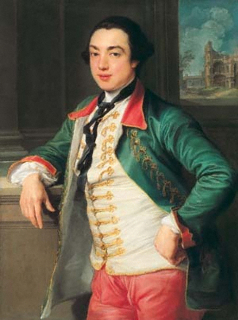
Caulfeild, the son of the 3rd Viscount Charlemont, succeeds his father as 4th Viscount in 1734. The title of Charlemont descends from Sir Toby Caulfeild, 1st Baron Caulfeild (1565–1627) of Oxfordshire, England, who is given lands in Ireland, and creates Baron Charlemont (the name of a fort on the Blackwater), for his services to King James I in 1620. The 1st Viscount is the 5th Baron (d. 1671), who is advanced by Charles II.
Lord Charlemont is well known for his love of Classical art and culture and spends nine years on the Grand Tour in Italy, Greece, Turkey and Egypt. He returns to Dublin and employs the Scottish architect Sir William Chambers to remodel his main residence Marino House, to design his town house Charlemont House and the unique Neoclassical Garden pavilion building, the Casino at Marino.
Lord Charlemont is historically interesting for his political connection with Henry Flood and Henry Grattan. He is a cultivated man with literary and artistic tastes, and both in Dublin and in London he has considerable social influence. He is the first President of the Royal Irish Academy and is a member of the Royal Dublin Society. He is appointed Custos Rotulorum of County Armagh for life in 1760. For various early services in Ireland, he is made an earl in 1763, but he disregards court favours and cordially joins Grattan in 1780 in the assertion of Irish independence. In 1783 he is made a founding Knight of the Order of St. Patrick.
Lord Charlemont is president of the volunteer convention in Dublin in November 1783, having taken a leading part in the formation of the Irish Volunteers, and he is a strong opponent of the proposals for the Acts of Union 1800. His eldest son, who succeeds him, is subsequently created an English Baron in 1837.
Lord Charlemont dies on August 4, 1799.
(Pictured: Charlemont as painted by Pompeo Batoni, c. 1753-56)
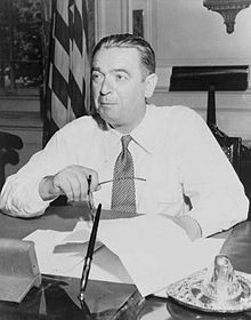
During World War II, Bing serves in the Royal Corps of Signals, attaining the rank of major. A 1943 experiment with parachutes at the GSO2 Airborne Forces Development Centre leaves him disfigured and he bears the scars for many years.
At the 1945 general election, Bing stands for Labour in Hornchurch, winning the seat. He is re-elected in 1950 and 1951, serving until 1955. He serves briefly as a junior whip in 1945-1946 but this is widely thought to have been the unintended result of confusion on the part of Clement Attlee, who confuses him for another Labour MP of a similar name.
On the backbenches, Bing is, according to his Times obituary, “the unrestrained leader of a small group of radicals, never fully trusted by their colleagues and known as ‘Bing Boys.'” He takes a particular interest in the cases of Timothy Evans and John Christie, and he supports the campaign to overturn the conviction of Evans, which is ultimately successful. He supports Communist China and takes a keen interest in Northern Ireland, the brewers’ monopoly and parliamentary procedure.
Bing also builds a practice in West Africa. He becomes close to Kwame Nkrumah, the first post-colonial president of Ghana and is appointed Ghana’s attorney-general, a post he holds until 1961. When Nkrumah is ousted in 1966, Bing is arrested and ill-treated, before being sent home some months later. His memoir of Nkrumah’s Ghana, Reap the Whirlwind, is published in 1968.
Geoffrey Henry Cecil Bing dies in London on April 24, 1977, at the age of 67.
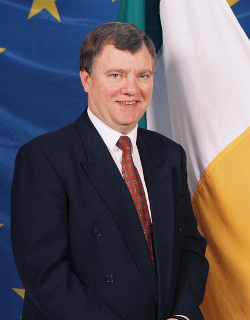
In 1982 Cushnahan is elected to the Prior Assembly for North Down and two years later he becomes the new leader of Alliance, succeeding Oliver Napier. During his tenure as leader, he seeks to strengthen the party’s links with the British Liberal Party. The Anglo-Irish Agreement is signed during this period and Cushnahan faces the difficult position of giving Alliance support to it and facing the united opposition of the Unionist parties. However, when the Assembly is dissolved in 1986, Cushnahan finds it financially difficult to remain in politics and so stands down as leader in 1987 to be succeeded by John Alderdice.
Two years later Cushnahan makes a surprise political comeback when he moves to the Republic of Ireland and stands as a Fine Gael candidate in the 1989 election to the European Parliament, winning a seat in the Munster constituency. He is an MEP for fifteen years before retiring at the 2004 elections.
Cushnahan now serves as a board member of the peace and reconciliation charity Co-operation Ireland.
Talbot receives a commission in the army as ensign before he is twelve years old, and is appointed at sixteen to aid his relative, the Lord Lieutenant of Ireland. He sees active service in Holland and at Gibraltar.
Talbot immigrates to Canada in 1791, where he becomes personal secretary to John Graves Simcoe, Lieutenant Governor of Upper Canada. After returning to England, Talbot convinces the government to allow him to implement a land settlement scheme along the shore of Lake Erie. His petition for 5,000 acres is granted in 1803. On May 21, 1803 he lands at a spot which has since been called Port Talbot and builds a log cabin. Nearby, he adds a sawmill, a cooper shop, a blacksmith shop, and a poultry house along with a barn. When settlers begin to arrive in 1809, Talbot adds a gristmill as well.
Here Talbot rules as an absolute, if erratic, potentate, doling out strips of land to people of his choosing, a group that emphatically does not include supporters of the American Revolution, liberals or anyone insufficiently respectful. For every settler he places on 50 acres of land, he receives an additional 200 acres for himself. One of the conditions attached to the free grant of 50 acres is the right to purchase an additional 150 acres at $3 each, and the promise of a road in front of each farm within three and a half years. The other condition is the building of a small house and the clearing and sowing of 10 acres of land.
The result of the road-making provision is that the settlement becomes noted for its good roads, especially for that named Talbot Road. By the late 1820s Talbot has organized the construction of a 300 mile long road linking the Detroit River and Lake Ontario as part of grand settlement enterprise in the south western peninsula. By 1820, all of the land originally allotted to Talbot has been taken up. From 1814 to 1837 he settles 50,000 people on 650,000 acres of land in the Thames River area. Many, if not most of the settlers, are American. He places about 20,000 immigrants on the Talbot settlement by 1826.
Because Talbot has done his work so well, the government places the southwestern part of the province under his charge. This affords him the opportunity of extending the Talbot road from the Long Point region to the Detroit River. In 1823, he decides to name the port after his friend Baron Edward Smith-Stanley, 14th Earl of Derby, whose son, Frederick Arthur Stanley eventually becomes Governor General of Canada and donates to the hockey world the elusive trophy, which still bears his name.
Talbot’s administration is regarded as despotic. He is infamous for registering settlers’ names on the local settlement map in pencil and if displeased is alleged to erase their entry. However, his insistence on provision of good roads, maintenance of the roads by the settlers, and the removal of Crown and clergy reserves from main roads quickly results in the Talbot Settlement becoming the most prosperous part of the province. Eventually, however, he begins to make political demands on the settlers, after which his power is reduced by the provincial government. His abuse of power is a contributing factor in the Upper Canada Rebellion of 1837.
Talbot dies in the home of George Macbeth at London, Ontario on February 5, 1853 and is interred in the cemetery of St. Peters Anglican Church near Tyrconnell, Ontario in Elgin County. Talbot’s home in Port Talbot, called Malahide, is demolished in 1997 generating much public outcry from heritage preservationists. Talbotville, a community in Southwold, Ontario, and the city of St. Thomas, Ontario are named after him, as well as Colonel Talbot Road and Talbot Street in both London and St. Thomas.
O’Dwyer studies at St. Nathy’s College, Ballaghaderreen, County Roscommon. He emigrates to the United States in 1910, after abandoning studies for the priesthood. He sails to New York City as a steerage passenger on board the liner Philadelphia and is inspected at Ellis Island on June 27, 1910. He first works as a laborer, then as a New York City police officer, while studying law at night at Fordham University Law School. He receives his degree in 1923 and then builds a successful practice before serving as a Kings County (Brooklyn) Court judge. He wins election as the Kings County District Attorney in November 1939 and his prosecution of the organized crime syndicate known as Murder, Inc. makes him a national celebrity.
After losing the mayoral election to Fiorello La Guardia in 1941, O’Dwyer joins the United States Army for World War II, achieving the rank of brigadier general as a member of the Allied Commission for Italy and executive director of the War Refugee Board, for which he receives the Legion of Merit. During that time, he is on leave from his elected position as district attorney and replaced by his chief assistant, Thomas Cradock Hughes, and is re-elected in November 1943.
In 1945, O’Dwyer receives the support of Tammany Hall leader Edward V. Loughlin, wins the Democratic nomination, and then easily wins the mayoral election. He establishes the Office of City Construction Coordinator, appointing Park CommissionerRobert Moses to the post, works to have the permanent home of the United Nations located in Manhattan, presides over the first billion-dollar New York City budget, creates a traffic department and raises the subway fare from five cents to ten cents. In 1948, he receives The Hundred Year Association of New York‘s Gold Medal Award “in recognition of outstanding contributions to the City of New York.” In 1948, he receives the epithets “Whirling Willie” and “Flip-Flop Willie” from U.S. Representative Vito Marcantonio of the opposition American Labor Party while the latter is campaigning for Henry A. Wallace.
Shortly after his re-election to the mayoralty in 1949, O’Dwyer is confronted with a police corruption scandal uncovered by the Kings County District Attorney, Miles McDonald. O’Dwyer resigns from office on August 31, 1950. Upon his resignation, he is given a ticker tape parade up Broadway‘s Canyon of Heroes in the borough of Manhattan. President Harry Truman appoints him U.S. Ambassador to Mexico. He returns to New York City in 1951 to answer questions concerning his association with organized crime figures and the accusations follow him for the rest of his life. He resigns as ambassador on December 6, 1952, but remains in Mexico until 1960.
O’Dwyer visits Israel for 34 days in 1951 on behalf of his Jewish constituents. Along with New York’s Jewish community, he helps organize the first Israel Day Parade.
In 1990 Wilson challenges Brian Lenihan for the Fianna Fáil nomination for the 1990 presidential election. Lenihan wins the nomination but fails to be elected President and is also sacked from the government. Wilson is then appointed Tánaiste. He remains in the cabinet until retirement in 1993. Although the 26th Dáil Éireann is dissolved in December 1992, he serves in Government until the new government takes office.
John Wilson dies at St. James Hospital, Dublin on July 9, 2007, one day after his 84th birthday. His funeral takes place at the Good Shepherd Church at Churchtown, Dublin. President Mary McAleese is one of a number of prominent figures among the mourners, while Taoiseach Bertie Ahern is represented by his Aide-de-Camp.
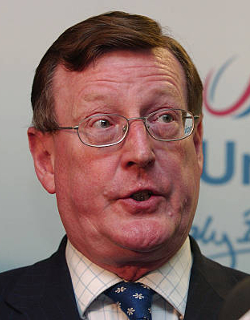
In the hours leading up to Trimble’s midnight resignation, there are minor clashes between the two sides as the Protestant “marching season,” an annual flashpoint for trouble, starts in Belfast.
Trimble, recipient of the Nobel Peace Prize with Catholic leader John Hume for their part in the 1998 Good Friday Agreement, precipitates the crisis by submitting a post-dated resignation letter several weeks earlier in protest of the Irish Republican Army‘s (IRA) refusal to disarm as part of the deal.
Under the landmark Good Friday Agreement, the power-sharing government of Catholics and Protestants that Trimble has headed has a six-week period to either re-install Trimble or replace him before the Northern Irish Assembly and Northern Ireland Executive are suspended. If such steps fail, Britain can call new provincial elections or re-impose direct rule from London.
As Trimble leaves the province, police and British troops mount a strong presence to head off trouble during a parade by the Protestant Orange Order institution. There are only minor scuffles between police and residents as a concrete and steel barrier is put up by security forces to seal off the Catholic enclave ahead of the march.
A spokesman for Trimble’s UUP says Empey’s appointment is intended to “shore up the political institutions and ensure its representation in the government.” Empey says his role is to perform the functions of First Minister but not take the title or salary. He says his party will not share power with the Irish Republican Army’s (IRA) political arm Sinn Féin unless the guerrilla group starts to disarm.
Sinn Fein leaders denounce Trimble’s resignation as an evasion of responsibility for peace in the province. The IRA says it wants a permanent peace and security sources say there is no sign of a return-to-war mood in the ranks of the guerrilla group. It has twice opened up arms dumps for international inspection to prove that the weapons have not been used, but Protestant politicians say that is not enough.
After serving for four years on the Roscommon County Council, Doherty is elected as a Fianna Fáil TD for the Roscommon–Leitrim constituency at the 1977 general election.
Doherty’s brother-in-law, Garda Thomas Nangle, is charged with assaulting James McGovern, a native of County Fermanagh, in a public house in December 1981. On September 27, 1982, hours before the case is due to be heard in District Court in the small village of Dowra, County Cavan, McGovern is arrested by the Special Branch of the Royal Ulster Constabulary (RUC) on the basis of entirely false Garda intelligence that he is involved in terrorism. The case against Nangle is dismissed because the principal witness, McGovern, fails to appear in court. The solicitor representing Nangle is Kevin Doherty, Seán Doherty’s brother. This questionable use of Garda/RUC Special Branch liaison, set up under the 1985 Hillsborough Anglo-Irish Agreement, prevents meetings between the Garda commissioner and the RUC chief constable for almost three years.
After Doherty leaves office it is revealed in The Irish Times that he ordered the tapping of three journalists home telephones. The newspaper also discloses that he has been interfering in the workings of the Garda and the administration of justice for both political and personal reasons. He immediately resigns from the party only to rejoin it in 1984.
At the 1989 general election his loses his seat in Dáil Éireann to the independent candidate Tom Foxe. He is also an unsuccessful candidate in the elections on the same day to the European Parliament, but he is later elected instead to the Seanad on the Administrative Panel and becomes the Cathaoirleach (Chairman) of the 19th Seanad.
In January 1992 the phone tapping scandal returns to haunt Fianna Fáil. Doherty announces in a television interview that he had shown transcripts of the conversations to Charles Haughey while Haughey was Taoiseach in 1982 although he had previously denied this. Haughey denies the claim also, but is forced to resign from the government, and then resigns as leader of Fianna Fáil. Doherty then regains his seat at the 1992 general election and holds it until his retirement at the 2002 general election.
Biden then travels to Government Buildings where he is formally welcomed by TaoiseachEnda Kenny. Kenny says he hopes Biden enjoyed his visit and Biden says that he himself has visited Ireland several times privately, but never as vice president. He adds that he had promised his late son Beau that he would make a family trip to Ireland, “Unfortunately Beau didn’t make it, but we decided that we would bring the whole family.”
Biden, an Irish American, speaks of his great-grandfather who emigrated from Ireland, and he also speaks of the pride his family feels in their Irish heritage.
Kenny presents Biden with a hurley and a sliotar, to which the Vice President responds, “I have witnessed one game and I have one regret, that they don’t have this in the United States. I played American football and American baseball in high school and college, but this would have been … this is a dangerous game.”
Biden holds a bilateral meeting with Kenny in the evening and meets with the President of Ireland, Michael D. Higgins, the following day at his official residence, Áras an Uachtaráin in Dublin‘s Phoenix Park. As he signs the visitors’ book, he paraphrases another famous Irish American, former U.S. PresidentJohn F. Kennedy, who had visited the Republic of Ireland 53 years earlier. His written entry makes reference to a speech made to Dáil Éireann in June 1963, when Kennedy said, “our two nations, divided by distance, have been united by history.”
During his visit Biden visits County Mayo and County Louth, where his ancestors originated, in addition to several engagements in Dublin and a stop at Newgrange. He also arranges to fit in a round of golf with Kenny.
Biden speaks at an event at Trinity College, Dublin on the morning of Friday, June 24 and delivers a keynote address to an American Ireland Fund event in Dublin Castle in the evening. He addresses the Irish American experience, the shared heritage of the two nations, and the values of tolerance, diversity and inclusiveness.
On Saturday, June 25, Biden visits various locations in County Louth including the Kilwirra Cemetery and Newgrange in County Meath.
Biden returns to the United States following a lunch with Kenny on Sunday, June 26.
(Pictured: U.S. Vice President Joe Biden signing the visitor’s book as Irish President Michael D. Higgins look on at his official residence, Áras an Uachtaráin)