seamus dubhghaill

Promoting Irish Culture and History from Little Rock, Arkansas, USA


Leave a comment

Use of the “Book of Common Prayer” Ordered in Ireland

The Book of Common Prayer, the short title of a number of related prayer books, is ordered to be used in Ireland on June 9, 1549.

The Book of Common Prayer is used in the Anglican Communion, as well as by the Continuing Anglican movement, Anglican realignment and other Anglican churches. The original book, published in 1549 during the reign of Edward VI, is a product of the English Reformation following the break with the Roman Catholic Church. Prayer books, unlike books of prayers, contain the words of structured, or liturgical, services of worship.

The work of 1549 is the first prayer book to include the complete forms of service for daily and Sunday worship in English. It contains Morning Prayer, Evening Prayer, the Litany, and Holy Communion and also the occasional services in full such as the orders for Baptism, Confirmation, Marriageanointing of the sick and a Funeral service. It also sets out in full the “propers,” that is the parts of the service which vary week by week or, at times, daily throughout the Church’s Year. Old Testament and New Testament readings for daily prayer are specified in tabular format as are the Psalms.

The 1549 book is soon succeeded by a more reformed revision in 1552 under the same editorial hand, that of Thomas Cranmer, Archbishop of Canterbury. It is used only for a few months, as after Edward VI’s death in 1553, his half-sister Mary I restores Roman Catholic worship. Mary dies in 1558, and, in 1559, Elizabeth I reintroduces the 1552 book with a few modifications to make it acceptable to more traditionally minded worshippers, notably the inclusion of the words of administration from the 1549 Communion Service alongside those of 1552.

In 1604, James I orders some further changes, the most significant of these being the addition to the Catechism of a section on the Sacraments. William Bedell undertakes an Irish translation of the Book of Common Prayer in 1606. Following the tumultuous events leading to and including the English Civil War, another major revision is published in 1662. This edition has remained the official prayer book of the Church of England, although in the 21st century, alternative provision under the title Common Worship has largely displaced the Book of Common Prayer at the main Sunday worship service of most English parish churches. An Irish translation of the revised prayer book of 1662 is affected by John Richardson and published in 1712.

A Book of Common Prayer with local variations is used in churches inside and outside the Anglican Communion in over 50 different countries and in over 150 different languages. In many parts of the world, other books have replaced it in regular weekly worship.

Traditional English Lutheran, Methodist and Presbyterian prayer books have borrowed from the Book of Common Prayer and the marriage and burial rites have found their way into those of other denominations and into the English language. Like the King James Version of the Bible and the works of William Shakespeare, many words and phrases from the Book of Common Prayer have entered common parlance.

(Pictured: A 1760 printing of the 1662 “Book of Common Prayer”)


Leave a comment

First Priests Ordained at St. Patrick’s College, Maynooth

The ordination of the first priests at St. Patrick’s College, Maynooth takes place on June 6, 1800. The college is the “National Seminary for Ireland” and a Pontifical university located in the village of Maynooth, fifteen miles from Dublin.

The college is established on June 5, 1795, as The Royal College of St. Patrick, by act of the Parliament of Ireland, to provide “for the better education of persons professing the popish or Roman Catholic religion.” The College in Maynooth is originally established to provide a university education for Catholic lay and ecclesiastical students and is based in Riverstown House on the south campus from 1802. With the opening of Clongowes Wood College in 1814, the lay college is closed and the college functions solely as a Catholic seminary for almost 150 years.

The college is particularly intended to provide for the education of Catholic priests in Ireland, who until this Act have to go to the continent for training. The added value in this is the reduction of the number of priests returning from training in revolutionary France, with whom Great Britain is at war, thus hindering potential revolution. The value to the government is proved by the condemnation by the Catholic Church hierarchy of the Irish Rebellion of 1798 and later support for the Act of Union.

In 1800, John Butler, 12th Baron Dunboyne, dies and leaves a substantial fortune to the College. Butler had been a Roman Catholic, and Bishop of Cork, who had embraced Protestantism in order to marry and guarantee the succession to his hereditary title. However, there are no children to his marriage, and it is alleged that he had been reconciled to the Catholic Church at his death. Were this the case, a Penal law demands that the will is invalid, and his wealth will pass to his family. Much litigation follows before a negotiated settlement in 1808 that leads to the establishment of a Dunboyne scholarship fund.

The land is donated by William FitzGerald, 2nd Duke of Leinster, who has argued in favour of Catholic emancipation in the Irish House of Lords. He lives nearby at Carton House and also at Leinster House. The building work is paid for by the British Government and parliament continues to give it an annual grant until the Irish Church Act 1869. When this law is passed the College receives a capital sum of £369,000. The trustees invest 75% of this in mortgages to Irish landowners at a yield of 4.25% or 4.75% per annum. This is considered a secure investment at the time but agitation for land reform and the depression of the 1870s erodes this security. The largest single mortgage is granted to the Earl of Granard. Accumulated losses on these transactions reached £35,000 by 1906.

The first building to go up on the site is designed by, and named after, John Stoyte. Stoyte House, which can still be seen from the entrance to the old campus, is a well-known building to Maynooth students and stands very close to the very historic Maynooth Castle. Over the next 15 years, the site at Maynooth undergoes rapid construction so as to cater to the influx of new students, and the buildings which now border St. Joseph’s Square are completed by 1824.

The Rev. Laurence F. Renehan (1797–1857), a noted antiquarian, church historian, and cleric, serves as president of St. Patrick’s from 1845 until 1857. Under Renehan, many of the college’s most important buildings are constructed by Augustus Pugin.

In 2015–16 there are approximately 80 men studying for the priesthood at Maynooth, 60 resident seminarians and approximately 20 non-residents.


Leave a comment

Birth of William Frederick Archdall Ellison, Clergyman & Astronomer

Reverend William Frederick Archdall Ellison FRAS, Irish clergymanHebrew scholar, organist, avid amateur telescope maker, and, from 1918 to 1936, director of Armagh Observatory in ArmaghNorthern Ireland, is born on April 28, 1864. He is the father of Mervyn A. Ellison, the senior professor of the School of Cosmic Physics at Dunsink Observatory from 1958 to 1963.

Ellison comes from a clerical family, his father Humphrey Eakins Ellison having been Dean of FernsCounty Wexford. He gains a sizarship of classics at Trinity College, Dublin in 1883, becomes a Scholar of the House in 1886 and graduates in 1887 with junior moderatorships in classics and experimental science. In 1890 he takes Holy Orders and moves to England, where he becomes the Curate of Tudhoe and Monkwearmouth. In 1894 he takes his MA and BD degrees and in the following year wins the Elrington Theological Prize.

In 1899 he returns to Ireland to become secretary of the Sunday School Society, a post which he holds for three years before accepting the incumbency of Monart, Enniscorthy, moving in 1908 to become Rector of Fethard-on-Sea with Tintern in Wexford. Ellison develops an interest in astronomy, having been introduced to practical optics by Dr. N. Alcock of Dublin and sets up his first observatory at Wexford. He becomes highly adept at making lenses and mirrors and writes several books and articles on the subject, including major contributions to the Amateur Telescope Making series, the Journal of the British Astronomical Association, and the weekly newspaper The English Mechanic. His book The Amateur’s Telescope (1920) is still considered a standard for telescope-makers and a forerunner of the more extensive series on the same topic by Albert Graham Ingalls.

On September 2, 1918 Ellison is appointed Director of the Armagh Observatory. He finds the Observatory in a state of disrepair and sets about repairing the instruments and the observatory dome. On January 3, 1919 he deeds a telescope of his own to the observatory, an 18-inch reflecting telescope, which is still there.

Ellison is a highly regarded planetary and binary star observer. Working with his son Mervyn, he makes many measurements of binary stars using the observatory’s 10-inch Grubb refracting telescope and even discovers a new one close to Beta Lyrae, and according to Patrick Moore, is one of the few people to have observed an eclipse of Saturn’s moon Iapetus by Saturn’s outermost ring on February 28, 1919.

In 1934 Ellison becomes Canon and Prebendary of BallymoreArmagh Cathedral. He dies on December 31, 1936, having held the office of Director of the observatory for nearly twenty years.


Leave a comment

Birth of Bishop Eamonn Casey

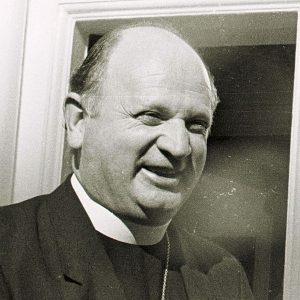
Eamonn Casey, Irish Roman Catholic prelate who serves as bishop of Galway and Kilmacduagh in Ireland from 1976 to 1992, is born in FiriesCounty Kerry on April 24, 1927.

Casey is educated in Limerick and in St. Patrick’s College, Maynooth. He is ordained a priest for the Diocese of Limerick on June 17, 1951, and appointed Bishop of Kerry on July 17, 1969. He holds this position until 1976, when he is appointed Bishop of Galway and Kilmacduagh and apostolic administrator of Kilfenora. While in Galway, he is seen as a progressive. It is a significant change in a diocese that has been led for nearly forty years by the very conservative Michael Browne.

Casey is well known for his work aiding Irish emigrants in Britain. In addition, he supports the Dunnes Stores‘ staff, who are locked out from 1982 to 1986 for refusing to sell goods from apartheid South Africa.

Casey attends the funeral of the murdered Archbishop of San SalvadorMonsignor Óscar Romero. He witnesses firsthand the massacre of those attending the funeral by government forces. He then becomes a vocal opponent of United States foreign policy in Central America, and, as a result, opposes the 1984 visit of United States President Ronald Reagan to Ireland, refusing to meet him when he comes to Galway.

Casey is highly influential in the Irish Catholic hierarchy and serves as bishop until his resignation in 1992. He is a friend and colleague of another highly prominent Irish priest, Father Michael Cleary.

In 1992, newspapers discover that Casey has had a sexual relationship with Annie Murphy, an American divorcée. Together they have a son, Peter, born in 1974 in Dublin. Murphy later claims that Casey had attempted to persuade her to give the child up for adoption at birth. She chooses not to do so and raises him with the help of her parents. When Murphy decides to go public about the relationship and informs The Irish Times, Casey tenders his resignation and leaves the country.

Casey’s resignation is regarded as a pivotal moment when the Roman Catholic hierarchy begins to lose its considerable influence over the society and politics of Ireland. He is succeeded by his Secretary, Bishop James McLoughlin, who serves in the post until his own retirement on July 3, 2005.

Casey opts to embrace the life of a foreign missionary in South America. He works with members of the Missionary Society of St. James in a rural parish in Ecuador, despite his lack of knowledge of the Spanish language. During this time, he travels long distances to reach the widely scattered members of his parish. After his missionary period is completed, instead of returning to Ireland, Casey takes a position in the parish of St. Pauls, Haywards Heath, in South East England. He returns to Ireland in 2006.

In 2005, Casey is investigated in conjunction with the sexual abuse scandal in Galway, Kilmacduagh and Kilfenora diocese. He is subsequently cleared of any wrongdoing.

Casey suffers four mini strokes in 2002 and begins to experience memory issues. In August 2011, he is admitted to a nursing home in County Clare. Eamonn Casey dies on March 13, 2017, at the age of 89.


Leave a comment

Death of St. Ruadhán of Lorrha

St. Ruadhán mac Fergusa Birn, also known as Rowan and Rodan, Irish Christian abbot who founds the monastery of Lorrha near Terryglass in County Tipperary, dies at the monastery on April 5, 584. Known for his prophesies, he is venerated as a saint and as one of the “Twelve Apostles of Ireland” after his death.

Ruadhán is educated in Clonard, County Meath, by St. Finnian and is known as one of the Twelve Apostles of Ireland. He is said to replace St. Brendan the Navigator at Lorrha after Brendan precedes to cross the River Shannon and set up his monastery at ClonfertCounty Galway.

Ruadhán founds a monastic settlement at Lorrha that consists of a monastery and various other buildings including cells for the many monks that live there. Also a ditch or large mound is built around the settlement to keep animals in and intruders out, the outlines of which remain visible today. Life for the monks is tough but simple, rising early from their beds which consist of rushes or straw placed on the bare ground. They then pray and fast between their domestic chores. The settlement is self-sufficient providing everything from food, clothing, to shelter. Villages and towns, such as the village of Lorrha, often pop up around monastic settlements as trade and refuge attracts the local people.

His embassy in 556 to King Diarmait mac Cerbaill at Tara, is worked into a legend known as the “Curse of Tara”, but the high-king continues to reside at Tara until his death in 564. Diarmuid Mac Cerbhaill violates the sanctity of the church by taking a hostage from its protection. The downfall of Tara from a once thriving royal residence is credited to Ruadhán.

Ruadhán gives the prophecy that Diarmait will be killed by the roof-beam of his hall at Tara. Diarmait has the beam cast into the sea. Diarmait then asks his druids to find the manner of his death, and they foretell that he will die of slaughter, drowning, and burning, and that the signs of his death will be a shirt grown from a single seed of flax and a mantle of wool from a single sheep, ale brewed from one seed of corn, and bacon from a sow which has never farrowed.

On a circuit of Ireland, Diarmait comes to the hall of Banbán at Ráith Bec, and there the fate of which he is warned comes to pass. The roof beam of Tara has been recovered from the sea by Banbán and set in his hall, the shirt, mantle, ale, and bacon are duly produced for Diarmait. Diarmait goes to leave Banbán’s hall, but Áed Dub mac Suibni, waiting at the door, strikes him down and sets fire to the hall. Diarmait crawls into an ale vat to escape the flames and is duly killed by the falling roof beam. Thus, all the prophecies are fulfilled.

The bell of St. Ruadhán is found in a well named after the Saint and is preserved in the British Museum. This well is situated across the road from the present day Church of Ireland.

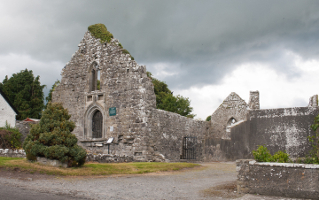
(Pictured: Lorrha Priory of St. Ruadhán)


Leave a comment

Birth of John B. Bannon, Irish Catholic Jesuit Priest

john-bannon

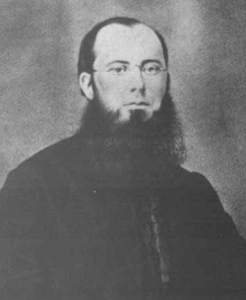
John B. Bannon, Irish Catholic Jesuit priest who serves as a Confederate chaplain during the American Civil War, is born in Roosky, County Roscommon, on December 29, 1829. He is also renowned as an orator.

Bannon is born to James Bannon, a Dublin grain dealer, and Fanny Bannon (née O’Farrell). He goes to the vincentian Castleknock College in Dublin. In 1846 he goes to study for the priesthood at St. Patrick’s Pontifical University, Maynooth, in the minor seminary until 1850 and completing his theology course in 1853. He is ordained on June 16, 1853, by Archbishop Paul Cullen for the Dublin Diocese. He soon applies to move to America.

Shortly after ordination he moves to the Archdiocese of St. Louis, Missouri. He becomes pastor to St. John the Apostle and Evangelist Church which he builds in 1858. He serves in the First Missouri Confederate Brigade, during the American Civil War. He ministers at the battles of Corinth, Fort Gibson, and at Big Black River Bridge, Vicksburg.

He is detained on July 4, 1863, when Vicksburg surrenders. After being released by Union forces, he goes to Richmond, Virginia in August 1863, where Jefferson Davis and Secretary of State Judah Benjamin ask him to go to Ireland to discourage recruitment for the Federal forces and try to get international help for the Confederacy.

In November 1863, Bannon returns to Ireland, writing and pamphleting to discourage people from emigrating and joining the Union side of the civil war. He makes two trips to Rome to try, unsuccessfully, to get the Vatican to side with the Confederacy. Following the American Civil War, he is banned from preaching in St. Louis, and stays in Ireland, becoming a Jesuit in 1865, spending some time in Milltown Park, Tullabeg College, and in Gardiner Street.

Bannon dies on July 14, 1913, in Upper Gardiner Street, and is buried in the Jesuit plot at Glasnevin Cemetery, Dublin.


1 Comment

Birth of Joseph Stock, Bishop of Waterford & Lismore

joseph-stock

Joseph Stock, Irish Protestant churchman and writer, Bishop of Killala and Achonry, and afterwards Bishop of Waterford and Lismore, is born at 1 Dame Street, Dublin, on December 22, 1740.

Stock is the son of Luke and Ann Stock. He is educated at Mr. Gast’s school in his native city and at Trinity College, Dublin. He obtains a scholarship in 1759, graduates B.A. in 1761, and gains a fellowship in 1763. Having taken orders, Stock retires on the college living of Conwall in the diocese of Raphoe.

Stock is a classical scholar, a linguist, and a man of general culture. In 1776 he publishes anonymously a life of George Berkeley, subsequently republished in the Biographia Britannica, the only memoir on Berkeley based on contemporary information.

In 1793 Stock is collated prebendary of Lismore, but resigns this preferment in 1795, on his appointment to the head-mastership of Portora Royal School. In January 1798 he succeeds John Porter as Bishop of Killala and Achonry. Shortly after his consecration, and while holding his first visitation at the castle of Killala, the bishop becomes a prisoner of the French army under General Jean Joseph Amable Humbert, when French forces land in support of the Irish Rebellion of 1798. Of his experiences as a prisoner of the French he leaves a partial record in his private diary — August 23 to September 15, 1798 — which is printed in William Hamilton Maxwell‘s History of the Rebellion of 1798, and in two letters to his brother Stephen, published in the Auckland Correspondence.

In 1799 Stock publishes a more complete account of the French invasion of County Mayo in his Narrative of what passed at Killala in the Summer of 1798. By an Eyewitness. The impartiality of this work is said to have been a bar to the bishop’s advancement. He also writes The Book of the Prophet Isaiah in Hebrew and English, with Notes (Bath, 1803) and The Book of Job metrically arranged and newly translated into English, with Notes (Bath, 1805).

Stock also publishes school editions of Tacitus and Demosthenes, and is an active contributor to the controversial theology of his day. He leaves two manuscript volumes of correspondence which are preserved in the library of Trinity College, Dublin. They consist chiefly of letters written from Killala and Waterford between 1806 and 1813 to his son Henry in Dublin.

In 1810 Stock is translated to the diocese of Waterford and Lismore, and dies at Waterford on August 13, 1813.


2 Comments

Birth of Cardinal Patrick Joseph O’Donnell

patrick-joseph-odonnell

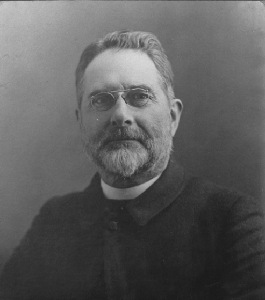
Patrick Joseph O’Donnell, Cardinal of the Roman Catholic Church, is born in Glenties, County Donegal, on November 28, 1856. He serves as Archbishop of Armagh from 1924 until his death and is elevated to the cardinalate in 1925.

O’Donnell, son of Daniel O’Donnell, a farmer, and his wife, Mary (née Breslin), is one of nine children in a family that claim descent from the O’Donnells of Tyrconnell. He is educated in the High School, Letterkenny, the Catholic University, Dublin, and St. Patrick’s Pontifical University, Maynooth. He is ordained to the priesthood on June 29, 1880. In that same year he is appointed to the staff of St. Patrick’s College, Maynooth, holding the chairs of Dogmatic and Moral Theology. In 1884 he becomes dean of the revived post-graduate Dunboyne Institute and in 1885 is awarded his STD. From his desk in Maynooth he pours out a continuous stream of articles on moral theology and canon law.

O’Donnell becomes Bishop of Raphoe on February 26, 1888, and is consecrated by Cardinal Michael Logue on April 3 in Letterkenny. With superior qualities of mind and body, he is a benign figure who is yet gifted with sharp political acumen. He has the most distinguished episcopate, locally and nationally. He undertakes and completes prodigious building projects including a superbly sited neo-gothic cathedral, St. Eunan’s Diocesan College, and the Presentation Monastery and Loreto schools and an extension to Loreto Convent, all in Letterkenny.

He is appointed coadjutor Archbishop of Armagh on January 14, 1922, and succeeds Cardinal Logue on November 19, 1924. On December 14, 1925, Pope Pius XI makes O’Donnell a Cardinal.

O’Donnell takes an active part in the social, political, and economic life of Ireland. A staunch activist for social justice, as Bishop of Raphoe, he is a member of the first Committee of the Irish Agricultural Organisation Society, founded by Sir Horace Plunkett. In 1918, when representing the nationalist’s side at the Irish Convention, he opposes John Redmond‘s amendment intended to bring about unanimity on All-Ireland Home Rule.

Cardinal O’Donnell dies on October 22, 1927, in Carlingford, County Louth. The St. Connell’s Museum in his hometown of Glenties has a display about his life.


Leave a comment

Death of Vergilius of Salzburg, Churchman & Astronomer

virgilius-of-salzburg

Vergilius of Salzburg, also known as Virgilius, Feirgil or Fergal, Irish churchman and early astronomer, dies on November 27, 784, in Salzburg, Austria. He serves as abbot of Aghaboe, bishop of Ossory and bishop of Salzburg. He is called “the Apostle of Carinthia” and “the geometer.”

He originates from a noble family of Ireland, where his name is Feirgil, and is said to have been a descendant of Niall of the Nine Hostages. Feirgil is likely educated at the Iona monastery.

In the Annals of the Four Masters and the Annals of Ulster he is mentioned as Abbot of Aghaboe, in County Laois, where he is known as “the Geometer” because of his knowledge of mathematics.

Around 745 Vergilius leaves Ireland, intending to visit the Holy land but, like many of his countrymen who seem to have adopted this practice as a work of piety, he settles down in France, where he is received with great favour by Pepin the Short, who is then Mayor of the Palace under Childeric III of Franconia. He serves as an adviser to Pepin. He probably uses a copy of the Collectio canonum Hibernensis, an Irish collection of canon law, to advise him to receive royal unction in 751, to assist his recognition as king Pippin III after the deposition of Childeric. After spending two years at Cressy, near Compiègne, he goes to Bavaria, at the invitation of Duke Odilo, where he founds the monastery of Chiemsee, and within a year or two is made Abbot of St. Peter’s at Salzburg. Among his notable accomplishments is the conversion of the Alpine Slavs and the dispatching of missionaries to Hungary.

While Abbot of St. Peter’s, Vergilius comes into collision with Saint Boniface. A priest, through ignorance, confers the Sacrament of Baptism using, in place of the correct formula, the words “Baptizo te in nomine patria et filia et spiritu sancta.” Vergilius holds that the sacrament has been validly conferred, but Boniface complains to Pope Zachary. The latter, however, decides in favour of Vergilius. Later on, Boniface accuses Vergilius of spreading discord between himself and Duke Odilo of Bavaria and of teaching a doctrine in regard to the rotundity of the earth, which is “contrary to the Scriptures.” Pope Zachary’s decision in this case is that “if it shall be clearly established that he professes belief in another world and other people existing beneath the earth, or in another sun and moon there, thou art to hold a council, and deprive him of his sacerdotal rank, and expel him from the church.”

Unfortunately, we no longer possess the treatise in which Vergilius expounds his doctrine. Two things, however, are certain: first, that there is involved the problem of original sin and the universality of redemption; secondly, that Vergilius succeeds in freeing himself from the charge of teaching a doctrine contrary to Scripture. It is likely that Boniface, already biased against Vergilius because of the preceding case, misunderstands him, taking it for granted, perhaps, that if there are antipodes, the “other race of men” are not descendants of Adam and are not redeemed by Christ.

After the martyrdom of Boniface, Vergilius is made Bishop of Salzburg in 766 or 767. Until his death in 784, he labours successfully for the upbuilding of his diocese as well as for the spread of Christianity in neighbouring heathen countries, especially in Carinthia.

Vergilius is venerated as a saint in the Orthodox Church and the Roman Catholic Church. In 1233 he is formally canonized by Pope Gregory IX. Aside from being personally associated with Abbey of Aghaboe and Salzburg Cathedral, a number of parishes around the world are dedicated to him, mostly being founded by small populations of far-flung Irish Catholics, like himself. There is a church still bearing his name dedicated to him in Broad Channel, Queens, New York. A parish in Morris Plains, New Jersey is also dedicated to him.


Leave a comment

Death of Saint Colmán of Cloyne

saint-colman

Saint Colmán of Cloyne, also known as Colmán mac Léníne, monk, founder, and patron of Cluain Uama, now Cloyne, County Cork, and one of the earliest known Irish poets to write in the vernacular, dies on November 24, 600.

Colmán is remembered as the founder of the monastery at Cluain Uama in Munster, which lay in the kingdom of the Uí Liatháin and the Uí Meic Caille, a sept of the former. The origin legend Conall Corc and the Corco Loígde claims that the land for the foundation is not given by the local king, but by Coirpre Cromm mac Crimthainn, who is king of Munster from the Eóganacht Glendamnach.

Cloyne appears to be his earliest settlement. The cathedral and round tower are situated on a limestone eminence in the midst of the valley, surrounded by rich meadows. In the rock is the cave extending in various branches underground to a great distance, from which the town derives its name. Here it is believed that Colmán took up his abode as a place of security. Colmán is also believed to have founded a monastery at what would become Killagha Abbey in County Kerry.

Colmán is credited with extraordinary poetic powers, being styled by his contemporaries “royal poet of Munster.” Several of his Irish poems are still extant, notably a metrical panegyric on Saint Brendan.

It is unclear whether Colmán is brought up as a Christian, but what is certain is that he is educated and becomes a bard or file, which requires a special education. As a member of the class of filí, he becomes attached to the court of Cashel where he remains until about the age of 48 years. In 570, he and Saint Brendan of Clonfert are said to have settled a dispute between rivals to the throne of Cashel and Aodh Caomh is acknowledged as king, the first Christian king of Cashel. The King is installed by Saint Brendan. During the time of the coronation Colmán and some others discover the lost shrine of Ailbhe of Emly. Brendan says that it is not right that the hands which have held this sacred relic should be defiled henceforth, thus it is that the son of Leinin offers himself to God. Brendan blesses him and gives him the name Colmán, which is a diminutive of Colm.

Colmán then goes to the school of Saint Iarlaithe of Tuam and after his studies he is next mentioned as preaching to the heathen population in the east of County Cork. He is described as a “religious and holy presbyter, who afterwards became a famous bishop.” The Prince of Déise, in the present county of Waterford, presents his child to Colmán for baptism. Colmán baptizes him Declán and urges his parents to educate him well in his faith. This child becomes Saint Declán of Ardmore.

Colmán is given churches in Erry and Killenaule by Coirpre Cromm mac Crimthainn, King of Munster (Cashel), as well as lands in Cloyne, County Cork. It may well be that the lands in Cloyne are conquered lands and to prevent the possibility of reconquest are given to the church. The Cloyne estate is large and contains some of the best land in the area.

After the king’s death (c. 580) Colmán somehow becomes involved in factional strife between Coirpre’s descendants in which some of them persecute him while others, the ancestors of the later dominant line, protect him.

His surviving verses date from the period 565 and 604, and are among the earliest examples of Irish writing in the Latin alphabet. He is commonly thought to have composed Luin oc laib, a poem in praise of Domnall mac Muirchertaig, king of Tara, and another poem on the death of Áed Sláine, king of the UÍ Néill. The latter poem has not survived complete.

Colmán dies on November 24, 600, and is likely buried is Cloyne, where he may have left a school of poetry in existence. The calendars are unanimous in dating his death on November 24, now his feast day.