Napoleon‘s Irish Legion fights at the battle of Löwenburg on August 21, 1813. This is the first occasion on which Napoleon is frustrated by the Trachenberg Plan, in which the Allies had agreed not to risk a battle against the emperor in person (War of Liberation).
On August 14, Marshal Gebhard Leberecht von Blücher prematurely crosses the armistice line in Silesia and begins to advance west. After briefly considering a move south to attack the Austrians in Bohemia, Napoleon decides to join his forces on the Bóbr and try and defeat Blücher.
By the evening of August 20 Blücher’s army is on the east bank of the Bóbr, facing Löwenberg (now Lwówek Śląski). On the opposite side of the river Michael Ney (III Corps), Jacques Lauriston (V Corps) and Jacques Macdonald (XI Corps) are spread out between Löwenberg and Bunzlau (modern Bolesławiec), a few miles to the north. Auguste de Marmont (VI Corps) and the Guard are approaching from the west, and Napoleon is at Lauban, where he puts in place attacks for a full-scale attack on the following day.
On the following day Napoleon is disappointed. The French capture Löwenberg without any problems and at noon V Corps crosses the Bóbr over the bridges in the town, followed by XI Corps. As they advance toward the heights on the east bank of the river, Blücher retreats. Yorck’s corps is pushed back along the road to Goldberg (Złotoryja, ten miles to the southwest of Legnica).
Napoleon misinterprets this move as demonstrating a lack of confidence amongst the Allied commanders, and that they had assumed the French would retreat without risking a battle so far east. Instead, it is part of a deliberate Allied plan – no individual Allied army is to risk a battle with the emperor in person.
On August 22 the French continue to push east, fighting a skirmish between Lauterseifen and Pilgramsdorf. Blücher retreats behind the Kaczawa. However, the French pursuit is halted by news from Dresden, where Claude Carra Saint-Cyr finds himself facing a considerable Austrian and Russian attack. As a result, Napoleon decides to return west to deal with the threat to Dresden, leaving Marshal Macdonald in command of a new Army of the Bóbr (III Corps, XI Corps and V Corps).
Over the next few days Napoleon wins the Battle of Dresden (August 26-27, 1813), his most impressive victory of the entire 1813 campaign, but at the same time Macdonald suffers a defeat on the Kaczawa on August 26, 1813, largely negating the results of that victory.
(From: Rickard, J (3 May 2017), Combat of the Bobr or Lowenberg, 21 August 1813, http://www.historyofwar.org/articles/combat_bobr.html | Pictured: Foreign regiments in the French Army 1810, painting of 1830 by Alfred de Marbot (1812-1865). In the center, wearing green uniforms, officer and grenadier of the Irish Legion.)
By August 1705, the French occupy most of Savoy, with the exception of Turin. In order to relieve the pressure, Prince Eugene tries to cross the river Adda at Cassano and threaten Milan. Although the French are taken by surprise, they manage to hold the bridge after six hours of intense conflict, both sides suffering heavy casualties.
The deep and fast-flowing river Adda has limited crossing points, especially for large bodies of men. The town of Cassano is on the right bank, with a stone bridge protected by a small fortification or redoubt. The area is also divided by numerous small streams and irrigation channels, the most significant being the Retorto, an irrigation canal running parallel to the Adda. This is connected to the left bank by another bridge, protected by another strongpoint.
Assuming Prince Eugene is still heading for Mantua, Vendôme orders his brother Philippe to leave his positions around Cassano and intercept him. In fact, the Imperial troops had marched overnight from Romanengo and are approaching the town when spotted by one of Vendôme’s cavalry patrols early the next morning. Realising their intentions, Vendôme heads to Cassano, along with approximately 2,000 reinforcements.
On arrival, he finds Philippe’s troops unprepared and in an extremely dangerous position, the bulk of their force caught between the Retorto canal and the Adda, and the main bridge blocked by their transport. Vendôme orders the baggage thrown into the river and forms a line running from the Retorto on the left, his centre around the main bridge, and his extreme right resting on the road leading to the nearby village of Rivolta d’Adda. Armand St. Hilaire, the French artillery commander, positions his guns inside the town, allowing him to fire directly on the bridge.
Around 2:00 in the afternoon, Austrian grenadiers attack the French positions around the Retorto. They initially succeed in capturing the bridge before being repulsed by St. Hilaire’s guns and a counterattack. Vendôme sends four regiments of the French Irish Brigade to reinforce his left, but after a fierce struggle, the Imperialists capture the canal’s sluice gates. After these are closed, the water level in the canal is lowered enough for men to wade across it.
Prince Eugene orders Leopold I, Prince of Anhalt-Dessau, and his Prussians into the canal to assault the French left. They manage to seize the further bank but suffer heavily in doing so. The battle surges back and forth across the river for several hours, in the course of which Vendôme has his horse killed under him, while Prince Eugene is wounded twice and has to leave the field. The fighting lasts another four to five hours, until ended by sheer exhaustion, with the opposing forces back at their starting positions.
The battle is inconclusive. While the French prevent the Imperialists crossing the Adda, Prince Eugene succeeds in delaying an assault on Turin until June 1706. Combined with having to transfer forces to Northern France following their defeat at Ramillies in May 1706, the French siege is broken in September, and fighting in Northern Italy ends in March 1707.
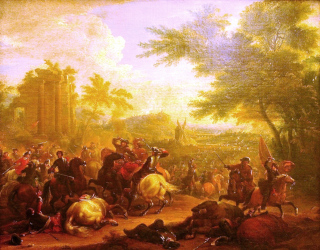
(Pictured: The battle of Cassano 1705 (War of the Spanish Succession), painted by Jean Baptiste Martin (1659-1735). Oil on canvas, Heeresgeschichtliches Museum, Vienna, Austria)
The Battle of Utoy Creek is fought August 4–7, 1864, during the Atlanta Campaign of the American Civil War. Major GeneralWilliam Tecumseh Sherman‘s Union armies have partially encircled the city of Atlanta, Georgia, which is being held by Confederate forces under the command of GeneralJohn Bell Hood. Sherman has at this point adopted a strategy of attacking the railroad lines into Atlanta, hoping to cut off his enemies’ supplies. This is the third direct attack on Confederate positions during the campaign and the effect of success would have ended the siege and won Atlanta on August 6, 1864.
Although Schofield’s troops are at Utoy Creek on August 2, they, along with the XIV Corps, Army of the Cumberland, do not cross until August 4. An initial attack by the Regular Brigade against James Patton Anderson‘s Division CSA of Stephen Dill Lee‘s Corps is unsuccessful. In addition, the Confederates dismount a brigade of cavalry, Armstrong’s, in the front of the federals in a deception plan, a feinted attack that is successful in delaying the combined force of the XXIII and XIV Corps USA.
Schofield makes an additional movement to exploit this situation on the morning of August 5. Although initially successful, Schofield has to regroup his forces, which takes the rest of the day. The delay allows the Confederates to strengthen their defenses with an abatis, which slows the Union attack when it restarts on the morning of August 6. The Federals are repulsed with heavy losses by William Brimage Bate‘s division and fail in an attempt to break the main defenses to gain the railroad.
On August 7, the Union troops move toward the Confederate main line skirmishing and extending to their right and entrench. Several attacks are made at Sandtown Road (Campbellton at Adams Park) on August 10 and East Point on August 18. Here US Forces remain, as far south as the Atlanta Christian College, until late August 1864 when the failure of Schofield’s offensive operations convinces Sherman to move on the Confederate lines of communication and supply.
After four years, all combatants are struggling to cope with the financial and material costs of the war. Hoping to end the war through a negotiated peace, Louis XIV of France decides to first improve his position by taking the offensive in the Rhineland, Catalonia and Flanders.
William has some 50,000 English, Dutch, German, and Spanish troops against about 80,000 French troops under Marshal Luxembourg, French commander in Flanders. William’s army has a strong defensive position to compensate for its numerical inferiority.
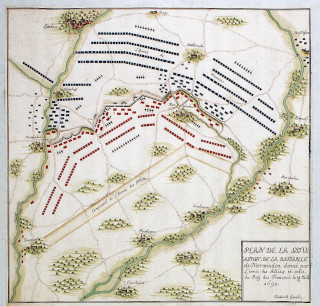
Luxembourg outmaneuvers the Allies. By doing so, he achieves local superiority and traps William’s army in an extremely dangerous position, with a river to their rear. Most of the fighting takes place on the Allied right, which protects the only bridge over the river, which is strongly fortified and holds the bulk of their artillery. On the French left flank, James FitzJames, 1st Duke of Berwick, and Patrick Sarsfield command in the assault on the village of Neerwinden, which they capture and lose twice before finally holding it.
The French assault the Allied position three times before the Gardes Françaises and the french cavalry under Antoine de Pas de Feuquières finally penetrate the Allied defences and drive William’s army from the field in a rout. The battle is, however, quite costly for both sides. The Irish win a measure of revenge against the victor of the Boyne, but it comes at a heavy price. Sarsfield, the defender of Limerick two years earlier, beloved by the Irish soldiers, is wounded and dies of his wounds three days later at Huy in Belgium, where he is buried in the grounds of St. Martin’s Church.
The French fail to follow up on their victory. The bulk of the Allied army escapes, although most of their artillery is abandoned. Like Steenkerque the previous year, Landen is yet another French victory that fails to achieve the decisive result needed to end the war. The Allies quickly replace their losses, leaving the overall position unchanged.
It is during this battle that, seeing the French determination to gain the high ground in spite of the murderous Allied volleys, William exclaims “Oh! That insolent nation!”
Brugha is born Charles William St. John Burgess of mixed Roman Catholic and Protestant parentage in Dublin on July 18, 1874. He attends Colmkille Schools until 1888 when he is admitted to Belvedere College. He intends to study medicine, but this does not come to fruition after his father’s business fails in 1890. He is seen as an austere figure, not very different from Éamon de Valera, and is known not to smoke cigarettes, swear or drink alcohol.
In 1899, Brugha joins the Gaelic League, and he subsequently changes his name from Charles Burgess to Cathal Brugha. He meets his future wife, Caitlín Kingston, at an Irish class in Birr, County Offaly, and they marry in 1912. The marriage produces six children. He becomes actively involved in the Irish Republican Brotherhood (IRB) and in 1913 he becomes a lieutenant in the Irish Volunteers. He leads a group of twenty Volunteers to receive the arms smuggled into Ireland in the Howth gun-running of 1914.
Brugha is second-in-command at the South Dublin Union under Commandant Éamonn Ceannt in the Easter Rising of 1916. On the Thursday of Easter Week, being badly wounded, he is unable to leave when the retreat is ordered. Brugha, weak from loss of blood, continues to fire upon the enemy and is found by Eamonn Ceannt singing “God Save Ireland” with his pistol still in his hands. He recovers over the next year but is left with a permanent limp.
Brugha proposes a Republican constitution at the 1917 Sinn Féin convention, which is unanimously accepted. In October 1917, he becomes Chief of Staff of the Irish Republican Army and holds that post until March 1919.
Brugha is elected Ceann Comhairle of Dáil Éireann at its first meeting on January 21, 1919, and he reads out the Declaration of Independence in Irish, which ratifies “the establishment of the Irish Republic.” On the following day he is appointed president of the ministry pro tempore. He retains this position until April 1, 1919, when Éamon de Valera takes his place.
Brugha has differences with Michael Collins, who, although nominally only the Irish Republican Army‘s (IRA) Director of Intelligence, has far more influence in the organisation as a result of his position as a high-ranking member of the IRB, an organisation that Brugha sees as undermining the power of the Dáil and especially the Ministry for Defence. He opposes the oath of allegiance required for membership of the IRB. In 1919, his proposition that all Volunteers should swear allegiance to the Irish Republic and the Dáil is adopted.
At a top-level IRA meeting in August 1920, Brugha argues against ambushes of Crown forces unless there is first a call to surrender, but it is dismissed as unrealistic by the brigade commanders present. He also has the idea of moving the front line of the war to England but is opposed by Collins.
On January 7, 1922, Brugha votes against the Anglo-Irish Treaty. During the Treaty debates, he points out that Collins has only a middling rank in the Department for Defence, which supervises the IRA, even though Griffith hails him as “the man who had won the war.” It is argued that, by turning the issue into a vote on Collins’ popularity, Brugha swings the majority against his own side. Frank O’Connor, in his biography of Collins, states that two delegates who had intended to vote against the Treaty changed sides in sympathy with Collins. Brugha leaves the Dáil and is replaced as Minister for Defence by Richard Mulcahy.
In the months between the Treaty debates and the outbreak of Irish Civil War, Brugha attempts to dissuade his fellow anti-treaty army leaders, including Rory O’Connor, Liam Mellows and Joe McKelvey, from taking up arms against the Free State. When the IRA occupies the Four Courts, he and Oscar Traynor call on them to abandon their position. When they refuse, Traynor orders the occupation of the area around O’Connell Street in the hope of easing the pressure on the Four Courts and of forcing the Free State to negotiate.
On June 28, 1922, Brugha is appointed commandant of the forces in O’Connell Street. The outbreak of the Irish Civil War ensues in the first week of July when Free State forces commence shelling of the anti-treaty positions.
Most of the anti-Treaty fighters under Traynor escape from O’Connell Street when the buildings they are holding catch fire, leaving Brugha in command of a small rearguard. On July 5, he orders his men to surrender, but refuses to do so himself. He then approaches the Free State troops, brandishing a revolver. He sustains a bullet wound to the leg which “severed a major artery causing him to bleed to death.” He dies on July 7, 1922, eleven days before his 48th birthday. He had been re-elected as an anti-Treaty TD at the 1922 Irish general election but dies before the Dáil assembles. He is buried in Glasnevin Cemetery in Dublin.
Lemass is a member of the 3rd Battalion, Dublin Brigade of the IRA. He along with his younger brother Seán, later Ireland’s fourth Taoiseach, take part in the Easter Rising where he fights at the General Post Office (GPO). He is employed as an engineer in Dublin Corporation. When the Irish Civil War breaks out in 1922 both he and his brother take the Anti-Treaty side, and both fight together at the Four Courts.
After the fall of the Four Courts, Lemass is imprisoned but manages to escape and makes his way to England. He returns to Ireland in the summer of 1923 when the cease-fire has been declared and goes back to his former employers at the Dublin Corporation, hoping to resume his work there. He offers the town clerk, John J. Murphy, if he would forward a letter to the authorities that he plans to write, “stating that he had no intention of armed resistance to the Government.”
In July 1923, two months after the Irish Civil War ends, Lemass is kidnapped in broad daylight by Free State agents outside MacNeils Hardware shop, at the corner of Exchequer and Drury Street. Three months later, on October 13, his decomposed body is found on the Featherbed Mountain near Sally Gap, twenty yards from the Glencree Road, in an area known locally as ‘The Shoots.’
The body is clothed in a dark tweed suit, light shirt, silk socks, spats and a knitted tie. The pockets contain Rosary beads, a watch-glass, a rimless glass, a tobacco pouch and an empty cigarette case. The trousers’ pockets are turned inside out, as if they had been rifled. There is what appears to be an entrance bullet wound on the left temple and the top of the skull is broken, suggesting an exit wound. He has been shot at least three times in the head and his left arm is fractured, his teeth have been brutally forced from his jaws and his right foot is never found. It is likely that he is killed elsewhere and dumped at this spot.
Meeting two days later, Dublin Council passes a strongly worded vote of sympathy with Lemass’s family. Describing their fellow employee as an “esteemed and worthy officer of the Council who had been foully and diabolically murdered,” the Council adjourns for one week as a mark of respect.
(Pictured: Captain Noel Lemass Memorial Stone at the spot where his body was found on Featherbed Mountain)
Kelly resumes his role as colonel of his regiment as more senior officers return to the brigade. However, with the death of Colonel Richard Byrnes at the Battle of Cold Harbor in 1864, he again commands the brigade. At the age of 42, he dies during the Siege of Petersburg on June 16, 1864, when he is shot through the head while leading the Irish Brigade forward against Confederate earthworks. His body is recovered and sent back to New York for his funeral. He is buried in Calvary Cemetery in Woodside, Queens, New York.
During the night of June 8–9, 1862, Brig. Gen.Charles S. Winder‘s Stonewall Brigade is withdrawn from its forward position near Bogota, a large house owned by Gabriel Jones, and rejoins Jackson’s division at Port Republic. Winder’s brigade is assigned the task of spearheading the assault against Union Army forces east of the river. Brig. Gen. Isaac R. Trimble‘s brigade and elements of Col. John M. Patton, Jr.’s, are left to delay Maj. Gen. John C. Frémont‘s Union forces at Cross Keys, while the rest of Maj. Gen. Richard S. Ewell‘s division march to Port Republic to be in position to support Winder’s attack.
Brig. Gen. Erastus B. Tyler‘s brigade joins Col. Samuel S. Carroll‘s brigade north of Lewiston on the Luray Road. The rest of Brig. Gen. James Shields‘s (a native of County Tyrone) division is strung out along the muddy roads back to Luray. General Tyler, in command on the field, advances at dawn on June 9 to the vicinity of Lewiston. He anchors the left of his line on a battery positioned on the Lewiston Coaling, extending his infantry west along Lewiston Lane to the South Fork near the site of Lewis’s Mill. The right and center are supported by artillery, 16 guns in all.
Winder’s brigade crosses the river by 5:00 AM and deploys to attack east across the bottomland. He sends two regiments, the 2nd Virginia Infantry and 4th Virginia Infantry, into the woods to flank the Union line and assault the Coaling. When the main Confederate battle line advances, it comes under heavy fire from the Union artillery and is soon pinned down. Confederate batteries are brought forward onto the plain but are outgunned and forced to seek safer positions. Ewell’s brigades are hurried forward to cross the river. Seeing the strength of the Union artillery at the Coaling, Jackson sends Richard Taylor‘s brigade, including the famed Louisiana Tigers, to the right into the woods to support the flanking column that is attempting to advance through the thick underbrush.
Winder’s brigade renews its assault on the Union right and center, taking heavy casualties. General Tyler moves two regiments from the Coaling to his right and launches a counterattack, driving Confederate forces back nearly half a mile. While this is occurring, the first Confederate regiments probe the defenses of the Coaling but are repulsed.
Finding resistance fiercer than anticipated, Jackson orders the last of Ewell’s forces still north of Port Republic to cross the rivers and burn the North Fork bridge. These reinforcements begin to reach Winder, strengthening his line and stopping the Union counterattack. Taylor’s brigade reaches a position in the woods across from the Coaling and launches a fierce attack, which carries the hill, capturing five guns. Tyler immediately responds with a counterattack, using his reserves. These regiments, in hand-to-hand fighting, retake the position. Taylor shifts a regiment to the far right to outflank the Union battle line. The Confederate attack again surges forward to capture the Coaling. Five captured guns are turned against the rest of the Union line. With the loss of the Coaling, the Union position along Lewiston Lane becomes untenable, and Tyler orders a withdrawal about 10:30 AM. Jackson orders a general advance.
William B. Taliaferro‘s fresh Confederate brigade arrives from Port Republic and presses the retreating Federals for several miles north along the Luray Road, taking several hundred prisoners. The Confederate army is left in possession of the field. Shortly after noon, Frémont’s army begins to deploy on the west bank of the South Fork, too late to aid Tyler’s defeated command, and watches helplessly from across the rain-swollen river. Frémont deploys artillery on the high bluffs to harass the Confederate forces. Jackson gradually withdraws along a narrow road through the woods and concentrates his army in the vicinity of Mt. Vernon Furnace. Jackson expects Frémont to cross the river and attack him on the following day, but during the night Frémont withdraws toward Harrisonburg.
The Civil War Trust, a division of the American Battlefield Trust, and its partners have acquired and preserved 947 acres of the Port Republic battlefield in seven transactions since 1988. The battlefield is located about three miles east of Port Republic at U.S. Route 340 and Ore Bank Road. It retains its wartime agrarian appearance. The Port Republic Battle Monument is on Ore Bank Road beside the site of The Coaling, a key battlefield feature. The Coaling is the first land acquisition of the modern Civil War battlefield preservation movement. The 8.55-acre site is donated to the Trust’s forerunner, the Association for the Preservation of Civil War Sites by the Lee-Jackson Foundation in 1988.
Fitzgerald is first elected to the Parliament of Ireland in 1783. His enthusiasm for the French Revolution leads to dismissal from the army in 1792. Four years later he joins the Society of United Irishmen, a nationalist organization that aspires to free Ireland from English control. This group appoints him to head the military committee formed to plan an uprising and obtain aid from the French revolutionary regime.
Although the French delay in supplying arms and troops, Fitzgerald’s committee proceeds with its plans for a general rebellion. The insurrection is set for May 23, 1798. In March his co-conspirators are seized by government agents, making him the most important United Irish leader still at liberty. On May 9 a reward of £1,000 is offered by Dublin Castle for his apprehension.
FitzGerald’s hiding place in a house in Thomas Street, Dublin is disclosed by a Catholic barrister and informant named Francis Magan. On May 18 Major Henry Sirr leads a military party to the house where FitzGerald is in bed suffering from a fever. Alerted by the commotion, he jumps out of bed and, ignoring the pleas of the arresting officers Captain William Bellingham Swan and Captain Daniel Frederick Ryan to surrender peacefully, FitzGerald stabs Swan and mortally wounds Ryan with a dagger in a desperate attempt to escape. He is secured only after Major Sirr shoots him in the shoulder.
FitzGerald is conveyed to New Prison, Dublin where he is denied proper medical treatment. After a brief detention in Dublin Castle he is taken to Newgate Prison, Dublin where his wound, which had now become infected, becomes mortally inflamed. His wife, whom the government probably has enough evidence to convict of treason, had fled the country, never to see her husband again, but his brother Henry and his aunt Lady Louisa Conolly are allowed to see him in his last moments.
FitzGerald dies at the age of 34 on June 4, 1798, as the rebellion rages outside. He is buried the next day in the cemetery of St. Werburgh’s Church, Dublin. An Act of Attainder confiscating his property is passed as 38 Geo. 3 c. 77 but is eventually repealed in 1819.
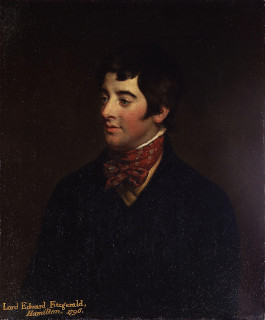
(Pictured: Portrait of Edward FitzGerald by Hugh Douglas Hamilton, 1796. National Portrait Gallery, London.)
The series of killings which lead to the Coagh ambush begin on April 26, 1988, when a 23-year-old UDR soldier from Coagh, Edward Gibson, is shot dead by an IRA unit at Ardboe while at work for Cookstown Council on a bin lorry. The Ulster Volunteer Force (UVF) retaliates by murdering Phelim McNally, brother of local Sinn Féin councillor Francie McNally, on November 24, 1988. This is followed by an IRA attack upon a car maintenance garage business owned by retired UDR soldier Leslie Dallas on March 7, 1989, in which Dallas, along with two civilian pensioners that are in the premises at the time of the attack, are all murdered by machine gun fire from a passing vehicle, the IRA attackers driving off afterwards cheering as reported by eyewitnesses in the vicinity.
The tit-for-tat campaign around Coagh continues on November 29, 1989, when UVF gunmen attack a pub owned by IRA member Liam Ryan, shooting Ryan dead. A customer in the premises is also killed in the incident. On March 8, 1990, part-time UDR soldier and construction worker Thomas Jamison is killed by the IRA in a gun and grenade ambush attack on a lorry he is driving near Donaghmore, while delivering concrete to a British Army base. On March 3, 1991, the Ulster Volunteer Force carries out an attack at the village of Cappagh, killing three IRA members. On April 9, 1991, the IRA’s East Tyrone Brigade shoots dead Derek Ferguson in Coagh, a cousin of local Member of Parliament Reverend William McCrea, stating afterward that he was a paramilitary with the Ulster Volunteer Force. Ferguson’s family subsequently refutes that he had anything to do with Loyalist paramilitarism.
At 7:30 AM on June 3, 1991, three Tyrone IRA paramilitaries, Tony Doris (21), Michael “Pete” Ryan (37) and Lawrence McNally (39), drive a stolen Vauxhall Cavalier from Moneymore, County Londonderry to the village of Coagh, crossing the border of counties Londonderry and Tyrone, to kill a part-time Ulster Defence Regiment soldier, who is in his civilian life a contractor that works with the security forces. Their intent, however, is known to the British security forces, having been revealed by either a Crown agent within the IRA itself or from covert technical surveillance. In consequence a detachment from the British Army’s Special Air Service is lying in wait on both sides of Coagh’s main street, and also in a red Bedford lorry at the scene.
The stolen car is driven by Doris towards the centre of the village, its journey from Moneymore being tracked on the ground and in the air. At the scene of the ambush the British Army has set up a “decoy” target for the IRA to go for in the form of an SAS trooper who is pretending to be their intended victim, sitting in his car at a regular spot while waiting to pick up a friend on their way to work, which IRA intelligence had established as a behavioral pattern of their intended victim. When the stolen car carrying the IRA men approaches the scene, the Special Air Service detachment opens sustained automatic fire upon it from close range. Doris is immediately hit and the out-of-control car crashes into two nearby parked cars. The shooting continues until the car explodes in flames. According to an eyewitness, one of the IRA men in the car returns fire from within the vehicle after the crash.
Some reports claim at least two of the IRA men attempt to exit the crashed car and are subsequently found lying half out of its doors by the later police investigation of the scene. Relatives of the IRA men subsequently state that they had received information from the scene that two of the IRA attackers had fled on foot from the car after the crash, but had been pursued after and shot down by the British Army in the vicinity, with their bodies being taken back to the car, which is subsequently reported to be riddled with over 200 bullet holes. A Royal Ulster Constabulary crime-scene report states that a balaclava belonging to one of the IRA men is found some distance away from the vehicle.
The bodies of Doris, Ryan and McNally are badly burned and have to be identified by police using their dental records. Two rifles are recovered from within the burned-out stolen car and subsequent police forensic examination reveals that they had both been used in the multiple murders at Leslie Dallas’s garage in March 1989.
(Pictured: Looking towards Coagh village, from the County Londonderry side)