seamus dubhghaill

Promoting Irish Culture and History from Little Rock, Arkansas, USA


Leave a comment

Birth of Charles Boyle, 4th Earl of Orrery

Charles Boyle, 4th Earl of Orrery, English nobleman, statesman and patron of the sciences, is born in Little Chelsea, London on July 28, 1674.

Boyle is the second son of Roger Boyle, 2nd Earl of Orrery, and his wife Lady Mary Sackville, daughter of Richard Sackville, 5th Earl of Dorset. He is educated at Christ Church, Oxford, and soon distinguishes himself by his learning and abilities. Like the first earl, he is an author, soldier and statesman. He translates Plutarch‘s life of Lysander, and publishes an edition of the epistles of Phalaris, which engages him in the famous controversy with Richard Bentley. He is a member of the Parliament of Ireland and sits for the Charleville constituency between 1695 and 1699. He is three times member for the town of Huntingdon and, upon the death of his brother, Lionel, 3rd earl, in 1703, he succeeds to the title.

Boyle enters the army, and in 1709 is raised to the rank of major-general and sworn one of Her Majesty’s Privy Council. He is appointed to the Order of the Thistle and appointed queen’s envoy to the states of Brabant and Flanders. Having discharged this trust with ability, he is created an English peer, as Baron Boyle of Marston, in Somerset. He inherits the estate in 1714.

Boyle becomes a Fellow of the Royal Society in 1706. In 1713, under the patronage of Boyle, clockmaker George Graham creates the first mechanical solar system model that can demonstrate proportional motion of the planets around the Sun. The device is named the orrery in the Earl’s honour.

Boyle receives several additional honours in the reign of George I but, having had the misfortune to fall under the suspicion of the government for playing a part in the Jacobite Atterbury Plot, he is committed to the Tower of London in 1722, where he remains six months, and is then admitted to bail. On a subsequent inquiry he is discharged.

Boyle writes a comedy, As you find it, printed in 1703 and later publishes together with the plays of the first earl. In 1728, he is listed as one of the subscribers to the Cyclopaedia of Ephraim Chambers.

Charles Boyle dies at his home in Westminster on August 28, 1731 and is buried in Westminster Abbey. He bequeaths his personal library and collection of scientific instruments to Christ Church Library. The instruments are now on display in the Museum of the History of Science, Oxford.

Boyle’s son John, the 5th Earl of Orrery, succeeds to the earldom of Cork on the failure of the elder branch of the Boyle family, as earl of Cork and Orrery.

Leave a comment

Birth of Poet Michael Longley

Michael Longley, one of Northern Ireland’s foremost contemporary poets, is born in Belfast on July 27, 1939. He is educated at the Royal Belfast Academical Institution and subsequently reads Classics at Trinity College, Dublin, where he edits the student literary magazine Icarus.

Longley is renowned for the quiet beauty of his compact, meditative lyrics. Known for using classical allusions to cast provocative light on contemporary concerns, including Northern Ireland’s “Troubles,” his poetry is also marked by sharp observation of the natural world, deft use of technique, and deeply felt emotion. His debut volume, No Continuing City (1969), heralds the arrival of a new talent from a region which has already produced recognized talents like Seamus Heaney and Derek Mahon. However, his early influences are English poets like Philip Larkin, Louis MacNeice, and the First World War poets, as well as masters from the classical tradition. The critic Langdon Hammer describes Longley’s poems as masterpieces of “lucidity, economy, sincerity…by means of meticulous, unpretentious technique.”

Longley’s work engages diverse subjects, including Homeric literature, the landscape of Carrigskeewaun, jazz, Walter Mitty, and the politics of Northern Ireland. On the public and political responsibilities of being a Northern Irish poet, he says, “Though the poet’s first duty must be to his imagination, he has other obligations, and not just as a citizen. He would be inhuman if he did not respond to tragic events in his own community, and a poor artist if he did not seek to endorse that response imaginatively.” Reviewing his Selected Poems (1993), critic Fran Brearton praises in particular Longley’s more political poems, noting his “use of a compassionate yet unsentimental voice, and an attention to detail which restores specificity at a point in history when it is most in danger of being lost in abstraction – numbers, dates, death-tolls counted beyond comprehension.”

After a 12-year publishing silence, Longley’s 1991 return, Gorse Fires, wins the Whitbread Poetry Prize. Subsequently, The Weather in Japan (2000) wins The Irish Times Literature Prize for Poetry, the Hawthornden Prize, and the T.S. Eliot Prize. Other publications include Snow Water (2004) and Collected Poems (2006). In 2001 Longley is awarded the Queen’s Gold Medal for Poetry. He is a fellow of the Royal Society of Literature.

Longley is Professor of Poetry for Ireland from 2007 to 2010, a cross-border academic post set up in 1998, previously held by John Montague, Nuala Ní Dhomhnaill, and Paul Durcan. He is succeeded in 2010 by Harry Clifton.


Leave a comment

Birth of John Field, Pianist & Composer

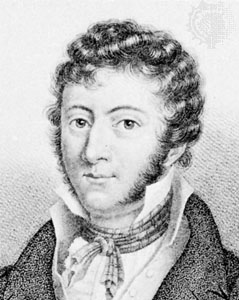
John Field, pianist, composer, and teacher, is born in Dublin into a musical family on July 26, 1782. He is the eldest son of Irish parents who are members of the Church of Ireland. His father, Robert Field, earns his living by playing the violin in Dublin theatres.

Field first studies the piano under his grandfather, who is a professional organist, and later under Tommaso Giordani. He makes his debut at the age of nine, a performance that is well-received, on March 24, 1792 in Dublin. By late 1793, the Fields have settled in London, where the young pianist starts studying with Muzio Clementi.

Field continues giving public performances and soon becomes famous in London, attracting favourable comments from the press and the local musicians. Around 1795 his performance of a Jan Ladislav Dussek piano concerto is praised by Joseph Haydn. Field continues his studies with Clementi, also helping the Italian with the making and selling of instruments. He also takes up the violin, which he studies under Johann Peter Solomon. His first published compositions are issued by Clementi in 1795. The first historically important work, the Piano Concerto No. 1, H 27, is premiered by the composer in London on February 7, 1799, when he is 16 years old. Field’s first official opus is a set of three piano sonatas published by Clementi in 1801.

In summer 1802 Field and Clementi leave London and go to Paris on business. They soon travel to Vienna, where Field takes a brief course in counterpoint under Johann Georg Albrechtsberger, and in early winter arrive in Saint Petersburg. Field is inclined to stay, impressed by the artistic life of the city. Clementi leaves in June 1803, but not before securing Field a teaching post in Narva. After Clementi’s departure, Field has a busy concert season, eventually performing at the newly founded Saint Petersburg Philharmonia. In 1805 Field embarks on a concert tour of the Baltic states, staying in Saint Petersburg during the summer. The following year he gives his first concert in Moscow. He returns to Moscow in April 1807 and apparently does not revisit Saint Petersburg until 1811. In 1810 he marries Adelaide Percheron, a French pianist and former pupil.

In 1811 Field returns to Saint Petersburg where he spends the next decade of his life, more productive than ever before, publishing numerous new pieces and producing corrected editions of old ones. He is successful in establishing a fruitful collaboration with both H.J. Dalmas, the most prominent Russian publisher of the time, and Breitkopf & Härtel, one of the most important music publishing houses of Europe. By 1819 Field is sufficiently wealthy to be able to refuse the position of court pianist that is offered to him. His lifestyle and social behaviour are becoming more and more extravagant.

In 1818 Field revisits Moscow on business, prompted by his collaboration with the publisher Wenzel. He and his wife give a series of concerts in the city in 1821, the last of which marks their last appearance in public together. Adelaide leaves Field soon afterward and attempts a solo career, which is not particularly successful. Field stays in Moscow and continues performing and publishing his music. In 1822 he meets Johann Nepomuk Hummel and the two collaborate on a performance of Hummel’s Sonata for Piano 4-Hands, Op. 92.

Partly as a result of his extravagant lifestyle, Field’s health begins to deteriorate by the mid-1820s. From about 1823 his concert appearances started decreasing. By the late 1820s he is suffering from colorectal cancer. Field leaves for London to seek medical attention. He arrives in September 1831 and, after an operation, gives concerts there and in Manchester. He stays in England for some time, meeting distinguished figures such as Felix Mendelssohn and Ignaz Moscheles. After a series of concerts in various European cities, Field spends nine months in a Naples hospital. His Russian patrons rescue him. He briefly stays with Carl Czerny in Vienna, where he gives three recitals, and then returns to Moscow. He gives his last concert in March 1836 and dies in Moscow almost a year later, on January 23, 1837, from pneumonia. He is buried in the Vvedenskoye Cemetery.


Leave a comment

Birth of Watercolourist Michael Angelo Hayes

Painter Michael Angelo Hayes is born in Waterford on July 25, 1820. Probably the best 19th century painter of animals in Ireland, Hayes is most accomplished as a watercolourist, although he occasionally uses oils.

Hayes is the son and pupil of Tipperary watercolour miniaturist Edward Hayes RHA. It is clear from his christening that he is expected to become an artist.  Fortunately, the younger Hayes is a talented draughtsman, and by his late teens has acquired something of a reputation as a painter of horses and military subjects.

Hayes begins showing at the Royal Hibernian Academy (RHA) in 1837, then for three years 1840-1842.  In 1842, he is appointed Military Painter-in-ordinary to the Lord Lieutenant.  He passes the next few years in London, where he exhibits watercolours at the New Society of Painters in Water Colours, of which he is elected an Associate Member in 1848, the same year he makes his one and only contribution to the Royal Academy of Arts.

Returning to Dublin, Hayes resumes exhibiting at the RHA, at the same time becoming involved in its administration.  He is elected an Associate member in 1853, a full Academician the following year, and Secretary in 1856.  The affairs of the Academy are totally disorganized at the time, inducing Hayes and others to resolve the situation.  His efforts to reform the institution and secure its finances meets with entrenched opposition from older members, which results in Hayes being removed from his post, although he is successfully reinstated in 1861.

Not long afterwards he is appointed secretary to the Lord Mayor of Dublin, Peter McSwiney, who happens to be his brother-in-law, and later becomes City Marshal in 1867.  He continues as Secretary of the RHA until he resigns in 1870, and continues showing until 1874.

Hayes makes a special study of horses in motion, and in 1876 publishes his conclusions in an illustrated pamphlet, The Delineation of Animals in Rapid Motion.  One of his Dublin paintings, Sackville Street, Dublin, depicts a view of Dublin’s premier street in the 1850s. The painting is a documentary of social life in Dublin. It achieves widespread popularity when reprinted as a lithograph.

Michael Angelo Hayes dies prematurely in 1877 in a tragic drowning accident at his home.


Leave a comment

Death of Sinn Féin Leader Margaret Buckley

Margaret Buckley, Irish republican and leader of Sinn Féin from 1937 to 1950, dies on July 24, 1962.

Originally from Cork, Buckley joins Inghinidhe na hÉireann, which was founded in 1900, taking an active role in the women’s movement. She is involved in anti-British royal visit protests in 1903 and 1907 and is among the group that founds An Dún in Cork in 1910. In 1906, she marries Patrick Buckley, described as “a typical rugby-playing British civil servant.” After his death she moves into a house in Marguerite Road, Glasnevin, Dublin. Later, she returns to Cork to care for her elderly father.

Arrested in the aftermath of 1916 Easter Rising, she is released in the amnesty of June 1917 and plays a prominent role in the reorganisation of Sinn Féin. She is involved in the Irish War of Independence in Cork.

After the death of her father, Buckley returns to Dublin. In 1920, she becomes a Dáil Court judge in the North city circuit, appointed by Austin Stack, the Minister for Home Affairs of the Irish Republic. She opposes the Anglo-Irish Treaty and is interned in Mountjoy Gaol and Kilmainham Gaol, where she goes on a hunger strike. She is released in October 1923. During her imprisonment, she is elected Officer Commanding (OC) of the republican prisoners in Mountjoy, Quartermaster (QM) in the North Dublin Union and OC of B-Wing in Kilmainham. She is an active member of the Women Prisoners’ Defence League, founded by Maud Gonne and Charlotte Despard in 1922.

In 1929, she serves as a member of Comhairle na Poblachta which unsuccessfully attempts to resolve the differences between Sinn Féin and the Irish Republican Army (IRA). She is also an organiser for the Irish Women Workers’ Union.

At the October 1934 Sinn Féin ardfheis, Buckley is elected one of the party’s vice-presidents. Three years later, in 1937, she succeeds Cathal Ó Murchadha, who is a former Teachta Dála (TD) of the second Dáil Éireann, as President of Sinn Féin at an ardfheis attended by only forty delegates.

When she assumes the leadership of Sinn Féin, the party is not supported by the IRA, which had severed its links with the party in the 1920s. When she leaves the office in 1950, relations with the IRA have been resolved. As President she begins the lawsuit Buckley v. Attorney-General, the Sinn Féin Funds case, in which the party seeks unsuccessfully to be recognised as owners of money raised by Sinn Féin before 1922 and held in trust in the High Court since 1924.

In 1938, her book, The Jangle of the Keys, about the experiences of Irish Republican women prisoners interned by the Irish Free State forces is published. In 1956, her Short History of Sinn Féin is published.

Buckley serves as honorary vice-president of Sinn Féin from 1950 until her death in 1962. She is the only member of the Ard Chomhairle of the party not to be arrested during a police raid in July 1957.

Margaret Buckley dies on July 24, 1962, and is buried in St. Finbarr’s Cemetery in Cork.


Leave a comment

Birth of Raymond Thornton Chandler, Novelist & Screenwriter

Raymond Thornton Chandler, American novelist and screenwriter, is born to Irish Quaker and Irish Catholic parents in Chicago, Illinois on July 23, 1888.

Chandler spends his early years in Plattsmouth, Nebraska, living with his mother and father near his cousins and his aunt and uncle. His father, an alcoholic civil engineer who works for the railway, abandons the family. To obtain the best possible education for Ray, his mother, originally from Ireland, moves them to the area of Upper Norwood in the London Borough of Croydon, England in 1900. In 1912, he borrows money from his Waterford uncle, who expects it to be repaid with interest, and returns to America, visiting his aunt and uncle before settling in San Francisco. The following year he moves to Los Angeles.

In 1932, at the age of forty-four, Chandler becomes a detective fiction writer after losing his job as an oil company executive during the Great Depression. His first short story, “Blackmailers Don’t Shoot,” is published in 1933 in Black Mask, a popular pulp magazine. His first novel, The Big Sleep, is published in 1939. In addition to his short stories, Chandler publishes seven novels during his lifetime. An eighth novel is in progress at the time of his death and is completed by Robert B. Parker. All but Playback have been made into motion pictures, some more than once.

Chandler has an immense stylistic influence on American popular literature. He is considered to be a founder of the hardboiled school of detective fiction, along with Dashiell Hammett, James M. Cain and other Black Mask writers. The protagonist of his novels, Philip Marlowe, like Hammett’s Sam Spade, is considered by some to be synonymous with “private detective.” Both are played in films by Humphrey Bogart, whom many consider to be the quintessential Marlowe.

Some of Chandler’s novels are important literary works, and three have been regarded as masterpieces: Farewell, My Lovely (1940), The Little Sister (1949), and The Long Goodbye (1953). The Long Goodbye is praised in an anthology of American crime stories as “arguably the first book since Hammett’s The Glass Key, published more than twenty years earlier, to qualify as a serious and significant mainstream novel that just happened to possess elements of mystery.”

In the year before his death, he is elected president of the Mystery Writers of America. He dies on March 26, 1959, in La Jolla, California. He is buried in Mount Hope Cemetery in San Diego, California.


Leave a comment

Death of Thomas Croke, Archbishop of Cashel & Emly

Thomas William Croke, the second Catholic Bishop of Auckland in New Zealand (1870–74) and later Archbishop of Cashel and Emly in Ireland, dies on July 22, 1902. He is important in the Irish nationalist movement especially as a Champion of the Irish National Land League in the 1880s. The main Gaelic Athletic Association stadium in Dublin is named Croke Park in his honour.

Croke is born in Castlecor, County Cork, on May 28, 1824. He is educated in Charleville, County Cork, the Irish College in Paris and the Pontifical Irish College in Rome, winning academic distinctions including a Doctor of Divinity with honours. He is ordained in May 1847. Returning to Ireland for a short time he is appointed a Professor in St. Patrick’s, Carlow College. The Irish radical William O’Brien says that Croke fought on the barricades in Paris during the French Revolution of 1848. Croke returns to Ireland and spends the next 23 years working there. In 1858 he becomes the first president of St. Colman’s College, Fermoy, County Cork and then serves as both parish priest of Doneraile and Vicar General of Cloyne diocese from 1866 to 1870. Croke attends the First Vatican Council as the theologian to the Bishop of Cloyne 1870.

Croke gains the good opinion of the Irish ecclesiastical authorities and is rewarded in 1870 by his promotion to Bishop of Auckland in New Zealand. His former professor, Paul Cullen, by then Cardinal Archbishop of Dublin, is largely responsible for filling the Australasian Catholic church with fellow Irishmen. His strong recommendations lead to Croke’s appointment. Croke arrives at Auckland on December 17, 1870, on the City of Melbourne. During his three years as bishop, he restores firm leadership to a diocese left in disarray by his predecessor, Bishop Jean Baptiste Pompallier. He devotes some of his considerable personal wealth to rebuilding diocesan finances and also takes advantage of Auckland’s economic growth following the development of the Thames goldfields to further his aims, ensuring that all surplus income from parishes at Thames and Coromandel is passed on to him, and he institutes a more rigorous system for the Sunday collection at St. Patrick’s Cathedral. He imports Irish clergy to serve the growing Catholic community, and with Patrick Moran, the first Catholic Bishop of the Diocese of Dunedin, he tries unsuccessfully to secure an Irish monopoly on future episcopal appointments in New Zealand. Croke supports separate Catholic schools and their right to state aid and voices his opposition to secular education as Auckland’s Catholic schools are threatened by the provincial council’s Education Act 1872, which helps to create a free, secular and compulsory education system. However, generally, Croke’s image is uncontroversial. On January 28, 1874, after barely three years in office, Croke departs for Europe, on what is ostensibly a 12-month holiday, and he does not return to New Zealand.

Croke becomes a member of the Irish hierarchy when he is translated to be Archbishop of Cashel, one of the four Catholic Irish archbishoprics in 1875. Archbishop Croke is a strong supporter of Irish nationalism, aligning himself with the Irish National Land League during the Land War, and with the chairman of the Irish Parliamentary Party, Charles Stewart Parnell. In an 1887 interview he explains that he had opposed the League’s “No rent manifesto” in 1881, preferring to stop payment of all taxes.

Croke also associates himself with the Temperance Movement of Fr. Theobald Mathew and Gaelic League from its foundation in 1893. Within Catholicism he is a supporter of Gallicanism, as opposed to the Ultramontanism favoured by the Archbishop of Dublin, Cardinal Cullen. His support of nationalism causes successive British governments and Lord Lieutenant of Ireland‘s governments in Dublin to be deeply suspicious of him, as are some less politically aligned Irish bishops.

Following the scandal that erupts over Parnell’s relationship with Katharine O’Shea, the separated wife of fellow MP Captain William O’Shea, Archbishop Croke withdraws from active participation in nationalist politics.

Thomas Croke, 78, dies at the Archbishop’s Palace in Thurles, County Tipperary on July 22, 1902. He is buried at the Cathedral of the Assumption in Thurles. In honour of Croke, his successors as Archbishop of Cashel and Emly traditionally are asked to throw in the ball at the minor Gaelic football and All-Ireland Senior Hurling Championship finals.


Leave a comment

Birth of Thomas Bodkin, Art Historian & Collector

Professor Thomas Patrick Bodkin, lawyer, art historian, art collector and curator, is born in Dublin on July 21, 1887. He serves as Director of the National Gallery of Ireland in Dublin from 1927 to 1935 and founding Director of the Barber Institute of Fine Arts in Birmingham, England from 1935 until 1952, where he acquires the nucleus of the collection described by The Observer as “the last great art collection of the twentieth century.”

Bodkin is the eldest son of Matthias McDonnell Bodkin, a nationalist journalist, judge and Member of Parliament. Graduating from the Royal University of Ireland in 1908 he practises law from 1911 until 1916 while collecting art privately, influenced by his uncle Sir Hugh Lane. With the death of Lane in the sinking of the RMS Lusitania in 1915, Bodkin is charged with ensuring that Lane’s collection of art is displayed in Dublin, a dispute that would only finally be settled in 1957 and about which Bodkin is to write Hugh Lane and his Pictures in 1932.

Bodkin leaves the legal profession in 1916 to become a Governor of the National Gallery of Ireland, being appointed Director in 1927. He also serves in 1926 on the committee that commissions the design of the new coinage of the Republic of Ireland from Percy Metcalfe.

In 1935 Bodkin leaves Ireland upon being appointed Director of the newly established Barber Institute of Fine Arts and Barber Professor of Fine Art at the University of Birmingham. The funds available to the Barber Institute for the purchase of new works compare favourably even to some national museums and Bodkin is able to make a string of exceptional purchases in the depressed art market around the time of World War II. The collection that in 1935 numbers just seven works, by 1939 holds major pieces such as Tintoretto‘s Portrait of a Youth (1554), Simone Martini‘s St. John the Evangelist (1320), Nicolas Poussin‘s Tancred and Erminia (1634) and James Abbott McNeill Whistler‘s Symphony in White No. III (1867). Bodkin retires in 1952 but retains control over acquisitions until 1959. His successor as Director and Professor, Ellis Waterhouse, wistfully refers to Bodkin’s wayward later purchases as “Acts of Bod.”

Bodkin is also an active broadcaster and author, publishing personal reminiscences and translations of modern French poetry as well as works of art history and criticism. In particular, his The Approach to Painting (1927), an introduction for a popular audience, runs through many editions over the succeeding thirty years.

A few years before his death Bodkin appears on the BBC panel show Animal, Vegetable or Mineral? identifying curiosities from around the world, along with museum curator Hugh Shortt and archaeologist Mortimer Wheeler.

Bodkin is awarded the Civil Division of the Order of St. Gregory the Great for services to his church. A bust of Bodkin, previously exhibited at the Royal Academy in 1958, is donated to the Barber Institute of Fine Arts by its sculptor, Sir Charles Wheeler, President of the Royal Academy and a personal friend of Bodkin’s, on the latter’s death.

Bodkin is the subject of This Is Your Life in March 1960 when he was surprised by Eamonn Andrews at the BBC’s Costa Green Studios in Birmingham.

Thomas Bodkin dies in Birmingham, England on April 24, 1961. His remains are interred in Glasnevin Cemetery, Dublin.


Leave a comment

The Hyde Park and Regent’s Park Bombings

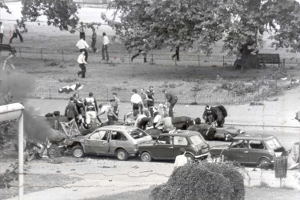
The Hyde Park and Regent’s Park bombings occur on July 20, 1982, in London. Members of the Provisional Irish Republican Army (IRA) detonate two bombs during British military ceremonies in Hyde Park and Regent’s Park, both in Central London.

At 10:40 AM, a nail bomb explodes in the boot of a blue Morris Marina parked on South Carriage Drive in Hyde Park. The bomb comprises 25 lbs. of gelignite and 30 lbs. of nails. It explodes as soldiers of the Household Cavalry, Queen Elizabeth II‘s official bodyguard regiment, are passing. They are taking part in their daily Changing of the Guard procession from their barracks in Knightsbridge to Horse Guards Parade. Three soldiers of the Blues & Royals are killed outright, and another, their standard-bearer, dies from his wounds three days later. The other soldiers in the procession are badly wounded, and a number of civilians were injured. Seven of the regiment’s horses are also killed or had to be euthanised because of their injuries. Explosives experts believe that the Hyde Park bomb is triggered by remote by an IRA member inside the park.

The second attack happens at about 12:55 PM, when a bomb explodes underneath a bandstand in Regent’s Park. Thirty Military bandsmen of the Royal Green Jackets are on the stand performing music from Oliver! to a crowd of 120 people. It is the first in a series of advertised lunchtime concerts there. Six of the bandsmen are killed outright and the rest are wounded. A seventh dies of his wounds on August 1. At least eight civilians are also injured. The bomb had been hidden under the stand some time before and triggered by a timer. Unlike the Hyde Park bomb, it contains no nails and seems to be designed to cause minimal harm to bystanders.

A total of 22 people are detained in hospital as a result of the blasts. The IRA claims responsibility for the attacks by deliberately mirroring Prime Minister Margaret Thatcher‘s words a few months before when Britain entered the Falklands War. They proclaimed that “The Irish people have sovereign and national rights which no task or occupational force can put down.” Reacting to the bombing, Thatcher states, “These callous and cowardly crimes have been committed by evil, brutal men who know nothing of democracy. We shall not rest until they are brought to justice.” The bombings have a negative impact on public support in the United States for the Irish republican cause.

In October 1987, 27-year-old Gilbert “Danny” McNamee, from County Armagh, is sentenced at the Old Bailey to 25 years in prison for his role in the Hyde Park bombing and others, despite his plea that he is not guilty. He is released from HM Prison Maze in late 1998 under the Good Friday Agreement.

On May 19, 2013, 61-year-old John Anthony Downey, from County Donegal, is charged with murder in relation to the Hyde Park bomb and intending to cause an explosion likely to endanger life. He appears at the Old Bailey on January 24, 2014, for the beginning of his trial and enters a not guilty plea. On February 25, 2014, it is revealed that Downey’s trial has collapsed after the presiding judge has ruled upon a letter sent by the Police Service of Northern Ireland to Downey in 2007, assuring him that he would not face criminal charges over the attack. Although the assurance is made in error and the police realise the mistake, it is never withdrawn, and the judge rules that therefore the defendant has been misled and prosecuting him would be an abuse of executive power. Downey is one of 187 IRA suspects who receive secret on-the-run letters guaranteeing them unofficial immunity from prosecution.

A memorial marks the spot of the Hyde Park bombing and the troop honours it daily with an eyes-left and salute with drawn swords. A plaque commemorating the victims of the second attack also stands in Regent’s Park.


Leave a comment

Death of Author Eilís Dillon

Eilís Dillon, Irish author of 50 books, dies on July 19, 1994. Her work has been translated into fourteen languages.

Dillon is the third of five children of Professor Thomas Dillon and his wife Geraldine née Plunkett, who is the sister of Joseph Mary Plunkett. She is raised at Dangan House outside of Galway before moving to the small fishing village of Barna. She attends the local primary school where she becomes proficient in Irish and gains an intimate knowledge of tradition in the Connemara. Dillon’s family is involved in Irish revolutionary politics. Her uncle, Joseph Mary Plunkett, is a signatory of the 1916 Proclamation of the Irish Republic and is executed after the Easter Rising.

Educated by the Ursuline nuns in Sligo, she works briefly in the hotel and catering trade. In 1940 she marries Cormac Ó Cuilleanáin, an academic from University College Cork and seventeen years her senior. They have at least three children, including the Irish poet and Trinity College, Dublin professor Eiléan Ní Chuilleanáin and her brother, Cormac Ó Cuilleanáin, also a Trinity professor, who writes novels as Cormac Millar.

Dillon’s first books are written in Irish including An Choill Bheo, published in 1948, Oscar agus an Cóiste sé nEasóg in 1952 and Ceol na coille in 1955. After the success of The Lost Island, published in 1952, she writes almost exclusively in English. Most of her books are aimed at teen readers with themes of self-discovery and problem solving evident.

In 1964 she moves to Rome due to her husband’s poor health. While there she acts as adviser to International Commission on English in the Liturgy. She returns to Cork with her husband in 1969 where he dies the following year. She continues to visit Italy over the next several years, setting some of her stories there including Living in Imperial Rome (1974) and The Five Hundred (1972), though these are not as popular as her Irish books. In 1974 she marries the American-based critic and professor Vivian Mercier, dividing her time between California, Italy and Dublin.

Dillon’s adult fiction career begins in 1953 with the publication of the detective novel Death at Crane’s Court. This is followed by Sent to His Account in 1954 and Death in the Quadrangle in 1956. These novels are known for their depiction of contemporary Ireland. Over the following decade Dillon publishes many novels including The Bitter Glass (1959), Across the Bitter Sea (1973) and The Wild Geese (1981).

In her later years Dillon plays a prominent role in Irish culture. She is a Fellow of the Royal Society for Literature and a member of Aosdána, serves on the Irish Arts Council from 1974 until 1979, chairs the Irish Writers’ Union and the Irish Writers’ Centre, and founds the Irish Children’s Book Trust.

In 1987 Dillon and her husband move permanently to Dublin where she supports up and coming Irish authors. Her last story is Children of Bach published in 1993. Eilís Dillon dies on July 19, 1994, and is buried beside her second husband in Clara, County Offaly. A prize in her memory is given annually as part of the Bisto Book of the Year Awards.