Johnson is born on May 17, 1872, in Liverpool, England. He works on the docks for an Irish fish merchant, spending much of his time in Dunmore East and Kinsale. It is this way that he picks up ideas about socialism and Irish nationalism, joining a Liverpool branch of the Independent Labour Party in 1893. In 1900 he starts work as a commercial traveller, then moves in 1903 with his family to Belfast where he becomes involved in trade union and labour politics.
In 1907, Johnson helps James Larkin organise a strike in the port, but has to watch in dismay as the strike, which begins with remarkable solidarity between labour, Orange, and nationalist supporters, collapses in sectarian rioting. At various times he is the president, treasurer and secretary of the Irish Trades Union Congress (ITUC) which is, at the time, also the Labour Party in Ireland, until officially founded in 1912 by James Connolly and James Larkin. Johnson becomes Vice-President of the ITUC in 1913, and President in 1915.
Johnson sympathizes with the Irish Volunteers, many of whom are sacked from their jobs, for illegal activities. During the Easter Rising, he notes in his diary that people in Ireland paid little heed to the fate of the defeated revolutionaries. He succeeds as leader of the Labour Party from 1917, when the party does not contest the 1918 Irish general election. When the British government tries to enforce conscription in Ireland in 1918, he leads a successful strike in conjunction with other members of the Irish anti-conscription movement.
Johnson is later elected a TD for Dublin County to the Third Dáil at the 1922 Irish general election and remains leader of the Labour Party until 1927. As such, he is Leader of the Opposition in the Dáil of the Irish Free State, as the anti-treaty faction of Sinn Féin refuses to recognise the Dáil as constituted. He issues a statement of support for the Government of the 4th Dáil when the Irish Army Mutiny threatens civilian control in March 1924.
Johnson is the only Leader of the Labour Party who serves as Leader of the Opposition in the Dáil. He loses his Dáil seat at the September 1927 Irish general election, and the following year he is elected to Seanad Éireann, where he serves until the Seanad’s abolition in 1936.
In 1896 he meets Marie Tregay, then a teacher in St. Multose’s National school, outside Kinsale. A native of Cornwall, she has advanced political views. They marry in 1898 in Liverpool. Their only son, Frederick Johnson, is born in 1899, and becomes a well-known actor. Johnson dies on January 17, 1963, at 49 Mount Prospect Avenue, Clontarf, Dublin.
Each summer, Labour Youth holds the “Tom Johnson Summer School” to host panel discussions, debates and workshops.
Mulcahy is second-in-command to Thomas Ashe in an encounter with the armed Royal Irish Constabulary (RIC) at Ashbourne, County Meath, during the 1916 Easter Rising, one of the few stand-out victories won by republicans in that week and generally credited to Mulcahy’s grasp of tactics. In his book on the Rising, Charles Townshend principally credits Mulcahy with the defeat of the RIC at Ashbourne, for conceiving and leading a flanking movement on the RIC column that had engaged with the Irish Volunteers. Arrested after the Rising, he is interned at Knutsford and at the Frongoch internment camp in Wales until his release on December 24, 1916.
Mulcahy and Michael Collins are largely responsible for directing the military campaign against the British during the Irish War of Independence. During this period of upheaval in 1919, he marries Mary Josephine (Min) Ryan, sister of Kate and Phyllis Ryan, the successive wives of Seán T. O’Kelly. Her brother is James Ryan. O’Kelly and Ryan both later serve in Fianna Fáil governments.
Mulcahy supports the Anglo-Irish Treaty of December 1921. Archive film shows that Mulcahy, as Minister of Defence, is the Irish officer who raises the Irish tricolour at the first hand-over of a British barracks to the National Army in January 1922. He is defence minister in the Provisional Government on its creation and succeeds Collins, after the latter’s assassination, as Commander-in-Chief of the Provisional Government’s forces during the subsequent Irish Civil War.
Mulcahy earns notoriety through his order that anti-Treaty activists captured carrying arms are liable for execution. A total of 77 anti-Treaty prisoners are executed by the Provisional Government. He serves as Minister for Defence in the new Free State government from January 1924 until March 1924, but resigns in protest because of the sacking of the Army Council after criticism by the Executive Council over the handling of the “Army Mutiny,” when some National Army War of Independence officers almost revolt after he demobilises many of them at the end of the Irish Civil War. He re-enters the cabinet as Minister for Local Government and Public Health in 1927.
After the resignation of W. T. Cosgrave as Leader of Fine Gael in 1944, Mulcahy becomes party leader while still a member of the Seanad. Thomas F. O’Higgins is parliamentary leader of the party in the Dáil at the time and Leader of the Opposition. Facing his first general election as party leader, Mulcahy draws up a list of 13 young candidates to contest seats for Fine Gael. Of the eight who run, four are elected. He is returned again to the 12th Dáil as a TD for Tipperary at the 1944 Irish general election. While Fine Gael’s decline had been slowed, its future is still in doubt.
Following the 1948 Irish general election Mulcahy is elected for Tipperary South, but the dominant Fianna Fáil party finishes six seats short of a majority. However, it is 37 seats ahead of Fine Gael, and conventional wisdom suggests that Fianna Fáil is the only party that can possibly form a government. Just as negotiations get underway, however, Mulcahy realises that if Fine Gael, the Labour Party, the National Labour Party, Clann na Poblachta and Clann na Talmhan band together, they would have only one seat fewer than Fianna Fáil and, if they can get support from seven independents, they will be able to form a government. He plays a leading role in persuading the other parties to put aside their differences and join forces to consign the then Taoiseach and Fianna Fáil leader Éamon de Valera, to the opposition benches.
Mulcahy initially seems set to become Taoiseach in a coalition government. However, he is not acceptable to Clann na Poblachta’s leader, Seán MacBride. Many Irish republicans had never forgiven him for his role in the Irish Civil War executions carried out under the Cosgrave government in the 1920s. Consequently, MacBride lets it be known that he and his party will not serve under Mulcahy. Without Clann na Poblachta, the other parties would have 57 seats between them — 17 seats short of a majority in the 147-seat Dáil. According to Mulcahy, the suggestion that another person serve as Taoiseach comes from Labour leader William Norton. He steps aside and encourages his party colleague John A. Costello, a former Attorney General of Ireland, to become the parliamentary leader of Fine Gael and the coalition’s candidate for Taoiseach. For the next decade, Costello serves as the party’s parliamentary leader while Mulcahy remained the nominal leader of the party.
Mulcahy goes on to serve as Minister for Education under Costello from 1948 until 1951. Another coalition government comes to power at the 1954 Irish general election, with Mulcahy once again stepping aside to become Minister for Education in the Second Inter-Party Government. The government falls in 1957, but he remains as Fine Gael leader until October 1959. In October the following year, he tells his Tipperary constituents that he does not intend to contest the next election.
Gwynn spends his early childhood in rural County Donegal, which is to shape his later view of Ireland. He attends Brasenose College, Oxford, where, as scholar, in 1884 he is awarded first-class honours in classical moderations and in 1886 literae humaniores. During term holidays he returns to Dublin, where he meets several of the political and literary figures of the day.
After graduating, Gwynn spends ten years from 1886 tutoring as a schoolmaster, for a time in France, which creates a lifelong interest in French culture, as expressed in his Praise of France (1927). By 1896 he has developed an interest in writing, becoming a writer and journalist in London focused on English themes, until he comes into contact with the emerging Irish literary revival, when he serves as secretary of the Irish Literary Society.
This is the beginning of a long and prolific career as a writer covering a wide range of literary genres, from poetry and biographical subjects to general historical works. The eighteenth century is Gwynn’s particular specialism. He writes numerous books on travel and on the topography of his own homeland, as well as on his other interests: wine, eighteenth-century painting and fishing.
Gwynn returns to Ireland in 1904 when he enters politics. In the 1906 Galway Borough by-election he wins a seat for Galway Borough, which he represents as a member of the Irish Parliamentary Party until 1918. During this period, he is active in the Gaelic League and is one of the few Irish MPs to have close links to the Irish literary revival. Along with Joseph Maunsel Hone and George Roberts he founds the Dublin publishing house of Maunsel and Company. He is opposed to the demand for the Irish language to be a compulsory subject for matriculation. He supports the campaign which wins the establishment of a Catholic university when he serves on the Irish University Royal Commission in 1908. During the debate on the third Home Rule Bill, and at the request of his party leader John Redmond, he writes The case for Home Rule (1911) and is in charge of much of the party’s official publicity and its replies to criticism from Sinn Féin.
On the outbreak of World War I in August 1914, Gwynn strongly supports Redmond’s encouragement of Irish nationalists and the Irish National Volunteers to support the Allied and British war effort by enlisting in Irish regiments of the Irish Divisions, especially as a means to ensure the implementation of the suspended Home Rule Act at the end of an expectedly short war. Now over fifty, he enlists in January 1915 with the 7th Leinster Regiment in the 16th (Irish) Division. In July he is commissioned as a captain in the 6th (Service) Battalion, Connaught Rangers and serves with them on the Western Front at Messines, the Somme and elsewhere.
Gwynn is one of five Irish Nationalist MPs who enlist and serve in the army, the others being John L. Esmonde, Willie Redmond, William Redmond and D. D. Sheehan, as well as former MP Tom Kettle. Together with Kettle and William Redmond, he undertakes a recruitment drive for the Irish divisions, co-operating with Kettle on a collection of ballads called Battle Songs for the Irish Brigade (1915). He is made a chevalier of the Legion of Honour in July 1915. In 1916, he is appointed to the Dardanelles Commission.
Recalled to Ireland in late 1917 to participate in the Irish Convention chaired by Sir Horace Plunkett, Gwynn sides with the Redmondite faction of the Irish Party in supporting a compromise with the southern unionists in an attempt to reach consensus on a Home Rule settlement which would avoid partition. On the death of Redmond in March 1918, he takes over as leader of the moderate nationalists in the Convention. He opposes the threat of compulsory military service during the Conscription Crisis of 1918, though as a member of the Irish Recruiting Council he continues to support voluntary recruitment, encountering intense opposition led by Sinn Féin.
Gwynn forms the Irish Centre Party in 1919 and stands unsuccessfully as an Independent Nationalist for Dublin University in the 1918 Irish general election. The party merges with Plunkett’s Irish Dominion League to press for a settlement by consent on the basis of dominion status, but Gwynn subsequently breaks with Plunkett due to his willingness to accept partition as a temporary compromise. The polarities which divide Ireland during the Irish War of Independence and Irish Civil War increasingly sideline his brand of moderate cultural nationalism. Although he supports the newly emergent nation, he equally condemns some of the excesses, such as the burning of houses belonging to Free State senators.
Gwynn’s personal life also becomes complicated at this stage and around 1920. He has a romantic association with married artist Grace Henry who is perhaps the best-known female artist in Ireland at the time. During this period, he and Grace travel in France and Italy and at various stages in his life she painted portraits of him including a very distinguished looking one of him in his late 60s or early 70s. Their relationship contributes significantly to the separation of Henry from her artist husband Paul Henry in 1930.
During the 1920s, Gwynn also devotes himself to writing, covering political events as Irish correspondent to The Observer and The Times. Later in his career, he writes some substantial works, and together with his son Denis Gwynn (The Life of John Redmond, 1932) does much to shape the retrospective image and self-justification of John Redmond. In the mid-1930s he authors three books with a connecting theme of fishing with the artist Roy Beddington serving as illustrator: The Happy Fisherman (1936), From River to River (1937), and Two in a Valley (1938).
Gwynn is awarded an honorary D.Litt. by the National University of Ireland in 1940, and a Litt.D. by the University of Dublin in 1945. The Irish Academy of Letters awards him the Gregory Medal in April 1950. In his literary writings he stands for a humanism and tolerance, which qualities, due to political upheavals, were relatively rare in the Ireland of his day.
Gwynn dies on June 11, 1950, at his home in Terenure, Dublin, and is buried at Tallaght Cemetery, south County Dublin.
Gwynn marries his cousin Mary Louisa (d. 1941), daughter of Rev. James Gwynn. She later converts to Catholicism. They have three sons and two daughters who are brought up in her religion, of whom Aubrey (1892–1983) becomes a Jesuit priest and professor of medieval history at University College Dublin (UCD). Their second son, Denis Rolleston (1893–1971), is professor of modern Irish history at University College Cork (UCC).
Gwynn’s brother Edward John (1868–1941) becomes provost of Trinity College and another brother Robert Malcolm becomes its senior dean. His sister Lucy Gwynn is the first woman registrar of Trinity. A third brother, Charles, has a successful career in the British Army and retires as a Major General. Younger brothers Lucius and Jack are noted cricketers.
McCabe resigns his Dáil seat on October 30, 1924, along with several other TDs, and the resulting by-election on March 11, 1925, is won by the Cumann na nGaedheal candidate Martin Roddy. He does not stand for public office again and returns to his post as a schoolteacher.
In the 1930s McCabe is involved with the short-lived but widely followed Irish Christian Front (ICF), serving as the organisation’s secretary and announcing its creation to the public on August 22, 1936. He is also a member of the Blueshirts during this period and later the Irish Friends of Germany (later known as the “National Club”) during World War II, a would-be Nazi Collaborator group in the event Germany were to invade Ireland. He chairs their meetings, denies the group is a fifth column and expresses the belief that a German victory will lead to a United Ireland. He is interned in 1940–41 because of his pro-German sympathies, which he claims resulted from the desire to “see the very lifeblood squeezed out of England.”
In 1935, McCabe co-founds the Educational Building Society with Thomas J. O’Connell. He retires from teaching in the 1940s and becomes the full-time managing director of the EBS.
McCabe dies in Dublin on May 31, 1972, leaving his wife, son, and three daughters. There is a bronze bust of him in the headquarters of the Educational Building Society, Westmoreland Street, Dublin.
Following Fine Gael’s defeat at the 1977 Irish general election, the new leader, Garret FitzGerald, appoints Bruton to the front bench as Spokesperson on Agriculture. He is later promoted as Spokesperson for Finance. He plays a prominent role in Fine Gael’s campaign in the 1981 Irish general election, which results in another coalition with the Labour Party, with FitzGerald as Taoiseach. He receives a personal vote in Meath of nearly 23%, and at the age of only 34 is appointed Minister for Finance, the most senior position in the cabinet. In light of overwhelming economic realities, the government abandons its election promises to cut taxes. The government collapses unexpectedly on the night of January 27, 1982, when Bruton’s budget, that was to impose an unpopular value-added tax (VAT) on children’s shoes, is defeated in the Dáil.
The minority Fianna Fáil government which follows only lasts until November 1982, when Fine Gael once again returns to power in a coalition government with the Labour Party. However, when the new government is formed, Bruton is moved from Finance to become Minister for Industry and Energy. After a reconfiguration of government departments in 1983, he becomes Minister for Industry, Trade, Commerce and Tourism. In a cabinet reshuffle in February 1986, he is appointed again as Minister for Finance. Although he is Minister for Finance, he never presents his budget. The Labour Party withdraws from the government due to a disagreement over his budget proposals leading to the collapse of the government and another election.
Following the 1987 Irish general election, Fine Gael suffers a heavy defeat. Garret FitzGerald resigns as leader immediately, and a leadership contest ensues between Alan Dukes, Peter Barry and Bruton himself, with Dukes being the ultimate victor. Dukes’s term as leader is lackluster and unpopular. The party’s disastrous performance in the 1990 Irish presidential election, in which the party finishes in a humiliating and then unprecedented third in a national election, proves to be the final straw for the party and Dukes is forced to resign as leader shortly thereafter. Bruton, who is the deputy leader of Fine Gael at the time, is unopposed in the ensuing leadership election.
Bruton’s election is seen as offering Fine Gael a chance to rebuild under a far more politically experienced leader. However, his perceived right-wing persona and his rural background are used against him by critics and particularly by the media. However, to the surprise of critics and of conservatives, in his first policy initiative he calls for a referendum on a Constitutional amendment permitting the enactment of legislation allowing for divorce in Ireland.
By the 1992 Irish general election, the anti-Fianna Fáil mood in the country produces a major swing to the opposition, but that support goes to the Labour Party, not Bruton’s Fine Gael, which actually loses a further 10 seats. Even then, it initially appears that Fine Gael is in a position to form a government. However, negotiations stall in part from Labour’s refusal to be part of a coalition which would include the libertarian Progressive Democrats, as well as Bruton’s unwillingness to take Democratic Left into a prospective coalition. The Labour Party breaks off talks with Fine Gael and opts to enter a new coalition with Fianna Fáil.
In late 1994, the government of Fianna Fáil’s Albert Reynolds collapses. Bruton is able to persuade Labour to end its coalition with Fianna Fáil and enter a new coalition government with Fine Gael and Democratic Left. He faces charges of hypocrisy for agreeing to enter government with Democratic Left, as Fine Gael campaigned in the 1992 Irish general election on a promise not to enter government with the party. Nevertheless, on December 15, 1994, aged 47, he becomes the then youngest ever Taoiseach. This is the first time in the history of the state that a new government is installed without a general election being held.
Bruton’s politics are markedly different from most Irish leaders. Whereas most leaders had come from or identified with the independence movement Sinn Féin (in its 1917–22 phase), Bruton identifies more with the more moderate Irish Parliamentary Party (IPP) tradition that Sinn Féin had eclipsed at the 1918 Irish general election.
Continued developments in the Northern Ireland peace process and Bruton’s attitude to Anglo-Irish relations come to define his tenure as Taoiseach. In February 1995, he launches the Anglo-Irish “Framework Document” with the British prime ministerJohn Major. It foreshadows the 1998 Good Friday Agreement, which, among other things, establishes an elected, power-sharing executive authority to be run by these onetime adversaries, ending 30 years of bloodletting that had claimed more than 3,000 lives. However, he takes a strongly critical position on the British Government‘s reluctance to engage with Sinn Féin during the Irish Republican Army‘s 1994–1997 ceasefire. He also establishes a working relationship with Gerry Adams of Sinn Féin; however, both are mutually distrustful of each other.
The coalition remains in force to contest the 1997 Irish general elections, which are indecisive, and Bruton serves as acting taoiseach until the Dáil convenes in late June and elects a Fianna Fáil–Progressive Democrats government. He retires from Irish politics in 2004 and serves as the European Union Ambassador to the United States (2004–09).
Bruton dies at the age of 76 on February 6, 2024, at the Mater Private Hospital in Dublin, following a long bout with cancer. A state funeral is held on February 10 at St. Peter’s and St. Paul’s Church in Dunboyne.
MacEntee is born as John McEntee at 47 King Street, Belfast, on August 23, 1889, the son of James McEntee, a publican, and his wife, Mary Owens, both of whom are from Monaghan. James McEntee is a prominent Nationalist member of Belfast Corporation and a close friend of Joseph DevlinMP.
MacEntee is educated at St. Mary’s Christian Brothers’ Grammar School, St. Malachy’s College and the Belfast Municipal College of Technology where he qualifies as an electrical engineer. His early political involvement is with the Irish Socialist Republican Party in Belfast. He quickly rises through the ranks of the trade union movement becoming junior representative in the city’s shipyards. Following his education, he works as an engineer in Dundalk, County Louth, and is involved in the establishment of a local corps of the Irish Volunteers in the town. He mobilises in Dundalk and fights in the General Post Office garrison in the Easter Rising in 1916. He is sentenced to death for his part in the rising. This sentence is later commuted to life imprisonment. He is released in the general amnesty in 1917 and is later elected a member of the National Executives of both Sinn Féin and the Irish Volunteers in October 1917. He is later elected Sinn Féin Member of Parliament (MP) for South Monaghan at the 1918 Irish general election.
An attempt to develop MacEntee’s career as a consulting engineer in Belfast is interrupted by the Irish War of Independence in 1919. He serves as Vice-Commandant of the Belfast Brigade of the Irish Republican Army (IRA). He is also a member of the Volunteer Executive, a sort of Cabinet and Directory for the Minister for Defence and the HQ Staff, however, he remains one of the few Sinn Féiners from the north. On August 6, 1920, he presents ‘a Memorial’ lecture to the Dáil from the Belfast Corporation. He tells the Dáil it is the only custodian of public order, that a Nationalist pogrom is taking place, and he advises them to fight Belfast. The Dáil government’s policy is dubbed Hibernia Irredenta or “Greening Ireland.” He is asked to resign his South Monaghan seat after voting against a bunting celebration in Lurgan to mark the signing of the Anglo-Irish Treaty.
In April 1921 MacEntee is transferred to Dublin to direct a special anti-partition campaign in connection with the May general election. It remains Michael Collins‘s policy, he declares, that the largely Protestant shipyard workers of Belfast are being directed by the British, urging all Irishmen to rejoin the Republic. Correspondingly the Ulster Unionist Council rejects the call for a review of the boundary commission decision made on Northern Ireland. But when Ulstermen choose James Craig as Premier, Collins denounces democracy in the north as a sham. It is on the partition of Ireland issue that MacEntee votes against the Anglo-Irish Treaty of 1921. During the subsequent Irish Civil War, he commands the IRA unit in Marlboro Street Post Office in Dublin. He later fights with Cathal Brugha in the Hamman Hotel and is subsequently interned in Kilmainham and Gormanstown until December 1923.
After his release from prison, MacEntee devotes himself more fully to his engineering practice, although he unsuccessfully contests the Dublin Countyby-election of 1924. He becomes a founder-member of Fianna Fáil in 1926 and is eventually elected a TD for Dublin County at the June 1927 Irish general election.
MacEntee founds the Association of Patent Agents in 1929, having gained his interest in Patents when he worked as an assistant engineer in Dundalk Urban District Council. He values his status as a Patent Agent as he maintains his name on the Register for over 30 years while he holds Ministerial rank in the Irish Government, although he is not believed to have taken any active part in the patent business, which is carried on by his business partners.
In 1932, Fianna Fáil comes to power for the very first time, with MacEntee becoming Minister for Finance. In keeping with the party’s protectionist economic policies his first budget in March of that year sees the introduction of new duties on 43 imports, many of them coming from Britain. This sees retaliation from the British government, which in turn provokes a response from the Irish government. This is the beginning of the Anglo-Irish Trade War between the two nations, however, a treaty in 1938, signed by MacEntee and other senior members brings an end to the issue.
In 1939, World War II breaks out and a cabinet reshuffle results in MacEntee being appointed as Minister for Industry and Commerce, taking over from his rival Seán Lemass. During his tenure at this department, he introduces the important Trade Union Act (1941). In 1941, another reshuffle of ministers takes place, with him becoming Minister for Local Government and Public Health. The Health portfolio is transferred to a new Department of Health in 1947. Following the 1948 Irish general election, Fianna Fáil returns to the opposition benches for the first time in sixteen years.
In 1951, Fianna Fáil are back in government, although in minority status, depending on independent deputies for survival. MacEntee once again returns to the position of Minister for Finance where he feels it is vital to deal with the balance of payments deficit. He brings in a harsh budget in 1951 which raises income tax and tariffs on imports. His chief aim is to cut spending and reduce imports, however, this comes at a cost as unemployment increases sharply. The increases are retained in his next two budgets in 1952 and 1953. It is often said that it is his performance during this period that costs Fianna Fáil the general election in 1954. The poor grasp on economics also does his political career tremendous damage as up to that point he is seen as a likely successor as Taoiseach. Seán Lemass, however, is now firmly seen as the “heir apparent.”
In 1957, Fianna Fáil returns to power with an overall majority with MacEntee being appointed Minister for Health. The financial and economic portfolios are dominated by Lemass and other like-minded ministers who want to move away from protection to free trade. He is credited during this period with the reorganisation of the health services, the establishment of separate departments of health and social welfare, and the fluoridation of water supplies in Ireland. In 1959, he becomes Tánaiste when Seán Lemass is elected Taoiseach.
Following the 1965 Irish general election, MacEntee is 76 years old and retires from the government. He re-emerges in 1966 to launch a verbal attack on Seán Lemass for deciding to step down as party leader and Taoiseach. The two men, however, patch up their differences shortly afterwards. MacEntee retires from Dáil Éireann in 1969 at the age of 80, making him the oldest TD in Irish history.
MacEntee dies in Dublin on January 9, 1984, at the age of 94. He is buried in Glasnevin Cemetery, Dublin.
In April 1919, Terence MacSwiney proposes the establishment of a daily paper by the Dáil for the purpose of publicity. His suggestion is not implemented until November, when Desmond FitzGerald decides that some form of printed counterpropaganda is vital to republican aims and to take advantage of the success of Sinn Féin and the increasing international interest in Ireland. Fitzgerald succeeds Laurence Ginnell in the Ministry following the latter’s arrest in April 1919, though he does not take up the position until July. At a Cabinet meeting held on November 7, there is agreement that there should be “A scheme for daily news bulletin to foreign correspondents, weekly lists of atrocities; entertainment of friendly journalists approved, and £500 voted for expenses under Mr. Griffith’s personal supervision.” Four days later the Irish Bulletin makes its debut, in a run consisting of just thirty copies. Five issues of the bulletin are issued each week for the next two years, despite efforts by the British authorities to suppress it.
The Irish Bulletin‘s offices are originally located at No. 6 Harcourt Street, Dublin. FitzGerald is the paper’s first editor, until his arrest and replacement by Erskine Childers. In the early days, the paper is produced mainly by Frank Gallagher and Robert Brennan. Brennan, as Sinn Féin’s Director of Publicity since April 1918, had played a leading role in that party’s success in the 1918 Irish General Election.
Following FitzGerald’s arrest in 1921, Childers is appointed Director of Propaganda taking charge of publicity and thus becoming the paper’s new editor. On May 9, 1921, both Childers and Gallagher are arrested and taken to Dublin Castle. Following the intervention of Sir Alfred Cope, both are released that night and go on the run. The hasty release of the two leads to speculation between Art O’Brien and Michael Collins that there is a rift developing between the British military authorities and the civil administration. Despite the arrests, the Irish Bulletin continues to appear on schedule. Alan J. Ellis, a journalist with The Cork Examiner makes occasional contributions to the paper. Kathleen Napoli McKenna is “a key force behind the daily newssheet.”
In the early days, the Irish Bulletin consists mainly of lists of raids by the security forces and the arrests of suspects. In order to stimulate interest, this is expanded in 1921 at the behest of the Irish President, Éamon de Valera, in his direction to Childers to give more detailed accounts of events. Extracts from foreign publications, particularly sympathetic English papers, are frequently included. A regular feature is accounts from the Dáil Courts, which are reported in detail.
The Irish Bulletin is more graphic in its coverage of violence than is usual for its time. An example is its reporting on the deaths of two prominent Sinn Féin leaders, Henry and Patrick Loughnane, from Shanaglish, Gort, County Galway. The men had been handed over by the Royal Irish Constabulary (RIC) to local members of the Auxiliary Division. On December 6, the bodies are found in a pond. The skulls had been battered in and the flesh was hanging loose on both bodies.The two men were evidently tied by the neck to a motor lorry and dragged behind it until they were dead. Before the bodies were hidden in a pond an effort was made to burn them.
On the night of March 26-27, 1921, the offices of the Irish Bulletin are discovered by the British authorities. Captured typewriters and duplicators are used to fabricate bogus issues of the paper. These are distributed to the usual subscribers using lists found at the office. Lord Henry Cavendish-BentinckMP on receiving some of the counterfeit papers through the post, asks in the House that those responsible “not (to) waste their money in sending me any more of their forgeries.” The initial efforts of the forgers, Captains Hugh Pollard and William Darling, are of poor quality and easily identified as counterfeit.
(Pictured: The “Irish Bulletin” issue of October 12, 1920, National Museum of Ireland)
Shanahan is involved in the Easter Rising in Dublin in April 1916. This leads to him having legal difficulties over the licence of his public house. He consults the lawyer and politician Tim Healy who comments:
“I had with me today a solicitor with his client, a Dublin publican named Phil Shanahan, whose licence is being opposed, and whose house was closed by the military because he was in Jacob’s during Easter week. I was astonished at the type of man – about 40 years of age, jolly and respectable. He said he ‘rose out’ to have a ‘crack at the English’ and seemed not at all concerned at the question of success or failure. He was a Tipperary hurler in the old days. For such a man to join the Rebellion and sacrifice the splendid trade he enjoyed makes one think there are disinterested Nationalists to be found. I thought a publican was the last man in the world to join a rising! Alfred Byrne, MP, was with him, and is bitter against the Party. I think I can save Shanahan’s property.”
Shanahan is elected for Dublin Harbour at the 1918 Irish general election, defeating Alfred Byrne. Like other Sinn Féin MPs, he does not take his seat at Westminster, but becomes a member of the revolutionary Dáil. He represents Dublin Harbour in the First Dáil from 1919 to 1921. He is arrested and detained in custody by the British government in April 1920 but is released in time to attend the next meeting of the Dáil on June 29, 1920.
During the Irish War of Independence, Billy Dunleavy recalls, “The IRA were the best men we ever had at that time. The Tans used to go around in the tenders with a wire over the top and if it was going by up there in Talbot Street they’d (IRA) say, ‘Get out of the way, quick!’ and they’d throw a hand grenade into the car. Now Phil Shanahan, he owned a pub over there on the corner, he was a great man and he used to hide them after they’d been out on a job. He had cellars and all the IRA men used to go there and hide their stuff.”
Smithson is christened Margaret Anne Jane but takes the names Anne Mary Patricia on her conversion to Catholicism. Her mother and father are first cousins, and her father dies when she is young. About 1881 her mother marries her second husband, Peter Longshaw, who owns a chemical factory in Warrington, Lancashire, England. She dislikes her stepfather and refers to him always as Mr. Longshaw. There are five children of the second marriage.
Smithson abandons her ambition to become a journalist in order to train as a nurse and a midwife. She trains in London and Edinburgh, before returning to Dublin in 1900. In 1901 she takes up a post as district nurse in Millton, County Down. There she falls in love with her colleague Dr. James Manton, a married man. Deciding that a relationship is impossible, she leaves Millton in 1906. They keep up a correspondence until her conversion, when she burns his letters.
Smithson takes the Republican side in the Irish Civil War and nurses participants in the siege at Moran’s Hotel. In 1922 she is imprisoned by Irish Free State forces and is rescued from Mullingar prison by Linda Kearns McWhinney and Muriel MacSwiney, posing as a Red Cross delegation. Her political views lead to her resignation from the Queen’s Nurses Committee and a move into private nursing. In 1924 she writes a series of articles on child welfare work for the Evening Mail newspaper, based on her work in tenements in the Dublin Liberties, one of the poorest areas of the city, where she continues to work until 1929.
Smithson is Secretary and Organiser of the Irish Nurse Organisation from 1929 to 1942. She writes for the Irish Nurses’ Magazine and edits the Irish Nurses Union Gazette.
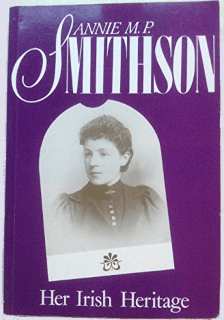
In 1917 Smithson publishes her first novel, Her Irish Heritage, which becomes a best-seller. It is dedicated to those who died in the Easter Rising of 1916. In all, she publishes twenty novels and two short story collections. Other successful novels include By Strange Paths and The Walk of a Queen. Many of her works are highly romantic and draw on her own life experiences, with nationalism and Catholicism featured as recurrent themes. In 1944 she publishes her autobiography, Myself – and Others.
From 1932 onwards Smithson shares a house in Rathmines, Dublin, with her stepsister and her stepsister’s family. She dies of heart failure on February 21, 1948, at 12 Richmond Hill, Dublin, and is buried in Whitechurch, Dublin.






 seamus dubhghaill