seamus dubhghaill

Promoting Irish Culture and History from Little Rock, Arkansas, USA


Leave a comment

Beginning of the Battle of Kilmallock

The Battle of Kilmallock begins on July 25, 1922, in County Limerick, ending on August 5. It is one of the largest engagements of the Irish Civil War.

The battle consists of ten days of fighting in the countryside around Kilmallock in County Limerick, in which the National Army of the Irish Free State, advancing south from Limerick city, find their path blocked by anti-Treaty IRA troops, dug into a number of villages at BruffBruree and Patrickswell. The fighting end with the retreat of the anti-Treaty fighters and the occupation of Kilmallock by Free State forces.

The prelude to the battle is the fall of Limerick city to Free State forces. The Republican forces in the city under Liam Deasy withdraw from their positions after a week of fighting and concentrate in Kilmallock and the nearby towns of Bruff and Bruree. The Free State forces, advancing south from the city, find their path blocked by the Republicans dug in at the three hilltop towns.

The National Army’s attempt to break through this position produces the only “line battle” of the war with the two sides facing each other along clear front-lines. The Kilmallock-Bruff-Bruree triangle sees some of the war’s most intense fighting.

Whereas in the fighting in Dublin, Limerick and Waterford, Free State troops equipped with artillery overcome Anti-Treaty resistance relatively easily, at Kilmallock they have a much harder time. The main reason for this is that the Free State troops, most of whom are new recruits, are facing some of the best of the IRA forces without an advantage in numbers or firepower. General Eoin O’Duffy complains of shortage of arms and ammunition. He estimates that while his forces have about 1,300 rifles, the Republicans could muster over 2,000. He is also critical of the quality of the troops at his disposal, whom he describes as, “a disgruntled, undisciplined and cowardly crowd.”

The Republicans know this and are confident of success. Nevertheless, the Republican commanders have their own issues with logistical support and lack of co-operation between forces from different counties. Deasy’s command includes Volunteers from counties Limerick itself, Cork and Kerry, all of whom have their own commanders. They have three improvised armoured cars, some mortars and heavy machine guns but no artillery.

O’Duffy draws up plans for the advance on Kilmallock with the assistance of his second-in-command Major General W. R. E. Murphy who had been a lieutenant colonel in World War I. His experience in the trenches has a major effect on his approach – pre-disposing him to cautious advances and use of trenches for cover.

The Republican forces have the better of the first clashes. On Sunday, July 23, Free State forces take Bruff and begin their advance on Kilmallock, but are twice beaten back by determined Republican resistance. The following day, the Republicans manage to retake Bruff in a counter-attack, taking 76 prisoners. As a result of this setback, O’Duffy calls off the advance for the time being and waits for reinforcements.

National Army forces quickly retake Bruff after reinforcements arrive. However, things get worse for the National Army as the week goes on. They make slow progress in taking the Republican strongpoints, and their casualties also mount. On Tuesday, July 25, a unit of the Dublin Guard under Tom Flood is ambushed on a narrow road. They fight their way clear, but only after losing four men. Three more Free State soldiers are killed two days later. On July 30, Major General Murphy launches an attack to take Bruree. The Dublin Guards attack the town from the southeast, supported by armoured cars and an 18-pound field gun. The Republicans hold out for five hours until Free State artillery is brought into action. At least 13 Free State soldiers and nine Anti-Treaty fighters are killed in the action and more are wounded before the Free State troops secure Bruree.

The Republican commander, Deasy, knows how important Bruree is to the defence of Kilmallock and draws up plans to recapture the town using three armoured cars, trench mortars and machine guns. On August 2, Republicans capture Patrickswell south of Limerick. The armoured cars then attack Bruree, taking Free State forces by surprise. One car attacks Commandant Flood’s headquarters at the Railway Hotel. The Commandant and his men manage to escape out the back of the building under the cover of Lewis gun fire. The second armoured car rams the front door of another post in the school house, which persuades the twenty-five troops inside to surrender.

However, when Free State reinforcements, along with armoured cars arrive, the Republican counter-attack stalls. The Free State reinforcements are led by Commandant General Seamus Hogan, who personally leads his forces, riding in the armoured car nicknamed “The Customs House.” Having failed to secure the surrender of the town, Republican forces retreat.

Having held Bruree against a Republican counterattack, Free State forces prepare to capture Kilmallock itself, but anticipate there will be heavy fighting. Republican Adjutant General Con Moloney comments on August 2, “Up to yesterday we have had the best of the operations there [the Kilmallock area]. There will, I fear, be a big change there now as the enemy have been reinforced very considerably.” In the 3rd Western Division area they have all but disbanded, unwilling to fight Free Staters, destroy roads, and now discouraged by the Catholic church.

On Thursday, August 3, a force of 2,000 Free State troops, backed up by armoured cars and artillery, advance on Kilmallock from Bruree, Dromin and Bulgaden. Seven hundred troops arrive the next day with an armoured car and a field gun. By Saturday, the town is surrounded by Free State forces. The Dublin Guard are also on hand to prevent Republican forces from escaping. Three miles away, Free State artillery is deployed and shells Republican forces on Kilmallock Hill and Quarry Hill. The two hills are soon controlled by Free State forces.

The National Army has, therefore, assembled sufficient force to smother resistance at Kilmallock. They are still, however, expecting hard fighting before they take the town. To their surprise, when the Free State troops enter the town, they encounter only light resistance from a Republican rearguard (volunteers from Cork). Most of the Republican troops have already abandoned their positions and retreated to Charleville.

They departed not because the Free State troops are stronger, but because they have been outflanked by Free State seaborne landings on the coasts of County Kerry and County Cork on August 2 and 8 respectively. The landings in Cork and Kerry force Commandant General Deasy to release units from this area to return home to their own areas. Although the landings in Cork occur after the retreat from Kilmallock, the subsequent loss of brigades from Cork adds to Commandant General Deasy’s problems. The final phase of the fighting in County Limerick comes when the Free State advance south is held up at Newcastle West. Another day of heavy fighting ensues in which the National Army troops have to bring up armoured cars and artillery to dislodge the Republicans, who reportedly lose up to 12 men before they retreat in the direction of Cork.

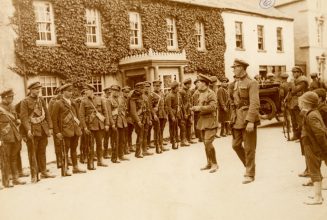
(Pictured: National Army troops lined up for a roll call during the Irish Civil War with local children casting an eye over the proceedings)


Leave a comment

Birth of Florence O’Donoghue, Historian & IRA Member

Florence O’Donoghue, historian and head of intelligence of the Cork No. 1 Brigade of the Irish Republican Army (IRA) during the Irish War of Independence, is born in Rathmore, County Kerry, on July 22, 1894, the son of farmer Patrick O’Donoghue and Margaret Cronin. He moves to Cork in 1910, where he works as an apprentice in the drapery trade.

The 1916 Easter Rising is a watershed in O’Donoghue’s life. In December 1916, he joins the Cork branch of the Irish Volunteers. In early 1917, he is elected unanimously First Lieutenant of the Cyclist Company and as a result devotes all his spare time to Volunteer work. He begins writing weekly for two years for The Irish World newspaper. By May 1917, he is sworn into the Irish Republican Brotherhood (IRB) and in October, Tomás Mac Curtain appoints him head of communications of the Cork Brigade. He replaces Pat Higgins as Brigade Adjutant in February 1917. He is a key organiser in the sensational jailbreak of Captain Donnchadh Mac Niallghuis on Armistice Day 1918 and takes personal responsibility for his protection. Michael Collins is the last officer from Volunteers General Headquarters to visit Cork shortly after Christmas 1919, until the truce in 1921.

O’Donoghue builds up an intelligence network and agents which includes his future wife, Josephine Marchment. She is head female clerk at the 6th Division Headquarters at Victoria Barracks, Cork, and passes on secret British Army correspondence to him. He recruits people to open letters, tap phone lines and intercept telegrams. The Irish Republican Army has 2,000 active members in Cork which are also used for intelligence gathering. By March 1920, after killing a Royal Irish Constabulary (RIC) Inspector, he is on the run and serving full-time in the IRA. In November of that year, the Cork Brigade kills six British Army officers and executes five Cork civilians on suspicion of spying.

After two and a half years of fighting, a truce is agreed upon on July 11, 1921. When the Dáil approves the Anglo-Irish Treaty, in January 1922, the IRA splits into pro- and anti-Treaty camps. Over the coming months and after being elected to the army’s executive as Adjutant General, O’Donoghue warns of the dangers of an Irish Civil War. In June 1922, he resigns from the army’s national executive and a month later, on July 3, 1922, from the army. Civil war does break out on June 28, 1922, between pro- and anti-Treaty factions, much to his dismay.

During the Irish Civil War, O’Donoghue remains neutral and tries to organise a truce to end the fighting. In December 1922, he forms a group called the “Neutral IRA”, along with Seán O’Hegarty, composed of pro-truce IRA men. He claims he has 20,000 members in this group. He campaigns for a month’s truce between the two sides, so that a political compromise could be reached. However, his efforts come to nothing and in March 1923, he winds up the “Neutral IRA,” judging that its objectives cannot be achieved. The Irish Civil War ends on May 24, 1923.

O’Donoghue serves as major in the Irish Army from 1939-1946. He forms a Supplementary Intelligence Service that is to remain behind enemy lines in the event of an invasion. He also teaches guerrilla warfare tactics to new army recruits.

O’Donoghue marries Josephine Brown (née Marchment) in April 1921, and they have four children. The couple also adopts two children from Josephine’s first marriage, including Reggie Brown, whom O’Donoghue kidnaps from his grandparents in Wales in 1920. He becomes a rate collector and remains outside politics.

In later years O’Donoghue becomes a respected historian. While in the army he edits An Cosantóir, the Irish Army’s magazine. He convinces Éamon de Valera to establish the Bureau of Military History to record personal accounts from the Irish War of Independence. He is a recording officer until 1948. His most famous work is his biography on Liam Lynch, entitled No Other Law.

O’Donoghue dies on December 18, 1967, in Mercy University Hospital, Cork, County Cork. Tom Barry gives the graveside oration. His papers are in the National Library of Ireland (NLI) and his statement to the Bureau of Military History is in the Military Archives.


Leave a comment

Kidnapping of Brig. Gen. Cuthbert Henry Tindall Lucas by the IRA

Major General Cuthbert Henry Tindall Lucas, CB, CMG, DSO, DL, British Army officer, is captured by the Irish Republican Army (IRA) on June 26, 1920, during the Irish War of Independence. He also commands the 4th Infantry Division during the final months of World War I and serves in the Second Boer War.

Lucas is born in Hitchin, Hertfordshire, England, on March 1, 1879. He later attends Marlborough College and the Royal Military College, Sandhurst.

Lucas is commissioned as a second lieutenant into 2nd Battalion, the Royal Berkshire Regiment, on May 7, 1898. He serves with the battalion in South Africa during the Second Boer War from 1899 to 1902, taking part in operations in the Orange Free State from February to July 1900, in Transvaal from July to November 1900, and later in Cape Colony south of the Orange River. He is promoted to lieutenant on August 1, 1900, while in South Africa. After the end of the war in June 1902, he and the rest of the 2nd battalion is sent to Egypt, where they arrive on the SS Dominion in November 1902. He later serves in the Egyptian Army and Sudan Civil Service.

Lucas serves in World War I with the British Expeditionary Force (BEF) and fights at Gallipoli in 1915 where he is promoted to command the 87th Brigade of the 29th Division. He leads the brigade during the Battle of the Somme and into 1917 before becoming Commandant of the Machine Gun Corps training centre in 1918. He is appointed General Officer Commanding (GOC) 4th Infantry Division in October 1918 during the closing stages of the war.

On June 30, 1919, Lucas is appointed a deputy lieutenant of Hertfordshire. He is made Commander of 17th Infantry Brigade in Ireland, and of Fermoy Barracks, on October 30, 1919. On June 26, 1920, during the Irish War of Independence, he is captured by the IRA while he is fishing on the Munster Blackwater near Fermoy along with Colonels Tyrell and Danford. After Danford is wounded during an unsuccessful attempt to escape from a moving car the same day, the volunteers free Tyrell to attend to Danford’s wounds. Both Colonels are subsequently taken to a military hospital at Fermoy.

Lucas is subsequently held in West Limerick and East Clare.

A letter from his wife, announcing the birth of their child, and addressed simply “to the IRA”, is delivered to him and his captors allow a subsequent exchange of letters between the couple. His letters home remain in the possession of his descendants and are shown on an episode of the BBC Television programme Antiques Roadshow.

The IRA moves Lucas to East Limerick from where he escapes four weeks later. It is believed his captors purposely relax the guard to allow him to escape rather than be faced with the possibility of executing him. While being transferred from Pallas Royal Irish Constabulary (RIC) barracks to Tipperary military barracks in a routine army patrol they are ambushed, and Lucas receives a slight injury.

Lucas becomes Assistant Adjutant General at Aldershot Command in 1924 and serves with the staff at General Headquarters, British Army of the Rhine from 1927 before he retires to Stevenage in 1932. He dies on April 7, 1956, and is buried in Graveley, Hertfordshire. His wife, Joan Holdsworth, whom he marries in October 1917, dies on September 6, 1979, and is also buried in Graveley, Hertfordshire.

In 2014, Barbara Scully, a granddaughter of George Power, one of the IRA volunteers involved, publishes his recollections to his family of the kidnap in The Irish Times. This brings a friendly reply from Lucas’ granddaughter, Ruth Wheeler, in which she states that Lucas risked a court-martial for stating that during his kidnap and time in captivity he was treated as “a gentleman by gentlemen” and was held by “delightful people.”

Ireland’s Defence Forces have published online Bureau of Military History witness statements by the IRA volunteers involved in the kidnap, as well as those who guarded General Lucas while he was held as a prisoner of war.

In 2020 Lucas’s granddaughter, Ruth Wheeler, and other members of the Lucas family publish online the letters he wrote and received while in captivity. Limerick Councillor Emmett O’Brien and other local people in March 2019 announce an intent to re-enact the capture, imprisonment, and release of Lucas on the anniversary in 2020.

(Pictured: Cuthbert Henry Tindall Lucas, bromide print by Walter Stoneman, 1919, National Portrait Gallery)


Leave a comment

Death of Major General William Hickie, Irish-Born British Army Officer

Major General Sir William Bernard Hickie, KCB, Irish-born senior British Army officer and Irish nationalist politician dies in Dublin on November 3, 1950. He sees active service in the Second Boer War from 1899 to 1902, is Assistant Quartermaster General in the Irish Command from 1912 to 1914 and serves in World War I from 1914 to 1918. He commands a brigade of the British Expeditionary Force in 1914 and is commander of the 16th (Irish) Division from 1915 on the Western Front.

Hickie is born on May 21, 1865, at Slevoir, Terryglass, near Borrisokane, County Tipperary, the eldest of the eight children of Colonel James Francis Hickie and his wife Lucila Larios y Tashara, originally of Castile. He is educated at St. Mary’s College, Oscott, Birmingham, England, a renowned seminary for training youths of prosperous Roman Catholic families.

Hickie attends the Royal Military College, Sandhurst, from 1882 to 1885. He is commissioned into his father’s regiment, the Royal Fusiliers at Gibraltar, in 1885 and serves with them for thirteen years in the Mediterranean, Egypt, and India, during which time he is promoted to captain on November 18, 1892. In 1899 he graduates as captain at the Staff College, Camberley, and is selected when the Second Boer War breaks out as a Special Service Officer in which capacity he acts in various positions of authority and command. He leaves Southampton for South Africa on board the SS Canada in early February 1900 and is promoted from captain of mounted infantry to battalion command as major on March 17, 1900. He is subsequently in command of a corps until eventually at the end of 1900 he is given command of an independent column of all arms. He holds this position for eighteen months. He serves with distinction at the Battle of Bothaville in November 1900 and receives the brevet promotion to lieutenant colonel on November 29, 1900. He serves in South Africa throughout the war, which ends with the Treaty of Vereeniging in June 1902. Four months later he leaves Cape Town on the SS Salamis with other officers and men of the 2nd battalion Royal Fusiliers, arriving at Southampton in late October, when the battalion is posted to Aldershot Garrison. In December 1902 he is elected a Fellow of the Royal Geographical Society (FRGS).

After the end of the war in South Africa there follows various staff appointments, the first from December 1902 as deputy-assistant adjutant general for district staff in the Cork district. In 1907 Hickie is back in regimental service in Dublin and Mullingar with the 1st Royal Fusiliers, where he is in command of the regiment for the last two years. From 1909 to 1912 is appointed to the Staff of the 8th Infantry Division in Cork where for four years he is well known in the hunting field and on the polo ground. In May 1912, he is promoted to colonel and becomes Quartermaster General of the Irish Command at Royal Hospital Kilmainham for which he is appointed a Companion of the Order of the Bath.

When war is declared, the Staff of the Irish Command becomes automatically the staff of the II Army Corps and accordingly with the outbreak of World War I in August 1914, Hickie is promoted to brigadier general and, as part of the British Expeditionary Force in France, takes charge of the Adjutant and Quartermaster-General’s Department during the retreat of the II Corps after the Battle of Mons, to Paris, and during the First Battle of the Marne. In mid-September 1914, he relieves one of the brigadiers in the fighting line as commander of the 13th Brigade (5th Infantry Division) and then commands the 53rd Brigade (18th Infantry Division) until December 1915, when he is ordered home to assume command of the 16th (Irish) Division at Blackburn.

Promoted to major general, Hickie takes over from Lieutenant General Sir Lawrence Parsons. It is politically a highly sensitive appointment which requires the professionalism and political awareness he, fortunately, possesses as the division is formed around a core of Irish National Volunteers in response to Edward Carson‘s Ulster Volunteers. He is much more diplomatic and tactful than his predecessors and speaks of the pride which his new command gives him but does not hesitate to make sweeping changes amongst the senior officers of the Irish Division. After putting the division through intensive training, it leaves under Irish command of which each man takes personal pride. It arrives in December 1915.

In the next two years and four months during which Hickie commands the 16th (Irish) Division, it earns a reputation for aggression and élan and wins many memorials and mentions for bravery in the engagements during the 1916 Battle of Guillemont and the capture of Ginchy, both of which form part of the Battle of the Somme, then during the Battle of Messines, the Third Battle of Ypres and in attacks near Bullecourt in the Battle of Cambrai offensive in November 1917.

During this period the Division makes considerable progress in developing its operational techniques but at a price in losses. The growing shortage of Irish replacement recruits, due to nationalist disenchantment with the war and the absence of conscription in Ireland, is successfully met by Hickie by integrating non-Irish soldiers into the division.

In February 1918, Hickie is invalided home on temporary sick leave, but when in the hospital the German spring offensive begins on March 21, with the result that after his division moves under the command of General Hubert Gough it is practically wiped out and ceases to exist as a division. Although promised a new command, this does not happen before the Armistice in November. He typifies the army’s better divisional commanders, is articulate, intelligent and is competent and resourceful during the BEF’s difficult period 1916–17, laying the foundations for its full tactical success in 1918. He is advanced to Knight Commander of the Order of the Bath in 1918.

Hickie retires from the army in 1922, when the six Irish line infantry regiments that have their traditional recruiting grounds in the counties of the new Irish Free State are all disbanded. He identifies himself strongly with the Home Rule Act and says that its scrapping is a disaster and is equally outspoken in condemning the activities of the Black and Tans. In 1925, he is elected as a member of Seanad Éireann, the Irish Free State Senate.

Hickie holds his seat until the Seanad is dissolved in 1936, to be replaced by Seanad Éireann in 1937. He is President of the Area Council (Southern Ireland) of the Royal British Legion from 1925 to 1948. He never marries.

Hickie dies on November 3, 1950, in Dublin and is buried in Terryglass, County Tipperary.


Leave a comment

Birth of Henry Lawes Luttrell, 2nd Earl of Carhampton

General Henry Lawes Luttrell, 2nd Earl of Carhampton PC, Anglo-Irish politician and soldier, who both in public and private life attracts scandal, is born on August 7, 1743. He is spurned by colleagues in the British House of Commons who believe that in the election of 1769 he played an underhand role in denying his seat to the popular choice, the reformer John Wilkes. In 1788 he is publicly accused in Dublin of raping a twelve-year-old girl. Ten years later, his command in the suppression of the Irish Rebellion of 1798 is criticised by fellow officers for its savagery, and not least against women. His last years in Parliament are marked by his opposition to Catholic Emancipation, and to parliamentary reform.

Luttrell is the scion of an Anglo-Irish landed family, descendants of Sir Geoffrey de Luterel, who established Luttrellstown Castle, County Dublin, in the early 13th century. His grandfather, Henry Luttrell, had been a pardoned Jacobite commander murdered on the street in Dublin in 1717 supposedly by his former comrades. His father, Simon Luttrell, is successively titled Baron Irnham, Viscount Carhampton and Earl Carhampton, all in the Peerage of Ireland. His mother, Maria, is the daughter of Sir Nicholas Lawes, Governor of Jamaica, and the eventual heir to a slave plantation on the West Indian Island which, on her husband’s death in 1787, passes to her son.

Educated at Westminster School and Christ Church, Oxford, Luttrell is commissioned into the 48th (Northamptonshire) Regiment of Foot in 1757. Two years later he becomes lieutenant of the 34th (Cumberland) Regiment of Foot.

Father and son, both accounted “notorious womanizers,” have a bitter relationship. His father once challenges him to a duel, but he declines, observing that his father is not a gentleman.

Luttrell, described as “strong in body, if not in mind,” achieves a reputation for bravery as a soldier during the Seven Years’ War, becoming Deputy Adjutant-General of the British Forces in Portugal. In 1768 he becomes a Tory Member of Parliament representing Bossiney.

With the support of the Grafton ministry and of the Court, in 1769 Luttrell stands in Middlesex against John Wilkes, the radical and popular figure who had already been the constituency’s three-time democratic choice. He loses the poll (1,143 votes to 269) but is seated in Parliament, Wilkes having once again been barred as an adjudged felon. As a result of the affair, for some months, Luttrell dares not appear in the street and is “the most unpopular man in the House of Commons.”

The government rewards Luttrell by appointing him Adjutant General for Ireland in 1770. He continues to sit in the Commons, where he describes the Whigs in their opposition to the conduct of the American War, as “the abetters of treason and rebellion combined purposely for the ruin of their country.”

Luttrell becomes active in Irish politics and between 1783 and 1787, he sits in the Irish House of Commons for Old Leighlin. On his father’s death in 1787, he succeeds to the earldom of Carhampton and other titles. He becomes Colonel of the 6th Dragoon Guards and Lieutenant-General of the Ordnance in Ireland.

In 1788, Luttrell is publicly accused in Dublin of the rape of a 12-year-old girl. Having been paid to deliver a message, Mary Neal claims she is bundled into a brothel and there assaulted throughout the night by Luttrell. The keeper of the house, Maria Llewellyn, is charged in a case marked by accusations of witness tampering, the death in prison of Mary’s mother and newborn baby sister and by the insinuation that Mary was already working as a prostitute. The affair becomes a cause célèbre with the public intervention of Archibald Hamilton Rowan, later a founding member of the Dublin Society of United Irishmen. To clear Mary’s name he brings her to Dublin Castle to see the Lord Lieutenant, John Fane, 10th Earl of Westmorland. Westmorland, unmoved, pardons Llewellyn and sets her at liberty. Luttrell is never asked to answer for raping Mary Neal. In 1790 he re-enters the British Parliament as Member for Plympton Erle.

In 1791 and 1792, Luttrell helps vote down bills to abolish the slave trade. Negroes, he proposes, only want “to murder their masters, ravish their women, and drink all their rum.” At the same time, he opposes lifting civil disabilities on Roman Catholics by abolishing the Test Act in Scotland and speaks scathingly of parliamentary reform.

In October 1793, a younger brother, Temple Simon Luttrell, is arrested in Boulogne and, until February 1795, is held in Paris where, on the strength of their sister Anne Luttrell being married to Prince Henry, Duke of Cumberland, he is publicly exhibited as the brother of the king of England.

In 1795, Luttrell is entrusted with the breakup and disarming of Defenders, the agrarian semi-insurgency, in Connacht. His proceedings and impressment of some 1,300 “rebels” into the British navy elicits criticism in otherwise loyal circles.

In 1796, with the leaders of the democratic party, the United Irishmen, preparing for a French-assisted insurrection, Luttrell is given overall command of the Crown forces in Ireland. He demonstrates still greater ruthlessness in attempting to “pacify” the country and suppress the eventual rising in the summer of 1798. His command has the unusual distinction of being upbraided by his successor as Commander in Chief, Sir Ralph Abercromby, for an army “in a state of licentiousness, which must render it formidable to everyone but the enemy.”

Luttrell is seen by his critics as having “fanned the flame of disaffection into open rebellion” by “the picketings, the free quarters, half hangings, flogging and pitch-cappings” he directs.

In July 1799, Luttrell sells his Irish property and by his own later account, he takes no part in the Acts of Union. He claims to be “disgusted at the scene that was passing before me”, and to abandon Ireland because, under a “cowardly” government, he sees “the country likely to become Catholic.” When the Dublin Post of May 2, 1811, erroneously reports his death, he demands a retraction which they print under the headline Public Disappointment.

Luttrell purchases an estate at Painshill Park in Surrey and lives for several years in relative obscurity. From 1813 he harries the government of Robert Jenkinson, 2nd Earl of Liverpool, with the claim that George III had promised him a secure seat in the Commons. In June 1817, five weeks short of his eightieth birthday, he finds his own way back to Parliament as Member for Ludgershall and revenges himself, in the four years remaining to him, by voting with the opposition. This, however, does not extend to joining in the attacks on the domestic spy system in 1818 nor to voting for parliamentary reform in 1819. Moreover, in the wake of the Peterloo Massacre, he supports the government, lauding the use of deadly force against “the Radicals and their system.”

Luttrell dies at his home at Bruton Street, London, on April 25, 1821.


Leave a comment

The Battle of Antrim

The Battle of Antrim is fought on June 7, 1798, in County Antrim during the Irish Rebellion of 1798 between British troops and Irish insurgents led by Henry Joy McCracken. The British win the battle, beating off a rebel attack on Antrim town following the arrival of reinforcements but the county governor, John O’Neill, 1st Viscount O’Neill, is fatally wounded.

The outbreak of the United Irish rebellion in Leinster on May 23 had prompted calls from Ulster United Irishmen to take to the field in support of their southern comrades. However, the organisation in Ulster had been severely damaged in a brutal disarmament campaign the previous year, and the new leadership are less radical and are not willing take to the field without French assistance, which is expected daily.

After waiting for two weeks while the rebellion rages in the south, the grassroots United Irish membership in Antrim decides to hold a number of meetings independent of their leaders. The outcome is the election of Henry Joy McCracken as their adjutant general and the decision to rise immediately. McCracken, together with James Hope, quickly formulate a plan to attack and seize all government outposts in County Antrim and then for the main attack to fall on Antrim town. Then using artillery seized at Antrim, the rebels are to march on Belfast in conjunction with the United Irish rebels in County Down.

McCracken has high hopes that many members of the militia will desert and join him, as disaffection is believed to be widespread, evidenced by the execution of four of the Monaghan militia for treason in Belfast in May.

On 6 June, McCracken and James Hope issue a proclamation calling for the United army of Ulster to rise. The initial plan meets with success, as the towns of Larne, Ballymena, Portaferry and Randalstown are taken and the bridge at Toome damaged to prevent the government from rushing reinforcements into Antrim from west of the River Bann. The rebels then assemble at Donegore Hill in preparation for the march and attack on Antrim town, where an emergency meeting of the county’s magistrates called by the county governor, Lord O’Neill, is due to take place.

Although almost 10,000 rebels assemble at Donegore, many display reluctance for the coming fight and stay on the hill in reserve or desert later so that probably fewer than 4,000 actually take part in the attack. The United Irishmen in Ulster are mostly Presbyterian, but are joined with Catholic Defenders and the tension between the two groups on the march likely causes some desertions. These difficulties lead to a loss of momentum, and the attack is delayed. McCracken is forced to make adjustments to his plan of attack, which had envisaged a simultaneous overwhelming assault on the town from four separate points.

The town is garrisoned by a small force of about 200 yeomen, cavalry under Lt. Col. William Lumley and armed volunteers but they also have four artillery pieces and the delay in the rebel attack allows them to send requests for assistance to Belfast and Lisburn from where reinforcements are already on the way. The garrison forms themselves at the base of the demesne wall of Antrim Castle, with artillery to the front and cavalry to the rear with their flanks anchored by the Market House and Presbyterian Meeting House. A part of the Scottish Quarter in the town is also burned by the garrison as it is perceived to be a stronghold of rebel sympathisers.

The attack finally begins shortly before 3:00 p.m. when the rebels begin a cautious march through the town. As rebel front ranks arrive to face the garrison’s defensive line, artillery opens fire on the rebels, causing them to pull back out of range. Large clouds of dust and smoke are thrown up which, together with the fires from the Scottish Quarter, obscure the garrison’s view of events.

The rebel withdrawal is mistaken for a full retreat and the cavalry moves out to pursue and rout the supposed fleeing rebels. The cavalry effectively runs into a gauntlet of rebels who are protected by a long churchyard wall and stationed in houses along the main street, suffering heavy losses to the gunfire and pikes of the rebels.

After routing the cavalry, the rebels attack the remainder of the garrison, which then begins to pull back to the safety of the castle wall. This is mistaken by a newly arrived rebel column as an attack on them, causing them to flee in panic. In the confusion, the county commander, Lord O’Neill, trapped with his magistrates, is fatally wounded by James Clements who avoids trial by joining the army. A rebel attempt to seize the artillery is only narrowly beaten off by troops stationed behind the demesne wall.

At this critical juncture, British reinforcements from Belfast arrive outside the town and, assuming it to be held by the rebels, begin to shell it with their artillery. This prompts more desertions and the rebel army begins to disintegrate, but their withdrawal is protected by a small band under James Hope which fights a successful rearguard action from the church grounds along the main street. This allows the bulk of the rebels to withdraw safely.

When the military enters the town, they begin a spree of looting, burning and murder, of which the most enthusiastic perpetrators are reported to be the Monaghan militiamen, who are anxious to prove their loyalty and expunge the shame of the recent executions of their comrades for sedition. The town of Templepatrick is burned to the ground and Old Stone Castle is razed to the ground. McCracken, Hope and their remaining supporters withdraw northward, establishing camps of ever dwindling size along the route of their retreat until news of the defeat at Ballynahinch causes their final dispersion. McCracken is arrested by yeomen on July 7 and is hanged in Belfast on July 17, having refused an offer of clemency in return for informing on his comrades.

Commemoration of the centenary of the battle, marked by a nationalist parade in Belfast on June 6, 1898, provokes loyalist riots.


Leave a comment

Birth of Sir William Bernard Hickie, British Army General

Sir William Bernard Hickie, British Army general, commander of the 16th (Irish) Division (1915–18) and an Irish nationalist politician, is born on May 21, 1865, at Slevoir, Terryglass, near Borrisokane, County Tipperary.

Hickie is the eldest son of Colonel James Francis Hickie, JP, of Slevoir, former commanding officer of the 7th Royal Fusiliers, and Lucila Calista (de Tejada) Hickie, daughter of Don Pablo Lariosy Herreros de Tejada of Laguna de Cameros, Castile. He is educated at St. Mary’s College, Oscott, before attending the Royal Military College, Sandhurst, and is commissioned into the Royal Fusiliers in 1885, serving in Egypt and India.

A major at the outbreak of the Second Boer War in 1899, Hickie serves on the staff of Lieutenant-Colonel P. W. J. Le Gallais, commanding officer of the mounted infantry. On November 6, 1900, he is involved in an attempt to capture General Christiaan De Wet at the Battle of Bothaville, when a force led by Le Gallais and Lieutenant-Colonel Wally Ross storm De Wet’s camp. De Wet escapes, while a rearguard of 100 men engages the British force. In a fierce fight Le Gallais is killed, and Wally Ross is badly wounded. Hickie decides to charge the Boer position and leads his small force forward just as reinforcements under Major-General C. E. Knox arrive. The Boers immediately surrender, and some are found with explosive bullets. He wants to execute them immediately, but Knox insists that they be tried. Exasperated with the whole affair, Hickie gives a highly critical interview after the action which is later published in The Times History of the War in South Africa (7 vols, 1900–09), edited by Leo Amery.

Hickie is promoted to brevet lieutenant colonel in 1901 and appointed deputy-assistant adjutant general of the 8th division (1903–06). In 1906, he is given command of the 1st battalion of the Royal Fusiliers. Promoted to colonel in 1912, he serves as assistant quartermaster general of the Irish command (1912–14) and is appointed a Companion of the Order of the Bath in 1914. On the outbreak of World War I, he is promoted to brigadier general and serves in Belgium and France in command of the adjutant’s and quartermaster-general’s department of II Corps. In this capacity, he is involved in the retreat following the Battle of Mons and during the First Battle of the Marne (September 1914). In December 1915, he is appointed to command the 16th (Irish) Division, with the rank of major general, replacing General Sir Lawrence W. Parsons. The division is based around a core of Redmondite National Volunteers, and Hickie, a Catholic and a home ruler, is an acceptable commander to John Redmond and other Irish nationalists.

Hickie is professional, politically adept, and popular with his men, and under his leadership the 16th is renowned for its aggressive fighting spirit. He commands the division during the Battle of the Somme in 1916 and, while proud of his men’s success in capturing Guillemont and Ginchy (September 1916), is appalled by their losses. When the division is ordered to capture Messines (now Mesen) in June 1917, he gives Major Willie Redmond permission to advance as far as the first objective and, following Redmond’s death, reproaches himself bitterly. After this attack the division is transferred to the fifth army and provides assault troops for future attacks. During the Third Battle of Ypres, and especially during the attack on Langemarck in August 1917, the division suffers horrendous casualties, losing 221 officers and 4,064 men. Among the casualties is Fr. Willie Doyle, who Hickie unsuccessfully recommends for a Victoria Cross. The division’s losses at Langemarck are highlighted by Irish MPs in the House of Commons, and Hickie’s handling of the attack is criticised. By this time, nationalist disillusionment with the war means that few Irish replacements are available, and Hickie is forced to accept increasing numbers of non-Irish conscripts into the division. Worn down by years of command, his health finally breaks, and, in February 1918, he is sent home on sick leave, being replaced by Major-General Sir Richard Amyatt Hull.

In 1918, Hickie is created a Knight Commander of the Order of the Bath (KCB) and is also awarded the French Croix de Guerre. During the Irish War of Independence (1919–21), he is critical of the methods used by Crown forces, denouncing in particular the indiscipline of the Black and Tans. In 1921 he retires from the army and becomes a prominent figure in the Royal British Legion in Ireland, tirelessly campaigning on behalf of ex-servicemen. In the 1920s he is involved with the Irish battlefield memorial committee, which erects memorial crosses at Wytschaete, Guillemont, and Salonika, commemorating the 10th and 16th divisions. He later serves as a senator of the Irish Free State (1925–36). Retiring from public life in 1936 to his residence at Terryglass, County Tipperary, he devotes his last years to gardening and reading.

Hickie dies on November 3, 1950, in Dublin, and is buried at Terryglass. He marries a daughter of the novelist Rev. J. O. Hannay, who predeceases him. There is a small collection of his papers in the National Library of Ireland (NLI).

(From: “Hickie, Sir William Bernard” by David Murphy, Dictionary of Irish Biography, http://www.dib.ie, October 2009)


Leave a comment

Death of Florence O’Donoghue, Historian & Member of the Irish Republican Army

Florence O’Donoghue, historian and head of intelligence of the Cork No. 1 Brigade of the Irish Republican Army (IRA) during the Irish War of Independence, dies on December 18, 1967, in Mercy University Hospital, Cork, County Cork.

O’Donoghue is born in Rathmore, County Kerry, on July 22, 1894, the son of farmer Patrick O’Donoghue and Margaret Cronin. He moves to Cork in 1910, where he works as an apprentice in the drapery trade.

The 1916 Easter Rising is a watershed in O’Donoghue’s life. In December 1916, he joins the Cork branch of the Irish Volunteers. In early 1917, he is elected unanimously First Lieutenant of the Cyclist Company and as a result devotes all his spare time to Volunteer work. He begins writing weekly for two years for The Irish World newspaper. By May 1917, he is sworn into the Irish Republican Brotherhood (IRB) and in October, Tomás Mac Curtain appoints him head of communications of the Cork Brigade. He replaces Pat Higgins as Brigade Adjutant in February 1917. He is a key organiser in the sensational jailbreak of Captain Donnchadh Mac Niallghuis on Armistice Day 1918 and takes personal responsibility for his protection. Michael Collins is the last officer from Volunteers General Headquarters to visit Cork shortly after Christmas 1919, until the truce in 1921.

O’Donoghue builds up an intelligence network and agents which includes his future wife, Josephine Marchment. She is head female clerk at the 6th Division Headquarters at Victoria Barracks, Cork, and passes on secret British Army correspondence to him. He recruits people to open letters, tap phone lines and intercept telegrams. The Irish Republican Army has 2,000 active members in Cork which are also used for intelligence gathering. By March 1920, after killing a Royal Irish Constabulary (RIC) Inspector, he is on the run and serving full-time in the IRA. In November of that year, the Cork Brigade kills six British Army officers and executes five Cork civilians on suspicion of spying.

After two and a half years of fighting, a truce is agreed upon on July 11, 1921. When the Dáil approves the Anglo-Irish Treaty, in January 1922, the IRA splits into pro- and anti-Treaty camps. Over the coming months and after being elected onto the army’s executive as Adjutant General, O’Donoghue warns of the dangers of an Irish Civil War. In June 1922, he resigns from the army’s national executive and a month later, on July 3, 1922, from the army. Civil war does break out on June 28, 1922 between pro- and anti-Treaty factions, much to his dismay.

During the Irish Civil War, O’Donoghue remains neutral and tries to organise a truce to end the fighting. In December 1922, he forms a group called the “Neutral IRA”, along with Seán O’Hegarty, composed of pro-truce IRA men. He claims he has 20,000 members in this group. He campaigns for a month’s truce between the two sides, so that a political compromise could be reached. However, his efforts come to nothing and in March 1923, he winds up the “Neutral IRA,” judging that its objectives cannot be achieved. The Irish Civil War ends on May 24, 1923.

O’Donoghue serves as major in the Irish Army from 1939-1946. He forms a Supplementary Intelligence Service that is to remain behind enemy lines in the event of an invasion. He also teaches guerrilla warfare tactics to new army recruits.

O’Donoghue marries Josephine Brown (née Marchment) in April 1921 and they have four children. The couple also adopts two children from Josephine’s first marriage, including Reggie Brown, whom O’Donoghue kidnaps from his grandparents in Wales in 1920. He becomes a rate collector and remains outside politics.

In later years O’Donoghue becomes a respected historian. While in the army he edits An Cosantóir, the Irish Army’s magazine. He convinces Éamon de Valera to establish the Bureau of Military History to record personal accounts from the Irish War of Independence. He is a recording officer until 1948. His most famous work is his biography on Liam Lynch, entitled No Other Law.

O’Donoghue dies on December 18, 1967, and Tom Barry gives the graveside oration. His papers are in the National Library of Ireland (NLI) and his statement to the Bureau of Military History is in the Military Archives.


Leave a comment

Birth of Gearóid O’Sullivan, Soldier & Politician

Gearóid O’Sullivan, soldier and politician, is born on January 28, 1891, at Coolnagrane, near Skibbereen, County Cork, fourth son among six sons and three daughters of Michael O’Sullivan, farmer, of Loughine, and Margaret Sullivan (née McCarthy) of Coolnagrane.

Christened Jeremiah but known in later life as Gearóid, O’Sullivan is an outstanding pupil at national school and secondary school in Skibbereen. Encouraged by his teachers, he acquires a love of the Irish language. Not yet ten, he joins the Gaelic League in Skibbereen in October 1900. He takes part in the Oireachtas debates of 1909. In 1911 he qualifies at St. Patrick’s College, Dublin, as a national schoolteacher and teaches at Kildorrery, County Cork, but returns to Dublin in 1912 to take up a post at St. Peter’s National School, Phibsborough. He takes an honours degree in Celtic studies at University College Dublin (UCD) (1913), an H.Dip.Ed. (1914), and an M.Ed. (1915). At the same time, he is an organiser and teacher with the Gaelic League, a member of its Keating branch at Parnell Square, Dublin, and a founder of the League’s “fáinne” proficiency badge.

O’Sullivan joins the F Company, 1st Battalion, Dublin Brigade of the Irish Volunteers at their foundation in November 1913, is aide-de-camp to Seán Mac Diarmada during the 1916 Easter Rising and is ordered by Patrick Pearse to raise the flag of rebellion over the General Post Office (GPO) stronghold in Dublin. Interned at Frongoch internment camp in Wales after the rising, he belongs to the Irish Republican Brotherhood (IRB) group of prisoners closely linked with Michael Collins, a proximity that continues throughout the crisis years to follow. Released in the amnesty of December 1916, he intensifies his Volunteer activity, playing a prominent role in Carlow Brigade, for which he is briefly detained while working as a teacher at St. Mary’s Knockbeg College, County Carlow. When the Irish Volunteers become the Irish Republican Army (IRA) in 1919, he is arrested again and goes on hunger strike at Mountjoy Prison, which leads to his release. Active throughout the Irish War of Independence (1919–21) and narrowly avoiding recapture during meetings with Collins, he joins the supreme council of the IRB in November 1921, remaining there for the remainder of his military career.

From February 1920, O’Sullivan replaces Collins as adjutant general of the IRA, a position he retains until the Anglo–Irish Treaty of December 1921 (which he supports), resuming it a month later as a lieutenant general of the new National Army, responsible for personnel and promotions. He is also elected to Dáil Éireann for Carlow–Kilkenny in 1921 and again in 1922, retiring in 1923. His intellectual and organisational abilities guarantee that his position within the army is safe after the death in August 1922 of Collins, to whom he owes much for his initial rise to prominence. On August 28 he is appointed to the newly created army council, whose most draconian prerogative becomes the military execution of republican prisoners.

After the Irish Civil War (1922–23), wholesale demobilisation of officers and other ranks takes place, but O’Sullivan and his council colleagues Richard Mulcahy, Seán Mac Mahon, and Seán Ó Murthuile survive the fiscal axe. Their privileged position angers some officers, led by Major General Liam Tobin, alarmed at the rate of demobilisation and the state’s apparent abandonment of Collins’s republican ideals. Through the Irish Republican Army Organisation, they deplore the devaluation of their pre-treaty IRA service and the retention of certain former British Army officers and instructors. O’Sullivan’s brief time as adjutant general places him in the role of personnel manager. As the Defence Forces (Temporary Provisions) Act, 1923, transforms the National Army into the defence forces of an Irish dominion, he is clearly in the sights of those who disagree with how these forces took shape.

As demobilisation continues and former British personnel become more evident, O’Sullivan and his colleagues become targets of suspicion that a hostile IRB clique had controlled the army council since its formation after the death of Collins. Exaggerated or not, such claims precipitate the army crisis of March 1924, in which O’Sullivan personally orders a raiding party under Colonel Hugo MacNeill to arrest its leaders. To defuse the crisis, he and his army council colleagues are forced to stand down, while the arrested dissidents are summarily retired. The subsequent army inquiry (April–June 1924) absolves him and his colleagues of any wrongdoing, but their active military careers are over. O’Sullivan, however, is for some time secretary of the military service pensions board.

Civilian life treats O’Sullivan well, as he enters a legal career and in 1926 is called to the bar. In 1927 he is appointed Judge Advocate General and remains so until 1932. After the assassination of Minister for Justice Kevin O’Higgins in July 1927, he fills the vacated Dublin County seat in a by-election in August, retaining it at subsequent elections until 1937. In August 1928 he is a Free State delegate to the Empire Parliamentary Association conference in Canada. Openly supporting Gen. Eoin O’Duffy and the short-lived ‘Blueshirts’ vanguard of the fledgling Fine Gael party during 1933–34, he pointedly refuses to surrender his legally held revolver when gardaí demand it as a precaution against a feared Blueshirt coup d’étât. In 1937 he becomes a barrister on the western circuit, and in 1940 commissioner for special purposes of the income tax acts, a post he holds for life.

O’Sullivan lives at St. Kevin’s Park, Dartry, Dublin, where he dies at the age of 57 on March 26, 1948. His military funeral to Glasnevin Cemetery, with his coffin draped in the same flag that had covered the coffin of Michael Collins, reflects his high national profile.

In 1922, O’Sullivan marries Maude Kiernan, sister of Kitty Kiernan and daughter of Peter and Bridget Kiernan, whose family is closely involved with the Irish political leadership, notably Michael Collins and Harry Boland. After Maude’s death he marries Mary Brennan of Belfast. They have three daughters and a son, all of whom survive him. O’Sullivan is commemorated in County Cork by a plaque at Skibbereen town hall.

(From: “O’Sullivan, Gearóid” contributed by Patrick Long, Dictionary of Irish Biography, http://www.dib.ie, shared in line with Creative Commons ‘Attribution’ (CC BY) licencing)


Leave a comment

Birth of Edward Hand, Soldier, Physician & Politician

Edward Hand, Irish soldier, physician, and politician who serves in the Continental Army during the American Revolutionary War, is born in Clyduff, King’s County (now County Offaly) on December 31, 1744. He rises to the rank of general and later is a member of several Pennsylvania governmental bodies.

Hand, the son of John Hand, is baptised in Shinrone. Among his immediate neighbours are the Kearney family, ancestors of United States President Barack Obama. He is a descendant of either the families of Mag Fhlaithimh (of south Ulaidh and Mide) or Ó Flaithimhín (of the Síol Muireadaigh) who, through mistranslation became Lavin or Hand.

Hand earns a medical certificate from Trinity College, Dublin. In 1767, he enlists as a Surgeon’s Mate in the 18th (Royal Irish) Regiment of Foot. On May 20, 1767, he sails with the regiment from Cobh, County Cork, arriving at Philadelphia on July 11, 1767. In 1772, he is commissioned an ensign. He marches with the regiment to Fort Pitt, on the forks of the Ohio River, returning to Philadelphia in 1774, where he resigns his commission.

In 1774, Hand moves to Lancaster, Pennsylvania, where he practices medicine. On March 13, 1775, he marries Catherine Ewing. Lancaster is the region of some of the earliest Irish and Scotch-Irish settlements in Pennsylvania. As a people, they are well known for their anti-English and revolutionary convictions. He is active in forming the Lancaster County Associators, a colonial militia. He is a 32nd degree Freemason, belonging to the Montgomery Military Lodge number 14.

Hand enters the Continental Army in 1775 as a lieutenant colonel in the 1st Pennsylvania Regiment under Colonel William Thompson. He is promoted to colonel in 1776 and placed in command of the 1st Continental, then designated the 1st Pennsylvania. Promoted to brigadier general in March 1777, he serves as the commander of Fort Pitt, fighting British loyalists and their Indian allies. He is recalled, after over two years at Fort Pitt, to serve as a brigade commander in Major General La Fayette‘s division.

In 1778, Hand attacks the Lenape, killing Captain Pipe‘s mother, brother, and a few of his children during a military campaign. Failing to distinguish among the Native American groups, he had attacked the neutral Lenape while trying to reduce the Indian threat to settlers in the Ohio Country, because other tribes, such as the Shawnee, had allied with the British.

After a few months, he is appointed Adjutant General of the Continental Army and serves during the Siege of Yorktown in that capacity. In recognition of his long and distinguished service, he is promoted by brevet to major general in September 1783. He resigns from the Army in November 1783.

Hand returns to Lancaster and resumes the practice of medicine. A Federalist, he is also active in civil affairs. Beginning in 1785, he owns and operates Rock Ford plantation, a 177-acre farm on the banks of the Conestoga River, one mile south of Lancaster, Pennsylvania. The Georgian brick mansion remains today, and the farm is a historic site open to the public.

Hand dies from typhoid fever, dysentery or pneumonia at Rock Ford on September 3, 1802, although medical records are unclear with some sources stating he died of cholera. There is no evidence Lancaster County suffered from a cholera epidemic in 1802. He is buried in St. James’s Episcopal Cemetery in Lancaster, the same church where he had served as a deacon.