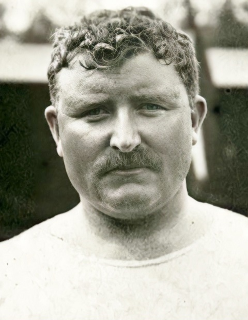
McDonald was born Patrick Joseph McDonnell in Killard, County Clare, on July 29, 1878. When his sister lands at Ellis Island after her sea voyage from Ireland, immigration officials pin a name tag on her with her name spelled “McDonald.” Taking no chances of being deported, she and all the McDonnells who come after her, accept the name McDonald.
McDonald competes for the United States in the 1912 Summer Olympics held in Stockholm, Sweden, in the shot put where he once again defeats Rose and wins the gold medal. He also takes part in the shot put competition where the distance thrown with each hand is added together. This is the only time this event is held in the Olympic program, and he finishes second behind Rose.
McDonald continues to be a nationally competitive athlete well into his 50s. At the age of 54, he beats his old rival Matt McGrath to win the weight throw for distance at the 1933 USA Outdoor Track and Field Championships. It is his 26th senior national championship meet, and the Omaha World-Herald notes that he has gray hair at the time of his last victory.
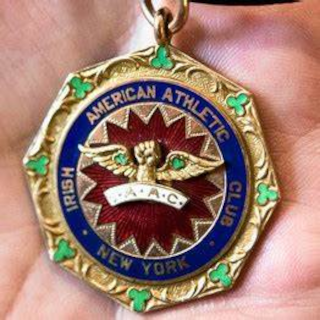
The Irish American Athletic Club, an amateur athletic organization based in Queens, New York, is established on January 30, 1898, originally as the Greater New York Irish Athletic Association. They shorten the name to the Irish American Athletic Club a few years later. They purchase a plot of land in what is then called Laurel Hill, Long Island, near Calvary Cemetery, Queens, and build a state-of-the-art athletic facility on what is farmland. The stadium, called Celtic Park, formally reopens after renovations on May 9, 1901, and until the facility is sold for housing in 1930, some of the greatest American athletes train or compete on Celtic Park’s track and field. The Irish American Athletic Club adopts a winged fist adorned with American flags and shamrocks as their emblem, with the Irish Gaelic motto “Láim Láidir Abú” or “A strong hand will be victorious,” and are often referred to as the “Winged Fists.” At one time they have clubs in Boston, Chicago, San Francisco and Yonkers, New York.
The Irish American Athletic Club is predominantly composed of Irish-born and first generation Irish American athletes, but many of the athletes who compete for the Winged Fist organization are neither.
The Irish American Athletic Club wins the Amateur Athletic Union national outdoor track and field team championship titles in 1904, 1906, 1907, 1908, 1910, 1911, 1912, 1913, 1914 and 1916. They also win the national indoor track and field team championship titles in 1906, 1908, 1909, 1911, 1913, 1914 and 1915. Individual athletes of the IAAC win 81 national outdoor championships titles and 36 individual national indoor championship titles.
In 1912–13, 1913–14, 1914–15 and 1916–17 the Irish American Athletic Club has a team, the New York Irish-Americans, represented in the American Amateur Hockey League. The team is coached by James C. “Jimmy” O’Brien and has on its roster for various seasons future NHL players Tom McCarthy and Moylan McDonnell. John McGrath and Patsy Séguin also play for the club.
Before the largest crowd that has ever assembled to see a track meet in the United States, on September 9, 1916, the Irish American Athletic Club defeats the New York Athletic Club at the Amateur Athletic Union’s National Championships, by a score of 38 to 27. Before a crowd of 30,000 spectators at Newark, New Jersey‘s Weequahic Park, the Irish American Athletic Club wins what is to be their last national championship title. The club disbands a year later when the United States becomes a combatant in World War I.
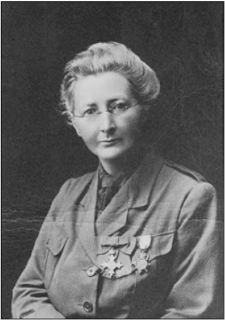
Stoney is born in Dublin on February 4, 1870, to George and Margaret Sophia Stoney. Her father is a mathematical physicist who later serves as Secretary of Queen’s University of Ireland and is an advocate for women’s right to higher education in Ireland. His efforts are considered to be among the principal reasons that women can qualify for a medical license. Of weak health as a child, she is at first privately educated in the home but then attends the Royal College for Science of Ireland with her sister Edith. In 1883, the Stoney family moves to London in order to provide higher education for the daughters since this is unavailable for women in Ireland at the time. She attends the London School of Medicine for Women where she is a distinguished student with great academic achievements in subjects such as anatomy and physiology. She obtains her MBBS with honours in 1895 and a Doctor of Medicine in 1898, going on to specialise in radiology.
Stoney works as an ENT clinical assistant at the Royal Free Hospital as well as spending six years as a demonstrator in anatomy at the London School of Medicine for Women.
After this she spends a short amount of time in the Victoria Hospital for Sick Children in Kingston upon Hull and then goes on to establish an X-ray department in the Elizabeth Garret Anderson Hospital for Women in London in 1902. At the hospital she carries out a variety of work but mainly deals with X-rays, often developing the radiographic plates at her own house. She is the first female radiologist to work in the United Kingdom at a time when knowledge on radiology and the equipment involved is still in its developmental stages. She is forced to work in poor conditions with badly ventilated rooms and a lack of space for X-ray work. She is given no assistance and has to do the majority of the work on her own. Furthermore, she is excluded as a member of the medical staff and from the X-ray department committee. In 1906 she sets up a practice in Harley Street.
Stoney leaves the hospital at the start of the war. She has 13 years of experience in her field when World War I breaks out in August 1914. She and her sister Edith, a medical physicist, volunteer to assist the British Red Cross, but both are refused by surgeon Frederick Treves since they were women. Despite the refusal, Stoney prepares an X-ray installation and helps to organise a unit of women volunteers alongside Mrs. St. Clair Stobart, Women’s Imperial Service League and the Belgian Red Cross to aid the Belgian soldiers in Antwerp. The team converts an abandoned music hall into a makeshift hospital where she manages the surgical unit as head of the medical staff and radiologist. The hospital comes under fire and after enduring ongoing shellfire for 18 hours, the hospital is evacuated. The team walks to Holland, where they manage to cross the Scheldt River on buses carrying ammunition, twenty minutes before the bridge is blown up. She and her unit earn the 1914 Star for bravery.
Stoney continues working in a hospital near Cherbourg in France, mainly dealing with cases relating to compound fractures and locating bullet fragments in wounds. During this time, she becomes experienced in recognizing dead bone and discovers that removing it will speed up recovery.
In March 1915, the Cherbourg hospital is no longer needed, and Stoney moves back London. She begins full-time work at the 1,000-bed Fulham Military Hospital. She is one of the first female physicians granted to serve as a full-time worker under the British War Office and goes on to receive the Order of the British Empire in June 1919. She works as the Head of the X-ray and Electrical Department and remains there until 1918.
In her later years, Stoney suffers from ill health, largely attributed to her over-exposure to radiation in her work. It is reported that she has X-ray dermatitis of her left hand, a painful skin condition associated in modern times with radiation therapy as a treatment for cancer. She moves to the south coastal town of Bournemouth in England where she is on the staff of two hospitals, practicing radiology part-time. She occupies the position of Honorary Medical Officer to the Electrical Department of the Royal Victoria and West Hants Hospital in Bournemouth. She is the founder and president of the Wessex branch of the British Institute of Radiology. She serves as the consulting actinotherapist at the Victoria Cripples Home. During retirement she pens a number of articles in contribution to the medical literature of the time. She publishes research on topics such as fibroids, goitre, Graves’ disease, soldier’s heart, rickets and osteomalacia.
Stoney retires from all of her hospital positions in 1928 at the age of 58. She, along with her older sister Edith, travel in retirement. One trip is to India, where she writes her final scientific paper, the subject of which is osteomalacia (bone softening), in particular in relation to pelvic deformities in childbirth. She studies and investigates this topic overseas, and specifically the association between UV exposure, vitamin D and skeletal development. In India, she also uses her expertise to advise on the use of UV light in hospitals.
Stoney dies at the age of 62, on October 7, 1932. She is suffering from a long and painful illness, vertebral cancer, again largely attributed to her work in the presence of high levels of radiation. Her funeral takes place on October 11 at Golders Green Crematorium, London. The British Journal of Radiology publishes her official obituary which spans five pages, containing many warm personal testimonials. After her sister’s death, Edith Stoney continues to travel and research.
Jack “Legs” Diamond, an Irish Americangangster in Philadelphia and New York City during the Prohibition era also known as John Nolan and Gentleman Jack, is born in Philadelphia on July 10, 1897, to Sara and John Moran, who emigrated from Ireland to Philadelphia in 1891. A bootlegger and close associate of gambler Arnold Rothstein, he survives a number of attempts on his life between 1916 and 1931, causing him to be known as the “clay pigeon of the underworld.” In 1930, his nemesis Dutch Schultz remarks to his own gang, “Ain’t there nobody that can shoot this guy so he don’t bounce back?”
In 1899, Diamond’s younger brother Eddie is born. He and Eddie both struggle through grade school, and their mother suffers from severe arthritis and other health problems. She passes away on December 24, 1913, following complications brought on by a bacterial infection and a high fever. John Moran then moves his family to Brooklyn, New York.
Diamond soon joins a Manhattan street gang called the Hudson Dusters. His first arrest for burglary occurs when he breaks into a jewelry store on February 4, 1914. He serves in the United States Army in World War I but is convicted and jailed for desertion in 1918 or 1919. He serves two years of a three- to five-year sentence at Leavenworth Military Prison. After being released in 1921, he becomes a hired thug and later personal bodyguard for crime boss Arnold Rothstein.
Diamond is known for leading a rather flamboyant lifestyle. He is an energetic individual, his nickname “Legs” derived either from his being a good dancer or from how fast he could escape his enemies. His wife Alice is never supportive of his life of crime but does not do much to dissuade him from it. He is a womanizer, with his best-known mistress being a showgirl and dancer, Marion “Kiki” Roberts.
In the late 1920s, Prohibition is in force, and the sale of beer and other alcoholic beverages is illegal in the United States. Diamond travels to Europe to acquire beer and narcotics but fails. However, he does obtain liquor, which is dumped overboard in partially full barrels that float to Long Island as ships enter New York Harbor. He pays children a nickel for every barrel they bring to his trucks.
Following the death of Jacob “Little Augie” Orgen, Diamond oversees illegal alcohol sales in downtown Manhattan via the Hotsy Totsy Club, an establishment partly owned by Diamond on Broadway. This work brings him into conflict with Dutch Schultz, who wants to move beyond his base in Harlem. He also runs into trouble with other gangs in the city. On July 14, 1929, he and fellow gang member Charles Entratta shoot three drunken brawlers in the Hotsy Totsy Club. Two of the brawlers, William Cassidy and Simon Walker, are killed, while the survivor, Peter Cassidy, is severely wounded. The club’s bartender, three waiters, and the hat check girl vanish, with one of them being found shot dead in New Jersey. He is not charged but is forced to close the club.
In 1930, Diamond and two henchmen kidnap truck driver Grover Parks in Cairo, New York, demanding to know where he had obtained his load of hard cider. When Parks denies carrying anything, Diamond and his men beat and tortured Parks, eventually letting him go. A few months later, he is charged with the kidnapping of James Duncan. He is sent to Catskill, New York, for his first trial, but is acquitted. However, he is convicted in a federal case on related charges and sentenced to four years in jail. He is tried in December 1931 in Troy, New York, also for kidnapping, and is once again acquitted.
On August 23, 1930, Diamond, under the false name John Nolan, boards the ocean liner SS Belgenland, bound for Europe. The New York City Police Department (NYPD) suspect that he might have left the U.S. aboard RMS Olympic or RMS Baltic, but he is not found on either ship when they reach Europe. The NYPD then sends a wireless telegraph message to the crew of SS Belgenland, who reply that a man similar to Diamond’s description is among the passengers. Diamond spends much of the voyage in the ship’s smoking-room playing poker, with one report claiming that he won thousands of dollars in this game. The SS Belgenland‘s officers, however, refute this, saying his winnings were small.
The NYPD telegraphs police in England, France and Belgium with the warning that Diamond is an undesirable character. When SS Belgenland reaches Plymouth on August 31, Scotland Yard officers tell Diamond he will not be allowed to land in England. He tells reporters that he wants to travel to the French spa town of Vichy for “the cure.” He disembarks in Antwerp on September 1, where Belgian police take him to their headquarters. Eventually, he agrees to voluntarily leave Belgium and is put on a train to Germany. When his train reaches Aachen, German police arrest him. On September 6, the German government decides to deport Diamond. He is driven to Hamburg and put on the cargo ship Hannover for passage to Philadelphia.
On September 23, Hannover arrives in Philadelphia, and Diamond is immediately arrested by the Philadelphia police. At a court hearing that day, the judge says he will release him if he leaves Philadelphia within the hour. Diamond agrees.
On October 24, 1924, Diamond is shot and wounded by shotgun pellets, reportedly after trying to hijack liquor trucks belonging to a rival crime syndicate.
On October 16, 1927, Diamond tries to stop the murder of “Little Augie” Orgen. His brother Eddie is Orgen’s bodyguard, but Diamond substitutes for Eddie that day. As Orgen and he are walking down a street on Manhattan’s Lower East Side, three young men approach them and start shooting. Orgen is fatally wounded, and Diamond is shot twice below the heart. He is taken to Bellevue Hospital, where he eventually recovers. Police interview him in the hospital, but he refuses to identify any suspects or help the investigation in any way. Police initially suspect that he is an accomplice and charge him with homicide, but the charge is dropped. The assailants are supposedly hired by Lepke Buchalter and Jacob “Gurrah” Shapiro, who are seeking to encroach on Orgen’s garment-district labor rackets.
On October 12, 1930, Diamond is shot and wounded at the Hotel Monticello on Manhattan’s West Side. Two men force their way into his room and shoot him five times. Still in his pajamas, he staggers into the hallway and collapses. When asked later by the police commissioner how he managed to walk out of the room, he says he drank two shots of whiskey first. He is rushed to the Polyclinic Hospital, where he eventually recovers. He is discharged from Polyclinic on December 30, 1930.
On April 21, 1931, Diamond is arrested in Catskill on assault charges for the Parks beating in 1930. Two days later, he is released from the county jail on $25,000 bond. Five days later, he is again shot and wounded at the Aratoga Inn, a roadhouse near Cairo. After eating in the dining room with three companions, he is shot three times and collapses by the front door. A local resident drives him to a hospital in Albany, where he eventually recovers. On May 1, while he is still in the hospital, the New York State Police seize over $5,000 worth of illegal beer and alcohol from his hiding places in Cairo and at the Aratoga Inn.
In August 1931, Diamond and Paul Quattrocchi go on trial for bootlegging. The same month, he is convicted and sentenced to four years in state prison. In September 1931, he appeals his conviction.
On December 18, 1931, Diamond’s enemies finally catch up with him. He is staying in a rooming house on Dove Street in Albany while on trial for kidnapping in Troy. On the night of his acquittal, December 17, he and his family and friends visit a restaurant in Albany. At 1:00 a.m., he and mistress, Marion “Kiki” Roberts, entertain themselves at the Rain-Bo Room of the Kenmore Hotel on North Pearl Street.
At 4:30 a.m., Diamond drunkenly goes back to the rooming house and passes out on his bed. Two gunmen enter his room about an hour later. One man holds Diamond down and the other shoots him three times in the back of the head.
There is much speculation as to who is responsible for the murder. Likely candidates include Schultz, the Oley Brothers, the Albany Police Department, and relatives of Red Cassidy, another Irish American gangster at the time. According to author William Kennedy in his book O Albany, Dan O’Connell, who runs the local Democraticpolitical machine, orders Diamond’s execution, which is carried out by the Albany police.
Given the power that the O’Connell machine holds in Albany and its determination to prevent organized crime, other than their own, from threatening their monopoly of vice in the city, some accept this account of the story. For those believing this theory, William Fitzpatrick’s promotion to chief of police is said to be a reward for executing Diamond. In 1945, Chief Fitzpatrick is shot and killed in his own office by John McElveney, an Albany police detective. McElveney is sentenced to 20 years to life in prison. He is released in 1957 when his sentence is commuted by GovernorW. Averell Harriman.
On December 23, 1931, Diamond is buried at Mount Olivet Cemetery in Maspeth, Queens. There is no church service or graveside ceremony. Family and spectators numbering 200 attend the interment. No criminal figures are spotted.
On July 1, 1933, Alice Kenny Diamond, Diamond’s 33-year-old widow, is found shot to death in her Brooklyn apartment. It is speculated that she is shot by Diamond’s enemies to keep her quiet.
Garstin is born on August 28, 1847, in Caherconlish, County Limerick, to Captain William Garstin and Mary Moore Garstin. He is raised by aunts and grandparents following his father’s suicide and his mother’s incapacitating disabilities.
Garstin attends Victoria College on the island of Jersey and then he works in architecture and engineering for brief periods. He then travels to South Africa where he befriends Cecil Rhodes, works as a journalist and is involved in government in Cape Town.
In 1886, Garstin marries Louisa Jones, also known as Dochie. Many of Garstin’s friends from school in Antwerp had settled in Newlyn. He and Dochie move to Mount Vernon in Newlyn by 1886. They have three children: Crosbie, Denis and Alethea. The boys take up journalism and Alethea becomes an artist. The family moves to Penzance by 1895.
In 1888 Garstin becomes a member of the New English Art Club (NEAC). He becomes a member of the Newlyn Society of Artists (NSA) and is on the Newlyn Art Gallery‘s Provisional Committee for its opening in 1895. Regarding the plein-air approach used by St. Ives and Newlyn artists he says they are “filled with this idea of a fresh unarranged nature to be studied in her fields, and by her streams, and on the margin of her great seas – in these things they were to find the motives of their art.”
Garstin is a teacher and takes groups to “his favorite painting haunts on the Continent.” For instance, Frances Hodgkins, a New Zealand artist, attends Garstin’s 1901 and 1902 summer sketching classes in France. He teaches Harold Harvey, the only Cornish Newlyn School painter, and his daughter, Alethea.
Garstin’s work consists primarily of small oil panels in the plein air style, something he had picked up from the French Impressionists, like Édouard Manet. He is also fascinated by Japanese prints and admires the work of the American painter James Abbott McNeill Whistler. Some of his works are at Tate and Penlee House.
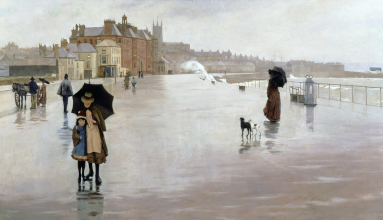
One of Garstin’s best and most famous works is his 1889 painting The Rain, It Raineth Every Day of the Penzance promenade. The title of the work comes from William Shakespeare‘s King Lear and Twelfth Night. “The composition of this painting demonstrates Garstin’s admiration for Japanese art,” says Penlee House.
Garstin dies in Penzance on June 22, 1926.
(Pictured: “The Rain It Raineth Every Day” oil on canvas by Norman Garstin, 1889, Penlee House)
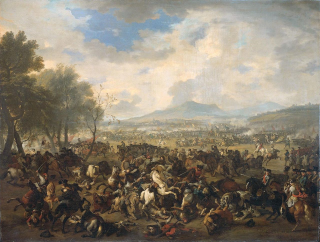
For the Grand Alliance – Austria, England, and the Dutch Republic – the Battle of Ramillies follows an indecisive campaign against the Bourbon armies of King Louis XIV of France in 1705. Although the Allies capture Barcelona that year, they are forced to abandon their campaign on the Moselle, stall in the Spanish Netherlands and suffer defeat in northern Italy. Yet despite his opponents’ setbacks Louis XIV wants peace, but on reasonable terms. Because of this, as well as to maintain their momentum, the French and their allies take the offensive in 1706.
In less than four hours Marlborough’s Dutch, English, and Danish forces overwhelm Villeroi’s and Maximilian II Emanuel‘s Franco-Spanish-Bavarian army. The Duke’s subtle moves and changes in emphasis during the battle, something his opponents fail to realise until it is too late, catches the French in a tactical vice. With their foe broken and routed, the Allies are able to fully exploit their victory. Town after town falls, including Brussels, Bruges and Antwerp. By the end of the campaign Villeroi’s army has been driven from most of the Spanish Netherlands. With Prince Eugene of Savoy‘s subsequent success at the Siege of Turin in northern Italy, the Allies impose the greatest loss of territory and resources that Louis XIV would suffer during the war. Thus, the year 1706 proves, for the Allies, to be an annus mirabilis.
(Pictured: “The Battle of Ramillies between the French and the English, 23 May 1706” by Jan van Huchtenburgh, oil on canvas painted between 1706 and 1710)
Lawless, a Catholic, is the confidant of Lord Edward FitzGerald, and Professor of Anatomy and Physiology in the Royal College of Surgeons in Ireland, Dublin. Closely connected with John Sheares in the direction of affairs in the spring of 1798, a warrant for his arrest is issued on May 20 with a reward of £300. Timely notice is, however, given him of the fact by Mr. Stewart, the Surgeon-General, and he escapes to France, where his abilities and spirit recommend him to the special favour of Napoleon. While in Paris, he spends time with other United Irishmen in exile, including Myles Byrne and William James MacNeven.
Lawless is placed on half-pay in 1800, but in 1803 is appointed captain of the Irish Legion, and in July 1806 is ordered to Vlissingen, then besieged by the English, to command the Irish battalion. To reach his post he has to pass in a small open boat through the English fleet. He is dangerously wounded in a sortie, and when General Monet capitulates without stipulating for the treatment of the Irish as prisoners of war, Lawless escapes from the town with the eagle of his regiment, conceals himself for two months in a doctor’s house, and at length finds an opportunity of getting to Antwerp by night in a fishing boat. MarshallJean Baptiste Jules Bernadotte welcomes him, extols him in general orders, and reports his exploits to Napoleon, who summons him to Paris, decorates him with the Legion of Honour, and promotes him to be lieutenant-colonel. In 1812 he gains a colonelcy, and on August 21, 1813, he loses a leg at the Battle of Dresden. He retires to his country house in Tours.
After the restoration of the Bourbons, Lawless is returned, in October 1814, to half-pay with the rank of brigadier general. He dies in Paris at the age of 52 on December 25, 1824. His remains are buried at Père Lachaise Cemetery in Paris. He is one of the best officers of the last large French unit of The Wild Geese. Thomas Moore describes him as “a person of that mild and quiet exterior which is usually found to accompany the most determined spirit.”
(Pictured: Gravesite of General William Lawless in Père Lachaise Cemetery in Paris, France)
O’Brien marries Mabel Emmeline Smyly, daughter of Sir Philip Crampton Smyly, on March 8, 1902. Together they have five children. His son Brendan, a surgeon in Dublin, marries artist Kitty Wilmer O’Brien. His daughter Rosaleen Brigid becomes an artist, also known as Brigid Ganly after her marriage to Andrew Ganly. Another artistic relative is Geraldine O’Brien.
Unlike many of his Irish contemporaries, after graduating from Cambridge O’Brien does not study art in Dublin, opting instead to travel to Paris, where he studies the paintings at the Louvre. In 1887, he visits galleries in Italy and then enrolls at the Royal Academy of Fine Arts in Antwerp, Belgium. At the Academy he is a fellow student of Walter Osborne. He leaves Antwerp in 1891 and returns to Paris, where he studies at Académie Julian. He relocates to London in 1893 and then Dublin in 1901.
O’Brien is designated an associate of the Royal Hibernian Academy in 1906, a member in 1907, and is later president between 1910 and 1945. He is made an honorary member of the Royal Academy of Arts, London in 1912.
On August 28, 1979, a bomb explodes under an open‐air stage on the Grote Markt in Brussels, Belgium where a British Army band is preparing to give a concert, injuring at least 15 persons, including four bandsmen, and causes extensive damage. Mayor Pierre van Halteren of Brussels says the Irish Republican Army (IRA) claims responsibility for the bombing in a telephone call to city hall.
The bombing comes just a day after Earl Mountbatten of Burma and three others are killed in a bombing in the Irish Republic, and 18 British soldiers die in an attack in Northern Ireland. The IRA claims responsibility for both attacks.
The band is from the Duke of Edinburgh’s Royal Regiment, which is stationed in Osnabrück, West Germany. The bombing occurs only minutes before the band is to have begun a concert in the broad square, a major tourist site surrounded by centuries‐old buildings. However, only 6 of the 30 members of the band are on the makeshift stage when the bomb explodes at about 3:00 PM. The others had left the stage to change into their red dress uniforms after setting up music stands and instruments.
The band is held up in traffic and is late arriving for the concert. The police say that if the bomb had gone off later, during the concert, the casualty toll would have been heavier.
Before the IRA telephone call is reported, Earl Nicoll, military attaché at the British Embassy in Brussels, says, “I’d guess it is either the IRA or people sympathetic to their aims. It is clearly a manifestation they wanted to hit the band, not any Belgians.”
The temporary stage is used for daily concerts to mark the city’s 1,000th birthday. A police spokesman says the explosives were under the stage floor in the back, on the side away from the square. At the time of the explosion only a few hundred people, most of them tourists, are in the square, which is lined by outdoor cafes, flower stalls and centuries‐old guildhalls.
The blast creates a 90‐by‐30‐foot hole in the stage floor, and severely damages the back wall and the ceiling. It shatters windows in the ancient buildings. A police spokesman says investigators did not yet know what kind of bomb was used. Officials estimate the damage at $134,000 to $167,000.
A number of other recent terrorist attacks on the continent are blamed on the IRA. On March 22, 1979, Sir Richard Sykes, Britain’s Ambassador to the Netherlands, and his Dutch valet are shot and killed as the envoy leaves for work in The Hague. On the same day, a Belgian bank employee is shot to death in front of his home in suburban Brussels in what police believe is a case of mistaken identity on the part of the IRA. Officials believe the gunmen were after Sir John Killick, deputy chief of Britain’s mission to the North Atlantic Treaty Organization, which has its headquarters in Belgium.
On July 6, a bomb that officials believe to be planted by the IRA goes off in the British consulate building in Antwerp, Belgium, causing damage but no injuries. Four days later, two bombs go off at two British Rhine Army barracks in Dortmund, West Germany, causing extensive damage but again no injuries. The IRA claims responsibility for those and other bombings at facilities of the 50,000‐member Rhine Army.
(From: “I.R.A. Sets Off Bomb at Belgian Concert,” The New York Times, August 29, 1979)
Most of Osborne’s paintings are figurative and focus on women, children, the elderly, the poor, and the day-to-day life of ordinary people on Dublin streets, as well as series of rural scenes. He also produces city-scapes, which he paints from both sketches and photographs. A prolific artist, he produces oils, watercolours, and numerous pencil sketches. He is best known for his documentary depictions of late 19th century working class life.
Osborne is the second of three sons of William Osborne, a successful animal painter who specialises in portraying horses and dogs for the then prosperous Irish landlords. He is educated at Rathmines School and at the Royal Hibernian Academy school. He learns from his father that there is money to be earned from painting animals. He produces quite a few, including of children with their pets, notably his 1885 A New Arrival, and a series of impressionistic works on cows.
In 1883, Osborne moves from Antwerp to Brittany where he paints his famous Apple Gathering, Quimperlé, now in the National Gallery of Ireland. Soon after, he moves to England where he works alongside Nathaniel Hill and Augustus Burke at Walberswick. During his period, he often returns to Dublin to make preparatory sketches for what becomes his most renowned series, of the everyday lives of the city’s poor. Although highly regarded today, these documentary street paintings are not commercially successful, and Osborne supplements his income through portrait paintings of the middle class, which are not as artistically satisfying.
In 1886, he is elected to the Royal Hibernian Academy and receives many commissions for portraits. This is an important source of income, as he has no private means of his own. After his sister dies, he is involved in looking after her daughter, and his own parents become increasingly financially dependent on him.
In 1892, he returns to Ireland to live in the family residence, and he also keeps a studio at No. 7 St. Stephen’s Green. He spends a considerable amount of time painting outdoors, in Dublin around St. Patrick’s Cathedral or in the country. He is well liked in social circles and counts the surgeon Sir Thornely Stoker, brother of Bram Stoker, among his best friends.
Osborne’s mother becomes ill in the early 1900s, and Walter spends significant periods caring for her. In 1903, while gardening, he overheats himself and catches a chill, which he neglects, and which develops into pneumonia. He dies prematurely from the illness at the age of 43 on April 24, 1903. He is buried in Mount Jerome Cemetery in Dublin.
Some critics have suggested that at the time of his death he is on the brink of his artistic maturity. His final work Tea in the Garden, a fusion of naturalism and impressionism, remains unfinished at his death and is now in the collection of the Hugh Lane Gallery in Dublin. Today his work is highly sought after by collectors.




 seamus dubhghaill