seamus dubhghaill

Promoting Irish Culture and History from Little Rock, Arkansas, USA


Leave a comment

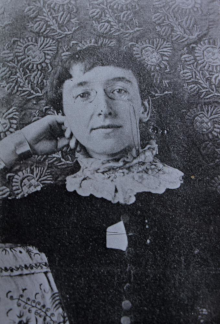
Death of Wilhelmina Geddes, Stained Glass Artist

Wilhelmina Geddes, Irish stained glass artist who is an important figure within the Irish Arts and Crafts movement and also the twentieth-century British stained glass revival, dies in London, England, on August 10, 1955. Her notable works include windows at St. Bartholomew’s Anglican Church (Ottawa, Canada), St. Peter’s Church (LampeterWales), and the King Albert Memorial Window, St. Martin’s Cathedral (Ypres, Belgium).

Geddes is born on her maternal grandparent’s farm at Drumreilly Cottage in Leitrim, County Leitrim, on May 25, 1887. She is the eldest of four children, three girls and a boy, of William Geddes and his wife Eliza Jane Stafford. The family, who migrates to Ireland from Scotland, has mainly been farmers. Her father, a Methodist, who is born near his father’s farm at TandrageeCounty Armagh, emigrates to the United States as a young man, working as a labourer for the railway construction business. This serves a useful purpose as he had worked as a site engineer at the Cavan, Leitrim and Roscommon Railway Company. When she is still an infant her parents move to their native home in Belfast, so her father can set up in business as a building contractor.

Geddes begins drawing subjects from life and nature from the age of four. She learns first how to draw from the school mistress in Ayrshire, where her father occasionally goes shooting. She begins her studies at Methodist College Belfast along with her three younger sisters. She later moves to the Belfast School of Art. She is encouraged by Rosamond Praeger, a sculptor from County Down, to continue with her studies. She is accepted as a student to study at the Belfast School of ArtUlster University. This is where she adapts and improves her style and is introduced to a professional standard of art work.

While still studying at the Belfast School of Art, Geddes takes part in the Arts and Crafts Society of Ireland‘s fourth exhibition. For this exhibition, she contributes a glowingly coloured illustration of the book Cinderella Dressing the Ugly Sister (Dublin City Gallery), which she had created. It is at this exhibition that her work is spotted by Sarah Purser, a well established painter seeking newly trained students to introduce to stained glass artistry. Purser, who goes on to be her lifelong mentor, invites the young Geddes to join her in Dublin, working under the established stained glass artist William Orpen.

Geddes contributes a watercolour illustration of a Ballad Seller with the Belfast Art Society in 1907. She is elected as an Associate of the Belfast Art Society’s successor, the Ulster Academy of Arts, in 1933 before promotion to Honorary Academician in 1935. She shows five illustrations in the 1911 Oireachtas Exhibition. It is some twenty-one years before she returns to the Oireachtas when she exhibits three cartoons and three sketches for stained glass in 1932.

Geddes joins Purser at the acclaimed stained glass workshop called An Túr Gloine in 1910. The workshop is held in Dublin’s Metropolitan School of Art. It is here that she discovers her passion for the craftsmanship of stained glass artistry and creates her most important works.

During her early years at An Túr Gloine, Geddes’s originality shines, and important commissions come from St. Ann’s Church, Dawson Street, Dublin and the Presbyterian church in Rathgar. Dogged by illness, she returns to Belfast before 1916 and lives between there and Dublin until moving in 1925, as she has long wanted, to work in London at The Glass House, Fulham. While working at The Glass House, she instructs the Irish painter and stained glass artist Evie Hone.

Geddes’s work is considered pioneering and represents a rejection of the Late Victorian approach. She creates a new view of men in stained glass windows, portraying them with close-shaven crew cuts. The muscularity and tension of her portraiture is matched by the radical design of her constructions. Ambitious large-scale projects, as at the cathedral in Ypres, are equalled by the drama of smaller-scale work at Wallasey (Lancashire) and Wallsend (Northumberland), or war memorial windows in obscure country churches.

Despite the hardships of living in London during World War II, poverty, and ill health, Geddes designs seventeen full-scale stained glass masterpieces, sixteen of which she completes.

Geddes dies on August 10, 1955 in London of a pulmonary embolism. She is buried in Carnmoney Cemetery, County Antrim, along with her mother and sister Ethel. Even after moving to London, she claims that her native identity never wavered as she says she was always “a Belfast woman.”


Leave a comment

Birth of Catherine O’Brien, Irish Stained Glass Artist

Catherine Amelia “Kitty” O’Brien, Irish stained glass artist and a member and director of An Túr Gloine, is born in Durra House, Spancill Hill, County Clare, on June 19, 1881.

O’Brien is one of five children of Pierce O’Brien, a gentleman landowner, and Sophia Angel St John O’Brien. Her first cousin is woodcarver Sophia St John Whitty. She attends the Mercy Convent in Ennis, going on to win a scholarship to the Dublin Metropolitan School of Art. While there she studies under William Orpen and Alfred E. Child who teach her the art of stained glass.

Among O’Brien’s first commissions is the St. Ita window for St. Brendan’s cathedral in Loughrea, County Galway, in 1904, which is designed by Sarah Purser. She joins An Túr Gloine in 1906, beginning her career there by designing Angel of the Annunciation window in the Enniskillen convent chapel. For a window in the Wilson private chapel at Coolcarrigan House, NaasCounty Kildare, in 1912, she incorporates Celtic design, some drawing on the Book of Durrow. In 1914, she tours the cathedrals of ParisRouen, and Chartres with Purser and Wilhelmina Geddes. She designs three windows depicting St. John, St. Flannan, and St. Munchin, for the Honan Chapel at University College Cork in 1916. Her 1923 design of the centenary memorial window in St. Andrew’s church, Lucan, represents the parable of the Good Shepherd. When in 1925 An Túr Gloine becomes a cooperative society, she becomes a shareholder along with Ethel RhindEvie Hone, and Michael Healy.

O’Brien’s 1926 lunette The Spirit of Night represents night, twilight, and dawn, and is for the private home of Keng Chee in Singapore, which is later demolished. The window of St. Catherine of Siena for the Sacred Heart convent chapel in Newton, Massachusetts dates from 1927. Her 1931 St. Patrick window, for the De La Salle school, East Coast Rd., Singapore, commissioned by architect Denis Santry, is the only extant stained-glass work by an Irish artist in that country. Much like Rhind, O’Brien also employs opus sectile, such as in her 1936 Mass in Penal Days in the Franciscan friary, AthloneCounty Westmeath. She contributes two windows, Pelican and Lamb and Host and Chalice: Wheat and Grapes, to the ten windows An Túr Gloine produces for Brophy College ChapelPhoenix, Arizona in 1937. From 1937 until 1947, she works on 22 opus sectile panels for the Protestant Church in Ennis.

Purser retires from An Túr Gloine in 1940, and O’Brien succeeds her as director, going on to purchase it and the contents in 1944. She rents a section of the premises to fellow stained-glass artist Patrick Pollen from 1954 onwards. She exhibits at the 1953 Irish Exhibition of Living Art, and the 1958 exhibition of the Arts and Crafts Society of Ireland. When the An Túr Gloine studios are damaged by fire in 1958, she rebuilds them and reopens by 1959. She is an active member of the Soroptimists and the Guild of Irish Art Workers. The last work she completes is a three-light window for the Church of St. MultoseKinsale, County Cork, in 1962. A commission for two windows for the private chapel of Áras an Uachtaráin for President Éamon de Valera is left unfinished at her death.

O’Brien dies in Dublin on July 18, 1963, and is buried in Whitechurch Parish Graveyard, County Dublin. She is commemorated in a window designed by Pollen in St. Laurence O’Toole chapel, Christ Church Cathedral, Dublin, where for forty years she made floral arrangements. Over 150 of her An Túr Gloine drawings from notebooks are now in the National Gallery of Ireland.

(Pictured: Stained glass window in the south wall of Ferns Cathedral, Ferns, County Wexford)


Leave a comment

Birth of Richard Orpen, Architect, Painter & Illustrator

Richard Francis Caulfield Orpen, Irish architect, painter, illustrator and designer, is born on December 24, 1863.

Orpen is born to Anne (née Caulfield) and Arthur Herbert Orpen, a solicitor of Oriel, Blackrock, Dublin. His maternal grandfather is the Bishop of Nassau, Charles Caulfield. He is the eldest of four brothers and two sisters. His youngest brother is William, the painter. He attends St. Columba’s College in Whitechurch, Dublin, and graduates from Trinity College Dublin (TCD) with a BA in 1885. While attending St. Columba’s, he publishes an Irish comic alphabet for the present times in 1881, which is a mix of cartoons and verse mocking Charles Stewart Parnell and the home rule movement.

Orpen wants to pursue painting, but “for family reasons” he becomes an architect. He spends eleven years with Thomas Drew, initially as a pupil, and later as a managing assistant from 1885 to 1892. From around 1884, he attends the annual excursions of the English Architectural Association. Around 1890, he establishes his own architectural practice in Drew’s offices at 22 Clare Street, Dublin. In 1896, he moves his office to 7 Leinster Street. In 1888 he is elected as a member of the Royal Institute of the Architects of Ireland (RIAI), serving as a council member from 1902 to 1910, as honorary secretary from 1903 to 1905, and as president from 1914 to 1917. He designs the institute’s official seal in 1909. In 1904, the Irish Builder describes him as the “originator of the bungalow in Ireland.”

From 1888, Orpen exhibits with the Royal Hibernian Academy (RHA), with watercolours and architectural drawings. He continues to exhibit with them until 1936. He collaborates with Percy French on a number of projects, including illustrating Racquetry Rhymes (1888) and The First Lord Liftinant and Other Tales (1890). He provides cartoons for French’s periodical, The Jarvey. His architectural illustrations are included in H. Goldsmith Whitton’s Handbook of the Irish Parliament Houses… (1891). He is one of the original members of the Architectural Association of Ireland, serving as its first president in 1896, and as vice-president in 1910.

Orpen is appointed the architect to St. Columba’s from 1897 to 1938, following a fire at the college in 1896. He becomes a fellow of the college, and the sanatorium becomes known as the Orpen building. He is an active member of the Arts and Crafts Society of Ireland, serving as secretary in 1895, on the committee in 1904, and in 1917 sits on the organising committee for the fifth exhibition. In 1906, he is a founding member of the Arts Club. In 1906 he moves his architectural practice to 13 South Frederick Street, and moves into a house he designed, Coologe, Carrickmines, County Dublin.

At the 1907 Irish International Exhibition, Dublin, Orpen exhibits a number of chalk drawings. The same year he designs the cover of a satirical pamphlet, The Abbey row, not edited by W. B. Yeats, which mocks The Arrow and the riots at the first production of The Playboy of the Western World. He unveils a bust of Hugh Lane at the opening of the Municipal Gallery of Modern Art on Harcourt Street in 1908. He is appointed secretary to the municipal gallery committee by Lane. In 1910, he is appointed architect to Christ Church Cathedral, as well as architect to St. Canice’s Cathedral, Kilkenny, and St. Patrick’s Cathedral, Dublin. In 1911 he is elected an associate of the Royal Hibernian Academy, a full member in 1912, and was the academy’s secretary from 1925 to 1937.

From 1910 to 1914, Orpen is in an architectural partnership with Page Dickinson, with the two collaborating on plans for the new Dublin municipal gallery and conversion of the Turkish Baths, Lincoln Place. Lane rejects his and Dickinson’s gallery plans, leading to him refusing to work with Lane’s choice of architect, Sir Edwin Lutyens. In 1914, he is appointed a guardian of the National Gallery of Ireland, and lectures at the Dublin Metropolitan School of Art on architectural history in 1914 and 1915. He is involved in the design of a number of memorials including the setting for a bronze relief by Beatrice Campbell for the members of the Royal Irish Regiment killed in the Second Boer War and the war memorial at the Rathgar Methodist church. He serves as president of the arts and crafts section of the Royal Dublin Society (RDS). He is also a governor of the Royal National Hospital for Consumption for Ireland in Newcastle, County Wicklow.

Orpen marries Violet Caulfield in 1900. They are both descended from William Caulfeild, 1st Viscount Charlemont. He dies on March 27, 1938, at his home, Coologe, and is buried in Dean’s Grange Cemetery.

Orpen features as one of the many portraits in Seán Keating‘s Homage to Sir Hugh Lane. St. Columba’s College holds a portrait of Orpen by his brother, William, as well as a memorial stained-glass window to him by Catherine O’Brien.


Leave a comment

Birth of Kathleen Cox, Artist, Sculptor & Mystic

Kathleen Cox, Irish artist, sculptor, and mystic, is born Christina Mary Kathleen Cox in Wo-Sung, China, on July 2, 1904. Cox is considered a pioneer of contemporary Irish pottery.

Cox is the eldest daughter of Dr. R. H. Cox, originally from Dundalk, County Louth, and the port health officer in Shanghai. He is also an amateur geologist and models in clay. In his retirement, he invents a periscope later used during World War I by the Royal Navy. The years living in China leave an impression on the young Cox, visually and culturally. The family returns to Ireland in 1911, first moving to Listowel, County Kerry, and later to Howth, County Dublin. She attends Alexandra College, and later the Dublin Metropolitan School of Art in 1921. While there she studies sculpture under Oliver Sheppard and is considered one of his most talented students, winning the Royal Dublin Society Taylor prize for modelling in 1925, 1926, and 1927. The money from these prizes allows Cox to travel to Paris in 1929.

Cox exhibits in 1924 at the Tailteann exhibitions, and in 1925 submits textile designs to the Arts and Crafts Society of Ireland. She establishes a pottery studio at 7 Schoolhouse Lane, Dublin, with college friend Stella Rayner in 1929. The studio has the first electric kiln in Ireland. The first exhibited piece by Cox shown by the Royal Hibernian Academy (RHA) is in 1930, with a pair of Madonna bookends, and portrait masks of the daughter of Dermod O’Brien, Brigid O’Brien, and writer Norris Davidson. Davidson is a friend and neighbour, who commissions her to design the poster for his 1929 film, Suicide. She exhibits with the RHA from 1931 to 1933, and the Tailteann 1932, while also holding exhibitions in her studio. During this period Hilda Roberts paints her portrait, Strange Spirit. Kathleen Cox in her studio. The theme of womanhood is prominent in her work, including in the sign of her studio.

In 1932, Cox begins producing a line of more commercial figurines, drawing influence from the Royal Doulton Burslem factory, where she works for a time. One such figurine is The Lavender Man (pictured), modelled on Michael Clifford, a Dublin street trader. In the mid 1930s, she develops a frustration with her work and with her lack of impact on the wider world. In attending the Chinese exhibition in London in 1935, it is confirmed to her that pottery should be practical rather than ornamental. It spurs her to destroy all her moulds and sell her kiln upon her return to Dublin.

Cox marries Alan Palmer in 1937, the couple has two daughters and relocate to England. Palmer is a conscientious objector during World War II, with the couple running a farm at Meopham, Kent, returning to London after the war.

Cox dies in early September 1972 in London. Some of her work is held in the collections of the National Museum of Ireland and with four works featured in the exhibition Not Just Pots: Contemporary Irish Ceramics of the 21st Century.

It is during the 1920s that Cox begins to question mainstream religion and becomes a vegetarian. Finding that her personal philosophy is similar to that of theosophy, she joins the movement and speaks at meetings. She is heavily influenced by the founder of the Order of the Great Companions, the Rev. William Hayes, who is living in Dublin in the 1930s. She writes and illustrates a children’s book on world religions, A story of stories, which she publishes under the pseudonym C.M. Kay in 1970.


Leave a comment

Birth of Evelyn Gleeson, Designer & Co-founder of Dun Emer Press

Evelyn Gleeson, English embroidery, carpet, and tapestry designer, is born on May 15, 1855, in Knutsford, Cheshire, England. Along with Elizabeth and Lily Yeats, she establishes the Dun Emer Press.

Gleeson is the daughter of Irish-born Edward Moloney Gleeson, a medical doctor, and Harriet (née Simpson), from Bolton, Lancashire. Her father has a practice in Knutsford but on a trip to Ireland he is struck by the poverty and unemployment and, with the advice of his brother-in-law, a textile manufacturer in Lancashire, he founds the Athlone Woollen Mills in 1859, investing all his money in the project. The family moves to Athlone in 1863, but Gleeson is educated in England, where she trains as a teacher. She later studies portraiture in London at the Atelier Ludovici from 1890–92. She goes on to study design with Alexander Millar, a follower of William Morris, who believes she has an exceptional aptitude for colour-blending. Many of her designs are bought by the exclusive Templeton Carpets of Glasgow.

Gleeson takes a keen interest in Irish affairs and, as a member of the Gaelic League and the Irish Literary Society, mixes with the Yeats family and the Irish artistic circle in London and is inspired by the Gaelic revival in art and literature. She is also involved in the suffrage movement and is chairwoman of the Pioneer Club, a women’s club in London. In 1900, an opportunity arises to make a practical contribution to the Irish renaissance and the emancipation of Irish women. She is suffering from ill-health, but her friend Augustine Henry, botanist and linguist, suggests she move away from the London smog to Ireland and open a craft centre with his financial assistance. She seizes the opportunity and discusses her plans with her friends the Yeats sisters, Elizabeth and Lily, who are talented craftswomen and have direct contact with William Morris and his followers. They have no money to contribute to the venture but are enthusiastic and can offer their skills and provide contacts. She seeks advice from W. B. and Jack Yeats, from Henry, who loans her £500, and from her cousin, T. P. Gill, secretary of the Department of Agriculture and Technical Instruction.

During the summer of 1902 Gleeson finds a suitable house in Dundrum, County Dublin, ten minutes from the railway station. The house, originally called Runnymede, is renamed Dun Emer, after the wife of Cú-Chulainn, renowned for her craft skills. The printing press arrives in November 1902, and soon three craft industries are in operation. Lily Yeats runs the embroidery section, since she had trained with Morris’s daughter May. Elizabeth Yeats operates the press, having learned printing at the Women’s Printing Society in London. Gleeson manages the weaving and tapestry and looks after the financial affairs of the industries. W. B. Yeats acts as literary adviser, an arrangement that often causes friction, and Gleeson’s sister, Constance McCormack, is also involved.

Local girls are employed and trained, and the industries seek to use the best of Irish materials to make beautiful, high-quality, lasting products of original design. Church patronage accounts for most of their orders and, in 1902–03, Loughrea cathedral commissions twenty-four embroidered banners portraying Irish saints. They also make vestments, traditional dresses, drapes, cushions and other items, all beautifully crafted and mostly employing Celtic design. The first book published is In the Seven Woods (1903), by W. B. Yeats, cased in full Irish linen.

Gleeson is in demand as an adjudicator in craft competitions around the country and at Feis na nGleann in 1904 she praises the workmanship of the entries but is critical of the lack of teaching in design. She gives lectures and tries to raise the status of craftwork from household occupation to competitive industry. There are tensions with the Yeats sisters, who complain that she is bad-tempered and arrogant. In truth she had taken on too much of a financial burden, even with the support of grants, and she is anxious to repay her debt to Augustine Henry, which he is prepared to forego. The sisters snub her and omit her name in an interview about Dun Emer in the magazine House Beautiful. Millar, her design teacher in London, likens the omission to Hamlet without the prince. In 1904, it is decided to split the industries on a cooperative basis: Dun Emer Guild Ltd. under Gleeson and Dun Emer Industries Ltd. under the Yeats sisters.

Work continues, and the guild and industries exhibit separately at the Royal Dublin Society (RDS) and other craft competitions. In 1907, the National Museum of Ireland commissions a copy of a Flemish tapestry. It takes far longer than anticipated to complete, but the result is beautiful and is exhibited at the Arts and Crafts Society of Ireland in 1910. The guild wins a silver medal at the Milan International exhibition in 1906. The guild and industries both show work at the New York exhibition of 1908. The guild alone shows work in Boston. By now cooperation has turned to rivalry, and there is a final split as the Yeats sisters leave, taking the printing press with them to their house in Churchtown, Dublin. Gleeson writes off a debt of £185 owed to her, on condition that they do not use the name Dun Emer.

The business thrives at Dundrum, with her niece Katherine (Kitty) MacCormack and Augustine Henry’s niece, May Kerley, assisting with design. Later they move the workshops to Hardwicke Street, Dublin. In 1909, Gleeson becomes one of the first members of the Guild of Irish Art Workers and is made master in 1917. The Irish Women Workers’ Union commissions a banner from her about 1919, and, among numerous other notable successes, a Dun Emer carpet is presented to Pope Pius XI in 1932, the year of the Eucharistic Congress of Dublin.

Gleeson dies at the age of 89 at Dun Emer on February 20, 1944, with Kitty carrying on the Guild after her death. The final home of Dun Emer is a shop on Harcourt Street, Dublin, which finally closes in 1964.

(From: “Gleeson, Evelyn” by Ruth Devine, Dictionary of Irish Biography, http://www.dib.ie, October 2009)


Leave a comment

Birth of T. W. Rolleston, Poet, Critic & Journalist

Thomas William Hazen Rolleston, poet, critic, and journalist, is born on May 1, 1857, at Glasshouse, near Shinrone, King’s County (now County Offaly).

Rolleston is the youngest child among three sons and a daughter of Charles Rolleston-Spunner, barrister and county court judge for Tipperary, and his wife Elizabeth, daughter of John Richards, judge and baron of the Court of Exchequer, Ireland. He attends St. Columba’s College, Rathfarnham, where he is head boy, and Trinity College Dublin (TCD), graduating with an MA in 1878. His literary ambitions first emerge at university, where he wins the vice-chancellor’s prize for English verse in 1876.

In 1879 Rolleston marries Edith Caroline, daughter of Rev. William de Burgh of Naas, County Kildare. She suffers from rheumatism, and this encourages the couple to live in Germany from 1879 to 1883. During this period, he develops a fascination for German philosophy and literature and begins a correspondence with the American poet Walt Whitman, whose work he knows through Edward Dowden. In 1881 he offers to translate into German, with S. K. Knortz, Whitman’s Leaves of Grass. This is published as Grashalme in 1889. In that year he also publishes a biography of the German philosopher Gotthold Lessing, and in 1892 delivers the Taylorian Lectures at the University of Oxford on this subject.

In the meantime, Rolleston has returned to Ireland and co-founds the Dublin University Review (DUR) with Charles Hubert Oldham in February 1885. In March 1885, under their stewardship the DUR is the first to publish W. B. Yeats. The poetry of Katharine Tynan and the first English translations of Ivan Turgenev also appear in the magazine. He has a fondness for clubs and at this time is associated with the Contemporary Club, where he becomes friendly with fellow member Douglas Hyde, and the Young Ireland Society, where he is vice-president and a disciple of John O’Leary. He writes the dedication to O’Leary in Poems and ballads of Young Ireland (1888) and is encouraged by the older man in his editing of The prose writing of Thomas Davis (1890). Under O’Leary’s influence he flirts with Fenianism, perhaps even joining the Irish Republican Brotherhood (IRB) for a time and is strongly critical of the prominent involvement of Catholic clergy in the home rule movement.

After the demise of the DUR in December 1886 Rolleston moves to London but remains involved in Irish literary activity. Although unenthusiastic in his assessment of The Wanderings of Oisín (1889), he is friendly with Yeats, and they instigate the Rhymers’ Club (1890). He is a much better critic and organiser than poet but contributes to The Book of the Rhymers’ Club (1892) and The Second Book of the Rhymers’ Club (1894). His work appears in a number of contemporary journals and anthologies, and he has one collection published, Sea Spray (1909).

Rolleston is first secretary of the Irish Literary Society (1892) and attends the foundation of its sister organisation in Dublin, the National Literary Society. These societies are soon riven by a dispute for control between Yeats and Charles Gavan Duffy, centred on the political and literary agenda of the movement. Rolleston at least acquiesces in, if not actively contributes to, Yeats’s defeat. They remain on reasonable terms, but Yeats is resentful. Rolleston edits the famous anthology, Treasury of Irish Poetry (1900), with the Rev. Stopford Augustus Brooke, whose daughter, Maud, he had married in October 1897. They have four children. His first marriage also produces four children, and he is godfather to Robert Graves, whose father, Alfred Perceval Graves, is a friend.

In 1894 Rolleston returns to Dublin, becoming managing director and secretary of the Irish Industries Association (1894–7) and honorary secretary of the Arts and Crafts Society of Ireland (1898–1908). A central figure in the latter as an organiser, propagandist, and critic rather than a practitioner, lecturing regularly and editing the journal of the society, he seeks to integrate the arts and crafts revival with other contemporary developments, cooperating with the Congested Districts Board for Ireland to organise classes. He is a supporter of the co-operative movement of Horace Plunkett, and a member of the Recess Committee. On the foundation of the Department of Agriculture and Technical Instruction (DATI), he is employed by Plunkett and T. P. Gill as organiser of lectures (1900–05). In this capacity he manages the Irish historic collection at the St. Louis exhibition of 1904 and publicly supports Plunkett in his dispute with the DATI in 1908. Convinced that the development of Irish industry is central to national progress, he believes that the Irish Parliamentary Party (IPP) failed to offer a clear practical programme for Irish nationalism. By 1900, however, his own nationalism is tempered by a belief in the importance of the imperial connection, and he opposes the pro-Boer stance taken by many Irish nationalists. In later years he publishes pamphlets urging economic development as a means of quelling Irish demands for home rule.

Rolleston is a sporadic member of the Gaelic League, writing the lyrics for the ‘Deirdre cantata,’ which wins first prize at the first Feis Ceoil in Dublin in 1897. At one point he suggests the foundation of a separate Gaelic League for Protestants and provokes controversy in 1896 by suggesting that scientific ideas cannot be represented in the Irish language. Later, he concedes that he is wrong. In 1909 he settles in London when offered the job of editor of the German language and literature section of The Times Literary Supplement, a position he holds until his death. He reinvolves himself in the Irish Literary Society and publishes a number of volumes based on Irish myth, including the influential Myths and Legends of the Celtic Race (1911), and Richard Wagner‘s Der Ring des Nibelungen. He is a founder of the India Society of London (1910). During the World War I he is librarian for the ministry of information and utilises his knowledge of Irish in the Obscure Languages section of the censor’s department.

Like many involved in cultural activities at this time Rolleston is satirised by George Moore in Hail and Farewell, but he remains very friendly with Moore, who dedicates the 1920 edition of Esther Waters to him. Rolleston dies suddenly on December 5, 1920, at his home in Hampstead, London. His widow donates many of his books to Cork Public Library.

(From: “Rolleston, Thomas William Hazen (T. W.)” contributed by William Murphy, Dictionary of Irish Biography, http://www.dib.ie)