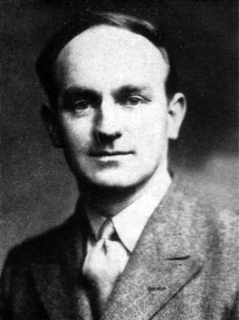
McLaverty is born on July 5, 1904, at Magheross, near Carrickmacross, County Monaghan, the son of Michael McLaverty, a waiter, and Kathleen McLaverty (née Brady). His father works in a hotel in the town until they move to Rathlin Island, and later to Belfast, when he is five years old. He attends St. Malachy’s College in the city, where an inspiring teacher instills in him a love of William Shakespeare‘s writings. He entered Queen’s University Belfast (QUB) in October 1924 and studies physics. He obtains a B.Sc. in 1928 and immediately takes his H.Dip.Ed., completing his teaching practice in St. Mary’s University College, Strawberry Hill, London. The following year he begins teaching at St. John’s Primary School in Colinward Street, west Belfast. He is admitted to the degree of M.Sc. at QUB in 1933.
In 1933, McLaverty marries Mary Conroy (formerly Giles), a young widow and fellow teacher at St. John’s. They have two sons and two daughters.
During his time at St. John’s, McLaverty writes his first five novels and fifteen short stories. In the 1930s he has developed a distinctive style in precise, unsentimental, but compassionate short stories. By the late 1930s, however, he switches his energies from short stories to the novel. Call My Brother Back (1939) contrasts the traditional world of Rathlin Island with the northern troubles in a family context. Another novel, Lost Fields (1941), and his collection of short stories, The White Mare (1943), explore the Belfast of his childhood and deal with the underlying tensions in Irish rural life. In the period 1949–55 he publishes five other novels: Three Brothers (1948), Truth in the Night (1951), School for Love (1954), The Choice (1958), and Brightening Day (1965). These novels deal with ordinary people and the dilemmas they encounter in their families and communities. His writings are influenced by Anton Chekhov, Leo Tolstoy, Katherine Mansfield, Gerard Manley Hopkins, and the Irish short story writers Liam O’Flaherty and Daniel Corkery.
As headmaster of St. Thomas’s intermediate school, a large school for boys in Ballymurphy, off the Falls Road, McLaverty gives his first job to the young Seamus Heaney, in whom he cultivates an interest in the writings of Chekhov and Tolstoy and the Irish writers Mary Lavin and Patrick Kavanagh. He deems Heaney to be the only genius he has ever met, and his work and success are a great source of pride and joy to him. His encouragement of the young John McGahern is of as much benefit to McLaverty himself, as their short but intense correspondence give him the energy to resume his writings.
Between his resignation from St. Thomas’s in 1963 and the early 1970s he teaches part-time at St. Joseph’s training college and St. Dominic’s High School, one of Belfast’s best-known grammar schools. In 1981 his old alma mater recognises his contribution to literature by awarding him an honorary master’s degree. In the same year he wins the American Irish literary fellowship, a prestigious literary award of $10,000, in recognition of his “impressive body of work as a short story writer and novelist.”
McLaverty dies on March 22, 1992, in County Down, Northern Ireland.
(From: “McLaverty, Michael” by Éamonn Ó Ciardha, Dictionary of Irish Biography, http://www.dib.ie, October 2009)
The 1973 Northern Ireland border poll is a referendum held in Northern Ireland on March 8, 1973, on whether Northern Ireland should remain part of the United Kingdom or join with the Republic of Ireland to form a united Ireland. It is the first time that a major referendum has been held in any region of the United Kingdom. The referendum is boycotted by nationalists and results in a conclusive victory for remaining in the UK. On a voter turnout of 58.7 percent, 98.9 percent vote to remain in the United Kingdom, meaning the outcome among registered voters is not affected by the boycott.
The Unionist parties support the “UK” option, as do the Northern Ireland Labour Party (NILP) and the Alliance Party of Northern Ireland (APNI). However, the Alliance Party is also critical of the poll. While it supports the holding of periodic plebiscites on the constitutional link with Great Britain, the party feels that to avoid the border poll becoming a “sectarian head count,” it should ask other relevant questions such as whether the people support the UK’s white paper on Northern Ireland. Nevertheless, on February 5, 1973, the party’s chairman, Jim Hendron, states that “Support for the position of Northern Ireland as an integral part of the United Kingdom is a fundamental principle of the Alliance Party, not only for economic reasons but also because we firmly believe that a peaceful solution to our present tragic problems is only possible within a United Kingdom context. Either a Sinn Féin all-Ireland republic or a Vanguard-style Ulster republic would lead to disaster for all our people.”
The Social Democratic and Labour Party (SDLP), however, calls for a boycott of the referendum, urging its members on January 23, 1973 “to ignore completely the referendum and reject this extremely irresponsible decision by the British Government.” Gerry Fitt, leader of the SDLP, says he has organised a boycott to stop an escalation in violence.
The civil authorities are prepared for violence on polling day. They put in place mobile polling stations which can be rushed into use if there is bomb damage to scheduled poll buildings. Two days before the referendum a British soldier, Guardsman Anton Brown of the 2nd Battalion, Coldstream Guards, is shot dead in Belfast as the army searches for weapons and explosives which can be used to disrupt the upcoming referendum.
As a political response to the referendum, the Provisional Irish Republican Army also plants four car bombs in London that day, two of which detonate, causing one death and injuring over two hundred.
The vote results in an overwhelming majority of those who voted stating they wish to remain in the UK. The nationalist boycott contributes to a turnout of only 58.7% of the electorate. In addition to taking a majority of votes cast, the UK option receives the support of 57.5% of the total electorate. According to the BBC, less than 1% of the Catholic population turn out to vote.
The referendum electorate consists of 1,030,084 adults registered to vote out of a total population of approximately 1,529,993.
The Government of the United Kingdom takes no action on receipt of the referendum result, as the result is in favour of the status quo (Northern Ireland remaining part of the UK). It is followed by an Assembly election on June 28, 1973.
Brian Faulkner, who had been the sixth and last Prime Minister of Northern Ireland, claims the result leaves “no doubt in any one’s mind what the wishes of Ulster’s people are. Despite an attempted boycott by some, almost 600,000 electors voted for the maintenance of the union with Great Britain.” He also claims that the poll showed that a “quarter of the [N.I.] Catholic population who voted … voted for the maintenance of the union” and that the result is a “blow … against IRA mythology.”
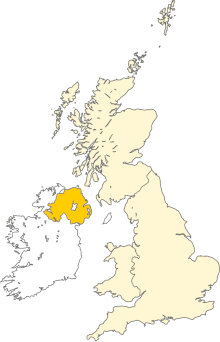
(Pictured: Map of Northern Ireland (yellow) within the United Kingdom.)
Father Des Wilson, Irish Catholic priest and church dissident who in the course of the Northern IrelandTroubles embraces ideas and practice associated, internationally, with liberation theology, dies in his native Belfast on November 5, 2019. He believes the Word of God can never be silent in the face of oppression, injustice and suffering. He seeks to apply the ideas of liberation theology to the North, supporting and empowering marginalised communities, and acting as a voice for the voiceless.
Wilson is born in Belfast on July 8, 1925, the youngest of five sons to William Wilson, a publican and native of County Cavan, and his wife Emma (née McAvoy), a native of south County Down. He spends his earliest years above his father’s pub in Belfast, before the family moves to a house in the suburbs.
Wilson attends primary school locally, then receives secondary education at St. Malachy’s College. During his time there Belfast is blitzed in April and May 1941. Almost 1,000 are killed. The carnage he sees is a factor in his deciding on the priesthood.
After ordination Wilson serves as chaplain in Belfast’s Mater Infirmorum Hospital, then spends 15 years in St. Malachy’s as spiritual director. Former pupils remember him as fair, and able to play jazz excellently on the organ.
Wilson lives out his beliefs, spending half a century in Belfast’s Ballymurphy estate, among the North’s most deprived, and one of the areas which suffers worst from the Troubles. There he plays a role in community development, establishing projects to provide employment in the area. He suffers, finding himself for years outside the official Catholic Church.
Wilson plays a significant role in providing adult education. He wants an education that does not just provide qualifications and open career paths but is psychologically liberating.
Life changes in 1966 when Wilson is moved to St. John’s Parish in West Belfast as a curate. Having come from a comfortable background in Ballymurphy, he is shocked by the poverty, the poor housing and the treatment of women. Unusual for a priest at the time, he moves into a terraced house in the estate. He finds the Catholic Church unable to respond to the multiple problems people are facing. That inability worsens as the Troubles erupt.
Wilson’s personal probity is so recognised that he is accepted as a mediator in feuds between the Provisional Irish Republican Army and Official Irish Republican Army in the 1970s and is able to broker permanent peace. He also helps bring about the ceasefires in the 1990s.
Wilson does not shirk unpopular stances. In the 1970s he refuses to condemn the Irish Republican Army (IRA). Later he says the conviction of former Real Irish Republican Army leader Michael McKevitt for directing terrorism is unsafe. He also publicly visits and supports a Ballymurphy couple which has a very bitter falling out with Sinn Féin, leading to a picket on their home.
By 1975 relations with his bishop has broken down and Wilson resigns but continues ministering in Ballymurphy. Forbidden to say Mass in a church, his pay cut off, he says Mass in his house. He suffers hardship, living from savings, some earnings from writing, broadcasting and lecturing, and help from Quaker and Presbyterian friends. By the early 1980s his Ballymurphy home becomes too small for the many classes he organises. His classes are rehoused and expanded as the Conway Education Centre in a vacant mill. He is able to offer a range of vocational and non-vocational courses with almost 1,000 students. In the mid-1980s his relationship with the Dioceses of Down and Connor is re-established, and he is allowed to continue his ministry.
Personally, Wilson has great gifts of head and heart and is incapable of rancour. A strong belief is that it is important to share food to talk, as happened in Biblical times. Thus, a lunch would last an afternoon.
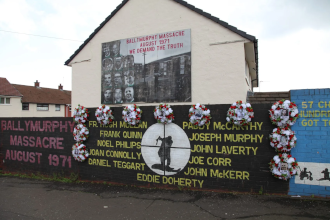
Wilson dies on November 5, 2019, in Belfast. Instead of wreaths, he asks mourners to donate to the Ballymurphy Massacre Memorial Garden. The garden is dedicated to the victims of the Ballymurphy massacre of August 1971, which saw the killing in the district of eleven civilians by soldiers of the 1st Battalion, Parachute Regiment. The victims include Fr. Hugh Mullan, who had been a student of Wilson’s at St. Malachy’s. He was shot while going to the aid of a wounded man.
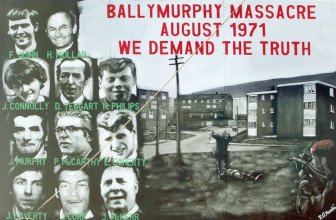
On the morning of Monday, August 9, 1971, the security forces launch Operation Demetrius, the main focus of which is to arrest and intern suspected members of the Provisional Irish Republican Army (IRA). The Parachute Regiment is selected to carry out the operation. The operation is chaotic and informed by poor intelligence, resulting in a number of innocent people being interned. By focusing solely on republicans, it excludes violence carried out by loyalistparamilitaries. Some nationalist neighbourhoods attempt to disrupt the army with barricades, petrol bombs and gunfire. In the Catholic district of Ballymurphy, ten civilians are shot and killed between the evening of August 9 and the morning of August 11, while another dies of heart failure.
Members of the Parachute Regiment state that they were shot at by republicans as they entered the Ballymurphy area and returned fire. The press officer for the British Army stationed in Belfast, Mike Jackson, later to become head of the British Army, includes a disputed account of the shootings in his autobiography, stating that those killed in the shootings were republican gunmen. This claim is strongly denied by the families of those killed in the shootings, including in interviews conducted during the documentary film The Ballymurphy Precedent. The claim is found to be without basis by a later coroner’s inquest, which establishes that those killed were “entirely innocent.”
The six civilians killed on August 9 are Francis Quinn (19), shot while going to the aid of a wounded man, Father Hugh Mullan (38), a Catholic priest, shot while going to the aid of a wounded man, reputedly while waving a white cloth to indicate his intentions, Joan Connolly (44), shot by three soldiers as she stands opposite the army base, Daniel Teggart (44), shot fourteen times mostly in the back as he lay injured on the ground, Noel Phillips (20) and Joseph Murphy (41), shot as they stand opposite the army base. Murphy is subsequently taken into army custody and after his release, as he is dying in hospital, he claims that he had been beaten and shot again while in custody. When his body is exhumed in October 2015, a second bullet is discovered in his body, which activists say corroborates his claim.
Edward Doherty (28), is shot and killed on August 10 while walking along Whiterock Road.
Another three civilians are shot on 11 August: John Laverty (20) and Joseph Corr (43) are shot at separate points at the top of the Whiterock Road. Laverty is shot twice, once in the back and once in the back of the leg. Corr is shot several times and dies of his injuries on August 27. John McKerr (49), is shot in the head by an unknown sniper while standing outside a Catholic church and dies of his injuries on August 20. While a number of eyewitnesses state that soldiers were seen shooting toward the area, the 2021 inquest cannot establish who had killed him. The coroner notes that a more specific finding is not possible, in large part, due to an “abject failing by the authorities to properly inquire into the death of [McKerr at the time].”
Paddy McCarthy (44), an eleventh civilian, dies on August 11 following an altercation with a group of soldiers. His family allege that an empty gun is put in his mouth and the trigger pulled, he suffers a heart attack and dies shortly after the alleged confrontation.
In February 2015, the conviction of Terry Laverty, younger brother of John Laverty, one of those killed, is quashed by the Criminal Cases Review Commission. He had been convicted of riotous behaviour and sentenced to six months on the eyewitness evidence of a private in the Parachute Regiment. The case is referred to court because the sole witness retracts his evidence.
In 2016, Sir Declan Morgan, the Lord Chief Justice of Northern Ireland, recommends an inquest into the killings as one of a series of “legacy inquests” covering 56 cases related to the Troubles. These inquests are delayed, as funding has not been approved by the Northern Ireland Executive. The Stormont first minister, Arlene Foster of the Democratic Unionist Party (DUP), defers a bid for extra funding for inquests into historic killings in Northern Ireland, a decision condemned by the human rights group Amnesty International. Foster confirms she has used her influence in the devolved power-sharing executive to hold back finance for a backlog of inquests connected to the conflict. The High Court says her decision to refuse to put a funding paper on the Executive basis is “unlawful and procedurally flawed.”
In January 2018, the coroner’s office announces that the inquest will begin in September 2018. On May 11, 2021, this coroner’s inquest finds that the ten civilians killed were innocent and that the use of lethal force by the British Army was “not justified.” The circumstances of the 11th death are not part of the inquest since Paddy McCarthy died from a heart attack, allegedly after being threatened by a soldier. Following the inquest verdict, Boris Johnson, the British prime minister, apologises for the deaths at Ballymurphy in a phone call to Foster and deputy First MinisterMichelle O’Neill. The lack of public apology is criticised by some relatives of the victims and Northern Irish politicians.
In May 2021, families of those shot dead by British soldiers in Ballymurphy urge the Irish government to oppose any attempt to prevent the prosecution of British soldiers alleged to have committed crimes during the Troubles.
The killings are the subject of the August 2018 documentaryThe Ballymurphy Precedent, directed by Callum Macrae and made in association with Channel 4.
O’Hagan, known to all and sundry simply as JB, dies on Monday, April 23, 2001, in the town in which he was born almost 79 years previously and from which he and his wife Bernadette had been exiled for 25 years during the current phase of the conflict. As befitted a soldier of Óglaigh na hÉireann, a uniformed IRA Guard of Honour attends O’Hagan’s body in the wake house and it is six of his comrades who carry the coffin, bedecked in the Irish Tricolour and beret and gloves, from the family home on the first section of its journey to St. Paul’s Chapel for the Funeral Mass.
Up to 2,000 people attend the funeral and businesses in the bustling North Armagh town close along the route as a mark of respect. At St. Colman’s Cemetery just outside the town, Sinn Féin President Gerry Adams pays fulsome tribute to a republican who had been active from the 1940s into the 1990s and right up to his sudden death. Adams notes O’Hagan’s strong faith and welcomes the tribute paid during the Funeral Mass to JB’s republican beliefs and exploits. He adds, however, that it is high time the Catholic hierarchy reverses its directive banning the Tricolour from republican funerals in church premises. “Our National Flag should be allowed to stay on the coffin for the entire ceremony,” he says.
“I have always associated JB with Bernadette,” he tells those gathered at the graveside, “even though they were apart for so many years. They were married for 52 years, and Bernadette told me yesterday that she wouldn’t change a day of it, that she was proud of him and of his life.”
“In many ways he died the way he had lived, very quietly, modestly, not complaining, unassuming to the end. He was one of the most respected republicans of our time. There is no greater tribute that can be paid to any man or woman than to be known as a decent human being and Joe B. was that and more.”
Adams goes on to briefly record the extraordinary history of O’Hagan’s involvement in the republican struggle, as soldier and political activist, since he first joined the IRA in 1940, including that famous 1973 escape from Mountjoy Jail by helicopter, accompanied by Kevin Mallon and the late Seamus Twomey.
“JB grew up in the 1920s in a state abandoned by the Irish Government, where nationalists were subjected to the B-Specials and the Special Powers Act. He stood up at a time when standing up was a very very dangerous thing to do,” says Adams. “It is a wonder to me that he was active in every decade from the 1940s on. There is a mighty man!”
“He also personifies why Irish republicanism has never been defeated. He was an example of a physical force republican who was prepared to support and exhaust other means of struggle. He saw armed struggle as a means rather than as an end, but he never ceased to be an unrepentant republican and to work always for the establishment of an Irish Republic based on national rights for the people of this island. He supported the Good Friday Agreement not as an end but as an effort to build a new accord with our opponents and enemies. Political unionism has found it very difficult to deal with this strategy.”
“Joe B was very philosophical and very wise. He is representative of that republican element who never broke a promise in their lives.”
“Those who seek to defeat the republican struggle by blaming the IRA for everything need to know that none of this will work. That is because of the work that JB and people like him put into this struggle. We won’t be worn down or accept anything less than our full rights. The message for David Trimble and Tony Blair is that it is impossible for us to accept inequality, injustice and second-class citizenship. That is the past. We are looking to the future.”
“Joe B’s passing has left a huge gap, but we should celebrate his life. He touched so many of us. Joe B kept us right. The flame he kept flickering in the lean times is burning brightly now because of his contribution.”
Adams extends his solidarity and sympathy and that of all those present to Bernadette, to O’Hagan’s children, Barry, Kevin, Fintan, Siobhán, Felim and Dara, to his eleven grandchildren and four great-grandchildren, his sisters and entire family circle.
At the end of the Funeral Mass for O’Hagan, the O’Hagan family lead by Joe’s son Fintan place the Irish Tricolour on the coffin before the remains are taken from the chapel. This act is borne out of anger and frustration.
O’Hagan was a republican, an honourable man and a religious man who went to Mass every day. So, his family feels that the Catholic Church, that was as much an influence on O’Hagan’s life as was his republicanism, should respect his wish and allow his coffin to be draped in the Tricolour. The family appeals to the Catholic Church authorities and Adams intercedes on their behalf, but they are refused the right to grant O’Hagan his wish that the Flag not be removed from his coffin.
Dara O’Hagan, the Sinn Féin Northern Ireland Assembly member for Upper Bann, tells the bishop that by sticking to their old policy the Catholic Church is criminalising republicanism and indeed criminalising her father.
Also, the Catholic hierarchy misses a great opportunity to heal a hurt that has existed for over 20 years, when the remains of IRA Volunteer Kevin `Dee’ Delaney were refused entry into Corpus Christi Church in Springhill while bearing the Irish Tricolour. The rancour and hurt felt by republicans over this slight, coming as it does, in conjunction with the British Government’s attempts to criminalise republicanism, has long been an insult that republicans have resented. After all, churches are the people’s property as it is their money and effort that build them. The people of Springhill and the Greater Ballymurphy area paid £5 a brick for the Corpus Christi building and the Delaney family no doubt contributed to that fund.
By taking matters into their own hands, the O’Hagan family claims back some ground for republicans and sends a message to the bishops that they have a part to play in this new political era and that they need to look at their attitude to republicanism.
O’Hagan’s wife Bernadette says that as Fintan draped the Irish Trocolour on Joe’s coffin and the church burst into spontaneous applause, her heart was lifted. “I was so glad, and I walked down the aisle with a smile on my face,” said Bernadette.
(From: “Unassuming and mighty man laid to rest” by Martin Spain, An Phoblacht Republican News, May 3, 2001)
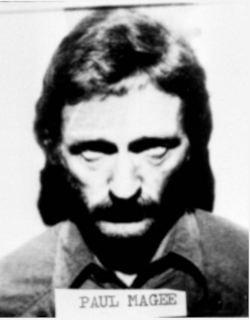
Magee joins the Belfast Brigade of the IRA and receives a five-year sentence in 1971 for possession of firearms. He is imprisoned in Long Kesh, where he holds the position of camp adjutant. In the late 1970s and early 1980s he is part of a four-man active service unit, along with Joe Doherty and Angelo Fusco, nicknamed the “M60 gang” due to their use of an M60general-purpose machine gun. On April 9, 1980, the unit lures the Royal Ulster Constabulary (RUC) into an ambush on Stewartstown Road, killing Constable Stephen Magill and wounding two others. On May 2 the unit is planning another attack and has taken over a house on Antrim Road, when an eight-man patrol from the British Army‘s Special Air Service (SAS) arrives in plain clothes, after being alerted by the RUC. A car carrying three SAS members goes to the rear of the house, and another car carrying five SAS members arrives at the front of the house. As the SAS members at the front of the house exit the car the IRA unit opens fire with the M60 machine gun from an upstairs window, hitting Captain Herbert Westmacott in the head and shoulder. Westmacott is killed instantly and is the highest-ranking member of the SAS killed in Northern Ireland. The remaining SAS members at the front of the house, armed with Colt Commando automatic rifles, submachine guns and Browning pistols, return fire but are forced to withdraw. Magee is apprehended by the SAS members at the rear of the house while attempting to prepare the IRA unit’s escape in a transit van, while the other three IRA members remain inside the house. More members of the security forces are deployed to the scene, and after a brief siege the remaining members of the IRA unit surrender.
The trial of Magee and the other members of the M60 gang begins in early May 1981, with them facing charges including three counts of murder. On June 10 Magee and seven other prisoners, including Joe Doherty, Angelo Fusco and the other member of the IRA unit, take a prison officer hostage at gunpoint in Crumlin Road Jail. After locking the officer in a cell, the eight take other officers and visiting solicitors hostage, also locking them in cells after taking their clothing. Two of the eight wear officer’s uniforms while a third wears clothing taken from a solicitor, and the group moves toward the first of three gates separating them from the outside world. They take the officer on duty at the gate hostage at gunpoint and force him to open the inner gate. An officer at the second gate recognises one of the prisoners and runs into an office and presses an alarm button, and the prisoners run through the second gate towards the outer gate. An officer at the outer gate tries to prevent the escape but is attacked by the prisoners, who escape onto Crumlin Road. As the prisoners are moving toward the car park where two cars are waiting, an unmarked RUC car pulls up across the street outside Crumlin Road Courthouse. The RUC officers open fire, and the prisoners return fire before escaping in the waiting cars. Two days after the escape, Magee is convicted in absentia and sentenced to life imprisonment with a minimum recommended term of thirty years.
Magee escapes across the border into the Republic of Ireland. Eleven days after the escape he appears in public at the Wolfe Tone commemoration in Bodenstown Graveyard, County Kildare, where troops from the Irish Army and the Garda‘s Special Branch attempt to arrest him but fail after the crowd throws missiles and lay down in the road blocking access. He is arrested in January 1982 along with Angelo Fusco and sentenced to ten years imprisonment for the escape under extra-jurisdictional legislation. Shortly before his release from prison in 1989, he is served with an extradition warrant, and he starts a legal battle to avoid being returned to Northern Ireland. In October 1991, the Supreme Court of Ireland in Dublin orders his return to Northern Ireland to serve his sentence for the murder of Captain Westmacott, but Magee jumps bail, and a warrant is issued for his arrest.
Magee flees to England, where he is part of an IRA active service unit. On June 7, 1992, Magee and another IRA member, Michael O’Brien, are traveling in a car on the A64 road between York and Tadcaster, when they are stopped by the police. Magee and O’Brien are questioned by the unarmed police officers, who become suspicious and call for back-up. Magee shoots Special Constable Glenn Goodman, who dies later in hospital, and then shoots the other officer, PC Kelly, four times. Kelly escapes death when a fifth bullet ricochets off the radio he is holding to his ear, and the IRA members drive away. Another police car begins to follow the pair and comes under fire near Burton Salmon. The lives of the officers in the car are in danger, but Magee and O’Brien flee the scene after a member of the public arrives. A manhunt is launched, and hundreds of police officers, many of them armed, search woods and farmland. Magee and O’Brien evade capture for four days by hiding in a culvert, before they are both arrested in separate police operations in the town of Pontefract.
On March 31, 1993, Magee is found guilty of the murder of Special Constable Goodman and the attempted murder of three other police officers and sentenced to life imprisonment. O’Brien is found guilty of attempted murder and receives an eighteen-year sentence. On September 9, 1994, Magee and five other prisoners, including Danny McNamee, escape from HM Prison Whitemoor. The prisoners, in possession of two guns that had been smuggled into the prison, scale the prison walls using knotted sheets. A guard is shot and wounded during the escape, and the prisoners are captured after being chased across fields by guards and the police. In 1996 Magee stages a dirty protest in HM Prison Belmarsh, in protest at glass screens separating prisoners from their relatives during visits. He has refused to accept visits from his wife and five children for two years, prompting Sinn Féin to accuse the British government of maintaining “a worsening regime that is damaging physically and psychologically.”
In January 1997, Magee and the other five escapees from Whitemoor are on trial on charges relating to the escape for a second time, as four months earlier the first trial had been stopped because of prejudicial publicity. Lawyers for the defendants successfully argued that an article in the Evening Standard prejudiced the trial as it contained photographs of Magee and two other defendants and described them as “terrorists,” as an order had been made at the start of the trial preventing any reference to the background and previous convictions of the defendants. Despite the judge saying the evidence against the defendants was “very strong”, he dismisses the case stating, “What I have done is the only thing I can do in the circumstances. The law for these defendants is the same law for everyone else. They are entitled to that, whatever they have done.”
On May 5, 1998, Magee is repatriated to the Republic of Ireland to serve the remainder of his sentence in Portlaoise Prison, along with Liam Quinn and the members of the Balcombe Street Gang. He is released from prison in late 1999 under the terms of the Good Friday Agreement and returns to live with his family in Tralee, County Kerry. On March 8, 2000, he is arrested on the outstanding Supreme Court extradition warrant from 1991 and remanded to Mountjoy Prison. The following day he is granted bail at the High Court in Dublin, after launching a legal challenge to his extradition. In November 2000 the Irish government informs the High Court that it is no longer seeking to return him to Northern Ireland. This follows a statement from Secretary of State for Northern IrelandPeter Mandelson saying that “it is clearly anomalous to pursue the extradition of people who appear to qualify for early release under the Good Friday Agreement scheme, and who would, on making a successful application to the Sentence Review Commissioners, have little if any of their original prison sentence to serve.” In December 2000 Magee and three other IRA members, including two other members of the M60 gang, are granted a Royal Prerogative of Mercy which allows them to return to Northern Ireland without fear of prosecution.
The 26-year-old O’Connor is shot dead as he sits in a car outside his mother’s house in Whitecliffe Parade in Ballymurphy. He comes from a well-known republican family and is understood to have been involved in welfare work for “Real IRA” prisoners. Royal Ulster Constabulary (RUC) sources do not suggest a motive for the shooting, except to say it is not sectarian and they believe it is a result of an inter-republican dispute. Continuity IRA sources deny their organisation is involved and the killing is condemned by Republican Sinn Féin.
O’Connor had just left his mother’s home and got into the passenger seat of a car when two hooded gunmen approach on foot and shoot him at point-blank range. He is hit in the head and dies instantly. A relative who is in the driver’s seat is uninjured.
O’Connor’s cousin, who lives nearby, says, “I heard one shot, then a silence, and then four more shots in quick succession.” Tensions between mainstream and dissident republicans at the time are high in Belfast but without serious violence.
O’Connor, who lives nearby in the Springhill Estate, is married with two young sons. His grandfather, Francisco Notarantonio, was shot dead by the Ulster Defence Association (UDA) in highly controversial circumstances at the same house 13 years earlier. That killing is at the centre of a legal battle between the British Ministry of Defence and the Sunday People over allegations of security force involvement.
O’Connor’s killing is condemned by First Minister of Northern IrelandDavid Trimble. He calls on the RUC Chief Constable, Ronnie Flanagan, to state who he believes is responsible. “I understand a police operation is still ongoing and there may very well be further developments, but the question we will all ask is who was responsible for this murder.”
The killing is condemned by Republican Sinn Féin. A Sinn Féin councillor, Sean McKnight, says local people are “shocked” by the killing. “We call on those responsible for this deliberate shooting to declare themselves and spell out to the people what their motives are,” a spokesman says. “Local sources indicate the deceased man was associated with the 32 County Sovereignty Movement. Republican Sinn Féin has no hesitation in condemning this action and points out the obvious dangers that lie ahead.”
The Social Democratic and Labour Party (SDLP) representative for Belfast West, Alex Attwood, condemns the murder as pointless but says no one should “rush to premature judgment” about who is responsible. “The overwhelming mass of political and wider opinion is determined to consolidate the political and peace process and no words, no acts and no narrow politics will destabilise it.”
(From “Leading ‘Real IRA’ member is shot dead in Ballymurphy” by Suzanne Breen, The Irish Times, October 14, 2000)
Two years into The Troubles and Belfast is particularly affected by political and sectarian violence. The British Army had been deployed in Northern Ireland in 1969, as events had grown beyond the control of the Royal Ulster Constabulary.
On the morning of Monday, August 9, 1971, the security forces launch Operation Demetrius. The plan is to arrest and intern anyone suspected of being a member of the Provisional Irish Republican Army. The unit selected for this operation is the Parachute Regiment. Members of the Parachute Regiment state that, as they enter the Ballymurphy area, they are shot at by republicans and return fire.
Mike Jackson, later to become head of the British Army, includes a disputed account of the shootings in his autobiography and his then role as press officer for the British Army stationed in Belfast while the incidents happened. This account states that those killed in the shootings were Republican gunmen. This claim has been strongly denied by the Catholic families of those killed in the shootings, in interviews conducted during the documentary film The Ballymurphy Precedent.
These inquests are delayed, as funding had not been approved by the Northern Ireland Executive. The former Stormont first minister Arlene Foster of the Democratic Unionist Party (DUP) defers a bid for extra funding for inquests into historic killings in Northern Ireland, a decision condemned by the human rights group Amnesty International. Foster confirms she had used her influence in the devolved power-sharing executive to hold back finance for a backlog of inquests connected to the conflict. The High Court says her decision to refuse to put a funding paper on the Executive basis was “unlawful and procedurally flawed.”
Fresh inquests into the deaths open at Belfast Coroner’s Court in November 2018 under Presiding Coroner Mrs. Justice Siobhan Keegan. The final scheduled witnesses give evidence on March 2-3, 2020, around the fatal shootings of Father Hugh Mullan and Frank Quinn on waste ground close to an army barracks at Vere Foster school in Springmartin on the evening of August 9. Justice Keegan sets a date of March 20 for final written submissions from legal representatives. A decision is still pending.
The killings are the subject of the August 2018 documentary The Ballymurphy Precedent, directed by Callum Macrae and made in association with Channel 4.
(Pictured: A mural in Belfast commemorating the victims of the Ballymurphy Massacre)




 seamus dubhghaill