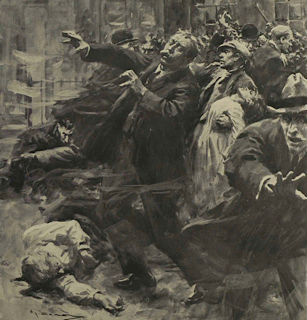
The Bachelor’s Walk massacre occurs in Dublin on July 26, 1914, when a column of troops of the King’s Own Scottish Borderers is accosted by a crowd on Bachelor’s Walk following the Howth gun-running operation. After some verbal baiting, the troops attack “hostile but unarmed” protesters with rifle fire and bayonets, resulting in the deaths of four civilians and injuries to in excess of 30 more. The four killed are Mary Duffy (50), Patrick Quinn (50), James Brennan (18) and Sylvester Pidgeon (40) who succumbs to his wounds on September 24. One of those shot is Luke Kelly, the father of folk singer Luke Kelly.
The events follow the landing of 1,500 rifles and ammunition, purchased for the Irish Volunteers in Hamburg, Germany, in May 1914. In a counter operation to the Unionistsrunning guns into Ulster, Erskine Childers lands the cargo in Howth, County Dublin, and a thousand rifle-carrying Irish Volunteers marched into Dublin. The quantity is negligible when compared to the far greater numbers of weapons landed and distributed by the Ulster Volunteers, completely without hindrance, but the reaction this time is severe from the British ruling authorities.
The incident proves a moment of political opportunity for Irish nationalists as it sharply brings out the different treatment for the Unionists and for unarmed Dublin civilians. Patrick Pearse declares, “The army is an object of odium, and the Volunteers are the heroes of the hour. The whole movement, the whole country, has been re-baptised by bloodshed for Ireland.”
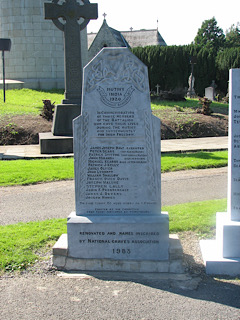
On June 28, 1920, four men from C Company of the 1st Battalion, Connaught Rangers, based at Wellington Barracks, Jalandhar in the Punjab Province, India, protest against martial law in Ireland by refusing to obey orders. One of them, Joe Hawes, had been on leave in County Clare in October 1919 and had seen a hurling match prevented from happening by British forces with bayonets drawn. Poor accommodation conditions in the Wellington Barracks likely provide an additional cause of the dispute.
The protestors are soon joined by other Rangers, including several English soldiers, such as John Miranda from Liverpool and Sergeant Woods. By the following morning, when a rebel muster takes place, 350 Irish members of the Rangers are involved in the mutiny.
On June 30, 1920, two mutineers from the Jalandhar barracks (Frank Geraghty and Patrick Kelly) travel to Solon barracks where C Company are stationed and, despite arrest, help spark a mutiny there, led by PrivateJames Daly, whose brother William also takes part in the protest.
Initially, the protests are peaceful with the men involved donning green, white and orange rosettes and singing Irish nationalist songs. At Solon, however, on the evening of July 1, a party of about thirty men led by James Daly, carrying bayonets, attempt to seize their company’s rifles, stored in the armoury. The troops guarding the magazine open fire and two men are killed: Private Smythe who is with Daly’s party, and Private Peter Sears, who had not been involved in the attack on the magazine but is returning to his billet when hit by a stray bullet. Within days, both garrisons are occupied by other British troops. Daly and his followers surrender and are arrested. Eighty-eight mutineers are court-martialed: seventy-seven are sentenced to imprisonment and ten are acquitted. James Daly is shot by a firing squad at Dagshai Prison on November 2, 1920. He is the last member of the British Armed Forces to be executed for mutiny. The bodies of Privates Sears and Smythe are buried at Solan, while Daly and Miranda (who later dies in prison) are buried at a cemetery in Dagshai. Among those who receive a sentence of life in prison is Martin Conlon, a half brother to the eight brothers from Sligo town who fight in World War I, in which four are killed in action.
In 1923, following Irish Independence, the imprisoned mutineers are released and returned to Ireland. In 1936, the Irish Free State‘s Fianna Fáil government awards pensions to those whose British Army pensions were forfeited by conviction for their part in the mutiny. The bodies of Privates Sears, Smythe, and Daly are repatriated from India to Ireland for reburial in 1970.
The East Clare Brigade plans to raid the Limerick train to take mail which will reveal the identity of a local spy. The eight IRA men, under the command of John McCormack, build a stone barricade across the tracks and put a red flag on top to stop the train. They will then board the train and take what they need. Tom Bentley, an IRA volunteer from Cratloe, is aboard the train so he can signal his comrades if there are British soldiers or Black and Tans on the train.
When the driver, a republican and supporter of the cause of Irish freedom, sees the barricade, he knows an ambush is about to take place but he also knows there are 30 British soldiers of the Royal Scots Regiment onboard and, should an ambush take place, the IRA will be out numbered and certainly outgunned. He smashes through the stone barricade, which is for the best, as McCormack does not see the signal from Bentley, their man on the train.
As the train passes, McCormack takes a pot shot at a soldier on the train, which turns out to be a bad idea. Once the train reaches Cratloe station, the soldiers make all civilians disembark and at gunpoint force the train driver to return to Woodcock Hill. McCormack knows the soldiers will alert the local military barracks and enemy troops will soon swarm the area. He climbs a telegraph pole to cut the wire but the shears break. He sends Lieutenant James O’Halloran to a nearby house to get replacement shears.
Gleeson and McCarthy are in charge of a group of volunteers waiting at the top of a field armed with rifles. When they see that something is delaying the cutting of the telegraph wires, they walk down the field to see what is happening. When they reach the edge of the tracks, the train comes around the bend one hundred yards from them. The Scots train their two machine guns and rifles on the fleeing volunteers. McCarthy is wounded during the opening volley and falls to the ground. As the rest of the ambushing party scatters, Gleeson realizes that McCarthy is not with them.
Gleeson races down the open field through a hail of British rifle and machine gun fire. He reaches McCarthy and helps him to his feet. In a desperate attempt to escape, Gleeson draws his revolver and staggers uphill supporting McCarthy with one arm and firing back at the British soldiers with his free hand.
They have only covered a short distance when Gleeson is shot and both men collapse to the ground. Gleeson is unable to continue but McCarthy manages to stagger on. Within a few seconds, the advancing British soldiers surround Gleeson and shoot him dead where he lay. McCarthy carries on through the fields but is soon outrun and is captured and killed by Lieutenant A. Gordan and a group of the Royal Scots, who shoot him several times and stab him with their bayonets.
Meanwhile, on the southern side of the railway track, McCormack is lying flat, hidden from the British soldiers. In order to make good his escape, he needs to climb over a thick fence of wire and hedge in full view of the soldiers. The train is only a short distance away and if the British soldiers make a search of the area, he is likely to become the third casualty the day. When he realises McCormack’s difficulty, James O’Halloran attempts to draw the British soldiers’ fire and attention and give McCormack a chance to escape. From behind a stone pier, O’Halloran opens fire on the British soldiers. He comes under heavy rifle fire but stands his ground and succeeds in wounding one of them before his rifle jams and he is forced to retreat. By this time, O’Halloran’s action has allowed McCormack to escape unseen. All the other IRA volunteers also manage to get away safely.
When the fighting ends, the British soldiers go to the scene of the killings and force a number of farm labourers to help them remove the two bodies. McCarthy’s body had been placed on a wicker gate and Michael Doherty and another farm labourer are ordered to carry it. Doherty lifts back the covering that has been placed over McCarthy’s body and sees that his throat has been cut and his chest is riddled with bullet wounds. Immediately, Doherty receives a blow of a rifle butt from one of the Royal Scots, who replaces the covers on McCarthy’s body.
Both bodies are taken to the house of the Collins family where the soldiers guard them until British reinforcements arrive and take them to Limerick. Gleeson and McCarthy are buried in the Republican plot in Meelick churchyard alongside Patrick White, who had been shot by a British sentry at Spike Island Prison, County Cork, earlier in the month.
This event, subsequently known as The Meelick Ambush, is the only occasion in County Clare during the Irish War of Independence when two Republicans are killed in action fighting against the British forces.
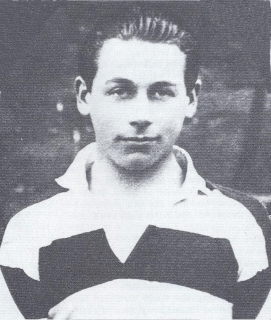
Barry is the fourth of seven children born to Thomas Barry, dairyman, and Mary Barry (née Dowling), both originally from northeast County Carlow. His father dies of heart disease on February 8, 1908, at the age of 56. His mother then moves the family to the family’s farm at Tombeagh, Hacketstown, County Carlow, while retaining the family’s townhouse on Fleet Street. As a child he goes to the National School in Rathvilly. In 1915, he is sent to live in Dublin and attends the O’Connell Schools for three months, before enrolling in the Preparatory Grade at St. Mary’s College, Rathmines, in September 1915. He remains at that school until May 31, 1916, when it is closed by its clerical sponsors. With the closure of St. Mary’s College, he transfers to Belvedere College, a Jesuit school in Dublin. He joins the Irish Volunteers, the forerunner of the IRA, while still at Belvedere College, and enters University College Dublin (UCD) in 1919 to study medicine.
As a member of 1st Battalion, Dublin Brigade of the Irish Volunteers, he takes part in a successful raid for arms on the military post in King’s Inns, Dublin, on June 1, 1920. Within only six minutes the raiders secure rifles, light machine guns, and large quantities of ammunition, and depart the site with no casualties. He also takes part in an abortive attempt to burn Aughavanagh House, Aughrim, County Wicklow in July 1920, and an attack on a British ration party in Church Street, Dublin, on September 20, with the aim of seizing arms. The final operation fails. Gunfire breaks out, three soldiers of around Barry’s own age are killed or fatally wounded, and he becomes the first Volunteer to be captured in an armed attack since 1916.
During interrogation, Barry is threatened with a bayonet and is mistreated. A general court-martial on October 20, which he refuses to recognise, condemns him to death for murdering the three soldiers, although one of the bullets taken from Private Marshall Whitehead’s body is a .45 calibre, while all witnesses state that Barry was armed with a .38 Mauser Parabellum. Despite widespread appeals on grounds of both clemency and expediency, the cabinet in London and officials in Dublin decide separately against a reprieve, probably because of its likely effect on the morale of soldiers and police.
On October 28, the Irish Bulletin, the official propaganda newspaper produced by Dáil Éireann‘s Department of Publicity, publishes Barry’s statement alleging torture. The headline reads English Military Government Torture a Prisoner of War and are about to Hang him. The Irish Bulletin declares Barry to be a prisoner of war, suggesting a conflict of principles is at the heart of the conflict. The British do not recognise a war and treat all killings by the Irish Republican Army (IRA) as murder. The public learns on this day that the date of execution has been fixed for November 1.
He was hanged in Mountjoy Prison, Dublin, on November 1, after hearing two Masses in his cell. The timing of the execution, only seven days after the death by hunger strike of Terence MacSwiney, the republican Lord Mayor of Cork, brings public opinion to a fever-pitch. He is buried in unconsecrated ground on the jail property. His comrade and fellow student Frank Flood is buried alongside him four months later. A plain cross marks their graves and those of Patrick Moran, Thomas Whelan, Thomas Traynor, Patrick Doyle, Thomas Bryan, Bernard Ryan, Edmond Foley and Patrick Maher who are hanged in the same prison before the Anglo-Irish Treaty of July 1921 which ends hostilities between Irish republicans and the British. The graves go unidentified until 1934. They become known as the Forgotten Ten by republicans campaigning for the bodies to be reburied with honour and proper rites. On October 14, 2001, the remains of the ten men are given a state funeral and moved from Mountjoy Prison to be re-interred at Glasnevin Cemetery in Dublin.
Barry is the first person to be tried and executed for a capital offence under the Restoration of Order in Ireland Act 1920, passed twelve weeks earlier. Together with his youth, this makes him a republican martyr celebrated in many ballads and verses. The best-known, set to a tune popular with British servicemen, is recorded by the American singer Paul Robeson, among others. A memorial stained-glass window by Richard King of the Harry Clarke Studio is later installed in the former UCD council chamber (afterward called the Kevin Barry Room), Earlsfort Terrace, Dublin.
At dawn on the morning of November 20, 1917, the 16th (Irish) Division of the British Army assaults an area of the German lines known as “Tunnel Trench,” named for an elaborate tunnel system that runs along it. The attack is meant as a diversion for the main attack, about eight miles to the southeast at Cambrai, France, where six infantry and two cavalry divisions of the British Expeditionary Force, with additional support from fourteen squadrons of the Royal Flying Corps, join the British Tank Corps in a surprise attack on the German lines.
By autumn 1917, three years into World War I, continuous shelling and lack of drainage has transformed the Ypres Salient, on the Western Front, into a waterlogged quagmire. In Ireland, meanwhile, a month earlier, Eamon de Valera becomes president of Sinn Féin and decides to push for an independent Irish republic. Despite the growing political turmoil at home, in France, on firm ground near the town of Cambrai, the British Army’s 16th (Irish) Division again proves to be formidable adversaries for the Germans.
According to the divisional historian, at Cambrai, the “swift and successful operation by 16th Division was a model of attack with a limited objective.” In addition to securing 3,000 yards of trench, 635 prisoners are captured from the German army’s 470th and 471st Regiments and 330 German bodies are counted in the trenches. More importantly, though, the mayhem caused by the diversionary assault contributes greatly to the initial success of the Cambrai offensive, though the offensive eventually sputters, dragging the war into 1918.
Cambrai becomes the field of operations when the British Commander-in-Chief, Field MarshalDouglas Haig, recognising that it is impossible to launch further military operations in the Ypres sector, seeks a new battlefield where he hopes success can be achieved before year’s end. Lieutenant ColonelJohn Fuller of the Tank Corps and GeneralJulian Byng, commander of the Third Army, recommend that a massed assault by 400 tanks should be mounted across the firm, chalky ground to the southwest of Cambrai. Haig adopts this proposal, confident that the tanks can punch a hole through the mighty Hindenburg Line and allow his underused Cavalry Divisions to break through to the enemy rear.
In order to create maximum confusion among the Germans, Sir Aylmer Haldane, commander of VI Corps, is ordered to stage a diversionary attack. The area selected for the assault is about eight miles to the northwest of Cambrai, where the British line passes through the villages of Bullecourt and Fontaine-lès-Croisilles. The units select to make this subsidiary attack are 3rd Army and 16th (Irish) Division.
The defences of the Hindenburg Line opposite VI Corps positions consists of Tunnel Trench, a heavily defended front-line trench, with a second, or support trench, some 300 yards behind. The whole area is scattered with concrete machine gun forts, or Mebus, similar to those that had decimated the 16th (Irish) Division at the Battle of Langemarck three months earlier.
Tunnel Trench is so called because it has a tunnel 30 or 40 feet below ground along its entire length, with staircase access from the upper level every 25 yards. The entire tunnel has electric lighting, and side chambers provide storage space for bunks, food, and ammunition. Demolition charges are set that can be triggered from the German rear in order to prevent the defences from falling into British hands.
The 16th (Irish) Division, attacking on a three-brigade front, is assigned the task of capturing a 2,000-yard section of the trench network. On the right flank of the Irishmen, 3rd Division’s 9th Brigade is detailed to capture an additional 800 yards. One unusual feature of the attack is that there is to be no preliminary bombardment as surprise is the key to the success of the operation. Once the assault begins, however, 16th (Irish) Division’s artillery, reinforced with guns from the 34th Division, is to open a creeping barrage upon the German positions.
The morning of the advance, November 20, is overcast, with low visibility. At 6:20 a.m., the Divisional 18 pounder-field guns open fire, and the leading assault companies spring from their jump-off positions. At the same time, Stokes mortars begin to lay a smoke barrage upon the German trenches in imitation of a gas attack. This deception proves successful, as many German troops don cumbersome gas masks and retreat to the underground safety of the tunnel, thus leaving the exposed portion of the trench undefended.
On the left flank, the attack of the 49th Brigade is launched by 2nd Royal Irish Regiment and 7/8th Royal Irish Fusiliers. They quickly cross the 200 yards of no-man’s-land and reach the enemy frontline just as the barrage lifts. Resistance above ground is minimal, and storming parties began the task of flushing the Germans from the tunnel with Mills bombs and bayonets.
Once the tunnel is secure, sappers, acting on information obtained by 7th Leinster Regiment’s intelligence officer, cut the leads connecting the demolition charges. Supporting companies then press on to capture Tunnel Support Trench, while Divisional support units rapidly wire and made secure the new defensive front in anticipation of German counterattacks.
Only on the extreme left flank does 49th Brigade encounter any serious opposition. In this sector, Company “B” of the 7/8th Royal Irish Fusiliers suffers heavy losses inflicted by concentrated machine gun fire from Mebus Flora. Nearly one-hour elapses before resistance from this strong point can be overcome.
In the centre, 10th and 2nd Royal Dublin Fusiliers head the attack of the 48th Brigade. The advance here is so rapid that the Irish find many Germans still wearing gas masks and unable to fight. Two more Mebus, Juno and Minerva, are stormed and many more prisoners taken, particularly by 10th Royal Dublin Fusiliers which captures 170 Germans.
After capturing their assigned section of Tunnel Trench, two companies of Rangers press forward to assault the strong points known as Mars and Jove. The Division had learned from the disastrous frontal attack made at Langemarck, and so the Rangers work around to the rear before pressing home with the bayonet.
Unfortunately, 3rd Division fails in its attempt to capture the trench network immediately to the right of 16th (Irish) Division, and the flank of the Connaught Rangers is thus exposed to a savage counterattack. The Rangers ferociously engage the Germans and use captured “potato masher” grenades brought up from the tunnel to great effect. Eventually, overwhelming numbers begin to tell, and “A” Company is forced to yield Jove and fall back upon “B” Company, which is holding Mars.
These two isolated companies doggedly hold their ground for several hours. The situation only improves when the Divisional pioneer battalion, the 11th Hampshire Regiment, digs a communication trench across the fire-swept no-man’s-land, thereby allowing the support companies of the Rangers to come to the aid of their comrades. The front is finally stabilised three days later when 7th Leinster Regiment recaptures and consolidates Jove and successfully assaults the untaken section of Tunnel Trench.
On the first day of the Battle of Cambrai, General Byng’s eight attacking Divisions achieve complete surprise and pierce the Hindenburg Line, driving the Germans back four miles toward Cambrai itself. Having captured 8,000 prisoners and 100 guns for the loss of only 5,000 British casualties, it is small wonder that church bells are sounded in celebration in Britain for the first time during the war.
Unfortunately, Byng lacks sufficient reserves to exploit, or consolidate his success, and German counterattacks, launched by some 20 Divisions, recover most of the lost ground. Although the battle ultimately ends in failure for the British, the willingness to employ new weaponry and tactics at Cambrai and during the diversionary assault upon Tunnel Trench, points the way to the final victory in 1918.
Although the capture of Tunnel Trench contributes greatly to the early success at Cambrai, it proves costly as VI Corps suffers 805 casualties. Most of these occur close to Jove Mebus, where the Connaught Rangers had engaged the enemy in hand-to-hand combat.
Perhaps an idea of the ferocious nature of this form of trench warfare can be gleaned from Father William Doyle, chaplain of the 8th Royal Irish Fusiliers, who once remarks, “We should have had more prisoners, only a hot-blooded Irishman is a dangerous customer when he gets behind a bayonet and wants to let daylight through everybody.”
(From: “Tunnel Trench: 16th (Irish) Division Clears the Way at Cambrai,” by Kieron Punch, posted by The Wild Geese, http://www.thewildgeese.irish, January 18, 2013 | Pictured: Troops from the Royal Irish Regiment about to go into action at Cambrai)
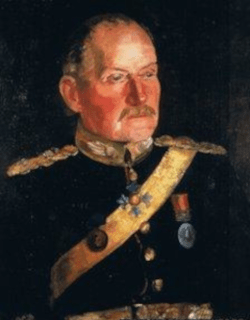
Colonel Frederick Hugh Crawford, CBE, JP, an officer in the British Army, is born in Belfast on August 21, 1861. A staunch Ulster loyalist, he is one of the lesser-known figures in Ulster Unionist history but one who is hugely influential because of his involvement in what is known as the Larne gun-running incident, when he is responsible for smuggling over 25,000 guns and ammunition into the North on the night of April 24, 1914. This makes him a hero for Northern Ireland‘s unionists.
According to the 1911 census for Ireland, Crawford is living in Marlborough Park, Belfast, with his wife of 15 years, Helen, and four of their five children: Helen Nannie, Marjorie Doreen, Ethel Bethea and Malcolm Adair Alexander. His other child, Stuart Wright Knox, is recorded as a pupil at Ballycloghan National School, Belfast. Stuart would become a lieutenant colonel in the British Army, before being invalided in 1944. Malcolm, after being a member of the Colonial Police, joins the Royal Ulster Constabulary (RUC), advancing to District Inspector. In 1931, Malcolm becomes a Justice of the Peace for Singapore.
Crawford works as an engineer for White Star Line in the 1880s, before returning from Australia in 1892. In 1894, he enlists with the Mid-Ulster Artillery regiment of the British Army, before being transferred to the Donegal Artillery, with which he serves during the Boer Wars, earning himself the rank of major.
In 1898, Crawford is appointed governor of Campbell College, Belfast. Two of his children, Stuart Wright Knox and Malcolm Adair Alexander, both attend Campbell College.
In 1911, Crawford becomes a member of the Ulster Unionist Council. On September 28, 1912, he is in charge of the 2,500 well-dressed stewards and marshals that escort Sir Edward Carson and the Ulster Unionist leadership from the Ulster Hall in central Belfast to the nearby City Hall on Donegall Square for the signing of the Ulster Covenant, which he allegedly signs in his own blood. With the formation of the Ulster Volunteers in 1913, he is made their Director of Ordnance.
With regard to Irish Home Rule, Crawford is strongly partisan and backs armed resistance to it, being contemptuous of those who use political bluffing. His advocation of armed resistance is evident when he remarks, at a meeting of the Ulster Unionist Council, that his heart “rejoiced” when he heard talk of looking into using physical force. At another meeting he even goes as far as asking some attendees to step into another room where he has fixed bayonets, rifles and cartridges laid out.
In 1910, the Ulster Unionist Council plans for the creation of an army to oppose Home Rule and approaches Crawford to act as their agent in securing weapons and ammunition. He tries several times to smuggle arms into Ulster, however, vigilant customs officials seize many of them at the docks. Despite this, the meticulously planned and audacious Larne gun-running of April 1914, devised and carried out by Crawford, is successful in bringing in enough arms to equip the Ulster Volunteer Force.
By the 1920s Crawford remains as stoic in his beliefs, remarking in a letter in 1920 that “I am ashamed to call myself an Irishman. Thank God I am not one. I am an Ulsterman, a very different breed.” In March 1920, he begins to reorganize the UVF and in May 1920 he appeals to Carson and James Craig for official government recognition. He states, “We in Ulster will not be able to hold our men in hand much longer…we will have the Protestants…killing a lot of the well-known Sinn Féin leaders and hanging half a dozen priests.” In 1921, he attempts to create an organisation intended to be a “Detective Reserve,” but called the “Ulster Brotherhood,” the aims of which are to uphold the Protestant religion and political and religious freedom, as well as use all means to “destroy and wipe out the Sinn Féin conspiracy of murder, assassination and outrage.” This organisation only lasts for a few months after failing to gain acceptance from the political authorities.
In 1921, Crawford is included in the Royal Honours List and appointed a CBE. In 1934, he writes his memoirs, titled Guns for Ulster.
Crawford dies on November 5, 1952, and is buried in the City Cemetery, Falls Road, Belfast. Upon news of his death, he is described by the then Prime Minister of Northern Ireland, Sir Basil Brooke, as being “as a fearless fighter in the historic fight to keep Ulster British.”
On June 17, as darkness falls, 12,000 troops move toward the fortifications of Monte Piccolo. At dawn the Walloon grenadiers of the Spanish regiments occupy the battery of Monte Piccolo, while other troops occupy the Artemisio Male, La Fajola and set fire to the Pratoni del Vivaro, the commander of the Monte Piccolo garrison, Jan. Pestaluzzi, is captured, probably drunk in a farmhouse of winemakers. The next day, Jean Thierry du Mont, comte de Gages, gives the order to withdraw and preserve only the Artemisio ridge line.
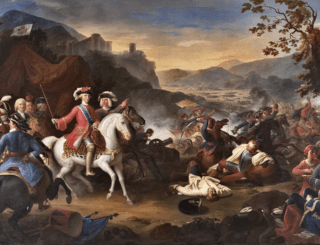
The surprise nighttime attack of Browne’s Austrians on Velletri on August 12 overruns the advanced Irish picquets commanded by Lt. Burke, who is killed, and capture much of King Charles III of Spain‘s royal entourage. But Burke’s men rally to make a fighting retreat, joined by members of the relief guard commanded by Capt. Slattery. The delaying tactics of the picquets allow the rest of the Brigade, along with a regiment of Walloons, to form a line to meet the Austrians. Still, the Irish are heavily outnumbered and suffer tremendous casualties as the Austrians push them. At Velletri’s gates they make a stand. Col. MacDonald of the Hibernia regiment and over 40 other Irish officers are killed, along with several hundred of the red-coated Irish soldiers. But they exhaust the Austrians, as well. With the rest of the Spanish army now rallied behind them, the remaining Irish and Walloons lead a bayonet charge that drives the Austrians from the field. So impressively did the Irish fight, the King of Spain awards each regiment a motto for their flags: “In Omneim Terram ex hivit sonos corum” (Their sound hath gone forth into all the earth). And to each regiment he also grants a sobriquet: To Irlanda, “El Famoso“; to Ultonia, “El Immortal“; and to Hibernia, “La Culumna Irlanda” (“The pillar of Ireland”).
The Tooreen ambush (also known as the Toureen ambush or Ballinhassig ambush) is an ambush carried out by the Irish Republican Army (IRA) on October 22, 1920, during the Irish War of Independence. It takes place near Roberts Farm, Tooreen, near Ballinhassig in County Cork. The IRA ambushes two lorries of British soldiers, killing three and wounding four others. The British surrender and their weapons and ammunition are seized by the IRA. Later that night, British soldiers go on a rampage in nearby Bandon.
Up until the Tooreen ambush, the 3rd Cork Brigade had finished its training, but had not previously engaged in battle with British troops stationed in County Cork. The Tooreen ambush is one of the first major ambushes carried out by the West Cork Brigade under Tom Barry.
The Essex Regiment of the British Army is deployed to West Cork and has a reputation for violently raiding houses throughout the countryside and arresting people believed to be IRA volunteers. They are also alleged to torture their prisoners in order to get information on the whereabouts of the flying columns, so this makes them a despised enemy to the West Cork IRA.
The Essex Regiment is known to travel on the road from Bandon to Cork City every morning and return in the evenings. The road goes through the hamlet of Toureen which the Third West Cork Brigade is stationed at nearby and it is decided to ambush this column of the Essex Regiment as it makes its way to Cork city.
Thirty-two ambushers, twenty-one being riflemen of the Third West Cork Brigade, occupy ambush positions outside Toureen and lay in wait for the approaching Essex Regiment. The Regiment normally goes in two or three lorries to Cork City so the IRA places a homemade mine on the road for use against them.
Scouts signal the approach of two lorries which are coming down the road toward the ambush site. As the first lorry passes, the order to fire is given and a homemade three-pound bomb is thrown. The bomb lands inside the lorry but does not explode. The mine that is placed on the road also fails to detonate. As the volunteers open fire, the second lorry stops and the soldiers inside leap out and return fire, but the volunteers are hidden behind a large timber gate which gives them cover. The first lorry continues on to Cork Barracks. As the fight goes on, the officer in command of the British troops, Captain Dixon, is shot in the head and killed as is one of his men.
The remaining British soldiers surrender soon after, and the IRA men cease firing. The British soldiers are relieved of their weapons and ammunition, but otherwise unharmed. Fourteen rifles, bayonets, equipment, several Mills bombs, around 1,400 rounds of ammunition and a couple of revolvers are taken from them.
Two British soldiers, Lt. Dixon MC of the Suffolk Regiment and Pte. Charles William Reid of the Essex Regiment, are killed in the ambush. Five are wounded, including Sergeant Thomas Bennett RASC who dies in Cork on the following day. Six are unhurt except for shock. None of the IRA volunteers are killed or wounded during the ambush and aid is given to the wounded soldiers, while the dead are pulled away from the lorry and it is then set on fire by the volunteers. The two soldiers who are not hurt during the ambush are released along with their wounded and they return to their barracks.
Later that night, members of the Essex Regiment go on a violent rampage through Bandon, destroying property and seeking out anyone they believe to be connected to the ambush. It is believed that at least some of the rampaging soldiers are those released unharmed by the IRA earlier in the day. The reprisal attacks are indiscriminate and include attacks on homes and properties of business owners with “establishment” connections – including the Brennan family of Kilbrogan House.
A Military Court of Inquiry into the soldiers killed, is conducted on October 28, 1920. There are mixed references to these proceedings in The Irish Times and the Irish Independent, both of which contain errors.
Lt. Dixon is buried with full military honours in St. Paul’s Church in Dover, Kent, England. Sergeant Bennett is buried in St. Peter & St. Paul Church in his home village of Shorne, near Gravesend in Kent.
(Pictured: Plaque on a farm wall marking the location of the Tooreen ambush)
On the morning of September 1, 1862, Union Maj. Gen. John Pope orders Maj. Gen.Edwin Vose Sumner of the II Corps, Army of the Potomac, to send a brigade north to reconnoiter. The army’s cavalry is too exhausted for the mission. But at the same time, he continues his movement in the direction of Washington, D.C., sending Maj. Gen. Irvin McDowell‘s III Corps to Germantown (on the western border of modern-day Fairfax, Virginia), where it can protect the important intersection of Warrenton Pike and Little River Turnpike that the army needs for the retreat. He also sends two brigades from Maj. Gen. Jesse L. Reno‘s IX Corps, under the command of Brig. Gen. Isaac Stevens, to block Jackson. Maj. Gen. Philip Kearny’s division from the III Corps follows later that afternoon.
Jackson resumes his march to the south, but his troops are tired and hungry and make poor progress as the rain continues. They march only three miles and occupy Ox Hill, southeast of Chantilly Plantation, and halt, while Jackson himself takes a nap. All during the morning, Confederate cavalry skirmish with Union infantry and cavalry. At about 3:00 PM, Stevens’s division arrives at Ox Hill. Despite being outnumbered, Stevens chooses to attack across a grassy field against Brig. Gen. Alexander Lawton‘s division in the Confederate center. The Union attack is initially successful, routing the brigade of Colonel Henry Strong and driving in the flank of Captain William Brown, with Brown killed during the fighting. The Union division is driven back following a counterattack by Brig. Gen. Jubal Early‘s brigade. Stevens is killed during this attack at about 5:00 PM by a shot through his temple.
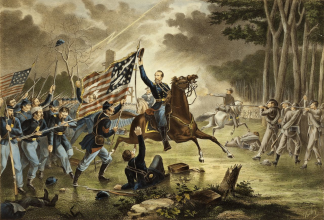
A severe thunderstorm erupts about this time, resulting in limited visibility and an increased dependence on the bayonet, as the rain soaks the ammunition of the infantry and makes it useless. Kearny arrives about this time with his division to find Stevens’s units disorganized. Perceiving a gap in the line he deploys Brig. Gen. David B. Birney‘s brigade on Stevens’s left, ordering it to attack across the field. Birney manages to maneuver close to the Confederate line but his attack stalls in hand-to-hand combat with Maj. Gen. A.P. Hill‘s division. Kearny mistakenly rides into the Confederate lines during the battle and is killed. As Kearny’s other two brigades arrive on the field, Birney uses the reinforcements as a rear guard as he withdraws the remainder of the Union force to the southern side of the farm fields, ending the battle.
That night, Maj. Gen. James Longstreet arrives to relieve Jackson’s troops and to renew the battle the following morning. The lines are so close that some soldiers accidentally stumble into the camps of the opposing army. The Union army withdraws to Germantown and Fairfax Court House that night, followed over the next few days by retreating to the defenses of Washington D.C. The Confederate cavalry attempts a pursuit but fails to cause significant damage to the Union army.
The fighting is tactically inconclusive. Although Jackson’s turning movement is foiled and he is unable to block the Union retreat or destroy Pope’s army, National Park Service historians count Chantilly as a strategic Confederate victory because it neutralizes any threat from Pope’s army and clears the way for Lee to begin his Maryland campaign. The Confederates claim a tactical victory as well because they hold the field after the battle. Two Union generals are killed, while one Confederate brigade commander is killed. Pope, recognizing the attack as an indication of continued danger to his army, continues his retreat to the fortifications around Washington, D.C. Lee begins the Maryland Campaign, which culminates in the Battle of Antietam, after Pope retreats from Virginia. The Army of the Potomac, under Maj. Gen. George B. McClellan, absorbs the forces of Pope’s Army of Virginia, which is disbanded as a separate army.
The site of the battle, once rural farmland, is now surrounded by suburban development in Fairfax County. A 4.8-acre (19,000 m²) memorial park, the Ox Hill Battlefield Park, is located off of State Route 608 (West Ox Road) and lies adjacent to the Fairfax Towne Center shopping area and includes most of the Gen. Isaac Stevens portion of the battle, about 1.5% of the total ground. The park is under the jurisdiction of the Fairfax County Park Authority. In January 2005, the Authority approves a General Management Plan and Conceptual Development Plan that sets forth a detailed history and future management framework for the site.
A small yard located within the nearby Fairfax Towne Center has been preserved to mark the area crossed by Confederate troops to get to the Ox Hill battlefield.
(Pictured: Color lithograph “General Kearney’s gallant charge,” published by John Smith, 804 Market St., Philadelphia. From the Library of Congress.)
Browne is born in Basel, Switzerland, the son of Count Ulysses von Browne (b. Limerick 1659) and his wife Annabella Fitzgerald, a daughter of the House of Desmond. Both families had been exiled from Ireland in the aftermath of the Nine Years’ War.
Browne’s early career is helped by family and marital connections. His father and his father’s brother, George (b. Limerick 1657), are created Counts of the Holy Roman Empire by Emperor Charles VI in 1716 after serving with distinction in the service of the Holy Roman Emperors. The brothers enjoy a lengthy, close friendship with John Churchill, 1st Duke of Marlborough, who is primarily responsible for their establishment in the Imperial Service of Austria. On his father’s death he becomes third Earl of Browne in the Jacobite peerage. His wife, Countess Marie Philippine von Martinitz, has valuable connections at court and his sister, Barbara (b. Limerick 1700), is married to Freiherr Francis Patrick O’Neillan, a Major General in the Austrian Service. So, by the age of 29 Browne is already colonel of an Austrian infantry regiment.
Browne justifies his early promotion in the field, and in the Italian campaign of 1734 he greatly distinguishes himself. In the Tirolese fighting of 1735, and in the Turkish war, he wins further distinction as a general officer.
Browne is a lieutenant field marshal in command of the Silesian garrisons when in 1740 Frederick II and the Prussian army overruns the province. His careful employment of such resources as he possesses materially hinders the king in his conquest and allows time for Austria to collect a field army. He is present at Mollwitz, where he receives a severe wound. His vehement opposition to all half-hearted measures brings him frequently into conflict with his superiors but contributes materially to the unusual energy displayed by the Austrian armies in 1742 and 1743.
In the following campaigns Browne exhibits the same qualities of generalship and the same impatience of control. In 1745 he serves under Count Traun and is promoted to the rank of Feldzeugmeister. In 1746 he is present in the Italian campaign and the battles of Piacenza and Rottofreddo. He and an advanced guard force their way across the Apennine Mountains and enter Genoa. He is thereafter placed in command of the invasion of France mounted in winter 1746-47, leading to the Siege of Antibes, but he is obliged to break off the invasion and return to Italy in February 1747 after Genoa rises in rebellion against the Austrian garrison he had left behind. In early 1747 he is appointed commander of all imperial forces in Italy, replacing Antoniotto Botta Adorno. At the end of the war, he is engaged in the negotiations on troop withdrawals from Italy, which leads to the convention of Nice on January 21, 1749. He becomes commander-in-chief in Bohemia in 1751, and field marshal two years later.
Browne is still in Bohemia when the Seven Years’ War opens with Frederick’s invasion of Saxony in 1756. His army, advancing to the relief of Pirna, is met, and, after a hard struggle, defeated by the king at the Battle of Lobositz, but he draws off in excellent order, and soon makes another attempt with a picked force to reach Pirna, by wild mountain tracks. He never spares himself, bivouacking in the snow with his men, and Thomas Carlyle records that private soldiers made rough shelters over him as he slept.
Brown actually reaches the Elbe at Bad Schandau, but as the Saxons are unable to break out, he retires, having succeeded, however, in delaying the development of Frederick’s operations for a whole campaign. In the campaign of 1757, he voluntarily serves under Prince Charles Alexander of Lorraine who is made commander-in-chief. On May 6 of that year, while leading a bayonet charge at the Battle of Prague, Browne, like Kurt Christoph, Graf von Schwerin, on the same day, meets his death. He is carried mortally wounded into Prague, and there dies on June 26, 1757.





 seamus dubhghaill