seamus dubhghaill

Promoting Irish Culture and History from Little Rock, Arkansas, USA


Leave a comment

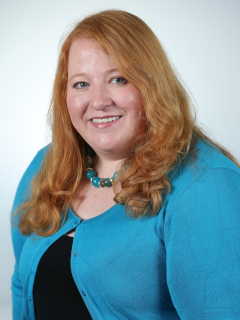
Birth of Naomi Long, Northern Irish Politician

Naomi Rachel Long MLA (née Johnston), a Northern Irish politician who serves as Minister of Justice in the Northern Ireland Executive from January 2020 to October 2022, is born in east Belfast, Northern Ireland, on December 13, 1971. She has served as leader of the Alliance Party of Northern Ireland (APNI) since 2016 and a Member of the Legislative Assembly (MLA) for Belfast East since 2020.

Long attends Mersey Street Primary and Bloomfield Collegiate School. She graduates from Queen’s University Belfast with a degree in civil engineering in 1994, works in a structural engineering consultancy for two years, holds a research and training post at Queen’s University for three years, and then goes back into environmental and hydraulic engineering consultancy for four years.

Long first takes political office in 2001 when she is elected to Belfast City Council for the Victoria ward. In 2003, she is elected to the Northern Ireland Assembly for Belfast East, succeeding her fellow party member John Alderdice. In 2006, she is named deputy leader of her party. In the 2007 Northern Ireland Assembly election, she more than doubles the party’s vote in the constituency, being placed second ahead of the leader of the Ulster Unionist Party (UUP). The overall UUP vote, however, is 22%. At 18.8%, her vote share is higher than that for Alderdice in 1998.

On June 1, 2009, Long is elected as Lord Mayor of Belfast, defeating Democratic Unionist Party (DUP) candidate William Humphrey by 26 votes to 24 in a vote at a council meeting. She becomes the second woman to hold the post, after Grace Bannister (1981–82).

On May 6, 2010, Long defeats Peter Robinson, First Minister of Northern Ireland and leader of the DUP, to become Member of Parliament (MP) for Belfast East in the House of Commons. She becomes the first MP elected to Westminster for the Alliance Party (previously, Stratton Mills, a former Ulster Unionist Party MP, had changed parties to Alliance). She also becomes the first Liberal-affiliated MP elected to Westminster in Northern Ireland since James Brown Dougherty in Londonderry City in 1914. Despite the close relationship between the Alliance Party and the Liberal Democrats, she does not sit with the coalition government nor take the coalition whip and is not a member of the Liberal Democrats.

On December 10, 2012, Long receives a number of death threats, and a petrol bomb is thrown inside an unmarked police car guarding her constituency office. This violence erupts as a reaction by Ulster loyalists to the decision by Alliance Party members of Belfast City Council to vote in favour of restricting the flying of the Union flag at Belfast City Hall to designated days throughout the year, which at the time constitutes 18 specific days.

In 2015, Long loses her seat in the Commons to Gavin Robinson of the DUP, as a result of a five-party unionist pact in the constituency which sees the UUP, UK Independence Party (UKIP), Traditional Unionist Voice (TUV) and Progressive Unionist Party (PUP) all stand aside in favour of Robinson.

In January 2016, Long announces that she will return as an Assembly candidate in the 2016 Northern Ireland Assembly election having been nominated in place of incumbent Judith Cochrane. She is subsequently elected on the first count with 14.7% of first-preference votes. Following her return to the Assembly, she assumes positions on the Committee for Communities, the All-Party Group on Fairtrade, the All-Party Group for Housing, and chairs the All-Party Group on Science, Technology, Engineering and Mathematics.

In August 2016, Long calls for Sinn Féin‘s Máirtín Ó Muilleoir to stand aside as Minister of Finance during an investigation of the Stormont Finance Committee’s handling of its Nama inquiry, while Ó Muilleoir is a committee member. This follows allegations that his party had “coached” loyalist blogger Jamie Bryson prior to his appearance before the committee.

In November 2016, Long criticises Sinn Féin and the DUP for delaying the publication of a working group report on abortion, which recommends legislative changes in cases of fatal foetal abnormality, calling on the Executive “to act without further delay to help women who decide to seek a termination in these very difficult circumstances.”

On October 26, 2016, Long is elected Alliance leader unopposed following the resignation of David Ford. In the first manifesto released under her leadership, she affirms her commitment to building a “united, open, liberal and progressive” society. Her party’s legislative priorities are revealed to include the harmonisation and strengthening of equality and anti-discrimination measures, the introduction of civil marriage equality, development of integrated education and a Northern Ireland framework to tackle climate change.

In the 2017 Northern Ireland Assembly election, Long tops the poll in Belfast East and is returned to the Assembly with 18.9% of first-preference votes. The election is widely viewed as a success for Alliance, with the party increasing its vote share by 2 percentage points and retaining all of its seats in a smaller Assembly. The party subsequently holds the balance of power at Stormont.

Alliance targets two seats in Belfast South and Belfast East in the 2017 United Kingdom general election. During the campaign, Long reaffirms her support for a People’s Vote, marriage equality, Votes at 16 and greater transparency surrounding political donations. She also pledges to oppose any rollback of the Human Rights Act 1998.

Following the collapse of talks to restore devolution in February 2018, Long reiterates her view that the pay of MLAs should be cut in the absence of a functioning Executive. In March 2018, Alliance launches its “Next Steps Forward” paper, outlining a number of proposals aimed at breaking the deadlock and Stormont. At the 2019 Alliance Party Conference, she accuses Secretary of State for Northern Ireland Karen Bradley of an “appalling dereliction of duty” over the ongoing stalemate, saying that she had made “no concerted effort to end this interminable drift despite it allegedly being her top priority.”

In the 2019 Northern Ireland local elections, Alliance sees a 65% rise in its representation on councils. Long hails the “incredible result” as a watershed moment for politics in Northern Ireland.

Long is elected to the European Parliament as a representative for Northern Ireland in May 2019 with 18.5% of first-preference votes, the best ever result for Alliance. She is subsequently replaced in the Assembly by Máire Hendron, a founding member of the party and former deputy lord mayor of Belfast. She then replaces Hendron in the Assembly with effect from January 9, 2020.

In 2019, Long becomes the first Northern Ireland politician to have served at every level of government.

On January 11, 2020, following the restoration of the Northern Ireland Assembly after three years of stalemate, Long is elected Minister of Justice in the Northern Ireland Executive. On January 28, she announces that she will progress new domestic abuse legislation through the Assembly which will make coercive control a criminal offence in Northern Ireland. In June 2020, she commissions a review into the support available for prison officers following concerns about absence rates. That same month, she announces her intention to introduce unexplained wealth orders in Northern Ireland to target paramilitary and criminal finances.

In November 2020, Long says she is seriously reconsidering her position within the Executive following the DUP’s deployment of a cross-community vote to prevent an extension of COVID-19 regulations. She tells BBC News, “I have asked people to desist from this abuse of power because it will make my position in the executive unsustainable.”

In March 2022, Long tells the Alliance Party Conference that “some politicians are addicted to crisis and conflict and simply not up to the job of actually governing.” Long leads Alliance into the 2022 Northern Ireland Assembly election on a platform of integrated education, health reform, a Green New Deal, tackling paramilitarism and reform of the Stormont institutions.

Long is a member of Bloomfield Presbyterian Church. Following the Church’s decision to exclude those in same-sex relationships from being full members, she expresses “great concern” and states that she “didn’t know” if she would remain a member herself. She is married to Michael Long, an Alliance councillor on Belfast City Council and former Lord Mayor of Belfast, and son of the engineer Professor Adrian Long. Long and her husband are the first husband and wife to have both served as Lord Mayors of Belfast.


Leave a comment

Founding of the Alliance Party of Northern Ireland

The Alliance Party of Northern Ireland (APNI), or simply Alliance, a liberal and centrist political party in Northern Ireland, is founded on April 21, 1970, with Phelim O’Neill as leader.

As of the 2022 Northern Ireland Assembly election, the Alliance Party is the third-largest party in the Northern Ireland Assembly, holding seventeen seats, and has made recent breakthroughs to place third in first preference votes in the 2019 European Parliament election and third highest-polling regionally at the 2019 United Kingdom general election. The party wins one of the three Northern Ireland seats in the European Parliament, and one seat, North Down, in the House of Commons, the lower house of the Parliament of the United Kingdom.

Founded in 1970 from the New Ulster Movement, the Alliance Party originally represents moderate and non-sectarian unionism. However, over time, particularly in the 1990s, it moves towards neutrality on the Union, and has come to represent wider liberal and non-sectarian concerns. It supports the Good Friday Agreement but maintains a desire for the reform of the political system toward a non-sectarian future. In the Northern Ireland Assembly, it is designated as neither unionist nor Irish nationalist, but “Other.”

The Alliance Party wins their first seat in the UK House of Commons in the 2010 United Kingdom general election, unseating the former Belfast East MP Peter Robinson, First Minister of Northern Ireland and leader of the Democratic Unionist Party (DUP). Naomi Long is the first MP from the Alliance Party since Stratton Mills, who joined the party from the Ulster Unionist Party (UUP) in 1973. However, the DUP regains the seat at the 2015 United Kingdom general election following an electoral pact with the UUP. In the 2019 United Kingdom general election, the Alliance Party regains its presence in the House of Commons when Stephen Farry wins the North Down seat vacated by the independent unionist, Sylvia Hermon. Earlier in the year, the party’s leader, Naomi Long, wins the party’s first seat in the European Parliament in the last European election before Brexit. Under Long’s leadership, the Alliance Party exceeds expectations in the 2022 Northern Ireland Assembly election and gains numerous seats in the Northern Ireland Assembly.

The Alliance Party is a member of Liberal International and the Alliance of Liberals and Democrats for Europe Party and is aligned with the Liberal Democrats in Great Britain.


Leave a comment

Ian Paisley Announces Retirement as Northern Ireland’s First Minister

In a March 4, 2008, announcement, the Rev. Ian Paisley signals the end of an era by announcing he will retire as First Minister of Northern Ireland. He also confirms he is stepping down as leader of the Democratic Unionist Party (DUP), the party he founded in the early 1970s. The news represents a huge moment in the politics and recent history of Northern Ireland, removing from the scene as it does one of its most striking figures.

The 81-year-old announces he will quit both posts following an international investment conference in Belfast in May 2008 but will remain as an MP and Assembly member.

“I came to this decision a few weeks ago when I was thinking very much about the conference and what was going come after the conference,” Paisley tells Ulster Television. “I thought that it is a marker, a very big marker and it would be a very appropriate time for me to bow out.”

Paisley denies he is leaving in part over allegations that his son, Ian Paisley Jr., lobbied Downing Street on behalf of a wealthy party member. He says his son has been “wrongly accused.” He is also weakened over defeat in a recent by-election – an indication that a section of the DUP’s electorate is uneasy about his historic decision to share power with Sinn Féin.

Significantly, Paisley does not back any contender in the DUP leadership contest to succeed him. “This is not the Church of Rome. I have no right to say who will succeed me. I will not be like Putin in Russia saying to the president – ‘this is the way you have to go.’ When I make a break it will be [a] break.”

Paisley defends his decision to enter into government with Sinn Féin. “It was the right thing to do because it was the only thing to do to save us from a united Ireland. We were threatened that we would be more Irish in our rulership, that there would be more Dublin say in government. That was what the British government threatened. We managed to put that to a rest.”

“We have laid to rest that and republicans have come to see that they have to put up with Paisley and his clan. We took what was meant for our destruction and turned it into our salvation.”

Speaking from Dubai the previous night, the deputy First Minister, Martin McGuinness, says, “It wasn’t unexpected. It was the right decision to go into sharing power with Sinn Féin which changed the politics of Ireland forever.”

The Sinn Féin MP describes Paisley as “courageous” for agreeing to enter into the power-sharing government. “We have had a positive and constructive working relationship,” McGuinness said.

Paisley’s fiercest critic within unionism, the ex-DUP MEP, Jim Allister, claims opposition to his power-sharing with Sinn Féin and his relationship with McGuinness means that Paisley “jumped before he was pushed.”

Allister’s new party, Traditional Unionist Voice (TUV), split the DUP vote in a by-election in February 2008 and cost the party a council seat in County Down. It was Paisley’s first electoral test since he agreed to share power with Sinn Féin following the St. Andrews Agreement at the end of 2006.

In April 2008, Peter Robinson is chosen to succeed Paisley as leader of the Democratic Unionist Party. The 36 DUP members of the Northern Ireland Assembly unanimously select Robinson, who has been MP for Belfast East since 1979 and Paisley’s deputy since 1980. He is the Minister of Finance and Personnel in the Northern Ireland Executive – Northern Ireland’s power-sharing government – for the previous year.

(From: “Paisley to step down as Ulster’s first minister” by Henry McDonald, Ireland correspondent, The Guardian, March 4, 2008)


Leave a comment

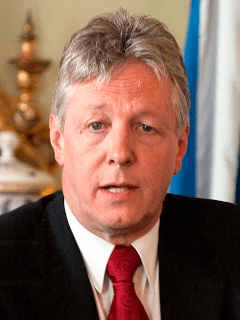
Birth of Peter Robinson, Northern Irish Politician

Peter David Robinson, retired Northern Irish politician, is born on December 29, 1948, in Belfast, Northern Ireland. He serves as First Minister of Northern Ireland from 2008 until 2016 and Leader of the Democratic Unionist Party (DUP) from 2008 until 2015. Until his retirement in 2016, he is involved in Northern Irish politics for over 40 years, being a founding member of the DUP along with Ian Paisley.

Robinson is the son of Sheila and David McCrea Robinson. He is educated at Annadale Grammar School and Castlereagh College, now part of the Belfast Metropolitan College. In 1966 he first hears Ian Paisley speak at a rally at Ulster Hall and shortly afterwards leaves school to devote himself to the Protestant fundamentalist cause. He considers joining the Royal Ulster Constabulary (RUC) but instead joins the Lagan Valley unit of the Ulster Protestant Volunteers (UPV), a paramilitary organisation tied to Ian Paisley’s Free Presbyterian Church of Ulster. He also joins the Ulster Constitution Defence Committee. As a young man he embraces a populist anti-Catholic fundamentalism. A former classmate alleges Robinson and a friend harassed a pair of Catholics nuns in the street in Portrush, County Antrim, yelling “Popehead, Popehead.” He initially gains employment as an estate agent for R.J. McConnell & Co. and later with Alex, Murdoch & Deane in Belfast.

Robinson serves in the role of General Secretary of the DUP from 1975, a position he holds until 1979 and which affords him the opportunity to exert unprecedented influence within the fledgeling party. In 1977, he is elected as a councillor for the Castlereagh Borough Council in Dundonald, County Down, and in 1979, he becomes one of the youngest Members of Parliament (MP) when he is narrowly elected for Belfast East. He holds this seat until his defeat by Naomi Long in 2010, making him the longest-serving Belfast MP since the Acts of Union 1800.

In 1980, Robinson is elected as the deputy leader of the DUP. Following the re-establishment of devolved government in Northern Ireland as a result of the Good Friday Agreement, he is elected in 1998 as the Member of the Legislative Assembly (MLA) for Belfast East. He subsequently serves as Minister for Regional Development and Minister of Finance and Personnel in the Northern Ireland Executive. He is elected unopposed to succeed Ian Paisley as leader of the DUP on April 15, 2008, and is subsequently confirmed as First Minister of Northern Ireland on June 5, 2008.

In January 2010, following a scandal involving his wife Iris (née Collins), Robinson temporarily hands over his duties as First Minister to Arlene Foster under the terms of the Northern Ireland Act 2006. Following a police investigation, which recommends that he should not be prosecuted following allegations made by the BBC in relation to the scandal, he resumes his duties as First Minister. The Official Assembly Commissioner’s Investigation and Report clears Robinson of any wrongdoing.

In September 2015, Robinson again stands aside to allow Arlene Foster to become acting First Minister after his bid to adjourn the assembly is rejected. His action is a response to a murder for which a member of Sinn Féin, a party in the Northern Ireland Executive, had been questioned. He resumes his duties on October 20, 2015. On November 19, 2015, he announces that he will be stepping down as First Minister and as leader of the DUP. He subsequently steps down as First Minister on January 11, 2016 and is now fully retired from frontline politics.

Robinson is the author of a number of books and pamphlets on local politics and history including: Capital Punishment for Capital Crime (1974), Savagery and Suffering (1975), Ulster the Facts (1981), Self-Inflicted (1981), A War to be Won (1983), It’s Londonderry (1984), Carson – Man of Action (1984), Ulster in Peril (1984), Their Cry was no Surrender (1986), Hands Off the UDR (1990), Sinn Féin – A Case for Proscription (1993), The Union Under Fire (1995), Give Me Liberty (no date), Ulster—the Prey (no date).


Leave a comment

Birth of Sir Oliver Napier, First Leader of Northern Ireland’s Alliance Party

Sir Oliver Napier, the first leader of the Alliance Party of Northern Ireland, is born in Belfast on July 11, 1935. In 1974 he serves as the first and only Legal Minister and head of the Office of Legal Reform in the Northern Ireland power-sharing executive set up by the Sunningdale Agreement.

Napier is educated at St. Malachy’s College, Belfast and Queen’s University Belfast before starting work as a solicitor.

Napier joins the Ulster Liberal Party, rising to become Vice President by 1969. That year, he leads a group of four party members who join the New Ulster Movement, accepting the post of joint Chairman of its political committee. The Liberal Party promptly expels him, but, working with Bob Cooper, he uses his position to establish a new political party, the Alliance Party of Northern Ireland, which seeks to become a political force that can command support from across the divided communities of the province, but remain pro-union. This aims to offer an alternative to what he describes as the sectarianism of the Ulster Unionist Party. Despite his faith he is a supporter of the Union.

Napier serves as the party’s joint leader from 1970 until 1972, then as its sole leader from 1973 to 1984. Under his leadership Alliance participates in successive assemblies that seek to solve the debate on the province’s position, including the Northern Ireland Assembly, 1973 in which he is a minister in the power-sharing Executive. In 1979 he comes closer to winning a seat in the Westminster Parliament than any other Alliance candidate up to that point when he is less than a thousand votes behind Peter Robinson‘s winning total in Belfast East in a tight three-way race. This record is beaten in 2010, when Naomi Long ousts Robinson from the same seat. When Napier steps down as leader in 1984 he receives many plaudits for his work. The following year he is knighted and in 1989 he stands down from Belfast City Council, seemingly to retire.

However, in 1995 Napier returns to the political fray when he contests the North Down by-election for the Alliance, standing again in the 1997 United Kingdom general election. In 1996 he is elected to the Northern Ireland Forum for North Down. Prior to his death he is the last prominent member of the Ulster Liberal Party.

Napier serves on the Board of Governors of Lagan College, the first integrated school in Northern Ireland.

Napier dies at the age of 75 on July 2, 2011. He is survived by his wife, Briege, whom he marries in 1961, three sons and five daughters, and 23 grandchildren. A son predeceases him.


Leave a comment

Birth of Garbhan Downey, Novelist & Editor

Garbhan Downey, novelist and editor, is born in Derry, County Londonderry, Northern Ireland, on February 24, 1966. He is the former Director of Communications and Marketing for Culture Company 2013, which delivers Derry’s City of Culture year.

Downey is a product of St. Columb’s College, the Catholic grammar school whose past pupils include John Hume, Seamus Heaney and Brian Friel.

Downey cuts his teeth in journalism editing University College Galway’s student magazine in the late 1980s. After graduating with an MSc in computing from the University of Ulster, he works as an entertainment columnist with the Derry Journal and then as a staff reporter with the Londonderry Sentinel, before moving to The Irish News to become the paper’s Derry correspondent.

Downey’s offbeat reports of the 1994 FIFA World Cup for The Irish News are subsequently compiled for his first book, Just One Big Party. He spends six years as a BBC news producer in Derry and Belfast, before joining the Derry News as editor in 2001. During his period as editor (2001–2004), the Derry News wins two Newspaper Society awards for Fastest Circulation Growth in the United Kingdom.

Since 2004, Downey has published six comic novels set in the criminal underbelly of post-ceasefire Ireland. His books have been described as “a superb blend of comedy, political dirty tricks, grisly murder and bizarre twists.”

A former deputy-president of the Union of Students in Ireland, Downey is one of the organisers of a student occupation of government offices in Dublin on Budget Day 1988 in protest against education cutbacks.

In June 2002, the Police Service of Northern Ireland (PSNI) get a court order to force Downey to hand over pictures the Derry News had captured of the Real Irish Republican Army attacking a communications post.

In 2006, Downey helps establish the new Northern Ireland literary review Verbal and edits the publication for its first six issues.

A lifelong political anorak, in 2007, Downey works as an election pundit for TV3 (Ireland), alongside the Irish comedian Brendan O’Carroll. In 2010, he wins a contest to predict the winners of Northern Ireland’s 18 Westminster constituencies, missing out on just one, Naomi Long, who surprisingly beat First Minister Peter Robinson in Belfast East. He donates his prize, a framed Ian Knox cartoon, to Long by way of apology.

Downey’s 2010 comedy-thriller The American Envoy is the first novel issued by an Irish publishing house as a Kindle e-book, simultaneously with its paperback release.

In June 2011, Downey is appointed Director of Media for Culture Company 2013, the body tasked with delivering Derry’s UK City of Culture year.

Downey is married to Una McNally, and they have two children.


Leave a comment

Birth of David Bleakley, Northern Ireland Politician

David Wylie Bleakley, politician and peace campaigner in Northern Ireland, is born in the Strandtown district of Belfast, Northern Ireland on January 11, 1925.

Bleakley works as an electrician in the Harland & Wolff dockyards while becoming increasingly active in his trade union. He studies economics at Ruskin College in Oxford, where he strikes up a friendship with C. S. Lewis, about whom he later writes a centenary memoir. He later attends Queen’s University Belfast. A committed Christian, he is a lifelong Anglican – a member of the Church of Ireland. Throughout his life, he is a lay preacher.

Bleakley joins the Northern Ireland Labour Party (NILP) and contests the Northern Ireland Parliament seat of Belfast Victoria in 1949 and 1953 before finally winning it in 1958. At Stormont, he is made the Chairman of the Public Accounts Committee, but he loses his seat in 1965. He is head of the department of economics and political studies at Methodist College Belfast from 1969 to 1979.

Bleakley runs for the Westminster seat of Belfast East in 1970 (gaining 41% of the vote), February 1974 and October 1974 for the Northern Ireland Labour Party each time, but never enough to win the Westminister seat from the Ulster Unionist Party (UUP). In 1971, Brian Faulkner appoints him as his Minister for Community Relations at Stormont, but as Bleakley is not an MP, he can only hold the post for six months. He resigns five days before his term expires in order to highlight his disagreement with government policy, specifically the failure to widen the government to include non-Unionist parties, and the decision to introduce internment. He writes a respectful biography of Faulkner and his own memoir of the period.

After the Parliament is abolished, Bleakley stands for, and is elected to, the Northern Ireland Assembly and its successor, the Northern Ireland Constitutional Convention. He stands again for Belfast East in the February and October UK general elections, but wins only 14% of the vote each time.

By the late 1970s, the NILP is in disarray, and does not stand a candidate for the 1979 European Assembly election. Bleakley instead stands as an “Independent Community Candidate,” but takes only 1.6% of the votes cast.

During the 1980s, Bleakley sits as a non-partisan member of various quangos. From 1980 to 1992 he is general secretary of the Irish Council of Churches. In 1992, he joins the Alliance Party of Northern Ireland and is an advisor to the group during the all-party talks. For the 1996 Northern Ireland Forum election, he is a prominent member of the Democratic Partnership list and stands in Belfast East, but is not elected. In 1998, he joins the Labour Party of Northern Ireland and stands in Belfast East in the Assembly elections, receiving 369 first preference votes.

Bleakley dies in Belfast at the age of 92 on June 26, 2017.