Aiming to raise awareness of world poverty, The Corrs and chartered accountants KPMG jointly launch the NetAid web site on October 7, 1999. NetAid is an anti-poverty initiative started as a joint venture between the United Nations Development Programme and Cisco Systems. It becomes an independent nonprofit organization in 2001 and becomes a part of Mercy Corps in 2007.
NetAid begins with a concert event on October 9, 1999 with simultaneous activities meant to harness the Internet to raise money and awareness for the Jubilee 2000 campaign. Concerts take place at Wembley Stadium in London, Giants Stadium in New Jersey and the Palais des Nations in Geneva. While the Wembley show is at capacity, the U.S. show suffers from very poor ticket sales.
The NetAid website, originally at http://www.netaid.org, receives over 2.4 million hits and raises $830,000 from eight countries. Cisco sponsors the concerts and the web site. Along with Kofi Annan, Keyur Patel, MD of KPMG Consulting spearhead the technology architecture development of the web site and Anaal Udaybabu (Gigabaud Studios, San Francisco) designs the user experience.
Following the concerts, NetAid is spun out of Cisco as an independent entity and tries various approaches to raising awareness of extreme poverty and raising money for anti-poverty projects undertaken by other organizations, through a variety of different NetAid campaigns.
By 2006, NetAid has narrowed its focus to raising awareness among high school students in the United States regarding poverty in developing countries.
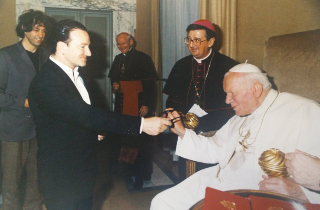
In an extraordinary meeting, marking 100 days to the millennium, Pope John Paul II makes a strong appeal to world to leaders to take urgent and decisive action towards resolving the debt crisis that afflicts the world’s poorest countries.
Speaking during a meeting with an international Jubilee 2000 delegation of economists, artists and campaigners, the Pope questions why progress in resolving the debt problem is so slow, and expresses impatience with the protracted negotiations. He warns that it “is the poor that pay the cost of indecision and delay.”
The Pope says “the Catholic Church looks at the situation with great concern. Not because she has any concrete technical model of development to offer, but because she has a moral vision of what the good of individuals and of the human family demands. She has consistently taught that there is a ‘social mortgage‘ on all private property, a concept which today must also be applied to ‘intellectual property‘ and to ‘knowledge.’ The law of profit alone cannot be applied to that which is essential for the fight against hunger, disease and poverty.”
Addressing the Pope on behalf of the delegation, Ann Pettifor, director and co-founder of Jubilee 2000, appeals to the Vatican to prevail upon the world’s leaders to meet again before the New Year, to cancel debts that result in the deaths of 20,000 children every day. She says, “This is a day that will go down in history. The Pope has given his endorsement and blessing to the passion and commitment of millions of Jubilee 2000 campaigners around the world. It is now up to the world’s leaders to rise to the Pope’s call and moral leadership.”
Following the meeting Bob Geldof says, “Were the spirit of this frail old man mirrored in a practical way by our political leaders, then the final push of political will to eradicate this unnecessary tragedy, would be easily achieved…and I liked his shoes!”
Professor Jeffrey Sachs adds, “With 100 days left to the millennium, we are halfway up the summit. But much more is needed. For hundreds of millions of the world’s poorest people, the Pope’s message today is crucial: the time is urgent for rich and poor to take the full and bold measure of debt cancellation that is so vitally needed.”
Bono summed it up saying, “His everyday courage amazes me. As aged as he is and as infirm as he has been, he will, you know, hang out with a bunch of pop stars…who could turn this man down?”
(Source: “Pope meets Bobo and calls for debt relief,” The Guardian, September 23, 1999)
Gavin Friday, born Fionán Martin Hanvey, Irish singer and songwriter, composer, actor and painter, is born in Dublin on October 8, 1959.
Friday grows up in Ballygall, a neighbourhood located on Dublin’s Northside between Finglas and Glasnevin where he went to school. When he is fourteen years old and living on Cedarwood Road, he meets Bono and Guggi at a party to which he has not been invited. Bono says, “We caught him trying to steal something of the house. Classic teenage stuff… but we became friends.”
Friday is a founding member of the post-punk group Virgin Prunes and has recorded several solo albums and soundtracks. In 1986, after the demise of The Virgin Prunes, he devotes himself to painting for a while, sharing a studio with Bono, Guggi and Charlie Whisker. This results in the exhibition Four Artists – Many Wednesdays (1988) at Dublin’s Hendricks Gallery. Friday, Guggi and Whisker show paintings, while Bono opts to exhibit photos taken in Ethiopia. Friday’s part of the show is entitled I didn’t come up the Liffey in a bubble, an expression often used by his father.
His main collaborator between 1987 and 2005 is multi-instrumentalist, Maurice Seezer. They sign to Island Records in 1988 and release three albums together, before parting with the company in 1996. After that Friday and Seezer compose the score for the Jim Sheridan films The Boxer and In America which is nominated for Best Original Film Score in the 2004 Ivor Novello Awards.
Friday has maintained a close friendship with U2‘s Bono since childhood, and they collaborate on the soundtrack for the Jim Sheridan’s film In the Name of the Father, including the title track, “Billy Boola” and “You Made Me the Thief of Your Heart”, which is sung by Sinéad O’Connor and nominated for a Golden Globe Award for Best Original Song. In 2003 they write “Time Enough for Tears,” the original theme tune for Sheridan’s film In America, as sung by Andrea Corr. The song is nominated for a Golden Globe Award for Best Original Song.
In 2009 Friday and Macken work on Bryars’ fourth studio album. On April 6, 2010, Rubyworks Records announces the signing of Gavin Friday and that a new album is on its way. The new CD is titled catholic and is released in Ireland on Good Friday, April 22, 2011.
Graham’s long time colleague and Hot Press editor Niall Stokes describes him, “In many ways, he was a founding father of modern Irish music. He inspired a whole generation of Irish fans and musicians to look at the world in a different and broader light. And he was good on more than music too. He felt a kinship with Northern Ireland and the people on both sides of the sectarian and political divide there that was unusual in those who were brought up within the narrow confines of the culture of Ireland in the ‘60s and ‘70s – and his political writing reflected this. And he was also ahead of the game in terms of his appreciation of the importance of the politics of food and the position of the developing world in the new era.”
Graham is instrumental in the formation of Irish rock band U2, having brought them to the attention of their manager Paul McGuinness. At an exhibition of early group photos, McGuinness remembers the role Bill Graham played by introducing him to the band. Despite being widely known as the man who “discovered” U2, it is a title he disavowed. He writes enthusiastically about the band, giving them their first exposure. Both guitarist The Edge and Bono have explained Graham’s role in the band’s development.
John Waters observes that “It is often said that Bill ‘discovered’ U2. This is untrue. Bill created U2, through his enthusiasm for them. He gave them a reflection of their own possibilities and they only looked back that once.” Graham has a deep knowledge of virtually every form of popular and roots music. Waters goes on to credit him as “the first Irish writer to write about the connection between Irish political culture and Irish rock’n’roll.”
A number of music critics/journalists have cited Graham as a primary influence, in some cases suggesting they got into the field as a direct result of his writing.
Ryan is born in Clontarf, County Dublin on June 4, 1956. He describes his father, Vinnie, as a “slightly eccentric” dentist from a Presbyterian background and his mother, Maureen, as “a flamboyant woman” who comes from a theatrical background and works in the theatre. His godfather is broadcaster Eamonn Andrews. He is educated at St. Paul’s College, Raheny.
Ryan marries Morah Brennan in 1988 and they have five children: Lottie, Rex, Bonnie, Elliott and Babette. In 1997, Morah famously telephones her husband’s show and, under the name Norah, tells half a million listeners intimate details concerning his personal household habits. Gerry and Morah announce their separation in March 2008, which Ryan calls “a very painful experience.” He soon begins a relationship with the former South African Ambassador to Ireland and the then UNICEF Ireland executive director, Melanie Verwoerd.
Ryan is noted for his love of fine food and wine. He battles a weight problem for several years and takes Reductil (Sibutramine), a “slimming pill,” which he says is effective and safe. Ryan concedes in his autobiography Would the Real Gerry Ryan Please Stand Up, released in October 2008, that he drinks too much for his own good.
Among the dignitaries to send tributes following Ryan’s death are Bono, Bill and Hillary Clinton, TaoiseachBrian Cowen, and President Mary McAleese. His funeral takes place on May 6, 2010, and is broadcast on 2fm, the home of Ryan’s radio show and a first for the predominantly youthpop-oriented station. His death also comes sixteen years to the day after he hosted Eurovision 1994.
An inquest shows that the cause of Ryan’s death is cardiac arrhythmia and that traces of cocaine found in Ryan’s system are the “likely trigger” of Ryan’s death. A considerable public controversy erupts when Ryan’s long-term use of cocaine comes to light. RTÉ eventually admits to having given insufficient coverage of Ryan’s cocaine habit in the aftermath of the inquest.
Clayton is the oldest child of Brian and Jo Clayton. His father is a pilot with the Royal Air Force, who moves into civil aviation, and his mother is a former airline flight attendant. When he is 4 years old his father works in Kenya as a pilot with East African Airways. Clayton regards this as the happiest period of his childhood. In 1965 the family moves to Malahide, County Dublin, where Clayton’s brother Sebastian is born. The Clayton family becomes friends with the Evans family, including their son, David, who later becomes a fellow U2 band-member with Clayton.
When he is eight years old Clayton is sent to the private junior boarding Castle Park School in Dalkey, Dublin, which he did not enjoy because he is not particularly sports orientated. At age 13 he enters the private St. Columba’s College secondary school in Rathfarnham, Dublin. Here he makes friends with other pupils who are enthusiastic about pop/rock music. It is here in the school band where Clayton plays the bass guitar for the first time.
Clayton later changes school to Mount Temple Comprehensive School in Dublin, where he meets future bandmates, Paul Hewson (aka “Bono“) and Larry Mullen Jr., and is reunited with his childhood friend David Evans (aka “The Edge”). In September 1976, Mullen puts an advert onto the school’s bulletin board seeking other musicians to form a band. The original band is a five-piece band known as “Feedback,” consisting of Bono, The Edge, Mullen, Dik Evans, and Clayton. The name is subsequently changed to “The Hype,” but changes to “U2” soon after Dik Evans leaves the band. Clayton stands in as the nearest thing that the band has to a manager in its early life, handing over the duties to Paul McGuinness in May 1978.
In 1981, around the time of U2’s second, spiritually charged October album, a rift is created in the band between Clayton and McGuinness, and the three other band members. Bono, The Edge, and Mullen have joined a Christian group, and are questioning the compatibility of rock music with their spirituality. However, Clayton, with his more ambiguous religious views, is less concerned, and so is more of an outsider, until Bono’s wedding to Alison Hewson (née Stewart), in which Clayton is the best man.
Clayton makes international headlines in August 1989 when he is arrested in Dublin for carrying a small amount of marijuana. He avoids conviction by making a large donation to charity. Clayton also has alcohol problems, which come to a head on November 26, 1993, when he is so hung over that he is unable to play that night’s show in Sydney, the dress rehearsal for their Zoo TV concert film. Bass duties are fulfilled by Clayton’s technician Stuart Morgan. After that incident, however, Clayton gives up alcohol.
In 1995, after the Zoo TV Tour and Zooropa album, Clayton heads to New York City with bandmate Mullen to receive formal training in the bass as until then Clayton has been entirely self-taught. Bono says of Clayton’s early bass playing, “Adam used to pretend he could play bass. He came round and started using words like ‘action’ and ‘fret’ and he had us baffled. He had the only amplifier, so we never argued with him. We thought this guy must be a musician; he knows what he’s talking about. And then one day, we discovered he wasn’t playing the right notes. That’s what’s wrong, y’know?”
In 2011 Clayton becomes an ambassador for the Dublin-based St. Patrick’s Hospital‘s Mental Health Service “Walk in My Shoes” facility.
The American Irish Historical Society (AIHS), a historical society devoted to Irish American history, is founded in Boston on January 20, 1897. In continuous operation since its founding, the Society has been non-partisan and non-sectarian since its inception. The Society is founded as a response to the establishment in 1889 of the Scotch-Irish Society.
AIHS is relocated to New York City in 1904 by T. H. Murray, then serving as Society’s Secretary-General. Perhaps the most notable member of AIHS at the time is President Theodore Roosevelt. The Society’s formal purpose is “to place permanently on record the story of the Irish in America from the earliest settlement to the present day, justly, impartially, fully, and sympathetically correcting neglect and misrepresentation by certain historians of the part taken in the founding, upbuilding and safeguarding of the Nation by persons of Irish birth and descent.” Notable members through the years have included politician William Bourke Cockran, tenor John McCormack, New York Governor Hugh Carey, and performer/composer George M. Cohan. In 1940, the Society moves its headquarters to a Beaux-Artstownhouse at 991 Fifth Avenue in New York City opposite the Metropolitan Museum of Art. The AIHS remains at this location today.
David Howell Evans, British-born Irish musician and songwriter best known by his stage name The Edge and as the lead guitarist, keyboardist, and backing vocalist of the rock band U2, is born at the Maternity Hospital in Barking, Essex, England on August 8, 1961. A member of U2 since its inception, he has recorded 13 studio albums with the band as well as one solo record.
The Edge is raised in Ireland after the Evans family relocates there while he is still an infant. He receives his initial formal education at St. Andrew’s National School in Dublin. As a child he also receives piano and guitar lessons, and practises music with his elder brother Richard. In 1976, at Mount Temple Comprehensive School, he goes to a meeting in response to an advert posted by another pupil, Larry Mullen Jr., on the school’s noticeboard seeking musicians to form a new band with him. Among the other pupils who respond to the note are Paul Hewson (Bono) and Adam Clayton. The band goes through a number of versions before becoming known as U2 in March 1978.
U2 begins its public performance life in small venues in Dublin, occasionally playing at other venues elsewhere in Ireland. In December 1979 they perform their first concerts outside Ireland, in London, and in 1980 begin extensive touring across the British Isles. Their debut album Boy is released in 1980.
In 1981, leading up to the October Tour, Evans comes very close to leaving U2 for religious reasons, but he decides to stay. During this period, he becomes involved with a group called Shalom Tigers, in which bandmates Bono and Larry Mullen Jr. are also involved. Shortly after deciding to remain with the band, he writes a piece of music that later becomes Sunday Bloody Sunday.
U2 eventually becomes one of the most popular acts in popular music, with successful albums such as 1987’s The Joshua Tree and 1991’s Achtung Baby. Over the years, the Edge has experimented with various guitar effects and introduced influences from several genres of music into his own style, including American roots music, industrial music, and alternative rock. With U2, the Edge also plays keyboards, co-produced their 1993 record Zooropa, and occasionally contributes lyrics.
The Edge, Bob Ezrin, and Henry Juszkiewicz co-found Music Rising in 2005, a charity that helps provide replacement instruments for those that were lost in Hurricane Katrina. The instruments are originally only replaced for professional musicians, but they soon realise the community churches and schools need instruments as well. The charity’s slogan is “Rebuilding the Gulf Region note by note” and has helped over a hundred musicians who were affected by the hurricane. The Edge also serves on the board of The Angiogenesis Foundation, a 501(c)(3) nonprofit organisation dedicated to improving global health by advancing angiogenesis-based medicine, diets, and lifestyle.
In 2011, Rolling Stone magazine places him at number 38 on its list of “The 100 Greatest Guitarists of All Time.” In 2012, Spin ranks him 13th on their own list.
Moya Brennan, born Máire Ní Bhraonáin, Irish folk singer, songwriter, harpist, and philanthropist, is born in Dublin on August 4, 1952.
After leaving secondary school, Brennan spends a few years at the Royal Irish Academy of Music in Dublin studying the harp, the piano, and singing. She has also taught music at Holy Cross College in Falcarragh, County Donegal.
In 1970 Brennan joins her two brothers, Pól and Ciarán, and their mother’s twin brothers, Noel and Pádraig Ó Dúgáin, and form the band Clannad. They are identified and introduced to television by Tony MacMahon. After enjoying a decade of being among the world’s foremost Irish musical groups, Clannad graduates to chart success in 1982 with the album Magical Ring. Brennan is at the forefront of the group’s success and her voice suddenly becomes synonymous with Celtic music and Irish music at the time. Brennan records 17 albums with Clannad and wins a Grammy Award, a BAFTA, and an Ivor Novello award with the quintet. Her sister, Eithne Ní Bhraonáin, who spends some time with Clannad, continues to pursue a very successful solo career under the name Enya.
In total Brennan has recorded 25 albums, and has sold 20 million records. Brennan and Clannad are credited with the creation of contemporary Celtic music and are held in high esteem for their vast contribution to bringing new life to old Irish songs. They have been compared to Seán Ó Riada, in that they brought the Irish language into popular culture through their music. One critic said, “Clannad’s music offers a terrific fusion between traditional and modern influences.” U2 front man Bono says of her voice, “I think Máire has one of the greatest voices the human ear has ever experienced.”
Paul David Hewson, Irish singer-songwriter, musician, venture capitalist, businessman, and philanthropist known by his stage name Bono, is born in the Rotunda Hospital, Dublin, on May 10, 1960.
Bono writes almost all U2 lyrics, frequently using religious, social, and political themes. During U2’s early years, his lyrics contribute to their rebellious and spiritual tone. As the band matures, his lyrics become inspired more by personal experiences shared with the other members. Bono wins numerous awards with U2, including twenty-two Grammy Awards and the 2003 Golden Globe Award for best original song, “The Hands That Built America,” for the film Gangs of New York.
In 2005, the U2 band members are inducted into the Rock and Roll Hall of Fame in their first year of eligibility. In November 2008, Rolling Stone magazine ranks Bono as the 32nd-greatest singer of all time.
In 1992, Bono, along with The Edge, purchase and refurbish Dublin’s two-star 70-bedroom Clarence Hotel, converting it into a five-star 49-bedroom hotel.
Bono is on the board of Elevation Partners, a private equity firm, which attempts to purchase Eidos Interactive in 2005 and has since gone on to invest in other entertainment businesses. Bono invests in the Forbes Media group in the United States through Elevation Partners. Elevation Partners becomes the first outsider to invest in the company, taking a minority stake in Forbes Media LLC, a new company encompassing the 89-year-old business which includes Forbes magazine, the Forbes.com website and other assets. The terms of the deal are not disclosed, but reports say the stake is worth about $250 million. The firm also owns a 1.5 percent stake in the social networking site Facebook, originally purchased for $210 million.
Bono is also widely known for his activism concerning Africa, for which he co-founds DATA, EDUN, the ONE Campaign and Product Red. He organises and plays in several benefit concerts and meets with influential politicians. Over the years, Bono is praised and criticised for his activism and involvement with U2.
In 2007, Bono is named in the UK‘s New Year Honours list as an honorary Knight Commander of the Order of the British Empire. On March 29, 2007, he is formally granted knighthood by Queen Elizabeth II of the United Kingdom for “his services to the music industry and for his humanitarian work.” He is also made a Commandeur of the French Ordre des Arts et des Lettres (Order of Arts and Letters). Together with Bill and Melinda Gates, Bono is named Time Person of the Year in 2005, among other awards and nominations.