seamus dubhghaill

Promoting Irish Culture and History from Little Rock, Arkansas, USA


Leave a comment

Birth of William Reeves, Bishop of Down, Connor & Dromore

bishop-william-reeves

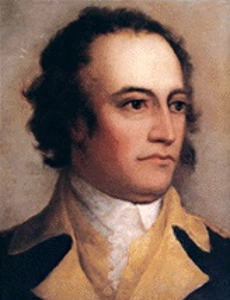
William Reeves, Irish antiquarian and the Church of Ireland Bishop of Down, Connor and Dromore from 1886 until his death, is born on March 16, 1815. He is the last private keeper of the Book of Armagh and at the time of his death is President of the Royal Irish Academy.

Reeves is born at Charleville, County Cork, the eldest child of Boles D’Arcy Reeves, an attorney, whose wife Mary is a daughter of Captain Jonathan Bruce Roberts, land agent to the Edmund Boyle, 8th Earl of Cork. This grandfather had fought at the Battle of Bunker’s Hill, and Reeves is born at his house in Charleville.

From 1823, Reeves is educated at the school of John Browne in Leeson Street, Dublin, and after that at a school kept by the Rev. Edward Geoghegan. In October 1830, he enters Trinity College, Dublin, where he quickly gains a prize for Hebrew. In his third year, he becomes a scholar and goes on to graduate BA in 1835. He proceeds to read medicine, wins the Berkeley Medal, and graduates MB in 1837. His object in taking his second degree is that he intends to become a clergyman and to practice the medical profession among the poor of his parish.

In 1838, Reeves is appointed Master of the diocesan school in Ballymena, County Antrim, and is ordained a deacon of Hillsborough, County Down. The following year, he is ordained a priest of the Church of Ireland at Derry.

In 1844, Reeves rediscovers the lost site of Nendrum Monastery when he visits Mahee Island in Strangford Lough, County Down, searching for churches recorded in 1306, and recognises the remains of a round tower. By 1845, he is corresponding with the Irish scholar John O’Donovan, and an archive of their letters between 1845 and 1860 is preserved at University College, Dublin. In July 1845, Reeves visits London.

Reeves resides in Ballymena from 1841 to 1858, when he is appointed vicar of Lusk following the success of his edition of Adomnán‘s Life of Saint Columba (1857), for which the Royal Irish Academy awards him their Cunningham Medal in 1858. In 1853, he purchases from the Brownlow family the important 9th-century manuscript known as the Book of Armagh, paying three hundred pounds for it. He sells the book for the same sum to Archbishop Beresford, who has agreed to present it to Trinity College, Dublin.

In 1875 Reeves is appointed Dean of Armagh, a position he holds until 1886 when he is appointed as Bishop of Down, Connor and Dromore. In 1891 he is elected as President of the Royal Irish Academy. As bishop, he resides at Conway House, Dunmurry, County Antrim, and signs his name “Wm. Down and Connor.”

William Reeves dies in Dublin on January 12, 1892, while still President of the Academy. At the time of his death, he is working on a diplomatic edition of the Book of Armagh, by then in the Trinity College Library. The work is completed by Dr. John Gwynn and published in 1913.
Leave a comment

The 1947 Blizzard

blizzard-of-1947

The worst blizzard in living memory hits Ireland on February 25, 1947. The penetrating Arctic winds had been blowing for several weeks. Munster and Leinster had been battling the snows since the middle of January.

On the evening of February 24, a major Arctic depression approaches the coast of Cork and Kerry and advances northeast across Ireland. By morning, Ireland is being pounded by the most powerful blizzard of the 20th century. The winter of 1946-1947 is the coldest and harshest winter in living memory. Temperatures rarely rise above freezing and the snows that have fallen across Ireland in January remain until the middle of March.

Worse still, all subsequent snowfall in February and March simply piles on top of all that has previously fallen. There is no shortage of snow that bitter winter. Of the fifty days between January 24 and March 17, it snows on thirty of them.

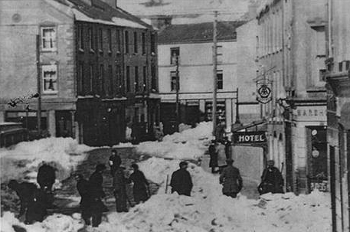
“The Blizzard” of February 25th is the greatest single snowfall on record and lasts for almost fifty consecutive hours. It smothers the entire island in a blanket of snow. Driven by persistent easterly gales, the snow drifts until every hollow, depression, arch and alleyway is filled and the Irish countryside becomes a vast ashen wasteland.

Everything on the frozen landscape is a sea of white. The freezing temperatures solidify the surface and it is to be an astonishing three weeks before the snows begins to melt.

(Pictured: Snow drifts on Main Street, Boyle, County Roscommon, February 1947)


3 Comments

Death of General Daniel Florence O’Leary

daniel-florence-oleary

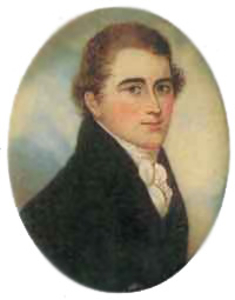
Daniel Florence O’Leary (Irish: Dónall Fínín Ó Laoghaire), a military general and aide-de-camp under Simón Bolívar, dies in Bogotá, Colombia on February 24, 1854.

O’Leary is born around 1800 in Cork, County Cork. His father is Jeremiah O’Leary, a butter merchant. Little is known of his early life.

In 1817, O’Leary travels to London to enlist in a regiment being formed by Henry Wilson. Wilson is recruiting officers and NCOs to go to South America and form a Hussar regiment in service to Simón Bolívar, who goes on to liberate much of South America from Spanish rule.

O’Leary sails for Venezuela with Wilson near the end of 1817, arriving in March 1818. Unlike many of the Irish who fight for Simón Bolívar in his many campaigns to win South American independence, he has not served in the Napoleonic Wars. He first meets Bolívar away from the front shortly his arrival and Bolívar is apparently impressed with the young Irish officer.

In March 1819, O’Leary sees his first action and is promoted to captain. In July, after Bolívar’s famous crossing through the Casanare Swamps and over the Andes, he receives a saber wound in the battle of Pantano de Vargas but he quickly recovers and takes part in the Battle of Boyacá on August 9. Shortly after this, he becomes aide-de-camp to Bolívar. Two years later, after much more fighting, Venezuela is freed.

During the next few years, as the fight continues to free the rest of South American from Spanish domination, O’Leary performs many dangerous missions for “The Liberator,” rising ever higher in his esteem. He continues to serve Bolívar well through the political and military intrigues that follow the freeing of South America from the Spanish.

After Bolívar’s death in December 1830, O’Leary disobeys orders to burn the general’s personal documents and is exiled to Jamaica by the new Venezuelan government. There he writes extensive memoirs that are later edited by his son, Simon Bolivar O’Leary, and published in the 1870s and 1880s. Simon is the eldest of six children O’Leary has with his South American wife. He also writes his own very extensive memoirs, spanning thirty-four volumes, of his time fighting in the revolutionary wars with Bolívar.

In 1833, O’Leary is able to return to Venezuela. He holds a number of diplomatic posts for the Venezuelan government for the next 20 years, and on at least two occasions is able to visit his boyhood home of Cork.

Daniel O’Leary dies in Bogotá on February 24, 1854. The Venezuelans name a plaza after him in Caracas. In 1882, they obtain permission to take O’Leary’s body from Bogotá to Caracas, where it is laid to rest in the National Pantheon of Venezuela to lie forever in death next to the man he had served so faithfully in life, Don Simón Bolívar. A bust and plaque honouring O’Leary are presented by the Venezuelan Government to the people of Cork and unveiled on May 12, 2010 by the Venezuelan Ambassador to Ireland, Dr. Samuel Moncada.


Leave a comment

Birth of Short Story Writer Seán Ó Faoláin

sean-ofaolain

Seán Proinsias Ó Faoláin, Irish short story writer, is born as John Francis Whelan on February 22, 1900, in Cork, County Cork.

Ó Faoláin is educated at the Presentation Brothers Secondary School in Cork. He comes under the influence of Daniel Corkery, joining the Cork Dramatic Society and increasing his knowledge of the Irish language, which he had begun in school. Shortly after entering University College Cork, he joins the Irish Volunteers and fights in the Irish War of Independence. During the Irish Civil War, he serves as Censor for The Cork Examiner and as publicity director for the Irish Republican Army (IRA). After the Republican loss, he receives M.A. degrees from the National University of Ireland and from Harvard University where he studies for three years. He is a Commonwealth Fellow from 1926 to 1928 and is a Harvard Fellow from 1928 to 1929.

Ó Faoláin writes his first stories in the 1920s, eventually completing 90 stories over a period of 60 years. From 1929 to 1933 he lectures at the Catholic college, St. Mary’s College, at Strawberry Hill in Twickenham, England, during which period he writes his first two books. His first book, Midsummer Night Madness, is published in 1932. It is a collection of stories partly based on his Civil War experiences. He afterwards returns to his native Ireland. He publishes novels, short stories, biographies, travel books, translations, and literary criticism – including one of the rare full-length studies of the short story, The Short Story (1948). He also writes a cultural history, The Irish, in 1947.

Ó Faoláin serves as director of the Arts Council of Ireland from 1956 to 1959, and from 1940 to 1990 is a founder member and editor of the Irish literary periodical The Bell. The list of contributors to The Bell include many of Ireland’s foremost writers, among them Patrick Kavanagh, Patrick Swift, Flann O’Brien, Frank O’Connor and Brendan Behan. His Collected Stories are published in 1983. He is elected Saoi of Aosdána in 1986.

Seán Proinsias Ó Faoláin dies after a short illness on April 20, 1991, in the Dublin nursing home where he had lived for two years.


Leave a comment

Birth of Daniel Corkery, Writer & Academic

daniel-corkery

Daniel Corkery, Irish politician, writer and academic, is born in Cork, County Cork on February 14, 1878. He is unquestionably best known as the author of The Hidden Ireland, his 1924 study of the poetry of eighteenth-century Irish Language poets in Munster.

Corkery is educated at the Presentation Brothers and St. Patrick’s College of Education, Dublin where he trains as a teacher. He teaches at Saint Patrick’s School in Cork but resigns in 1921 when he is refused the headmastership. Among his students are the writer Frank O’Connor and the sculptor Seamus Murphy.

After leaving St. Patrick’s, Corkery teaches art for the local technical education committee, before becoming inspector of Irish in 1925, and later Professor of English at University College Cork in 1930. Among his students in UCC are Seán Ó Faoláin and Seán Ó Tuama. He is often a controversial figure in academia for his “nativist” views on Irish literature, views which result in conflict with many Irish Language scholars, most notably Pádraig de Brún and his niece Máire Mhac an tSaoi. Ó Tuama, however, is frequently a staunch defender of Corkery’s reputation.

In his late twenties Corkery learns Irish and this brings him into contact with leading members of the Irish Language revival movement, including Terence MacSwiney, T. C. Murray and Con O’Leary, with whom he founds the Cork Dramatic Society in 1908. His plays Embers and The Hermit and the King are performed by the society. Later plays are staged at the famous Abbey Theatre, including The Labour Leader (1919) and The Yellow Bittern (1920).

Corkery is also a writer of short stories, including the collections A Munster Twilight (1916), The Hounds of Banba (1920), The Stormy Hills (1929), and Earth Out of Earth (1939), and a novel, The Threshold of Quiet (1917).

Corkery also writes non-fiction works, including The Hidden Ireland (1924), a highly influential work about the riches of eighteenth-century Irish poetry. In this he attempts to reconstruct a worldview preserved by Gaelic poets amongst the poor and oppressed Catholic peasantry of the Penal Laws era, virtually invisible in the Anglo-Irish tradition that has dominated the writing of Irish history. “An instant, influential classic,” writes Patrick Walsh, “its version of the past provided powerful cultural underpinning to the traditional nationalist history that became, in the 1930s, the educational orthodoxy of the new state.”

Corkery serves as a member of Seanad Éireann from 1951 to 1954 when he is nominated by the Taoiseach.

Daniel Corkery dies on December 31, 1964. His papers are held in the Boole Library of University College Cork.


1 Comment

Palmerstown House Burned by the IRA

palmerstown-house

Palmerstown House in Johnstown, County Kildare, the home of Dermot Bourke, 7th Earl of Mayo, is burned and destroyed by the Irish Republican Army (IRA) on January 29, 1923.

The destruction of country houses in Ireland is a phenomenon of the Irish revolutionary period (1919–1923), which sees at least 275 country houses deliberately burned down, blown up, or otherwise destroyed by the Irish Republican Army.

The vast majority of the houses, known in Ireland as Big Houses, belong to the Anglo-Irish aristocracy of the Protestant Ascendancy. The houses of some Roman Catholic unionists, suspected informers, and members or supporters of the new Irish Free State government are also targeted. Although the practice by the IRA of destroying country houses begins in the Irish War of Independence, most of the buildings are destroyed during the Irish Civil War (1922–23).

Attacks are planned and organised, and generally focused on Irish peers who have sat in the House of Lords, members of the Senate of the Irish Free State and former Irish Unionist Party politicians. The assault on the “Big Houses” is part of a wider campaign against Free State supporters as a reprisal for the executions policy of the Government.

At least 76 country houses are destroyed in the War of Independence as thirty “Big Houses” are burned in 1920 and another 46 in the first half of 1921, mostly in the conflict’s Munster heartland which includes counties Cork, Kerry, Tipperary, Clare and Limerick. It is believed that 199 country houses are destroyed during the Irish Civil War. Some houses are destroyed in the fighting of the early months of the war, but the campaign against them begins in earnest in late 1922.

In most cases, no one is injured during the destruction of the house. It is recorded that in several cases, members of the IRA help the targeted family to remove their possessions from the house before it is destroyed. When Dermot Bourke’s house is attacked on January 29, 1923, he describes the IRA guerrillas as being “excessively polite” and apologetic. Nonetheless, there are incidents of violence and deaths in such attacks. The Church of Ireland Gazette records numerous instances of Unionists and Loyalists being shot, burned out or otherwise forced from their homes during the early 1920s.

Today, most of the targeted buildings are in ruins or have been demolished. Some have been restored by their owners, albeit often smaller in size, or have been rebuilt and are now used for other purposes.


Leave a comment

Birth of William Martin Murphy

william-martin-murphy

William Martin Murphy, Irish businessman, journalist and politician, is born on January 6, 1845, in Castletownbere, County Cork. A member of parliament (MP) representing Dublin from 1885 to 1892, he is dubbed “William Murder Murphy” among Dublin workers and the press due to the Dublin Lockout of 1913. He is arguably both Ireland’s first “press baron” and the leading promoter of tram development.

Murphy is educated at Belvedere College. When his father, the building contractor Denis William Murphy dies in 1863, he takes over the family business. His enterprise and business acumen expand the business, and he builds churches, schools and bridges throughout Ireland, as well as railways and tramways in Britain, West Africa and South America.

Murphy is elected as Irish Parliamentary Party MP for Dublin St. Patrick’s at the 1885 general election, taking his seat in the House of Commons of the United Kingdom of Great Britain and Ireland. He is a member of the informal grouping, the “Bantry Band,” a group of politicians who hail from the Bantry Bay area.

When the Irish Parliamentary Party splits in 1890 over Charles Stewart Parnell‘s leadership, Murphy sides with the majority Anti-Parnellites. However, Dublin emerges as a Parnellite stronghold and in the bitter general election of 1892, Murphy loses his seat by over three to one to a Parnellite newcomer, William Field.

Murphy is the principal financial backer of the “Healyite” newspapers the National Press and the Daily Nation. His support for Tim Healy attracts the hostility of the majority anti-Parnellite faction led by John Dillon. He makes two attempts to return to Parliament, at South Kerry in 1895 and North Mayo in 1900, but both are unsuccessful because of Dillonite opposition.

In 1900, Murphy purchases the insolvent Irish Daily Independent from the Parnellites, merging it with the Daily Nation. He re-launches this as a cheap mass-circulation newspaper, which rapidly displaces the Freeman’s Journal as Ireland’s most popular nationalist paper. In 1906, he founds the Sunday Independent newspaper.

Murphy is highly critical of the Irish Parliamentary Party. From 1914 he uses the Irish Independent to oppose the partition of Ireland and advocate Dominion Home Rule involving full fiscal autonomy.

Worried that the trade unions would destroy his Dublin tram system, Murphy leads Dublin employers against the trade unions led by James Larkin, an opposition that culminates in the Dublin Lockout of 1913. This makes him extremely unpopular with many, being depicted as a vulture or a vampire in the workers’ press.

After the 1916 Easter Rising, he purchases ruined buildings in Abbey Street as sites for his newspaper offices, however it is his viewpoints that make him even more unpopular, by calling for the executions of Seán MacDiarmada and James Connolly at a point when the Irish public is beginning to feel sympathy for their cause. He privately disavows the editorial, claiming it had been written and published without his knowledge.

In 1917 Murphy is invited to take part in talks during the Irish Convention which is called to agree terms for the implementation of the suspended 1914 Home Rule Act. However, he discovers that John Redmond is negotiating agreeable terms with Unionists under the Midleton Plan to avoid the partition of Ireland but at the partial loss of full Irish fiscal autonomy. This infuriates Murphy who criticises the intention in his newspaper, which severely damages the Irish Parliamentary Party. However, the Convention remains inconclusive, and the ensuing demise of the Irish party results in the rise of Sinn Féin, whose separatist policies Murphy also does not agree with.

William Martin Murphy dies in Dublin on June 26, 1919. His family controls Independent Newspapers until the early 1970s, when the group is sold to Tony O’Reilly.


Leave a comment

John Sullivan & The Battle of Trenton

john-sullivan

The Battle of Trenton is a small but pivotal battle during the American Revolutionary War which takes place on the morning of December 26, 1776, in Trenton, New Jersey.

The Continental Army has previously suffered several defeats in New York and has been forced to retreat through New Jersey to Pennsylvania. Morale in the army is low. To end the year on a positive note, George Washington, Commander-in-Chief of the Continental Army, devises a plan to cross the Delaware River on the night of December 25–26 and surround the Hessian garrison.

Because the river is icy and the weather severe, the crossing proves dangerous. Two detachments are unable to cross the river, leaving Washington with only 2,400 men under his command in the assault, 3,000 less than planned.

Washington’s army marches 9 miles south to Trenton. One division commanded by John Sullivan, the third son of Irish settlers from the Beara Peninsula in County Cork, secures the important bridge over the Assunpink Creek to the south of the town. This prevents escape and ensures the high number of Hessian prisoners captured.

The Hessians have lowered their guard, thinking they are safe from the American army, and have no long-distance outposts or patrols. Washington’s forces catch them off guard and, after a short but fierce resistance, most of the Hessians surrender, with negligible losses to the Americans. Almost two thirds of the 1,500-man garrison are captured, and only a few troops escaped across Assunpink Creek.

Despite the battle’s small numbers, the American victory inspires rebels in the colonies. With the success of the revolution in doubt a week earlier, the army had seemed on the verge of collapse. The dramatic victory inspires soldiers to serve longer and attracted new recruits to the ranks.

John Sullivan goes on to serve as a delegate in the Continental Congress, the third Governor of New Hampshire and a judge of the United States District Court for the District of New Hampshire. He dies on January 23, 1795, at the age of 54 in Durham, New Hampshire. He is buried in the Sullivan Family Burial Ground in Durham.


Leave a comment

Alan Brodrick Appointed Lord Chief Justice of the Court of Queen’s Bench

alan-brodrick

Alan Brodrick, 1st Viscount Midleton, a leading Anglo-Irish lawyer and politician of the early eighteenth century, is appointed Lord Chief Justice of the Court of Queen’s Bench on December 24, 1709. He is a man of great gifts, but so hot-tempered and passionate that even Jonathan Swift is said to have been afraid of him.

Brodrick is the second son of Sir St. John Brodrick of Ballyannan, near Midleton in County Cork, by his wife Alice, daughter of Laurence Clayton of Mallow, County Cork. His father receives large land grants during The Protectorate, and thus the family has much to lose if the land issue in Ireland is settled to the satisfaction of dispossessed Roman Catholics. He is educated at Magdalen College, Oxford and the Middle Temple, being called to the English bar in 1678. He and his relatives flee Ireland during the Glorious Revolution. They are attainted under the rule of King James II in Ireland. In exile in England, Brodrick argues for a speedy reconquest.

In 1690 Brodrick returns to Dublin and is given the legal office of Third Serjeant. He also becomes Recorder of Cork. He is dismissed as Serjeant in 1692, apparently on the ground that there is no work for him to do. While complaining bitterly about his dismissal, he admits privately that his post has been a superfluous one.

As a prominent Whig supporter of the outcome of the Glorious Revolution he is not always in agreement with court policies in Ireland, which he considers too lenient on the Jacobites. The dismissal of the First Serjeant, John Osborne, at the same time as Brodrick is due to his even stronger opposition to Court policy. Despite this he often holds Irish government offices and aspires to manage the Irish Parliament for English ministers. He represents Cork City in the Irish Parliament, which meets in 1692 and holds this seat until 1710. He is a vocal opponent of court policies, until the new Whig Lord Deputy of Ireland, Lord Henry Capell, decides to appoint him Solicitor-General for Ireland in 1695. He promotes penal laws against Catholics, whilst also supporting greater powers for the Irish Parliament.

Brodrick is Speaker of the Irish House of Commons from September 21, 1703. After promoting resolutions critical of the Lord Lieutenant of Ireland he loses his post as Solicitor-General in 1704. From 1707 until 1709 he is Attorney-General for Ireland. He becomes Chief Justice of Ireland in 1710 and is replaced as Speaker on May 19, 1710, but again holds the office in the next Parliament (November 25, 1713 – August 1, 1714), where he also represents County Cork. He is appointed Lord Chancellor of Ireland in 1714 and is ennobled in the Peerage of Ireland in 1715, as the 1st Baron Brodrick. He is advanced to the rank of 1st Viscount Midleton in 1717.

Brodrick feuds with his successor as Speaker William Conolly, as they are rivals to be the leading figure in Irish politics. Despite intrigues in England, he loses out and resigns as Lord Chancellor in 1725. He leaves behind him a legacy of bitterness and ill-will for which he is not really responsible as the Irish peers choose to blame him for the loss of their powers under the Sixth of George I, rather than their own misjudgment in imprisoning the Barons of the Exchequer.


Leave a comment

Death of Author Violet Florence Martin

violet-florence-martin

Violet Florence Martin, Irish author, dies in Drishane, County Cork, on December 21, 1915. She is the co-author of a series of novels with her cousin Edith Somerville under the pen name of Martin Ross in the late nineteenth and early twentieth centuries.

Martin is born at Ross House in Connemara, County Galway, the youngest of sixteen children of James Martin of Ross (1804–1872). The Martin family, a branch of the Martyn family – one of the Tribes of Galway – had settled at Ross by the early seventeenth century, having previously inhabited the town of Galway for some three hundred years. Her father is a Protestant, his grandfather having converted from the Catholic faith in order to retain the family estates under the Penal Laws. Nevertheless, each child of the family is secretly ‘baptised’ by the family servants.

Martin is a kinswoman of Richard Martin and her contemporary, Edward Martyn, two other notable members of the tribe. Her older brother, Robert Jasper Martin, is a noted songwriter and a well-regarded member of the Tory party in London. She shares a great-grandmother with the writer Maria Edgeworth, whose use of Irish vernacular speech she follows in her work.

Martin’s father manages to save both his estate and his tenants during the Great Famine boasting that not one of his people died during the disaster, but at the cost of bankruptcy. Following his death in 1872, the family moves to Dublin and only returns to Ross in 1888 following revelations of financial fraud of the estate by their agent.

Violet Martin and Edith Somerville are second cousins. They originally meet on January 17, 1886, at Castletownshend, after which they become lifelong companions and literary partners. They come to share a home in Drishane, County Cork. In 1889, Violet adopts the pseudonym Martin Ross, which comprises her surname and the name of her ancestral home. Thus, the authors are called Somerville and Ross. Their works include The Real Charlotte (1889), Some Reminiscences of an Irish R.M. and In the Vine Country.

Martin is a convinced Irish Unionist, in opposition to Somerville’s open nationalism. Both she and her brother Robert are well-regarded members of the literary circle in Irish unionism. However, unlike her brother, Martin is a convinced suffragette, becoming vice-president of the Munster Women’s Franchise League. While on friendly terms with the leading members of the Gaelic literary revival such as W.B. Yeats and Lady Gregory, she objects to their romantic version of Irish peasantry. She is on good terms with Edward Martyn, partner of Gregory and Yeats – and her kinsman – and shares his love of the Irish language and culture.

Martin is seriously injured in a riding accident in November 1898, from which she never fully recovers. This is a contributing factor to her death in Drishane, County Cork, on December 21, 1915. Edith Somerville continues to write under their joint literary names, claiming that they are still in contact. The two women leave thousands of letters and 116 volumes of diaries, detailing their lives, much of them yet unpublished. Edith dies at Castletownshend in October 1949, aged 91, and is buried alongside Violet Florence Martin at Saint Barrahane’s Church, Castletownsend, County Cork, Ireland.