seamus dubhghaill

Promoting Irish Culture and History from Little Rock, Arkansas, USA


Leave a comment

Birth of John Hume, Northern Ireland Nationalist Politician

John Hume KCSG, Irish nationalist politician from Northern Ireland, is born into a working-class Catholic family in Derry, County Londonderry, on January 18, 1937. He is widely regarded as one of the most important figures in the recent political history of Ireland and is credited as being the thinker behind many political developments in Northern Ireland, from the power sharing Sunningdale Agreement to the Anglo-Irish Agreement and the Good Friday Agreement. He wins the Nobel Peace Prize in 1998 alongside the leader of the Ulster Unionist Party (UUP), David Trimble.

Hume is the eldest of seven children of Samuel Hume, a former soldier and shipyard worker, and Anne “Annie” (née Doherty), a seamstress. He has a mostly Irish Catholic background, though his surname derives from one of his great-grandfathers, a Scottish Presbyterian who migrated to County Donegal. He attends St. Columb’s College and goes on to St. Patrick’s College, Maynooth, the leading Catholic seminary in Ireland and a recognised college of the National University of Ireland, where he intends to study for the priesthood. Among his teachers is Tomás Ó Fiaich, the future cardinal and Primate of All Ireland.

Hume does not complete his clerical studies but does obtain an M.A. degree in French and history from the college in 1958. He then returns home to his native Derry, where he becomes a teacher at his alma mater, St. Columb’s College. He is a founding member of the Credit Union movement in the city and is chair of the University for Derry Committee in 1965, an unsuccessful fight to have Northern Ireland’s second university established in Derry in the mid-1960s.

Hume becomes the youngest ever President of the Irish League of Credit Unions at age 27. He serves in the role from 1964 to 1968. He once says that “all the things I’ve been doing, it’s the thing I’m proudest of because no movement has done more good for the people of Ireland, north and south, than the credit union movement.”

Hume becomes a leading figure in the civil rights movement in the late 1960s along with people such as Hugh Logue. He is a prominent figure in the Derry Citizens’ Action Committee. The DCAC is set up in the wake of the October 5, 1968, march through Derry which had caused much attention to be drawn towards the situation in Northern Ireland. The purpose of the DCAC is to make use of the publicity surrounding recent events to bring to light grievances in Derry that had been suppressed by the Unionist Government for years. The DCAC, unlike the Northern Ireland Civil Rights Association (NICRA), is aimed specifically at a local campaign, improving the situation in Derry for everyone, and maintaining a peaceful stance. The committee also has a Stewards Association that is there to prevent any violence at marches or sit-downs.

Hume becomes an Independent Nationalist member of the Parliament of Northern Ireland in 1969 at the height of the civil rights campaign. He is elected to the Northern Ireland Assembly in 1973 and serves as Minister of Commerce in the short-lived power-sharing Executive in 1974. He stands unsuccessfully for the Westminster Parliament for the Londonderry constituency in October 1974, and is elected for Foyle in 1983.

In October 1971, Hume joins four Westminster MPs in a 48-hour hunger strike to protest at the internment without trial of hundreds of suspected Irish republicans. State papers that have been released under the 30-year rule that an Irish diplomat eight years later in 1979 believes Hume supported the return of internment.

In 1977, Hume challenges a regulation under the Civil Authorities (Special Powers) Act (Northern Ireland) 1922 which allows any soldier to disperse an assembly of three or more people. The Lord Chief Justice of Northern Ireland, Robert Lowry, holds that the regulation is ultra vires under Section 4 of the Government of Ireland Act 1920 which forbids the Parliament of Northern Ireland to make laws in respect of the army.

A founding member of the Social Democratic and Labour Party (SDLP), Hume succeeds Gerry Fitt as its leader in 1979. He also serves as one of Northern Ireland’s three Members of the European Parliament and serves on the faculty of Boston College, from which he receives an honorary degree in 1995.

Hume is directly involved in secret talks with the British government and Sinn Féin, in an effort to bring Sinn Féin to the discussion table openly. The talks are speculated to lead directly to the Anglo-Irish Agreement in 1985.

The vast majority of unionists reject the agreement and stage a massive and peaceful public rally in Belfast City Centre to demonstrate their distaste. Many Republicans and nationalists also reject it, as they see it as not going far enough. Hume, however, continues dialogue with both governments and Sinn Féin. The “Hume–Adams process” eventually delivers the 1994 Irish Republican Army (IRA) ceasefire which ultimately provides the relatively peaceful backdrop against which the Good Friday agreement is brokered.

On February 4, 2004, Hume announces his complete retirement from politics and is succeeded by Mark Durkan as SDLP leader. He does not contest the 2004 European Parliament election where his seat is won by Bairbre de Brún of Sinn Féin, nor does he run in the 2005 United Kingdom general election, in which Mark Durkan retains the Foyle constituency for the SDLP.

Hume and his wife, Pat, continue to be active in promoting European integration, issues around global poverty and the Credit Union movement. He is also a supporter of the Campaign for the Establishment of a United Nations Parliamentary Assembly, an organisation which campaigns for democratic reformation of the United Nations.

In 2015, Hume is diagnosed with Alzheimer’s disease, of which he had first displayed symptoms in the late 1990s. He dies in the early hours of August 3, 2020, at a nursing home in Derry, at the age of 83. On his death, former Labour Party leader and prime minister Tony Blair says, “John Hume was a political titan; a visionary who refused to believe the future had to be the same as the past.” The Dalai Lama says on Twitter, “John Hume’s deep conviction in the power of dialogue and negotiations to resolve conflict was unwavering… It was his leadership and his faith in the power of negotiations that enabled the 1998 Good Friday Agreement to be reached. His steady persistence set an example for us all to follow.”

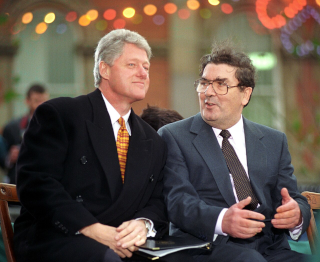
(Pictured: John Hume with U.S. President Bill Clinton in 1995)


2 Comments

Hugh O’Neill’s Army Defeated at the Battle of Kinsale

On December 24, 1601, Hugh O’Neill, Earl of Tyrone, and his Spanish and Irish allies are defeated by the English at the Battle of Kinsale, one of the most important battles in Irish history. With the able assistance of his main ally, Hugh Roe “Red” O’Donnell, he is fighting to defend Gaelic Ireland against the forces of Elizabeth I of England.

O’Neill, along with O’Donnell, train an army and before long they find a powerful ally, King Phillip III of Spain. King Phillip is more than keen to help the Irish for two reasons. Firstly, he wants revenge for the famous defeat of his Spanish Armada in 1588 and secondly, he sees Ireland as a terrific foundation from which he can invade England.

King Phillip agrees to the request of O’Neill and O’Donnell to send a large army to help them defeat the English. For several years prior they had held the English at bay from the strongholds in Ulster, beating them at Yellow Ford in 1598 and Moyry Pass in 1600. But if they are to ever drive the English back across the Irish Sea, they have to come out from the hills and passes and meet them in open battle. King Phillip eventually sends his army of 4,800 men to Kinsale in County Cork, thirteen miles south of Cork, arriving on September 21, 1601. They are surrounded by the English army, led by Charles Blount, 8th Baron Mountjoy, and George Carew, 1st Earl of Totnes, the President of Munster.

The landing of the Spanish army is not where O’Neill would have hoped as he and O’Donnell are located in the northern county of Donegal. He had sent a message asking them to land further north, so they might join forces and march against the English, but that message either never arrives or arrives too late. Now O’Neill and O’Donnell face a long march to join with their allies, and the English are much closer to Kinsale than they.

Before the Irish can get there, Mountjoy’s army has laid siege to the Spaniards at Kinsale. To leave their northern strongholds holds many dangers for the Irish chieftains, but leave they do, marching their army 250 miles to Kinsale to put the future of Gaelic Ireland to the test on the battlefield, a march which many say is one of the greatest marches to date in Irish History.

On the morning of December 24, O’Neill moves to attack Mountjoy’s army. There is no coordination between O’Neill’s army and the Spanish in Kinsale, under Don Juan del Águila. The Spaniards make no attempt to attack in force or even create a diversion. O’Neill’s army, especially his cavalry, which perform badly, are not ready to meet the English in this sort of combat. The battle lasts only an hour, with Irish losses of 1,200 soldiers whereas the English lose only twenty. The critical battle of the Nine Years’ War has been lost.

Afterwards, O’Donnell flees to Spain where he lives comfortably until he dies a few months later, said to have been poisoned by a spy of Carew’s named Blake.

Hugh O’ Neill surrenders to the English in 1603 and later returns to Ulster, where Lord Mountjoy treats him respectively well. However, most of his lands and authority are non-existent. In 1607, he goes to Spain with a number of family members and supporters, most of whom are lesser chieftains, and this becomes famously known as the Flight of the Earls. The power of the Gaelic chiefs in Ireland become a thing of the past.


Leave a comment

The Battle of Tory Island

The Battle of Tory Island, sometimes called the Battle of Donegal, Battle of Lough Swilly or Warren’s Action, is a naval action of the French Revolutionary Wars, fought on October 12, 1798, between French and British squadrons off the northwest coast of County Donegal, then in the Kingdom of Ireland. The last action of the Irish Rebellion of 1798, the Battle of Tory Island ends the final attempt by the French Navy to land substantial numbers of soldiers in Ireland during the war.

Britain’s enemies in Continental Europe have long recognised Ireland as a weak point in Britain’s defences. Landing troops there is a popular strategic goal, not only because an invader can expect the support of a large proportion of the native population, but also because at least initially they will face fewer and less reliable troops than elsewhere in the British Isles. Additionally, embroiling the British Army in a protracted Irish campaign will reduce its availability for other theatres of war. Finally, French planners consider that a successful invasion of Ireland might act as the ideal platform for a subsequent invasion of Great Britain.

The Society of United Irishmen, led by Theobald Wolfe Tone, launches an uprising against British rule in Ireland in May 1798. At the request of the rebels, a small French force under General Jean Joseph Amable Humbert is landed at Killala, County Mayo, but by early September both this expedition and the rebellion has been defeated.

Unaware of Humbert’s surrender, the French despatch reinforcements under the command of Commodore Jean-Baptiste-François Bompart on September 16. Having missed one invasion force, the Royal Navy is more watchful. Roving frigate patrols cruise off the principal French ports and in the approaches to Ireland, while squadrons of battleships from the Channel Fleet sail nearby, ready to move against any new invasion force. In command of the squadron on the Irish station is Commodore Sir John Borlase Warren, a highly experienced officer (and politician) who has made a name for himself raiding the French coast early in the war.

The squadron carrying the reinforcements is soon spotted after leaving Brest. After a long chase, the French are brought to battle in a bay off the rugged County Donegal coast in the west of Ulster, very close to Tory Island. During the action the outnumbered French attempt to escape, but are run down and defeated piecemeal, with the British capturing four ships and scattering the survivors. Over the next fortnight, British frigate patrols scour the passage back to Brest, capturing three more ships. Of the ten ships in the original French squadron, only two frigates and a schooner reach safety. British losses in the campaign are minimal.

The battle marks the last attempt by the French Navy to launch an invasion of any part of the British Isles. It also ends the last hopes the United Irishmen have of obtaining outside support in their struggle against the British. After the action, Wolfe Tone is recognised aboard the captured French flagship and arrested. He is brought ashore by the British at Buncrana, on the Inishowen peninsula. He is later tried for treason, convicted, and commits suicide while in prison in Dublin, hours before he is to be hanged.

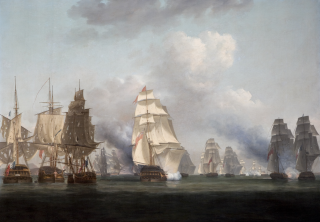
(Pictured: Attack of the French Squadron under Monsr. Bompart Chef d’Escadre, upon the Coast of Ireland, by a Detachment of His Majesty’s Ships under the Command of Sir J. B. Warren, October 12, 1798, by Nicholas Pocock, 1799)


Leave a comment

Birth of Matthew Gerard Sweeney, Irish Poet

Matthew Gerard Sweeney, Irish poet, is born at Lifford, County Donegal, on October 6, 1952. His work has been translated into Dutch, Italian, Hebrew, Japanese, Latvian, Mexican Spanish, Romanian, Slovakian and German.

Growing up in Clonmany, Sweeney attends Gormanston College (1965–70). He then reads sciences at University College Dublin (1970–72). He goes on to study German and English at the Polytechnic of North London, spending a year at the University of Freiburg, before graduating with a BA Honours degree in 1978.

Sweeney meets Rosemary Barber in 1972 and they marry in 1979. Two offspring – daughter Nico and son Malvin – are produced before the couple goes their separate ways in the early 21st century. Having lived in London for many years until 2001, he separates from Rosemary and goes to live in Timișoara, Romania and Berlin. In 2007, he meets his partner, Mary Noonan, and in early 2008 he moves to Cork to live with her there.

Sweeney produces numerous collections of poetry for which he wins several awards. His novels for children include The Snow Vulture (1992) and Fox (2002). He authors a satirical thriller, co-written with John Hartley Williams, and entitled Death Comes for the Poets (2012).

As Bill Swainson, Sweeney’s editor at Allison & Busby in the 1980s, recalls: “As well as writing his own poetry, Matthew was a great encourager of poetry in others. The workshops he animated, and later the residencies he undertook, were famous for their geniality and seriousness and fun. Sometime in the late 1980s I attended one of these workshops in an upstairs room of a pub in Lamb’s Conduit Street, Bloomsbury, where the poems were circulated anonymously and carefully read and commented on by all. Around the pushed-together tables were Ruth Padel, Eva Salzman, Don Paterson, Maurice Riordan, Jo Shapcott, Lavinia Greenlaw, Michael Donaghy, Maura Dooley and Tim Dooley.” Sweeney later has residencies at the University of East Anglia and Southbank Centre, among many others. He reads at three Rotterdam Poetry Festivals, in 1998, 2003 and 2009.

According to the poet Gerard Smyth: “I always sensed that in the first instance [Sweeney] regarded himself as a European rather than an Irish poet – and rightly so: like the German Georg Trakl whom he admired he apprehended the world in a way that challenged our perceptions and commanded our attention.” Sweeney’s work has been considered “barely touched by the mainstream of English writing” and more so by the German writers Heinrich von Kleist, Georg Büchner, Franz Kafka, Günter Grass and Heinrich Böll, as well as the aforementioned Georg Trakl. According to Poetry International Web, he would be among the top five most famous Irish poets on the international scene.

Sweeney’s final year sees the publication of two new collections: My Life As A Painter (Bloodaxe Books) and King of a Rainy Country (Arc Publications), inspired by Charles Baudelaire‘s posthumously published Petits poèmes en prose.

Having been diagnosed with motor neuron disease the previous year, Sweeney dies at the age of 65 at Cork University Hospital in Wilton, Cork, on August 5, 2018, surrounded by family and friends. He continues writing up until three days before his death. In an interview shortly before his death he is quizzed on his legacy, to which he gives the response, “Mostly what awaits the poet is posthumous oblivion. Maybe there will be a young man in Hamburg, or Munich, or possibly Vienna, for whom my German translations will be for a while important – and might just contribute to him becoming a German language poet with Irish leanings.”

Among those attending a special ceremony on August 8, 2018, at the Triskel Arts Centre in Cork to celebrate Sweeney’s life are fellow poets Jo Shapcott, Thomas McCarthy, Gerry Murphy, Maurice Riordan and Padraig Rooney. On August 9, 2018, he is buried in Clonmany New Cemetery in County Donegal.


Leave a comment

Ulster Day

Ulster’s Solemn League and Covenant, commonly known as the Ulster Covenant, is signed by nearly 500,000 people on and before September 28, 1912, in protest against the Third Home Rule Bill introduced by the British Government in the same year.

The Covenant is first drafted by Thomas Sinclair, a prominent unionist and businessman from Belfast. Sir Edward Carson is the first person to sign the Covenant at Belfast City Hall with a silver pen, followed by Charles Stewart Vane-Tempest-Stewart, 6th Marquess of Londonderry (the former Lord Lieutenant of Ireland), representatives of the Protestant churches, and then by Sir James Craig. The signatories, 471,414 in all, are all against the establishment of a Home Rule parliament in Dublin. The Ulster Covenant is immortalised in Rudyard Kipling‘s poem “Ulster 1912.” On September 23, 1912, the Ulster Unionist Council votes in favour of a resolution pledging itself to the Covenant.

The Covenant has two basic parts: the Covenant itself, which is signed by men, and the Declaration, which is signed by women. In total, the Covenant is signed by 237,368 men; the Declaration, by 234,046 women. Both the Covenant and Declaration are held by the Public Record Office of Northern Ireland (PRONI). An online searchable database is available on the PRONI website.

In January 1913, the Ulster Volunteers aim to recruit 100,000 men between the ages of 17 and 65 who had signed the Covenant as a unionist militia. A British Covenant, similar to the Ulster Covenant in opposition to the Home Rule Bill, receives two million signatures in 1914.

The majority of the signatories of the Covenant are from Ulster, although the signing is also attended by several thousand southern unionists. Acknowledging this, Carson pays tribute to “my own fellow citizens from Dublin, from Wicklow, from Clare [and], yes, from Cork, rebel Cork, who are now holding the hand of Ulster,” to cheers from the crowd.

Robert James Stewart, a Presbyterian from Drum, County Monaghan, and the grandfather of Heather Humphreys, the Minister for Arts, Heritage and the Gaeltacht (2014-16) in the Republic of Ireland, is one of around 6,000 signatories in County Monaghan, where one quarter of the population is Protestant before the establishment of the Irish Free State. Almost 18,000 people sign either the Covenant or the Declaration in County Donegal.

The signature of Frederick Hugh Crawford is claimed by him to have been written in blood. However, this is disputed. Based on the results of a forensic test that he carries out in September 2012 at PRONI, Dr. Alastair Ruffell of Queen’s University Belfast asserts that he is 90% positive that the signature is not blood. Crawford’s signature is injected with a small amount of luminol. This substance reacts with iron in blood’s hemoglobin to produce a blue-white glow. The test is very sensitive and can detect tiny traces even in old samples. Crawford’s signature is still a rich red colour today which would be unlikely if it had been blood. Nevertheless, some unionists are not convinced by the evidence.

The term “Solemn League and Covenant” recalls a key historic document signed in 1643, by which the Scottish Covenanters make a political and military alliance with the leaders of the English Parliamentarians during the First English Civil War.

The Ulster Covenant is used as a template for the “Natal Covenant,” signed in 1955 by 33,000 British-descended Natalians against the nationalist South African government’s intention of declaring the Union a republic. It is signed in Durban‘s City Hall. Loosely based on Belfast’s Ulster Covenant, the Ulster scene is almost exactly reproduced.

September 28 is today known as “Ulster Day” to unionists.

(Pictured: Sir Edward Carson signing the Solemn League and Covenant)


Leave a comment

The Electricity Supply Board (ESB) is Established

The Electricity Supply Board (ESB; Irish: Bord Soláthair an Leictreachais), a state-owned electricity company operating in the Republic of Ireland, is established on August 11, 1927, by the fledgling Irish Free State government under the Electricity (Supply) Act 1927, to manage Ireland’s electricity supply after the successful Shannon hydroelectric scheme at Ardnacrusha and take over all existing projects for the electrification of Ireland. While historically a monopoly, the ESB now operates as a commercial semi-state concern in a “liberalised” and competitive market. It is a statutory corporation whose members are appointed by the government of Ireland.

The Shannon hydroelectric scheme at Ardnacrusha is Ireland’s first large-scale electricity plant and, at the time, it provides 80% of the total energy demands of Ireland. To give an idea of the growth in demand, the output of Ardnacrusha is now approximately two per cent of national peak demand for power.

By 1937, plans are being finalised for the construction of several more hydroelectric plants. The plans called for stations at Poulaphouca, Golden Falls, Leixlip (all in Leinster), Clady, Cliff and Cathaleen’s Fall (between Belleek and Ballyshannon in County Donegal), Carrigadrohid and Inniscarra (in County Cork). All these new plants are completed by 1949 and together harness approximately 75% of Ireland’s inland waterpower potential. Many of these plants are still in operation, however, as can be expected with continuing growth in demand, their combined capacity falls far short of Ireland’s modern needs.

With Ireland’s towns and cities benefiting from electricity, the new government pushes the idea of Rural Electrification. Between 1946 and 1979, the ESB connects in excess of 420,000 customers in rural Ireland. The Rural Electrification Scheme is described as “the Quiet Revolution” because of the major socio-economic change it brings about. The process is greatly helped in 1955 by the Electricity Supply Amendment Act, 1955.

In 1947, the ESB, needing ever more generation capacity, builds the North Wall station on a 7.5-acre site in Dublin‘s industrial port area on the north side of the River Liffey on the site of an old oil refinery. The original station consists of one 12.5 MW steam turbine that is originally purchased for a power station at Portarlington but instead used at North Wall. Other power stations built around this time include the peat fired stations at Portarlington, County Laois, and Allenwood, County Kildare.

Because of the risks of becoming dependent on imported fuel sources and the potential for harvesting and utilising indigenous peat, the ESB – in partnership with Bord na Móna – establishes those stations and ESB also builds Lanesboro power station in 1958. Located in County Longford, the plant burns peat, cut by Bord na Móna in the bogs of the Irish midlands. In 1965, the Shannonbridge station, located in County Offaly, is commissioned. The two stations have been replaced by new peat-fired stations near the same locations, and peat is also used to power the independent Edenderry Power Station in County Offaly.

As in most countries, energy consumption is low at night and high during the day. Aware of the substantial waste of night-time capacity, the ESB commissions the Turlough Hill pumped-storage hydroelectric station in 1968. This station, located in County Wicklow, pumps water uphill at night with the excess energy created by other stations, and releases it downhill during the day to turn turbines. The plant can generate up to 292 MW of power, but output is limited in terms of hours because of the storage capacity of the reservoir.

The 1970s bring about a continued increase in Ireland’s industrialisation and with it, a greater demand for energy. This new demand is to be met by the construction of the country’s two largest power stations – Poolbeg Generating Station in 1971 and Moneypoint Power Station in 1979. The latter, in County Clare, remains Ireland’s only coal-burning plant and can produce 915 MW, just shy of the 1015 MW capacity of Poolbeg. In 2002 and 2003, new independent stations, Huntstown Power (north Dublin) and Dublin Bay Power (Ringsend, Dublin), are constructed.

In 1991, the ESB establishes the ESB Archive to store historical documents relating to the company and its impact on Irish life.

On September 8, 2003, two of the last remaining places in Ireland unconnected to the national grid – Turbot Island and Inishturk Island (off the coast of County Galway)- are finally connected to the main supply. Some islands are still powered by small diesel-run power stations.

Sixty wind farms are currently connected to the power system and have the capacity to generate 590 MW of power, depending on wind conditions. These wind farms are mainly owned by independent companies and landowners.

On March 16, 2005, the ESB announces that it is to sell its ShopElectric (ESB Retail) chain of shops, with the exception of the Dublin Fleet Street and Cork Academy Street outlets, to Bank of Scotland (Ireland), converting them into main street banks. Existing staff are offered positions as bank tellers.

On March 27, 2008, the ESB announces a €22bn capital investment programme in renewable energy technology, with the aim to halve its carbon emissions within 12 years and achieve carbon net-zero by 2035.


Leave a comment

Preparations Commence for the Plantation of Ulster

On July 19, 1608, preparations commence for the plantation of six Ulster counties of Armagh, Cavan, Coleraine, Donegal, Fermanagh, and Tyrone.

The Plantation of Ulster is the organised colonisation, or plantation, of the Irish province of Ulster by people from Great Britain during the reign of King James I. Most of the settlers, or planters, come from southern Scotland and northern England. Their culture differs from that of the native Irish. Small privately funded plantations by wealthy landowners begin in 1606, while the official plantation begins in 1609. Most of the colonised land had been confiscated from the native Gaelic chiefs, several of whom had fled Ireland for mainland Europe in 1607 following the Nine Years’ War against English rule. The official plantation comprises an estimated half a million acres of arable land in counties Armagh, Cavan, Fermanagh, Tyrone, Donegal, and Coleraine. Land in counties Antrim, Down, and Monaghan is privately colonised with the king’s support.

Among those involved in planning and overseeing the plantation are King James, the Lord Deputy of Ireland, Arthur Chichester, and the Attorney-General for Ireland, John Davies. They see the plantation as a means of controlling, anglicising, and “civilising” Ulster. The province is almost wholly Gaelic, Catholic, and rural and has been the region most resistant to English control. The plantation is also meant to sever Gaelic Ulster’s links with the Gaelic Highlands of Scotland. The colonists, or “British tenants,” are required to be English-speaking, Protestant and loyal to the king. Some of the undertakers and settlers, however, are Catholic. The Scottish settlers are mostly Presbyterian Lowlanders and the English mostly Anglican Northerners. Although some “loyal” natives are granted land, the native Irish reaction to the plantation is generally hostile, and native writers bewail what they see as the decline of Gaelic society and the influx of foreigners.

The Plantation of Ulster is the biggest of the Plantations of Ireland. It leads to the founding of many of Ulster’s towns and creates a lasting Ulster Protestant community in the province with ties to Britain. It also results in many of the native Irish nobility losing their land and leads to centuries of ethnic and sectarian animosity, which at times spills into conflict, notably in the Irish Rebellion of 1641 and, more recently, the Troubles.


Leave a comment

Birth of Pat Doherty, Sinn Féin Politician & Member of Parliament

Patrick Doherty, retired Sinn Féin politician and the abstentionist Member of Parliament (MP) for West Tyrone from 2001 to 2017, is born in Glasgow, Scotland, on July 18, 1945. He is a member of the Northern Ireland Assembly for the West Tyrone Assembly constituency from June 1998 to June 2012. He serves as Vice President of Sinn Féin from 1988 to 2009, when Mary Lou McDonald becomes the party’s new Vice President.

Doherty is educated at St. Joseph’s College, Lochwinnoch, and is a site engineer who likes building stone walls. He is the brother of former Provisional Irish Republican Army (IRA) member Hugh Doherty, known for his involvement in the Balcombe Street siege. According to The Times Guide to the House of Commons, he is married with three daughters and two sons.

Doherty’s parents are from County Donegal in the Republic of Ireland. He moves to Donegal in 1968, shortly before the Troubles break out across the Irish border in Northern Ireland. He is an abstentionist Sinn Féin Member of Parliament of the British parliament for West Tyrone from 2001 to 2017, as well as a member of the Northern Ireland Assembly from the 1998 Northern Ireland Assembly election until 2012. He also stands for election in the Republic of Ireland, in the constituency of Donegal North-East in 1989, 1996 (a by-election) and 1997, and also in the Connacht–Ulster constituency in the European Parliament elections in 1989 and 1994.

In May 2002, using parliamentary privilege, Ulster Unionist Party (UUP) MP David Burnside names Doherty as a member of the IRA Army Council.

Over a two-and-a-half-year period, Doherty spends £16,000 on printer cartridges, an amount that he admits is “probably excessive.”

In 2012, to some surprise, Doherty writes to the Arts Council of Northern Ireland in support of funding for the loyalist Castlederg Young Loyalist Flute Band. He praises the band for reaching out to “all sections of the community.” The band had sought support for its funding application from a community group who then, unbeknownst to the band, reached out to Doherty. A spokesman for the band, whose website includes sections on IRA atrocities, the controversial B Specials and lyrics to songs, including one glorifying Ulster Volunteer Force (UVF) terrorist Brian Robinson, distances themselves from the application, claiming the band is unaware of Doherty’s support and does not want it. He adds that “The band harbours nothing but contempt for Irish republicanism and its attacks on their community.” Four of the band’s members are killed by the IRA.


Leave a comment

Death of Irish Actor Ray McAnally

Ray McAnally, Irish actor and winner of four BAFTA awards in the late 1980s, dies in County Wicklow on June 15, 1989.

McAnally is born on March 30, 1926, in Buncrana, a seaside town located on the Inishowen peninsula of County Donegal. The son of a bank manager, he is educated at Saint Eunan’s College in Letterkenny where he writes, produces and stages a musical called “Madame Screwball” at the age of sixteen. He enters St. Patrick’s College, Maynooth at the age of 18 but leaves after a short time having decided that the priesthood is not his vocation. He joins the Abbey Theatre in 1947 where he meets and marries actress Ronnie Masterson.

The couple later forms Old Quay Productions and present an assortment of classic plays in the 1960s and 1970s. McAnally makes his theatre debut in 1962 with A Nice Bunch of Cheap Flowers and gives a well-received performance as George in Who’s Afraid of Virginia Woolf?, opposite Constance Cummings, at the Piccadilly Theatre.

On television he is a familiar face, often in glossy thriller series like television series The Avengers, Man in a Suitcase, and Strange Report. In 1968 he takes the title role in Spindoe, a series charting the return to power of an English gangster, Alec Spindoe, after a five-year prison term. This is a spin-off from another series, The Fellows (1967) in which McAnally had appeared in several episodes as the Spindoe character. He could render English accents very convincingly.

McAnally regularly acts in the Abbey Theatre and at Irish festivals, but in the last decade of life he achieves award-winning notice on TV and films. His impressive performance as Cardinal Altamirano in the film The Mission (1986) earns him Evening Standard and BAFTA awards. He earns a second BAFTA award for his role in the BBC’s A Perfect Spy (1987). In 1988 he wins the BAFTA for Best Actor for his performance in A Very British Coup, a role that also brings him a Jacob’s Award. In the last year of his life, he portrays the father of Christy Brown, played by Daniel Day-Lewis, in the Academy Award-winning film, My Left Foot (1989).

McAnally dies suddenly of a heart attack on June 15, 1989, at the age of 63, at his home in County Wicklow which he shares with Irish actress Britta Smith. He remains married to actress Ronnie Masterson until his death, although they reside in different homes. He receives a posthumous BAFTA award for Best Supporting Actor for his last film, My Left Foot, in 1990.

At the time of his death, McAnally is due to play “Bull McCabe” in Jim Sheridan‘s film The Field. The part eventually goes to Richard Harris who receives an Academy Award nomination for his performance. McAnally had also been cast in the lead role of First and Last, a drama about a man who walked from Land’s End to John o’ Groats. Filming is almost a third of the way done when he dies, but the whole play has to be re-filmed, with Joss Ackland taking the role instead.


Leave a comment

Death of Peadar O’Donnell, Irish Republican & Socialist Activist

Peadar O’Donnell, Irish republican, socialist activist, politician, writer and one of the foremost radicals of 20th-century Ireland, dies in Dublin on May 13, 1986.

O’Donnell is born on February 22, 1893, in Meenmore, near Dungloe, County Donegal, youngest among six sons and three daughters of Biddy and James O’Donnell. He is greatly influenced by his upbringing in the Rosses, in northwest Donegal, one of the poorest and most remote parts of Ireland. His father, a popular local fiddler, earns a living through his smallholding, seasonal labouring in Scotland, and winter work in a local corn mill. His mother, who comes from a radical labour and nationalist political background, works in a local cooperative store. He attends Rampart national school and Roshine national school, near Burtonport, where he is a monitor for four years. In 1911 he wins a scholarship to attend St. Patrick’s College in Drumcondra, Dublin, and returns in 1913 to the Rosses, where he spends two years teaching on the islands of Inishfree. In 1915 he is appointed head of Derryhenny national school, near Dungloe, and the following year becomes principal of a national school on the island of Arranmore, where he begins to write.

O’Donnell had long been concerned by the poor conditions of the local ‘tatie-hokers’ (potato pickers) who migrate annually to Scotland. In the summer of 1918, he travels there to help organise the Scottish Farm Servants’ Union. While there he is influenced by left-wing radicals such as Willie Gallacher, later a communist Member of Parliament (MP), and Emanuel ‘Manny’ Shinwell, later Baron Shinwell. In September 1918, against a background of rising labour militancy, he leaves teaching to become a full-time organiser for the Irish Transport and General Workers’ Union (ITGWU) in the west Ulster area. The following year he organises one of Ireland’s first “soviets” when the attendants and nurses of the Monaghan District Lunatic Asylum occupy the grounds and appoint O’Donnell as governor until their demands are met.

In early 1919 O’Donnell joins the Irish Republican Army (IRA) in Monaghan, resigning from the ITGWU for full-time IRA service in late 1920. He leads the 2nd Battalion, Donegal IRA, from the summer of 1920. In December 1920 he goes “on the run” and leads a flying column in west Donegal until May 1921, when he is wounded. Regarded as insubordinate and militarily inexperienced, he is unpopular among the other senior officers of the 1st Northern Division. He, in turn, is disappointed by the lack of social radicalism among the nationalist leadership. He opposes the Anglo-Irish Treaty, is placed in command of the minority anti-treaty 1st Northern Division and is a member of the IRA executive that occupies the Four Courts in Dublin in defiance of the provisional government.

Arrested in June 1922, O’Donnell shares a prison cell with Liam Mellows and influences his radical “Notes from Mountjoy,” an important document for subsequent left-wing republicans. He spends the next two years in various prisons and internment camps. His execution is widely expected to follow those of December 8, 1922. In August 1923, he is elected as a Sinn Féin Teachta Dála (TD) for Donegal in the general election called after the end of the Irish Civil War. He goes on hunger strike for forty-one days in late 1923 and succeeds in escaping from the Curragh in March 1924. In June 1924, while on the run, he marries Lile O’Donel, a wealthy Cumann na mBan activist who had smuggled communications for republican prisoners. O’Donel, a radical and member of the Communist Party, is the daughter of Ignatius O’Donel, a prominent landowner from Mayo. They have no children but raise their nephew, Peadar Joe, as their own son after the death in New York of O’Donnell’s brother Joe.

O’Donnell begins writing seriously while in jail and remains a prolific writer, journalist, and editor until the 1960s. His first novel, Storm, set in the Irish War of Independence, is published in 1925. One of his most highly regarded books, Islanders, is published in 1928. Adrigoole, like Islanders a story of poverty and starvation in rural Ireland, is published the following year. The Knife (1930) and On the Edge of the Stream (1934) soon follow. The most significant of his later novels is probably The Big Windows (1954). Foremost among his qualities as a writer is his empathy for the people, life, and landscape of rural Ireland. But his novels have been criticised for their slow pace, excessive detail, and didactic nature. He claims his writing is incidental to his political activism. His trilogy of autobiographical non-fiction, The Gates flew Open (1932), Salud! An Irishman in Spain (1936), and There Will Be Another Day (1963), which respectively concern the Irish Civil War, his activism during the Spanish Civil War, and his role in the land annuities agitation, remain highly regarded. His other important literary achievement is with The Bell, an innovative literary and political magazine which plays a useful dissenting role in an insular and conservative period. He founds The Bell with the writer Seán Ó Faoláin in 1940 and edits it from 1946 until it ceases publication in 1954.

O’Donnell exercises an influential role in the interwar IRA, particularly through his editorship of An Phoblacht (1926–29), which he attempts to divert from militarism to socialist agitation. His ultimate aim is for a thirty-two-county socialist republic. His most successful campaign is organising small farmers against the payment of land annuities to the government in the late 1920s and early 1930s. This campaign is later adopted by Fianna Fáil and contributes to their electoral success in 1932. He is less successful in radicalising the IRA. After the failure of Saor Éire, a left-wing IRA front which provokes clerical and popular hostility against the IRA, increasing tensions between the IRA’s left-wing and the leadership lead O’Donnell, along with Frank Ryan and George Gilmore, to split from the IRA to establish the short-lived Republican Congress in 1934.

Although O’Donnell claims he was never a Communist Party member, he plays a central role in forging links between republicans and the revolutionary left both in Ireland and internationally and invariably supports the communist party line at critical junctures. After the failure of Republican Congress, he takes up the cause of the Spanish republic. His championing of unpopular causes such as communism and Spain entail a good deal of frustration. He is physically attacked at political meetings and in 1932, despite having never visited the Soviet Union, loses a high-profile libel action against the Dominican Irish Rosary, which claim he had studied in Moscow‘s Lenin College. He is banned from entering the United States for several decades, although he maintains: “My relations with all the great powers continue to be friendly.”

O’Donnell continues to support radical campaigns until his death. He is an outspoken advocate of Irish emigrants. He is prominent in the Irish Campaign for Nuclear Disarmament and serves as its president in the early 1960s. He is a leading protester against the Vietnam War and a supporter of African anti-colonial movements such as that against apartheid. In later years he is involved in the “Save the west” campaign, highlighting the problems of the west of Ireland.

After several months of ill-health following a heart attack, O’Donnell dies in Dublin, aged 93, on May 13, 1986. He leaves instructions that there are to be “no priests, no politicians and no pomp” at his funeral, and those wishes are granted. He is cremated in Glasnevin Cemetery and his ashes are buried at his wife’s home in Swinford, County Mayo. Although he once remarked that every cause he fought for was a failure, he is now regarded as one of the most influential socialist republican theorists and an important voice of dissent in twentieth-century Ireland.

(From: “O’Donnell, Peadar” by Fearghal McGarry, Dictionary of Irish Biography, http://www.dib.ie)