Meagher is born on August 3, 1823, at Waterford, County Waterford, in what is now the Granville Hotel on the Quay. He is educated at Roman Catholicboarding schools. When he is eleven, his family sends him to the Jesuits at Clongowes Wood College in County Kildare. It is at Clongowes that he develops his skill of oratory, becoming at age 15 the youngest medalist of the Debating Society. After six years, he leaves Ireland for the first time, to study in Lancashire, England, at Stonyhurst College, also a Jesuit institution. He returns to Ireland in 1843, with undecided plans for a career in the Austrian army, a tradition among a number of Irish families.
Meagher becomes a member of the Young Ireland Party in 1845 and in 1847 is one of the founders of the Irish Confederation, dedicated to Irish independence. In 1848 he is involved, along with William Smith O’Brien, in an abortive attempt to mount an insurrection against English rule. Arrested for high treason, he is condemned to death, but his sentence is commuted to life imprisonment in Van Diemen’s Land, now Tasmania.
Meagher escapes in 1852 and makes his way to the United States. After a speaking tour of U.S. cities, he settles in New York City, studies law and is admitted to the bar in 1855. He soon becomes a leader of the Irish in New York and, from 1856, edits the Irish News.
At the close of the war, Meagher is appointed secretary of Montana Territory where, in the absence of a territorial governor, he serves as acting governor.
In the summer of 1867, Meagher travels to Fort Benton, Montana, to receive a shipment of guns and ammunition sent by General William Tecumseh Sherman for use by the Montana Militia. On the way to Fort Benton, the Missouri River terminus for steamboat travel, he falls ill and stops for six days to recuperate. When he reaches Fort Benton, he is reportedly still ill.
Sometime in the early evening of July 1, 1867, Meagher falls overboard from the steamboat G. A. Thompson, into the Missouri River. His body is never recovered. Some believe his death to be suspicious and many theories circulate about his death. Early theories included a claim that he was murdered by a Confederate soldier from the war, or by Native Americans. In 1913 a man claims to have carried out the murder of Meagher for the price of $8,000 but then recants. In the same vein, American journalist and novelist Timothy Egan, who publishes a biography of Meagher in 2016, claims Meagher may have been murdered by Montana political enemies or powerful and still active vigilantes. On the frontier men are quick to kill rather than adjudicate. A similar theory shown on Death Valley Days (1960) has him survive the assassination attempt because his aide had been mistakenly murdered when he accepted one of his trademark cigars, and Meagher uses his apparent death as leverage over his political opponents.
An Act for the better securing the dependency of the Kingdom of Ireland on the Crown of Great Britain (long title) is an Act passed by the Parliament of Great Britain which declares that it has the right to pass laws for the Kingdom of Ireland, and that the British House of Lords has appellate jurisdiction for Irish court cases. It becomes known as the Declaratory Act, and opponents in the Irish Patriot Party refer to it as the Sixth of George I, from the regnal year it is passed. Legal and political historians have also called it the Dependency of Ireland on Great Britain Act 1719 or the Irish Parliament Act, 1719. Prompted by a routine Irish lawsuit, it is aimed at resolving the long-running dispute between the British and the Irish House of Lords as to which is the final court of appeal from the Irish Courts. Along with Poynings’ Law, the Declaratory Act becomes a symbol of the subservience of the Parliament of Ireland, and its repeal is long an aim of Irish statesmen, which is finally achieved for Anglican Irish as part of the Constitution of 1782.
In 1709, the Irish Court of Exchequer hears a lawsuit between Maurice Annesley and his cousin Hester Sherlock over which of them have the right to possession of certain lands at Naas, County Kildare. The court finds in Annesley’s favour. Mrs. Sherlock appeals to the Irish House of Lords which upholds her appeal. Annesley then invokes the long-disputed jurisdiction of the British House of Lords to hear appeals from the Irish courts, and that house pronounces in his favour. The Court of Exchequer duly complies with the decree of the British House, but Mrs. Sherlock appeals again to the Irish house, which orders the Barons of the Exchequer to comply with its own decree and, when they refuse, imprison them for contempt of Court. The political uproar is out of all proportion to the importance of the lawsuit itself.
The bill has its second reading in the Commons on March 4, 1719, where it is chiefly opposed on the grounds that it appears to have no purpose beyond increasing the power of the House of Lords. Other objections include an argument that the preamble and the enacting section of the bill are contradictory, and that Ireland has historically had an independent judiciary. It is supported by Joseph Jekyll and Philip Yorke, and carries 140 votes to 83. It is then passed on March 26, 1719.
Section I of the Act notes that the Irish House of Lords had recently “assumed to themselves a Power and Jurisdiction to examine, correct and amend” judgements of the Irish courts, which it holds to be illegal. As such, it declares that the Kingdom of Ireland is subordinate to and dependent upon the British crown, and that the King, with the advice and consent of the Parliament of Great Britain, has “full power and authority to make laws and statutes of sufficient validity to bind the Kingdom and people of Ireland.” Section II declares that the House of Lords of Ireland has no jurisdiction to judge, affirm or reverse any judgement, sentence or decree made in any court within the Kingdom of Ireland, and that all proceedings before the House upon any such matter are declared to be null and void to all intents and purposes whatsoever.
The Irish House of Lords is understandably infuriated by the curtailment of its powers, and the Barons of the Exchequer, though they are soon released from custody, are subject to intense vilification. While many people think that the Irish House of Lords had brought about the crisis by its own high-handed behaviour, the “Sixth of George I” remains a source of grievance for decades.
After finishing his schooling at fifteen, O’Herlihy follows his grandfather into journalism and secures a job in the reading room of The Cork Examiner. He is only seventeen years-old when he subsequently becomes sub-editor of the Evening Echo, a position he holds for five years. He also graduates to the positions of news, features and sports reporter.
In the early 1960s O’Herlihy begins his broadcasting career when he starts to do local association football reports from Cork for Radio Éireann. In 1965, he makes his first television broadcast in a programme commemorating the sinking of the RMS Lusitania off the Cork coast. After three years O’Herlihy is asked to join RTÉ’s current affairs programme 7 Days to add the required field-reporting skills to the studio-based interviews. The programme has a reputation for its hard-hitting investigative reporting, and he reports on many varying stories from illegal fishing in Cork to the outbreak of the crisis in Northern Ireland. In November 1970, the 7 Days programme comes into controversy when O’Herlihy reports a story on illegal money lending. The report is unconventional as it is one of the first television pieces to use hidden cameras, it claims the government is not responding to illegal moneylending. A tribunal of inquiry follows, and O’Herlihy is forced to move away from current affairs.
Following this controversy, while O’Herlihy is not sacked as he has fifteen months left on his contract with RTÉ, he is moved to the RTÉ Sports department. There he works under Michael O’Hehir, who dislikes him and his broadcasting style. In spite of this O’Herlihy fronts RTÉ’s television coverage of the Olympic Games that year. He also becomes involved in the production of various sports programmes.
O’Herlihy is not long in the RTÉ Sports department when he becomes a regular presenter for such programmes as Sunday Sport and Sports Stadium. In 1978 he becomes RTÉ Soccer host alongside Eamon Dunphy and, in 1984, Johnny Giles joins the panel and Liam Brady follows in 1998. Since 1974 O’Herlihy becomes RTÉ’s chief sports presenter for such events as all Olympic Games until 2012, FIFA World Cups until 2014, UEFA European Football Championships until 2012 and European and World Track and Field Championships. He hosts RTÉ highlights of the Ryder Cup in 2006 when it is at the K Club in County Kildare and continues to present coverage of Ireland’s soccer internationals for RTÉ, along with Dunphy, Giles and Brady.
O’Herlihy hosts RTÉ’s coverage of rugby union in the 1980s and early 1990s. However, when RTÉ attains the rights to cover the English Premier League in 1992, Tom McGurk takes over as host of RTÉ’s coverage of rugby union. O’Herlihy covers the Premier League, Irish Internationals and The Champions League before dropping the Premier League in 2008. He continues to cover the Olympic Games and International Athletic Championships such as the European and World Athletics. He presents the first Rugby World Cup on RTÉ television in 1987 and, with Jim Carney, co-presents the first edition of The Sunday Game in 1979.
In 2012, while covering Chloe Magee‘s progress at the 2012 Summer Olympics O’Herlihy remarks that badminton was once considered “a mainly Protestant sport.” RTÉ subsequently receives a number of complaints, and while Magee criticises the remarks, the argument is made that the incident inadvertently reflected a complex historical reality.
O’Herlihy presents RTÉ Sport‘s coverage of the 2010 FIFA World Cup, his ninth FIFA World Cup. He fronts 18 European Championships and FIFA World Cups for RTÉ, the last of which comes in 2014. This proves to be the final tournament with O’Herlihy at the helm. He retires at its conclusion and dies the following year.
O’Herlihy attends the 12th Irish Film & Television Awards on Sunday, May 24, 2015. He dies peacefully in his sleep at his home the following day at the age of 76 nearly a year after his retirement. He is survived by wife Hillary and daughters Jill and Sally. Giles, Brady and Dunphy appear on The Late Late Show in tribute later that week. At the time of his death O’Herlihy is working on a sports version of Reeling in the Years, which RTÉ immediately cancels.
Prosperous is founded by Sir Robert Brooke in 1780 as a village for processing cotton produced in the Americas. When a rebellion spearheaded by the United Irishmen breaks out against British rule in Ireland, rebel forces led by John Esmonde make plans to capture Prosperous. Esmonde has 200 rebels under his command, while Prosperous is garrisoned by elements of the Royal Cork City Militia under the command of Captain Richard Swayne and reinforced by detachments of a Welsh mounted fencible regiment, the Ancient British Regiment of Fencible Cavalry Dragoons (also known as the Ancient Britons), numbering 150 men in all.
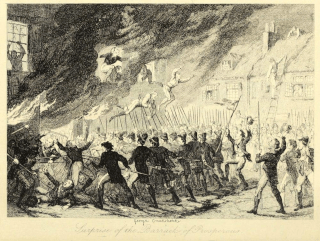
On May 24, 1798, Esmonde leads his forces to attack Prosperous. Their entry is preceded by the infiltration of a small rebel vanguard, who with the possible help of female sympathisers residing in Prosperous, scale the walls of the town’s barracks, kill the sentries and open the town gates. The barracks are quickly surrounded and attacked by the rebels who repulse an attempt by the garrison to break out. “Swayne himself was surprised in bed, shot and piked to death and his body burned in a tar barrel.” The remainder of the garrison are trapped in the upper floors of the barracks, which is set on fire by the rebels, causing them to jump in desperation onto the ground below, where they are summarily executed with pikes. While the rebels suffer no known casualties, approximately 40 members of the garrison are killed in the battle.
Ten members of the garrison, all belonging to the Ancient Britons, manage to escape from Prosperous to Dunlavin, County Wicklow, where they participate in the Dunlavin Green executions on May 26. Esmonde is later captured by Crown forces and brought to Dublin for trial. As he had previously enlisted at the rank of lieutenant in the ClaneYeomanry, Esmonde is court-martialled on June 13 and found guilty of being a deserter. He is executed by hanging on June 14 on Carlisle Bridge (now the O’Connell Bridge) with his coat being worn reversed to indicate that he had been convicted of desertion. Prosperous remains under the control of the United Irishmen until June 19, when a detachment of the 5th Dragoon Guards under the command of Lieutenant Colonel Stewart recaptures the town.
Rynne’s father is Stephen Rynne, a writer, broadcaster, author and wit, while his mother, Alice Curtayne, is a writer, hagiographer, lecturer, linguist and scholar. He attends Prosperous National School from 1947 to 1951 and Ring College Waterford from 1951 do 1952. From 1961 to 1968, he attends the Royal College of Surgeons in Ireland. After graduation, he emigrates to Canada with an internship with Hamilton Civic Hospital.
Rynne starts his general practise in Mitchell, Ontario, from 1968 to 1973, where he is introduced to vasectomy. In 1970, he is appointed as the coroner for Perth County, Ontario. In January 1974, he returns to Ireland and establishes a general practise in Clane, County Kildare.
In 1975, Rynne joins Irish Family Planning Association and starts doing vasectomies for them. In 1984, he sells condoms as an act of civil disobedience and gets fined £500. In the following year, he becomes the Chairman of IFPA. In the same year, he founds Clane General Hospital with the opposition from the Catholic Church and the local supporters.
In 1990, Rynne is shot by a man on whom he had carried out a vasectomy eight years previously. According to Rynne, the gunman fires six or seven times with a .22 Long Rifle and shoots him in the right hip. The incident is the subject of a short film The Vasectomy Doctor by Paul Webster.
Daly’s father, Kevin Daly, was a colonel in the Irish Army, where he was Director of Signals. She is an atheist, while her brother and an uncle are Catholic priests. She studies accountancy at Dublin City University (DCU). She is twice elected president of the DCU Students’ Union and is active in the students’ movement as a campaigner for abortion rights and information. On leaving college she takes a job in the catering section of Aer Lingus on a low wage and becomes SIPTU‘s shop steward at Dublin Airport when the airline is engaged in extensive cost-cutting and outsourcing.
Since 2012, Daly has formed a close political association with Mick Wallace. After Wallace is condemned by left-wing TDs following the revelation his building company had avoided €2.1 million in taxes, she resigns from the Socialist Party in August 2012 in protest and redesignates herself as a United Left Alliance TD, before switching party again in 2015 to her current party, Independents 4 Change.
At the 2019 European Parliament elections, Daly is elected for the Dublin constituency. Since becoming an MEP, she has gained international attention for her foreign policy views, particularly regarding Russia and China, which have been the subject of controversy and criticism.
A report by The Irish Times in April 2022 describes Daly and Wallace’s media profile in China, and discusses how since January 2021, Daly has been featured in more Chinese-language news articles than any other Irish person, while Wallace has the second most Chinese-language news articles. In April 2022, Daly and Wallace initiate defamation proceedings against RTÉ.
Byrne is educated at Newbridge College, County Kildare, University College Dublin (UCD) and King’s Inns, Dublin. He is called to the Bar in 1970 and practises law in the Irish and European Courts. During his student days in Dublin, he founds the Free Legal Advice Centre, a student-run organisation providing legal aid to citizens in association with the legal profession. He campaigns in favour of Irish entry into the European Community (EC) in the 1970s and has been a keen supporter of European integration ever since.
In 1997 Byrne becomes Attorney General of Ireland in the Fianna Fáil-Progressive Democratscoalition government. As one of the negotiators of the Good Friday Agreement in April 1998, he drafts and oversees the major constitutional amendments required by that agreement, which are approved by Referendum in May 1998. He also advises on the constitutional amendments necessary for Ireland’s ratification of the Treaty of Amsterdam. During his tenure, he establishes the first independent Food Safety Agency in Europe responsible to the Minister for Health.
Byrne is nominated to the European Commission by TaoiseachBertie Ahern in September 1999, serving as Ireland’s EU Commissioner and has responsibility for Health & Consumer Protection in the Prodi Commission. He continues in that role until replaced as Ireland’s Commissioner by Charlie McCreevy in 2004.
Byrne is mooted as a potential candidate for the position of Director General of the World Health Organization following the death of the incumbent, Dr Lee Jong-wook in 2006. However, he is eventually not included in the list of thirteen candidates to head the agency.
After leaving the European Commission, Byrne holds a variety of paid and unpaid positions, including Co-Chair of European Alliance for Personalised Medicine, member of the International Advisory Board of FleishmanHillard, Chairman of the Ethics Committee of the International Prevention Research Institute (IPRI), Chairman of the Advisory Committee of the National Treasury Management Agency (NTMA), of counsel of Wilmer Cutler Pickering Hale and Dorr, Honorary Co-Chair of the World Justice Project (WJP) and a member of the World Prevention Alliamce.
Patrick (Pat) James John Eddery, flat racingjockey and trainer, is born on March 18, 1952, in Newbridge, County Kildare, near the Curragh Racecourse. He is the fifth of twelve children of Jimmy Eddery, a jockey who is Irish Flat Champion in 1954 and 1955, and who rides Panaslipper to win the Irish Derby in 1955. His mother, Josephine, is the daughter of Jack Moylan, also a jockey. His brother Paul goes on to become a successful jockey also. He initially attends the Patrician Brothers’ Primary School in Newbridge, later enrolling in Oatlands Primary School in Stillorgan when the family moves to Blackrock, Dublin.
Devoted from his earliest years to riding horses, Eddery has little interest in school. He begins his career on his fourteenth birthday as an apprentice jockey in Ireland (1966–67) with the stable of Seamus McGrath. In 1967, he moves to England where he is apprenticed to Frenchie Nicholson until 1972. After riding for more than a season without success, he records his first win on April 24, 1969, at Epsom Downs Racecourse on a horse named Alvaro, trained by Major Michael Pope. Alvaro provides Eddery with six wins in succession during the 1969 season.
Eddery finishes the 1971 season as champion apprentice with seventy-one winners, and in 1972 has his first Derby ride, the 50–1 chance Pentland Firth, who finishes third behind Roberto and Rheingold. In 1972 he also has his first victory in a Group 1 race via Erimo Hawk, when awarded the Ascot Gold Cup following the disqualification of Rock Roi for interference.
Eddery rides for the Newmarket trainer Geoffrey Barling in 1972 before becoming the stable jockey for leading trainer, Peter Walwyn, later that year. For Walwyn, he wins his first two English classic races on Polygamy (Oaks) and Grundy (Derby) and is Champion Jockey in four consecutive seasons from 1974 to 1977. While under retainer with Walwyn, he clinches the first of these titles when just twenty-two years old, a record in the post-war era. In 1975, after winning the Irish Derby on Grundy, he rides the horse to a hard-fought victory over Bustino in the King George VI and Queen Elizabeth Stakes at Ascot in what is described by many at the time as “the race of the century.”
Eddery remains as stable jockey to Walwyn for eight years, before joining the Ballydoyle racehorse training facility of legendary Irish trainer Vincent O’Brien, for whom he rides a string of big-race winners, including the brilliant Golden Fleece, owned by Robert Sangster, in the 1982 Epsom Derby.
The O’Brien–Eddery combination experiences controversial defeat in the 1984 Epsom Derby when Eddery rides then unbeaten 2000 Guineas Stakes-winner El Gran Senor and seems to be cruising to victory in the final furlong, only to be caught on the line and beaten by a short head by Secreto, trained by O’Brien’s son David. He later admits that he should have won the race, but when the horses in front of him fell away early in the straight he was left in front too soon and was unable to repel Secreto’s late challenge. He later wins the Irish Derby on El Gran Senor, beating the subsequent Prix de L’Arc de Triomphe winner, Rainbow Quest. During 1984, he also partners the O’Brien-trained and subsequent outstanding stallion, Sadler’s Wells, to two of his three Group 1 successes.
The 1980s represent the pinnacle of Eddery’s career and include victories in the 1983 Arlington Million in Chicago on Tolomeo, the 1985 Breeders’ Cup Turf at Aqueduct Racetrack, New York, on Pebbles, and the 1986 Japan Cup on Jupiter Island, the latter two horses being trained by Clive Brittain. He also has four victories in the Prix de l’Arc de Triomphe: on Detroit in 1980, Rainbow Quest in 1985, the great Dancing Brave, on whom he also wins the King George VI and Queen Elizabeth Stakes in 1986, and Trempolino in 1987. The field for the 1986 ‘Arc’ is extremely strong and Dancing Brave’s late winning run a thrilling spectacle. The race is voted “the greatest ever horserace” in a poll conducted by the Racing Post in 2022.
Rainbow Quest and Dancing Brave are both owned by the Saudi Prince Khalid Abdullah, whose Juddmonte Farms is by then one of the world’s largest racing and breeding organisations. In 1987, Eddery becomes Abdullah’s retained jockey. Highlights of their association, which lasts until 1994, include Quest for Fame winning the 1990 Epsom Derby, and Zafonic, winner of the 1993 2000 Guineas Stakes.
Meanwhile, Eddery continues to win the jockeys’ championships, a task made easier by being retained by Juddmonte in England rather than commuting regularly to Ireland to ride for Vincent O’Brien. His highest seasonal total of wins is 209 in 1990, which is the first time a jockey has exceeded 200 since Sir Gordon Richards in 1952. His epic battle for the championship in 1987 with American Steve Cauthen is particularly intense, with Cauthen securing the title with 197 winners and Eddery coming close at 195. The title would have been shared at 196 winners apiece but for a successful objection by the rider of the third horse to the winner after the last definitive race between Eddery and Cauthen when they finished first and second, respectively. In 1988, Eddery retains the title with 183 winners from just over 480 rides, a remarkable strike rate of over thirty-eight per cent. He wins the championship for the eleventh and final time in 1996. His final classic win is on Silver Patriarch in the St. Leger Stakes of 1997.
Eddery rides major winners outside Europe and the United States, including Jupiter Island in the 1986 Japan Cup, and French Glory in the Canadian International Stakes. He teams up with Lester Piggott, Joe Mercer and French jockeys Freddie Head and Yves Saint-Martin to take part in a series of challenge races under the Ritz Club Challenge Trophy at Singapore and other Asian cities starting in 1983 for several years. His overall total of winners in the UK, Ireland, mainland Europe and overseas, exceeds 6,000. Although fiercely competitive on the racetrack, he is popular with fellow jockeys, trainers, owners and racegoers, who respond to his good-natured personality, courtesy and sense of humour.
Eddery has a distinctive riding style that is not classically elegant but undoubtedly effective and strong in a finish. He rides a number of truly outstanding racehorses including Dancing Brave, El Gran Senor and Pebbles, but maintains that the brilliant and undefeated Derby winner, Golden Fleece, is the greatest of all the horses he partnered throughout his career.
Eddery continues to ride into his fifties, finally retiring in 2003. He is appointed an honorary Order of the British Empire (OBE) in 2005. He sets up an owners’ syndication business and takes out a training licence but has difficulty adjusting to life out of the saddle and becomes increasingly dependent upon alcohol. His training career meets with limited success, though he does train Hearts of Fire to win the Group 1 Gran Criterium of Italy in 2009.
Eddery marries Carolyn Mercer in November 1978. She is the daughter of flat jockey Manny Mercer, niece of jockey Joe Mercer, and granddaughter of jockey Harry Wragg. They have two daughters, Nichola and Natasha, and a son Harry. He has a son from an extramarital relationship, Toby Atkinson, who also becomes a jockey. The marriage with Carolyn breaks down in 2008 and the couple divorces in 2009.
Shortly after his marriage breaks down, Eddery begins living with Emma Owen, a former stable employee, at his 100-acre Musk Hill stud farm near Aylesbury, Buckinghamshire. He becomes progressively estranged from his children due to his continued alcoholism.
Eddery dies of a heart attack at the age of 63 on November 10, 2015. He leaves his £1.3 million estate to Emma Owen. His funeral takes place on December 8, 2015, and his remains are cremated at Oxford. Throughout his career, Eddery rode the winners of 4,632 British flat races, a figure exceeded only by Sir Gordon Richards and was UK Champion Jockey on eleven occasions and Irish Champion Jockey once. A plaque in his honour is unveiled by his children Nichola, Natasha and Harry at Ascot Racecourse in 2016, where he had been champion jockey at the Royal meeting on six occasions. He is inducted into the Qipco British Champions Series Hall of Fame in 2021, the second jockey after Lester Piggott to be so honoured.
(From: “Eddery, Patrick (Pat) James John” by P. Gerry McKenna, Dictionary of Irish Biography, http://www.dib.ie, September 2022)
Bardwell is born to Irish parents William Hone and Mary Collise and moves to Ireland at the age of two. Her father’s family are of the Anglo-IrishHone family. She has a difficult childhood growing up in Leixlip, County Kildare. She is educated at Alexandra College and briefly studies in Switzerland. She works in a variety of jobs in Ireland and later Scotland, where, in 1948, she meets poet Michael Bardwell. The couple has two children and later separate.
Bardwell becomes a part of the literary scene of Soho in London, where she socialises with fellow writers, including Anthony Cronin, Francis Bacon, Patrick Kavanagh and Anthony Burgess. In the 1950s, she meets Fintan McLachlan, with whom she has three children, including the composer, John McLachlan. The family moves back to Dublin, where she works as a reviewer for Hibernia magazine and as a poetry editor.
From 1970 onward, Bardwell’s work is published regularly, starting with her first volume of poetry, The Mad Cyclist, which is later followed by her first novel, Girl on a Bicycle. She writes a number of plays and short stories, such as Outpatients, and her works are produced for RTÉ and the BBC. In 1984, she writes a musical play, No Regrets, based on the life of Édith Piaf. It opens at the Gaiety Theatre starring Anne Bushnell, and later tours across Ireland.
Bardwell’s work is heavily influenced by her difficult upbringing and her experiences in London and Dublin. In her memoir, A Restless Life, she describes her life as “a crescendo of madness.” She is considered an important poet by her contemporaries, who include Patrick Kavanagh, John Jordan, Paul Durcan, Macdara Woods and Michael Hartnett. On the publication of her fourth collection of poetry, The White Beach, Eilean Ni Chuilleanain states “it is good to see her work of the decades collected – it has inspired many Irish poets, male and female, and should be much more widely known,” adding that her work is “witty, full of sharp intimate honesty, full of truth and surprises.”
In 1975, Bardwell co-founds the long running literary magazine Cyphers with Eiléan Ní Chuilleanáin and Macdara Woods, and acts as a co-editor until 2012. She is the recipient of the Marten Toonder Award in 1993, and the Dede Korkut Short Story Award from Turkish PEN in 2010.
In later life, Bardwell moves to Annamakarraig in County Monaghan and later to Cloonagh in County Sligo, where in 1993 she co-founds the Scríobh Literary Festival. She is a member of the Irish artists’ association Aosdána and acts as one of Patrick Kavanagh’s literary executors.
Bardwell dies at the age of 94 in Sligo, County Sligo, on June 28, 2016.
Shackleton is the second of ten children and the first of two sons. His father, Henry Shackleton, tries to enter the British Army, but his poor health prevents him from doing so. He becomes a farmer instead, settling in Kilkea. Shackleton’s mother, Henrietta Letitia Sophia Gavan, is descended from the Fitzmaurice family. His brother Frank achieves notoriety as a suspect, later exonerated, in the 1907 theft of the so-called Irish Crown Jewels, which have never been recovered.
The Shackleton family moves to Sydenham, London when he is ten. His first experience of the polar regions is as third officer on Captain Robert Falcon Scott‘s Discovery Expedition of 1901–04, from which he is sent home early on health grounds, after he and his companions Scott and Edward Adrian Wilson set a new southern record by marching to latitude 82°S. During the Nimrod Expedition of 1907–09, he and three companions establish a new record Farthest South latitude at 88°S, only 97 geographical miles from the South Pole, the largest advance to the pole in exploration history. Also, members of his team climb Mount Erebus, the most active Antarctic volcano. For these achievements, he is knighted by King Edward VII on his return home.
After the race to the South Pole ends in December 1911, with Roald Amundsen‘s conquest, Shackleton turns his attention to the crossing of Antarctica from sea to sea, via the pole. To this end, he makes preparations for what becomes the Imperial Trans-Antarctic Expedition, 1914–17. Disaster strikes this expedition when its ship, Endurance, becomes trapped in pack ice and is slowly crushed before the shore parties can be landed. The crew escapes by camping on the sea ice until it disintegrates, then by launching the lifeboats to reach Elephant Island and ultimately South Georgia island, a stormy ocean voyage of 720 nautical miles and Shackleton’s most famous exploit.
In 1921, Shackleton returns to the Antarctic with the Shackleton–Rowett Expedition on a 125-ton Norwegian sealer, named Foca I, which he renames Quest. When the party arrives in Rio de Janeiro, he suffers a suspected heart attack. He refuses a proper medical examination, so Quest continues south, and on January 4, 1922, arrives at South Georgia. In the early hours of the next morning, Shackleton summons the expedition’s physician, Alexander Macklin, to his cabin, complaining of back pains and other discomfort. According to Macklin’s own account, he tells Shackleton he has been overdoing things and should try to “lead a more regular life,” to which Shackleton answers, “You are always wanting me to give up things, what is it I ought to give up?” “Chiefly alcohol, Boss,” replies Macklin. A few moments later, at 2:50 AM on January 5, 1922, he suffers a fatal heart attack. At his wife’s request, he is buried there.
Away from his expeditions, Shackleton’s life is generally restless and unfulfilled. In his search for rapid pathways to wealth and security, he launches business ventures which fail to prosper, and he dies heavily in debt. Upon his death, he is lauded in the press but is thereafter largely forgotten, while the heroic reputation of his rival Scott is sustained for many decades. Later in the 20th century, Shackleton is “rediscovered”. He rapidly becomes a role model for leadership as one who, in extreme circumstances, kept his team together in a survival story described by cultural historian Stephanie Barczewski as “incredible.”