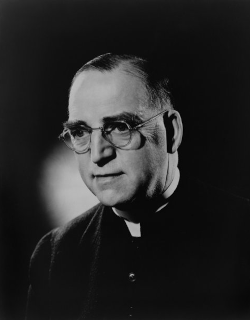
In 1917, Flanagan founds a home for homeless boys in Omaha. Bishop Jeremiah James Harty of the Diocese of Omaha has misgivings but endorses Flanagan’s experiment. Because the downtown facilities are inadequate, he establishes Boys Town, ten miles west of Omaha in 1921. Under his direction, Boys Town grows to be a large community with its own boy-mayor, schools, chapel, post office, cottages, gymnasium, and other facilities where boys between the ages of 10 and 16 can receive an education and learn a trade.
Boys Town, a 1938 film starring Spencer Tracy based on Flanagan’s life, wins Tracy an Academy Award for Best Actor for his performance. Mickey Rooney also stars as one of the residents. Tracy spends his entire Oscar acceptance speech talking about Flanagan. Without confirming it with Tracy, an overzealous MGM publicity representative announces incorrectly that Tracy is donating his Oscar to Flanagan. The Academy of Motion Picture Arts and Sciences hastily strikes another inscription so Tracy keeps his statuette and Boys Town gets one as well. A sequel also starring Tracy and Rooney, Men of Boys Town, is released in 1941.
Flanagan himself appears in a separate 1938 MGM short, The City of Little Men, promoting Boys Town and giving a tour of its facilities. The actor Stephen McNally plays Flanagan in a 1957 episode of the ABC religion anthology series, Crossroads.
Flanagan receives many awards for his work with the delinquent and homeless boys. Pope Pius XI names him a Domestic Prelate with the title Right Reverend Monsignor in 1937. He serves on several committees and boards dealing with the welfare of children and is the author of articles on child welfare. Internationally known, he travels to the Republic of Ireland in 1946, where he is appalled by the children’s institutions there, calling them “a national disgrace.” When his observations are published after returning to Omaha, instead of improving the horrid conditions, vicious attacks are leveled against him in the Irish print media and the Oireachtas. He is invited by General Douglas MacArthur to Japan and Korea in 1947 to advise on child welfare, as well as to Austria and Germany in 1948. While in Berlin, Germany, he dies of a heart attack on May 15, 1948. He is interred at Dowd Memorial Chapel of the Immaculate Conception Parish in Boys Town, Nebraska.
On February 25, 2012, the Catholic Archdiocese of Omaha, Nebraska opens the canonization process of Flanagan. At a March 17, 2012 prayer service at Boys Town’s Immaculate Conception Church, he is given the title “Servant of God,” the first of three titles bestowed before canonization as a Catholic saint. The investigation is completed in June 2015 and the results forwarded to the Vatican. If the Vatican approves the local findings, Flanagan will be declared venerable. The next steps will be beatification and canonization.
There is a portrait statue dedicated to Fr. Edward J. Flanagan in Ballymoe, County Galway.
Wilde is born in March 1815 at Kilkeevin, near Castlerea, County Roscommon, the youngest of the three sons and two daughters of a prominent local medical practitioner, Thomas Wills Wilde, and his wife, Amelia Flynne. His family are members of the Church of Ireland, and he is descended from a Dutchman, Colonel de Wilde, who came to Ireland with King William of Orange‘s invading army in 1690, and numerous Anglo-Irish ancestors. He receives his initial education at the Elphin Diocesan School in Elphin, County Roscommon. In 1832, he is bound as an apprentice to Abraham Colles, the pre-eminent Irish surgeon of the day, at Dr. Steevens’ Hospital in Dublin. He is also taught by the surgeons James Cusack and Sir Philip Crampton and the physician Sir Henry Marsh. He also studies at the private and highly respected school of anatomy, medicine, and surgery in Park Street (later Lincoln Place), Dublin. In 1837, he earns his medical degree from the Royal College of Surgeons in Ireland. In the same year, he embarks on an eight-month-cruise to the Holy Land with a recovering patient, visiting various cities and islands throughout the Mediterranean. Porpoises are flung on board the ship, Crusader, and Wilde dissects them. Taking notes, he eventually composes a two-volume book on the nursing habits of the creatures. Among the places he visits on this tour is Egypt. In a tomb he finds the mummified remains of a dwarf and salvages the torso to bring back to Ireland. He also collects embalmed ibises.
Wilde runs his own hospital, St. Mark’s Ophthalmic Hospital for Diseases of the Eye and Ear, in Dublin and is appointed to serve as Oculist-in-ordinary to Queen Victoria. At one point, he performs surgery on the father of another famous Irish dramatist, George Bernard Shaw.
Wilde had a very successful medical practice and is assisted in it by his natural son, Henry Wilson, who had been trained in Dublin, Vienna, Heidelberg, Berlin, and Paris. Wilson’s presence enables him to travel, and he visits Scandinavia, where he receives an honorary degree from Uppsala University, and is welcomed in Stockholm by Anders Retzius, among others. King Charles XV of Sweden confers on him the Nordstjärneorden (Order of the Polar Star). In 1853, he is appointed Surgeon Occulist in Ordinary to the Queen in Ireland, the first position of its kind, probably created for him.
Wilde is awarded a knighthood in a ceremony at Dublin Castle on January 28, 1864, more for his involvement with the Irish census than for his medical contributions, although he had been appointed medical commissioner to the Irish census in 1841. In 1845, he becomes editor of the Dublin Journal of Medical & Chemical Science, to which he contributes many articles.
Wilde marries the poet Jane Francesca Agnes Elgee on November 12, 1851, who writes and publishes under the pen name of Speranza. The couple has two sons, William (Willie) and Oscar, and a daughter, Isola Francesca, who dies in childhood.
In addition to his children with his wife, Wilde is the father of three children born out of wedlock before his marriage: Henry Wilson, born in 1838, and Emily and Mary Wilde, born in 1847 and 1849, respectively, of different parentage to Henry. He acknowledges paternity of his illegitimate children and provides for their education, but they are reared by his relatives rather than with his wife and legitimate children. Emily and Mary both die in 1871 following a Halloween party at which their dresses accidentally catch fire.
From 1855 until his death in 1876, Wilde lives at 1 Merrion Square, now the headquarters of American College Dublin. The building is named Oscar Wilde House after William Wilde’s son, who also lives at the address from 1855 until 1878. There is a plaque at 1 Merrion Square dedicated to him.
Wilde’s reputation suffers when Mary Travers, a long-term patient of his and the daughter of a colleague, claims that he had seduced her two years earlier. She writes a pamphlet crudely parodying Wilde and Lady Wilde as Dr. and Mrs. Quilp, and portraying Dr. Quilp as the rapist of a female patient anaesthetised under chloroform. She distributes the pamphlets outside the building where Wilde is about to give a public lecture. Lady Wilde complains to Mary’s father, Robert Travers, which results in Mary bringing a libel case against her. Mary Travers wins her case but is awarded a mere farthing in damages by the jury. Legal costs of £2,000 are awarded against Lady Wilde. The case is the talk of all Dublin, and Wilde’s refusal to enter the witness box during the trial is widely held against him as ungentlemanly behaviour.
From this time onwards, Wilde begins to withdraw from Dublin to the west of Ireland, where he had started in 1864 to build what becomes Moytura, his house overlooking Lough Corrib in Connemara, County Galway. His health deteriorates in 1875. He dies, likely of cancer, at the age of 61 on April 19, 1876. He is buried in Mount Jerome Cemetery in Dublin.
(Pictured: Sketch of William Wilde by J.H. Maguire, 1847)
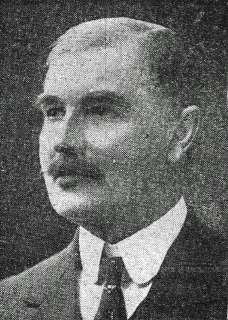
Alan Bell, policeman and resident magistrate, is tasked by British Intelligence to track down Michael Collins’s war chest. By March 26, 1920, he has successfully confiscated over £71,000 from Sinn Féin‘s headquarters and by investigating banks throughout the country and is set to seize much more. On that day he is pulled off a tram in South Dublin and shot three times in the head.
Bell is born in Banagher, King’s County (now County Offaly), one of at least two sons of the Rev. James Adamson Bell, Church of Ireland clergyman. His mother’s name is unknown. Educated locally, he joins the Royal Irish Constabulary (RIC) in September 1879 as a cadet, serving in the counties of Cavan, Galway, Roscommon, Westmeath, and Cork up to the rank of district inspector. During the Land War (1879–82) he investigates sources of Irish National Land League funds and in 1882 arrests the American land reformer and journalist Henry George in Athenry. He, along with District Inspector William Henry Joyce, compile evidence against the nationalist and agrarian agitation for the special commission of 1888–89 which investigates charges against the nationalist leader Charles Stewart Parnell and his associates. His actions make him popular with unionists but a marked man among nationalists.
After almost twenty years’ police service, Bell becomes a resident magistrate on November 12, 1898, a civil service post under the Constabulary Act, 1836. His districts included Athenry, Claremorris, Armagh, Belfast, and Portadown. With many years’ experience in criminal intelligence, he is transferred to Dublin Castle early in the Irish War of Independence as a special investigator and intelligence gatherer. In December 1919 he questions suspects for the attempted Irish Republican Army (IRA) assassination of the viceroy, Lord French, and place suspect premises under surveillance. His vulnerability is made evident by the shooting in January 1920 of Dublin Metropolitan Police assistant commissioner William C. Redmond, one of his informants. He remains in Dublin to investigate the “republican loan” raised by Michael Collins and Sinn Féin, believed to be hidden in suspect bank accounts. Refusing protective accommodation in Dublin Castle where other officials have already retreated, he opts to live with his wife at a private suburban residence, 19 Belgrave Square, Monkstown, County Dublin. He summons bank managers to his office in early March 1920 and progresses sufficiently to force Collins into taking action.
Carrying a pocket revolver for protection, Bell travels to work daily by tram until the morning of March 26, 1920. At the busy junction of Simmonscourt Road, Sandymount Avenue, and Merrion Road, Ballsbridge, a group of men immobilise the crowded vehicle and surround their target, declaring, “Come on, Mr. Bell, your time has come.” Bundling him on to the street, they shoot him dead in public view and run from the scene. In spite of vivid eyewitness accounts in the press, no killer is identified. His death comes amid almost daily violence and barely a week after the shooting of the Sinn Féin Lord Mayor of Cork, Tomás Mac Curtain, allegedly by police assassins. He acts fearlessly, perhaps expecting a violent death as the outcome of his mission.
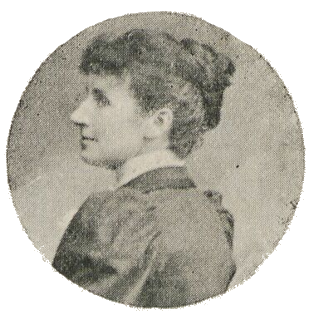
Eccles is the fourth daughter of Alexander O’Conor Eccles of Ballingard House, the founder of a home-rule newspaper, The Roscommon Messenger. She attends a Catholic grammar school, Upton Hall School FCJ, near Birkenhead and convents in Paris and Germany.
Eccles later lives in London with her mother and sister where, after a number of setbacks, she becomes a journalist in the London office of the New York Herald. She goes on to become a staff member of the Daily Chronicle and the Star. She comments in an article in the June 1893 issue of Blackwood’s Magazine on “the immense difficulty a woman finds in getting into an office in any recognised capacity,”
Eccles joins the agricultural reformer Sir Horace Plunkett in writing and lecturing around Ireland for the Department of Agriculture and Technical Instruction. Another of her Blackwood’s Magazine articles, in December 1888, covers “Irish Housekeeping and Irish Customs in the Last Century.”
Eccles’s other books include Aliens of the West (Cassell, 1904) and The Matrimonial Lottery (Eveleigh Nash, 1906). An obituary in The Times describes Aliens of the West as “one of the best modern books of short stories on Ireland yet written.”
In 1783 FitzGerald visits the West Indies before returning to Ireland, where his brother, William FitzGerald, 2nd Duke of Leinster, has procured Edward’s election to the Irish Parliament as an MP for Athy, a seat he holds until 1790. In Parliament he acts with the small Opposition Irish Patriot Party group led by Henry Grattan but takes no prominent part in debate. In the spring of 1786, he takes the then unusual step for a young nobleman of entering the Military College, Woolwich, after which he makes a tour through Spain in 1787. Dejected by unrequited love for his cousin Georgina Lennox, he sails for New Brunswick to join the 54th Regiment with the rank of Major.
In April 1789, guided by compass, FitzGerald traverses the country with a brother officer from Fredericton, New Brunswick to Quebec, falling in with Indians by the way, with whom he fraternizes. He accomplishes the journey in twenty-six days and establishes a shorter practicable route than that hitherto followed. The route crosses the extremely rugged and heavily forested northern part of the present state of Maine. In a subsequent expedition he is formally adopted at Detroit by the Bear clan of the Mohawk with the name “Eghnidal,” and makes his way down the Mississippi River to New Orleans, whence he returns to England.
Finding that his brother has procured his election for Kildare County, a seat he holds from 1790 to 1798, and desiring to maintain political independence, FitzGerald refuses the command of an expedition against Cádiz offered him by William Pitt the Younger and devotes himself for the next few years to the pleasures of society and to his parliamentary duties. He is on terms of intimacy with his first cousin Charles Fox, with Richard Sheridan and other leading Whigs. According to Thomas Moore, FitzGerald is only one of numerous suitors of Sheridan’s first wife, Elizabeth, whose attentions are received with favour. She conceives a child by him, a baby girl who is born on March 30, 1792.
His Whig connections, together with his transatlantic experiences, predisposed FitzGerald to sympathize with the doctrines of the French Revolution, which he embraces enthusiastically when he visits Paris in October 1792. He lodges with Thomas Paine and listens to the debates in the Convention. While in Paris, he becomes enamoured of a young girl named Pamela whom he chances to see at the theatre, and who has a striking likeness to Elizabeth Sheridan. On December 27, 1792, he and Pamela are married at Tournai, one of the witnesses being Louis Philippe, afterwards King of the French. In January 1793 the couple reaches Dublin.
Ireland is by then seething with dissent which is finding a focus in the increasingly popular and revolutionary Society of the United Irishmen, which has been forced underground by the outbreak of war between France and Britain in 1793. FitzGerald, fresh from the gallery of the Convention in Paris, returns to his seat in the Irish Parliament and immediately springs to their defence. Within a week of his return, he is ordered into custody and required to apologise at the bar of the House of Commons for violently denouncing in the House a government proclamation which Grattan had approved for the suppression of the United-Irish attempt to revive the Irish Volunteer movement with a “National Guard.” However, it is not until 1796 that he joins the United Irishmen, who by now have given up as hopeless the path of constitutional reform and whose aim, after the recall of Lord Fitzwilliam in 1795, is nothing less than the establishment of an independent Irish republic.
In May 1796 Theobald Wolfe Tone is in Paris endeavouring to obtain French assistance for an insurrection in Ireland. In the same month, FitzGerald and his friend Arthur O’Connor proceed to Hamburg, where they open negotiations with the Directory through Reinhard, French minister to the Hanseatic towns. The Duke of York, meeting Pamela at Devonshire House on her way through London with her husband, tells her that his plans are known and advises that he should not go abroad. The proceedings of the conspirators at Hamburg are made known to the government in London by an informer, Samuel Turner. The result of the Hamburg negotiations is Louis Lazare Hoche‘s abortive expedition to Bantry Bay in December 1796.
In September 1797 the Government learns from the informer Leonard McNally that FitzGerald is among those directing the conspiracy of the United Irishmen, which is now quickly maturing. Thomas Reynolds, converted from a conspirator to an informer, keeps the authorities posted in what is going on, though lack of evidence produced in court delays the arrest of the ringleaders. But on March 12, 1798, Reynolds’ information leads to the seizure of a number of conspirators at the house of Oliver Bond. FitzGerald, warned by Reynolds, is not among them.
As a fellow member of the Ascendancy class, the Government are anxious to make an exception for FitzGerald, avoiding the embarrassing and dangerous consequences of his subversive activities. They communicate their willingness to spare him from the normal fate meted out to traitors. FitzGerald however refuses to desert others who cannot escape, and whom he has himself led into danger. On March 30 the government proclamation of martial law authorising the military to act as they see fit to crush the United Irishmen leads to a campaign of vicious brutality in several parts of the country.
FitzGerald’s social position makes him the most important United Irish leader still at liberty. On May 9 a reward of £1,000 is offered by Dublin Castle for his apprehension. Since the arrests at Bond’s house, he has been in hiding. The date for the rising is finally fixed for May 23 and FitzGerald awaits the day hidden by Mary Moore above her family’s inn in Thomas Street, Dublin.
Tipped off that the house is going to be raided, Moore turns to Francis Magan, a Catholicbarrister and trusted sympathiser, who agrees to hide Fitzgerald. Making its way to Magan’s house on May 18, Fitzgerald’s party is challenged by Major Henry Sirr and a company of Dumbarton Fencibles. Moore escapes with Fitzgerald and takes him back to Thomas Street to the house of Nicholas Murphy.
Moore explains to Magan what had happened and, unbeknownst to her, Magan informs Dublin Castle. The Moore house is raided that day. Mary, running to warn the Leinster Directory meeting nearby in James’s Gate, receives a bayonet cut across the shoulders. That same evening Sirr storms Murphy’s house where FitzGerald is in bed suffering from a fever. Alerted by the commotion, he jumps out of bed and, ignoring the pleas of the arresting officers to surrender peacefully, he stabs one and mortally wounds the other with a dagger in a desperate attempt to escape. He is secured only after Major Sirr shoots him in the shoulder.
FitzGerald is conveyed to New Prison, Dublin where he is denied proper medical treatment. After a brief detention in Dublin Castle he is taken to Newgate Prison, Dublin where his wound, which has become infected, becomes mortally inflamed. His wife, whom the government probably has enough evidence to convict of treason, has fled the country, never to see her husband again, but FitzGerald’s brother Henry and his aunt Lady Louisa Conolly are allowed to see him in his last moments. He dies at the age of 34 on June 4, 1798, as the rebellion rages outside. He is buried the next day in the cemetery of St. Werburgh’s Church, Dublin. An Act of Attainder confiscating his property is passed as 38 Geo. 3 c. 77 but is eventually repealed in 1819.
On April 9, 1980, the unit lures the Royal Ulster Constabulary (RUC) into an ambush on Stewartstown Road, killing one constable and wounding two others. On May 2 the unit is planning another attack and has taken over a house on Antrim Road, when an eight-man patrol from the SAS arrive in plain clothes, after being alerted by the RUC. A car carrying three SAS members goes to the rear of the house, and another car carrying five SAS members arrives at the front of the house. As the SAS members at the front of the house exit their car the IRA unit opens fire with the M60 machine gun from an upstairs window, hitting Captain Herbert Westmacott in the head and shoulder, killing him instantly. He is the highest-ranking member of the SAS killed in Northern Ireland. The remaining SAS members, armed with Colt Commando automatic rifles, submachine guns and Browning pistols, return fire but are forced to withdraw. Magee is apprehended by the SAS members at the rear of the house while attempting to prepare the IRA unit’s escape in a transit van, while the other three IRA members remain inside the house. More members of the security forces are deployed to the scene, and after a brief siege the remaining members of the IRA unit surrender.
The trial of Fusco and the other members of the M60 gang begins in early May 1981, with them facing charges including three counts of murder. On June 10 Fusco and seven other prisoners, including Joe Doherty and the other members of the IRA unit, take a prison officer hostage at gunpoint in Crumlin Road Jail. After locking the officer in a cell, the eight take other officers and visiting solicitors hostage, also locking them in cells after taking their clothing. Two of the eight are wearing officer’s uniforms while a third wears clothing taken from a solicitor, and the group moves towards the first of three gates separating them from the outside world. They take the officer on duty at the gate hostage at gunpoint and force him to open the inner gate. An officer at the second gate recognises one of the prisoners and runs into an office and presses an alarm button, and the prisoners run through the second gate towards the outer gate. An officer at the outer gate tries to prevent the escape but is attacked by the prisoners, who escape onto Crumlin Road. As the prisoners are moving towards the car park where two cars are waiting, an unmarked RUC car pulls up across the street outside Crumlin Road Courthouse. The RUC officers open fire, and the prisoners returned fire before escaping in the waiting cars. Two days after the escape, Fusco is convicted in absentia and sentenced to life imprisonment with a minimum recommended term of thirty years.
Fusco escapes across the border into the Republic of Ireland before being arrested in January 1982 and is sentenced to ten years imprisonment for the escape and firearms offences under extra-jurisdictional legislation. A further three years are added to his sentence in 1986 after he attempts to escape from Portlaoise Prison, and he is released in January 1992. Upon his release, he is immediately served with extradition papers from the British government for his return to the Maze Prison in Northern Ireland to serve his sentence for the murder conviction. The extradition is granted by a District Court but Fusco appeals, and in 1995 he wins a legal victory when a judge at the High Court in Dublin rules it would be “unjust, oppressive and invidious” to order his extradition due to the time lag involved. Fusco settles in Tralee with his wife and three children until February 1998, when the Supreme Court of Ireland brings an end to the six-year legal battle by ordering his extradition, but he has already fled on bail and a warrant is issued for his arrest.
Fusco is arrested at a Garda checkpoint in Castleisland, County Kerry, on January 3, 2000. The following day he is being escorted back to Northern Ireland to be handed over to the RUC, when his handover is halted by a successful court appeal by Sinn Féin. The arrest and abortive return of Fusco undermines the Northern Ireland peace process, with Unionist politicians including Ken Maginnis criticising the extradition being halted. Republicans are critical of Fusco’s arrest, with leading Sinn Féin member Martin Ferris stating, “The Irish government should immediately move to rescind the warrant against Angelo Fusco. The action will cause great anger and resentment within the nationalist community,” and graffiti in one republican area reads “Extradite Bloody Sunday war criminals, not Fusco.” On January 6 Fusco is refused bail and remanded to prison in Castlerea, County Roscommon, to await a legal review of his extradition, prompting scuffles outside the court between police and Sinn Féin supporters.
Fusco is freed on bail on March 21 pending the outcome of his legal challenge, and in November 2000 the Irish government informs the High Court that it is no longer seeking to return him to Northern Ireland. This follows a statement from Secretary of State for Northern IrelandPeter Mandelson saying that “it is clearly anomalous to pursue the extradition of people who appear to qualify for early release under the Good Friday Agreement scheme, and who would, on making a successful application to the Sentence Review Commissioners, have little if any of their original prison sentence to serve.” After the court hearing Fusco states, “I’m relieved it’s over,” and that he will continue to live in Tralee with his family and work for Sinn Féin.
In December 2000 Fusco and three other IRA members, including two other members of the M60 gang, are granted a royal prerogative of mercy which allows them to return to Northern Ireland without fear of prosecution.
Educated at St. Jarlath’s College, Tuam, Horan trains for the priesthood in St. Patrick’s College, Maynooth. He is ordained in 1936, and his first post is in Glasgow, where he remains for three years. Having served as chaplain on an ocean liner and briefly in Ballyglunin, County Galway, he becomes curate in Tooreen, a small townland close to Ballyhaunis, County Mayo. While there, he organises the construction of a dance hall, which becomes a popular local amenity. He secures financing for the project by collecting £8,000 on a tour of American cities. After also serving in Cloonfad, County Roscommon, he is transferred to Knock in 1963, where he becomes parish priest in 1967. He is troubled by the struggles of daily life and mass emigration in the west of Ireland, and he works to improve the living standards of the local community.
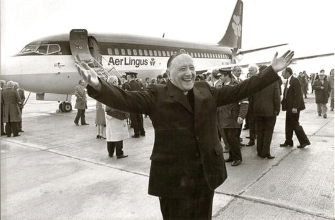
While stationed at Knock, Horan oversees the building of a new church for Knock Shrine, which is dedicated in 1976. The shrine is the stated goal of Pope John Paul II’s visit in 1979. The pope travels to Knock as part of a state visit to Ireland, marking the centenary of the famous Knock apparitions. Horan works with Judy Coyne to organise the papal visit. He is responsible for the refurbishment of the church grounds, along with the construction of a huge church, with a capacity of 15,000. This newly constructed church is given the status of basilica by the pope. The day after the papal visit, Horan begins his campaign to build an international airport in Barnacuige, a small village near Charlestown, County Mayo.
Critics regard the idea of an airport on a “foggy, boggy site” in Mayo as unrealistic, but funding is approved by then TaoiseachCharles Haughey, who performs the official opening in May 1986, five years after work commenced. Although Horan had secured IR£10,000,000 in funding from Haughey, following the Fianna Fáil party’s defeat in the general election of 1982, his funding is cut, with the airport unfinished. He raises the IR£4,000,000 shortfall by holding a “Jumbo Draw.” This large lottery succeeds in raising the required revenue, but only after a painstaking tour of several countries, including Australia and the United States. This takes its toll on the ageing Horan and leads to his death shortly after the completion of the airport. The airport is originally known as Horan International Airport but is now officially referred to as Ireland West Airport Knock.
Horan dies on August 1, 1986, while on a pilgrimage to Lourdes, just a few months after the official opening of the airport. His remains are flown into Knock, the first funeral to fly into the airport he had campaigned for. He is buried in the grounds of the Knock Basilica. His life and work are chronicled in a musical written by Terry Reilly and local broadcaster Tommy Marren, entitled A Wing and a Prayer. It premières in The Royal Theatre in Castlebar, County Mayo, on November 25, 2010.
McKearney joins the Provisional IRA and is first arrested in 1972 on charges of blowing up the post office in Moy. He spends six weeks on remand but is released due to insufficient evidence. In December 1973 he is arrested again and later sentenced to seven years for possession of a rifle. He is imprisoned in Long Kesh Detention Centre and later in Magilligan Prison. During this time, a younger brother, Seán, also an IRA paramilitary, is killed on May 13, 1974. He is released in 1977 but is sentenced to 14 years in August 1980 after being caught by the British Army with a loaded Sten gun along with fellow IRA member Gerard O’Callaghan. That same year an older brother, Tommy McKearney, who had been sentenced to life imprisonment for the murder of an off-duty Ulster Defence Regiment (UDR) soldier who worked as a postman in 1977, nearly dies on hunger strike after refusing food for 53 days. Another brother, Kevin, and an uncle, Jack McKearney, are both murdered by Loyalist paramilitaries in revenge attacks upon the family.
On September 25, 1983, McKearney takes part in the Maze Prison escape along with 37 other prisoners. At the beginning of 1984 he rejoins IRA activity in his native East Tyrone with the Provisional IRA East Tyrone Brigade. He advocates the commencement of the “third phase” of the armed struggle, the ‘strategic defensive,’ in which the Royal Ulster Constabulary (RUC), Ulster Defence Regiment and British Army would be denied all support in selected areas following repeated attacks on their bases. In 1985 Patrick Kelly becomes commander of the Provisional IRA East Tyrone Brigade, and it is under his leadership that this strategy is pursued. Remote Royal Ulster Constabulary bases are attacked and destroyed, and building contractors who try to repair them are targeted and sometimes murdered, as occurs with the attack on the Ballygawley barracks in December 1985, which results in the death of two policemen, and The Birches police station in August 1986.
McKearney is shot dead by the British Army on May 8, 1987, during an IRA attack that he is taking part in upon Loughgall police station, which also claims the lives of seven other IRA members. His body is buried at his hometown of Moy.
Parke joins the British Army Medical Services (AMS) in February 1881 as a surgeon, first serving in Egypt during the final stages of the ʻUrabi revolt in 1882. As a senior medical officer at a field hospital near Cairo, he is responsible for treating battle casualties as well as the deadly cholera epidemic that afflicts 20% of British troops stationed there. In late 1883, he returns to Ireland, where he is stationed at Dundalk with the 16th The Queen’s Lancers. He arrives in Egypt once again in 1884 as a part of the Nile Expedition sent in relief of General Charles Gordon, who is besieged in Khartoum by Mahdists in neighbouring Sudan. The expedition arrives too late, and Gordon is killed. Parke later negatively recounts this experience in an 1892 journal article titled How General Gordon Was Really Lost. Following the expedition, he spends the next few years stationed in Alexandria, where he notably introduces fox hunting to Egypt, becoming master of the Alexandria Hunt Club.
In January 1887, while in Alexandria, Parke is invited by Edmund Musgrave Barttelot to accompany him on the Emin Pasha Relief Expedition. The expedition is led by Henry Morton Stanley, and journeys through the African wilderness in relief of Emin Pasha, an Egyptian administrator who had been cut off by Mahdist forces following the Siege of Khartoum. He is initially rejected by Stanley upon his arrival in Alexandria but is invited by telegram a day later to join the expedition in Cairo. On February 25, 1887, the expedition sets off from Zanzibar for the Congo.
The expedition lasts for three years and faces great difficulty, with the expedition of 812 men suffering from poor logistical planning and leadership. The rainforest is much larger than Stanley expected, leading much of the party to face starvation and disease. The expedition has to resort to looting native villages for food, escalating the conflict between the two groups. Parke, for his part, saves the lives of many in the party, including Stanley, who suffers from acute abdominal pain and a bout of sepsis. Stanley describes Parke’s care as “ever striving, patient, cheerful and gentle…most assiduous in his application to my needs, and gentle as a woman in his ministrations.” Parke also treats Arthur Jephson for fever, and nurses Robert H. Nelson through starvation. Furthermore, after a conflict with the natives, he has to save William Grant Stairs by orally sucking the poison out of an arrow wound.
During the expedition, Parke purchases from an Arab slaver a Mangbetu Pigmy girl, who serves as his nurse and servant for over a year.
After returning to Ireland, Parke receives an Honorary Fellowship of the Royal College of Surgeons in Ireland and is awarded gold medals from the British Medical Association (BMA) and the Royal Geographical Society. He publishes several books, including My Personal Experiences in Equatorial Africa (1891) and A Guide to Health in Africa.
French belongs to the long-established French family of Frenchpark, County Roscommon, who are substantial landowners who also make money in the wine trade. He is the eldest son of Arthur French MP and Alicia Magenis, daughter of Richard Magenis of Dublin and sister of Richard Magenis. He marries Margaret Costello, daughter of Edmond Costello of Edmondstown, County Mayo, and has nine children, including Arthur French, 1st Baron de Freyne, John, 2nd Baron and Charles, 3rd Baron.
In 1783, French is elected a Member of Parliament (MP) for Roscommon County in the Irish House of Commons. After the Act of Union 1800 he represents Roscommon in the Parliament of the United Kingdom. He is alleged to have been offered an Earldom if he would support the union of Ireland with Great Britain but refuses the honour. Later he also refuses a Barony with no strings attached, although in time three of his sons would hold the title of Baron de Freyne. The Crown is frequently irritated by his demands for offices and favours for his brothers and sons, although such behaviour is entirely typical of an Irish politician at the time.
A critic of the policy of collective fines as a deterrent to the illicit distillation of poteen, French incurs the wrath of Chief Secretary for IrelandRobert Peel who calls him “an Abominable fellow,” but his enormous popularity in Roscommon means that he cannot be ignored. He also criticizes the continuation of martial law in Ireland.
By 1817 French is complaining of ill-health. He dies on November 24, 1820. One report at the time states that he had died “from excessive fox hunting.”





 seamus dubhghaill