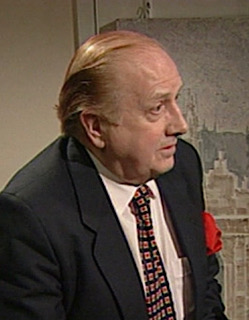
Discontented with James Chichester-Clark and Brian Faulkner who come to government after O’Neill’s 1969 fall from power, Boal resigns from the UUP in 1971 and joins Ian Paisley in establishing the Democratic Unionist Party (DUP) in order to provide dissident unionist opinion with a viable political alternative. He works as the first chairman and one of the first public representatives of the DUP and continues to sit in Stormont during the years of 1971–1972. He later resumes his practice as a barrister.
While Boal’s interest in federalism diminishes after the 1970s, the federalist Boal scheme of January 1974 is again put forward by liberal protestants such as John Robb as late as 2007. His friendship with Paisley finally breaks when the DUP agrees to enter government with Sinn Féin in 2007. He tells Paisley, who takes the breach very hard, that he had betrayed everything he ever advocated.
In Enniskillen, armed Williamite civilians drawn from the local Protestant population organise a formidable irregular military force. The armed civilians of Enniskillen ignore an order from Robert Lundy that they should fall back to Derry and instead launch guerrilla attacks against the Jacobites. Operating with Enniskillen as a base, they carry out raids against the Jacobite forces in Connacht and Ulster, plundering Trillick, burning Augher Castle, and raiding Clones.
A Jacobite army of about 3,000 men, led by Justin McCarthy, Viscount Mountcashel (in the Jacobite peerage), advance on them from Dublin. Lord Mountcashel’s men consist of three regiments of infantry and two of dragoons. The regiments include his own regiment, Mountcashel (approx. 650 men in 13 companies), The O’Brien regiment (also 13 companies of 650 men), and the Lord Bophin (Burke) regiment. He also has the dragoon regiments of Cotter and Clare, each with seven companies of about 350 dragoons. On July 28, 1689, Mountcashel’s force encamps near Enniskillen and bombards the Williamite outpost of Crom Castle to the southeast of Enniskillen. Crom Castle is almost 20 miles (32 km) from Enniskillen by road and about 5 miles (8.0 km) from Newtownbutler.
Two days later, they are confronted by about 2,000 Williamite ‘Inniskilliniers’ under Colonel Berry, Colonel William Wolseley and Gustave Hamilton. The Jacobite dragoons under Antoine Hamilton stumble into an ambush laid by Berry’s men near Lisnaskea and are routed, taking 230 casualties. Mountcashel manages to drive off Berry’s cavalry with his main force but is then faced with the bulk of the Williamite strength under Wolseley. There is some debate in the sources over troop numbers, though it is believed that Mountcashel has a large number of poorly armed conscripts. Unwisely, Mountcashel halts and draws up his men for battle about a mile south of Newtownbutler.
Williamite histories claim that many of the Jacobite troops flee as the first shots are fired. Up to 1,500 of them are hacked down or drowned in Upper Lough Erne when pursued by the Williamite cavalry. Of the 500 men who try to swim across the Lough, only one survives. Approximately 400 Jacobite officers, along with Lord Mountcashel, the Jacobite commander, are captured and later exchanged for Williamite prisoners, with the other Jacobites being killed. These claims seem unlikely, for several reasons. Each Irish regiment includes approximately 40 officers. The entire force, therefore, would include only about 200 officers. Many of these officers are accounted for in an October 1689 roll call, which shows approximately a 15–20% change in the officer roll call since July for the infantry regiments and 5% for the dragoons. This totals some 20–30 officers in all. Also, the Mountcashel regiment’s roll call for October shows that companies which would normally have 50–60 men, have around 25, which results in a loss of approximately 300–400 men for this regiment. The Cotter and Clare dragoons who ride away from the battle do not have significant losses, based on the October 1689 roll call. Assuming the other two infantry regiments suffer similar losses, gives a total loss of 1,200–1,300. Given their officers are recorded in the October roll and show fewer losses than the Mountcashel regiment among officers, there may be fewer losses in the ranks as well. The Williamite histories acknowledge that they captured approximately 400, including men who are later sent to Derry, which would indicate a total loss of killed, wounded, and missing of 800–900, and likely less. This number is necessarily an estimate based on the available data but should be contrasted with Williamite claims that they killed and drowned 2,000. It appears likely that a couple of hundred men from Mountcashel’s regiment may have fled into the bogs toward Lough Erne, and some of them who made it to the river tried to swim and were drowned, leading to the story of the hundreds drowned.
The battle is still commemorated by the Orange Order in Ulster and is mentioned in the traditional unionist song, “The Sash.”
The battle is significant in another way: the regiments on both sides go on to have long and famous histories. On the Williamite side, the Innsikilling Regiment (27th Foot), and on the Jacobite side, the Clare and Mountcashel/Lee/Bulkeley regiments of the Irish Brigade. The two Irish regiments face off again at the Battle of Fontenoy in 1745, where the Irish Brigade famously drives the British army from the battlefield with a charge in the final stage of the battle.
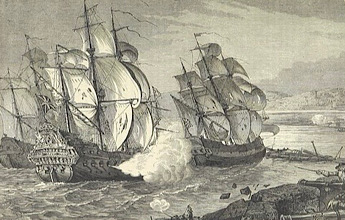
On July 28, 1689, two armed merchant ships, Mountjoy and Phoenix, sail toward the heavily defended defensive boom (floating barrier) across the River Foyle at Culmore, protected by the frigate HMS Dartmouth under Captain John Leake. Mountjoy rams and breaches the boom at Culmore fort and the ships move in, unloading many tons of food to relieve the Siege of Derry.
The Siege of Derry in 1689 is the first major event in the Williamite War in Ireland. The siege is preceded by an attempt against the town by Jacobite forces on December 7, 1688, that is foiled when thirteen apprentices shut the gates. This is an act of rebellion against James II.
The second attempt begins on April 18, 1689, when James himself appears before the Derry city walls with an Irish army led by Jacobite and French officers. The town is summoned to surrender but refuses. The siege begins. The besiegers try to storm the walls, but fail. They then resort to starving Derry. They raise the siege and do not leave until supply ships break through to the town.
Frederick Schomberg, having been appointed commander-in-chief by William III, orders Major-GeneralPercy Kirke to attack the boom. Thereupon, on July 28, Kirke sends four ships to the mouth of the River Foyle to try to bring food into Derry. These are HMS Dartmouth and three merchant ships: Mountjoy from Derry, Phoenix from Coleraine, and Jerusalem. Dartmouth, under Captain John Leake, engages the shore batteries, while Mountjoy, commanded by her Master Michael Browning, rams and breaches the boom, whereupon Mountjoy and Phoenix sail up to Derry, unloading many tons of food. Seeing that he can no longer starve out Derry and not having enough troops to storm the town, Conrad von Rosen, the commander of the Jacobite troops, decides to raise the siege. On August 1, the besieged discover that the enemy is gone. On August 3, Kirke reports the raising of the siege to London. On July 31, another Jacobite army is defeated at Newtownbutler by the armed citizens of Enniskillen.
The city endures 105 days of siege, from April 18 to August 1, 1689. Some 4,000 of its garrison of 8,000 are said to have died during this siege. The siege is commemorated annually by the Protestant community.
(Pictured: HMS Dartmouth fires at shore batteries while Mountjoy rams through the boom, from the 1873 book British Battles on Land and Sea, Volume 1)
Kilfedder leaves the UUP in 1977 in opposition to the party’s policies tending to integrationism, preferring to advocate the restoration of the Stormont administration. For a time he sits as an “Independent Ulster Unionist.” He contests the 1979 European Parliament election under that label, finishing fourth in the count for the three seats, having overtaken the UUP leader Harry West on transfers.
On March 20, 1995, while traveling by train into London from Gatwick Airport, Kilfedder dies of a heart attack. This is the same day that the Belfast Telegraph carries a front-page story saying that an Ulster MP has been targeted as one of twenty MPs invited by the LGBT rights organisation OutRage! in a letter to come out. He dies unmarried and is survived by two sisters.
O’Brien is one of five children of Pierce O’Brien, a gentleman landowner, and Sophia Angel St John O’Brien. Her first cousin is woodcarver Sophia St John Whitty. She attends the Mercy Convent in Ennis, going on to win a scholarship to the Dublin Metropolitan School of Art. While there she studies under William Orpen and Alfred E. Child who teach her the art of stained glass.
Among O’Brien’s first commissions is the St. Ita window for St. Brendan’s cathedral in Loughrea, County Galway, in 1904, which is designed by Sarah Purser. She joins An Túr Gloine in 1906, beginning her career there by designing Angel of the Annunciation window in the Enniskillen convent chapel. For a window in the Wilson private chapel at Coolcarrigan House, Naas, County Kildare, in 1912, she incorporates Celtic design, some drawing on the Book of Durrow. In 1914, she tours the cathedrals of Paris, Rouen, and Chartres with Purser and Wilhelmina Geddes. She designs three windows depicting St. John, St. Flannan, and St. Munchin, for the Honan Chapel at University College Cork in 1916. Her 1923 design of the centenary memorial window in St. Andrew’s church, Lucan, represents the parable of the Good Shepherd. When in 1925 An Túr Gloine becomes a cooperative society, she becomes a shareholder along with Ethel Rhind, Evie Hone, and Michael Healy.
O’Brien’s 1926 lunetteThe Spirit of Night represents night, twilight, and dawn, and is for the private home of Keng Chee in Singapore, which is later demolished. The window of St. Catherine of Siena for the Sacred Heart convent chapel in Newton, Massachusetts dates from 1927. Her 1931 St. Patrick window, for the De La Salle school, East Coast Rd., Singapore, commissioned by architect Denis Santry, is the only extant stained-glass work by an Irish artist in that country. Much like Rhind, O’Brien also employs opus sectile, such as in her 1936 Mass in Penal Days in the Franciscan friary, Athlone, County Westmeath. She contributes two windows, Pelican and Lamb and Host and Chalice: Wheat and Grapes, to the ten windows An Túr Gloine produces for Brophy College Chapel, Phoenix, Arizona in 1937. From 1937 until 1947, she works on 22 opus sectile panels for the Protestant Church in Ennis.
Purser retires from An Túr Gloine in 1940, and O’Brien succeeds her as director, going on to purchase it and the contents in 1944. She rents a section of the premises to fellow stained-glass artist Patrick Pollen from 1954 onwards. She exhibits at the 1953 Irish Exhibition of Living Art, and the 1958 exhibition of the Arts and Crafts Society of Ireland. When the An Túr Gloine studios are damaged by fire in 1958, she rebuilds them and reopens by 1959. She is an active member of the Soroptimists and the Guild of Irish Art Workers. The last work she completes is a three-light window for the Church of St. Multose, Kinsale, County Cork, in 1962. A commission for two windows for the private chapel of Áras an Uachtaráin for PresidentÉamon de Valera is left unfinished at her death.
O’Brien dies in Dublin on July 18, 1963, and is buried in Whitechurch Parish Graveyard, County Dublin. She is commemorated in a window designed by Pollen in St. Laurence O’Toole chapel, Christ Church Cathedral, Dublin, where for forty years she made floral arrangements. Over 150 of her An Túr Gloine drawings from notebooks are now in the National Gallery of Ireland.
(Pictured: Stained glass window in the south wall of Ferns Cathedral, Ferns, County Wexford)
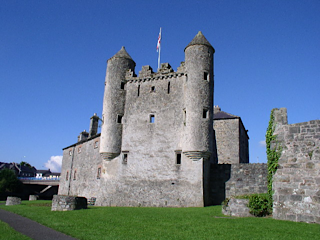
The siege of Enniskillen takes place at Enniskillen in Fermanagh, present day Northern Ireland, in 1594 and 1595, during the Nine Years’ War. In February 1594, the English had captured Enniskillen Castle from the Irish after a waterborne assault and massacred the defenders after they surrendered. From May 1594, an Irish army under Hugh Maguire and Cormac MacBaron O’Neill besiege the English garrison in the castle, and in August they defeat an English relief force. A second relief force is allowed to resupply the garrison, but the castle remains cut off. Eventually, in May 1595, the English garrison surrenders to the Irish and are then massacred.
In 1593, Hugh Maguire, Chief of the Name and Lord of Fermanagh, had objected to the behaviour of the newly-appointed English Crown sheriff Humphrey Willis. As he had done before being expelled by Hugh Roe O’Donnell from Tyrconnell in 1592, Willis is cattle raiding and plundering throughout Clan Maguire territory. Maguire is not strong enough to resist the sheriff, but after receiving reinforcements from Hugh O’Neill, Earl of Tyrone, Maguire expels Willis. In May and June 1593, Maguire and Brian Oge O’Rourke of West Breifne raid lands held by the English Lord President of Connaught, Richard Bingham. They destroy the town around Ballymote Castle. This is part of a proxy war waged to distract the Crown while Tyrone strengthens his position in Ulster. As hoped for, the Crown responds by sending an army under Sir Henry Bagenal and Gaelic leader Hugh O’Neill, Earl of Tyrone (outwardly still loyal to the Crown), who defeat Maguire’s force at the Battle of Belleek in October 1593. However, Maguire’s main force remains unscathed.
On May 17, 1594, now acting with the covert support of Tyrone, Hugh Maguire and Cormac MacBaron O’Neill lay siege to Enniskillen which is now isolated in hostile country. Their army consists of 1,400 foot soldiers and 600 horsemen. It quickly grows with support arriving from HughRoeO’Donnell. The English commander, James Eccarsall, has only 50 foot soldiers and 24 horsemen to defend the castle, along with some light artillery. Eccarsall launches a sortie by boat but has to retreat under heavy fire. Irish fortifications cut off access by river and the castle is attacked nightly. Many of the garrison fall sick due to food shortages and exhaustion brought on by incessant skirmishing with the Irish.
On August 7, Maguire and his allies defeat an English relief force for Enniskillen at the Battle of the Ford of the Biscuits. A second relief force commanded by the Lord DeputyWilliam Russell is sent by another route. Although it is not attacked by the Irish, none of Russell’s scouts or messengers reach the castle nor return. Russell relieves the beleaguered garrison by August 30 with six months supplies, then withdraws. Following this, there is a truce, but “subterfuge and deception were the hallmarks of this stage of the war.”
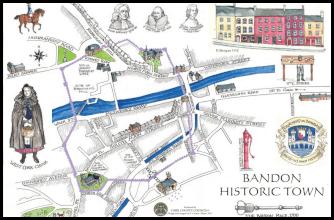
The Capture of Bandon begins on February 23, 1689, when the town of Bandon, County Cork, is forcibly seized from its rebellious Protestant inhabitants by force of Irish Army troops under Justin McCarthy. The skirmishing at the town takes place during the early stages of the Williamite War in Ireland. The Jacobite success at Bandon helps suppress any chance of a general Munster uprising against the rule of James II similar to that which occurs in Ulster the same year. The slogan “No Surrender!” is believed to have been first used at Bandon and subsequently taken up, more famously, by the defenders at the Siege of Derry later in the year.
In 1685, the Catholic James II comes to the throne. This leads to a sharp reversal of government policy in Ireland, which had previously favoured the Protestant inhabitants. This is quickly changed by James’ representative Richard Talbot, 1st Earl of Tyrconnell. Under Talbot’s administration, the army and civil government are mostly purged of Protestants, who are replaced by Catholics. In Bandon, the previous town burgesses are replaced by Catholic nominees.
Talbot’s actions lead to a growing hostility amongst the Protestant inhabitants across the island toward the King and his Irish government. Bandon is a historic centre of Protestants, dating back to the Plantation of Munster in the Elizabethan era and is a natural focus of dissent against James’s rule. In 1688, a similar opposition in England leads to the Glorious Revolution, in which William III successfully invades with a Dutch Army. Many Protestants now believe William to be their rightful King while Catholics, and some Protestants, remain loyal to James. During the growing turmoil, many rural County Cork Protestants come to shelter in Bandon.
Fearing a potential outbreak of rebellion in Bandon will occur, the government sends a detachment of the Irish Army under Captain Daniel O’Neill to take the town. They reportedly enter on a Sunday morning while the inhabitants are attending church services. The following day, February 24, sometimes referred to as “Black Monday,” the townspeople rise and attack the soldiers. Various sources say between three and eight of the redcoats are killed and the remainder are driven out of the town. Using their captured weapons, the Protestants then make an effort to prepare Bandon to withstand an assault.
Having received word about the growing rebellion in the county, Talbot in Dublin has already dispatched six companies of infantry under Justin McCarthy, an experienced Irish Catholic soldier. Instead of immediately assaulting Bandon, McCarthy first seizes nearby Cork, another major centre of Protestants in the south of the country and clamps down on other potential dissidents. He then proceeds to Bandon with his troops, plus some cavalry and artillery. Although they had previously hung out a banner proclaiming “No Surrender,” the defenders negotiate a surrender in exchange for generous conditions. Despite the usual punishment for rebellion being death, the town corporation is fined £1,000 and the walls are ordered to be demolished.
The comparatively light terms imposed on the town are part of a wider attempt by King James to convince Protestants of his goodwill toward them. It angers more hardline Catholics, including McCarthy’s nephew, Donough MacCarthy, 4th Earl of Clancarty, who wants a harsher punishment for the rebels.
The fighting at Bandon is part of a succession of defeats of locally raised Protestant troops both across Munster (at Castlemartyr) and Ireland as a whole, with the Ulster-raised Army of the North suffering heavy defeats at the Break of Dromore and the Battle of Cladyford. The advance of the mainly Catholic Jacobite Army is halted by the successful Protestant defence of Enniskillen and Derry. The arrival of large-scale reinforcements under Frederick Schomberg and King William reverse the tide, and Dublin is captured following the Battle of the Boyne in 1690. The same year, Bandon is re-taken by Protestant forces following John Churchill, 1st Duke of Marlborough‘s successful Siege of Cork. The walls are not rebuilt, as they are becoming increasingly militarily obsolete.
As a teenager, Foster is on a school bus that is bombed by the IRA, the vehicle targeted because its driver is a soldier in the Ulster Defence Regiment (UDR). A girl sitting near her is seriously injured. She is a pupil at Enniskillen Collegiate Grammar School in Enniskillen from 1982 to 1989, and attends Queen’s University Belfast (QUB), where she graduates with an LLB degree. Her political career begins at QUB when she joins the Queen’s Unionist Association, part of the Ulster Unionist Party (UUP). She serves as the association’s chair from 1992 to 1993.
After leaving QUB Foster remains active in the UUP, chairing its youth wing, the UYUC, in 1995. In 1996, she becomes an Honorary Secretary of the UUP’s ruling body, the Ulster Unionist Council, a position which she holds until her resignation from the UUP on December 18, 2003. She is a councillor on Fermanagh District Council representing Enniskillen from 2005 to 2010.
McGuinness resigns as deputy First Minister in January 2017 amid the Renewable Heat Incentive scandal, which involves a green energy scheme that Foster set up during her time as Minister for Enterprise and Investment. The scheme is set to cost the taxpayer £490 million and there are allegations of corruption surrounding her role in implementing the scheme. McGuinness asks her to step aside as First Minister while her involvement in the scheme is investigated, but she refuses to step aside or resign and says that the voices calling for her resignation are those of “misogynists and male chauvinists.” Under the terms of the Northern Ireland power-sharing agreement, the First and deputy First Ministers are equal and, therefore, she cannot remain in her post as First Minister and is subsequently removed from office. McGuinness’s resignation causes a 2017 snap assembly election to be held, in which the DUP loses ten seats. After no party receives an outright majority in the 2017 United Kingdom general election, the DUP enters into an agreement with the Conservative Party to support Prime MinisterTheresa May‘s government. In January 2020, she becomes First Minister of Northern Ireland again after the Executive is reinstated under the terms of the New Decade, New Approach agreement.
On April 28, 2021, after more than twenty DUP MLAs and four DUP MPs sign a letter “…voicing no confidence in her leadership,” Foster announces that she will resign as party leader and as First Minister. She is succeeded by Edwin Poots as DUP leader on May 28, 2021. She leaves office as First Minister on June 14, 2021, and is succeeded by Paul Givan as First Minister on June 17, 2021. She resigns from the Northern Ireland Assembly in October 2021 and becomes a presenter on GB News.
In May 2024, it is confirmed that Foster will be appointed chairperson of Intertrade UK, a new body to promote trade within the UK which is announced as part of the UK government package to restore devolution.
Foster and her husband, Brian, have three children. They live on the outskirts of Brookeborough, a village in the east of County Fermanagh. In 2008, she is recognised as Assembly member of the year at the Women in Public Life Awards.
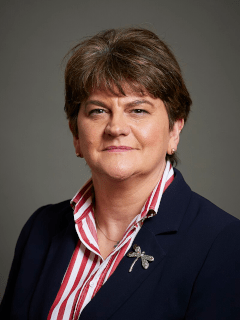
(Pictured: Official portrait of Baroness Foster of Aghadrumsee, January 30, 2024)
A party of eighteen armed B-Specials, a part-time auxiliary police force which is almost 100% Protestant, when traveling by train to Enniskillen, are stopped at Clones railway station in County Monaghan by an IRA group. The B-Specials react immediately by shooting Commander Fitzpatrick. His colleagues retaliate by fatally shooting four Specials and arresting the survivors. Trouble in the North is at a boiling point and in the three days after the Clones incident thirty people are murdered in Belfast.
Collins and James Craig, Prime Minister of Northern Ireland, have further discussions in Dublin in early February 1922 but the meeting breaks down over the question of the boundary revision. Craig informs reporters that he has the assurance of the British Government that the Boundary Commission will make only slight changes. He complains that the maps which Collins had produced led him to the assumption that Collins had already been promised almost half of Northern Ireland. Craig agrees to minor changes but if North and South fail to agree, there will be no change at all. Collins issues a statement which refuses to admit any ambiguity and says that majorities must rule.
The British and the Provisional Government finally agreed that an Irish Free State Agreement Bill will legalise the Treaty and the transfer of power to the Provisional Government and will authorise the election of a Provisional Parliament to enact the Free State Constitution. Final ratification of the Treaty is deferred until the British confirm the Free State Constitution. Only then will Northern Ireland be allowed to exclude itself formally from the Free State.
(From: “OTD in 1922 – The IRA Kidnaps More Than Forty Loyalists Activists and ‘B’ Specials,” Stair na hÉireann | History of Ireland, https://stairnaheireann.net | Picture: Colour image of the IRA patrolling Grafton Street, Dublin, during the Irish Civil War in 1922, 1916 Easter Revolution in Colour)
The bombing follows repeated warnings from senior police officers on both sides of the Northern Ireland border that republican dissidents continue to pose a threat. Both the Continuity IRA and Real IRA have been recruiting and rearming in preparation for a campaign to wreck the Northern Ireland peace process.
The splinter republican organisation is behind a bomb attack on the Killyhevlin Hotel in Enniskillen in July 1996. The attack follows a week-long marching stand-off at Drumcree.
In January 1998, a Continuity IRA bomb wrecks a club in County Fermanagh. The explosion coincides with a series of loyalist attacks, which follow the murder of the Portadown Loyalist Volunteer Force (LVF) leader Billy Wright.
The latest explosion in Irvinestown comes in a week when the new political institutions are facing suspension because of the stalemate over paramilitary arms decommissioning. This attack by the Continuity IRA looks deliberately timed to add to the peace process’s troubles.
BBC Northern Ireland political editor Stephen Grimason says the bomb will not help the current situation. “We are hearing an argument reinforced from unionists that if these things are left lying around then people will use them,” he says. “So the anti-agreement unionists will be using this as a weapon. But I would have thought it will harden the attitudes of the Ulster Unionist Council and the Ulster Unionist executive, meeting tonight on the issue of weapons,” he adds.
Grimason adds that unionists in general will want to hear about the forensics of the bomb and if there was a Semtex booster charge used. “They will use that as another means of saying that this is all the IRA,” he says. But he adds that there will be those who will see this as a move against Sinn Féin President Gerry Adams because it removes the room for manoeuvre that he has.
BBC Northern Ireland chief security correspondent Brian Rowan says the bomb contained one to two kilos of high explosive, but that the security forces had not yet revealed what type it is. He says the bomb had the appearance of the Continuity IRA which in “times of trouble made more trouble.” He adds, “They would see this as a reminder that they are still out there and as a reminder to other republicans that there is an alternative to the mainstream IRA, and to the peace process strategy. It is about damaging a process that this organisation very much opposes, a process in which they believe republicans principles have been sold out.”
Rowan says security sources believe in some areas the Real IRA, Continuity IRA and the more mainstream Irish National Liberation Army (INLA) co-operate in attacks. INLA prisoners have been released under the Good Friday Agreement early prisoner release scheme, following the INLA’s ceasefire declaration.
“In the Fermanagh area security forces believe the Continuity IRA is operating alone and there is a pattern of activity over a period of years. There is nothing to suggest it was any other group.” He says there is nothing coming from republicans or security sources at this time to suggest that the IRA has any intention of actual decommissioning in the “immediate period ahead.”
(From: “Bombing follows dissident pattern,” BBC News, http://www.news.bbc.co.uk, February 7, 2000 | Photo: RUC forensic experts examine the scene of the bomb attack at Mahons Hotel in Irvinestown, Northern Ireland, Associated Press)