In July 2015 there are 4,242 applications submitted by people in Great Britain compared to 7,321 in July 2016. Meanwhile 6,638 passport requests are submitted from Northern Ireland.
Within in a day of the Brexit vote there is a surge in online interest in Irish passports and moving to Ireland. While the UK as a whole vote to leave the EU in the referendum, Northern Ireland votes to remain by a majority of 56 percent to 44 percent. The Department of Foreign Affairs says there is “an increase in queries in respect of entitlements to Irish passports” the very next day. The year-on-year figures for January show a 20 percent increase in applications prior to the vote.
Google Trends says UK searches for “getting an Irish passport” jump more than 100% after the Brexit result comes through. And while the data analysts do not reveal the exact number of searches for information on the Republic of Ireland‘s citizenship rules, they say most interest is shown in Northern Ireland with the normally unionist heartland of Holywood, County Down, taking top spot.
Sinn Féin repeatedly says that Northern Ireland must not be “dragged out of Europe.” Up to this point the British government dismisses calls from its representatives and others for a border poll in Irish unity.
In 1846, William Smith O’Brien, alongside John Mitchel, form the Irish Confederation with the Young Ireland movement which is dedicated to direct action against the British. Two short years later they are already calling for open rebellion, despite the fact that Ireland is now in the third year of the devastating famine which is leaving millions of the country’s people in brutal starvation.
Just a year after Black ‘47, the worst year of the Great Famine, the Young Ireland movement is hoping to uprise and overthrow the British but with the starving Irish just struggling to stay alive, dying or emigrating in their thousands, their revolutionary talk does little to act as a call to arms for the average Irish person.
Whereas the mistreatment of the Irish people by the British had rightly led to an increased radicalism in Irish nationalist movement, without the general Irish population able to think of anything other than staying alive, it seems doomed to failure, especially after the arrest of Mitchel before the rebellion is even started. He is convicted of sedition and transported to a penal colony in Australia before the revolt begins, a move that leads to an increased furor to revolt among the leaders that remain.
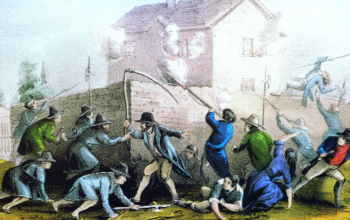
On July 29, 1848, O’Brien launches his rebellion. After being chased by a force of Young Irelanders and their supporters, a Royal Irish Constabulary unit takes refuge in a house and holds those inside as hostages.
It was evident to the rebels that the position of the police is almost impregnable. When a party of the Cashel police are seen arriving over Boulea Hill, the rebels attempt to stop them even though they are low on ammunition. The police continue to advance, firing up the road. It becomes clear that the police in the house are about to be reinforced and rescued. The rebels then fade away, effectively terminating both the era of Young Ireland and Repeal, but the consequences of their actions follow them for many years. This event is colloquially known as “The Battle of Widow McCormack’s cabbage plot.”
In O’Brien’s subsequent trial, the jury finds him guilty of high treason. He is sentenced to be hanged, drawn, and quartered. Petitions for clemency are signed by 70,000 people in Ireland and 10,000 people in England. On June 5, 1849, the sentences of O’Brien and other members of the Irish Confederation are commuted to transportation for life to Van Diemen’s Land (Tasmania in present-day Australia). In 1854, after five years in Van Diemen’s Land, O’Brien is released on the condition he never return to the United Kingdom. He settled in Brussels.
(Pictured: The attack on the Widow McCormack’s house on Boulagh Common, Ballingarry, County Tipperary)
In January 1941 Picture Post publishes their “Plan for Britain.” This includes minimum wages throughout industry, full employment, child allowances, a national health service, the planned use of land and a complete overhaul of education. This document leads to discussions about post-war Britain and is a populist forerunner of William Beveridge‘s November 1942 Social Insurance and Allied Services (known as the Beveridge Report).
Sales of Picture Post increase further during World War II and by December 1943 the magazine is selling 1,950,000 copies a week. By the end of 1949 circulation declines to 1,422,000.
Founding editor Stefan Lorant, who has some Jewish ancestry, had been imprisoned by Adolf Hitler in the early 1930s, and wrote a best-selling book thereafter, I Was Hitler’s Prisoner. By 1940, he fears he will be captured in a Nazi invasion of Britain and flees to Massachusetts in the United States, where he writes important illustrated U.S. histories and biographies. He is succeeded by Sir Tom Hopkinson following his departure in 1940.
During World War II, the art editor of the magazine, Edgar Ainsworth, serves as a war correspondent and accompanies the United States 7th Army on their advance across Europe in 1945. He visits the Bergen-Belsen concentration camp three times after the British army liberates the complex in April 1945. Several of his sketches and drawings from the camp are published in a September 1945 article, Victim and Prisoner. Ainsworth also commissions the artist Mervyn Peake to visit France and Germany at the end of the war, and he too reports from Bergen-Belsen.
On June 17, 1950, Leader Magazine is incorporated in Picture Post. Hopkinson is often in conflict with Sir Edward George Warris Hulton, the owner of Picture Post. Hulton mainly supports the Conservative Party and objects to Hopkinson’s socialist views. This conflict leads to Hopkinson’s dismissal in 1950 following the publication of James Cameron‘s article about South Korea‘s treatment of political prisoners in the Korean War.
By June 1952, circulation has fallen to 935,000. Sales continue to decline in the face of competition from television and a revolving door of new editors. By the time the magazine closes in July 1957, circulation is less than 600,000 copies a week.
Picture Post has been digitised as The Picture Post Historical Archive, 1938-1957 and consists of the complete, fully searchable facsimile archive of Picture Post. It is made available in 2011 to libraries and institutions.
(Pictured: Cover of the Picture Post Vol. 8, No. 12, dated September 21, 1940)
Roberts’s father, Rex Roberts, played double bass with a dance band called The Melodists in the 1940s. The headmaster at The High School, Dublin, calls his father in one day to suggest that he consider move his son to a boarding school as he is spending a lot of time in detention.
After being bribed with the promise of a bicycle, Roberts is moved to a Quaker-run boarding school, Newtown School, Waterford. The move proves successful but not for the anticipated reasons. He quickly takes notice of the electric guitars of the school band and realizes that is to be his future.
In 1976, Roberts and Johnnie Fingers (Moylett) decide to put a band together and, between them, they recruit the other four members, Pete Briquette (bass), Gerry Cott (guitar), Simon Crowe (drums) and singer Bob Geldof to form The Boomtown Rats.
Following the breakup of The Boomtown Rats in 1986, Roberts works with Simply Red, Orchestral Manoeuvres in the Dark and Flesh For Lulu in the role of audio engineer on tours in the UK and the United States. He avoids playing the guitar in public for ten years, after which he and Simon Crowe play together for four years in the rhythm and blues four-piece band The Velcro Flies.
After fifteen successful years as an Independent Financial Adviser, Roberts becomes disillusioned with the life insurance industry and becomes a central heating engineer to keep himself occupied between gigs. Roberts and Crowe, with Darren Beale on second lead guitar, and Peter Barton on bass guitar and lead vocals, are now playing together as Boomtown Rats Roberts and Crowe, and are performing material from the Boomtown Rats’ first three albums across Europe and the UK.
Eight Provisional Irish Republican Army prisoners escape from Crumlin Road Gaol in Belfast, one of the most heavily guarded prisons in Europe, on June 10, 1980. Using handguns that had been smuggled into the prison, they take prison officers hostage and shoot their way out of the building and exit through the front gate.
The regime inside Crumlin Road Gaol on that day is just like any other. The prison had been the scene of several protests regarding strip-searching shortly beforehand, but the rules had been somewhat relaxed. On A and C Wings the remand prisoners are outside in the yard for exercise. As usual, several men from each wing are called for visits. Some of these visits are from solicitors and an area of the prison is set aside to allow legal teams and the accused a place to discuss their business in private.
When warders come to return one set of prisoners to their wing, the operation begins. One of the Volunteers produces a gun, forces the warders to release the other prisoners and then locks about ten warders in the cell. They then make their way to B wing’s visiting area and arrest all the warders, visitors and solicitors who are there, before locking about thirty up in a room. One warder named Killen reaches for his baton, is disarmed and hit over the head.
Two warders and a solicitor are ordered to strip and three of the IRA Volunteers, dress in two uniforms and a suit respectively, calmly walk to the main gate which is opened for them. They then pull guns on the real warders in this key security area and make them lie on the ground until their five comrades run across a small courtyard to join them.
Once outside however, the alarm is set off and British Army sentries pour a hail of automatic fire at the prisoners from a watch tower before they are able to reach the front gate. Undeterred, the prisoners dash through the bullets, weaving from side to side to throw off their attackers.
As the men make their escape, clearly visible to republican prisoners in cells on the top landing of A wing, loud cheers go up and makeshift flags are flown from the windows.
Outside the prison, cars have been parked by the IRA’s Belfast Brigade in the car park of the health clinic beside the courthouse, their ignition keys hidden under the floor mats. The prisoners run across the road towards the health centre, dodging bullets as they run. The escapees head towards the loyalistShankill area where they commandeer cars to help their getaway.
Stunned by the daring escapees, the crown forces erect checkpoints across Belfast and along all border routes.
All eight men reach safe houses within an hour and, after a lying low for a short while, are spirited over the border to begin new lives “on the run.”
One week later, at the annual pilgrimage to the graveside of Wolfe Tone, the father of republicanism, which is always a source of renewed strength for its participants, the crowd is given an added morale boost when at the closing ceremony, one of the escapees, Paul ‘Dingus’ Magee, makes a dramatic appearance on the platform.
There are many more attempts to break free from Crumlin Road Gaol before it finally closes its doors in April 1995, having been used as a weapon in the attempted suppression of the Irish freedom struggle for 151 years.
A rebel force, over a thousand strong, converge on a large house owned by the McKee family. The McKees are a family of loyalists, who are unpopular in the region because they had provided information to the authorities leading to the arrest of a radical Presbyterian minister and some members of his congregation. The McKees know that they are unpopular and are thus armed to the teeth. As the house is surrounded, shots are fired from the fortified house, hitting some of the attackers. Gunfire holds the insurgents back for a short while, until one of them, a fiddler by the name of Orr, manages to sneak around the back of the house with a ladder and sets the roof alight. The house is destroyed, and all eight members of the family inside are killed. News of this quickly reaches the British forces in the area, and a 300 strong force under Colonel Granville Staplyton, consisting of NewtownardsYeomanry cavalry and 270 York Fencibles, as well as two light cannon, march to the region.
The rebels, however, anticipate the move and are waiting in ambush. Stapylton sees the road ahead twisting into woods, and orders a pair of scouts to check for anything suspicious. The men do not seem to be particularly vigilant, as they return and declared the road ahead to be safe.
The redcoats march into the wooded area, a dense hedge snaking along the road on one side. On the opposite side, the ground steadily rises, with the areas higher up the slope dominated by demesne woods. This provides cover for the Irish. The Irish rebels are mostly armed with pikes and the terrain allows them to quickly swarm the soldiers on the road below. In the fierce hand-to-hand combat that follows the British forces are overwhelmed. One of the fencibles, a veteran of wars in Europe who manages to survive the attack later states that he had never before witnessed such fierce fighting.
Over fifty men are piked to death before Staplyton manages to order the soldiers. He then brings his cannon into play against the mass of rebels before him, inflicting enough casualties with canister and grapeshot to blunt their attack. In the meantime, Staplytons force uses the situation to march to safety.
The Battle of Saintfield is largely regarded as a victory of the United Irish rebels. Long after, in the 1950s, two skeletons, a sword and bayonet of the York fencibles are found in the area.
The rebellion in Down proves to be short lived. Only a few days later the rebel army is slaughtered at the Battle of Ballynahinch.
Many of the dead from both sides of the battle are placed in a mass grave within the grounds of the nearby Presbyterian church. Although there is a plaque signifying the location of these graves, the area seems largely neglected with what appears to be temporary vehicle access over the belligerents final resting place. In May 2010 a memorial park is finished and opened. The area has been cleared and landscaped, with several new plaques and information boards being erected. The graves have been refurbished and the headstones relaid.
William III, also widely known as William of Orange, dies at Kensington Palace on March 8, 1702, following a fall from his horse when it stumbles on a molehill. Upon his death, Anne accedes to the throne of Britain and Ireland.
A Protestant, William participates in several wars against the powerful Catholic King of France, Louis XIV, in coalition with Protestant and Catholic powers in Europe. Many Protestants herald him as a champion of their faith. In 1685, William’s Catholic uncle and father-in-law, James, becomes king of England, Scotland and Ireland. James’s reign is unpopular with the Protestant majority in Britain. William, supported by a group of influential British political and religious leaders, invades England in what becomes known as the Glorious Revolution. On November 5, 1688, he lands at the southern English port of Brixham. James is deposed and William and his wife become joint sovereigns in his place.
William’s reputation as a staunch Protestant enables him to take power in Britain when many are fearful of a revival of Catholicism under James. William’s victory at the Battle of the Boyne in 1690 is still commemorated by loyalists in Northern Ireland and Scotland.
William and Mary reign together until Mary’s death from smallpox on December 28, 1694, after which William rules as sole monarch. Despite his conversion to Anglicanism, his popularity plummets during his reign as a sole monarch. His reign in Britain marks the beginning of the transition from the personal rule of the House of Stuart to the more Parliament-centred rule of the House of Hanover.
On March 8, 1702, William dies of pneumonia, a complication from a broken collarbone following a fall from his horse, Sorrel. The horse had been confiscated from Sir John Fenwick, one of the Jacobites who had conspired against William. Because his horse had stumbled into a mole’s burrow, many Jacobites toast “the little gentleman in the black velvet waistcoat.” Years later, Winston Churchill, in his A History of the English-Speaking Peoples, states that the fall “opened the door to a troop of lurking foes.” William is buried in Westminster Abbey alongside his wife. His sister-in-law, Anne, becomes queen regnant of England, Scotland and Ireland.
William’s death means that he would remain the only member of the Dutch House of Orange to reign over England.
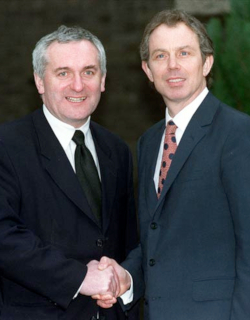
As EU delegates discuss the Union’s budget and Europe‘s farming subsidies, the two prime ministers vow to battle on with the peace deal’s outstanding problems.
“We’re very clear on what we have to do in the Good Friday agreement … we have just got to keep pushing the thing forward as well as we possibly can,” says Blair.
Both Ahern and Blair say the way forward on the outstanding deadlocked issue of paramilitary disarmament is through the official decommissioning commission. Chaired by former Canadian General John de Chastelain, the international commission is working to take arms out of the province’s political arena.
The republican party Sinn Féin insists it is fully cooperating with the commission, which is implementing the final deadline for the handover of arms in May 2000. But some Ulster Unionists oppose further peace moves because of the Irish Republican Army‘s (IRA) failure to begin disarming.
According to Ahern and Blair, the following few weeks will be a key time to try and finalise disarmament issues.
“During the month of March … we can conclude the central aspects,” says Blair.
However, in a separate development on February 26, the chairman of the IRA’s political wing, Sinn Féin’s Mitchel McLaughlin, warns that pressure on disarmament could cause irreparable damage to the fragile peace process. He adds that disarmament should not become a litmus test for progress.
“Those who are now demanding prior decommissioning before we move to setting up the executive are reneging on the Good Friday Agreement,” says McLaughlin in an interview with BBC Radio.
(From BBC News Online Network, Friday, February 26, 1999 | Pictured: Bertie Ahern with Tony Blair at the signing of the Good Friday Agreement in April 1998)
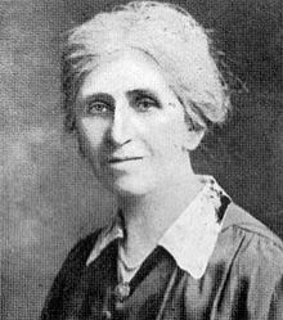
Knowles’ early interest in botany is encouraged by her father, William James Knowles, himself an amateur scientist who takes Matilda and her sister to meetings of the Belfast Naturalists’ Field Club. This is where she first meets Robert Lloyd Praeger who continues to be a lifelong influence. In 1895 she is introduced to the Derry botanist Mary Leebody and together they work on a supplement to Samuel Alexander Stewart‘s and Thomas Hughes Corey‘s 1888 book the Flora of the North-east of Ireland.
Knowles then volunteers to help with the crowdsourcing of material about the plants of County Tyrone. While completing this work Knowles publishes her own first paper about Tyrone’s flowering plants in 1897. She eventually sends in over 500 examples that are considered for inclusion in the Irish Topographical Botany, which Praeger publishes in 1901.
In 1902, after attending the Royal College of Science for Ireland for a year, Knowles is appointed a temporary assistant in the then Botanical Section of the National Science and Art Museum. She works closely with Professor Thomas Johnson to continue the development of the Herbarium collection. She also co-authors with him the Hand List of Irish Flowering Plants and Ferns (1910).
One of Knowles’ first works is The Maritime and Marine Lichens of Howth, which the Royal Dublin Society publishes in 1913. Knowles had gathered the knowledge and experience to do this while diligently assisting with a survey of Clare Island as suggested by Praeger. This novel survey involves not only Irish but also several European scientists including prominent UK lichenologist, Annie Lorrain Smith. This is claimed as the most extensive piece of field work at the time. As a result, Knowles is able to create a foundation for her later specialism in lichens.
Knowles publishes more than thirty scientific papers on a wide range of botanical subjects between 1897 and 1933. It is while studying the lichens of Howth that she discovers how lichens by the shore grow in distinct tidal zones that can be distinguished by their colour: black, orange and grey.
Her major work is The Lichens of Ireland which adds over 100 species of lichen to the Irish List and records the distribution of the eight hundred species identified in Ireland. She achieves this task with the collaboration of thirty other natural scientists. It is published in 1929 and includes twenty lichens that had previously not been identified as Irish.
Professor Thomas Johnson retires in 1923, allowing Knowles to take over curatorship, working with Margaret Buchanan. As she becomes older Knowles’ hearing begins to fail such that she has to rely on an ear trumpet. Despite her deafness she still attends meetings. She cares for and adds to the National Museum Herbarium collection although never gets the credit she deserves. In 1933 she plans to retire but pneumonia ends her life before she ends her career. Knowles dies in Dublin on April 27, 1933.
Knowles is honoured with a commemorative plaque by the Irish National Committee for Science and Engineering in October 2014 to mark the 150th anniversary of her birth.
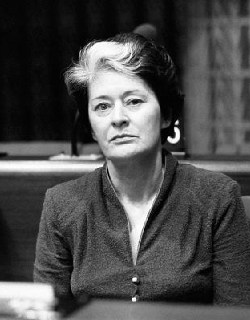
Harrington is educated locally at the Convent of Mercy in Kinsale, where she is one of only two girls in her class to sit the Leaving Certificate examination. Before entering politics, she works as a civil servant with the Department of Posts and Telegraphs. She marries Dan Desmond in 1958.
Desmond is elected to the European Parliament at the 1979 European Parliament election for the Munster constituency. However, her time in Europe is short-lived, as she returns to domestic politics when she is offered a position as Minister and the chance to impact upon national legislation. At the 1981 general election she switches her constituency to Cork South-Central. A Fine Gael–Labour Party coalition comes to power, and she is appointed Minister for Health and Social Welfare.
Desmond’s cabinet appointment is historic, as she is only the second woman to be a member of cabinet since the foundation of the state in 1922, and the first in any Fine Gael or Labour Party cabinet. Countess Markievicz had held the cabinet post of Minister for Labour in the revolutionary First Dáil in 1919, but only one woman had held cabinet office after the foundation of the state, Máire Geoghegan-Quinn of Fianna Fáil who was appointed as Minister for the Gaeltacht in 1979.
Desmond retires from full-time politics at the 1987 general election for health reasons. She dies suddenly in Cork, County Cork on January 6, 2005.