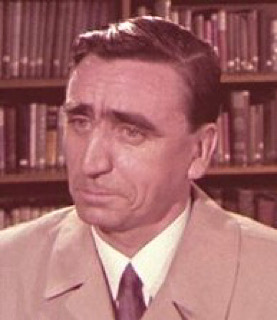
After lecturing at St. Patrick’s College, Dublin, from 1941 to 1944, Slevin enters the civil service. Despite no prior interest in heraldry, he is selected via competition to assist the newly installed Chief Herald, Dr. Edward MacLysaght, in the genealogical office, Bedford Tower, Dublin Castle. After serving as Deputy Chief Herald (1944–54), he succeeds MacLysaght as Chief Herald of Ireland, becoming the longest-serving occupant of the office (1954–81).
One of three national heralds named to a vexillogical committee to devise a common emblem for the Council of Europe, Slevin persuades his colleagues to eschew religious iconography, such as the Christian cross, as inappropriate. His own design of a circle of twelve golden stars on an azure field is selected by the committee in 1954, and formally accepted by the council in December 1955. With blue chosen as a colour common to the flags of many European countries, the twelve stars represent not individual states but such associations as the zodiac and a clock face, suggesting ideals of universality, harmony, and evolution through time. Adopted in 1985 for the flag of the European Community (latterly the European Union), his design attracts wide acclaim in heraldic circles, leading to his being awarded membership of the Académie Internationale d’Héraldique.
During Slevin’s tenure as Chief Herald, several hundred patents of arms are issued to Irish public bodies, including civic and municipal authorities, and to individuals of Irish descent worldwide. On behalf of the Irish government, he confirms the Irish connections of such notables as United StatespresidentsKennedy, Nixon, and Reagan, French president Charles de Gaulle, and Princess Grace of Monaco. His coat of arms for President Kennedy, combining the ancient arms of the Kennedy and Fitzgerald families, wins renown as a masterpiece of heraldic design. While possessing a keen sense of graphic impact, he is not a great draughtsman, and he employs the noted heraldic painter Myra Maguire to execute the designs that he creates. He oversees expansion of genealogical office services, instituting an advisory service and team of research assistants for the growing numbers – especially within emigrant communities abroad – seeking to trace Irish ancestry. He establishes a committee to catalogue churchyard memorial inscriptions as an archival resource, meant to redress the loss of state records in the 1922 Four Courts fire.
Slevin wins first prize in successive years in the 1950s for entries in the Oireachteas drama competition, both plays being subsequently produced at the Abbey Theatre. He writes a detective novel in Irish, and contributes numerous articles to learned journals, chiefly on medieval heraldry and Anglo-Irish families. Erudite and possessed of great presence, courtesy, and wit, he is an engaging speaker.
Resident in south County Dublin, Slevin is active in amateur dramatics, local history societies, and the ecumenical movement. His recreation is long country walks. He marries Millicent Nolan in 1950 and they have three sons. He dies on January 18, 1997.
(From: “Slevin, (John) Gerard” by Lawrence William White, Dictionary of Irish Biography, http://www.dib.ie, October 2009 (last revised February 2025))
European Movement Ireland (EM Ireland) (Irish: Gluaiseacht na hEorpa in Éirinn) is founded in Dublin on January 11, 1954. EM Ireland is an independent not-for-profit organisation that campaigns for every Irish person to get involved in the European Union (EU) and by doing so, help shape it. It is the oldest Irish organisation dealing with the EU, pre-dating Ireland’s membership of the European Economic Community (EEC) in 1973 by almost twenty years. The organisation is headed by Chief Executive Officer (CEO), Noelle Connell. Julie Sinnamon acts as Chair of the EM Ireland Board.
These seven signatories lay the first stone paving Ireland’s way to full membership of the EU. The aim of the Irish Council is to inform Irish individuals and organisations about the EU. One of its primary objectives is for Ireland to gain membership of the European Communities (EC) (principally the European Economic Community (EEC), as the EU is then known). Former TaoisighGarret FitzGerald and Jack Lynch, and former PresidentMary Robinson back the initiative. After a referendum is held on the Third Amendment of the Irish Constitution, which is overwhelmingly approved by voters in May 1972, Ireland joins the European Communities as a full member state on January 1, 1973.
The Irish Council later becomes European Movement Ireland. Today the organisation claims to act as source of information for Irish citizens regarding the work of the EU and its stated aim is to promote reasoned robust and fair debate about EU in Ireland.
EM Ireland is part of a pan-European network. European Movement International is a lobbying association that coordinates the efforts of associations and national councils with the goal of promoting European integration, and disseminating information about it. It seeks to encourage and facilitate the active participation of citizens and civil society organisations in the European Union as it develops. The European Movement network is represented in over 41 countries and has over 20 international organisations as members. The current President of European Movement is the former MEP from Belgium, Guy Verhofstadt. For a full list of all European Movement offices, and an outline of the history of the international network visit the EM International website at http://www.europeanmovement.eu/
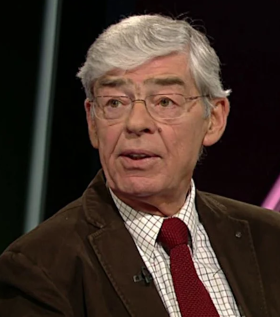
Alan Martin Dukes, former Fine Gaelpolitician, is born in Drimnagh, Dublin, on April 20, 1945. He holds several senior government positions and serves as a Teachta Dála (TD) from 1981 to 2002. He is one of the few TDs to be appointed a minister on their first day in the Dáil.
The Dukes family originally comes from the north of England. His grandfather serves with the Royal Engineers in World War I and settles in County Cork and then County Kerry afterward where he works with the Post Office creating Ireland’s telephone network.
Dukes is educated by the Christian Brothers at Coláiste Mhuire, Dublin, and is offered several scholarships for third level on graduation, including one for the Irish language. His interest in the Irish language continues to this day, and he regularly appears on Irish-language television programmes.
On leaving school he attends University College Dublin (UCD), where he captains the fencing team to its first-ever Intervarsity title.
In the 1979 European Parliament election, Dukes stands as a Fine Gael candidate in the Munster constituency. He has strong support among the farming community, but the entry of T. J. Maher, a former president of the IFA, as an independent candidate hurts his chances of election. Maher tops the poll.
This minority Fine Gael–Labour Partycoalition government collapses in February 1982 on the budget but returns to power with a working majority in December 1982. Dukes is again appointed to cabinet, becoming Minister for Finance less than two years into his Dáil career.
He faces a difficult task as finance minister. Ireland is heavily in debt while unemployment and emigration are high. Many of Fine Gael’s plans are deferred while the Fine Gael–Labour Party coalition disagrees on how to solve the economic crisis. The challenge of addressing the national finances is made difficult by electoral arithmetic and a lack of support from the opposition Fianna Fáil party led by Charles Haughey. He remains in the Department of Finance until a reshuffle in February 1986 when he is appointed Minister for Justice.
This is a difficult time for the country. Haughey’s Fianna Fáil runs on promises to increase spending and government services, and attacking the cutbacks favoured by Fine Gael. However, on taking office, the new Taoiseach and his finance minister Ray MacSharry immediately draw up a set of cutbacks including a spate of ward and hospital closures. This presents a political opportunity for the opposition to attack the government.
However, while addressing a meeting of the TallaghtChamber of Commerce, Dukes announces, in what becomes known as the Tallaght Strategy that: “When the government is moving in the right direction, I will not oppose the central thrust of its policy. If it is going in the right direction, I do not believe that it should be deviated from its course, or tripped up on macro-economic issues.”
This represents a major departure in Irish politics whereby Fine Gael will vote with the minority Fianna Fáil Government if it adopts Fine Gael’s economic policies for revitalising the economy. The consequences of this statement are huge. The Haughey government is able to take severe corrective steps to restructure the economy and lay the foundations for the economic boom of the nineties. However, at a snap election in 1989, Dukes does not receive electoral credit for this approach, and the party only makes minor gains, gaining four seats. The outcome is the first-ever coalition government for Fianna Fáil, whose junior partner is the Progressive Democrats led by former Fianna Fáil TD Desmond O’Malley.
Initially, Fianna Fáil’s Brian Lenihan Snr is the favourite to win. However, after several controversies arise, relating to the brief Fianna Fáil administration of 1982, and Lenihan’s dismissal as Minister for Defence midway through the campaign, the Labour Party’s Mary Robinson emerges victorious. To many in Fine Gael, the humiliation of finishing third is too much to bear and a campaign is launched against Dukes’ leadership. He is subsequently replaced as party leader by John Bruton.
Bruton brings Dukes back to the front bench in September 1992, shortly before the November 1992 Irish general election. In February 1994, Dukes becomes involved in a failed attempt to oust Bruton as leader and subsequently resigns from the front bench. Bruton becomes Taoiseach in December 1994 and Dukes is not appointed to cabinet at the formation of the government.
In 2001, Dukes backs Michael Noonan in his successful bid to become leader of Fine Gael.
After 21 years, Dukes loses his Dáil seat at the 2002 Irish general election. This contest sees many high-profile casualties for Fine Gael, including Deputy LeaderJim Mitchell, former deputy leader Nora Owen and others. Many local commentators feel that Dukes’ loss is due to a lack of attention to local issues, as he is highly involved in European projects and has always enjoyed a national profile.
He retires from frontline politics in 2002 and is subsequently appointed Director General of the Institute of International and European Affairs. He remains active within Fine Gael and serves several terms as the party’s vice-president. From 2001 to 2011, he is President of the Alliance française in Dublin, and in June 2004, the French Government appoints him an Officer of the Legion of Honour. In April 2004, he is awarded the Commander’s Cross of the Order of Merit of the Republic of Poland.
In December 2008, Dukes is appointed by Finance Minister Brian Lenihan Jnr as a public interest director on the board of Anglo Irish Bank. The bank is subsequently nationalised, and he serves on the board until the Irish Bank Resolution Corporation (IBRC) is liquidated in 2013.
Dukes has lived in Kildare since first being elected to represent the Kildare constituency in 1981. His wife Fionnuala (née Corcoran) is a former local politician and serves as a member of Kildare County Council from 1999 until her retirement in 2009. She serves as Cathaoirleach of the council from 2006 to 2007, becoming only the second woman to hold the position in the body’s one-hundred-year history. They have two daughters.
The founders of the Libertas Institute are Declan Ganley, who serves as President, Naoise Nunn, James O’Reilly, Norrie Keane, Martina Higgins, Seán Ganley (Declan’s brother) and Dr. Chris Coughlan.
The group’s mission statement is “…to initiate and provoke enlightened discussion on the European Union, its relevance to its member states and peoples and its role in World affairs having regard to our shared values of peace, democracy, individual liberty and free markets…”
The Libertas Charter defines what is considered to be Europe‘s traditional values and influences, asserts what citizens’ rights and responsibilities are, acknowledges the EU’s role since World War II, states that the present EU structure is inherently undemocratic and unaccountable, and pledges to create a popular movement to debate Europe’s future.
The Libertas Institute has a loan facility with Ganley, and by October 3, 2008, it has used €200,000 of this money. Since January 1, 2008, it also has the facility to receive public donations via its website. Ganley and his wife, Delia Mary Ganley (née Paterek), also donate the maximum amount of €6,300 each. Libertas states that its donors are “100% Irish.”
The Libertas Institute is a “third party” for the purposes of political fundraising. Regulation of such is monitored by the Standards in Public Office Commission which imposes a donations limit of €5,348 per donor per year, rising to €6,348.69 per donor per year in 2009, imposes a limit of €126.97 for any given anonymous donation, and disallows any donation from any non-Irish citizens resident outside the island of Ireland.
The Libertas Institute advocates a European Energy Innovation Fund intended to license and fund carbon-neutral energy producers, the funding deriving from auctions of CO2 emissions allowances. It also deprecates the Treaty of Lisbon and advocates a “no” vote in Lisbon I, the first Irish referendum on the Treaty of Lisbon. On March 12, 2008, Libertas launches a “no” campaign called “Facts, not politics” and states that they expect to spend in the region of €1.5m on the campaign. The campaign targets wavering moderates, the most critical votes for the referendum. The campaign is joined by businessman Ulick McEvaddy on April 20, 2008.
Several politicians, including Minister of State for European AffairsDick Roche, clashes with the group’s campaign stance but The Sunday Business Post reports that the group’s efforts at projecting its warnings about the treaty in the media are “hugely successful.” The referendum is held on June 12, 2008, and is defeated by 53.4% to 46.6%, with a turnout of 53.1%.
Following the referendum, attention shifts to Ganley’s new political party, Libertas.eu, and the Libertas Institute website, libertas.org, is redirected to that party’s website.
An Taisce is established on a provisional basis in September 1946 and incorporated as a company based on an “association not for profit” in June 1948. It is a charitable non-governmental organisation (NGO) active in the areas of the environment and built heritage in the Republic of Ireland. It considers itself the oldest environmental and non-governmental organisation in the country and is somewhat similar to the National Trust of England, Wales and Northern Ireland but based more directly on the National Trust for Scotland. Its first president is the prominent naturalist Robert Lloyd Praeger.
An Taisce is a membership-based charity, rather than a state or semi-state organisation, or quango, but it does receive government and European Union funding for specific programmes, such as Blue Flag beaches, and Green Schools private-sector funding for, for example, the Irish Business Against Litter surveys, and a mix of State and private funding for the annual National Spring Clean. An Taisce has for decades also had a statutory role in certain planning and environmental processes in the country.
The work of the organisation includes policy recommendation and campaigning in the built and natural heritage areas, the holding in trust of relevant properties, and environmentally relevant education. It has a number of local associations, which may assist in caring for properties, and monitor planning in their areas.
A public meeting to consider the need for a national trust is held in the Mansion House in September 1946, convened by the Royal Irish Academy, the Royal Society of Antiquaries of Ireland, An Óige, the Geographical Society of Ireland, the Dublin Naturalists’ Field Club and the Irish Society for the Preservation of Birds. The meeting resolves to create such a body, and elect both a provisional committee, and a council of 16 plus 4 co-opted members, who secure bankers, auditors and solicitors. After extensive debate, the two-part name is chosen and application is made to form a not-for-profit company. Special approval is sought from the Minister for Trade and Commerce for charity-appropriate memorandum and articles, adhering to the “association not for profit” section of the then Companies Act, with a prohibition on distribution of surpluses, and for permission to omit the word “Limited” from the company name.
An Taisce is an indirect successor to the all-Island National Trust Committee which had ceased to exist in 1946 after the passing of the Northern Ireland National Trust Act.
The organisation is duly incorporated as a company limited by guarantee on June 28, 1948. The initial constitution is modelled on that of the National Trust for Scotland. The first official meeting of the company was held on July 15, 1948, at the Royal Irish Academy’s headquarters, Academy House on Dawson Street, and the first annual general meeting is convened on September 23 of the same year, with formal greetings from the National Trust and the National Trust for Scotland.
The treaty had been intended to enter into force on January 1, 2009, but has to be delayed following the Irish rejection. However, the Lisbon treaty is approved by Irish voters when the Twenty-eighth Amendment of the Constitution of Ireland is approved in the second Lisbon referendum, held in October 2009.
The Treaty of Lisbon is signed by the member states of the European Union on December 13, 2007. It is in large part a revision of the text of the Treaty establishing a Constitution for Europe (TCE) after its rejection in referendums in France in May 2005 and in the Netherlands in June 2005. The Treaty of Lisbon preserves most of the content of the Constitution, especially the new rules on the functioning of the European Institutions but gives up any symbolic or terminologic reference to a constitution.
Because of the decision of the Supreme Court of Ireland in Crotty v. An Taoiseach (1987), an amendment to the Constitution is required before it can be ratified by Ireland. Ireland is the only one of the then fifteen EU member states to put the Treaty to the people in a referendum. Ratification of the Treaty in all other member states is decided upon by national parliaments alone.
The government parties of Fianna Fáil and the Progressive Democrats are in favour of the treaty, but the other government party, the Green Party, is divided on the issue. At a special convention on January 19, 2008, the leadership of the Green Party fails to secure a two-thirds majority required to make support for the referendum official party policy. As a result, the Green Party itself does not participate in the referendum debate, although individual members are free to be involved in whatever side they chose. All Green Party members of the Oireachtas support the Treaty. The main opposition parties of Fine Gael and the Labour Party are also in favour. Only one party represented in the Oireachtas, Sinn Féin, is opposed to the treaty, while minor parties opposed to it include the Socialist Party, the Workers’ Party and the Socialist Workers Party. Independent TD’s Tony Gregory and Finian McGrath, Independent MEPKathy Sinnott, and Independent members of the Seanad from the universities David Norris, Shane Ross and Rónán Mullen advocate a “No” vote as well.
The Government sends bilingual booklets written in English and Irish, explaining the Treaty, to all 2.5 million Irish households. However, compendiums of the two previous treaties, of which the Lisbon Treaty is intended to be a series of reforms and amendments, remain unavailable in Ireland. Some commentators argue that the treaty remains essentially incomprehensible in the absence of such a compendium.
On March 12, 2008, the Libertas Institute, a lobby group started by businessman Declan Ganley, launches a campaign called Facts, not politics which advocates a “No” vote in the referendum. A month later, the German Chancellor, Angela Merkel, appeals to Irish people to vote “Yes” in the referendum while on a visit to Ireland. The anti-Lisbon Treaty campaign group accuses the government and Fine Gael of a U-turn on their previous policy of discouraging foreign leaders from visiting Ireland during the referendum campaign. The European Commissioner for Internal MarketCharlie McCreevy admits he had not read the Treaty from cover to cover and says, “he would not expect any sane person to do so.”
At the start of May, the Irish Alliance for Europe launches its campaign for a “Yes” vote in the referendum this consists of trade unionists, business people, academics and politicians. Its members include Garret FitzGerald, Ruairi Quinn, Pat Cox and Michael O’Kennedy. The TaoiseachBrian Cowen states that should any member of the Fianna Fáil parliamentary party campaign against the treaty, they will likely be expelled from the party.
On May 21, 2008, the executive council of the Irish Congress of Trade Unions votes to support a “Yes” vote in the referendum. Rank and file members of the individual unions are not balloted, and the Technical, Engineering and Electrical Union (TEEU) advises its 45,000 members to vote “No.” The Irish bishops conference states the Catholic Church‘s declaration that the treaty will not weaken Ireland’s constitutional ban on abortion, however the conference does not advocate either a “Yes” or “No” vote. By the start of June, Fianna Fáil, Fine Gael and the Labour Party have united in their push for a “Yes” vote despite earlier divisions. The two largest farming organisations, the Irish Creamery Milk Suppliers Association (ICMSA) and the Irish Farmers’ Association call for a “Yes” vote, the latter giving its support after assurances from Taoiseach Brian Cowen that Ireland will use its veto in Europe if a deal on World Trade reform is unacceptable.
There were 3,051,278 voters on the electoral register. The vast majority of voting takes place on Thursday, June 12, between 7:00 a.m. and 10:00 p.m. Counting begins at 9:00 a.m. the following morning. Several groups vote before the standard polling day, with some casting postal votes before June 9. These include members of the Irish Defence Forces serving in United Nations peacekeeping missions, Irish diplomats and their spouses abroad, members of the Garda Síochána, those unable to vote in person due to physical illness or disability, those who are unable to vote in person due to their employment (including students) and prisoners.
Votes are counted separately in each Dáil constituency. The overall verdict is formally announced by the Referendum Returning officer in Dublin Castle by accumulating the constituency totals.
(Pictured: Campaign posters in St. Stephen’s Green, Dublin)
Following Fine Gael’s defeat at the 1977 Irish general election, the new leader, Garret FitzGerald, appoints Bruton to the front bench as Spokesperson on Agriculture. He is later promoted as Spokesperson for Finance. He plays a prominent role in Fine Gael’s campaign in the 1981 Irish general election, which results in another coalition with the Labour Party, with FitzGerald as Taoiseach. He receives a personal vote in Meath of nearly 23%, and at the age of only 34 is appointed Minister for Finance, the most senior position in the cabinet. In light of overwhelming economic realities, the government abandons its election promises to cut taxes. The government collapses unexpectedly on the night of January 27, 1982, when Bruton’s budget, that was to impose an unpopular value-added tax (VAT) on children’s shoes, is defeated in the Dáil.
The minority Fianna Fáil government which follows only lasts until November 1982, when Fine Gael once again returns to power in a coalition government with the Labour Party. However, when the new government is formed, Bruton is moved from Finance to become Minister for Industry and Energy. After a reconfiguration of government departments in 1983, he becomes Minister for Industry, Trade, Commerce and Tourism. In a cabinet reshuffle in February 1986, he is appointed again as Minister for Finance. Although he is Minister for Finance, he never presents his budget. The Labour Party withdraws from the government due to a disagreement over his budget proposals leading to the collapse of the government and another election.
Following the 1987 Irish general election, Fine Gael suffers a heavy defeat. Garret FitzGerald resigns as leader immediately, and a leadership contest ensues between Alan Dukes, Peter Barry and Bruton himself, with Dukes being the ultimate victor. Dukes’s term as leader is lackluster and unpopular. The party’s disastrous performance in the 1990 Irish presidential election, in which the party finishes in a humiliating and then unprecedented third in a national election, proves to be the final straw for the party and Dukes is forced to resign as leader shortly thereafter. Bruton, who is the deputy leader of Fine Gael at the time, is unopposed in the ensuing leadership election.
Bruton’s election is seen as offering Fine Gael a chance to rebuild under a far more politically experienced leader. However, his perceived right-wing persona and his rural background are used against him by critics and particularly by the media. However, to the surprise of critics and of conservatives, in his first policy initiative he calls for a referendum on a Constitutional amendment permitting the enactment of legislation allowing for divorce in Ireland.
By the 1992 Irish general election, the anti-Fianna Fáil mood in the country produces a major swing to the opposition, but that support goes to the Labour Party, not Bruton’s Fine Gael, which actually loses a further 10 seats. Even then, it initially appears that Fine Gael is in a position to form a government. However, negotiations stall in part from Labour’s refusal to be part of a coalition which would include the libertarian Progressive Democrats, as well as Bruton’s unwillingness to take Democratic Left into a prospective coalition. The Labour Party breaks off talks with Fine Gael and opts to enter a new coalition with Fianna Fáil.
In late 1994, the government of Fianna Fáil’s Albert Reynolds collapses. Bruton is able to persuade Labour to end its coalition with Fianna Fáil and enter a new coalition government with Fine Gael and Democratic Left. He faces charges of hypocrisy for agreeing to enter government with Democratic Left, as Fine Gael campaigned in the 1992 Irish general election on a promise not to enter government with the party. Nevertheless, on December 15, 1994, aged 47, he becomes the then youngest ever Taoiseach. This is the first time in the history of the state that a new government is installed without a general election being held.
Bruton’s politics are markedly different from most Irish leaders. Whereas most leaders had come from or identified with the independence movement Sinn Féin (in its 1917–22 phase), Bruton identifies more with the more moderate Irish Parliamentary Party (IPP) tradition that Sinn Féin had eclipsed at the 1918 Irish general election.
Continued developments in the Northern Ireland peace process and Bruton’s attitude to Anglo-Irish relations come to define his tenure as Taoiseach. In February 1995, he launches the Anglo-Irish “Framework Document” with the British prime ministerJohn Major. It foreshadows the 1998 Good Friday Agreement, which, among other things, establishes an elected, power-sharing executive authority to be run by these onetime adversaries, ending 30 years of bloodletting that had claimed more than 3,000 lives. However, he takes a strongly critical position on the British Government‘s reluctance to engage with Sinn Féin during the Irish Republican Army‘s 1994–1997 ceasefire. He also establishes a working relationship with Gerry Adams of Sinn Féin; however, both are mutually distrustful of each other.
The coalition remains in force to contest the 1997 Irish general elections, which are indecisive, and Bruton serves as acting taoiseach until the Dáil convenes in late June and elects a Fianna Fáil–Progressive Democrats government. He retires from Irish politics in 2004 and serves as the European Union Ambassador to the United States (2004–09).
Bruton dies at the age of 76 on February 6, 2024, at the Mater Private Hospital in Dublin, following a long bout with cancer. A state funeral is held on February 10 at St. Peter’s and St. Paul’s Church in Dunboyne.
TaoiseachBrian Cowen resigns as leader of the ruling Fianna Fáil party on January 22, 2011. Having won a secret leadership ballot on Tuesday, January 18, during a week of political turmoil, he says he will remain at the head of government until the upcoming election on March 11, 2011.
“I’m concerned that renewed internal criticism of Fianna Fáil is deflecting attention from this important debate,” Cowen says. “Therefore, taking everything into account after discussing the matter with my family I have taken on my own counsel, the decision to step down.”
Cowen says he spoke to John Gormley, leader of the junior coalition party, the Green Party, before making the announcement. He says his resignation will not affect government business.
“My political assessment is that this is the right thing to do for the party,” Cowen says at a press conference at the Merrion Hotel in central Dublin. “But it’s about me directing my attention to the country.”
During the past week, six ministers resigned, and Cowen’s cabinet reshuffle collapsed, prompting a Green Party threat to pull out of the coalition government.
“I believe that it was my duty to put in place the best possible team we could to fight this election to put them on the frontbench and into position,” Cowen says. “It was not a cynical view by me, it was a political act.”
Opposition parties demand Cowen set a new date for the general election. The Fine Gael leader, Enda Kenny, says he would move a motion of no confidence in Cowen as Taoiseach in the Dáil on Tuesday, January 25, unless he goes to the president to seek a dissolution of parliament. He says his party will also vote against the government in upcoming motion of confidence previously put forward by the Labour Party.
The Labour Party leader, Eamon Gilmore, says the Irish people do not want the government to remain in office another day. “It is simply not tenable for Cowen to remain on as Taoiseach as his colleagues in Fianna Fáil squabble over the remnants of their party,” he says.
The Sinn Féin president, Gerry Adams, says Cowen’s decision will lead to further instability. “The government and Fianna Fáil are in chaos. Their focus is not on the problems facing the country,” he says.
(From: “Irish prime minister Brian Cowen resigns as party leader” by David Batty, The Guardian, http://www.theguardian.com, January 22, 2011)
The meeting is an important opportunity to discuss developments and reflect on the perspectives and priorities of all participants since the last British-Irish Council summit in July 2016. There is specific focus during the EU exit roundtable session on agriculture, agri-food and fisheries, trade, and implications of the UK’s exit from the EU.
UK government ministers also emphasize their continued commitment to work closely with all seven member administrations on the UK’s exit from the EU, using existing structures of bilateral and multilateral engagement.
Secretary of State for Wales, Alun Cairns, says, “The British-Irish Council summit is an important forum as we prepare to leave the European Union. The meeting allows us to maintain and strengthen relations between our governments and ensure we are all in the best position to face challenges and find new opportunities. It’s important to remember the UK is leaving the EU, but we are not leaving Europe. We want the best possible relationship with the EU as a whole. The eight council members will discuss issues including Brexit and provide the best opportunities for our young people as part of Early Years strategy. I look forward to some positive and constructive talks on both topics.”
Secretary of State for Northern Ireland, James Brokenshire, says, “At July’s BIC meeting we established an important commitment to maintain intensive and open dialogue and today’s sessions reflected the kind of mature cooperation that close friends and partners enjoy. There was a strong collective will to continue to work together in order to achieve the best outcomes for the people we represent. The UK wants the strongest possible economic links with our European neighbours, especially with Ireland – our nearest neighbour and the only EU member with which we share a land border. So as we forge a new relationship between the UK and Europe we must also maintain and strengthen the bonds within these islands. The BIC will continue to make a vital contribution to that effort and underlines our commitment to the structures set out in the Belfast Agreement and its successors.”
Minister at the Department for Exiting the European Union, Robin Walker, says, “As we begin the work of leaving the European Union, forums such as the British-Irish Council are an important way of maintaining close cooperation and open dialogue between our governments. This includes maintaining our special and friendly relationship with Ireland which has gone from strength to strength over many years. And we will continue to build on this strong relationship as we make a success of Brexit and maximise the opportunities for both our countries.”
A second session at the council addresses the Early Years policies of the eight administrations and welcomes the latest sector report highlighting progress since the 2012 summit. All in attendance acknowledge the critical importance of investment in early years provision in creating strong foundations for children, families and societies to thrive.
The British-Irish Council is a forum for discussion. It was established by the Belfast Agreement to promote positive, practical relationships among the people of the islands and to provide a forum for consultation and co-operation.
(From: “British-Irish Council Summit: Focus on EU exit and ‘Early Years’ policy” press release by the Government of the United Kingdom, http://www.gov.uk, November 25, 2016)
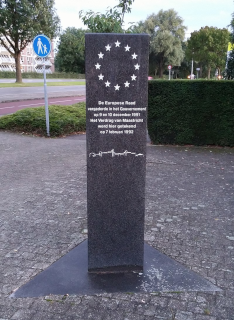
The Treaty on European Union, commonly known as the Maastricht Treaty, comes into effect on November 1, 1993, formally establishing the European Union (EU).
Concluded in 1992 between the then-twelve member states of the European Communities, the treaty announces “a new stage in the process of European integration.” The treaty establishes a European Union (EU), with EU citizenship granted to every person who is a citizen of a member state. EU citizenship enables people to vote and run for office in local and European Parliament elections in the EU country in which they live, regardless of their nationality. The treaty also provides for the introduction of a central banking system and a common currency (the euro), commits members to implement common foreign and security policies, and calls for greater cooperation on various other issues, including the environment, policing, and social policy.
Although these provisions are widely seen to presage a “federal Europe,” the focus of constitutional debate shifts to the later 2007 Treaty of Lisbon. In the wake of the European debt crisis unfolding from 2009, the most enduring reference to the Maastricht Treaty has been to the rules of compliance – the “Maastricht criteria” – for the currency union.
Against the background of the end of the Cold War and the reunification of Germany, and in anticipation of accelerated globalisation, the treaty negotiates tensions between member states seeking deeper integration and those wishing to retain greater national control. The resulting compromise faces what is to be the first in a series of EU treaty ratification crises.
The twelve members of the European Communities signing the Treaty are represented by:
(Pictured: Stone memorial in front of the entry to the Limburg Province government building in Maastricht, Netherlands, commemorating the signing of the Maastricht Treaty)




 seamus dubhghaill