seamus dubhghaill

Promoting Irish Culture and History from Little Rock, Arkansas, USA


Leave a comment

Death of Patrick Sarsfield, 1st Earl of Lucan

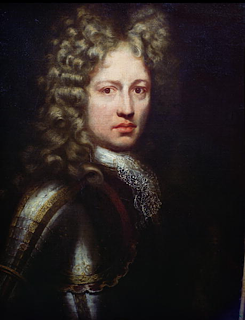
Patrick Sarsfield, 1st Earl of Lucan, an Irish army officer, is killed at Huy, Belgium, on August 21, 1693, while serving in the French Royal Army. He is now best remembered as an Irish patriot and military hero.

Originally of English descent, Sarsfield is born into a wealthy Catholic family around 1655. His father, Patrick, is an Irish landowner and soldier, and his mother is Anne O’Moore, daughter of Rory O’Moore, a Gaelic noble who plays a leading part in the Irish Rebellion of 1641.

There are few surviving records of Sarsfield’s early life, although it is generally agreed he is brought up on the family estates at Tully. While some biographies claim he is educated at a French military college, there is no evidence for this.

In the 1670 Secret Treaty of Dover, Charles II agrees to support a French attack on the Dutch Republic, and supply 6,000 troops for the French army. When the Franco-Dutch War begins in 1672, Sarsfield is commissioned into his brother-in-law James Scott, 1st Duke of Monmouth‘s regiment. Although England leaves the war in 1674, the brigade continues to serve in the Rhineland, under Henri de La Tour d’Auvergne, Viscount of Turenne. Sarsfield transfers into a regiment commanded by Irish Catholic Sir George Hamilton.

Sarsfield fights at EntzheimTurckheim and Altenheim. He and Hamilton are standing next to Turenne when he is killed by a chance shot at Salzbach in July 1675. He remains in France until the war ends in 1678, then returns to London to join a new regiment being recruited by Thomas Dongan, 2nd Earl of Limerick. However, the Popish Plot then results in Sarsfield and other Catholics being barred from serving in the military.

This leaves Sarsfield short of money, and he becomes involved in an expensive legal campaign to regain Lucan Manor from the heirs of his brother William, who dies in 1675. This ultimately proves unsuccessful amid allegations of forged documents, and in 1681 he returns to London, where he makes two separate attempts to abduct an heiress and is lucky to escape prosecution. When Charles’s Catholic brother James becomes king in 1685, Sarsfield rejoins the army and fights in the decisive Battle of Sedgemoor, which ends the Monmouth Rebellion. James is keen to promote Catholics, whom he views as more loyal, and by 1688 Sarsfield is colonel of a cavalry unit.

After Richard Talbot, 1st Earl of Tyrconnell, is appointed Lord Deputy of Ireland in 1687, he begins creating a Catholic-dominated Irish army and political establishment. Aware of preparations for invasion by his nephew and son-in-law William of Orange, James sends Sarsfield to Dublin in September to persuade Tyrconnell to provide him with Irish troops. This proves unsuccessful, and in November James is deposed by the Glorious Revolution. Sarsfield takes part in the Wincanton Skirmish, one of the few military actions during the invasion. He remains in England until January when he is allowed to join James in France.

Accompanied by French troops and English exiles, James lands in Ireland in March 1689, beginning the Williamite War in Ireland. Sarsfield is promoted brigadier, elected to the 1689 Irish Parliament for County Dublin, and commands cavalry units in the campaign in Ulster and Connacht. When an Irish brigade is sent to France in October, French ambassador Jean-Antoine de Mesmes proposes Sarsfield as its commander. He notes that while “not…of noble birth […], (he) has distinguished himself by his ability, and (his) reputation in this kingdom is greater than that of any man I know […] He is brave, but above all has a sense of honour and integrity in all that he does”.

James rejects this, stating that although unquestionably brave, Sarsfield is “very scantily supplied with brains.” His role at the Battle of the Boyne is peripheral, although the battle is less decisive than often assumed, Jacobite losses being around 2,000 from a force of 25,000. James returns to France, leaving Tyrconnell in control. He is the leader of the “Peace Party,” who want to negotiate a settlement preserving Catholic rights to land and public office. Sarsfield heads the “War Party,” who feel they can gain more by fighting on. It includes the Luttrell brothers, Nicholas Purcell and English Catholic William Dorrington, a former colleague from Monmouth’s Regiment.

The position of the War Party is strengthened by the Declaration of Finglas, which offers the rank and file amnesty but excludes senior officers. French victories in the Low Countries briefly increases hopes of a Stuart restoration, and the Jacobites establish a defensive line along the River Shannon. Sarsfield cements his reputation with an attack on the Williamite artillery train at Ballyneety, widely credited with forcing them to abandon the  first siege of Limerick. The Jacobites also retain Athlone, offset by the loss of Kinsale and Cork, which make resupply from France extremely difficult.

With Tyrconnell absent in France, Sarsfield takes control and in December 1690, arrests several leaders of the peace faction. He then bypasses James by asking Louis XIV directly for French support, and requesting the removal of Tyrconnell and the army commander James FitzJames, 1st Duke of Berwick, James’ illegitimate son. The latter, who later describes Sarsfield as “a man […] without sense”, albeit “very good-natured,” leaves Limerick for France in February.

Tyrconnell returns in January 1691, carrying letters from James making Sarsfield Earl of Lucan, an attempt to placate an “increasingly influential and troublesome figure.” A large French convoy arrives at Limerick in May, along with Charles Chalmot de Saint-Ruhe, appointed military commander in an attempt to end the conflict between the factions. Saint-Ruhr and 7,000 others die at Aughrim in July 1691, reputedly the bloodiest battle ever on Irish soil. Sarsfield’s role is unclear: one account claims he quarrels with Saint-Ruhe and is sent to the rear with the cavalry reserves.

The remnants of the Jacobite army regroup at Limerick. Tyrconnell dies of a stroke in August, and in October, Sarsfield negotiates terms of surrender. He is criticised for this, having constantly attacked Tyrconnell for advocating the same thing, while it is suggested the Williamite army is weaker than he judged. However, the collapse of the Shannon line and surrender of Galway and Sligo leaves him little option. Without French supplies, the military position is hopeless, and defections mean his army is dissolving.

The military articles of the Treaty of Limerick preserve the Jacobite army by allowing its remaining troops to enter French service. About 19,000 officers and men, including Sarsfield, choose to leave in what is known as the Flight of the Wild Geese. Sarsfield’s handling of the civil articles is less successful. Most of its protections are ignored by the new regime, although Sarsfield possibly views it as temporary, hoping to resume the war.

On arrival in France, Sarsfield becomes Major-General in the army of exiles, an appointment James makes with great reluctance. In addition to other acts of perceived insubordination, Sarsfield allegedly tells William’s negotiators at Limerick “change but kings with us, and we will fight it over again.” After the planned invasion of England is abandoned in 1692, the exiles become part of the French army, and Sarsfield a French maréchal de camp.

Sarsfield fights at Steenkerque in August 1692, and is fatally wounded at the Battle of Landen in 1693, dying at Huy on August 21, 1693. Despite several searches, no grave or burial record has been found, although a plaque at St. Martin’s Church, Huy, has been set up in commemoration and an announcement in 2023 states that, pending exhumation and identification, his remains have been located. Like much else, his reputed last words, “Oh that this had been shed for Ireland!” are apocryphal.

Leave a comment

Death of Myles Byrne, United Irishman & French Army Officer

Myles Byrne, United Irishman, French army officer, and author, dies at his house in the rue Montaigne (now rue Jean Mermoz, 8th arrondissement, near Champs-Élysées), Paris on January 24, 1862.

Byrne is born on March 20, 1780, at Ballylusk, Monaseed, County Wexford, the eldest son of Patrick Byrne, a middling Catholic farmer, and Mary (née Graham). He joins the United Irishmen in the spring of 1797 and, although only seventeen, becomes one of the organisation’s most active agents in north Wexford.

When rebellion engulfs his home district on May 27, 1798, Byrne assumes command of the local Monaseed corps and rallies them at Fr. John Murphy‘s camp on Carrigrew Hill on June 3. They fight at the rebel victory at Tubberneering on June 4 and the unsuccessful attempt to capture Arklow five days later. After the dispersal of the main rebel camp at Vinegar Hill on June 21, he accompanies Murphy to Kilkenny but begins the retreat to Wexford four days later. Heavily attacked at Scollagh Gap, he is one of a minority of survivors who spurn the proffered amnesty and join the rebel forces in the Wicklow Mountains. He is absent when the main force defeats a cavalry column at Ballyellis on June 30 but protects the wounded who are left in Glenmalure when the rebels launch a foray into the midlands the following week. He takes charge of the Wexfordmen who regain the mountains and fight a series of minor actions in the autumn and winter of 1798 under the militant Wicklow leader Joseph Holt. On November 10, he seizes an opportunity to escape into Dublin, where he works as a timber-yard clerk with his half-brother Edward Kennedy.

Byrne is introduced to Robert Emmet in late 1802 and immediately becomes a prominent figure in his insurrection plot. He is intended to command the many Wexford residents of the city during the planned rising of 1803. On July 23, 1803, he assembles a body of rebels at the city quays, which disperse once news is received that the rising has miscarried. At Emmet’s request, he escapes to Bordeaux in August 1803 and makes his way to Paris to inform Thomas Addis Emmet and William James MacNeven of the failed insurrection. In his Paris diary, the older Emmet recalls passing on “the news brought by the messenger” to Napoleon Bonaparte‘s military advisors.

Byrne enlists in the newly formed Irish Legion in December 1803 as a sub-lieutenant and is promoted to lieutenant in 1804 but only sees garrison duty. The regiment eventually moves to the Low Countries, and is renamed the 3rd Foreign Regiment in 1808, the year he is promoted to captain. He campaigns in Spain until 1812, participating in counterinsurgency against Spanish guerillas. He fights in Napoleon’s last battles and is appointed Chevalier de la Légion d’Honneur on June 18, 1813. With Napoleon’s defeat in 1815, the former Irish Legion, with its undistinguished and somewhat unfortunate history, is disbanded.

Though a supporter of Napoleon during the Hundred Days, Byrne is not involved in his return, yet he is included in an exclusion order from France which he successfully appeals. In November 1816, he swears the oath of loyalty to the now Royal Order of the Legion of Honour and becomes a naturalised French subject by royal decree on August 20, 1817. He becomes a half-pay captain but is recalled for active service in 1828 and serves as a staff officer in the French expeditionary force in Morea in support of Greek independence (1828–1830). His conduct on this campaign leads to his promotion as chef de bataillon (lieutenant-colonel) of the 56th Infantry Regiment in 1830.

After five years of service in garrisons around France, including counterinsurgency duty in Brittany, Byrne retires from the army in 1835. On December 24, 1835, he marries a Scottish woman, Frances “Fanny” Horner, at the British Embassy Chapel in Paris. They live in modest circumstances in various parts of Paris and remain childless. Though it is unclear when he is awarded the Chevalier de St Louis, having initially applied for it unsuccessfully in 1821, this distinction is mentioned in his tomb inscription, under his Legion of Honour. John Mitchel, who visits him regularly in Paris in the late 1850s, recalls Byrne sporting the rosette of the Médaille de Sainte Hélène, awarded in 1857 to surviving veterans of Napoleon’s campaigns.

An early list of Irish Legion officers describes Byrne as an upright and disciplined man, with little formal instruction but aspiring to improve himself. He becomes fully fluent in French but also learns Spanish and his language skills are a useful asset in various campaigns. Because of his suspected Bonapartist leanings, he is under police surveillance for some time after the Bourbon Restoration. He does, however, cultivate a wide social circle in Paris over the years. Various references throughout his writings testify to an inquisitive and cultured mind. He intended publishing a lengthy criticism of Gustave de Beaumont‘s Irlande, sociale, politique et religieuse (1840), claiming that it misrepresented the 1798 rebellion, but he withdraws it after meeting the author, not wishing to prejudice the reception of such an important French work on “the sufferings of Ireland.”

A lifelong nationalist, Byrne acts as Paris correspondent of The Nation in the 1840s and is a well-known figure in the Irish community there. He works in the 1850s on his notably unapologetic and candid Memoirs, an early and significant contribution to the Irish literature of exile. This autobiography is acclaimed by nationalists when published posthumously by his wife in 1863, with a French translation swiftly following in 1864. His detailed testimony of key battles of the 1798 rebellion in the southeast and Emmet’s conspiracy are written with the immediacy of an eyewitness and make them an invaluable contribution to that period of Irish history.

Byrne dies on January 24, 1862, in Paris, and is buried in Montmartre Cemetery. On November 25, 1865, John Martin writes of him: “In truth he was a beautiful example of those natures that never grow old. A finer, nobler, gentler, kindlier, gayer, sunnier nature never was than his, and to the last he had the brightness and quickness and cheeriness of youth”.

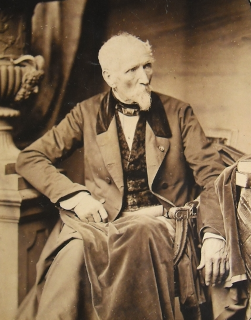
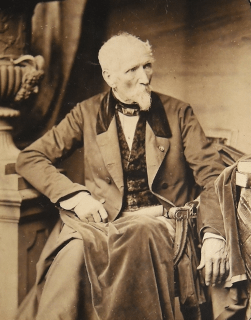
Byrne’s engaging and dispassionate Memoirs have ensured his special status among Irish nationalists. Because of his longevity he is the only United Irishman to have been photographed. His wife had sketched him in profile in middle age, and the photograph taken almost three decades later shows the same, strong features though those of a frail, but dignified man of 79 years.

(From: “Byrne, Miles” by Ruan O’Donnell and Sylvie Kleinman, Dictionary of Irish Biography, http://www.dib.ie, October 2009, last revised August 2024 | Pictured: Photograph of Miles Byrne taken in Paris in 1859)


Leave a comment

Birth of Myles Byrne, United Irishman & French Army Officer

Myles Byrne, United Irishman, French army officer and author, is born into a Catholic farming family in the townland of Ballylusk, near Monaseed, County Wexford, on March 20, 1780.

At the age of 17, Byrne is asked to join the government Yeomanry. He chooses instead to join the Society of United Irishmen. In defiance of the British Crown and the Protestant Ascendancy the oath-bound movement is determined to achieve an independent and representative government for Ireland. He participates in preparations in Wexford for the Irish Rebellion of 1798 and, at the age of 18, fights at the Battle of Tubberneering on June 4 and, in command of a division of pikemen, in the Battle of Arklow on June 9, in which the rebel leader Father Michael Murphy is killed. In the face of a general rout, he leads a rebel charge in the Battle of Vinegar Hill on June 21.

Keeping command of a small band, Byrne seizes Goresbridge on June 23 but has to deplore the murder of several prisoners and other atrocities committed by his men in revenge for the torture and executions that had been visited upon the peasantry by the yeomanry and government militia. After further skirmishes he joins Joseph Holt and Michael Dwyer in taking to the Wicklow Mountains to continue a guerrilla resistance.

After Holt accepts transportation to Australia in November, Byrne, assisted by his sister, escapes to Dublin. He recalls of his sister, “If I had not remarked a long scar on her neck, she would not have mentioned anything herself. A yeoman … threatened to cut her throat with his sabre if she did not tell instantly the place in which I was hiding. The cowardly villain, no doubt, would have put his threat in execution had not some of his comrades interfered to prevent him.”

In the winter of 1802-03, Byrne enters into the plans of Robert Emmet and Anne Devlin for a renewed uprising. In his Memoirs he describes a meeting he arranged between Robert Emmet and the Wexford rebel leader Thomas Cloney at Harold’s Cross Green, Dublin, just prior to Emmet’s Rebellion, “I can never forget the impression this meeting made on me at the time – to see two heroic patriots, equally devoted to poor Ireland, discussing the best means of obtaining her freedom.”

In July 1803, the plans unravel when Anne Devlin’s cousin, Michael Dwyer, still holding out in Wicklow, recognises that there are neither the promised arms nor convincing proof of an intended French landing. In the north Thomas Russell and James Hope find no enthusiasm for a renewal of the struggle in what in 1798 are the strongest United Irish and Catholic Defender districts.

In Dublin, with their preparations revealed by an accidental explosion of a rebel arms depot, Emmet proceeds with a plan to seize the centres of government. The rising, for which for Byrne turns out with Emmet and Malachy Delaney in gold-trimmed green uniforms, is broken up after a brief confrontation in Thomas Street.

Two days after the fight in Thomas Street, Byrne meets with the fugitive Emmet and agrees to go to Paris to procure French assistance. But in Paris he finds Napoleon‘s attentions focused elsewhere. The First Consul uses a cessation of hostilities with Britain to pursue a very different venture, the re-enslavement of Haiti.

Byrne is commissioned as a captain in Napoleon’s Irish Legion. But at a time when he is convinced that “all Catholic Ireland” is “ready to rise the moment a rallying point was offered,” the Irish exiles cannot deflect the First Consul from other priorities. Rather than in Ireland, with his diminishing Irish contingent, he is to see action in the Low Countries, Germany and Spain.

Byrne rises to the rank of brigadier general and is awarded the Legion of Honour in 1813. Following the Bourbon Restoration, with fellow legionnaire John Allen, he narrowly avoids deportation as a foreign Bonapartist. An introduction to the Prince de Broglie, then vice-president of the Chamber of Deputies, and two audiences with the Minister of War, Marshal Henri Clarke, the Duke of Feltre, contribute to the latter’s decision to quash the deportation order. In August 1817 Byrne is naturalised as a French citizen.

For much of the next decade Byrne finds himself effectively retired on half pay. Returned to active military service in 1828, he distinguishes himself in the French expedition to Morea during the Greek War of Independence. He retires in 1835 with the rank of Chef de Bataillion.

In the 1840s, Byrne is Paris correspondent for The Nation in Dublin, the Young Irelander newspaper that does much to rehabilitate the memory of the United Irishmen.

In his last years Byrne writes his Memoirs, which are an account of his participation in the Irish Rebellion and his time in the Irish Legion of Napoleon. These are first published in three volumes in 1863, but there have been many subsequent reprints. Against the portrayal of 1798 as a series of disjointed, unconnected risings, his memoirs present the United Irishmen as a cohesive revolutionary organisation whose aim of a democratic, secular, republic had captured the allegiance of a great mass of the Irish people.

Byrne dies at his house in the rue Montaigne (now rue Jean Mermoz, 8th arrondissement, near Champs-Élysées), Paris on January 24, 1862, and is buried in Montmartre Cemetery. His grave there is marked by a Celtic Cross, however this headstone appears to be a 1950s replacement for an earlier one.

(Pictured: Miles Byrne (1780-1862), United Irishman. Photograph taken by an unknown photographer in Paris in February 1859. The photograph now resides in Áras an Uachtaráin, the residence of the President of Ireland, in Dublin.)


Leave a comment

The Irish Brigade of France Fight in the Battle of Marsaglia

Units of the Irish Brigade of France fight in Italy at the Battle of Marsaglia, a battle in the Nine Years’ War, on October 4, 1693. The battle involves the French army of Marshal Nicolas Catinat against the army of the Grand Alliance, allies of William of Orange, under the Duke of Savoy, Victor Amadeus II of Sardinia.

Catinat, advancing from Fenestrelle and Susa to the relief Pinerolo, defended by René de Froulay, Comte de Tessé, and which the Duke of Savoy is besieging, takes up a position in formal order of battle north of the village of Marsaglia, near Orbassano. Here, on October 4, the Duke of Savoy attacks him with his entire army, front to front, but the greatly superior regimental efficiency of the French, and Catinat’s minute attention to details in arraying them, gives the new marshal a victory that is a worthy pendant to Neerwinden.

During the battle, Irish dragoons are reported to have “overthrown squadrons, sword in hand,” but elsewhere on the battlefield, Prince Eugene of Savoy overruns a French line and advances to the second line, held by Irish regiments. There Eugene’s advance is broken, and his troops are soon put to rout. The impetuous Irish then pursue without orders. Seeing this development, the French commander orders a general advance and the allied army breaks and runs. Official French reports speak of the “extreme valor” of the Irish that day.

The Piedmontese and their allies lose approximately 12,000 killed, wounded and prisoners, as against Catinat’s 1,800. Among the Irish killed in this great victory are Brigadier Francis O’Carroll of the dragoons and Colonel Daniel O’Brien, 4th Viscount Clare. One very young officer of the Irish Brigade who survives the fight is Lieutenant Peter Lacy.

Marsaglia is, if not the first, at any rate, one of the first, instances of a bayonet charge by a long deployed line of infantry. Hussars figure here for the first time in Western Europe. A regiment of them had been raised in 1692 from deserters from the Austrian service. It is also notable as one of the first major battles to see the new Irish Brigade in action for the French army.

(Pictured: Marshal Nicholas Catinat at the Battle of Marsaglia, October 4, 1693, painting by Eugène Devéria, 1837, Museum of the History of France)


Leave a comment

Birth of Count Daniel Charles O’Connell, French General & Uncle of “The Liberator”

Count Daniel Charles O’Connell, French general and count in the French nobility, is born on May 21, 1745, in Derrynane, County Kerry, twenty-first among twenty-two children of Donal Mor O’Connell, a Catholic landowner, and his wife Mary, daughter of Daniel O’Donoghue of Glenflesk, near Killarney.

O’Connell is tutored at home in Latin and Greek, and before he is sixteen, he leaves with his cousin, Murty O’Connell, to join the French army. On February 13, 1760, he becomes a cadet in the Régiment de Royal Suédois. He spends almost his entire career in France or serving abroad with French regiments, but remains in close contact with his family, being in constant correspondence with the head of the clan, his brother Maurice O’Connell, who is almost twenty years his senior, and later arranging army appointments for a host of young nephews and cousins.

O’Connell serves with the Royal Suédois in the last two campaigns of the Seven Years’ War and is made assistant adjutant (sous-aide-major) of the regiment. At the close of the war, he is recommended for the military academy of Strasbourg (1765–66). He has a talent for self-advancement and is well regarded by his seniors, being tall, strong, handsome, disciplined, industrious, and sober. He has an almost morbid horror of drink, and his great boast is that he has never wasted a moment of his time or a farthing of his money.

Appointed to Col. Meade’s regiment of Lord Clare’s Irish Brigade with the rank of captain in October 1769, he sets sail immediately for Mauritius. Two years later he is allowed a visit home to Kerry for the first time in eleven years. In 1775 the death of Lord Clare’s son and the extinction of the title results in the reduction of the Irish Brigade and destroys O’Connell’s chance of promotion. He devotes himself to the study of chemistry, literature, and the military. A published study, Discipline of the army, comes under the notice of the military authorities, who obtain for him a Cross of Saint Louis, a pension of 2,000 livres a year, and the rank of lieutenant-colonel with which he is posted to his old regiment, the Royal Suédois, in 1778. With them he serves at the taking of Menorca in 1781 and is severely wounded at the Great Siege of Gibraltar in 1782 but manages to save the life of Charles Philippe, Count of Artois, the future Charles X. For these services he is made a count, one of only twenty-two people outside the royal family to receive this honour, and is made colonel of the German regiment of Salm-Salm in French pay, which at a grand review of 30,000 French troops in Alsace in 1785 is pronounced the best regiment. He begins to move in court circles and in 1788 kisses the hand of Marie Antoinette and rides in the king’s coach.

In 1788 O’Connell recommends to his brother Maurice the college of Saint-Omer as a suitable school for his nephews, Maurice and Daniel O’Connell, but taking belated notice of the gathering revolutionary storm, tries unsuccessfully to dissuade them. During the French Revolution of 1789 he allegedly announces his readiness to move his regiment into the capital to disperse revolutionary mobs but is not able to obtain the king’s permission. In 1790 his men mutiny, leaving him in the anomalous position of a colonel without a regiment. A protégé of the Ancien Régime, he nevertheless remains in Paris in 1790–91, serving the nouveau régime as a member of a commission engaged in revising army regulations.

In 1792 O’Connell joins Charles William Ferdinand, Duke of Brunswick‘s émigré army at Koblenz and takes part in the disastrous Battle of Valmy in Berchini’s regiment. Ever cautious, he serves as a private, refusing any command so that his name would not be mentioned in France. In November 1792 he is in London, almost penniless and bent on concealing that he had served against the republic. An alibi is procured and attested at Tralee to the effect that O’Connell had been in Ireland all the time and was forwarded to Paris to prevent the confiscation of property.

In London O’Connell petitions William Pitt the Younger to reconstruct the Irish Brigade in the service of George III. Six regiments are raised, with O’Connell appointed colonel of the 4th, but the scheme is only partially realised as three of the regiments are sent to the West Indies and Nova Scotia, where they succumb to pestilence. By 1798 the brigade has entirely ceased to exist, though he retains his full pay as a British colonel, which he draws to the end of his life. At this period his name is mooted by Gen. Henry Clarke and Theobald Wolfe Tone as a possible commander of their troops. Clarke gives his opinion that O’Connell is a good parade officer but has no genius in command, to which Wolfe Tone replies that he “was in favour of his being employed for I know he hates England.”

In 1796, O’Connell marries Martha, comtesse de Bellevue (née Drouillard de Lamarre; d. 1807), a young widow with three children, at the French chapel in Covent Garden. In 1802 he takes advantage of the peace of Amiens to return to France. On the renewal of war, the couple is detained by Napoleon as British subjects, and remain virtual prisoners in France until the restoration of the Bourbons in 1814. Back in favour, O’Connell receives the rank of lieutenant-general in the French army and commander of the Order of Saint Louis. His fortunes revive, he advances a large sum to his nephew Daniel to save him from bankruptcy in 1815 and comes to his rescue again in 1818, though by this date he has already settled the bulk of his fortune on his great-nephews. He follows his namesake’s career with keen interest, but his advice is invariably cautious and is not much heeded. After the French Revolution of 1830 he refuses to take the oath of allegiance to Louis Philippe I and is struck off the military list, though he becomes a naturalised French citizen in 1831.

O’Connell dies on July 9, 1833, at the Château de Bellevue at Meudon, near Blois, and is buried at the cemetery at Coudé. He has no children and his title, though not his fortune, descends to his godson, the Baron d’Eschegoyen’s second son, who takes the name O’Connell. A portrait by Paul Guérin hangs in Derrynane House.

(From: “O’Connell, Count Daniel Charles” by Bridget Hourican, Dictionary of Irish Biography, http://www.dib.ie)


2 Comments

Death of Justin McCarthy, Jacobite General

justin-mccarthy-lord-mountcashel

Justin McCarthy, Viscount Mountcashel, a Jacobite general in the Williamite War in Ireland and a personal friend of James II of England, dies in France of complications from previous battle wounds on July 1, 1694.

McCarthy, born about 1643, is the younger son of Donough MacCarty, 1st Earl of Clancarty, head of the MacCarthy of Muskerry dynasty who holds extensive lands in the former Kingdom of Desmond. His mother is Lady Eleanor Butler, sister of James Butler, 1st Duke of Ormond. The family has their property confiscated under Oliver Cromwell‘s regime, but it is restored to them at the Restoration of Charles II of England. McCarthy is made Viscount Mount Cashel with the subsidiary title of Baron Castleinch on May 1, 1689 and becomes a Lieutenant-General.

McCarthy becomes a professional soldier and shows great skill in his profession, but poor eyesight hampers his career. He enters the French army in 1671 and then transfers to James Scott, 1st Duke of Monmouth‘s regiment, then in French pay, and serves against the Dutch.

McCarthy comes to England in 1678 and is befriended by the future James II, who generally chooses soldiers, especially Irish soldiers, as his boon companions. Charles II decides to use his services in Ireland and makes him a colonel in Sir Thomas Dongan‘s regiment. On the outbreak of the Popish Plot, however, the discovery of McCarthy’s presence at Whitehall causes uproar. He flees the country and the Secretary of State for the Northern Department, Sir Joseph Williamson, who had issued his commission, is sent to the Tower of London.

Under the Catholic King James II, McCarthy becomes both Major General and a member of the Privy Council of Ireland. He quarrels with the Lord Lieutenant of Ireland, Henry Hyde, 2nd Earl of Clarendon, and probably intrigues to secure his recall.

In 1689 McCarthy takes Castlemartyr and Bandon for James. At Bandon there is a massacre called “Black Monday,” but he persuades the King to issue a general pardon to his defeated opponents. He meets James at his landing at Kinsale and is commanded to raise seven regiments. He sits in the Irish House of Lords in the Parliament of Ireland of 1689.

With 3,000 men McCarthy advances from Dublin toward Enniskillen, which with Derry is the remaining resistance to James II. He is met by 2,000 Protestant “Inniskillingers” at the Battle of Newtownbutler on July 31, 1689. His forces are routed, he is wounded and then captured. Allowed out on parole he breaks parole and escapes to Dublin. Frederick Schomberg, 1st Duke of Schomberg, remarks that he had thought McCarthy was a man of honour, but on the other hand he expected no better from an Irishman.

McCarthy goes into exile in France and commands the first Irish Brigade of Louis XIV. His later career is hampered by his near blindness. He dies at Barèges on July 1, 1694, and is buried there.


Leave a comment

Birth of Januarius MacGahan, Journalist & Correspondent

januarius-macgahan

Januarius Aloysius MacGahan, American journalist and war correspondent for the New York Herald and The Daily News, is born near New Lexington, Ohio on June 12, 1844. His articles describing the massacre of Bulgarian civilians by Turkish soldiers and irregular volunteers in 1876 creates public outrage in Europe and are a major factor in preventing Britain from supporting Turkey in the Russo–Turkish War of 1877–78, which leads to Bulgaria gaining independence from the Ottoman Empire.

MacGahan’s father is an immigrant from Ireland who had served on the Northumberland, the ship which took Napoleon into exile on Saint Helena. He moves to St. Louis, where he briefly works as a teacher and as a journalist. There he meets his cousin, General Philip Sheridan, an American Civil War hero also of Irish parentage, who convinces him to study law in Europe. He sails to Brussels in December 1868.

MacGahan does not get a law degree, but he discovers that he has a gift for languages, learning French and German. He runs short of money and is about to return to America in 1870 when the Franco-Prussian War breaks out. Sheridan happens to be an observer with the German Army, and he uses his influence to persuade the European editor of the New York Herald to hire MacGahan as a war correspondent with the French Army.

MacGahan’s vivid articles from the front lines describing the stunning defeat of the French Army win him a large following, and many of his dispatches to the Herald are reprinted by European newspapers. When the war ends, he interviews French leader Léon Gambetta and Victor Hugo and, in March 1871, he hurries to Paris and is one of the first foreign correspondents to report on the uprising of the Paris Commune. He is arrested by the French military and nearly executed and is only rescued through the intervention of the U.S. Minister to France Elihu B. Washburne.

In 1871 MacGahan is assigned as the Herald‘s correspondent to Saint Petersburg. He learns Russian, mingles with the Russian military and nobility, covers the Russian tour of General William Tecumseh Sherman and meets his future wife, Varvara Elagina, whom he marries in 1873. In 1874 he spends ten months in Spain, covering the Third Carlist War.

In 1876 MacGahan quarrels with James Gordon Bennett Jr., the publisher of the New York Herald, and leaves the newspaper. He is invited by his friend, Eugene Schuyler, the American Consul-General in Constantinople, to investigate reports of large-scale atrocities committed by the Turkish Army following the failure of an attempted uprising by Bulgarian nationalists in April 1876. He obtains a commission from The Daily News, then the leading liberal newspaper in England, and leaves for Bulgaria on July 23, 1876.

MacGahan reports that the Turkish soldiers have forced some of the villagers into the church, then the church is burned, and survivors tortured to learn where they have hidden their treasures. He says that of a population of seven thousand, only two thousand survive. According to his account, fifty-eight villages in Bulgaria are destroyed, five monasteries demolished, and fifteen thousand people in all massacred. These reports, published first in The Daily News, and then in other papers, cause widespread popular outrage against Turkey in Britain. The government of British Prime Minister Benjamin Disraeli, a supporter of Turkey, tries to minimize the massacres and says that the Bulgarians are equally to blame, but his arguments are refuted by the newspaper accounts of MacGahan.

In the wake of the massacres and atrocities committed by the Ottoman forces during the suppression of the April Uprising, as well as centuries-long conflicts between Russia and Turkey in Crimea, the Russian Government, stirred by anti-Turkish and Pan-Slavism sentiment, prepare to invade the Ottoman Empire, and declare war on it on April 24, 1877. The Turkish Government of Sultan Abdul Hamid II appeals for help to Britain, its traditional ally against Russia, but the British government responds that it cannot intervene “because of the state of public feeling.”

MacGahan is assigned as a war correspondent for The Daily News and, thanks to his friendship with General Skobelev, the Russian commander, rides with the first units of the Russian Army as it crosses the Danube into Bulgaria. He covers all the major battles of the Russo–Turkish War, including the Siege of Plevna and the Battle of Shipka Pass. He reports on the final defeat of the Turkish armies and is present at the signing of the Treaty of San Stefano, which ends the war.

MacGahan is in Constantinople, preparing to travel to Berlin for the conference that determines the final borders of Bulgaria, when he catches typhoid fever. He dies on June 9, 1878, and is buried in the Greek cemetery, in the presence of diplomats, war correspondents, and General Skobelev. Five years later his body is returned to the United States and reburied in New Lexington and a statue is erected in his honor by a society of Bulgarian Americans.


4 Comments

Birth of Major General Thomas Conway

thomas-conway

Thomas Conway, a major general in the American Continental Army during the American Revolutionary War, is born in Cloghane, County Kerry, on February 27, 1735. He becomes involved with the alleged Conway Cabal with Horatio Gates and later serves with Émigré forces during the French Revolutionary War.

Conway is born to James Conway and his wife Julieanne Conway. As a child, he immigrates to France with his parents. At 14, he enrolls in the Irish Brigade of the French Army and rises rapidly to the rank of colonel by 1772.

Following the outbreak of the American Revolutionary War he volunteers to the Continental Congress for service with the American rebels in 1777. Based on an introduction from Silas Deane, the Congress appoints him a brigadier general on May 13, and sends him on to George Washington.

Conway commands the leading brigade on the American right flank at the Battle of Germantown and is justly praised for his actions. However, Washington opposes his promotion to major general, believing that many American-born officers with longer and valuable service deserve the rank. This, and Conway’s condescending attitude, lead to continued friction between the men. Congress appoints Conway a major general anyway in December 1777 and makes him inspector general of the army.

When his name is used politically, it is used to describe the infighting known as the Conway Cabal. During the affair, he has written a letter to General Horatio Gates in which he refers to Washington as a “weak general.” The letter is intercepted by Washington and his backers after its delivery is botched by Brigadier General James Wilkinson and is brought before the Congress for inquiry. When the contents of the letter are made public, Conway loses his command as a result. He tries a ploy that had worked before his promotion and submits his resignation to Congress in March 1778. This time, however, it is accepted, so he is forced to leave the Continental Army. John Cadwalader shoots him in a duel on July 4, 1778. When he recovers, he writes an apology to Washington and returns to France.

Conway later returns to the French Army. In 1787 he receives promotion to Maréchal-de-camp (Major General) and an appointment as Governor of French colonies in India.

In 1793 he fights with royalist forces in opposition to French Revolution in southern France. Their loss forces him to become an exile from his adopted country.

During the French Revolution he is condemned to death. He is saved only by an appeal to Great Britain, against which he had fought in the American Revolution, but is compelled to flee from France for his life. He supposedly returns to Ireland and remains there until his death.

After that Conway disappears from history. He is believed to have died about 1800 in poverty and exile.


Leave a comment

Birth of Patrick d’Arcy, Scientist & Soldier

patrick-darcy

Patrick d’Arcy, scientist and soldier in the Irish Brigade of France, is born in Kitulla, County Galway, on September 27, 1725.

The d’Arcy family, who are Catholics, suffer under the Penal Laws. In 1739 d’Arcy is sent to Paris for his education. He is tutored in mathematics by Jean-Baptiste Clairaut, and becomes a friend of Jean-Baptiste’s son, Alexis-Claude Clairaut, who is a brilliant young mathematician. d’Arcy makes original contributions to dynamics. He is best known for his part in the discovery of the principle of angular momentum, in a form which is known as “the principle of areas,” which he announces in 1746.

Perhaps seeking more adventure than an academic life can provide, d’Arcy enlists in the French army. He fights in Germany in the regiment of Condé and serves as an aide-de-camp to Marshal Saxe at the Battle of Fontenoy. He obtains the title of “Count” in the French nobility and is a generous patron of Irish refugees in France. He sails for Scotland in 1745, attempting to fight in “Bonnie” Prince Charlie‘s rising, but his ship is captured, and he is taken prisoner.

After his release, d’Arcy returns to France where he continues both his scientific and military careers. In addition to his contributions to dynamics, he performs research on artillery and electricity. One of his experiments on visual perception, reported in 1765, is often referenced. It involves a rotating disk on which a burning coal ember is placed. When the disk is spun at an angular velocity exceeding seven revolutions per second, a full circle of light is perceived. This and other experiments make d’Arcy the first person to demonstrate the illusion of a moving image, although Joseph Plateau greatly elaborates on this initial finding.

Patrick d’Arcy is elected to the Academie Royale des Sciences in 1749. He died from cholera in Paris on October 18, 1779.


Leave a comment

The Beginning of the Williamite War

battle-of-the-boyne

The Williamite War in Ireland begins on March 12, 1688. It is a conflict between Jacobites, who support the English Catholic King James II, and Williamites, who support the Dutch Protestant Prince William of Orange, over who would be King of England, Scotland, and Ireland.

The cause of the war is the deposition of James II as King of the Three Kingdoms in the “Glorious Revolution” of 1688. James is supported by the mostly Catholic Jacobites in Ireland and hopes to use the country as a base to regain his Three Kingdoms. He is given military support by France. For this reason, the war becomes part of a wider European conflict known as the Nine Years’ War, or War of the Grand Alliance. Some Protestants of the established Church in Ireland also fight on the side of King James.

James is opposed in Ireland by the mostly Protestant Williamites, who are concentrated in the north of the country. William lands a multi-national force in Ireland, composed of English, Scottish, Dutch, Danish, and other troops, to put down Jacobite resistance. James leaves Ireland after a reverse at the Battle of the Boyne in 1690 and the Irish Jacobites are finally defeated after the Battle of Aughrim in 1691.

The Treaty of Limerick, signed on October 3, 1691, offers favourable terms to Jacobites willing to stay in Ireland and give an oath of loyalty to William III. Peace is concluded on these terms between Patrick Sarsfield and Godert de Ginkell, giving toleration to Catholicism and full legal rights to Catholics that swear an oath of loyalty to William and Mary. Part of the treaty agreed to Sarsfield’s demand that the Jacobite army be allowed to leave Ireland as a body and go to France. This event is popularly known in Ireland as the “Flight of the Wild Geese.” Around 14,000 men with around 10,000 women and children leave Ireland with Patrick Sarsfield in 1691.

The Williamite victory in the war in Ireland has two main long-term results. The first is that it ensures James II will not regain his thrones in England, Ireland, and Scotland by military means. The second is that it ensures closer British and Protestant dominance over Ireland. Until the 19th century, Ireland is ruled by what becomes known as the “Protestant Ascendancy,” the mostly Protestant ruling class. The majority of the Irish Catholic community and the Ulster-Scots Presbyterian community are systematically excluded from power, which is based on land ownership.

For over a century after the war, Irish Catholics maintain a sentimental attachment to the Jacobite cause, portraying James and the Stuarts as the rightful monarchs who would have given a just settlement to Ireland, including self-government, restoration of confiscated lands and tolerance for Catholicism. Thousands of Irish soldiers leave the country to serve the Stuart monarchs in the Irish Brigade (Spanish) and Irish Brigade of the French Army. Until 1766, France and the Papacy remain committed to restoring the Stuarts to their British Kingdoms. At least one composite Irish battalion drawn from Irish soldiers in the French service fight on the Jacobite side in the Scottish Jacobite uprisings leading up to the Battle of Culloden in 1746.

Protestants, on the other hand, portray the Williamite victory as a triumph for religious and civil liberty where triumphant murals of King William still controversially adorn the gable walls in Ulster. The defeat of the Catholics in the Williamite war is still commemorated by Protestant Unionists in Ulster on the Twelfth of July by the Orange Order.