seamus dubhghaill

Promoting Irish Culture and History from Little Rock, Arkansas, USA


Leave a comment

Birth of Karl Mullen, Rugby Union Player & Gynecologist

Dr. Karl Daniel Mullen, rugby union player and consultant gynecologist who captains the Irish rugby team and captains the British Lions on their 1950 tour to Australia and New Zealand, is born on November 26, 1926, in Courtown Harbour, County Wexford.

Mullen is one of three sons and seven daughters of Daniel Mullen, an officer of the customs and excise, and his wife Annie (née Hargrove). After his parents move to Home Farm Road, Drumcondra, Dublin, he is educated at the Dominican St. Thomas’s Academy, Eccles Street, the Jesuit Belvedere College, Great Denmark Street, and the Royal College of Surgeons in Ireland (RCSI). He plays rugby and cricket at school, association football with Home Farm F.C., and golf in the summer months. Initially a centre, he becomes a prop on the Belvedere junior cup team and, after injury to a teammate, hooker on the senior cup team, which loses the Leinster Schools Rugby Senior Cup final to Castleknock College in 1944.

On January 25, 1947, Mullen makes his formal Irish debut in a 12–8 loss to France. He plays as hooker, winning 25 caps for Ireland from 1947 to 1952. A year later, on January 31, 1948, he plays his first game for Barbarian F.C. in a 9–6 victory over Australia in Cardiff, Wales. After helping Ireland to victory over France on January 1, 1948, at the age of 21, he captains Ireland for the first time, on February 14, 1948, leading them to an 11–10 victory over England at Twickenham Stadium.

Mullen captains the Irish team to their first Grand Slam in the 1948 Five Nations Championship and is one of eight players from that team who live to see the country’s next Grand Slam in 2009.

Ireland retains the triple crown in 1949 by beating Wales 5–0 in Swansea, ending a run of defeats on Welsh soil lasting fourteen years. The following season Ireland suffers from injuries and loses to both England and Wales, the latter securing the triple crown.

Mullen is selected to captain the 1950 Lions Tour to Australia and New Zealand. After appearing in the first two tests against New Zealand, a 9–9 draw and an 8–0 loss, he sustains an ankle injury in the latter game and concedes his place to Dai Davies of Wales. Returning for the second test against Australia, a resounding 24–3 victory, he also plays in a semi-official “British Isles RFU” team against Ceylon during their return journey in September.

Under Mullen’s captaincy Ireland regains the international championship in 1951. His last cap comes in a 14–3 loss to Wales at Lansdowne Road on March 8, 1952. In twenty-five successive appearances (fifteen as captain), he secured three international championships and two triple crowns for Ireland in four seasons, their most successful haul of the twentieth century.

Mullen’s distinguished rugby career has to be fitted around his medical studies. In 1945, he enters the RCSI, graduating L and LM (RCSI and RCPI) in 1949. Awarded the diploma in obstetrics (1952) and membership of the Royal College of Obstetricians and Gynaecologists (1956), he trains at Sir Patrick Dun’s Hospital, Jervis Street Hospital and the Rotunda hospitals. After serving as senior obstetrics registrar at the Derby City General Hospital (1953–56), he returns to Dublin to become a consultant obstetrician, based at Mount Carmel Community Hospital, Churchtown, Dublin, and develops a considerable private practice. By his retirement in 2002, he is estimated to have delivered over 40,000 babies. A proponent of sex education in schools, he appears on RTÉ‘s 7 Days in December 1970, outlining various methods of birth control and calling for a more honest and realistic approach to artificial contraception.

Mullen marries Doreen Kilbride, an accomplished soprano, on April 30, 1952, in Donnybrook, Dublin, interrupting their honeymoon to play for Old Belvedere R.F.C. in the Leinster Senior Cup final. They have eight children, three boys and five girls. In 1975, they move from Altamount, Dundrum, Dublin, to Tulfarris House, Blessington, County Wicklow, adjacent to Poulaphouca Reservoir, where they farm and bred Irish draught horses. In 1985, he sells the property and much of his art collection and moves to Kilcullen, County Kildare.

Mullen is one of eight surviving members of the 1948 team to witness Ireland’s second grand slam on March 21, 2009. Only weeks later, having suffered from a long illness, he dies on April 27, 2009, at his home, Gilltown Lodge, in Kilcullen.

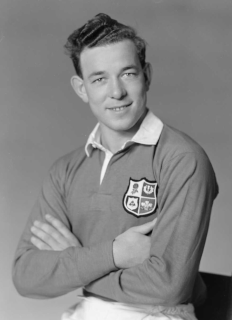
(Pictured: Karl Mullen, captain of the British Lions rugby union team, 1950)

Leave a comment

Birth of Professional Golfer Harry “The Brad” Bradshaw

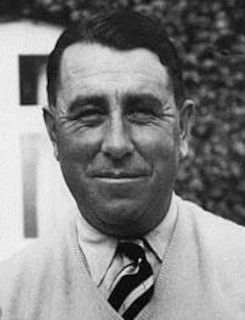
Harry “The Brad” Bradshaw, a leading Irish professional golfer of the 1940s and 1950s, is born in Delgany, County Wicklow on October 9, 1913.

Bradshaw is the son of the Delgany professional golfer Ned Bradshaw. He and his three brothers, Jimmy, Eddie and Hughie, all become professional golfers. He represents Ireland in the Triangular Professional Tournament at the Cawder Golf Club in Bishopbriggs, Glasgow, Scotland in October 1937 and the Llandudno International Golf Trophy match play tournament at the Maesdu Golf Club in Llandudno, Wales in September 1938. He wins the Irish PGA Championship ten times between 1941 and 1957, tied with Christy O’Connor Snr for most wins in that event. He is also the Irish Open champion in 1947 and 1949. He teams with Christy O’Connor to win the Canada Cup for Ireland in Mexico City, Mexico in 1958, finishing second in the individual section of the event despite suffering nosebleeds due to the altitude. He plays in the Ryder Cup in 1953, 1955 and 1957 and is twice Dunlop Masters champion, in 1953 and 1955.

Bradshaw loses the 1949 The Open Championship following a playoff against Bobby Locke at Royal St. George’s Golf Club, after an extraordinary incident in the second round when his drive at the 5th hole comes to rest against broken glass from a beer bottle on the fairway. Rather than taking a drop (to which he is probably entitled) he elects to play the ball as it lay, but is only able to move it slightly forward, dropping the shot. The setback results in his tying with Locke with an aggregate of 283, thereby equaling the championship record. However he loses the playoff to Locke. Arguably the incident with the bottle costs Bradshaw the tournament.

Bradshaw dies at the age of 77 on December 22, 1990.


Leave a comment

Death of Cardinal John Joseph Glennon

Cardinal John Joseph Glennon, prelate of the Roman Catholic Church, dies on March 9, 1946, in Dublin. He serves as Archbishop of St. Louis from 1903 until his death. He is elevated to the cardinalate in 1946.

Glennon is born on June 14, 1862, in Kinnegad, County Westmeath, to Matthew and Catherine (née Rafferty) Glennon. After graduating from St. Finian’s College, he enters All Hallows College near Dublin in 1878. He accepts an invitation from Bishop John Joseph Hogan in 1882 to join the newly erected Diocese of Kansas City in the United States. After arriving in Missouri in 1883, he is ordained to the priesthood by Bishop Hogan on December 20, 1884.

Glennon is then assigned to St. Patrick’s Church in Kansas City and, briefly returning to Europe, furthers his studies at the University of Bonn in Germany. Upon his return to Kansas City, he becomes rector of the Cathedral of the Immaculate Conception. He is later made vicar general (1892) and apostolic administrator (1894) for the diocese.

On March 14, 1896, Glennon is appointed Coadjutor Bishop of Kansas City and Titular Bishop of Pinara by Pope Leo XIII. He receives his episcopal consecration on the following June 29 from Archbishop John Joseph Kain, with Bishops Maurice Francis Burke and John Joseph Hennessy serving as co-consecrators. At age 34, he becomes one of the youngest bishops in the world.

Glennon is named Coadjutor Archbishop of St. Louis on April 27, 1903. He succeeds Archbishop Kain as the fourth Archbishop of St. Louis upon the latter’s death on October 13 of that year. Realizing the Cathedral of St. Louis can no longer accommodate its growing congregation, he quickly begins raising funds for a new cathedral, the cornerstone of which is later laid on October 18, 1908.

Glennon opens the new Kenrick Seminary in 1915, followed by the minor seminary in Shrewsbury. He delivers the eulogy at the funeral of Cardinal James Gibbons and is appointed an Assistant at the Pontifical Throne on June 28, 1921. He opposes British rule in Ireland and supports the leaders of the Easter Rising. He is an outspoken opponent of divorce, condemns gambling games, and prohibits dancing and drinking at church-sponsored events. He sometimes throws the opening ball for the St. Louis Cardinals, but does not play any sports himself, once saying, “I once tried golf, but I so disfigured the scenery that I never played again, in fear of public indignation and reprisal.”[2]

Despite a rather popular tenure, as Archbishop of St. Louis Glennon opposes racial integration in the city’s Catholic schools, colleges, and universities. During the early 1940s, many local priests, especially Jesuits, challenge the segregationist policies at the city’s Catholic schools. The St. Louis chapter of the Midwest Clergy Conference on Negro Welfare, formed locally in 1938, pushes the all-female Webster College to integrate first. However, in 1943, Glennon blocks the enrollment of a young black woman at the college by speaking privately with the Kentucky-based superior of the Sisters of Loretto, which staffs the college. When approached directly by pro-integration priests, he calls the integration plan a “Jesuit ploy,” and quickly transfers one of the complaining priests away from his mission at an African American parish.

The Pittsburgh Courier, an African American newspaper with national circulation, discovers Glennon’s intervention and runs a front-page feature on the Webster incident. In response, Father Claude Heithaus, professor of Classical Archaeology at the Catholic Saint Louis University, delivers an angry sermon accusing his own institution of immoral behavior in its segregation policies. Saint Louis University begins admitting African American students that summer when its president, Father Patrick Holloran, manages to secure approval from the reluctant Archbishop Glennon. Nevertheless, St. Louis maintains one of the largest numbers of African American parishes and schools in the country.

On Christmas Eve 1945, it is announced that the 83-year-old Glennon will be elevated to the College of Cardinals. He originally thinks himself too old to make the journey to Rome, but eventually joins fellow Cardinals-elect Francis Spellman and Thomas Tien Ken-sin on their flight, during which time he contracts a cold from which he does not recover. Pope Pius XII creates him Cardinal Priest of San Clemente al Laterano in the consistory of February 18, 1946.

During the return trip to the United States, Glennon stops in his native Ireland, where he is received by President Seán T. O’Kelly and Taoiseach Éamon de Valera. While in Dublin, he is diagnosed with uremic poisoning and dies on March 9, 1946, ending a 42-year tenure as Archbishop. The Cardinal’s body is returned to St. Louis and then buried at the Cathedral.

Glennon is the namesake of the community of Glennonville, Missouri. The only diocesan hospital for children, Cardinal Glennon Children’s Hospital, affiliated with Saint Louis University Hospital, is created in his name.

(Pictured: Cardinal John J. Glennon, photo by the St. Louis Dispatch)


Leave a comment

Birth of Humanitarian John O’Shea

John O’Shea, founder and former CEO of GOAL, an Irish non-governmental organization devoted to assisting the poorest of the poor, is born in Limerick, County Limerick on February 28, 1944.

O’Shea’s father, a banker, moves the family to Dublin when he is age 11. He is schooled in CBC Monkstown and is a sports fanatic playing rugby at school and a keen golfer and tennis player in Monkstown. He remains a keen fan of rugby, tennis and golf, playing tennis every Saturday and also giving opinions on Irish sports to radio and newspapers. He goes on to study Economics, English and Philosophy at University College Dublin (UCD) and has a career as a sports journalist in the Evening Press for many years after meeting Tim Pat Coogan while studying.

In 1977, O’Shea begins his charitable organisation with a 10,000 punts donation for a feeding project in Calcutta after which he founds GOAL. The charity has a major sporting backbone. John McEnroe, Pat Cash and Gordon D’Arcy are amongst the sport stars to have become “Goalies”(volunteers).

In its 36 years of operation, GOAL has distributed €790 million and has had over 1,400 volunteers. It has operated in over 50 countries worldwide. O’Shea cites watching the “Goalies” working around the world as the best part of his years involved in the charity. He believes that governments of developed countries should be far more involved in the distribution of aid.

A sometimes controversial figure, O’Shea is known for his forthright public statements, particularly when he feels political correctness is getting in the way of assisting those in need, and a hands on approach to tackling poverty related issues. He has been criticised by some in the INGO community for advocating military invasion and intervention in Sudan by the United States, UK and NATO, under the guise of humanitarian intervention. He has also been critical of perceived inaction by the UN in humanitarian crises in conflict zones and of governmental aid agencies in giving aid directly to allegedly corrupt African governments. He has advocated using private companies to provide aid and military forces to directly force aid on countries. Most other Irish Aid agencies disagree stating that every type of aid channels must be used and have described his policies as recolonisation.

In 2012, O’Shea is asked to slow down by his doctor. In November 2012, former Fianna Fáil politician, Barry Andrews, is appointed chief executive of GOAL.

O’Shea’s list of achievements and awards include the People of the Year Awards 1987 and 1992, The Ballygowan Outstanding Achievement Award 1988, MIR Award 1992, The Late Late Show Tribute 1995 and 2007, Texaco Outstanding Achievement Award 1995 and the Tipperary International Peace Award 2003, Ernst & Young Social Entrepreneur of the Year 2005.

In 2008, O’Shea is conferred with an honorary doctorate of laws from the University of Notre Dame in recognition of his work. He is shortlisted in the top 40 of the 2010 RTÉ poll to find Ireland’s Greatest person.

O’Shea currently gives talks at NUI Galway and interpersonal skills class UCD. He has become involved with the university for a few years where he shares his story. He is an advocate for social (non-profit) entrepreneurs and tries to convince students to go down that path.