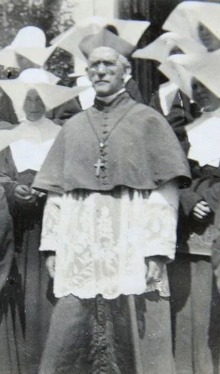
Cohalan is an outspoken critic during the Irish War of Independence, condemning acts of violence on both sides. In particular, he denounces the policy of reprisals. In July 1920, he pronounces an interdict on the killers of a Royal Irish Constabulary (RIC) sergeant, shot dead in the church porch in Bandon. He declares that anyone killing from ambush will be excommunicated. On December 12, 1920, Cohalan issues a decree saying that “anyone within the diocese of Cork who organises or takes part in ambushes or murder, or attempted murder, shall be excommunicated.” In turn, his life is threatened by the Irish Republican Army (IRA). In August 1928, he condemns the British government which had allowed Terence MacSwiney to die on hunger strike in 1920.
The Bessborough Home in Cork is run by the Sisters of the Sacred Hearts of Jesus and Mary and when the department “sought a change of superior in Bessborough because of the appallingly high death rate, he [Catholic Bishop of Cork Dr. Daniel Cohalan] denounced the request. The replacement of the Bessborough superior was delayed for four years after the department requested it, and many infants died during that time. It seems probable that the bishop’s intervention was elicited by the congregation.” In general, the report finds that the major causes of infant mortality in the homes were respiratory infections and gastroenteritis, while “public attention has focused on marasmus [malnutrition]” suggesting “willful neglect.” However, it says that “the term marasmus is best seen as indicating that a child was failing to thrive, but medical experts suggest that this was due to an underlying, undiagnosed medical condition.”
Cohalan dies in office at the age of 94 at Bon Secours Hospital, Cork, on August 24, 1952. A story, current at the time in Cork, refers to his antipathy towards bishops of the Church of Ireland who styled themselves “Bishop of Cork.” A month before his death, and on his deathbed, word is brought to him of the death of the Church of Ireland Bishop of Cork, Cloyne and Ross, Robert Hearn. The response of Cohalan, known “affectionately” as “Danny Boy”, is reputedly, “now he knows who’s Bishop of Cork.”
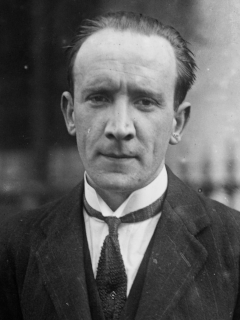
A man of intellectual power, O’Higgins is described by William Butler Yeats as “a great man in his pride confronting murderous men.” He is in fact murdered by maverick republicans while on his way to church.
O’Higgins is born in Stradbally, Queen’s County (County Laois since 1922) on June 7, 1892. Educated at University College Dublin, he is apprenticed to his uncle, a lawyer. Following the Easter Rising in 1916, he joins the Sinn Féinnationalist movement and is imprisoned. In 1918, while still in jail, he is elected to Parliament from Queen’s County, and in the next year he becomes assistant to the minister of local government, William Thomas Cosgrave. He goes on to become a prominent member of Cumann na nGaedheal.
As Minister for Justice, O’Higgins establishes the Garda Síochána police force and takes summary measures to restore order following the civil war between the Free State forces and the Irish Republican Army. His role in the execution of 77 republicans in 1922–23 makes him many enemies, as does his sardonic wit, his inflammatory speeches during the civil war, and his curtailment of the liquor trade.
On Sunday, July 10, 1927, O’Higgins is assassinated at the age of 35 on the Booterstown Avenue side of Cross Avenue in Booterstown, a coastal suburb of Dublin, while on his way to Mass at the Church of the Assumption. The assassination is carried out by three anti-Treaty members of the IRA, Timothy Coughlan, Bill Gannon and Archie Doyle, in revenge for O’Higgins’ part in the executions of the 77 IRA prisoners during the Irish Civil War.
None of the three assassins is ever apprehended or charged, but Coughlan, a member of Fianna Fáil as well as the IRA, is killed in 1928 in Dublin by a police undercover agent whom he is attempting to murder. The other two benefit from the amnesty to IRA members issued by Éamon de Valera, upon his assumption of power in 1932. Gannon, who dies in 1965, joins the Communist Party of Ireland and plays a central role in organising Irish volunteers for the Spanish Civil War. Doyle remains a prominent IRA militant and takes part in various acts in the early 1940s. He lives to an old age, dying in 1980, and continues to take pride in having killed O’Higgins.
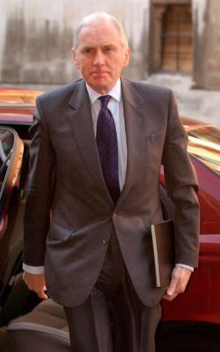
Hutton becomes a Queen’s Counsel in 1970. From 1979 to 1989, as Sir Brian Hutton, he is a High Court judge. In 1989, he becomes Lord Chief Justice of Northern Ireland, becoming a member of the Privy Council of Northern Ireland, before moving to England to become a Lord of Appeal in Ordinary on January 6, 1997. He is consequently granted a life peerage as Baron Hutton, of Bresagh in the County of Down.
On March 30, 1994, as Lord Chief Justice of Northern Ireland, Hutton dismisses Private Lee Clegg‘s appeal against his controversial murder conviction. On March 21, 2002 he is one of four Law Lords to reject David Shayler‘s application to use a “public interest” defence as defined in section 1 of the Official Secrets Act 1989 at his trial.
Hutton represents the Ministry of Defence at the inquest into the killing of civil rights marchers on “Bloody Sunday.” Later, he publicly reprimands Major Hubert O’Neil, the coroner presiding over the inquest, when the coroner accuses the British Army of murder, as this contradicts the findings of the Widgery Tribunal.
Hutton also comes to public attention in 1999 during the extradition proceedings of former Chilean dictator General Augusto Pinochet. Pinochet had been arrested in London on torture allegations by request of a Spanish judge. Five Law Lords, the UK’s highest court, decide by a 3-2 majority that Pinochet is to be extradited to Spain. The verdict is then overturned by a panel of seven Law Lords, including Hutton, on the grounds that Lord Lennie Hoffmann, one of the five Law Lords, has links to human rights group Amnesty International which had campaigned for Pinochet’s extradition.
In 1978, Hutton defends the UK at the European Court of Human Rights in the case of Ireland v United Kingdom, when the court decides that the interrogation techniques used were “inhuman and degrading” and breached the European Convention on Human Rights, but do not amount to “torture.” The court also finds that the practice of internment in Northern Ireland had not breached the Convention. He sentences ten men to 1,001 years in prison on the word of “supergrass” informer Robert Quigley, who is granted immunity in 1984.
Hutton is appointed by Tony Blair‘s government to chair the inquiry on the circumstances surrounding the death of scientist David Kelly. The inquiry commences on August 11, 2003. Many observers are surprised when he delivers his report on January 28, 2004 and clears the British Government in large part. His criticism of the BBC is regarded by some as unduly harsh with one critic commenting that Hutton had given the “benefit of judgement to virtually everyone in the government and no-one in the BBC.” In response to the verdict, the front page of The Independent newspaper consists of one word, “Whitewash?”
Peter Oborne writes in The Spectator in January 2004: “Legal opinion in Northern Ireland, where Lord Hutton practised for most of his career, emphasises the caution of his judgments. He is said to have been habitually chary of making precedents. But few people seriously doubt Hutton’s fairness or independence. Though [he is] a dour Presbyterian, there were spectacular acquittals of some very grisly IRA terrorist suspects when he was a judge in the Diplock era.”
Hutton retires as a Law Lord on January 11, 2004. He remains a member of the House of Lords until retiring under the House of Lords Reform Act 2014 on April 23, 2018.
The Irish Citizen Army also becomes involved in the battle, supporting the anti-Treaty IRA in the O’Connell Street area. The fighting begins with an assault by Provisional Government forces on the Four Courts building and ends in a decisive victory for the Provisional Government.
On April 14, 1922, about 200 Anti-Treaty IRA militants, with Rory O’Connor as their spokesman, occupy the Four Courts in Dublin, resulting in a tense stand-off. They want to spark a new armed confrontation with the British, which they hope will bring down the Anglo-Irish Treaty, unite the two factions of the IRA against their former common enemy and restart the fight to create an all-Ireland Irish Republic. At the time the British Army still has thousands of soldiers concentrated in Dublin, awaiting evacuation.
Winston Churchill and the British cabinet have been applying pressure on the Provisional Government to dislodge the rebels in the Four Courts, as they consider their presence a violation of the Treaty. Such pressure falls heaviest on Michael Collins, President of the Provisional Government Cabinet and effective head of the regular National Army. Collins, a chief IRA strategist during the War of Independence from Britain, has resisted giving open battle to the anti-Treaty militants since they occupied Four Courts in April. His colleagues in the Provisional Government Cabinet, including Arthur Griffith, agree that Collins must mount decisive military action against them.
In June 1922 the Provisional Government engages in intense negotiations with the British Cabinet over a draft Constitution that seeks to avert the impending civil war. They particularly seek to remove the requirement of an oath to the British Crown by all members of the Dublin government, a key point of contention with anti-Treaty partisans. However, the conservative British Cabinet refuses to cooperate. The pro-treaty element of Sinn Féin wins the elections on June 16.
Following the assassination of Sir Henry Wilson in London on June 22, 1922, and the arrest by Four Courts troops of National Army Deputy Chief of Staff Gen. J. J. “Ginger” O’Connell, British pressure on the Provisional Government intensifies. The British now threaten to invade and re-occupy all of Ireland. On June 27 the Provisional Government Cabinet agrees on an ultimatum to the Four Courts garrison to evacuate or face immediate military action.
Churchill offers a loan of British artillery for use by the National Army, along with 200 shells from their store of 10,000 at Kilmainham, three miles away. It is possible that some British special troops are also covertly loaned. Two 18-pounder field guns are placed on Bridge Street and Winetavern Street, across the River Liffey from the Four Courts complex. After an ultimatum is delivered to the anti-Treaty garrison in the early hours of June 28, the National Army commences the bombardment of Four Courts.
No authoritative record exists regarding the order to commence bombardment. Historians tend to attribute the order to Collins, but some biographers dispute this. Anti-Treaty survivors allege that they are preparing for an 8:00 a.m. evacuation when the bombardment begins at 4:00 a.m.
Inside the building are 12 members of the Irish Republican Army Executive, including Chief of StaffJoe McKelvey, Director of Engineering Rory O’Connor, Quartermaster General Liam Mellows and Director of Operations Ernie O’Malley. The garrison consists of roughly 180 men drawn from the 1st and 2nd Battalions of the IRA’s 1st Dublin Brigade, commanded by Commandant Paddy O’Brien, armed for the most part only with small arms apart from one captured armoured car, which they name “The Mutineer.” The members of the IRA Army Executive are the political leaders of the garrison but serve as common soldiers under the command of O’Brien. The Anti-Treaty side fortifies the Four Courts to some extent, planting mines around the complex and barricading the doors and windows, but their leadership orders them not to fire first, in order to retain the moral high ground, and so the Free State troops are allowed to surround the Four Courts.
After the first day’s bombardment proves ineffective, the British give the Free State two more 18-pounder cannon and proffer 60-pounder howitzers along with an offer to bomb the Four Courts from the air. Collins turns down the latter two offers because of the risk of causing heavy civilian casualties. On June 29, Free State troops storm the eastern wing of the Four Courts, losing three killed and 14 wounded and taking 33 prisoners. The republicans’ armoured car is disabled and abandoned by its crew. Early the next day O’Brien is injured by shrapnel and O’Malley takes over military command in the Four Courts. By this time the shelling has caused the Four Courts to catch fire. In addition, orders arrive from Oscar Traynor, the anti-treaty IRA commander in Dublin, for the Four Courts garrison to surrender, as he cannot reach their position to help them. O’Malley rules this order invalid, as the Four Courts is a GHQ operation. However, in view of the rapidly deteriorating situation, at 3:30 p.m. on June 30, O’Malley surrenders the Four Courts to Brigadier GeneralPaddy Daly of the Free State’s Dublin Guard unit. Three of the republican garrison die in the siege.
Several hours before the surrender, the Public Record Office of Ireland (PRO) block located in the western block of the Four Courts, which is used as an ammunition store by the Four Courts garrison, is the centre of a huge explosion, destroying Irish state records going back to the Anglo-Norman conquest. Forty advancing Free State troops are badly injured. Assigning blame for the explosion remains controversial. It is alleged by the National Army Headquarters that the Anti-treaty forces deliberately booby-trapped the PRO to kill advancing Free State troops. Tim Healy, a government supporter, later claims that the explosion is the result of land mines laid before the surrender, which explode after the surrender. However, a study of the battle concludes that the explosion is caused by fires ignited by the shelling of the Four Courts, which eventually reach two truckloads of gelignite in the munitions factory. A towering mushroom cloud rises 200 feet over the Four Courts.
At this stage in the battle troops on each side still have a sense of kinship with the other, as most of them had fought together in the Irish Republican Army during the Irish War of Independence. By appealing to friends on the Free State side, several anti-Treaty leaders among the Four Courts garrison, notably Ernie O’Malley and Seán Lemass, escape from captivity to continue the fight.
Despite the Free State force’s success in taking the Four Courts, fighting continues in Dublin until July 5. On June 29 anti-Treaty IRA units from the Dublin Brigade led by Oscar Traynor have occupied O’Connell Street, part of Parnell Square, York Street and some of other locations to try to distract Free State attention from their attack on the Four Courts. Not all the IRA units in the capital are prepared to fight against the new Irish government, however, and their numbers are probably about 500 throughout the city. Their numbers are supplemented by about 150 Citizen Army men and women who bring with them arms and ammunition dumped since the insurrection of Easter 1916.
The republicans occupy the northeastern part of O’Connell Street, with their strong point at “the block,” a group of buildings that the Anti-Treatyites had connected by tunneling through the walls. They had also taken over the adjoining Gresham, Crown, Granville and Hammam hotels. Their only position on the western side of the street is in the YMCA building. Additionally, they have an outpost south of the River Liffey at the Swan Pub on Aungier Street. Oscar Traynor apparently hopes to receive reinforcements from the rest of the country, but only Anti-Treaty units in Belfast and Tipperary reply and both of them arrive too late to take part in the fighting.
The Provisional Government troops, commanded by General Tom Ennis, start by clearing out the outlying anti-treaty garrisons, which is accomplished by July 1. They then draw a tighter cordon around O’Connell Street. Artillery is used to drive the Anti-Treaty fighters out of positions on Parnell Street and Gardiner Street, which gives the Free State troops a clear field of fire down O’Connell Street.
The republican outpost in the YMCA is eliminated when Free State troops tunnel underneath it and detonate a bomb. Traynor’s men in “the block” hold out until artillery is brought up, under the cover of armored cars, to bombard them at point-blank range. Incendiary bombs are also planted in the buildings. Traynor and most of his force make their escape when the buildings they are occupying catch fire. They mingle with civilian crowds and make their way to Blessington.
Left behind is Republican leader Cathal Brugha and a rear guard of 15 men, who stay behind in the Hammam Hotel after Traynor, and most other IRA men have left. At 5:00 p.m. on July 5, when the fires make the hotel untenable, Brugha orderes his men to surrender. He, however, stays behind, only to emerge from the building alone, armed with a revolver. He is shot in the thigh by Free State troops and dies later from blood loss. There are some further sporadic incidents of fighting around the city as Free State troops disperse anti-treaty IRA groups.
Cathal Brugha is the last casualty in the Battle of Dublin, which costs the lives of at least 80 people (15 anti-Treaty IRA Volunteers, 29 National Army soldiers, one British Royal Air Force serviceman and 35 civilians) and over 280 wounded. In addition, the Free State takes over 450 Republican prisoners. The high civilian casualties are doubtless the result of the use of heavy weapons, especially artillery, in a densely populated urban area.
When the fighting in Dublin dies down, the Free State government is left firmly in control of the Irish capital and the anti-treaty forces disperse around the country. Roundups after the fighting result in more Republican prisoners and the death of prominent anti-Treaty activist Harry Boland who is shot dead in Skerries, Dublin, on July 31.
Oscar Traynor, Ernie O’Malley and the other anti-Treaty fighters who escape the fighting in Dublin regroup in Blessington, around 30 km southwest of the city. An anti-Treaty IRA force from County Tipperary had arrived there but too late to participate in the Dublin fighting. Instead, this force heads south and takes a string of towns, including Enniscorthy and Carlow, but quickly abandons them when faced with superior Free State forces. Most of the Republicans then retreat further south to the so-called Munster Republic, territory southwest of a line running from Limerick to Waterford. This in turn is taken by the Free State in an offensive from July to August 1922.
Four of the Republican leaders captured in the Four Courts, Rory O’Connor, Liam Mellows, Joe McKelvey and Richard Barrett, are later executed by the government in reprisal for the Anti-Treaty side’s killing of TDSeán Hales. The street where Cathal Brugha is killed is later renamed Cathal Brugha Street in his honour.
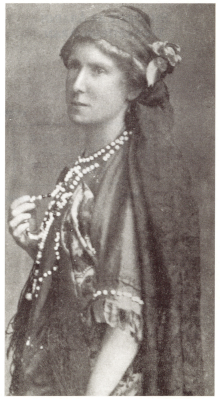
O’Farrelly is one of five daughters and three sons of Peter Dominic Farrelly and Ann Farrelly (née Sheridan), a family with a traditional interest in the Irish language. After her articles Glimpses of Breffni and Meath are published in The Anglo-Celt in 1895, the editor, E. T. O’Hanlon, encourages her to study literature. Graduating from the Royal University of Ireland (BA 1899, MA 1900), she is appointed a lecturer in Irish at Alexandra College and Loreto College. A founder member in 1902, along with Mary Hayden, of the Irish Association of Women Graduates and Candidate Graduates, to promote equal opportunity in university education, she gives evidence to the Robertson (1902) and Fry (1906) commissions on Irish university education, arguing successfully for full co-education at UCD. Appointed lecturer in modern Irish at UCD in 1909, she is also a member of the first UCD governing body and the National University of Ireland (NUI) senate (1914–49). In 1932, on the retirement of Douglas Hyde, she is appointed professor of modern Irish at UCD, holding the position until her retirement in 1947. She is also president of the Irish Federation of University Women (1937–39) and of the National University Women Graduates’ Association (NUWGA) (1943–47).
One of the most prominent women in the Gaelic League, a member of its coiste gnótha (executive committee) and a director of the Gaelic press An Cló-Chumann Ltd, O’Farrelly is a close friend of most of its leading figures, especially Douglas Hyde, Kuno Meyer, and Eoin MacNeill. One of Hyde’s allies in his battle to avoid politicising the league, she is so close to him that students at UCD enjoy speculating about the nature of their friendship. She advocates pan-Celticism, but does not get involved in disputes on the matter within the league. A founder member, and subsequently principal for many years, of the Ulster College of Irish, Cloghaneely, County Donegal, she is also associated with the Leinster and Connacht colleges and serves as chairperson of the Federation of Irish Language Summer Schools.
Having presided at the inaugural meeting of Cumann na mBan in 1914, espousing its subordinate role in relation to the Irish Volunteers, O’Farrelly leaves the organisation soon afterwards because of her support for recruitment to the British Army during World War I. A close friend of Roger Casement, in 1916, along with Col. Maurice Moore she gathers a petition that seeks a reprieve of his death sentence. She is a member of a committee of women which negotiate unsuccessfully with Irish Republican Army (IRA) leaders to avoid civil war in 1922, and is heavily defeated as an independent candidate for the NUI constituency in the general elections of 1923 and June 1927. In 1937 she is actively involved in the National University Women Graduates’ Association’s campaign against the constitution, seeking deletion of articles perceived as discriminating against women.
Popular among students at UCD, O’Farrelly has a reputation as a social figure and entertains frequently at her homes in Dublin and the Donegal Gaeltacht. A founder member (1914) and president (1914–51) of the UCD camogie club, she persuades William Gibson, 2nd Baron Ashbourne, to donate the Ashbourne Cup for the camogie intervarsities. She is also president of the Camogie Association of Ireland in 1941–42. A supporter of native Irish industry, she is president of the Irish Industrial Development Association and the Homespun Society, and administrator of the John Connor Magee Trust for the development of Gaeltacht industry. A poet and writer in both Irish and English, often using the pseudonym ‘Uan Uladh’, her principal publications in prose are The reign of humbug (1900), Leabhar an Athar Eoghan (1903), Filidheacht Segháin Uí Neachtáin (1911), and her novel Grádh agus crádh (1901); and in poetry Out of the depths (1921) and Áille an domhain (1927).
Béaslaí is born Percy Frederick Beazley in Liverpool, England on February 15, 1881, to Irish Catholic parents, Patrick Langford Beazley, originally from Killarney, County Kerry, and Nannie Hickey, from Newcastle West, County Limerick. During his summer holidays in his younger years, he spends time in Ireland (near Kenmare, County Kerry) with his paternal uncle, Father James Beazley, where he begins to learn the Irish language. He is educated at St. Francis Xavier’s College in Liverpool, where he develops his keen interest in Irish. By the time he is aged 17 his Irish proficiency is exceptional.
After finishing his education at St. Francis Xavier’s, Béaslaí is encouraged to begin Irish poetry by Tadhg Ó Donnchadha. He follows his father’s footsteps into journalism, initially working for the local Wallasey News. In 1906 he moves to Dublin, and within a year becomes a freelance writer for the Irish Peasant, Irish Independent, Freeman’s Journal and Express. He is offered a permanent position with Independent Newspapers, as assistant leader writer and special reporter for the Dublin Evening Telegraph. He writes regularly for the Freeman’s Journal, including a daily half-column in Irish.
After his early introduction to Irish poetry Béaslaí becomes involved in staging Irish-language amateur drama at the Oireachtas annual music festival. He begins to write both original works and adaptations from foreign languages. One of these works, Eachtra Pheadair Schlemiel (1909), is translated from German into Irish.
Later Béaslaí continues to write poetry, such as the collection “Bealtaine 1916” agus Dánta Eile (1920), and short stories such as “Earc agus Aine agus Scéalta Eile.” Between 1913 and 1939 he writes many plays, including Cliuche Cartaí (1920), An Sgaothaire agus Cúig Drámaí Eile (1929), An Danar (1929) and An Bhean Chródha (1931). He writes two books about his comrade Michael Collins: Michael Collins and the Making of a New Ireland (2 volumes, 1926) and Michael Collins: Soldier and Statesman (1937).
Béaslaí’s works revolve around the Irish language movement and the Irish Republican Army (IRA), focusing on the independence struggle of Ireland. He writes about these topics in newspapers such as the Standard and The Kerryman. His most notable work in newspapers during his later life includes his contribution to the Irish Independent, which publishes a section called ‘A Veteran Remembers’ five days a week from May 16 to June 1957, as well as a weekly section called ‘Moods and Memories’ on Wednesdays from May 24, 1961, to June 16, 1965.
One of the awards Béaslaí gains during his career is on August 14, 1928, a gold medal at the Tailteann Literary Awards. While in Dublin, he joins the Keating Branch of the Gaelic League, and after he moves to Ireland, he begins using the Irish form of his name, Piaras Béaslaí, rather than Percy Beazley.
Béaslaí is a founding member of the Irish Volunteers in 1913. In January 1916 he serves as a courier for political activist and revolutionary leader Seán Mac Diarmada. By the time of the Easter Rising that year, he is deputy commanding officer of the 1st Dublin Battalion. In an audio recording to which he contributes in 1958, he details his experience in the Rising, describing the rebels assembling before noon in Blackhall Street at battalion headquarters. After midday they march out to the Four Courts, erecting barricades as they do so. The Four Courts is his main station.
In the audio, Béaslaí recalls a green flag with a gold harp in the centre. This is the non-Sinn Féin flag at the time. He is in direct charge of the Four Courts area, and at one point during the fight he orders a complete blackout. He recalls, “things were going badly for the English soldiers” and describes the whole event as “a weird experience.” He remembers the streets being lit up with fires in the darkness as if it were bright as day. He speaks of the intensity of the firing line and then how it suddenly ceases on the Friday. He remembers falling asleep and when he awakens being presented with Patrick Pearse‘s order to surrender. The rebels are brought to Richmond Barracks. He then spends fifteen months in English prisons.
Béaslaí serves three years of penal servitude divided between a stringent HM Prison Portland and a more lenient HM Prison Lewes. He is then imprisoned two times within four months during 1919, both terms ending in celebrated escapes. After his final prison release, Michael Collins approaches him about editing An tOglach, the Irish Volunteer newspaper. This sees communication between GHQ and local volunteers drastically improve.
Later, Béaslaí becomes director of publicity for the Irish Republican Army, and at the 1918 Irish general election he is elected to the First Dáil as Sinn Féin MP for East Kerry. Sinn Féin MPs elected in the Westminster elections of 1918 refuse to recognise the Parliament of the United Kingdom, and instead assemble the following January at the Mansion House in Dublin as a revolutionary parliament, Dáil Éireann. Béaslaí is noted for his translation of the democratic programme of the First Dáil, which he reads aloud at the inaugural sitting.
Béaslaí and Con Collins share the distinction of having been elected in three Irish general elections unopposed by any other candidates.
During Béaslaí’s time in London, he gives a lot of his time to the Gaelic League. In the Keating branch of the league, in Ireland, he develops an interest in the IRB. Cathal Brugha, a branch member, asks him to join the IRB. The Keating branch is where Béaslaí meets Michael Collins, eventually introducing Collins to his cousin and fellow branch member, Elizabeth Mernin. He is also instrumental in establishing An Fáinne, an Irish-speaking league whose members vow to speak solely Irish among themselves and wear a membership badge of a circle. This coincides with his involvement in the IRB. His love of the Irish language gives him an opportunity to delve into his other hobbies. He writes for Banba, an Irish journal published by the Gaelic League. He is able to express his love for theatre, in the Gaelic League, forming a group of men called “Na hAisteoirí.”
Lynch returns to Ireland in 1909, where he starts training as a teacher in St Patrick’s College, Dublin. He graduates in 1911 as a primary school teacher. In April 1912 he begins working as a national schoolteacher at St. Michan’s School, Dublin, becomes an active member of the Keating branch of the Gaelic League, and is recruited into the Irish Republican Brotherhood (IRB) by Seán Mac Diarmada. He also joins the Irish Volunteers in 1913, and becomes captain of F Company, 1st Battalion, Dublin Brigade. With Piaras Béaslaí he founds Na hAisteoirí, a drama company dedicated to the production of plays in Irish, with many of its members fighting during the 1916 Easter Rising. In the months before the rising Lynch temporarily stands down from the Volunteers after his school manager tells him he will be sacked if he does not. Learning that a rising was imminent, he rejoins the Volunteers, and over the Easter weekend commands the detachment that guards Bulmer Hobson to prevent him from interfering with Volunteer mobilisation. During the rising he is involved in heavy fighting in the North King Street area and is subsequently imprisoned.
Held at Lewes Prison, Lynch is released under the general amnesty. In August 1916 he is reimprisoned for making an inflammatory speech, and in September leads the Mountjoy Prisonhunger strike with Austin Stack and Thomas Ashe. He is released in November following a further hunger strike at Dundalk prison. He is imprisoned again in May 1918 on the same charge during the ‘German Plot’ allegations and is released in August 1919, after which he helps to plan the escape of other prisoners.
Elected a Sinn FéinTD for South Kerry in December 1918 and for Kerry–Limerick West in May 1921, Lynch serves as assistant secretary to the Anglo-Irish Treaty delegation in London (October–December 1921), where he is largely responsible for organising the living arrangements at the two Irish headquarters. A supporter of the treaty, he addresses Pro-Treaty rallies with Michael Collins, and from January to August 1922 is Minister for Education with the Provisional Government, at the same time as Michael Hayes is Minister for Education for Dáil Éireann. Possible conflict is avoided by the pragmatic division of duties, under which Hayes takes responsibility for intermediate and higher education, and Lynch for primary education. It is also left for Lynch to clarify the relationship between the new Provisional Government and the board of commissioners of intermediate education, which is not abolished until 1923. These developments, however, are overshadowed by the beginning of the Irish Civil War, where military considerations take precedence over civic responsibilities.
Required to serve in the army, in July 1922 Lynch is appointed a vice-commandant of the south-western division with the rank of commandant-general, commanding a unit of Dublin soldiers in County Kerry, where on occasion he has to endure being ambushed, leading a fellow commandant to note ironically that his constituents do not seem to think much of him. However, the reluctance of former colleagues to attack him possibly ensure his survival during the war. Frank Henderson of Dublin’s No. 1 brigade of the Irish Republican Army (IRA) tells Ernie O’Malley of his reluctance to become involved in reprisal shootings after Free State executions, commenting, “I didn’t like that order. I could have shot Eamonn Duggan and Fionán Lynch, for they went home every night drunk, but I left them alone.”
After the Irish Civil War Lynch is elected a Cumann na nGaedheal TD for Kerry, a seat he holds until 1937, after which he represents the constituency of Kerry South (1937–44). He serves as Minister for Fisheries (1922–28) and Minister for Lands and Fisheries (1928–32) and retains his interest in education. He supports the Irish National Teachers‘ Organisation policy on the Irish language during the 1920s, commenting that he is entirely opposed to attempting to teach subjects through Irish where Irish is not the known language.
In 1931 Lynch qualifies as a barrister. After Fianna Fáil comes to power and during the rise of the Blueshirts he speaks at public meetings with Eoin O’Duffy, and they are attacked by a crowd in Tralee in October 1933. After the fall of O’Duffy and the reorganisation of Fine Gael, W. T. Cosgrave appoints a front bench designed to represent the various groups in the party, which witness former ministers, including Desmond FitzGerald, Patrick Hogan, and Lynch, relegated to the back benches. Lynch serves as Leas-Cheann Comhairle of the Dáil (1938–39). Having built up a legal practice, he retires from politics in October 1944 and is subsequently appointed a circuit court judge in the north-west district, retiring from the bench in 1959.
Lynch dies suddenly at his home in Dartry, County Dublin, on June 3, 1966, shortly after celebrating the 50th anniversary of the Easter Rising. He is survived by his wife Brighid (née Slattery), a native of Tralee, and by their five sons and one daughter. His papers are on permanent loan to Kerry County Library archives.
(From: “Lynch, Fionán (Finian)” by Diarmaid Ferriter, Dictionary of Irish Biography, http://www.dib.ie)
Traynor works as a boot maker and is married with ten children. At the time of his death the eldest is 18 years and the youngest 5 months. The eldest son, Frank, represents Ireland at the 1928 Summer Olympics in Amsterdam, competing as a bantamweight boxer.
Traynor is captured during an ambush on Auxiliaries in Brunswick Street, Dublin, on March 14, 1921, and is tried on April 5 at City Hall. He is part of a party of IRA volunteers keeping watch outside a meeting at 144 Brunswick Street that includes Seán MacBride. During the fight an IRA volunteer, Leo Fitzgerald, is killed, as are Constable James O’Farrell and Cadet Bernard Beard of the Dublin Metropolitan Police. Traynor is reportedly badly beaten by members of the Igoe Gang.
Traynor is hanged in Mountjoy Prison in Dublin on April 25, 1921, one of a group of men, commonly referred to as the Forgotten Ten, hanged in Mountjoy Prison from 1920–21, during the Irish War of Independence. He is 38 years old at the time of his death.
Mark Sturgis, assistant to the Under-Secretary for Ireland, writes, “Traynor, captured red handed with an attacking party when Auxiliaries were killed in Brunswick Street, was executed this morning. I don’t think they will make much fuss as there is no sort of ‘alibi’ business this time – nor is he the usual ‘youth’, dear to ‘The Freeman‘, as he is over 40 and has a pack of children, the poor deluded idiot.”
On the day following Traynor’s death, Gilbert Potter, a Royal Irish Constabulary (RIC) District Inspector based in Cahir, County Tipperary, and being held for Traynor’s safe treatment is executed in reprisal by members of the 3rd Tipperary Brigade of the IRA. Another IRA volunteer, Jack Donnelly, captured with Traynor, is sentenced to death but is reprieved by the declaration of an impending truce in June 1921.
In 1965 a statue is erected to honor Traynor in his native town of Tullow. The Ballad of Thomas Traynor is written in his memory.
The 860-ruling Unionist Party council had been scheduled to meet on Saturday, May 13, but postponed the session for a week to allow Trimble to broaden his support among unionists still opposed to the deal. The council is expected to vote on resuming participation in a joint executive, which had been suspended on February 11 after the Irish Republican Army (IRA) failed to initiate disarmament.
The postponement of the unionist council meeting means a scheduled restart of devolution two days later will also be postponed. Great Britain and Ireland had offered to restore the Northern Ireland Assembly and a power-sharing executive composed of unionist, nationalist and republican members by May 22.
Great Britain and Ireland are co-sponsors of the 1998 Good Friday Agreement on reconciliation between the Catholic and Protestant communities. Trimble tells news media he is ready to support a return to sharing power with Sinn Féin, the IRA’s political wing, after receiving assurances on the arms issue.
Earlier in the month, the IRA broke the stalemate with an offer to put its arms arsenals beyond use under international supervision. The IRA offer fell short of a pledge to submit its weapons to destruction, as was understood from previous talks on the issue, but both Great Britain and Ireland back the compromise and press for its acceptance by unionists and nationalists as well.
Great Britain’s Northern Ireland SecretaryPeter Mandelson describes the postponement as the “correct decision.” He says, “David Trimble has been clarifying some issues and driving a hard bargain over others. Now he needs time to present the outcome to his party.” He says he is confident that Trimble will be successful and the way will then be paved for the return to power-sharing.
However, hard-line Ulster Unionist leader Jeffrey Donaldson says he does not believe that weapons will be put beyond use. “What we actually need to know and hear from the IRA is are they going to decommission their weapons?” Donaldson, a member of the British parliament, says in a BBC interview. “We haven’t had any clarification from the IRA.”
British Prime MinisterTony Blair says in parliament on Wednesday, May 17, the IRA offer to put its weapons “beyond use” is “an important confidence-building measure” but only the start of a process of silencing the guns. “We need to make progress until the time when these weapons are indeed completely, verifiably, beyond use,” Blair says.
(From: “Unionist leader says he will back Ulster deal,” UPI Archives, http://www.upi.com/archives, May 18, 2000)
Dan Breen and Seán Treacy rescue their comrade Seán Hogan from a Dublin-Cork train at Knocklong, County Limerick, on May 13, 1919, in what becomes known as the Knocklong Ambush. Two policemen guarding Hogan are killed.
One of the most famous photographs (left) of the Irish War of Independence (1919-21) is taken at Breen’s wedding in June 1921. Breen is already burnishing his reputation as the romantic guerilla campaigner three years before the publication of his bestselling autobiography My Fight for Irish Freedom. On his lap there is a Luger pistol, an incongruity in a wedding photograph, but in keeping with his penchant for self-mythologising. In the background on the left is his best man Hogan who is dressed in the uniform of the Irish Volunteers. Unlike Breen, he looks shy and awkward, his body tilted as if to convey how ill at ease with himself he is.
Had Hogan shown the same diffidence in May 1919, he might have saved himself and his comrades a great deal of trouble. He is the youngest of those involved in the Soloheadbeg ambush on January 21, 1919, the event that is viewed in retrospect as the event that starts the Irish War of Independence.
Hogan is only 18, according to most reports, but to date no birth certificate has been found for him. His youth may explain his lack of caution in early May 1919 when he slips his minder after a dance in Kilshenane, County Tipperary, and ends up, not in the arms of his sweetheart Bridie O’Keeffe, but in the embrace of the Royal Irish Constabulary (RIC). He escorts O’Keeffe back to her relative’s farmhouse where she is spending the night. He sleeps on the sofa. When he wakes up, the house is surrounded. He flees, but is picked up by the RIC in a laneway near the house. He, along with the others involved in the Soloheadbeg ambush, are the most wanted men in Ireland. He faces interrogation and possible execution.
The Knocklong ambush, which occurs on May 13, 1919, saves Hogan from such a fate, but it comes at a terrible price for all those involved. He is put on the 6:00 p.m. train from Thurles to Cork where he is due to be interrogated in the military prison. Knocklong Station, just over the border in County Limerick, is chosen as the place for the escape attempt because of its distance from the nearest RIC barracks.
Four volunteers of the Irish Republican Army (IRA) East Limerick Brigade get on the train at Emly in order to signal to the men waiting at Knocklong Station the carriage in which Hogan is being detained. He is being escorted to Cork by four RIC men. They face five volunteers, three of whom are armed. A ferocious gun battle ensues, lasting 14 minutes. Constable Michael Enright (30), from Ballyneety, County Limerick, is shot dead immediately.
Sgt. Peter Wallace and Treacy, another of those involved at Soloheadbeg, wrestle over Treacy’s gun. Wallace, who is a huge man, shoots Treacy in the throat before the gun is turned on Wallace, who later dies from his wounds. Hogan smashes his mangled chains in the head of another of his armed guards who is then thrown out of the window of the train. The last remaining guard picks up a rifle and opens fire on the IRA party through the carriage window wounding three volunteers waiting on the platform, including Breen. Hogan is taken immediately to a butcher’s shop where his chains are smashed with a cleaver, setting him free.
Knocklong becomes an exalted event in the iconography of Irish republicanism. At Soloheadbeg, eight armed and ready volunteers faced two unwary policemen. It was not a fair fight. Hogan’s rescue from the train at Knocklong demands organisation, courage and daring of the highest order.
Hogan continues to serve in the Irish War of Independence and on the anti-Treaty side in the Irish Civil War (1922-23). By the time hostilities cease in 1923, he is only 23, but has spent the previous five years in armed combat. The toll on his mind and body are huge. In 1924, he is admitted to St. Bricin’s Military Hospital suffering from “attacks of restlessness and depression – inability to concentrate his mind on anything.” His wife at the time, Christina, runs a nursing home in Tipperary, where her patients include many shellshocked Irish veterans of World War I. The couple later separates.
Hogan’s fortunes change with the change of government in 1932 bringing to power Fianna Fáil, a party which Hogan supports. He is given a job in the Board of Works, but his mental health continues to deteriorate. He complains of the “nerves and all the ailments that go with them.” His circumstances are such that he spends two years living in the family home of Séumas Robinson, the officer commanding at Soloheadbeg.
In early 2019, Robinson’s daughter, Dimphne Brennan, tells The Irish Times, “He had nowhere else to go. He never got over what happened. His nerves were shattered. We were all just kids and we didn’t disturb him in his room. He didn’t talk to us.”
Hogan dies on Christmas Eve 1968 from a cerebral hemorrhage and chronic bronchitis. At the funeral reception, his estranged widow supposedly tells a niece of Hogan, “Well, but wasn’t that some waste of a life.”
Hogan and Christina are buried 50 paces from each other in St. Michael’s Cemetery in Tipperary, divided in death as they were in life. Seán Hogan: His Life: A Troubled Journey, by John Connors, is published by Tipp Revolution.
(From: “Knocklong ambush, on May 13th, 1919 involved a 14-minute gun battle” by Ronan McGreevy, The Irish Times, http://www.irishtimes.com, May 20, 2019)




 seamus dubhghaill