seamus dubhghaill

Promoting Irish Culture and History from Little Rock, Arkansas, USA


Leave a comment

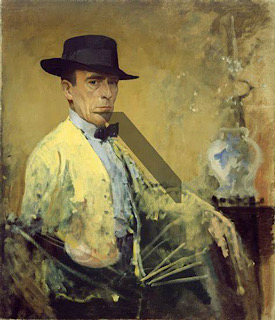
Death of Leo Whelan, Portrait & Genre Painter

(Michael) Leo Whelan, portrait and genre painter, dies from leukemia on November 6, 1956, at the Mater private nursing home in Dublin.

Whelan is born on January 17, 1892, at 20 St. George’s Villas, Fairview, Dublin, one of two sons and three daughters of Maurice Whelan, a draper, of County Kerry ancestry, and Mary Whelan (née Cruise), from County Roscommon. The family subsequently moves to 65 Eccles Street, where his parents operated a small hotel. Educated at Belvedere College, Dublin, he then attends the Dublin Metropolitan School of Art (DMSA) (1908–14), where he is a student of William Orpen, who has a huge influence on his artistic style. His fellow students at the school include Patrick Tuohy and Séan Keating.

Whelan is awarded many prizes in the Royal Dublin Society (RDS) Taylor art competitions, including one in 1912 for a portrait of his sister Lena, entitled On the Moors, rendered in a strongly academic technique. In 1916, he wins the Taylor scholarship for the Royal Hibernian Academy (RHA) schools for his finest early work, The Doctor’s Visit, an adroitly executed composition of contrasting shadows and light. Typical of many of his genre interiors, the painting depicts a room in the family home, with relatives as models: Whelan’s mother sits by the bed watching over his ill cousin, while his sister, dressed in a Mater hospital nurse’s uniform, is in the background opening the door for the doctor. The subtly evoked atmosphere of restrained emotion foreshadowed a hallmark of his mature style.

Whelan exhibits annually at the RHA for forty-five years (1911–56), averaging six works per year. He is elected an RHA associate in 1920, becoming a full member in 1924. He participates in the Exposition d’art irlandais at the Galerie Barbazanges in Paris in 1922. A visiting teacher at the RHA schools in 1924, he also teaches in the DMSA for a time. He has studios at 64 Dawson Street (1914–27) and 7 Lower Baggot Street (1931–56). Beginning in the 1910s, he receives regular commissions for portraits, constituting his primary source of income. Having become the family’s main breadwinner following his parents’ deaths in the 1920s, he concentrates most of his production on this lucrative activity, portraying numerous leading figures in the spheres of politics, academia, religion, society, medicine, and law.

Coming from a family of militant nationalist sympathies, in 1922 he begins a large group portrait, GHQ Staff of the Pre-Treaty IRA, including Michael CollinsRichard MulcahyRory O’ConnorLiam Mellows and nine others, composed from individual studies of the men rendered during clandestine sittings in his home and studio. The painting, which he leaves unfinished, is in McKee Barracks, Dublin. He receives special praise for his portraits of John Henry Bernard, Provost of Trinity College Dublin (TCD) and of Louis Claude Purser, TCD vice-provost. The latter is awarded a medal at the 1926 Tailteann Games. He exhibits seventeen paintings at the Royal Society of Portrait Painters, London, of which he is a member, and shows two works at the Royal Academy of Arts, London. His 1929 portrait of John McCormack, one of his major patrons, is presented by the tenor’s family some fifty years later to the National Concert Hall, Dublin.

Situated securely in the academic tradition, in most of his portraits Whelan favours a sombre, restricted palette, with the sitter placed, in grave demeanour, against a monotone background with few accessories. In a 1943 interview he asserts that twentieth-century portraiture suffers from the drabness of modern costume, for which the artist must compensate by careful rendition of the subject’s hands. He tends to depart from his prevailing portrait style when painting women, whom he characteristically depicts in meticulously observed interiors, a notable example being his portrait of Society hostess Gladys Maccabe (c.1946; NGI).

Whelan’s commercial concentration on portraiture notwithstanding, he expresses his true talent in genre compositions, especially kitchen interiors, in which he emulates the technique of the Dutch painter Johannes Vermeer. Two of the most accomplished of these depict his sister Frances in the basement kitchen of the family home: The Kitchen Window (1927; Crawford Art Gallery, Cork) demonstrates a particularly skillful use of light, while Interior of a Kitchen (1935) is notable for the dexterous handling of objects of varied shapes and textures. His genre works include both urban and rural scenes, with a distinctive interest in portraying occupations and other activities. Gypsy (1923), an Orpenesque composition of a shawled woman in a west-of-Ireland landscape with a caravan in the background, receives wide contemporary critical acclaim. Jer (c.1925), depicting a man seated by the fire in a cottage interior, is reproduced in J. Crampton Walker’s Irish Art and Landscape (1927). The Fiddler (c.1932), a naturalistic, sensitively characterised study, is first shown at an Ulster Academy exhibition at Stranmillis, Belfast. A Kerry Cobbler is reproduced in Twelve Irish Artists (1940), introduced by Thomas Bodkin, as among the works denoting the development of a distinctively Irish school of painting.

In 1929, Whelan designs the first Irish Free State commemorative stamp, a portrait of Daniel O’Connell for the centenary of Catholic emancipation. Commissioned by the Thomas Haverty trust to paint an incident from the life of Saint Patrick for the 1932 Eucharistic Congress, he executes The Baptism by St. Patrick of Ethna the Fair and Fedelmia the Ruddy, Daughters of the Ard Rí Laoghaire, a work highly conservative in style. He rapidly completes an oil study of the papal legate, Lorenzo Lauri, also for the Eucharistic Congress. He is represented in the art competitions at the 1932 Summer Olympics in Los Angeles. His depiction of Saint Brigid, shown at the Academy of Christian Art exhibition (1940), becomes a familiar image owing to the wide circulation of reproductions.

Whelan’s political portraits are influential in creating a strong, assured image of the newly formed Irish state, and thus retain an historical significance. His posthumous portrait, The Late General Michael Collins, exhibited at the RHA in 1943 and now held in Leinster House, is an iconic, heroic image of the fallen leader. His portraits of Arthur Griffith and Kevin O’Higgins – commissioned posthumously, as is the Collins, by Fine Gael – also hang in Leinster House, while that of John A. Costello, exhibited at the RHA in 1949, is now held in the King’s Inns, Dublin. He paints two presidents, Douglas Hyde and Seán T. O’Kelly, both works currently in Áras an Uachtaráin. A portrait of Éamon de Valera, painted in 1955 when the sitter is Leader of the Opposition, is in Leinster House. In 1954, he designs a second commemorative stamp, picturing a reproduction of a portrait bust of John Henry Newman, to mark the centenary of the Catholic University of Ireland.

Whelan is elected an honorary academician of both the Ulster Academy of Arts (1931), and the Royal Ulster Academy (1950). He becomes a member of the United Arts Club in 1934. As a representative of the RHA, he sits on the board of governors of the National Gallery of Ireland for many years, and is on the advisory committee of the Municipal Gallery of Modern Art. Unmarried, he resides until his death at the Eccles Street address, with two sisters who continue to manage the family hotel. He dies on November 6, 1956, from leukemia at the Mater private nursing home in Dublin. He is buried in Glasnevin Cemetery.

(From: “Whelan, (Michael) Leo,” by Carmel Doyle, Dictionary of Irish Biography, http://www.dib.ie, October 2009)


Leave a comment

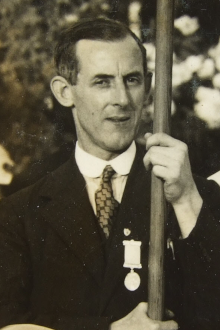
Birth of Frank Duff, Lay Catholic & Author

Francis Michael Duff, Irish authorlay Catholic and founder of the Legion of Mary, known for bringing attention to the role of the Catholic laity during the Second Vatican Council of the Roman Catholic Church, is born at 97 Phibsboro Road, Dublin, on June 7, 1889.

Duff is the eldest of seven children of John Duff, a civil servant with the local government board, and his wife, Susan Letitia (née Freehill), a civil servant with the post office. The wealthy family lives in the city at St. Patrick’s Road, Drumcondra. He attends Blackrock College.

In 1908, Duff enters the Civil Service and is assigned to the Irish Land Commission. In 1913, he joins the Society of Saint Vincent de Paul and is exposed to the real poverty of Dublin. Many who live in tenement squalor are forced to attend soup kitchens for sustenance, and abject poverty, alcoholism, street gangs, and organized prostitution are rife in parts of Dublin. He joins and soon rises through the ranks to become President of the Saint Patrick’s Conference at Saint Nicholas of Myra Parish. Having concern for people he sees as materially and spiritually deprived, he has the idea to picket Protestant soup kitchens as he considers they are giving aid in the form of food and free accommodation at hostels, in return for not attending Catholic services. He sets up rival Catholic soup kitchens and, with his friend, Sergeant Major Joe Gabbett, who has already been working at discouraging Catholics from patronizing Protestant soup kitchens. They succeed in closing down two of them over the years.

In 1916, Duff publishes his first pamphlet, Can we be Saints?, where he expresses the conviction that all are called to be saints without exception, and that through Christian faith, all have the means necessary.

In 1918, a friend gifts Duff a copy of the book True Devotion to Mary by the seventeenth-century French cleric Louis de Montfort, which influences his views on Mary. He is additionally influenced by the writings of John Henry Newman.

Duff briefly acts as private secretary to Michael Collins, then-Chairman of the Provisional Government and commander-in-chief of the National Army. In 1924, he is transferred to the Department of Finance.

On September 7, 1921, along with Fr. Michael Toher and fifteen predominantly young women, he is present at the first meeting of the association which he would forge as the Legion of Mary. He models the Legion on the Roman legions, naming the local unit the “praesidium,” and he immerses himself in the apostolic work which dominates the rest of his life.

In 1922, Duff establishes the Sancta Maria hostel in Dublin as a refuge for prostitutes, and is the driving force behind the closure of “Monto,” Dublin’s notorious red-light district. In 1927, he establishes the Morning Star hostel for homeless men in Dublin, and in 1930 the Regina Coeli hostel for homeless women, which provides special units for unmarried mothers and their children at a time when neither church nor state favour helping unmarried women to keep their children.

While Duff enjoys the support of W. T. Cosgrave, Ireland’s head of government, and in May 1931 is granted an audience with Pope Pius XI, his efforts are opposed internally in the Dublin diocese. In the 1930s and 1940s, he creates the Mercier Society, a study group designed to bring together Catholics and Protestants, as well as the Pillar of Fire, a group designed to promote dialogue between Irish Catholics with Ireland’s Jewish community.

Duff retires from the Civil Service in 1934 to devote all of his time to the Legion of Mary. For the rest of his life, with the help of many others, he guides the Legion’s worldwide extension.

In 1965, Pope Paul VI invites Duff to attend the Second Vatican Council as a lay observer. When he is introduced to the assembly by Archbishop John Heenan of Liverpool, he receives a standing ovation.

Duff makes the promotion of devotion to the Sacred Heart of Jesus part of the Legion’s apostolate.

Duff dies in Dublin at the age of 91 on November 7, 1980. He Is interred in Glasnevin Cemetery. In July 1996, the cause of Duff’s beatification is introduced by Cardinal Desmond Connell.

Today, the Legion of Mary has an estimated four million active members and 10 million auxiliary members in close to 200 countries in almost every diocese in the Catholic Church.


Leave a comment

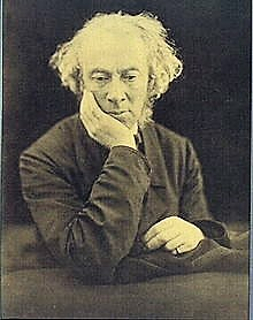
Death of Denis Florence MacCarthy, Poet & Translator

Denis Florence MacCarthy, Irish poet, translator, and biographer, dies at 7 Herbert Terrace, Blackrock, Dublin, on April 7, 1882.

MacCarthy is born in Lower O’Connell Street, Dublin, on May 26, 1817, and educated there and at St. Patrick’s College, Maynooth. He acquires an intimate knowledge of Spanish from a learned priest, who had spent much time in Spain, which he is later to turn to good advantage. In April 1834, before turning seventeen, he contributes his first verses to the Dublin Satirist. He is one of a coterie of writers whose works appear in The Nation, which is started by Charles Gavan Duffy in 1842. Writing under the pseudonym “Desmond,” most of MacCarthy’s patriotic verse appears in this organ.

In 1846, MacCarthy is called to the Irish bar but never practises. In the same year he edits The Poets and Dramatists of Ireland, which he prefaces with an essay on the early history and religion of his countrymen. About this time, he also edits The Book of Irish Ballads (by various authors), with an introductory essay on ballad poetry in general. His Ballads, Poems, and Lyrics appears in 1850, original and translated. His attention is first directed to Pedro Calderón de la Barca by a passage in one of Percy Bysshe Shelley‘s essays, and from then on, the interpretation of the “Spanish Shakespeare” claims the greater part of his attention.

The first volume of MacCarthy’s translations, containing six plays, appears in 1853, and is followed by further instalments in 1861, 1867, 1870, and 1873. His version of Daybreak in Capacabana is completed only a few months before his death.

Until 1864, MacCarthy resides principally on Killiney Hill, overlooking Dublin Bay. The delicate health of some members of his family then renders a change of climate imperative, and he pays a prolonged visit to continental Europe. On his return, he settles in London in 1871, where he publishes – in addition to his translations – Shelley’s Early Life, which contains an account of that poet’s visit to Dublin in 1812.

During MacCarthy’s final illness he returns to Dublin, settling at 7 Herbert Terrace, Blackrock, and died there on Good Friday, April 7, 1882. He is buried in Glasnevin Cemetery. His memorial committee includes Cardinals John Henry Newman and Edward McCabe, a lifelong friend, Thomas (Lord) O’Hagan, Gavan Duffy, Timothy Daniel Sullivan, and the poets Aubrey Thomas de Vere and Sir Samuel Ferguson. The committee finances the publication of his Poems (1882), edited by his eldest son, John, a minor poet living in London, and commission a bust by Thomas Farrell which is displayed at City Hall, Dublin. His poetical gifts are inherited by his daughter, who becomes a nun and writes as Sister Mary Stanislaus.

MacCarthy’s poems are distinguished by a sense of harmony and sympathy with natural beauty. Such poems as “The Bridal of the Year,” “Summer Longings” (alias “Waiting for the May”), and his long narrative poem, “The Voyage of St. Brendan,” are among his most enduring works. The last-mentioned, which paraphrases the “Ave Maria Stella” as the evening song of the sailors, is also marked by the earnest religious feeling which mark its author throughout life. But it is by his version of Calderon that he is considered to have won a permanent place in English letters. His success is sufficiently testified by George Ticknor, who declares in his History of Spanish Literature that MacCarthy “has succeeded in giving a faithful idea of what is grandest and most effective in [Calderon’s] genius… to a degree which I had previously thought impossible. Nothing, I think, in the English language will give us so true an impression of what is most characteristic of the Spanish drama, and of Spanish poetry generally.”


Leave a comment

Death of Frank Duff, Founder of the Legion of Mary in Dublin

Francis Michael Duff, Irish lay Catholic and author known for bringing attention to the role of the Catholic Laity during the Second Vatican Council of the Roman Catholic Church, dies in Dublin on November 7, 1980. He is also the founder of the Legion of Mary in Dublin.

Duff is born in Dublin on June 7, 1889, at 97 Phibsboro Road, the eldest of seven children of John Duff and his wife, Susan Letitia (née Freehill). The wealthy family lives in the city at St. Patrick’s Road, Drumcondra. He attends Blackrock College.

In 1908, Duff enters the Civil Service and is assigned to the Irish Land Commission. In 1913, he joins the Society of Saint Vincent de Paul and is exposed to the real poverty of Dublin. Many who live in tenement squalor are forced to attend soup kitchens for sustenance, and abject poverty, alcoholism, and prostitution are rife in parts of Dublin. He joins and soon rises through the ranks to President of the St. Patrick’s Conference at St. Nicholas of Myra Parish. Having concern for people he sees as materially and spiritually deprived, he gets the idea to picket Protestant soup kitchens as he considers they are giving aid in the form of food and free accommodation at hostels in return for not attending Catholic services. He sets up rival Catholic soup kitchens and, with his friend, Sergeant Major Joe Gabbett, discourages Catholics from patronizing Protestant soup kitchens. They succeeded in closing down two of them over the years.

Duff publishes his first pamphlet, Can we be Saints?, in 1916. In it, he expresses the conviction that all, without exception, are called to be saints, and that through Christian faith, all have the means necessary.

In 1918, a friend gifts Duff a copy of True Devotion to Mary by the seventeenth-century French cleric Louis de Montfort, which influences his views on Mary. He is additionally influenced by the writings of John Henry Newman.

Duff briefly acts as private secretary to Michael Collins, the chairman of the Provisional Government and the commander-in-chief of the National Army. In 1924, he is transferred to the Department of Finance.

On September 7, 1921, Duff is a part of a meeting alongside Fr. Michael Toher and fifteen women which becomes the nucleus of what would become the Legion of Mary. The Legion of Mary is created to organise lay Catholics to perform voluntary work. He models the organisation on Roman legions. Some of the first causes the Legion pursues is to become involved with homelessness and prostitution in Dublin. In 1922, he defies the wishes of the Archbishop of Dublin and the widespread Crypto-Calvinism, or Jansenism, within the Catholic Church in Ireland, which had created an intense hostility towards both prostitutes and other allegedly “fallen women.” Similarly, to St. Vitalis of Gaza before him, he begins an outreach to the prostitutes living in often brutal and inhuman conditions in the “kip houses” of “the Monto,” as Dublin’s red-light district, one of the largest in Europe at the time, is then called. Although middle-class Dubliners dismissively view these women as “whores,” the impoverished but devoutly Catholic residents of the Monto tenements refer to local prostitutes as “unfortunate girls,” and understand that they often turn to prostitution as a last resort. As part of his work, Duff establishes the Sancta Maria hostel, a safe house for former prostitutes who had run away from their “kip keepers.” Following the Irish War of Independence and Irish Civil War, he also persuades the first Catholic Commissioner of the Dublin Metropolitan Police, former Irish Army General W. R. E. Murphy, to launch a crackdown and, even though prostitution in the Republic of Ireland, rooted in human trafficking, still exists, the closure of the Monto’s last “Kip-Houses” is announced on March 12, 1925.

In 1927, Duff establishes the Morning Star hostel for homeless men, followed shortly by the Regina Coeli hostel for homeless women in 1930. Unlike the Magdalen Asylums, the Regina Coeli hostel reflects his view that unwed mothers should be taught how to be able to provide for and raise their children. This defies the norm of the era which holds that the children of unwed mothers should be saved from the stigma of their illegitimacy by being put up for adoption as quickly as possible.

While Duff enjoys the support of W. T. Cosgrave, Ireland’s head of government, and in May 1931 is granted an audience with Pope Pius XI, his efforts are opposed internally in the Dublin diocese. The Archbishop of Dublin Edward Joseph Byrne and his successor John Charles McQuaid seek to censor him because of his involvement with prostitutes. McQuaid also does not approve of his ecumenical efforts. In the 1930s and 1940s Duff creates the Mercier Society, a study group designed to bring together Catholics and Protestants, as well as the Pillar of Fire, a group designed to promote dialogue with Ireland’s Jewish community. In communication with Irish social dissidents Seán Ó Faoláin and Peadar O’Donnell, he suggests he is far more censored than even they are.

Duff does have some supporters amongst the Catholic hierarchy though. With the backing of Cardinal Joseph MacRory and Francis Bourne of Westminster, the Legion is able to expand rapidly and internationally. In 1928 the Legion establishes its first presidium in Scotland. In 1932 he is able to use the occasion of the Eucharistic Congress of Dublin to introduce the concept of the Legion of Mary to several visiting bishops, leading to further international growth.

Duff retires from the Civil Service in 1934 to devote all of his time to the Legion of Mary.

In July 1940, an overseas club for Afro-Asian students in Dublin is created. At that time Ireland is a popular destination for students from Asia and Africa because of its recent anti-imperial, anti-colonial history. Duff personally funds the purchase of a building for the club using funds from an inheritance. The club lasts until 1976 and facilitate many notable students, including Jaja Wachuku.

For the rest of his life, and with the help of many others, Duff guides the Legion’s worldwide extension. Today, the Legion of Mary has an estimated four million active members and 10 million auxiliary members in close to 200 countries in almost every diocese in the Catholic Church.

In 1965, Pope Paul VI invites Duff to attend the Second Vatican Council as a lay observer. When he is introduced to the assembly by the Archbishop of Liverpool, John Heenan, he receives a standing ovation.

Duff makes the promotion of devotion to the Most Sacred Heart of Jesus part of the Legion’s apostolate.

Duff dies in Dublin at the age of 91 on November 7, 1980, and is interred at Glasnevin Cemetery. In July 1996, the cause of his beatification is introduced by Cardinal Desmond Connell.


Leave a comment

Death of Daniel Murray, Roman Catholic Archbishop of Dublin

Daniel Murray, Roman Catholic Archbishop of Dublin, dies in Dublin on February 26, 1852.

Murray is born on April 18, 1768, at Sheepwalk, near Arklow, County Wicklow, the son of Thomas and Judith Murray, who are farmers. At the age of eight he goes to Thomas Betagh‘s school at Saul’s Court, near Christ Church Cathedral, Dublin. At sixteen, Archbishop John Carpenter sends him to the Irish College at Salamanca, completing his studies at the University of Salamanca. He is ordained priest in 1792 at the age of twenty-four.

After some years as curate at St. Paul’s Church, Dublin, Murray is transferred to Arklow and is there in 1798 when the rebellion breaks out. The yeomanry shoots the parish priest in bed and Murray, to escape a similar fate, flees to the city where for two years he serves as curate at St. Andrew’s Chapel on Hawkins Street. As a preacher, he is said to be particularly effective, especially in appeals for charitable causes, such as the schools. He is then assigned to the Chapel of St. Mary in Upper Liffey Street where Archbishop John Troy is the parish priest.

In 1809, at the request of Archbishop Troy, Murray is appointed coadjutor bishop and consecrated on November 30, 1809. In 1811 he is made Administrator of St. Andrew’s. That same year he helps Mary Aikenhead establish the Religious Sisters of Charity. While coadjutor he fills for one year the position of president of St. Patrick’s College, Maynooth.

Murray is an uncompromising opponent of a proposal granting the British government a “veto” over Catholic ecclesiastical appointments in Ireland, and in 1814 and 1815, makes two separate trips to Rome concerning the controversy.

Murray becomes Archbishop of Dublin in 1825 and on November 14, 1825, celebrates the completion of St. Mary’s Pro-Cathedral. He enjoys the confidence of successive popes and is held in high respect by the British government. His life is mainly devoted to ecclesiastical affairs, the establishment and organisation of religious associations for the education and relief of the poor. With the outbreak of cholera in the 1830s, in 1834 he and Mother Aikenhead found St. Vincent’s Hospital. He persuades Edmund Rice to send members of the Christian Brothers to Dublin to start a school for boys. The first is opened in a lumber yard on the city-quay. He assists Catherine McAuley in founding the Sisters of Mercy, and in 1831 professes the first three members.

Edward Bouverie Pusey has an interview with Murray in 1841, and bears testimony to his moderation, and John Henry Newman has some correspondence with him prior to Newman’s conversion from the Anglican Church to the Roman Catholic Church in 1845. A seat in the privy council at Dublin, officially offered to him in 1846, is not accepted. He takes part in the synod of the Roman Catholic clergy at Thurles in 1850.

Towards the end of his life, Murray’s eyesight is impaired, and he reads and writes with difficulty. Among his last priestly functions is a funeral service for Richard Lalor Sheil who had died in Italy, and whose body had been brought back to Ireland for burial. Murray dies in Dublin on February 26, 1852, at the age of eighty-four. He is interred in the St. Mary’s Pro-Cathedral, Dublin, where a marble statue of him has been erected in connection with a monument to his memory, executed by James Farrell, president of the Royal Hibernian Academy of Fine Arts.

(Pictured: Portrait of Daniel Murray, Archbishop of Dublin, by unknown 19th century Irish portrait painter)


Leave a comment

Birth of Daniel Murray, Archbishop of Dublin

Daniel Murray, Roman Catholic Archbishop of Dublin, is born on April 18, 1768, at Sheepwalk, near Arklow, County Wicklow.

Murray is the son of Thomas and Judith Murray, who are farmers. At the age of eight he goes to Thomas Betagh‘s school at Saul’s Court, near Christ Church Cathedral, Dublin. At sixteen, Archbishop John Carpenter sends him to the Irish College at Salamanca, completing his studies at the University of Salamanca. He is ordained priest in 1792 at the age of twenty-four.

After some years as curate at St. Paul’s Church in Dublin, Murray is transferred to Arklow and is there in 1798 when the rebellion breaks out. The yeomanry shoots the parish priest in bed and Murray, to escape a similar fate, flees to the city where for two years he serves as curate at St. Andrew’s Chapel on Hawkins Street. As a preacher, he is said to be particularly effective, especially in appeals for charitable causes, such as the schools. He is then assigned to the Chapel of St. Mary in Upper Liffey Street where Archbishop John Troy is the parish priest.

In 1809, at the request of Archbishop Troy, Murray is appointed coadjutor bishop and consecrated on November 30, 1809. In 1811 he is made Administrator of St. Andrew’s. That same year he helps Mary Aikenhead establish the Religious Sisters of Charity. While coadjutor he fills for one year the position of president of St. Patrick’s College, Maynooth.

Murray is an uncompromising opponent of a proposal granting the British government a “veto” over Catholic ecclesiastical appointments in Ireland, and in 1814 and 1815, makes two separate trips to Rome concerning the controversy.

Murray becomes Archbishop of Dublin in 1825 and on November 14, 1825, celebrates the completion of St. Mary’s Pro-Cathedral. He enjoys the confidence of successive popes and is held in high respect by the British government. His life is mainly devoted to ecclesiastical affairs, the establishment and organisation of religious associations for the education and relief of the poor. With the outbreak of cholera in the 1830s, in 1834 he and Mother Aikenhead found St. Vincent’s Hospital. He persuades Edmund Rice to send members of the Christian Brothers to Dublin to start a school for boys. The first is opened in a lumber yard on the city-quay. He assists Catherine McAuley in founding the Sisters of Mercy, and in 1831 professes the first three members.

Edward Bouverie Pusey has an interview with Murray in 1841, and bears testimony to his moderation, and John Henry Newman has some correspondence with him prior to Newman’s conversion from the Anglican Church to the Roman Catholic Church in 1845. A seat in the privy council at Dublin, officially offered to him in 1846, is not accepted. He takes part in the synod of the Roman Catholic clergy at Thurles in 1850.

Towards the end of his life, Murray’s eyesight is impaired, and he reads and writes with difficulty. Among his last priestly functions is a funeral service for Richard Lalor Sheil who had died in Italy, and whose body had been brought back to Ireland for burial. Murray dies in Dublin on February 26, 1852, at the age of eighty-four. He is interred in the St. Mary’s Pro-Cathedral, Dublin, where a marble statue of him has been erected in connection with a monument to his memory, executed by James Farrell, president of the Royal Hibernian Academy of Fine Arts.

(Pictured: Portrait of Daniel Murray, Archbishop of Dublin, by unknown 19th century Irish portrait painter)


Leave a comment

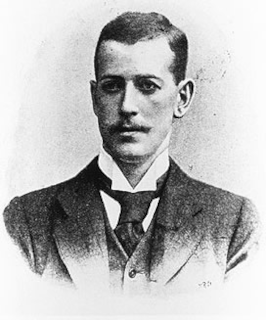
Birth of John Boland, Politician & Olympic Medalist

John Mary Pius Boland, Irish Nationalist politician, is born at 135 Capel Street, Dublin, on September 16, 1870. He serves as a Member of Parliament (MP) in the House of Commons of the United Kingdom of Great Britain and Ireland and as a member of the Irish Parliamentary Party for South Kerry (1900–1918). He is also noteworthy as a gold medalist tennis player at the first modern Olympics in Athens in 1896.

Boland is born to Patrick Boland (1840–1877), businessman, and Mary Donnelly. Following the death of his mother in 1882, he is placed with his six siblings under the guardianship of his uncle Nicholas Donnelly, auxiliary bishop of Dublin.

Boland is educated at two private Catholic schools, one Irish, the second English, and both of whose existence and evolution are influenced by John Henry Newman – the Catholic University School, Dublin, and The Oratory School, Birmingham. His secondary education at the two schools helps give him the foundation and understanding to play an influential role in the politics of Great Britain and Ireland at the beginning of the 20th century, when he is a member of the Irish Parliamentary Party which pursues constitutional Home Rule.

In 1892 Boland graduates with a BA from London University. He studies for a semester in Bonn, Germany, where he is a member of Bavaria Bonn, a student fraternity that is member of the Cartellverband. He studies law at Christ Church, Oxford, graduating with a BA in 1896 and MA in 1901. Although called to the Bar in 1897, he never practises.

Boland is the first Olympic champion in tennis for Great Britain and Ireland at the first modern Olympics, which takes place in Athens in 1896. He visits his friend Thrasyvoulos Manos in Athens during the Olympics, and Manos, a member of the organising committee, enters Boland in the tennis tournament. Boland promptly wins the singles tournament, defeating Friedrich Traun of Germany in the first round, Evangelos Rallis of Greece in the second, Konstantinos Paspatis of Greece in the semifinals, and Dionysios Kasdaglis of Greece in the final.

Boland then enters the doubles event with Traun, the German runner whom he had defeated in the first round of the singles. Together, they win the doubles event. They defeat Aristidis and Konstantinos Akratopoulos of Greece in the first round, have a bye in the semifinals, and defeat Demetrios Petrokokkinos of Greece and Dimitrios Kasdaglis in the final. When the Union Flag and the German flag are run up the flagpole to honour Boland and Traun’s victory, Boland points out to the man hoisting the flags that he is Irish, adding “It’s a gold harp on a green ground, we hope.” The officials agree to have an Irish flag prepared.

Following a visit to Kerry, Boland becomes concerned about the lack of literacy among the native population, as he also has a keen interest in the Irish language.

In 1908, Boland is appointed a member of the commission for the foundation of the National University of Ireland (NUI). From 1926 to 1947, he is General Secretary of the Catholic Truth Society. He receives a papal knighthood, becoming a Knight of St. Gregory in recognition for his work in education, and in 1950 he is awarded an honorary doctorate of Laws by the NUI.

Boland marries Eileen Moloney (1876–1937), daughter of an Australian Dr. Patrick Moloney, at SS Peter and Edward, Palace-street, Westminster, on October 22, 1902. They have one son and five daughters. His daughter Honor Crowley (née Boland) succeeds her husband, Frederick Crowley, upon his death sitting as Fianna Fáil TD for South Kerry from 1945 until her death in 1966. His daughter Bridget Boland is a playwright who writes The Prisoner.

Boland dies at the age of 87 at his home in London on Saint Patrick’s Day, March 17, 1958.


Leave a comment

Birth of Aubrey Thomas de Vere, Critic & Poet

aubrey-de-vere

Aubrey Thomas de Vere, a critic and poet who adapts early Gaelic tales, is born on January 10, 1814, at Curraghchase House, now in ruins at Curraghchase, Kilcornan, County Limerick.

Hunt de Vere is the third son of Sir Aubrey de Vere, 2nd Baronet and his wife Mary Spring Rice, daughter of Stephen Edward Rice and Catherine Spring, of Mount Trenchard, County Limerick. He is a nephew of Thomas Spring Rice, 1st Baron Monteagle of Brandon and a younger brother of Sir Stephen de Vere, 4th Baronet. His sister Ellen marries Robert O’Brien, the brother of William Smith O’Brien. In 1832, his father drops the original surname “Hunt” by royal licence, assuming the surname “de Vere.”

de Vere is strongly influenced by his friendship with the astronomer Sir William Rowan Hamilton through whom he comes to a knowledge and reverent admiration for William Wordsworth and Samuel Taylor Coleridge. He is educated privately at home and in 1832 enters Trinity College, Dublin, where he reads Immanuel Kant and Coleridge. Later he visits Oxford, Cambridge, and Rome, and comes under the potent influence of John Henry Newman. He is also a close friend of Henry Taylor.

The characteristics of de Vere’s poetry are high seriousness and a fine religious enthusiasm. His research in questions of faith leads him to the Roman Catholic Church where in 1851 he is received into the Church by Cardinal Henry Edward Manning in Avignon. In many of his poems, notably in the volume of sonnets called St. Peters Chains (1888), he makes rich additions to devotional verse. For a few years he holds a professorship, under Newman, in the Catholic University in Dublin.

In A Book of Irish VerseW. B. Yeats describes de Vere’s poetry as having “less architecture than the poetry of Ferguson and Allingham, and more meditation. Indeed, his few but ever memorable successes are enchanted islands in gray seas of stately impersonal reverie and description, which drift by and leave no definite recollection. One needs, perhaps, to perfectly enjoy him, a Dominican habit, a cloister, and a breviary.”

de Vere also visits the Lake Country of England, and stays under Wordsworth’s roof, which he calls the greatest honour of his life. His veneration for Wordsworth is singularly shown in later life, when he never omits a yearly pilgrimage to the grave of the poet until advanced age makes the journey impossible.

de Vere is of tall and slender physique, thoughtful and grave in character, of exceeding dignity and grace of manner, and retains his vigorous mental powers to a great age. According to Helen Grace Smith, he is one of the most profoundly intellectual poets of his time. His census return for 1901 lists his profession as “Author.”

Aubrey de Vere dies at Curraghchase on January 20, 1902, at the age of eighty-eight. As he never married, the name of de Vere at his death becomes extinct for the second time and is assumed by his nephew.


Leave a comment

Opening of the Catholic University of Ireland

The Catholic University of Ireland in Dublin is opened, and lectures commence on November 3, 1854, with the registration of seventeen students, the first being Daniel O’Connell, grandson of the notable Catholic politician Daniel O’Connell.

The university is founded in 1851 following the Synod of Thurles in 1850, and in response to the Queen’s University of Ireland and its associated colleges which are non-denominational. Cardinal Paul Cullen has previously forbidden Catholics from attending these “godless colleges.” On May 18, 1854, the university is formally established with five faculties of law, letters, medicine, philosophy, and theology with John Henry Newman as the Rector.

In 1861, Dr. Bartholomew Woodlock, the rector from 1860–1879, tries to secure land for a building near Holy Cross College Clonliffe, the establishment to be known as St. Patrick’s University. Plans are drawn up by architect J.J. McCarthy and a foundation stone laid. Cardinal Cullen is against the idea of educating lay and clerical students on the same premises. However, this plan is shelved because of the expansion of the railway line. A church and monastery are eventually built on the site. Under the name St. Patrick’s University night classes are advertised by the University under Dr. Woodlock’s name.

Some feeder secondary schools are established for the Catholic University of Ireland. The nearby Catholic University School is joined by St. Flannan’s College in County Clare and Catholic University High School in Waterford.

The Catholic University is neither a recognised university so far as the civil authorities are concerned, nor an institution offering recognised degrees. Newman has little success in establishing the new university, though over £250,000 has been raised from the laity to fund it. Though they hold the foundation money as trustees, the hierarchy in 1859 spends most of it to support an Irish Brigade led by Myles O’Reilly to help defend Rome in the Second Italian War of Independence. Newman leaves the university in 1857.

Subsequently the school goes into a serious decline, with only three students registered in 1879. The situation changes in 1880 when the recognised Royal University of Ireland comes into being and students at the Catholic University are entitled to sit the Royal University examinations and receive its degrees.

In 1909 the Catholic University essentially comes to an end with the creation of the National University of Ireland, with University College Dublin as a constituent, however the Catholic University of Ireland remains a legal entity until 1911.

(Pictured: J. J. McCarthy’s design for the Catholic University of Ireland)