seamus dubhghaill

Promoting Irish Culture and History from Little Rock, Arkansas, USA


Leave a comment

First Issue of “The Nation” Published

the-nation-01-17-1852

The first issue of The Nation, an Irish nationalist weekly newspaper, is published on October 15, 1842. It is printed at 12 Trinity Street, Dublin until January 6, 1844. The paper is later published at 4 D’Olier Street from July 13, 1844, until July 28, 1848, when the issue for the following day is seized and the paper suppressed. It is published again in Middle Abbey Street on its revival in September 1849.

The founders of The Nation are three young men, Charles Gavan Duffy, its first editor, Thomas Davis and John Blake Dillon. All three are members of Daniel O’Connell‘s Repeal Association, which seeks repeal of the disastrous Acts of Union 1800 between Ireland and Britain. This association later becomes known as Young Ireland.

John Mitchel joins the staff of The Nation in the autumn of 1845. On Mitchel’s frequent trips from Banbridge, County Down to Dublin, he had come in contact with the Repeal members who gathered about The Nation office and in the spring of 1843, he becomes a member of the Repeal Association. For the next two years he writes political and historical articles and reviews for The Nation. He covers a wide range of subjects, including the Irish Potato Famine, on which he contributes some influential articles which attract significant attention.

Mitchel resigns his position as lead writer for The Nation in 1847 because he comes to regard as “absolutely necessary a more vigorous policy against the English Government than that which William Smith O’Brien, Charles Gavan Duffy and other Young Ireland leaders were willing to pursue.” Upon his resignation he starts his own paper, The United Irishman.

Women also write for The Nation and publish under pseudonyms such as Speranza (Jane Elgee, Lady Wilde, Oscar Wilde‘s mother), Eithne (Marie Thompson) and Eva (Mary Eva Kelly, who would marry Kevin Izod O’Doherty.

The role played by some of its key figures in the paper in the ill-fated Young Ireland Rebellion of 1848 cement the paper’s reputation as the voice of Irish radicalism. Dillon is a central figure in the revolt and is sentenced to death, the sentence later commuted. He flees Ireland, escaping first to France and, eventually, to the United States, where he serves the New York Bar.

Its triumvirate of founders follow differing paths. Davis dies at age 30 in 1845. Both Dillon and Duffy become MPs in the British House of Commons. Duffy emigrates to Australia where he becomes premier of the state of Victoria, later being knighted as a Knight Commander of St. Michael and St. George (KCMG). Dillon dies in 1866. His son, John Dillon, becomes leader of the Irish Parliamentary Party and his grandson, James Dillon, leader of Fine Gael.

The Nation continues to be published until 1900, when it merges with the Irish Weekly Independent. Later political figures associated with the paper included Timothy Daniel Sullivan and J.J. Clancy.


Leave a comment

The Young Ireland Rebellion of 1848

young-irelander-rebellion-1848

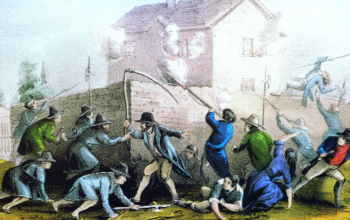
The Young Ireland Rebellion, a failed Irish nationalist uprising against the British led by the Young Ireland movement, takes place on July 29, 1848, in the village of Ballingarry, County Tipperary. The rebellion is part of the wider Revolutions of 1848 that affect most of Europe. It is sometimes called the Famine Rebellion (since it takes place during the Great Famine) or the Battle of Ballingarry.

In 1846, William Smith O’Brien, alongside John Mitchel, form the Irish Confederation with the Young Ireland movement which is dedicated to direct action against the British. Two short years later they are already calling for open rebellion, despite the fact that Ireland is now in the third year of the devastating famine which is leaving millions of the country’s people in brutal starvation.

Just a year after Black ‘47, the worst year of the Great Famine, the Young Ireland movement is hoping to uprise and overthrow the British but with the starving Irish just struggling to stay alive, dying or emigrating in their thousands, their revolutionary talk does little to act as a call to arms for the average Irish person.

Whereas the mistreatment of the Irish people by the British had rightly led to an increased radicalism in Irish nationalist movement, without the general Irish population able to think of anything other than staying alive, it seems doomed to failure, especially after the arrest of Mitchel before the rebellion is even started. He is convicted of sedition and transported to a penal colony in Australia before the revolt begins, a move that leads to an increased furor to revolt among the leaders that remain.

On July 29, 1848, O’Brien launches his rebellion. After being chased by a force of Young Irelanders and their supporters, a Royal Irish Constabulary unit takes refuge in a house and holds those inside as hostages.

It was evident to the rebels that the position of the police is almost impregnable. When a party of the Cashel police are seen arriving over Boulea Hill, the rebels attempt to stop them even though they are low on ammunition. The police continue to advance, firing up the road. It becomes clear that the police in the house are about to be reinforced and rescued. The rebels then fade away, effectively terminating both the era of Young Ireland and Repeal, but the consequences of their actions follow them for many years. This event is colloquially known as “The Battle of Widow McCormack’s cabbage plot.”

In O’Brien’s subsequent trial, the jury finds him guilty of high treason. He is sentenced to be hanged, drawn, and quartered. Petitions for clemency are signed by 70,000 people in Ireland and 10,000 people in England. On June 5, 1849, the sentences of O’Brien and other members of the Irish Confederation are commuted to transportation for life to Van Diemen’s Land (Tasmania in present-day Australia). In 1854, after five years in Van Diemen’s Land, O’Brien is released on the condition he never return to the United Kingdom. He settled in Brussels.

(Pictured: The attack on the Widow McCormack’s house on Boulagh Common, Ballingarry, County Tipperary)


Leave a comment

Birth of Thomas Clarke Luby, Irish Revolutionary

thomas-clarke-luby

Thomas Clarke Luby, Irish revolutionary, author, journalist and one of the founding members of the Irish Republican Brotherhood, is born in Dublin on January 16, 1822.

Luby is the son of a Church of Ireland clergyman from Templemore, County Tipperary, his mother being a Catholic. He is educated at Trinity College Dublin where he studies law and puts in the necessary number of terms in London and Dublin where he acquires a reputation as a scholar and takes his degree. He goes on to teach at the college for a time.

Luby supports the Repeal Association and contributes to The Nation newspaper. After the breach with Daniel O’Connell, he joins the Young Irelanders in the Irish Confederation. He is deeply influenced by James Fintan Lalor at this time. Following the suppression of the Young Ireland Rebellion of 1848, he with Lalor and Philip Gray attempt to revive the fighting in 1849 as members of the secret Irish Democratic Association. This, however, ends in failure.

In 1851 Luby travels to France, where he hopes to join the French Foreign Legion to learn infantry tactics but finds the recruiting temporarily suspended. From France he goes to Australia for a year before returning to Ireland. From the end of 1855 he edits the Tribune newspaper founded by John E. Pigot who had been a member of The Nation group. During this time, he remains in touch with the small group of ’49 men including Philip Gray and attempts to start a new revolutionary movement. Luby’s views on social issues grow more conservative after 1848 which he makes clear to James Stephens whom he meets in 1856.

In the autumn of 1857 Owen Considine arrives with a message signed by four Irish exiles in the United States, two of whom are John O’Mahony and Michael Doheny. The message conveys the confidence they have in Stephens and asks him to establish an organisation in Ireland to win national independence. Considine also carries a private letter from O’Mahony to Stephens which is a warning, and which is overlooked by Luby and Stephens at the time. Both believe that there is a strong organisation behind the letter, only later to find it is rather a number of loosely linked groups. On December 23 Stephens dispatches Joseph Denieffe to America with his reply which is disguised as a business letter dated and addressed from Paris. In his reply, Stephen’s outlines his conditions and his requirements from the organisation in America.

On March 17, 1858, Denieffe arrives in Dublin with the acceptance of Stephens’s terms by the New York Committee and the eighty pounds. On that very evening the Irish Republican Brotherhood is established in Peter Langan’s timberyard in Lombard Street.

In mid-1863 Stephens informs his colleagues he wishes to start a newspaper, with financial aid from O’Mahony and the Fenian Brotherhood in America. The offices are established at 12 Parliament Street, almost at the gates of Dublin Castle. The first issue of the Irish People appears on November 28, 1863. The staff of the paper along with Luby are Charles J. Kickham and Denis Dowling Mulcahy as the editorial staff. Jeremiah O’Donovan Rossa and James O’Connor have charge of the business office, with John Haltigan being the printer. John O’Leary is brought from London to take charge in the role of Editor.

On July 15, 1865, American-made plans for a rising in Ireland are discovered. Superintendent Daniel Ryan, head of the G Division of the Dublin Metropolitan Police at Dublin Castle, has an informer within the offices of the Irish People who supplies him with an “action this year” message on its way to the IRB unit in Tipperary. With this information, Ryan raids the offices of the Irish People on Thursday, September 15, followed by the arrests of Luby, O’Leary and O’Donovan Rossa. Kickham is caught after a month on the run. Stephens is also caught with the support of Fenian prison warders. The last number of the paper is dated September 16, 1865.

After his arrest and the suppression of the Irish People, Luby is sentenced to twenty years of penal servitude. He is released in January 1871 but is compelled to remain away from Ireland until the expiration of his sentence.

Upon his release Luby goes first to the Continent and later settles in New York City. He lectures all over the country for years and writes for a number of Irish newspapers on political topics. At the memorial meeting on the death of John Mitchel, he delivers the principal address in Madison Square Garden.

Thomas Clarke Luby dies at 109½ Oak Street, Jersey City, New Jersey of paralysis, on November 29, 1901, and is buried in a grave shared with his wife in Bayview Cemetery in Jersey City. His epitaph reads: “Thomas Clarke Luby 1822–1901 He devoted his life to love of Ireland and quest of truth.”


Leave a comment

Birth of Richard D’Alton Williams, Physician & Poet

richard-dalton-williams

Richard D’Alton Williams, physician and poet, is born in Dublin on October 8, 1822. He is the son of James and Mary Williams, who come from County Westmeath. He grows up in Grenanstown, a townland near the Devil’s Bit in County Tipperary, where his father farms for Count Dalton. He is educated at Tullabeg Jesuit College and St. Patrick’s, Carlow College.

Williams becomes a member of the Young Ireland movement and contributes poetry to The Nation under the pseudonym “Shamrock.” He is immediately successful. In the January 21, 1843 edition there appears: “Shamrock is a jewel. He cannot write too often. His verses are full of vigour, and as natural as the harp of Tara.”

Later in 1843 Williams goes to Dublin to study medicine at Saint Vincent’s Hospital. In 1848 he brings out a newspaper, the Irish Tribune, to take the place of the suppressed United Irishman, founded by John Mitchel. Before the sixth weekly publication, it is seized by the Government, and proceedings are instituted against the editors, Williams and his friend Kevin Izod O’Doherty. On October 30, 1848, at a third trial, O’Doherty is convicted of treason and transported to Australia while Williams is successfully defended by lawyer and fellow poet Samuel Ferguson two days afterwards on the same charge. He then resumes his medical studies, takes out his degree at Edinburgh, Scotland in 1849 and emigrates to the United States in 1851.

Williams is married to Elizabeth Connolly on September 8, 1856, with whom he has four children of whom the youngest is commemorated in Lines on the Death of his Infant Daughter, Katie.

In the United States Williams practises medicine until he becomes ill and dies of tuberculosis in Thibodaux, Louisiana on July 5, 1862. He is buried there in St. Joseph’s Cemetery. His headstone is later erected that year by Irish members of the 8th New Hampshire Volunteer Infantry, then encamped in Thibodaux.


Leave a comment

Death of William Smith O’Brien, Young Ireland Leader

william-smith-obrien

William Smith O’Brien, Irish nationalist Member of Parliament (MP) and leader of the Young Ireland movement, dies in Bangor, Gwynedd, Wales on June 18, 1864.

Born in Dromoland, Newmarket-on-Fergus, County Clare, O’Brien is the second son of Sir Edward O’Brien, 4th Baronet, of Dromoland Castle. His mother is Charlotte Smith, whose father owns a property called Cahirmoyle in County Limerick. He takes the additional surname Smith, his mother’s maiden name, upon inheriting the property. He lives at Cahermoyle House, a mile from Ardagh, County Limerick. He is a descendant of the eleventh century Ard Rí (High King of Ireland), Brian Boru. He receives an upper-class English education at Harrow School and Trinity College, Cambridge. Subsequently, he studies law at King’s Inns in Dublin and Lincoln’s Inn in London.

From April 1828 to 1831 O’Brien is Conservative MP for Ennis. He becomes MP for Limerick County in 1835, holding his seat in the House of Commons of the United Kingdom until 1849.

Although a Protestant country-gentleman, O’Brien supports Catholic emancipation while remaining a supporter of British-Irish union. In 1843, in protest against the imprisonment of Daniel O’Connell, he joins O’Connell’s anti-union Repeal Association.

Three years later, O’Brien withdraws the Young Irelanders from the association. In January 1847, with Thomas Francis Meagher, he founds the Irish Confederation, although he continues to preach reconciliation until O’Connell’s death in May 1847. He is active in seeking relief from the hardships of the famine. In March 1848, he speaks out in favour of a National Guard and tries to incite a national rebellion. He is tried for sedition on May 15, 1848, but is not convicted.

On July 29, 1848, O’Brien and other Young Irelanders lead landlords and tenants in a rising in three counties, with an almost bloodless battle against police at Ballingarry, County Tipperary. In O’Brien’s subsequent trial, the jury finds him guilty of high treason. He is sentenced to be hanged, drawn, and quartered. Petitions for clemency are signed by 70,000 people in Ireland and 10,000 people in England. In Dublin on June 5, 1849, the sentences of O’Brien and other members of the Irish Confederation are commuted to transportation for life to Van Diemen’s Land (Tasmania in present-day Australia).

O’Brien attempts to escape from Maria Island off Tasmania but is betrayed by the captain of the schooner hired for the escape. He is sent to Port Arthur where he meets up with John Mitchel.

O’Brien is a founding member of the Ossianic Society, which is founded in Dublin on St. Patrick’s Day 1853, whose aim is to further the interests of the Irish language and to publish and translate literature relating to the Fianna. He writes to his son Edward from Van Diemen’s Land, urging him to learn the Irish language. He himself studies the language and uses an Irish-language Bible and presents to the Royal Irish Academy Irish-language manuscripts he has collected.

In 1854, after five years in Tasmania, O’Brien is released on the condition he never returns to Ireland. He settles in Brussels. In May 1856, he is granted an unconditional pardon and returns to Ireland that July. He contributes to the Nation newspaper but plays no further part in politics.

In 1864 he visits England and Wales, with the view of rallying his failing health, but no improvement takes place, and he dies at Bangor, in Wales on June 16, 1864.

A statue of William Smith O’Brien stands in O’Connell Street, Dublin. Sculpted in Portland limestone, it is designed by Thomas Farrell and erected in D’Olier Street, Dublin, in 1870. It is moved to its present position in 1929.


Leave a comment

Pickett’s Charge

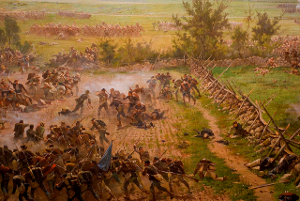
On July 3, 1863, at Gettysburg, Pennsylvania, as the sun rises behind the men of Colonel Dennis O’Kane’s Irish 69th Pennsylvania Volunteer Infantry on Cemetery Ridge, the most famous assault of the American Civil War is being prepared across the mile of open field in front of them. The 69th Pennsylvania will be at the very vortex of that assault, now known to posterity as Pickett’s Charge.

Pickett’s Charge is an infantry assault ordered by Confederate General Robert E. Lee against Major General George G. Meade‘s Union positions on the last day of the Battle of Gettysburg during the American Civil War. Its futility is predicted by the charge’s commander, Lt. General James Longstreet, and it is arguably an avoidable mistake from which the Southern war effort never fully recovers militarily or psychologically. The farthest point reached by the attack has been referred to as the high-water mark of the Confederacy.  The charge is named after Maj. General George Pickett, one of three Confederate generals who lead the assault under Longstreet.

Pickett’s charge is part of Lee’s “general plan” to take Cemetery Hill and the network of roads it commands. On the night of July 2, Meade correctly predicts at a council of war that Lee will attack the center of his lines the following morning.

At 1:00 PM on July 3, a massive artillery bombardment by the Confederate guns sails mostly over the heads of the 69th. The bombardment is meant to soften up the Union defense and silence its artillery but is largely ineffective. About 3:00 PM the barrage slackens, and the rebel infantrymen begin their assault. “And let your work this day be for victory or to the death,” Colonel Dennis O’Kane tells his men as the furious rebel onslaught approaches. Approximately 12,500 men in nine infantry brigades advance over open fields for three-quarters of a mile under heavy Union artillery and rifle fire.

Soon the 69th is forced to refuse both flanks as the Confederate tide rolls up to them and laps around both sides. While many around them run, the 69th stands fast. Although some Confederates are able to breach the low stone wall that shields many of the Union defenders, they cannot maintain their hold and are repulsed with over 50% casualties. The regiment’s tenacious stand in front of the famous copse of trees is a pivotal part of the crucial Union victory and a decisive defeat for the Confederacy that ends the three-day battle and Lee’s campaign into Pennsylvania.

Good to his word, Colonel O’Kane is killed and, lying dead near the 69th’s position, wearing gray lay Pvt. Willie Mitchel of the 1st Virginia Infantry, son of Irish patriot John Mitchel. At the most crucial battle of America’s Civil War, Irish are killing Irish on a foreign field once again.

Years later, when asked why his charge at Gettysburg failed, Pickett replies, “I’ve always thought the Yankees had something to do with it.”


Leave a comment

William Smith O’Brien Pardoned from Deportation

william-smith-obrien

William Smith O’Brien, leader of the Young Ireland Rebellion of 1848, is pardoned from his deportation to Van Diemen’s Land on February 26, 1854, on the condition of exile from Ireland.

From April 1828 to 1831 O’Brien serves as Conservative MP for Ennis. He becomes MP for Limerick County in 1835, holding his seat in the House of Commons until 1849.

Although a Protestant country-gentleman, O’Brien supports Catholic Emancipation while remaining a supporter of British-Irish union. In 1843, in protest against the imprisonment of Daniel O’Connell, he joins O’Connell’s anti-union Repeal Association.

Three years later, O’Brien withdraws the Young Irelanders from the association. In January 1847, along with Thomas Francis Meagher, he founds the Irish Confederation, although he continues to preach reconciliation until O’Connell’s death in May 1847. He is active in seeking relief from the hardships of the famine. In March 1848, he speaks out in favour of a National Guard and tries to incite a national rebellion. He is tried for sedition on May 15, 1848, but is not convicted.

On July 29, 1848, O’Brien and other Young Irelanders lead landlords and tenants in a rising in three counties, with an almost bloodless battle against police at Ballingarry, County Tipperary. In O’Brien’s subsequent trial, the jury finds him guilty of high treason. He is sentenced to be hanged, drawn, and quartered. Petitions for clemency are signed by 70,000 people in Ireland and 10,000 people in England.

In Dublin on June 5, 1849, the sentences of O’Brien and other members of the Irish Confederation are commuted to transportation for life to Van Diemen’s Land, which is Tasmania in present-day Australia.

O’Brien attempts to escape from Maria Island off Tasmania but is betrayed by Captain Ellis of the schooner hired for the escape. He is sent to Port Arthur where he meets up with John Mitchel, who had been transported prior to the rebellion. The cottages which O’Brien lives in on Maria Island and Port Arthur have been preserved in their 19th century state as memorials.

Having emigrated to the United States, Ellis is tried by another Young Irelanders leader, Terence MacManus, at a lynch court in San Francisco for the betrayal of O’Brien. He is freed for lack of evidence.

In 1854, after five years in Tasmania, O’Brien is released on the condition he never return to Ireland. He settles in Brussels. In May 1856, he is granted an unconditional pardon and returns to Ireland that July. He contributes to The Nation newspaper but plays no further part in politics.

In 1864 he visits England and Wales, with the view of rallying his failing health, but no improvement takes place, and he dies at Bangor, Wales on June 16, 1864.


Leave a comment

Death of John O’Mahony, Founder of the Fenian Brotherhood

john-omahony

John Francis O’Mahony, Gaelic scholar and the founding member of the Fenian Brotherhood in the United States, sister organisation to the Irish Republican Brotherhood, dies in New York City on February 7, 1877.

O’Mahony is born in 1816 in Kilbeheny, County Limerick. His father and uncle were members of the Society of United Irishmen and took part in the Irish Rebellion of 1798. On the death of an elder brother, he inherits a property which yields £300 per annum. He enters Trinity College, Dublin, where he studies Sanskrit, Hebrew, and Irish. He becomes an accomplished Gaelic scholar, and later teaches Greek and Latin, and contributes articles to Irish and French journals. He leaves Trinity without getting a degree.

In 1843, O’Mahony joins Daniel O’Connell‘s movement for the Repeal of the Acts of Union 1800, but quickly becomes dissatisfied with the lack of progress and joins the Young Ireland movement which William Smith O’Brien leads and takes part in the failed Young Ireland Rebellion of 1848. His participation in the rebellion obligates him to leave Ireland, and he settles for a time in Paris, where he lives in great poverty. In 1854, he joins John Mitchel in New York City, and takes part in the Emigrant Aid Association, the Emmet Monument Association, and other Irish organisations.

In 1857, O’Mahony publishes History of Ireland, by Geoffrey Keating, D. D., translated from the Original Gaelic, and Copiously Annotated (New York, 1857). O’Mahony’s notes are copied from John O’Donovan‘s translations of Annals of the Four Masters, and it is on this ground that Hodges & Smith procures an injunction against the sale of the book in the United Kingdom. The mental strain to which O’Mahony is subjected in the preparation of this work, which brings him no pecuniary gain, affects his reasoning and he is removed by his friends for a short time to a lunatic asylum.

In 1860, O’Mahony organises the Fenian Brotherhood, also known as the Irish Republican Brotherhood. The object of the association is to secure the freedom of Ireland. The name is probably derived from O’Mahony’s Gaelic studies, the Fenians having been a military body in pagan Ireland, celebrated in the songs of Ossian. The organisation of the new society is completed at conventions that are held in Chicago in 1864 and in Cincinnati in January 1865.

At the time of the Cincinnati convention, O’Mahony holds the rank of colonel of the 69th Regiment of New York State Militia, recruited mainly from the ranks of the Brotherhood, which has also furnished a large proportion of Thomas Francis Meagher‘s Irish Brigade, Michael Corcoran‘s legion, and Irish regiments engaged in the American Civil War. The rapid growth in membership of the Fenian Brotherhood renders it impossible for O’Mahony to retain the colonelcy of the 69th regiment, which he has held for some time. He resigns in order to give all his attention to the spread of Fenianism.

The close of the civil war in the spring of 1865 gives a great impetus to the Fenians, owing to the number of Irish American soldiers that are disbanded and anxious to see service elsewhere. Money pours into the Fenian exchequer. Many differences occur between O’Mahony and James Stephens and the Central Council relative to the policy to be pursued for the attainment of their object, but O’Mahony remains president of the organisation for several years. He does not take any part personally in the attempted insurrection in Ireland or in the raids on Canada, although his advice counts for much in these enterprises.

He devotes the last years of his life to literary pursuits, but suffers from ill health, and he has a hard struggle to secure the bare means for subsistence. However, visionary may have been his objectives, he is honest, and although thousands have passed through his hands, he is often at a loss for a dollar. When his poverty is discovered, he declines to receive assistance in any form. He dies in New York City on February 7, 1877, and soon after his death his remains are returned to Ireland and interred with the honors of a public funeral in Glasnevin Cemetery in Dublin.


Leave a comment

Birth of Irish Rebel Leader John Devoy

john-devoy

John Devoy, one of the most devoted revolutionaries the world has ever seen, is born in Kill, County Kildare, on September 3, 1842. Dedicating over 60 years of his life to the cause of Irish freedom, he is one of the few people to have played a leading role in the Fenian Rising of 1867, the 1916 Easter Rising, and the Irish War of Independence (1919 – 1921).

After the Great Famine, the family moves to Dublin where Devoy’s father obtains at job at Watkins’ brewery. Devoy attends night school at the Catholic University before joining the Fenians. In 1861 he travels to France with an introduction from Timothy Daniel Sullivan to John Mitchel. Devoy joins the French Foreign Legion and serves in Algeria for a year before returning to Ireland to become a Fenian organiser in Naas, County Kildare.

In 1865, when many Fenians are arrested, James Stephens, founder of the Irish Republican Brotherhood (IRB), appoints Devoy Chief Organiser of Fenians in the British Army in Ireland. His duty is to enlist Irish soldiers in the British Army into the IRB. In November 1865 Devoy orchestrates Stephens’ escape from Richmond Prison in Dublin.

In February 1866 an IRB Council of War calls for an immediate uprising but Stephens refuses, much to Devoy’s annoyance, as he calculated the Fenian force in the British Army to number 80,000. The British get wind of the plan through informers and move the regiments abroad, replacing them with regiments from Britain. Devoy is arrested in February 1866 and interned in Mountjoy Gaol, then tried for treason and sentenced to fifteen years penal servitude. In Portland Prison Devoy organises prison strikes and, as a result, is moved to Millbank Prison in Pimlico, London.

In January 1871, he is released and exiled to the United States as one of the “Cuba Five.” He receives an address of welcome from the House of Representatives. Devoy becomes a journalist for the New York Herald and is active in Clan na Gael. Under Devoy’s leadership, Clan na Gael becomes the central Irish republican organisation in the United States. In 1877 he aligns the organisation with the Irish Republican Brotherhood in Ireland.

In 1875, Devoy and John Boyle O’Reilly organise the escape of six Fenians from Fremantle Prison in Western Australia aboard the ship Catalpa. Devoy returns to Ireland in 1879 to inspect Fenian centres and meets Charles Kickham, John O’Leary, and Michael Davitt en route in Paris. He convinces Davitt and Charles Stewart Parnell to co-operate in the “New Departure” during the growing Land War.

Devoy’s fundraising efforts and work to sway Irish Americans to physical force nationalism makes possible the Easter Rising in 1916. In 1914, Patrick Pearse visits the elderly Devoy in America, and later the same year Roger Casement works with Devoy in raising money for guns to arm the Irish Volunteers. Though he is skeptical of the endeavor, he finances and supports Casement’s expedition to Germany to enlist German aid in the struggle to free Ireland from English rule. Also, before and during World War I, Devoy is also identified closely with the Ghadar Party, and is accepted to have played a major role in supporting Indian Nationalists, as well as playing a key role in the Hindu-German Conspiracy which leads to the trial that is the longest and most expensive trial in the United States at the time.

In 1916 Devoy plays an important role in the formation of the Clan-dominated Friends of Irish Freedom, a propaganda organization whose membership totals 275,000 at one point. The Friends fail in their efforts to defeat Woodrow Wilson for the presidency in 1916. Fearful of accusations of disloyalty for their cooperation with Germans and opposition to the United States’ entering the war on the side of Great Britain, the Friends significantly lower their profile after April 1917. Sinn Féin‘s election victories and the British government’s intentions to conscript in Ireland in April 1917 help to revitalize the Friends.

With the end of the war, Devoy plays a key role in the Friends’ advocacy for not the United States’ recognition of the Irish Republic but, in keeping with President Wilson’s war aims, self-determination for Ireland. The latter does not guarantee recognition of the Republic as declared in 1916 and reaffirmed in popular election in 1918. American Irish republicans challenge the Friends’ refusal to campaign for American recognition of the Irish Republic. Not surprisingly, Devoy and the Friends’ Daniel F. Cohalan become the key players in a trans-Atlantic dispute with de facto Irish president Éamon de Valera, touring the United States in 1919 and 1920 in hopes of gaining U.S. recognition of the Republic and American funds. Believing that the Americans should follow Irish policy, de Valera forms the American Association for the Recognition of the Irish Republic in 1920 with help from the Philadelphia Clan na Gael.

Devoy returns to Ireland and in 1919 addresses Dáil Éireann. He later supports the Anglo-Irish Treaty of 1921. Devoy is editor of The Gaelic American from 1903 until his death in Atlantic City on September 29, 1928. His body is returned to Ireland and buried in Glasnevin Cemetery. A large memorial to him stands on the road between his native Kill and Johnstown.


Leave a comment

First Public Unveiling of the Irish Tricolour

irish-flag

At a meeting in his native Waterford on March 7, 1848, the Young Ireland leader Thomas Francis Meagher first publicly unveils the flag from a second-floor window of the Wolfe Tone Club.

Following the Irish Rebellion of 1798, which pits the “green” United Irishmen against the Orange Order who are traditionally loyal to the British Crown, the ideal of making peace between both traditions in a self-governed Ireland is first mooted.

The oldest known reference to the use of green, white, and orange as a nationalist emblem date from September 1830 when the colours are used for rosettes and badges. Since that historical period the use of the tricolour becomes the preferred mark of a republic in national flags. However, widespread recognition is not accorded to the flag until 1848.

Presented to Meagher as a gift in 1848 by a small group of French women symathetic to the Irish cause, the flag flies proudly as Meagher addresses the Waterford crowd gathered on the street below who are celebrating news of the French Revolution. Speeches made at that time by Meagher suggest that it is regarded as an innovation and not as the revival of an older flag.

From March 1848 Irish tricolours appear side-by-side with French “tricolores” at meetings held all over the country. John Mitchel, referring to the provisional Irish banner which Meagher had presented at a meeting in Dublin on April 15, 1848, says, “I hope to see that flag one day waving as our national banner.”

Although the tricolour is not forgotten as a symbol of a free Ireland, it is rarely used between 1848 and 1916. Even up to the eve of the 1916 Easter Rising, the green flag featuring a harp holds undisputed sway. Neither the colours nor the arrangement of the early tricolours are standardised. All of the 1848 tricolours show green, white, and orange, but orange is sometimes put next to the staff, and, in at least one flag, the order is orange, green and white.

In 1850, a flag of green for the Roman Catholics, orange for the Protestants of the Established Church, and blue for the Presbyterians is proposed.

In 1883, a Parnellite tricolour of yellow, white, and green, arranged horizontally, is proposed. Down to modern times, yellow has occasionally been used instead of orange but such substitution tarnish’s the tricolour’s fundamental symbolism.

The flag is adopted by the rebels in the 1916 Easter Rising rebels and raised above the General Post Office in Dublin. This marks the first time that the tricolour is regarded as the national flag. It is subsequently adopted by the Irish Republic during the Irish War of Independence (1919–1921). Its use is continued by the Irish Free State (1922–1937) and is later given constitutional status under the 1937 Constitution of Ireland. The tricolour is used by nationalists on both sides of the border as the national flag of the whole island of Ireland since 1916.