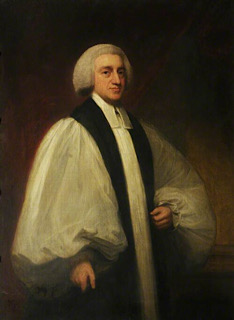
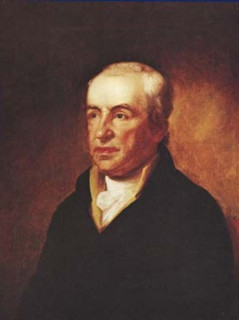
Agar is known to have held particularly marked Calvinistic positions. He serves as Dean of Kilmore from 1765 to 1768, and then as Bishop of Cloyne until 1779.
In 1794, Agar is raised to the Peerage of Ireland as Baron Somerton. In 1801, he is translated to become Archbishop of Dublin and is created Viscount Somerton. In 1806, he is further honoured when he is made Earl of Normanton. These titles are all in the Peerage of Ireland. He remains as Archbishop of Dublin until his death in 1809, and from the beginning of 1801 onward, sits in the House of Lords as one of the twenty-eight original Irish representative peer, following the Acts of Union 1800 which unites Ireland and Great Britain.
Agar dies on July 14, 1809, aged 72, and is succeeded in his secular titles by his son Welbore Ellis Agar. He is buried in the north transept of Westminster Abbey. His widow Jane, Countess of Normanton, is buried alongside him following her death in 1826. His tomb dates from 1815 and is created by John Bacon.
Two acts are passed in 1800 with the same long title: An Act for the Union of Great Britain and Ireland. The short title of the act of the British Parliament is Union with Ireland Act 1800, assigned by the Short Titles Act 1896. The short title of the act of the Irish Parliament is Act of Union (Ireland) 1800, assigned by a 1951 act of the Parliament of Northern Ireland, and hence not effective in the Republic of Ireland, where it was referred to by its long title when repealed in 1962.
Before these acts, Ireland has been in personal union with England since 1542, when the Irish Parliament passes the Crown of Ireland Act 1542, proclaiming King Henry VIII of England to be King of Ireland. Since the 12th century, the King of England has been technical overlord of the Lordship of Ireland, a papal possession. Both the Kingdoms of Ireland and England later come into personal union with that of Scotland upon the Union of the Crowns in 1603.
In 1707, the Kingdom of England and the Kingdom of Scotland are united into a single kingdom: the Kingdom of Great Britain. Upon that union, each House of the Parliament of Ireland passes a congratulatory address to Queen Anne, praying her: “May God put it in your royal heart to add greater strength and lustre to your crown, by a still more comprehensive Union.” The Irish Parliament is both before then subject to certain restrictions that made it subordinate to the Parliament of England and after then, to the Parliament of Great Britain; however, Ireland gains effective legislative independence from Great Britain through the Constitution of 1782.
By this time access to institutional power in Ireland is restricted to a small minority: the Anglo-Irish of the Protestant Ascendancy. Frustration at the lack of reform among the Catholic majority eventually leads, along with other reasons, to a rebellion in 1798, involving a French invasion of Ireland and the seeking of complete independence from Great Britain. This rebellion is crushed with much bloodshed, and the motion for union is motivated at least in part by the belief that the union will alleviate the political rancour that led to the rebellion. The rebellion is felt to have been exacerbated as much by brutally reactionary loyalists as by United Irishmen (anti-unionists).
Furthermore, Catholic emancipation is being discussed in Great Britain, and fears that a newly enfranchised Catholic majority will drastically change the character of the Irish government and parliament also contributes to a desire from London to merge the Parliaments.
According to historian James Stafford, an Enlightenment critique of Empire in Ireland lays the intellectual foundations for the Acts of Union. He writes that Enlightenment thinkers connected “the exclusion of the Irish Kingdom from free participation in imperial and European trade with the exclusion of its Catholic subjects, under the terms of the ‘Penal Laws’, from the benefits of property and political representation.” These critiques are used to justify a parliamentary union between Britain and Ireland.
Complementary acts are enacted by the Parliament of Great Britain and the Parliament of Ireland.
The Parliament of Ireland gains a large measure of legislative independence under the Constitution of 1782. Many members of the Irish Parliament jealously guard that autonomy (notably Henry Grattan), and a motion for union is legally rejected in 1799. Only Anglicans are permitted to become members of the Parliament of Ireland though the great majority of the Irish population are Roman Catholic, with many Presbyterians in Ulster. Under the Roman Catholic Relief Act 1793, Roman Catholics regain the right to vote if they own or rent property worth £2 annually. Wealthy Catholics are strongly in favour of union in the hope for rapid religious emancipation and the right to sit as MPs, which only comes to pass under the Roman Catholic Relief Act 1829.
From the perspective of Great Britain’s elites, the union is desirable because of the uncertainty that follows the French Revolution of 1789 and the Irish Rebellion of 1798. If Ireland adopts Catholic emancipation willingly or not, a Roman Catholic Parliament could break away from Britain and ally with the French, but the same measure within the United Kingdom would exclude that possibility. Also, in creating a regency during King George III‘s “madness”, the Irish and British Parliaments give the Prince Regent different powers. These considerations lead Great Britain to decide to attempt the merger of both kingdoms and Parliaments.
The final passage of the Act in the Irish House of Commons turns on an about 16% relative majority, garnering 58% of the votes, and similar in the Irish House of Lords, in part per contemporary accounts through bribery with the awarding of peerages and honours to critics to get votes. The first attempt is defeated in the Irish House of Commons by 109 votes to 104, but the second vote in 1800 passes by 158 to 115.
O’Connell had rejected a suggestion from “friends of emancipation,” and from the English Roman Catholic bishop, John Milner, that the fear of Catholic advancement might be allayed if the Crown were accorded the same right exercised by continental monarchs: a veto on the confirmation of Catholic bishops. O’Connell insists that Irish Catholics would rather “remain forever without emancipation” than allow the government “to interfere” with the appointment of their senior clergy. Instead, he relies on their confidence in the independence of the priesthood from Ascendancy landowners and magistrates to build his Catholic Association into a mass political movement. On the basis of a “Catholic rent” of a penny a month (typically paid through the local priest), the Association mobilises not only the Catholic middle class, but also poorer tenant farmers and tradesmen. Their investment enables O’Connell to mount “monster” rallies that stay the hands of authorities and embolden larger enfranchised tenants to vote for pro-emancipation candidates in defiance of their landlords.
O’Connell’s campaign reaches its climax when he himself stands for parliament. In July 1828, he defeats a nominee for a position in the British cabinet, William Vesey-FitzGerald, in a County Clare by-election, 2057 votes to 982. This makes a direct issue of the parliamentary Oath of Supremacy by which, as a Catholic, he will be denied his seat in the Commons.
As Lord Lieutenant of Ireland, Wellington’s brother, Richard Wellesley, had attempted to placate Catholic opinion, notably by dismissal of the long-serving Attorney-General for Ireland, William Saurin, whose rigid Ascendancy views and policy made him bitterly unpopular, and by applying a policy of prohibitions and coercion against not only the Catholic Ribbonmen but also the Protestant Orangemen. But now both Wellington and his Home Secretary, Robert Peel, are convinced that unless concessions are made, a confrontation is inevitable. Peel concludes, “though emancipation was a great danger, civil strife was a greater danger.” Fearing insurrection in Ireland, he drafts the Relief Bill and guides it through the House of Commons. To overcome the vehement opposition of both the King and of the House of Lords, Wellington threatens to resign, potentially opening the way for a new Whig majority with designs not only for Catholic emancipation but also for parliamentary reform. The King initially accepts Wellington’s resignation and the King’s brother, Ernest Augustus, Duke of Cumberland, attempts to put together a government united against Catholic emancipation. Though such a government would have considerable support in the House of Lords, it would have little support in the Commons and Ernest abandons his attempt. The King recalls Wellington. The bill passes the Lords and becomes law.
The key, defining, provision of the Acts is its repeal of “certain oaths and certain declarations, commonly called the declarations against transubstantiation and the invocation of saints and the sacrifice of the mass, as practised in the Church of Rome,” which had been required “as qualifications for sitting and voting in parliament and for the enjoyment of certain offices, franchises, and civil rights.” For the Oath of Supremacy, the act substitutes a pledge to bear “true allegiance” to the King, to recognise the Hanoverian succession, to reject any claim to “temporal or civil jurisdiction” within the United Kingdom by “the Pope of Rome” or “any other foreign prince … or potentate,” and to “abjure any intention to subvert the present [Anglican] church establishment.”
This last abjuration in the new Oath of Allegiance is underscored by a provision forbidding the assumption by the Roman Church of episcopal titles, derived from “any city, town or place,” already used by the United Church of England and Ireland. (With other sectarian impositions of the Act, such as restrictions on admittance to Catholic religious orders and on Catholic-church processions, this is repealed with the Roman Catholic Relief Act 1926.)
The one major security required to pass the Act is the Parliamentary Elections (Ireland) Act 1829. Receiving its royal assent on the same day as the relief bill, the act disenfranchises Ireland’s forty-shilling freeholders, by raising the property threshold for the county vote to the British ten-pound standard. As a result, “emancipation” is accompanied by a more than five-fold decrease in the Irish electorate, from 216,000 voters to just 37,000. That the majority of the tenant farmers who had voted for O’Connell in the Clare by-election are disenfranchised as a result of his apparent victory at Westminster is not made immediately apparent, as O’Connell is permitted in July 1829 to stand unopposed for the Clare seat that his refusal to take the Oath of Supremacy had denied him the year before.
In 1985, J. C. D. Clark depicts England before 1828 as a nation in which the vast majority of the people still believed in the divine right of kings, and the legitimacy of a hereditary nobility, and in the rights and privileges of the Anglican Church. In Clark’s interpretation, the system remained virtually intact until it suddenly collapsed in 1828, because Catholic emancipation undermined its central symbolic prop, the Anglican supremacy. He argues that the consequences were enormous: “The shattering of a whole social order. … What was lost at that point … was not merely a constitutional arrangement, but the intellectual ascendancy of a worldview, the cultural hegemony of the old elite.”
Clark’s interpretation has been widely debated in the scholarly literature, and almost every historian who has examined the issue has highlighted the substantial amount of continuity before and after the period of 1828 through 1832.
Eric J. Evans in 1996 emphasises that the political importance of emancipation was that it split the anti-reformers beyond repair and diminished their ability to block future reform laws, especially the great Reform Act of 1832. Paradoxically, Wellington’s success in forcing through emancipation led many Ultra-Tories to demand reform of Parliament after seeing that the votes of the rotten boroughs had given the government its majority. Thus, it was an ultra-Tory, George Spencer-Churchill, Marquess of Blandford, who in February 1830 introduced the first major reform bill, calling for the transfer of rotten borough seats to the counties and large towns, the disfranchisement of non-resident voters, the preventing of Crown officeholders from sitting in Parliament, the payment of a salary to MPs, and the general franchise for men who owned property. The ultras believed that a widely based electorate could be relied upon to rally around anti-Catholicism.
In Ireland, emancipation is generally regarded as having come too late to influence the Catholic-majority view of the union. After a delay of thirty years, an opportunity to integrate Catholics through their re-emerging propertied and professional classes as a minority within the United Kingdom may have passed. In 1830, O’Connell invites Protestants to join in a campaign to repeal the Act of Union and restore the Kingdom of Ireland under the Constitution of 1782. At the same, the terms under which he is able to secure the final measure of relief may have weakened his repeal campaign.
George Ensor, a leading Protestant member of the Catholic Association in Ulster, protests that while “relief” bought at the price of “casting” forty-shilling freeholders, both Catholic and Protestant, “into the abyss,” might allow a few Catholic barristers to attain a higher grade in their profession, and a few Catholic gentlemen to be returned to Parliament, the “indifference” demonstrated to parliamentary reform will prove “disastrous” for the country.
Seeking, perhaps, to rationalise the sacrifice of his freeholders, O’Connell writes privately in March 1829 that the new ten-pound franchise might actually “give more power to Catholics by concentrating it in more reliable and less democratically dangerous hands.” The Young IrelanderJohn Mitchel believes that the intent is to detach propertied Catholics from the increasingly agitated rural masses.
In a pattern that had been intensifying from the 1820s as landlords clear land to meet the growing livestock demand from England, tenants have been banding together to oppose evictions and to attack tithe and process servers.
Britain’s enemies in Continental Europe have long recognised Ireland as a weak point in Britain’s defences. Landing troops there is a popular strategic goal, not only because an invader can expect the support of a large proportion of the native population, but also because at least initially they will face fewer and less reliable troops than elsewhere in the British Isles. Additionally, embroiling the British Army in a protracted Irish campaign will reduce its availability for other theatres of war. Finally, French planners consider that a successful invasion of Ireland might act as the ideal platform for a subsequent invasion of Great Britain.
Unaware of Humbert’s surrender, the French despatch reinforcements under the command of CommodoreJean-Baptiste-François Bompart on September 16. Having missed one invasion force, the Royal Navy is more watchful. Roving frigate patrols cruise off the principal French ports and in the approaches to Ireland, while squadrons of battleships from the Channel Fleet sail nearby, ready to move against any new invasion force. In command of the squadron on the Irish station is Commodore Sir John Borlase Warren, a highly experienced officer (and politician) who has made a name for himself raiding the French coast early in the war.
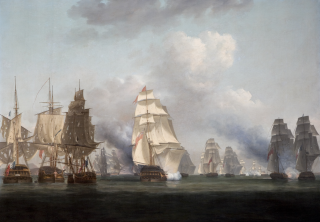
The squadron carrying the reinforcements is soon spotted after leaving Brest. After a long chase, the French are brought to battle in a bay off the rugged County Donegal coast in the west of Ulster, very close to Tory Island. During the action the outnumbered French attempt to escape, but are run down and defeated piecemeal, with the British capturing four ships and scattering the survivors. Over the next fortnight, British frigate patrols scour the passage back to Brest, capturing three more ships. Of the ten ships in the original French squadron, only two frigates and a schooner reach safety. British losses in the campaign are minimal.
The battle marks the last attempt by the French Navy to launch an invasion of any part of the British Isles. It also ends the last hopes the United Irishmen have of obtaining outside support in their struggle against the British. After the action, Wolfe Tone is recognised aboard the captured French flagship and arrested. He is brought ashore by the British at Buncrana, on the Inishowen peninsula. He is later tried for treason, convicted, and commits suicide while in prison in Dublin, hours before he is to be hanged.
(Pictured: Attack of the French Squadron under Monsr. Bompart Chef d’Escadre, upon the Coast of Ireland, by a Detachment of His Majesty’s Ships under the Command of Sir J. B. Warren, October 12, 1798, by Nicholas Pocock, 1799)
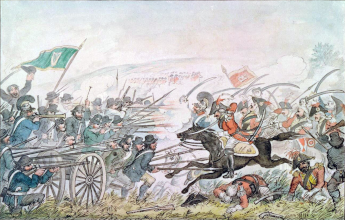
The Battle of Ballyellis, a clash during the Irish Rebellion of 1798, takes place on June 30, 1798. The battle is between a surviving column of the dispersed Wexford rebel army and pursuing British forces. It is the last Irish victory in the most violent Irish rebellion in modern history with at least 10,000 killed in a campaign that sees appalling atrocities inflicted by English and Irish.
The British victory at the Battle of Vinegar Hill on June 21 had denied the rebels static bases of operation but had not finished the rebellion and at least three major columns of rebels are operating throughout the southeast, moving outwards from County Wexford in an effort to spread and revive the rebellion.
One such column, numbering about 1,000 but accompanied by a number of women and juveniles, is mobile in north County Wexford, continually altering course to elude combined movements of pursuing British forces. The column is led by Joseph Holt, and under his command Denis Taaffe. It heads in the direction of Carnew, County Wicklow, toward the security offered by its mountain ranges when one of its foraging parties is intercepted and destroyed by a cavalry patrol. It quickly becomes evident to the British authorities that this party is a detachment from the main body of rebels. A mounted force of 200 troops consisting of Ancient Britons, dragoons, and three yeomanry corps, assemble near the neighbourhood of Monaseed to begin a pursuit of the rebels.
However, the approaching British are spotted and a force of rebels then moves ahead of the main force to prepare an ambush at the townland of Ballyellis. The spot chosen is behind a curve in the road flanked by high ditches and estate walls. Wagons are placed on the road and access points cut into the ditches. The main force arrives and deploys itself behind the wagons, on the wall and ditches with a small force left to stand on the road ahead of the barricades standing to face and lure in the approaching soldiers.
Upon spotting the small force standing on the road, the pursuing British quicken their pace and charge forward, assuming that they are facing only the rearguard of the fleeing column. Upon reaching the turn, they are met by a barrage of gunfire and are hemmed in by the rebels on three sides. As more mounted troops arrive they press their comrades further into the trap making effective manoeuvre impossible and many are easily picked off by the long pikes of the rebels.
The rear-ranks quickly flee with a few more soldiers escaping by jumping their mounts over the ditch. The rebels organise a relentless pursuit of the soldiers who are tracked and killed through the adjoining fields. At the end of the action about 120 troops, including a French émigré, and two officers are killed with no rebel casualties.
The news of this rebel victory comes as a shock to the authorities in Dublin Castle who had assumed that the offensive capabilities of the rebels had been finished at the Battle of Vinegar Hill. Reports of the defeat are downplayed and the scale of losses withheld from the general public, but the military now recognises Wicklow as the main theatre of rebel operations and begins to transfer troops there in anticipation of a new anti-insurgency campaign.
By this time access to institutional power in Ireland was restricted to a small minority, the Anglo-Irish of the Protestant Ascendancy, and frustration at the lack of reform among the Catholic majority eventually led, along with other reasons, to the Irish Rebellion in 1798, involving a French invasion of Ireland and the seeking of complete independence from Great Britain. This rebellion was crushed with much bloodshed, and the subsequent drive for union between Great Britain and Ireland that passes in 1800 is motivated at least in part by the belief that the rebellion was caused as much by reactionary loyalist brutality as by the Society of United Irishmen.
Furthermore, Catholic emancipation is being discussed in Great Britain, and fears that a newly enfranchised Catholic majority will drastically change the character of the Irish government and parliament also contributes to a desire from London to merge the Parliaments.
Complementary acts have to be passed in the Parliament of Great Britain and in the Parliament of Ireland. The Parliament of Ireland had recently gained a large measure of legislative independence under the Constitution of 1782. Many members of the Irish Parliament jealously guard this autonomy and a motion for union is legally rejected in 1799.
Only Anglicans are permitted to become members of the Parliament of Ireland, though the great majority of the Irish population are Roman Catholic, with many Presbyterians in Ulster. In 1793 Roman Catholics regain the right to vote if they own or rent property worth £2 per acre. The Catholic hierarchy is strongly in favour of union, hoping for rapid emancipation and the right to sit as MPs, which is delayed after the passage of the acts until the passage of the Roman Catholic Relief Act 1829.
From the perspective of Great Britain, the union is desirable because of the uncertainty that followed the Irish Rebellion of 1798 and the French Revolution of 1789. If Ireland adopted Catholic Emancipation, willingly or not, a Roman Catholic Parliament could break away from Britain and ally with the French. Also the Irish and British Parliaments, when creating a regency during King George III‘s “madness”, gave the Prince Regent different powers. These considerations lead Great Britain to decide to attempt merger of the two kingdoms and their Parliaments.
The final passage of the Act in the Irish Parliament is achieved with substantial majorities, in part according to contemporary documents through bribery, namely the awarding of peerages and honours to critics to get their votes. Whereas the first attempt had been defeated in the Irish House of Commons by 109 votes against to 104 for, the second vote in 1800 produces a result of 158 to 115.
In the first Parliament of the United Kingdom of Great Britain and Ireland, the members of the House of Commons are not elected afresh. By royal proclamation authorised by the Act, all the members of the last House of Commons from Great Britain take seats in the new House, and from Ireland 100 members are chosen from the last Irish House of Commons: two members from each of the 32 counties and from the two largest boroughs, and one from each of the next 31 boroughs (chosen by lot) and from the University of Dublin. The other 84 Irish parliamentary boroughs are disfranchised, all being pocket boroughs, whose patrons receive £15,000 compensation for the loss of what is considered their property.
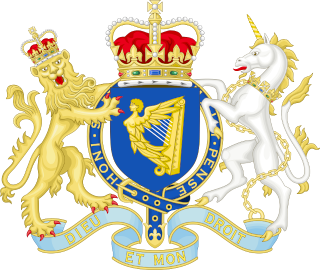
(Pictured: Coat of Arms of the United Kingdom from 1837 to 1952 used by Queen Victoria, King Edward VII, George V, Edward VIII and George VI)
Dunlap is born in 1747 in Strabane, County Tyrone, in what is now Northern Ireland. When he is ten years old, he goes to work as an apprentice to his uncle, William Dunlap, a printer and bookseller in Philadelphia. In 1766, William Dunlap leaves the business in the care of his nephew, who eventually purchases the business. Initially he makes a living by printing sermons, broadsides and handbills. In November 1771, he begins the publication of the Pennsylvania Packet, or General Advertiser, a weekly newspaper. In 1773 he marries Elizabeth Hayes Ellison.
In 1776, Dunlap secures a lucrative printing contract for the Continental Congress. In July 1776, fighting between the American colonists and the British forces had been going on for over a year. On July 2, the Second Continental Congress votes on the Lee Resolution to secede. Two days later, they approve the final wording of a public declaration regarding their decision, which ultimately comes to be known as the Declaration of Independence. President of Congress John Hancock signs the fair copy with Secretary of Congress Charles Thomson attesting it. That evening Hancock orders Dunlap to print broadside copies of the declaration. He prints perhaps 200 broadsides, since known as the Dunlap broadsides, which are the first published versions of the Declaration.
Dunlap also prints items for Pennsylvania’s revolutionary government. In 1777 he takes over the printing of the Journals of the Continental Congress from Robert Aitken, but loses the contract in 1779 after printing in his newspaper a letter from Thomas Paine that leaks news of the secret French aid to the Americans.
In 1784, Dunlap’s paper becomes a daily with a new title: the North American and United States Gazette. It is not the first daily in the United States as the Pennsylvania Evening Post is the first in 1783, but it becomes the first successful daily.
Continuing to serve the changing needs of the government, Dunlap and his partner David Claypoole print the Constitution of the United States on September 19, 1787 for use by the Constitutional Convention, and later publish it for the first time in the Pennsylvania Packet.
Dunlap’s major financial success comes from real estate speculation. During the American Revolutionary War, he purchases property confiscated from Loyalists who refuse to take Pennsylvania’s new loyalty oath. After the war, he purchases land in Kentucky. By 1795, when he is forty-eight, he is able to retire with a sizable estate. Retirement does not agree with him, however. According to his friend, Dr. Benjamin Rush, he becomes a drunkard in his final years. He dies in Philadelphia on November 27, 1812.
Charles is the eldest son of James Francis Edward Stuart, the exiled Stuart claimant to the British throne. Believing there is support for a Stuart restoration in both Scotland and England, he lands in Scotland in July 1745. The Jacobite Army is often assumed to have been largely composed of Gaelic-speaking Catholic Highlanders. In reality nearly a quarter of the rank and file are recruited in Aberdeenshire, Forfarshire and Banffshire, with another 20% from Perthshire. Although the army is predominantly Scots it contains a few English recruits plus significant numbers of Irish, Scottish and French professionals in French service with the Irish Brigade and Garde Écossaise.
After amassing his army of Scots Jacobite supporters, Charles takes Edinburgh by September and defeats a British government force at Prestonpans. The government recalls 12,000 troops from the Continent to deal with the rising. A Jacobite invasion of England reaches as far as Derby before turning back, having attracted relatively few English recruits.
The Jacobites, with limited French military support, attempt to consolidate their control of Scotland, whereby early 1746 they are opposed by a substantial government army. A scrambled Jacobite victory at Falkirk fails to change the strategic situation. With supplies and pay running short and with the government troops resupplied and reorganised under the Duke of Cumberland, son of British monarch George II, the Jacobite leadership has few options left other than to stand and fight. The two armies eventually meet at Culloden, on terrain that gives Cumberland’s larger, well-rested force the advantage.
The battle lasts only an hour, with the Jacobites suffering a bloody defeat with between 1,500 and 2,000 killed or wounded. Approximately 300 government soldiers are killed or wounded. While perhaps as many as 6,000 Jacobites remain in arms in Scotland, the leadership takes the decision to disperse, effectively ending the rising. The men of the combined Irish regiments, under the command of Brigadier Walter Stapleton, are the last off the field, covering the retreat of Prince Charles and the remnants of his army. The Irish had given their blood to the cause of a Stuart King for the last time. Most of the surviving Irish surrender at Inverness. The prince himself eventually manages to make his escape to France.
Culloden and its aftermath continue to arouse strong feelings. The University of Glasgow awards the Duke of Cumberland an honorary doctorate, but many modern commentators allege that the aftermath of the battle and subsequent crackdown on Jacobite sympathisers were brutal, earning Cumberland the sobriquet “Butcher.” Efforts are subsequently made to further integrate the comparatively undeveloped Scottish Highlands into the Kingdom of Great Britain. Civil penalties are introduced to undermine the Scottish clan system, which had provided the Jacobites with the means to rapidly mobilise an army.
Today, a visitor centre is located near the site of the battle. This centre is first opened in December 2007, with the intention of preserving the battlefield in a condition similar to how it was on April 16, 1746. One difference is that it currently is covered in shrubs and heather. During the 18th century, however, the area was used as common grazing ground, mainly for tenants of the Culloden estate. Those visiting can walk the site by way of footpaths on the ground and can also enjoy a view from above on a raised platform. Possibly the most recognisable feature of the battlefield today is the 20-foot-tall memorial cairn, erected by Duncan Forbes in 1881. In the same year Forbes also erects headstones to mark the mass graves of the clans.
In the century that followed the union of England and Scotland, Ireland gained effective legislative independence from Great Britain through the Constitution of 1782. However, access to institutional power in Ireland was restricted to a small minority, the so-called Anglo-Irish of the Protestant Ascendancy. Frustration at the lack of reform eventually led to a rebellion in 1798, involving a French invasion of Ireland and seeking complete independence from Great Britain. The rebellion was crushed with much bloodshed and the subsequent drive for union between Great Britain and Ireland that passed in 1800 was motivated at least in part by the belief that the rebellion was caused as much by loyalist brutality as by the United Irishmen.
Each Act had to be passed in the Parliament of Great Britain and the Parliament of Ireland. The final passage of the Act in the Irish Parliament was achieved with substantial majorities, achieved in part according to contemporary documents through bribery, namely the awarding of peerages and honours to critics to get their votes.





 seamus dubhghaill