seamus dubhghaill

Promoting Irish Culture and History from Little Rock, Arkansas, USA


Leave a comment

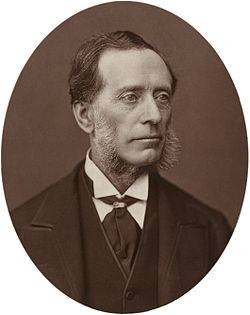
Birth of Richard Robert Madden, Historian & Abolitionist

Richard Robert Madden, Irish doctor, writer, abolitionist and historian of the Society of United Irishmen, is born on August 22, 1798. He takes an active role in trying to impose anti-slavery rules in Jamaica on behalf of the British government.

Madden is born at Wormwood Gate, Dublin to Edward Madden, a silk manufacturer, and his wife Elizabeth (née Corey). His father has married twice and fathered twenty-one children. Luckily for young Richard his father is still affluent enough by the time he is reaching adolescence to afford him a top-quality education. This means private schools and a medical apprenticeship in Athboy, County Meath. He studies medicine in Paris, Italy, and St. George’s Hospital, London. While in Naples he becomes acquainted with Marguerite Gardiner, Countess of Blessington and her circle.

In 1828 Madden marries Harriet Elmslie, herself coincidentally the youngest of twenty-one children. Born in Marylebone in 1801 and baptised there into the Church of England, she is the last child of John Elmslie, a Scot who owns hundreds of slaves on his plantations in Jamaica, and his wife Jane Wallace. Both Harriet’s parents are of Quaker stock, but while living in Cuba she converts to Roman Catholicism. On marriage, Madden stops travelling and practises medicine for five years.

Eventually he realises that he needs to contribute to the abolitionist cause. The slave trade has been illegal in the empire since 1807, but slaves still exist. Abolishing slavery is a popular cause, and it is obvious that the trading of slaves is still in progress, and many are not actively involved but they are complicit with the activity.

Madden is employed in the British civil service from 1833, first as a justice of the peace in Jamaica, where he is one of six Special Magistrates sent to oversee the eventual liberation of Jamaica’s slave population, according to the terms of the Slavery Abolition Act 1833. From 1835 he is Superintendent of the freed Africans in Havana. His son, Thomas More Madden, who later becomes a surgeon and writer, is born there. In 1839 he becomes the investigating officer into the slave trade on the west coast of Africa and, in 1847, the secretary for the West Australian colonies. He returns to Dublin and in 1850 is named secretary of the Office for Loan Funds in Dublin.

Richard Madden dies at his home in Booterstown, just south of Dublin, on February 5, 1886, and is interred in Donnybrook Cemetery.


Leave a comment

Birth of Phil Lynott, Thin Lizzy Vocalist & Bassist

Philip Parris “Phil” Lynott, Irish musician, singer, songwriter, and a founding member, principal songwriter, lead vocalist, and bassist of Thin Lizzy, is born on August 20, 1949, in Hallam Hospital in West Bromwich, Staffordshire, England.

Lynott goes to live with his grandmother, Sarah Lynott, in Crumlin, Dublin when he is four years old. He is introduced to music through his uncle Timothy’s record collection and becomes influenced by Tamla Motown and The Mamas and the Papas.

Growing up in Dublin in the 1960s, Lynott fronts several bands as a lead vocalist, most notably teaming up with bassist Brendan ‘Brush’ Shiels to form Skid Row in early 1968. It is during this period that Lynott learns to play the bass guitar.

Toward the end of 1969, Lynott, now confident enough to play bass himself in a band, teams with Brian Downey, Eric Bell, and Eric Wrixon to form Thin Lizzy. The band’s first top ten hit comes in 1973 with a rock version of the well-known Irish traditional song “Whiskey in the Jar.” With the release of the Jailbreak album in 1976, Lynott and Thin Lizzy become international superstars on the strength of the album’s biggest hit, “The Boys Are Back in Town.” The song reaches the Top 10 in the United Kingdom, No. 1 in Ireland, and is a hit in the United States and Canada.

Having finally achieved mainstream success, Thin Lizzy embarks on several consecutive world tours. However, the band suffers from personnel changes. By the early 1980s, Thin Lizzy is starting to struggle commercially and Lynott starts showing symptoms of drug abuse, including regular asthma attacks. After the resignation of longtime manager Chris O’Donnell, Lynott decides to disband Thin Lizzy in 1983.

In 1984, Lynott forms a new band, Grand Slam, with Doish Nagle, Laurence Archer, Robbie Brennan, and Mark Stanway. The band tours various clubs but suffers from being labeled a poor version of Thin Lizzy due to the inclusion of two lead guitarists. Grand Slam disbands at the end of the year due to a lack of money and Lynott’s increasing addiction to heroin.

Lynott’s last years are dogged by drug and alcohol dependency leading to his collapse on December 25, 1985, at his home in Kew. He is taken to Salisbury Infirmary where he is diagnosed as suffering from septicemia. His condition worsens by the start of the new year, and he is put on a respirator. He dies of pneumonia and heart failure due to septicemia in the hospital’s intensive care unit on January 4, 1986, at the age of 36.

Lynott’s funeral is held at St. Elizabeth of Portugal Church, Richmond, London on January 9, 1986, with most of Thin Lizzy’s ex-members in attendance, followed by a second service at Howth Parish Church on January 11. He is buried in St. Fintan’s Cemetery, Sutton, Dublin.


Leave a comment

Death of Winston Dugan, 1st Baron Dugan of Victoria

Winston Joseph Dugan, 1st Baron Dugan of Victoria and known as Sir Winston Dugan between 1934 and 1949, dies in Marylebone, London, England, on August 17, 1951. He is a British administrator and a career British Army officer. He serves as Governor of South Australia from 1934 to 1939, then Governor of Victoria until 1949.

Dugan is the son of Charles Winston Dugan, of Oxmantown Mall, Birr, County Offaly, an inspector of schools, and Esther Elizabeth Rogers. He attends Lurgan College in Craigavon from 1887 to 1889, and Wimbledon College, Wimbledon, London.

Dugan is a sergeant in the Royal Sussex Regiment but transfers to the Royal Lincolnshire Regiment as a second lieutenant on January 24, 1900. He fights with the 2nd battalion of his regiment in the Second Boer War and receives the Queen’s South Africa Medal with three clasps. Following the war, he is appointed adjutant of his battalion on June 28, 1901, and is promoted to lieutenant on November 1, 1901. He later fights with distinction in World War I, where he is wounded and mentioned in despatches six times. He is awarded the Distinguished Service Order (DSO) in 1915 and appointed a Companion of the Order of St. Michael and St. George (CMG) in 1918. In 1929 he is made a Companion of the Order of the Bath (CB) and the following year is promoted to major general. From 1931 to 1934 he commands the 56th (1st London) Division, Territorial Army.

In 1934, Dugan is appointed Governor of South Australia. He is appointed a Knight Commander of the Order of St. Michael and St. George (KCMG), retires from the Army and moves to Adelaide with his wife. They become an extremely popular and glamorous vice-regal couple. Sir Winston and Lady Dugan are both excellent public speakers and travel widely in order to bring problems to the attention of the ministers of the day. Upon the expiration of his term, there is bipartisan parliamentary support for him to serve a second term, but he has already accepted an appointment to be Governor of Victoria.

Sir Winston and Lady Dugan arrive in Melbourne on July 17, 1939. They continue their active role in community affairs, promoting unemployment reduction and making the ballroom of Government House available for the Australian Red Cross.

Dugan has an active role stabilising state politics during the tumultuous 1940s. Upon the disintegration of Albert Dunstan‘s Country Party in 1943, he installs Australian Labor Party leader John Cain as Premier. Four days later, Dunstan forms a coalition with the United Australia Party. Following the collapse of that ministry in 1945, Dugan dissolves parliament and calls a general election for November, which results in the balance of power being held by independents. Dugan commissions Cain to form the ministry of a minority government.

Dugan’s term as Governor is extended five times. He returns to England in February 1949. On July 7, 1949, he is raised to the peerage as Baron Dugan of Victoria, of Lurgan in County Armagh.

Winston Dugan dies at Marylebone, London, on August 17, 1951, at the age of 74. As there are no children from his marriage, the barony becomes extinct.


Leave a comment

Death of Novelist & Playwright Kate O’Brien

Kathleen Mary Louise “Kate” O’Brien, novelist and playwright, dies in Canterbury, England, on August 13, 1974.

O’Brien is born in Limerick, County Limerick on December 3, 1897. Following the death of her mother when she is five years old, she becomes a boarder at Laurel Hill Convent. She graduates in English and French from the newly established University College Dublin, and she then moves to London, where she works as a teacher for a year.

In 1922–1923, O’Brien works as a governess in the Basque Country, in the north of Spain, where she begins to write fiction. Upon her return to England, she works at the Manchester Guardian. After the success of her play Distinguished Villa in 1926, she takes to full-time writing and is awarded both the 1931 James Tait Black Memorial Prize and the Hawthornden Prize for her debut novel Without My Cloak. O’Brien is best known for her 1934 novel The Ante-Room, her 1941 novel The Land of Spices, and the 1946 novel That Lady.

Many of O’Brien’s books deal with issues of female agency and sexuality in ways that are new and radical at the time. Her 1936 novel, Mary Lavelle, is banned in Ireland and Spain, while The Land of Spices is banned in Ireland upon publication. In addition to novels, she writes plays, film scripts, short stories, essays, copious journalism, two biographical studies, and two very personal travelogues. Throughout her life, she feels a particular affinity with Spain. While her experiences in the Basque Country inspire Mary Lavelle, she also writes a life of the Spanish mystic Teresa of Avila, and she uses the relationship between the Spanish king Philip II and Maria de Mendoza to write the anti-fascist novel That Lady.

O’Brien writes a political travelogue, Farewell Spain, to gather support for the leftist cause in the Spanish Civil War, and it has been argued that she is close to anarchism in the 1930s. A feminist, her novels promote gender equality and are mostly protagonised by young women yearning for independence. Several of her books include positive gay/lesbian characters. Her determination to encourage a greater understanding of sexual diversity makes her a pioneer in queer literary representation. She is very critical of conservatism in Ireland, and by spearheading a challenge to the Irish Censorship Act, she helps bring to an end the cultural restrictions of the 1930s and 40s in the country.

Kate O’Brien lives much of her life in England and died in Faversham, near Canterbury, on August 13, 1974.


Leave a comment

Birth of Charles Boyle, 4th Earl of Orrery

Charles Boyle, 4th Earl of Orrery, English nobleman, statesman and patron of the sciences, is born in Little Chelsea, London on July 28, 1674.

Boyle is the second son of Roger Boyle, 2nd Earl of Orrery, and his wife Lady Mary Sackville, daughter of Richard Sackville, 5th Earl of Dorset. He is educated at Christ Church, Oxford, and soon distinguishes himself by his learning and abilities. Like the first earl, he is an author, soldier and statesman. He translates Plutarch‘s life of Lysander, and publishes an edition of the epistles of Phalaris, which engages him in the famous controversy with Richard Bentley. He is a member of the Parliament of Ireland and sits for the Charleville constituency between 1695 and 1699. He is three times member for the town of Huntingdon and, upon the death of his brother, Lionel, 3rd earl, in 1703, he succeeds to the title.

Boyle enters the army, and in 1709 is raised to the rank of major-general and sworn one of Her Majesty’s Privy Council. He is appointed to the Order of the Thistle and appointed queen’s envoy to the states of Brabant and Flanders. Having discharged this trust with ability, he is created an English peer, as Baron Boyle of Marston, in Somerset. He inherits the estate in 1714.

Boyle becomes a Fellow of the Royal Society in 1706. In 1713, under the patronage of Boyle, clockmaker George Graham creates the first mechanical solar system model that can demonstrate proportional motion of the planets around the Sun. The device is named the orrery in the Earl’s honour.

Boyle receives several additional honours in the reign of George I but, having had the misfortune to fall under the suspicion of the government for playing a part in the Jacobite Atterbury Plot, he is committed to the Tower of London in 1722, where he remains six months, and is then admitted to bail. On a subsequent inquiry he is discharged.

Boyle writes a comedy, As you find it, printed in 1703 and later publishes together with the plays of the first earl. In 1728, he is listed as one of the subscribers to the Cyclopaedia of Ephraim Chambers.

Charles Boyle dies at his home in Westminster on August 28, 1731 and is buried in Westminster Abbey. He bequeaths his personal library and collection of scientific instruments to Christ Church Library. The instruments are now on display in the Museum of the History of Science, Oxford.

Boyle’s son John, the 5th Earl of Orrery, succeeds to the earldom of Cork on the failure of the elder branch of the Boyle family, as earl of Cork and Orrery.


Leave a comment

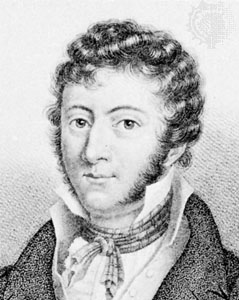
Birth of John Field, Pianist & Composer

John Field, pianist, composer, and teacher, is born in Dublin into a musical family on July 26, 1782. He is the eldest son of Irish parents who are members of the Church of Ireland. His father, Robert Field, earns his living by playing the violin in Dublin theatres.

Field first studies the piano under his grandfather, who is a professional organist, and later under Tommaso Giordani. He makes his debut at the age of nine, a performance that is well-received, on March 24, 1792 in Dublin. By late 1793, the Fields have settled in London, where the young pianist starts studying with Muzio Clementi.

Field continues giving public performances and soon becomes famous in London, attracting favourable comments from the press and the local musicians. Around 1795 his performance of a Jan Ladislav Dussek piano concerto is praised by Joseph Haydn. Field continues his studies with Clementi, also helping the Italian with the making and selling of instruments. He also takes up the violin, which he studies under Johann Peter Solomon. His first published compositions are issued by Clementi in 1795. The first historically important work, the Piano Concerto No. 1, H 27, is premiered by the composer in London on February 7, 1799, when he is 16 years old. Field’s first official opus is a set of three piano sonatas published by Clementi in 1801.

In summer 1802 Field and Clementi leave London and go to Paris on business. They soon travel to Vienna, where Field takes a brief course in counterpoint under Johann Georg Albrechtsberger, and in early winter arrive in Saint Petersburg. Field is inclined to stay, impressed by the artistic life of the city. Clementi leaves in June 1803, but not before securing Field a teaching post in Narva. After Clementi’s departure, Field has a busy concert season, eventually performing at the newly founded Saint Petersburg Philharmonia. In 1805 Field embarks on a concert tour of the Baltic states, staying in Saint Petersburg during the summer. The following year he gives his first concert in Moscow. He returns to Moscow in April 1807 and apparently does not revisit Saint Petersburg until 1811. In 1810 he marries Adelaide Percheron, a French pianist and former pupil.

In 1811 Field returns to Saint Petersburg where he spends the next decade of his life, more productive than ever before, publishing numerous new pieces and producing corrected editions of old ones. He is successful in establishing a fruitful collaboration with both H.J. Dalmas, the most prominent Russian publisher of the time, and Breitkopf & Härtel, one of the most important music publishing houses of Europe. By 1819 Field is sufficiently wealthy to be able to refuse the position of court pianist that is offered to him. His lifestyle and social behaviour are becoming more and more extravagant.

In 1818 Field revisits Moscow on business, prompted by his collaboration with the publisher Wenzel. He and his wife give a series of concerts in the city in 1821, the last of which marks their last appearance in public together. Adelaide leaves Field soon afterward and attempts a solo career, which is not particularly successful. Field stays in Moscow and continues performing and publishing his music. In 1822 he meets Johann Nepomuk Hummel and the two collaborate on a performance of Hummel’s Sonata for Piano 4-Hands, Op. 92.

Partly as a result of his extravagant lifestyle, Field’s health begins to deteriorate by the mid-1820s. From about 1823 his concert appearances started decreasing. By the late 1820s he is suffering from colorectal cancer. Field leaves for London to seek medical attention. He arrives in September 1831 and, after an operation, gives concerts there and in Manchester. He stays in England for some time, meeting distinguished figures such as Felix Mendelssohn and Ignaz Moscheles. After a series of concerts in various European cities, Field spends nine months in a Naples hospital. His Russian patrons rescue him. He briefly stays with Carl Czerny in Vienna, where he gives three recitals, and then returns to Moscow. He gives his last concert in March 1836 and dies in Moscow almost a year later, on January 23, 1837, from pneumonia. He is buried in the Vvedenskoye Cemetery.


Leave a comment

Birth of Watercolourist Michael Angelo Hayes

Painter Michael Angelo Hayes is born in Waterford on July 25, 1820. Probably the best 19th century painter of animals in Ireland, Hayes is most accomplished as a watercolourist, although he occasionally uses oils.

Hayes is the son and pupil of Tipperary watercolour miniaturist Edward Hayes RHA. It is clear from his christening that he is expected to become an artist.  Fortunately, the younger Hayes is a talented draughtsman, and by his late teens has acquired something of a reputation as a painter of horses and military subjects.

Hayes begins showing at the Royal Hibernian Academy (RHA) in 1837, then for three years 1840-1842.  In 1842, he is appointed Military Painter-in-ordinary to the Lord Lieutenant.  He passes the next few years in London, where he exhibits watercolours at the New Society of Painters in Water Colours, of which he is elected an Associate Member in 1848, the same year he makes his one and only contribution to the Royal Academy of Arts.

Returning to Dublin, Hayes resumes exhibiting at the RHA, at the same time becoming involved in its administration.  He is elected an Associate member in 1853, a full Academician the following year, and Secretary in 1856.  The affairs of the Academy are totally disorganized at the time, inducing Hayes and others to resolve the situation.  His efforts to reform the institution and secure its finances meets with entrenched opposition from older members, which results in Hayes being removed from his post, although he is successfully reinstated in 1861.

Not long afterwards he is appointed secretary to the Lord Mayor of Dublin, Peter McSwiney, who happens to be his brother-in-law, and later becomes City Marshal in 1867.  He continues as Secretary of the RHA until he resigns in 1870, and continues showing until 1874.

Hayes makes a special study of horses in motion, and in 1876 publishes his conclusions in an illustrated pamphlet, The Delineation of Animals in Rapid Motion.  One of his Dublin paintings, Sackville Street, Dublin, depicts a view of Dublin’s premier street in the 1850s. The painting is a documentary of social life in Dublin. It achieves widespread popularity when reprinted as a lithograph.

Michael Angelo Hayes dies prematurely in 1877 in a tragic drowning accident at his home.


Leave a comment

The Hyde Park and Regent’s Park Bombings

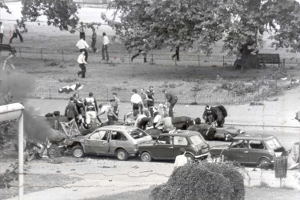
The Hyde Park and Regent’s Park bombings occur on July 20, 1982, in London. Members of the Provisional Irish Republican Army (IRA) detonate two bombs during British military ceremonies in Hyde Park and Regent’s Park, both in Central London.

At 10:40 AM, a nail bomb explodes in the boot of a blue Morris Marina parked on South Carriage Drive in Hyde Park. The bomb comprises 25 lbs. of gelignite and 30 lbs. of nails. It explodes as soldiers of the Household Cavalry, Queen Elizabeth II‘s official bodyguard regiment, are passing. They are taking part in their daily Changing of the Guard procession from their barracks in Knightsbridge to Horse Guards Parade. Three soldiers of the Blues & Royals are killed outright, and another, their standard-bearer, dies from his wounds three days later. The other soldiers in the procession are badly wounded, and a number of civilians were injured. Seven of the regiment’s horses are also killed or had to be euthanised because of their injuries. Explosives experts believe that the Hyde Park bomb is triggered by remote by an IRA member inside the park.

The second attack happens at about 12:55 PM, when a bomb explodes underneath a bandstand in Regent’s Park. Thirty Military bandsmen of the Royal Green Jackets are on the stand performing music from Oliver! to a crowd of 120 people. It is the first in a series of advertised lunchtime concerts there. Six of the bandsmen are killed outright and the rest are wounded. A seventh dies of his wounds on August 1. At least eight civilians are also injured. The bomb had been hidden under the stand some time before and triggered by a timer. Unlike the Hyde Park bomb, it contains no nails and seems to be designed to cause minimal harm to bystanders.

A total of 22 people are detained in hospital as a result of the blasts. The IRA claims responsibility for the attacks by deliberately mirroring Prime Minister Margaret Thatcher‘s words a few months before when Britain entered the Falklands War. They proclaimed that “The Irish people have sovereign and national rights which no task or occupational force can put down.” Reacting to the bombing, Thatcher states, “These callous and cowardly crimes have been committed by evil, brutal men who know nothing of democracy. We shall not rest until they are brought to justice.” The bombings have a negative impact on public support in the United States for the Irish republican cause.

In October 1987, 27-year-old Gilbert “Danny” McNamee, from County Armagh, is sentenced at the Old Bailey to 25 years in prison for his role in the Hyde Park bombing and others, despite his plea that he is not guilty. He is released from HM Prison Maze in late 1998 under the Good Friday Agreement.

On May 19, 2013, 61-year-old John Anthony Downey, from County Donegal, is charged with murder in relation to the Hyde Park bomb and intending to cause an explosion likely to endanger life. He appears at the Old Bailey on January 24, 2014, for the beginning of his trial and enters a not guilty plea. On February 25, 2014, it is revealed that Downey’s trial has collapsed after the presiding judge has ruled upon a letter sent by the Police Service of Northern Ireland to Downey in 2007, assuring him that he would not face criminal charges over the attack. Although the assurance is made in error and the police realise the mistake, it is never withdrawn, and the judge rules that therefore the defendant has been misled and prosecuting him would be an abuse of executive power. Downey is one of 187 IRA suspects who receive secret on-the-run letters guaranteeing them unofficial immunity from prosecution.

A memorial marks the spot of the Hyde Park bombing and the troop honours it daily with an eyes-left and salute with drawn swords. A plaque commemorating the victims of the second attack also stands in Regent’s Park.


Leave a comment

Death of Statesman Edmund Burke

Edmund Burke, statesman born in Dublin, dies on July 9, 1797, in Beaconsfield, Buckinghamshire, England. He is also known as an author, orator, political theorist, and philosopher who, after moving to London, served as a member of parliament (MP) for many years in the House of Commons with the Whig Party.

Burke receives his early education at a Quaker school in Ballitore, County Kildare. In 1744, he enters Trinity College, Dublin, a Protestant establishment, which up until 1793, did not permit Catholics to take degrees. He graduates from Trinity in 1748. Burke’s father wants him to read Law, and with this in mind he goes to London in 1750, where he enters the Middle Temple, before soon giving up legal study to travel in Continental Europe. After eschewing the Law, he pursues a livelihood through writing.

Burke criticizes British treatment of the American colonies, including through its taxation policies. He also supports the American Revolution, believing both that it could not affect British or European stability and would be an innovative experiment in political development since the Americas are so far away from Europe and thus could have little impact on England.

Burke is remembered for his support for Catholic emancipation, the impeachment of Warren Hastings from the East India Company, and for his later opposition to the French Revolution. In his Reflections on the Revolution in France, he claims that the revolution is destroying the fabric of good society and condemned the persecution of the Catholic Church that results from it. This leads to his becoming the leading figure within the conservative faction of the Whig Party, which he dubs the “Old Whigs,” as opposed to the pro–French Revolution “New Whigs” led by Charles James Fox.

For more than a year prior to his death, Burke realizes that his “stomach” is “irrecoverably ruind.” Edmund Burke dies in Beaconsfield, Buckinghamshire, on July 9, 1797, and is buried there alongside his son and brother. His wife, Mary Jane Nugent, survives him by nearly fifteen years.

In the nineteenth century Burke is praised by both conservatives and liberals. Subsequently, in the twentieth century, he becomes widely regarded as the philosophical founder of modern conservatism.


Leave a comment

Birth of Admiral Sir Francis Leopold McClintock

Admiral Sir Francis Leopold McClintock, Irish explorer in the British Royal Navy who is known for his discoveries in the Canadian Arctic Archipelago, is born on July 8, 1819 in Dundalk, County Louth.

McClintock is the eldest son of Henry McClintock, formerly of the 3rd Dragoon Guards, by his wife Elizabeth Melesina, daughter of the Ven. George Fleury, D.D., archdeacon of Waterford. His uncle is John McClintock (1770–1855) of Drumcar House.

In 1835 McClintock becomes a member of the Royal Navy as a gentleman volunteer, and joins a series of searches for Sir John Franklin between 1848 and 1859. He masters traveling by using human hauled sleds, which remain the status quo in Royal Navy Arctic and Antarctic overland travel until the death of Captain Robert Falcon Scott RN in his bid to reach the South Pole. In 1848-49, McClintock accompanies James Clark Ross on his survey of Somerset Island. As part of Capt. Henry Kellett‘s expedition 1852 to 1854, McClintock travels 1,400 miles by sled and discovers 800 miles of previously unknown coastline.

In 1854 the explorer John Rae travels west from Repulse Bay, Nunavut and learns from the Inuit that a ship has been abandoned somewhere to the west. Previous expeditions have not searched the area because they believe it to be ice-blocked. In April 1857 McClintock agrees to take command of the Fox, which belongs to Lady Franklin, and searches for her husband in the area west of Repulse Bay. At Disko Bay he hires thirty sled dogs and an Inuit driver. It is a bad year for ice and from September he is frozen in for eight months. The following year, 1858, is another bad year and he does not reach Beechey Island until August. He enters Peel Sound, finds it blocked by ice, backs up, enters Prince Regent Inlet in the hope of passing Bellot Strait. He is glad to extricate himself from this narrow passage and finds winter quarters near its entrance.

In February 1859, when sledging becomes practical, he goes south to the North Magnetic Pole which had been found by James Clark Ross in 1831. Here he meets some Inuit who tell him that a ship has been crushed by ice off King William Island, the crew has landed safely and that some white people have starved to death on an island. In April he goes south again and on the east coast of King William Island meets other Inuit who sell him artifacts from Franklin’s expedition. William Hobson, who has separated from him, finds the only written record left by Franklin on the northwest corner of the island. They also find a skeleton with European clothes and a ships boat on runners containing two corpses. They get as far south as Montreal Island and the mouth of the Back River.

McClintock returns to England in September 1859 and is knighted. The officers and men of the Fox share a £5,000 parliamentary reward. The tale is published in The Voyage of the ‘Fox’ in the Arctic Seas: A Narrative of the Discovery of the Fate of Sir John Franklin and His Companions. London, 1859.

In 1872–1877 McClintock is Admiral-Superintendent of Portsmouth Dockyard. In 1879 he is appointed Commander-in-Chief, North America and West Indies Station with the flagship HMS Northampton. McClintock leaves the Royal Navy in 1884 as a Rear Admiral. He dies on November 17, 1907. He is buried in Kensington Cemetery, Hanwell, Middlesex.

On October 29, 2009 a special service of thanksgiving is held in the chapel at the Old Royal Naval College in Greenwich, to accompany the rededication of the national monument to Sir John Franklin there. It also marks the 150th anniversary of Sir Francis Leopold McClintock’s voyage aboard the yacht Fox.

Admiral Sir Frances Leopold McClintock has several portraits in the National Portrait Gallery, London.