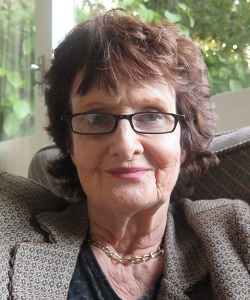
Eavan Boland, Irish poet, author and professor who has been active since the 1960s and helped develop feminist publishing company Arlen House, is born in Dublin on September 24, 1944. She is currently a professor at Stanford University, where she has taught since 1996. Her work deals with the Irish national identity and the role of women in Irish history. A number of poems from Boland’s poetry career are studied by Irish students who take the Leaving Certificate.
Boland’s father, Frederick Boland, is a career diplomat and her mother, Frances Kelly, is a noted post-expressionist painter. When she is six, her father is appointed Irish Ambassador to the United Kingdom. The family follows him to London, where she has her first experiences of anti-Irish sentiment. Her dealing with this hostility strengthens her identification with her Irish heritage. She speaks of this time in her poem “An Irish Childhood in England: 1951.”
At 14, she returns to Dublin to attend Holy Child School in Killiney. She publishes a pamphlet of poetry, 23 Poems, in her first year at Trinity College, Dublin in 1962. She earns a BA with First Class Honors in English Literature and Language from Trinity in 1966. Since then, she has held numerous teaching positions and published poetry, prose criticism and essays. She marries the novelist Kevin Casey in 1969 and has two daughters. Her experiences as a wife and mother influence her to write about the centrality of the ordinary, as well as provide a frame for more political and historical themes.
Boland has taught at Trinity College, Dublin, University College Dublin, and Bowdoin College, and was a member of the International Writing Program at the University of Iowa. She was also writer in residence at Trinity College, Dublin, and at the National Maternity Hospital, Dublin. In the late 1970s and 1980s, she teaches at the School of Irish Studies in Dublin. Since 1996 she has been a tenured Professor of English at Stanford University where she is currently Bella Mabury and Eloise Mabury Knapp Professor in the Humanities and Melvin and Bill Lane Professor for Director of the Creative Writing program. She divides her time between Palo Alto, California and her home in Dublin.
In 2015, Boland says that Trinity College, Dublin not only “influenced her career,” but “determined her career.”
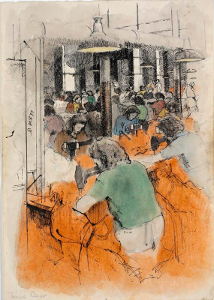
Thomas James Carr, British artist who is associated with the Euston Road School in the 1930s and has a long career as a painter of domestic scenes and landscapes, is born in Belfast to a well-to-do family on September 21, 1909.
Although essentially a realist painter, Carr is included in the 1934 Objective Abstractionists exhibition at Zwemmer’s Gallery. In 1937, he shares an exhibition with Victor Pasmore and Claude Rogers at the Storran Gallery and subsequently becomes associated with the representational style of the Euston Road School. Starting in 1940, at Georges Wildenstein‘s gallery, he holds a series of one-man exhibitions at various galleries including at the Leicester Galleries, The Redfern Gallery and also at Thomas Agnew & Sons.
After the war, Carr teaches at the Belfast College of Art and moves to Belfast in 1955. After the death of his wife in 1995, he moves to Norfolk, England to be nearer one of his three daughters and her family. He continues to paint into old age and tends to concentrate on landscape painting.
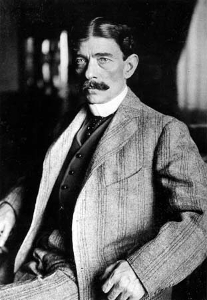
Darley is educated at Dungannon College in County Tyrone. His uncle, the Reverend John Darley, is headmaster of the college. In July 1847 he commences studying at Trinity College, Dublin, and he graduates in July 1851 with a Bachelor of Arts (BA). He is called to the English bar at the King’s Inn in January 1853 but returns to Ireland and practises there for about nine years on the Munster circuit. He meets Sir Alfred Stephen when Stephen is on a visit to Europe and is told that there are good prospects for him in Australia.
Darley marries Lucy Forest Browne at Hunsdon, Hertfordshire, on December 13, 1860. Lucy is the sister of novelist Rolf Boldrewood (Thomas Alexander Browne) who is best known for the book Robbery Under Arms. They have two sons and four daughters.
Darley decides to emigrate to Australia and arrives in Sydney in 1862. He is admitted to the NSW Bar on June 2, 1862, and is later appointed a Queens Counsel (QC) in 1878. In September 1868 he is nominated to the New South Wales Legislative Council. In November 1881 he becomes vice-president of the executive council in the third Henry Parkes ministry. In November 1886 Darley is offered the position of Chief Justice of New South Wales in succession to Sir James Martin. He does not desire the office and to accept it would mean a considerable monetary sacrifice. As a barrister, he is likely earning more than twice the amount of the salary offered. He declines the position, and it is accepted by Julian Salomons who subsequently resigns a few days later.
Darley is again approached and this time he accepts the position. He is sworn in on December 7, 1886. He carries out his duties with great distinction, although he is not an exceptional jurist. On the retirement of Sir Alfred Stephen in November 1891, Darley is appointed Lieutenant-Governor of New South Wales, and he administers the government seven times in that capacity. When the position of Governor of New South Wales becomes vacant in 1901, there are many suggestions that Darley should be given the post, but it is given to Sir Harry Rawson.
Darley’s longest period administering the government is from November 1, 1900, to May 27, 1902, a significant period in Australia’s political history with the lead up to and the aftermath of federation of the then Australian colonies. But his anxiety for New South Wales’s supremacy possibly contributes to the “Hopetoun Blunder.” Darley’s private assessment in 1902 is that “Australian Federation is so far a pronounced failure.”
Darley is knighted in 1887, created a Knight Commander of the Order of St. Michael and St. George (KCMG) in 1897, and receives the Knight Grand Cross of the Order of St. Michael and St. George (GCMG) on May 15, 1901, in preparation of the forthcoming royal visit of the Duke and Duchess of Cornwall and York (later King George V and Queen Mary).
Darley visits England in 1902 and is appointed a member of the royal commission on the South African war. He is also appointed a member of the privy council in 1905. He dies in London on January 4, 1910.
In mid-1863, James Stephens informs his colleagues he wishes to start a newspaper, with financial aid from John O’Mahony and the Fenian Brotherhood in America. The offices are established at 12 Parliament Street, almost at the gates of Dublin Castle. The first edition of The Irish People appears on November 28, 1863. The staff of the paper along with Charles Kickham are Thomas Clarke Luby and Denis Dowling Mulcahy as the editorial staff. Jeremiah O’Donovan Rossa and James O’Connor are in charge of the business office, with John Haltigan being the printer. John O’Leary is brought from London to take charge in the role of Editor. Shortly after the establishment of the paper, James Stephens departs on an American tour, and to attend to organisational matters.
American Fenians make plans for a rising in Ireland, but the plans are discovered on July 15, 1865 when an emissary loses them at Kingstown railway station. They find their way to Dublin Castle and to Superintendent Daniel Ryan head of G Division. Ryan has an informer within the offices of The Irish People named Pierce Nagle, who supplies Ryan with an “action this year” message on its way to the Irish Republican Brotherhood unit in Tipperary. With this information, Ryan raids the offices of The Irish People on September 15, followed by the arrests of John O’Leary, Thomas Clarke Luby and Jeremiah O’Donovan Rossa. The last edition of the paper is dated September 16, 1865.
Before leaving for America, Stephens entrusts to Luby a document containing secret resolutions on the Committee of Organization or Executive of the IRB. Though Luby intimates its existence to O’Leary, he does not inform Kickham as there seems no necessity. This document later forms the basis of the prosecution against the staff of The Irish People. The document reads:
EXECUTIVE
I hereby appoint Thomas Clarke Luby, John O’Leary and Charles J. Kickham, a Committee of Organisation or Executive, with the same supreme control over the Home Organisation (Ireland, England, Scotland, etc.) I have exercised myself. I further empower them to appoint a Committee of Military Inspection, and a Committee of Appeal and Judgment, the functions of which Committee will be made known to each member of them by the Executive. Trusting to the patriotism and ability of the Executive, I fully endorse their action beforehand, and call on every man in our ranks to support and be guided by them in all that concerns our military brotherhood.
9 March 1864, Dublin J. STEPHENS
Charles Kickham is caught after a month on the run and James Stephens is also eventually caught but with the support of Fenian prison warders John J. Breslin and Daniel Byrne is less than a fortnight in Richmond Bridewell Prison when he vanishes and escapes to France.
Wellesley rises to prominence as a general during the Peninsular War of the Napoleonic Wars and is promoted to the rank of field marshal after leading the allied forces to victory against the First French Empire at the Battle of Vitoria in 1813. Following Napoleon’s exile in 1814, he serves as the ambassador to France and is granted a dukedom. During the Hundred Days in 1815, he commands the allied army which, together with a Prussian army under Gebhard Leberecht von Blücher, defeats Napoleon at Waterloo. Wellesley’s battle record is exemplary, and he ultimately participates in some 60 battles during the course of his military career.
Wellesley is famous for his adaptive defensive style of warfare, resulting in several victories against numerically superior forces while minimising his own losses. He is regarded as one of the greatest defensive commanders of all time, and many of his tactics and battle plans are still studied in military academies around the world.
Wellesley dies at Walmer Castle in Deal, Kent, his residence as Lord Warden of the Cinque Ports, on September 14, 1852. He is found to be unwell on that morning and is aided from his military campaign bed, the same one he used throughout his historic military career and seated in his chair where he dies. His death is recorded as being due to the aftereffects of a stroke culminating in a series of seizures.
Although in life Wellesley hates travelling by rail, his body is taken by train to London, where he is given a state funeral, one of only a handful of British subjects to be honoured in that way, and the last heraldic state funeral to be held in Britain. The funeral takes place on November 18, 1852. He is buried in a sarcophagus of luxulyanite in St. Paul’s Cathedral next to Horatio Nelson, 1st Viscount Nelson.
Marian Keyes, Irish novelist and non-fiction writer best known for her work in women’s literature, is born on September 10, 1963, in Limerick, County Limerick. She is an Irish Book Awards winner. More than 22 million copies of her novels have been sold worldwide, and her books have been translated into 32 languages. She is regarded as a pioneer of the “chick lit” genre. Her stories usually revolve around a strong female character who overcomes numerous obstacles to achieve lasting happiness.
Raised in Monkstown, Keyes graduates from University of Dublin with a law degree. After completing her studies, Keyes takes an administrative job before moving to London in 1986. During this period, she develops alcoholism and clinical depression, culminating in a suicide attempt and subsequent rehabilitation in 1995 at the Rutland Centre in Dublin.
Keyes begins writing short stories while suffering from alcoholism. After her treatment at the Rutland Centre, she returns to her job in London and submits her short stories to Poolbeg Press. The publisher encourages her to submit a full-length novel, and Keyes begins work on her first book, Watermelon. The novel is published the same year.
Since 1995 she has published twelve novels and three works of nonfiction. After a long hiatus due to severe depression, a food title, Saved by Cake, is released in February 2012. Keyes currently lives in Dún Laoghaire with her husband Tony Baines, after returning to Ireland from London in 1997.
Keyes has written frankly about her clinical depression, which left her unable to sleep, read, write, or talk. She becomes known worldwide for Watermelon, Lucy Sullivan is Getting Married, and This Charming Man, with themes including domestic violence and alcoholism.
In 2014, after Keyes goes on Marian Finucane‘s RTÉ One show to talk about her new book, she tells her Twitter followers that Finucane has the “compassion and empathy of a cardboard box. Even my mammy called her a bad word.”
Patrick Cotter O’Brien, the first of only seventeen people in medical history to stand at a verified height of eight feet or more, dies on September 8, 1806 in Bristol, England.
O’Brien is born in Kinsale, County Cork. His real name was Patrick Cotter and he adopts O’Brien as his stage name in the sideshow circus, claiming descent from the legendarily gigantic Brian Boru. He is also known as the Bristol Giant and the Irish Giant. Another giant of this period, Charles Byrne, also claims to be an O’Brien.
It is believed that O’Brien dies from the effects of the disease gigantism.
No hearse can be found to accommodate his nine foot four inch coffin encased in lead, and his remains are borne to the grave by relays of fourteen men. In his will, Cotter leaves £2,000 to his mother and requests that his body be entombed within twelve feet of solid rock in order to prevent exhumation for scientific or medical research.
O’Brien’s remains are exhumed three times – in 1906, 1972 and finally in 1986. In 1972 O’Brien’s remains are examined and it is determined that, while alive, he stood approximately 8 feet 1 inch (246 cm) tall. This makes him the tallest person ever at that time, a record that is surpassed by the next “eight-footer,” John Rogan, who dies almost a century later. O’Brien is subsequently reburied but in 1986, during a redevelopment in the area, his remains are again identified and then cremated after a church service. O’Brien’s giant boots are on display in the Kinsale Museum.
At the time Franklin is based in London attempting to negotiate on behalf of the American Colonies. Franklin details his views of Dublin and Ireland in a letter to Thomas Cushing, a lawyer and statesman from Boston, Massachusetts. Franklin has a keen interest in Irish affairs, writing in a letter two years prior to visiting the country that “all Ireland is strongly in favour of the American cause. They have reason to sympathise with us.”
As Franklin tours Ireland in 1771 and is astounded and moved by the level of poverty he sees there. Ireland is under the trade regulations and laws of England, which affect the Irish economy, and Franklin fears that America will suffer the same plight if Britain’s exploitation of the colonies continues. During his visit, Franklin also attends two sessions of Irish Parliament as an observer.
Franklin is struck by the contrast between the grandeur of Dublin city itself and the intense poverty of those beyond its core.
Franklin writes to a friend, “The people in that unhappy country, are in a most wretched situation. Ireland is itself a poor country, and Dublin a magnificent city; but the appearances of general extreme poverty among the lower people are amazing. They live in wretched hovels of mud and straw, are clothed in rags, and subsist chiefly on potatoes. Our New England farmers, of the poorest sort, in regard to the enjoyment of all the comforts of life, are princes when compared to them. Perhaps three-fourths of the Inhabitants are in this situation.”
In 1977, the United States Ambassador to IrelandWalter J.P. Curley presents a bust of Benjamin Franklin to the Bank of Ireland to commemorate the visit. Speaking at the unveiling of the bust, the Ambassador notes that Franklin’s friendship for Ireland was no fleeting whim. He had said “You have ever been friendly to the rights of mankind and we acknowledge with pleasure and gratitude that your nation has produced patriots who have nobly distinguished themselves in the cause of humanity and America.”
Harris is born James Thomas Harris on February 14, 1855, in Galway, County Galway, to Welsh parents. While living with his older brother he is, for a year or more, a pupil at The Royal School, Armagh. At the age of twelve he is sent to Wales to continue his education as a boarder at the Ruabon Grammar School in Denbighshire, a time he is to remember later in My Life and Loves. Harris is unhappy at the school and runs away within a year.
Harris runs away to the United States in late 1869, arriving in New York City virtually penniless. The 13-year-old takes a series of odd jobs to support himself, working first as a shoeshiner, a porter, a general laborer, and a construction worker on the erection of the Brooklyn Bridge. He later turns these early occupational experiences into art, incorporating tales from them into his book The Bomb.
From New York Harris moves to the American Midwest, settling in Chicago, where he takes a job as a hotel clerk and eventually a manager. Owing to Chicago’s central place in the meat packing industry, Harris makes the acquaintance of various cattlemen, who inspire him to leave the big city to take up work as a cowboy. He eventually grows tired of life in the cattle industry and enrolls at the University of Kansas, where he studies law and earns a degree, gaining admission to the Kansas state bar association.
Harris is not cut out to be a lawyer and soon decides to turn his attention to literature. He returns to England in 1882, later traveling to various cities in Germany, Austria, France, and Greece on his literary quest. He works briefly as an American newspaper correspondent before settling down in England to seriously pursue the vocation of journalism.
From 1908 to 1914 Harris concentrates on working as a novelist, authoring a series of popular books such as The Bomb, The Man Shakespeare, and The Yellow Ticket and Other Stories. With the advent of World War I in the summer of 1914, Harris decides to return to the United States.
From 1916 to 1922 he edits the U.S. edition of Pearson’s Magazine, a popular monthly which combines short story fiction with socialist-tinted features on contemporary news topics. One issue of the publication is banned from the mails by United States Postmaster GeneralAlbert S. Burleson during the period of American participation in the Great War. Despite this Harris manages to navigate the delicate situation which faces the left wing press and to keep the Pearson’s Magazine functioning and solvent during the war years.
Harris becomes an American citizen in April 1921. In 1922 he travels to Berlin to publish his best-known work, his autobiography My Life and Loves. It is notorious for its graphic descriptions of Harris’ purported sexual encounters and for its exaggeration of the scope of his adventures and his role in history. Years later, Time Magazine reflects in its March 21, 1960 issue “Had he not been a thundering liar, Frank Harris would have been a great autobiographer….he had the crippling disqualification that he told the truth, as Max Beerbohm remarked, only ‘when his invention flagged’.” A fifth volume, supposedly taken from his notes but of doubtful provenance, is published in 1954, long after his death.
Harris also writes short stories and novels, two books on Shakespeare, a series of biographical sketches in five volumes under the title Contemporary Portraits and biographies of his friends Oscar Wilde and George Bernard Shaw. His attempts at playwriting are less successful. Only Mr. and Mrs. Daventry (1900), which is based on an idea by Oscar Wilde, is produced on the stage.
Married three times, Harris dies of a heart attack in Nice at the age of 75 on August 26, 1931. He is subsequently buried at Cimetière Caucade in the same city. Just after his death a biography written by Hugh Kingsmill (pseudonym of Hugh Kingsmill Lunn) is published.
In November 1938, Lord Killanin is commissioned into the Queen’s Westminsters, a territorial regiment of the British Army, where he is responsible for recruiting fellow journalists, including future The Daily Telegraph editor Bill Deedes, and friends who are musicians and actors. He reaches the rank of major and takes part in the planning of D-Day and the Invasion of Normandy in 1944, acting as brigade major for the 30th Armoured Brigade, part of the 79th Armoured Division. He is appointed, due to the course of operations, a Member of the Order of the British Empire (MBE). After being demobilised, he goes to Ireland. He resigns his TA commission in 1951.
In 1950, Lord Killanin becomes the head of the Olympic Council of Ireland (OCI) and becomes his country’s representative in the IOC in 1952. He becomes senior vice-president in 1968, and succeeds Avery Brundage, becoming President-elect at the 73rd IOC Session (August 21–24) held in Munich prior to the 1972 Summer Olympics. He takes office soon after the Games.
Lord Killanin serves as Honorary Consul-General of Monaco in Ireland from 1961 to 1984 and as Chairman of the Race Committee for Galway Racecourse from 1970 to 1985. A keen horse racing enthusiast, he also serves as a steward of the Irish Turf Club on two occasions and on the National Hunt Steeplechase Committee. In his business life Lord Killanin is a director of many companies including Irish Shell, Ulster Bank, Beamish & Crawford and Chubb Ireland. He is a founder member of An Taisce (The National Trust for Ireland) and is chairman of the National Monuments Advisory Council until his death.
Lord Killanin dies at his home in Dublin on April 25, 1999, at the age of 84 and, following a bilingual funeral Mass at St. Enda’s Church in Spiddal, County Galway, he is buried in the family vault in the New Cemetery, Galway.







 seamus dubhghaill