seamus dubhghaill

Promoting Irish Culture and History from Little Rock, Arkansas, USA


Leave a comment

Birth of “Jem” Finer, Founding Member of The Pogues

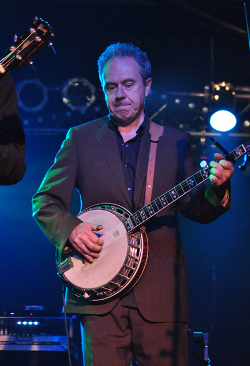
jem-finerJeremy Max “Jem” Finer, English musician, artist, composer, and one of the founding members of The Pogues, is born in Stoke-on-Trent, England on July 20, 1955.

After college at Keele University, Finer travels around Europe and spends some time working on a barge in France. He settles in London and becomes the bass player in a group called The Petals and lives in 32 Burton Street, a house which he sometimes shares with Spider Stacey and Shane MacGowan. Together with James Fearnley they found The Pogues. Primarily a banjoist, he also plays other instruments, including mandola, saxophone, hurdy-gurdy, and the guitar. Apart from Shane MacGowan, Finer is the most prolific composer for the band.

Finer appears on all the band’s albums until their breakup in 1996. He continues working as a musician and composer after leaving The Pogues.

On January 1, 2000, the Finer-composed Longplayer piece of music is started and is designed to last 1,000 years without ever repeating itself. It currently exists in both computer-generated and live versions. Longplayer represents a convergence of many of his concerns, particularly those relating to systems, long-durational processes, and extremes of scale in both time and space.

Finer serves as “Artist in Residence” at the Astrophysics Sub-department of the University of Oxford between October 2003 and June 2005. Finer and Hamburg-based swamp pop legend DM Bob begin recording and performing together in 2005, releasing their album Bum Steer in August of that year and co-producing the debut album by experimental pop band Marseille Figs. In July 2005, Finer wins the PRS Foundation New Music Award on the basis of his proposal to build a device that will automatically “compose” a song of indeterminate length by harnessing the creative force of the weather.

In March 2012, Mobile Sinfonia, a global composition for ringtones is launched, developed during a year Finer spends as a non-resident artist at the University of Bath. This piece concerns mutual invasion of soundscape via ringtones.

Finer is currently working on a number of new projects continuing his interest in long-term sustainability and the reconfiguring of older technologies, including Spiegelei, a spherical camera obscura featuring Finer’s innovative 360-degree projection system and the Supercomputer in Cambridge, a 5-bit mechanical sculpture which will compute minimal musical scores.


Leave a comment

Birth of Irish Dancer & Choreographer Michael Ryan Flatley

michael-flatley

Michael Ryan Flatley, Irish American dancer, choreographer, and musician, is born to Irish parents in Chicago, Illinois on July 16, 1958. He becomes internationally known for Irish dance shows Riverdance, Lord of the Dance, Feet of Flames, and Celtic Tiger.

Flatley begins dancing lessons at age 11 and, at age 17, is the first American to secure a World Irish Dance title at the World Irish Dance Championships, the Oireachtas Rince na Cruinne. He is also an accomplished flautist, having won twice in the All-Ireland Fleadh Cheoil Concert Flute competitions from 1975-1976.

Flatley is taught dance by Dennis Dennehy at the Dennehy School of Irish Dance in Chicago. After graduating from Brother Rice High School, on Chicago’s Southwest Side, he opens a dance school but later closes it to focus on performing.

In 1978 and 1979 Flatley tours with Green Fields of America and then with The Chieftains in the 1980s. In May 1989, Flatley sets a Guinness Book world record for tapping speed at 28 taps per second, and subsequently breaks his own record in 1998 with 35 taps per second.

Flatley creates and choreographs the original Riverdance and leads the show to great success as the intermission act in the Eurovision Song Contest staged in Ireland on April 30, 1994. Flatley abruptly leaves the show over creative control disputes in October 1995.

Shortly after the Riverdance split, Flatley creates Lord of the Dance, which plays mostly in arenas and stadiums instead of stage theaters. He also puts together a dance production called Feet of Flames in 1998. Flately’s Irish dance show Celtic Tiger opens in July 2005. The show explores the history of the Irish people and Irish emigration to the United States, fusing a wide range of dance styles, including jazz.

Flatley returns to the stage in 2009 for a limited run of the “Hyde Park” version of Feet of Flames in Taiwan. His return is met with multiple standing ovations and the run of shows has to be extended to meet the demand for tickets.

Flatley premiers Lord of the Dance: Dangerous Games at the celebrated Palladium Theatre on London’s West End in 2014 and moves to the Dominion Theatre in 2015 where he makes his final appearance on the West End stage before revisiting another sold out Wembley Arena for his final performance in the United Kingdom.

Flatley embarks on his final tour on February 19, 2016 and performs on stage for the last time at The Colosseum at Caesar’s Palace in Las Vegas, NV, on March 17, 2016. He continues as the show’s creator, producer, and choreographer.


Leave a comment

Death of Countess Constance Georgine Markievicz

markievicz-funeral-procession

Countess Constance Georgine Markievicz, née Gore-Booth, Irish politician, revolutionary nationalist, and suffragette, dies on July 15, 1927, in Sir Patrick Dun’s Hospital, Dublin, of complications related to appendicitis.

Constance Gore-Booth is born into the Anglo-Irish aristocracy and grows up at her family’s estate, Lissadell House, in County Sligo. Constance enrolls at London’s Slade School of Fine Art in 1893. In the late 1890s she travels to Paris, where she meets Count Casimir Dunin-Markievicz of Poland. They are married in 1900.

In 1903 the Markieviczes move to Dublin, where Constance’s interests soon turn from art to Irish politics. At age 40, in 1908, she embraces Irish nationalism, joining the revolutionary women’s group Inghinidhe na hÉireann (Daughters of Ireland) and the Sinn Féin political party. The following year she forms Na Fianna Éireann (Soldiers of Ireland), a republican organization loosely based on the Boy Scouts, in which young boys are trained to be nationalist soldiers.

In 1911 she is arrested for demonstrating against King George V’s visit to Ireland. This is just the first of several arrests and imprisonments for Markievicz, whose political activism results in jail time intermittently for the remainder of her life. In 1913–14 she provides food for workers and their families during a labour dispute in which thousands of people are locked out of their workplaces for refusing to reject union membership.

In April 1916 Markievicz takes part in the Easter Rising, the republican insurrection in Dublin against British government in Ireland. After the general surrender, she is arrested and imprisoned. Though many women participate in the uprising, Markievicz is the only one to be court-martialed. She is sentenced to death, but the sentence is commuted to a lifetime of penal servitude on account of her gender. The following year, under a general amnesty, Markievicz is released, but soon finds herself back in jail for supposed participation in a plot against the British government. In December 1918, while still carrying out a prison sentence, Markievicz is elected to the House of Commons as the representative for Dublin’s St. Patrick’s division. Along with the other members of Sinn Féin, she refuses to swear an oath of allegiance to the king and, thus, does not take her seat. Instead, under the leadership of Éamon de Valera, the Irish republicans set up their own provisional government, Dáil Éireann.

After her release from prison, Markievicz serves in the first Dáil Éireann as the minister of labour, a post she holds from 1919 until she is defeated in the 1922 elections. That same year the Irish Free State is established, and Dáil Éireann is incorporated as the lower house of the Oireachtas (Irish parliament). Markievicz is elected to the Dáil in the 1923 general election but, along with the other members of Sinn Féin, she again refuses to swear allegiance to the king and does not take her seat. Instead, she devotes herself to charity work. Markievicz joins de Valera’s Fianna Fáil party on its founding in 1926 and is again elected to the Dáil in 1927 but dies a month later without having taken her seat.

Refused a state funeral by the Free State government, Markievicz is buried at Glasnevin Cemetery, Dublin, and de Valera gives the funeral oration.


Leave a comment

Birth of Francis Fowke, Engineer & Architect

francis-fowke

Francis Fowke, engineer, architect, and a Captain in the Corps of Royal Engineers, is born in Ballysillan, Belfast, on July 7, 1823. Most of his architectural work is executed in the Renaissance style, although he makes use of relatively new technologies to create iron framed buildings, with large open galleries and spaces.

Fowke studies at The Royal School Dungannon, County Tyrone, and the Royal Military Academy, Woolwich. He obtains a commission in the Royal Engineers and serves with distinction in Bermuda and Paris. On his return to England, he is appointed architect and engineer in charge of the construction of several government buildings.

Among his projects are the Prince Consort’s Library in Aldershot, the Royal Albert Hall and parts of the Victoria and Albert Museum in London, the Royal Museum in Edinburgh, and the National Gallery of Ireland in Dublin. He is also responsible for planning the 1862 International Exhibition in London. The Crystal Palace at the Great Exhibition of 1851 being a hard act to follow, the International Exhibition building is described as “a wretched shed” by The Art Journal. Parliament declines the Government’s proposal to purchase the building. The materials are sold and used for the construction of Alexandra Palace.

Before his sudden death from a burst blood vessel on December 4, 1865, Fowke wins the competition for the design of the Natural History Museum, although he does not live to see it executed. His renaissance designs for the museum are altered and realised in the 1870s by Alfred Waterhouse, on the site of Fowke’s Exhibition building.

Francis Fowke is buried in Brompton Cemetery, London.

A medal is issued by the Royal Engineers in 1865, as a memorial prize for architectural works carried out by members of the corps. With the demise of great architectural works, the prize has transformed into the prize awarded to the top student on the Royal Engineers Clerks of Works course.


Leave a comment

Birth of Katie Taylor, Olympic Boxing Champion

katie-taylor

Katie Taylor, Irish sportswoman who has represented Ireland in both boxing and association football, is born in Bray, County Wicklow, on July 2, 1986. As of this writing, she is the Irish, European, World, and Olympic boxing champion in the 60 kg division. Regarded as the outstanding Irish athlete of her generation, she is the flag bearer for Ireland at the 2012 London Olympics opening ceremony before going on to win an Olympic gold medal in the lightweight division.

Taylor first begins boxing in 1998 at the age of eleven. Her father coaches her and her two older brothers, Lee and Peter, at St. Fergal’s Boxing Club, which operates out of a former boathouse in Bray. At 15, she fights the first officially sanctioned female boxing match in Ireland at the National Stadium and defeats Alanna Audley from Belfast.

Between 1999 and 2005 Taylor attends St. Kilian’s Community School in Bray with her three older siblings. In addition to boxing and playing association football, Taylor also plays Gaelic football and camogie with her local GAA clubs, Bray Emmets and Fergal Ógs. Several American colleges reportedly offer her athletic scholarships while she is still a pupil at St. Killian’s. She opts, however, to attend University College Dublin. Although UCD is well known for sports scholarships, Taylor qualifies via her Leaving Cert results. As her sporting career begins to take off, however, she chooses not to complete her studies at UCD.

Taylor qualifies for the 2012 Summer Olympics in London, the first time women’s boxing has been considered for inclusion. Crowds gather on the streets of her hometown to watch her progress on giant screens erected especially for the occasion.

Taylor’s first appearance at the 2012 Summer Olympics comes on August 6, after a first-round bye. She achieves an impressive 26-15 victory over Great Britain‘s Natasha Jonas, booking her place in the semi-final and guaranteeing her, at least, an Olympic bronze medal.

In the semi-final on August 8, 2012, she proves far too good for Tajikistan‘s Mavzuna Chorieva and wins in a 17-9 victory, booking her place in the final and guaranteeing her of at least a silver medal.

Taylor defeats Russia‘s Sofya Ochigava in the final bout by 10-8 on August 9, 2012, winning the Olympic gold medal and becoming the first ever Olympic female lightweight champion.

On her return to Dublin with the rest of the Olympic squad she gets into the cockpit of the plane and leans out the window waving an Irish flag.


Leave a comment

The Bombing of Air India Flight 182

air-india-182

Air India Flight 182, an Air India flight operating on the Montreal, CanadaLondon, U.K.Delhi, India route, is destroyed by a bomb on June 23, 1985, at an altitude of 31,000 feet and crashes into the Atlantic Ocean while in Irish airspace.

It is the first bombing of a 747 jumbo jetliner. A total of 329 people are killed, including 268 Canadian citizens, 27 Britons, and 24 Indians. The majority of the victims were Canadian citizens of Indian ancestry. The incident is the largest mass murder in Canadian history. It is the deadliest terrorist attack involving an airplane until the September 11, 2001, attacks in the United States in 2001. The bombing of Air India 182 occurs at the same time as the Narita Airport bombing in Japan. Investigators believe that the two plots are linked, and that those responsible are aiming for a double bombing. However, the bomb at Narita explodes before it can be loaded onto a plane.

At 07:14:01 GMT, the crew of Air India 182 “squawked 2005,” a routine activation of its aviation transponder, as requested by Shannon International Airport Air Traffic Control (ATC). The plane then disappears from radar. A bomb in a Sanyo tuner in a suitcase in the forward cargo hold explodes while the plane is at 31,000 feet at 51°3.6′N 12°49′W. It causes rapid decompression and the break-up of the aircraft in mid-air. The wreckage settles in 6,700-feet deep water off the southwest coast of Ireland, 120 miles offshore of County Cork. No “mayday” call is received by Shannon ATC. ATC asks aircraft in the area to try to contact Air India, to no avail. By 07:30:00 GMT, ATC has declared an emergency and requests nearby cargo ships and the Irish Naval Service vessel Aisling to begin searching for the aircraft.

The bomb kills all 22 crew and 307 passengers. One hundred thirty-two bodies are recovered. The remaining 197 are lost at sea. Eight bodies exhibit “flail pattern” injuries, indicating that they had exited the aircraft before it hit the water. This is a sign that the aircraft had broken up in mid-air. Twenty-six bodies show signs of hypoxia (lack of oxygen). Twenty-five, mostly victims who were seated near windows, show signs of explosive decompression. Twenty-three have signs of “injuries from a vertical force.” Twenty-one passengers are found with little or no clothing.

Canadian law enforcement determines that the main suspects in the bombing are members of the Sikh militant group Babbar Khalsa. The attack is thought to be a retaliation against India for the operation carried out by the Indian Army Operation Blue Star to flush out several hundred Sikh militants who were within the premises of the Golden temple and the surrounding structures ordered by the Indian government, headed by Prime Minister Indira Gandhi. Though a handful of members are arrested and tried, Inderjit Singh Reyat, a Canadian national, remains the only person convicted of involvement in the bombing. Singh pleads guilty in 2003 to manslaughter. He is sentenced to 15 years in prison for building the bombs that exploded aboard Flight 182 and at Narita.

The subsequent investigation and prosecution lasts almost twenty years and is the most expensive trial in Canadian history, costing nearly CAD 130 million. The Governor General-in-Council in 2006 appoints the former Supreme Court Justice John C. Major to conduct a commission of inquiry. His report is completed and released on June 17, 2010. It concludes that a “cascading series of errors” by the government of Canada, the Royal Canadian Mounted Police (RCMP), and the Canadian Security Intelligence Service (CSIS) had allowed the terrorist attack to take place.


Leave a comment

Birth of The Pogues’ Guitarist Philip Chevron

philip-chevron

Philip Ryan, Irish singer-songwriter and guitarist professionally known as Philip Chevron and best known as a member of The Pogues, is born on June 17, 1957. He is regarded as one of the most influential figures in Irish punk music.

Chevron grows up in Santry, a suburb of Dublin. Beginning in the late 1970s, he is lead singer and co-founder of the punk rock group The Radiators from Space, receiving some critical acclaim but little widespread popularity or financial success. Following a temporary breakup of the band in 1981, he lives in London for a while where he meets and befriends Shane MacGowan through time spent working together at a record shop. Following the release of the Pogues’ 1984 debut album Red Roses For Me, Chevron is invited to join the band as a temporary replacement for banjo player Jem Finer while on paternity leave. He takes over as guitarist following MacGowan’s decision to concentrate on singing, thereby becoming a full-time member of the band in time for the recording of its second album, Rum, Sodomy and the Lash.

Chevron proves himself as a singer-songwriter, writing the songs Thousands Are Sailing and Lorelei among others. He leaves The Pogues in 1994 following problems with drugs and alcohol. In 2003, he reforms The Radiators (Plan 9) with ex-Pogues bassist Cait O’Riordan. They release the album Trouble Pilgrim in 2006.

In later years, he becomes The Pogues’ unofficial spokesperson and resident expert on the reclusive MacGowan, frequently visiting online fora and directly answering questions from fans. In 2004, he personally oversees the remastering and re-release of The Pogues’ entire back catalogue on CD. He tours regularly with The Pogues, who reunite after a successful reunion tour in 2001.

In June 2007, The Pogues’ website announces that Chevron has been diagnosed with oesophageal cancer. In early 2008, the website announces that Chevron has recovered, and to his surprise and joy, his hearing has returned to almost pre-treatment levels. He embarks on the March 2008 tour of the United States and manages to sing Thousands Are Sailing at each performance. By 2009, Chevron appears to have recovered from the cancer.

However, in May 2013, it is announced that the cancer has returned, and it is “lethal.” In June he stoically tells the Irish Daily Mail, “I am a gay, Irish, Catholic, alcoholic Pogue who is about to die from cancer – and don’t think I don’t know it.” Chevron dies on October 8, 2013, in Dublin at the age of 56. His last public appearance is at the Olympia Theatre in Dublin for a fundraiser in August of that same year.


Leave a comment

Birth of Tenor John McCormack

john-mccormack

John McCormack, an Irish tenor celebrated for his performances of the operatic and popular song repertoires and renowned for his diction and breath control, is born in Athlone, County Westmeath, on June 14, 1884.

McCormack receives his early education from the Marist Brothers in Athlone, and later attends Summerhill College in Sligo. He sings in the choir of the old St. Peters church in Athlone under choirmaster Michael Kilkelly. When the family moves to Dublin, he sings in the choir of St. Mary’s Pro-Cathedral where he is discovered by composer Vincent O’Brien. In 1903 he wins the coveted gold medal of the Dublin Feis Ceoil.

Fundraising activities on his behalf enable McCormack to travel to Italy in 1905 to receive voice training by Vincenzo Sabatini in Milan. In 1906, he makes his operatic début at the Teatro Chiabrera, Savona. The next year he begins his first important operatic performance at Covent Garden in Mascagni‘s Cavalleria rusticana, becoming the theatre’s youngest principal tenor.

In less than three years he is singing opera in the United States, as well as beginning a career on the recital stage that makes him one of the most successful singers of all time. In 1917 he becomes a citizen of the United States, his adopted country, where his concert appeal has proven to be nearly universal and unrelenting.

McCormack originally ends his career in 1938 at the Royal Albert Hall in London. However, one year after that farewell concert he is back singing for the Red Cross and in support of the war effort. He concertizes, tours, broadcasts, and records in this capacity until 1943 when failing health forced him to permanently retire.

Ill with emphysema, he purchases a house near the sea at Booterstown, County Dún Laoghaire–Rathdown, just south of Dublin. After a series of infectious illnesses, including influenza and pneumonia, McCormack dies on September 16, 1945. He is mourned by his countrymen, his English public who had taken him to their hearts as well, a vast number of his fellow citizens in the United States, and music lovers all over the world. He is buried in Deansgrange Cemetery.


Leave a comment

Barry McGuigan Wins the World Featherweight Boxing Title

barry-mcguigan

Finbar Patrick McGuigan, known as Barry McGuigan and nicknamed The Clones Cyclone, wins the World Boxing Association featherweight title on June 8, 1985, defeating Eusebio Pedroza in a unanimous 15-round decision at Loftus Road soccer stadium in London.

Barry McGuigan, the son of singer Pat McGuigan, is born in Clones, County Monaghan. He represents Northern Ireland in the Commonwealth Games at Edmonton in 1978 and represents Ireland at the 1980 Summer Olympics in Moscow.

After a successful juvenile boxing career, McGuigan begins his professional boxing career on May 10, 1981, beating Selwyn Bell by knockout in two rounds in Dublin. He wins four out of five additional bouts in 1981. In 1982, McGuigan wins eight fights, seven by knockout, although one of these almost destroys his career and his life. Opposed by Young Ali, on June 14, 1982, McGuigan wins by a knockout in six rounds. Ali falls into a coma and dies five months later.

In 1985, McGuigan meets former world featherweight champion Juan Laporte and wins a 10-round decision. Following one more win, he finally gets his world title attempt when the long reigning WBA featherweight champion, Eusebio Pedroza of Panama, comes to London to put his title on the line at Loftus Road soccer stadium. McGuigan becomes the champion by dropping Pedroza in the seventh round and winning a unanimous fifteen-round decision in a fight refereed by hall of fame referee Stanley Christodoulou. McGuigan and his wife are feted in a public reception through the streets of Belfast that attracts several hundred thousand spectators. Later that year, he is named BBC Sports Personality of the Year, becoming the first person not born in the United Kingdom to win the award.

McGuigan twice successfully defends his title, first against American Bernard Taylor, who is stopped in nine  rounds, and then against Dominican Danilo Cabrera in a controversial knock out in fourteen rounds. The fight is stopped after Cabrera bends over to pick up his mouthpiece after losing it, a practice that is allowed in many countries but not in Ireland. Cabrera is not aware of this, and the fight is stopped.

McGuigan’s next defence takes place in Las Vegas in June 1986, where he faces the relatively unknown Steve Cruz of Texas, in a gruelling 15-round title bout under a blazing sun. McGuigan holds a lead halfway through, but suffers dehydration due to the extreme heat and wilts near the end, being dropped in the tenth and fifteenth rounds. He eventually loses the world title, which he never reclaims, in a close decision. After the fight McGuigan requires hospitalisation because of his dehydrated state.

McGuigan retires after the fight but returns to the ring between 1988 and 1989, beating former world title challengers Nicky Perez and Francisco Tomas da Cruz, as well as contender Julio César Miranda, before losing to former EBU featherweight champ and future WBC and WBA super featherweight challenger Jim McDonnell by a technical knockout. After the McDonnell fight he permanently retires from boxing. His record is 32 wins and 3 losses, with 28 knockouts. In January 2005, McGuigan is elected into the International Boxing Hall of Fame.

McGuigan founds and is the current President of the Professional Boxing Association (PBA). He is also the CEO and founder of Cyclone Promotions.


1 Comment

Ronald Reagan Visits His Ancestral Home in Ballyporeen

reagan-visits-ballyporeen-1984U.S. President Ronald Reagan visits his ancestral home in Ballyporeen, County Tipperary, on June 3, 1984. Reagan’s great-grandfather, Michael Regan, who later changed the spelling of his name, is baptised in the village in 1829. Around 1851, after the Great Famine, he emigrates to London and ultimately the United States in 1857.

Surrounded by throngs of photographers and security people, Reagan slowly makes his way through the tiny village in the bright green hills of County Tipperary. Speaking to 3,000 applauding and cheering visitors gathered under drizzly skies at the main crossroads of Ballyporeen, Reagan explains that until recently he had never known of his roots because his father had been orphaned before reaching the age of six.

“And now,” Reagan tells the exuberant crowd, “thanks to you and the efforts of good people who have dug into the history of a poor immigrant family, I know at last whence I came. And this has given my soul a new contentment. And it is a joyous feeling. It is like coming home after a long journey.”

Reagan, joined by his wife, Nancy, aides, dignitaries, and townspeople worship at the modest Church of the Assumption in Ballyporeen, where his great-grandfather was supposedly baptized in 1829.

After the service, Reagan makes his way down Church Street, shaking the hands of well-wishers. Amid the handshaking, a marching bagpipe corps plays A Nation Once Again and other patriotic tunes.

At the town center, the Reagans visit the pub run by John O’Farrell, who first capitalizes on the news of the President’s lineage and names his establishment “The Ronald Reagan” in 1981. Reagan unveils a plaque for the President Reagan tourist center that is to be built here. While the building housing the pub still stands, the pub closes in 2004 and the following year its fittings and external signage are transported to the Ronald Reagan Presidential Library in Simi Valley, California, where it still stands today.

There is some opposition to Reagan’s visit to Ireland. Authorities keep approximately 600 protesters behind barriers on the outskirts of the village and they are not permitted into the village until after the presidential party had departed. The main focus of the protesters is toward the Reagan administration’s foreign policy, in particular its support of the Contras in Nicaragua.