In April 1916, Germany offers the Irish 20,000 Mosin–Nagant 1891 rifles, ten machine guns and accompanying ammunition, but no German officers. It is a fraction of the quantity of the arms Casement had hoped for, with no military expertise on offer. The weapons leave Germany bound for Ireland on a German cargo vessel named the SS Libau, disguised as a Norwegian vessel, Aud-Norge.
Casement confides his personal papers to Dr. Charles Curry, with whom he has stayed at Riederau on the Ammersee, before leaving Germany. He departs with Robert Monteith and Sergeant Daniel Beverley (Bailey) of the Irish Brigade in a submarine, initially the SM U-20, which develops engine trouble, and then the SM U-19, shortly after the Aud sails. According to Monteith, Casement believes the Germans are toying with him from the start and providing inadequate aid that will doom a rising to failure. He wants to reach Ireland before the shipment of arms and to convince Eoin MacNeill, who he believes is still in control, to cancel the rising.
Casement sends John McGoey, a recently arrived Irish American, through Denmark to Dublin, ostensibly to advise what military aid is coming from Germany and when, but with Casement’s orders “to get the Heads in Ireland to call off the rising and merely try to land the arms and distribute them.” McGoey does not reach Dublin, nor does his message. His fate is unknown until recently. Evidently abandoning the Irish Nationalist cause, he joins the Royal Navy in 1916, survives the war, and later returns to the United States, where he dies in an accident on a building site in 1925.
About 2:00 a.m. on the morning of April 21, 1916, three days before the rising begins, Robert Monteith, Daniel Bailey (calling himself Beverly), and Casement climb into a small boat for the trip to shore at Banna Strand in Tralee Bay, County Kerry. Their boat, now in the Imperial War Museum in London, capsizes before they reach shore.
Monteith helps an exhausted Casement to safety on shore. Casement is convinced that the Rising cannot be successful without a large number of German troops, and the best he has been able to obtain is one boatload of arms. Suffering from a recurrence of the malaria that had plagued him since his days in the Congo, and too weak to travel, Monteith and Bailey leave Casement at the ruins of McKenna’s Fort, an ancient ring fort in Rahoneen, Ardfert, now renamed Casement’s Fort, and head for Tralee.
About 1:30 p.m., Casement is discovered by two Royal Irish Constabulary (RIC) officers. He nearly talks his way out of being arrested, but a 12-year-old boy at the scene points out a piece of paper Casement had tossed away as the police approach. On that paper is a German code list. He is arrested on charges of high treason, sabotage and espionage against the Crown. He manages to send word to Dublin about the inadequate German assistance.
The Kerry Brigade of the Irish Volunteers might have tried to rescue Casement over the next three days, but its leadership in Dublin holds that not a shot is to be fired in Ireland before the Easter Rising is in train and therefore orders the Brigade to “do nothing.” A subsequent internal inquiry attaches “no blame whatsoever” to the local Volunteers for failing to attempt a rescue. Casement is taken to Brixton Prison and placed under special observation for fear of an attempt of suicide as there is no staff at the Tower of London to guard suicidal cases.
On the day of his execution by hanging at Pentonville Prison, August 3, 1916, Casement is received into the Catholic Church at his request. He is attended by two Catholic priests, Dean Timothy Ring and Father James Carey, from the East London parish of SS Mary and Michael. The latter, also known as James McCarroll, says of Casement that he was “a saint … we should be praying to him [Casement] instead of for him.” At the time of his death he is 51 years old.
Casement’s body is buried in quicklime in the prison cemetery at the rear of Pentonville Prison, though his last wish was to be buried at Murlough Bay on the north coast of County Antrim, in present-day Northern Ireland. Finally, in 1965, his remains are repatriated to Ireland. His remains lay in state at the Garrison Church, Arbour Hill (now Arbour Hill Prison) in Dublin for five days, close to the graves of other leaders of the 1916 Easter Rising, although he would not be buried beside them. After a state funeral, the remains are buried with full military honours in the republican plot in Glasnevin Cemetery in Dublin, alongside other Irish republicans and nationalists. The President of Ireland, Éamon de Valera, who is then in his mid-eighties and the last surviving leader of the Easter Rising, attends the ceremony, along with an estimated 30,000 others.
Coalisland is a town in County Tyrone that has a tradition of militant republicanism; five residents are killed by British security forces before the first IRA ceasefire in 1994. In February 1992, four IRA volunteers are killed in a gun battle with the SAS during their escape after a machine gun attack on the RUC/British Army barracks there. Three months later, an IRA bomb attack on a British Army patrol at Cappagh, in which a paratrooper loses his legs, triggers a series of clashes between local residents and British troops on May 12 and 17. A number of civilians and soldiers are injured, a soldier’s backpack radio destroyed, and two British weapons stolen. The melee is followed by a 500-strong protest in the town and bitter exchanges between Republic of Ireland and British officials. Further scuffles between civilians and soldiers are reported in the town on March 6, 1994.
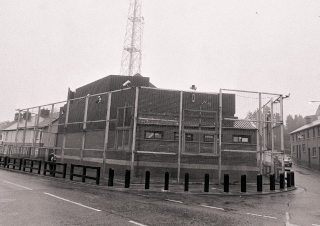
At 9:40 p.m. on Wednesday, March 26, 1997, a grenade is thrown at the joint British Army/RUC base at Coalisland, blowing a hole in the perimeter fence. The RUC reports that a 1 kg device hit the fence ten feet off the ground. Another source claims that the device is a coffee-jar bomb filled with Semtex. The grenade is thrown or fired by two unidentified men. At the time of the attack, there is an art exhibition at Coalisland Heritage Hall, also known as The Mill, from where the explosion and the gunshots that follow are clearly heard. The incident lasts less than two minutes.
Just one minute after the IRA attack, bypassers hear high-velocity rounds buzzing around them. A number of men, apparently SAS soldiers, get out of civilian vehicles wearing baseball caps with “Army” stamped on the front. A source initially describes them as members of the 14 Field Security and Intelligence Company. The men are firing Browning pistols and Heckler & Kochsubmachine guns. Witnesses say there are eight to ten gunshots, while a republican source claims that up to eighteen rounds are fired. Nineteen-year-old Gareth Doris is shot in the stomach and falls to the ground. He is allegedly returning from the local church and is in the company of a priest when he is shot. A local priest, Seamus Rice, is driving out of the church car park when his car is hit by bullets, smashing the windscreen.
Three minutes after the blast, hundreds of angry residents gather at the scene and confront the undercover soldiers. The soldiers fire live rounds at the ground and into the air to keep people back. The crowd keeps drawing back and moving forward again until 9:50 p.m., when the RUC arrives and begins firing plastic bullets at the protesters. Two women are wounded by plastic bullets and the undercover soldiers then flee in unmarked cars, setting off crackers or fireworks at the same time. Sinn FéincouncillorFrancie Molloy claims that the protesters forced the SAS to withdraw, saving Doris’s life in the process. Witnesses allegedly fear an undercover soldier brandishing a pistol would have killed the wounded Doris with a shot to his head.
Afterward, hundreds of residents are forced to leave their homes as security forces search the area near the base. This keeps tensions high, according to local republican activist Bernadette McAliskey. Two men are later questioned by the RUC about the attack.
The attack, along with two large bombings the same day in Wilmslow, England, raise concerns that the IRA is trying to influence the upcoming UK general election. Martin McGuinness describes the shooting as “murderous,” while independent councillor Jim Canning says that more than a dozen soldiers “were threatening to shoot anybody who moved […] while a young man lay shot on the ground.” Republican sources claim that this is another case of shoot-to-kill policy by the security forces. Ulster Unionist Party (UUP) MPKen Maginnis, however, praises the SAS for their actions.
Gareth Doris is admitted to South Tyrone Hospital in Dungannon, where he is arrested after undergoing surgery. He is later transferred to Musgrave Park Hospital in Belfast. He is later convicted for involvement in the bombing and sentenced to ten years in jail, before being released in 2000 under the terms of the Good Friday Agreement. Gareth is the cousin of Tony Doris, an IRA member killed in an SAS ambush in the nearby village of Coagh on June 3, 1991, and a cousin of Sinn Féin leader Michelle O’Neill. According to Sinn Féin councillor Brendan Doris, another cousin of Gareth, “He absolutely denies being involved in terrorist activity of any description.” Amnesty International raises its concerns over the shooting and the fact that no warning is given beforehand.
DNA evidence collected in the area of the shooting leads to the arrest of Coalisland native Paul Campbell by the Police Service of Northern Ireland (PSNI) in 2015, on the charges of being the other man with Doris during the attack. In February 2020, he is convicted by a Diplock court in Belfast. He denies the charges but receives a seven-and-a-half-year sentence. The prosecutor acknowledges that Campbell would have been released by this time under the provisions of the Good Friday Agreement but argues that that was a decision for the parole commission, not the court.
On July 5, 1997, on the eve of the 1997 nationalist riots in Northern Ireland, the British Army/RUC base is the scene of another attack, when an IRA volunteer engages an armoured RUC vehicle with gunfire beside the barracks. One female officer is wounded. The former RUC station at Coalisland is eventually shut down in 2006 and sold for private development in 2010.
(Pictured: Coalisland RUC/British Army base in Coalisland, County Tyrone, Northern Ireland)
Donnelly is born in Killybrackey, near Dungannon, County Tyrone, on July 10, 1914, into a family of cattle breeders. His father, Joseph Donnelly, sells his farm in 1917 and the family moves to Dundalk and opens a greengrocer‘s shop. Joseph Donnelly becomes quite prosperous, running his shop, dealing cattle and buying and selling property in the Dundalk area. In addition to Charles, the Donnellys have five other sons and two daughters. His mother, Rose, dies in 1927, when he is 13 years old.
Donnelly receives his early education in the Christian Brothers school in Dundalk. When he is fourteen in 1928, the family moves again, this time to Dublin, where his father purchases a house on Mountjoy Square in the north inner city. He enrolls in O’Connell School on North Frederick Street but is expelled after only a few weeks. He spends the next few months wandering the streets of Dublin during school time before his father discovers what had happened. Also at this time, he meets and is befriended by radical political activists from the Irish Republican Army (IRA), the Communist Party of Ireland and the left-Republican group Saor Éire.
Donnelly’s father and aunts get him an apprenticeship with a carpenter, but he gives this up after a year to enroll in University College Dublin (UCD) in 1931, where he studies Logic, English, History and the Irish language. In university he begins writing poetry and prose for student publications but fails his first-year examinations. At this time, he also becomes deeply involved in radical left-wing and republican politics. He drops out of university in 1934, having failed his first-year exams three times and joins the radical group, the Republican Congress. There he befriends veteran republicans Frank Ryan and George Gilmore. He also becomes involved in a romantic relationship with another republican activist, Cora Hughes, Éamon de Valera‘s goddaughter and later partner of George Gilmore. In July 1934, he is arrested and imprisoned for two weeks for his role in picketing a Dublin bakery with other Congress members. After this, his father expells him from the family home and he spends a period sleeping in parks around Dublin.
The Republican Congress splits at its first annual meeting in September 1934, but the 20-year-old Donnelly is elected to the National Executive of the truncated organisation. Thereafter, he writes for the Congress newspaper on political and social questions. In January 1935, he is again arrested for assaulting a Garda at a Congress demonstration and is imprisoned for a month. In February 1935, he leaves Ireland for London. In the British capital he forms the first Republican Congress branch in London and becomes its first chairman. He finds employment variously as a dishwasher in pubs and cafes and as a reporter with an international news agency. While in London he remains a regular contributor to the Republican Congress newspaper and various left-wing publications. Together with two other poets, Leslie Daiken and Ewart Milne, he is one of the founders of a duplicated publication called Irish Front, the London journal of the Republican Congress. Daiken admits that many of the Irish Front editions are written almost entirely by Donnelly.
Eoin McNamee recalls Donnelly as “a frail looking Dublin man with a Tyrone background…he was something of an intellectual and clearly the theorist of the Irish Republican Congress in London at that time. He was well versed in Marxism, wrote for the Congress and Communist press, and frequently appeared on left-wing public platforms.”
In July 1936, on the outbreak of the Spanish Civil War, Donnelly urges the Republican Congress to send fighters to the International Brigades. He himself returns to Dublin with the intention of organising such a force. By the end of 1936, he has gone again to London and joins the Brigades. He reaches Spain on January 7, 1937, and at Albacete, meets up with an Irish contingent, led by Frank Ryan, known as the Connolly Column, who had come to Spain to fight on the Republican side. He and his comrades are attached to the American Lincoln Battalion. On February 15, after receiving only rudimentary military training, the Lincoln Battalion is thrown into the Battle of Jarama, near Madrid. Donnelly reaches the front on February 23, where he is promoted to the rank of field commander. On February 27, his unit is sent on a frontal assault on the Nationalist positions on a hill named Pingarrón. The object of the attack is to take the enemy trenches and ultimately to drive them across the Jarama River. He and his unit are pinned down by machine gun fire all day. In the evening, the Nationalists launch a counterattack.
A Canadian veteran recalls, “We ran for cover, Charlie Donnelly, the commander of an Irish company is crouched behind an olive tree. He has picked up a bunch of olives from the ground and is squeezing them. I hear him say something quietly between a lull in machine gun fire: Even the olives are bleeding.” The line later becomes famous.
A few minutes later, as his unit retreats, Donnelly is caught in a burst of gunfire. He is struck three times, in the right arm, the right side and the head. He collapses and dies instantly. His body lay on the battlefield until it is recovered by fellow Irish Brigadier Peter O’Connor on March 10. He is buried at Jarama in an unmarked grave with several of his comrades.
Written by Donnelly’s brother Joseph, a collection of his work, Charlie Donnelly: the Life and Poems, is published in 1987 by Dedalus Press. On the eve of the 71st anniversary of his death, February 26, 2008, he is commemorated with the unveiling of a plaque at his alma mater, UCD, attended by 150 people. The commemoration, organised jointly by a group of UCD students and the Donnelly family, is hosted by the School of English and also includes a lecture by Gerald Dawe on Donnelly’s life and poetry. In April 2008, the UCD branch of the Labour Party is renamed the Charlie Donnelly Branch in his honour.
Donnelly’s friend Blanaid Salkeld commemorates him in her poem “Casualties,” writing “That Charlie Donnelly small and frail/ And flushed with youth was rendered pale/ But not with fear, in what queer squalor/ Was smashed up his so-ordered valour.” A 1976 documentary about the Civil War by Cathal O’Shannon is entitled Even the Olives are Bleeding.
Donnelly is survived by a brother, Joseph, who manages to get many of his poems published in 1987; only five or six are published during his lifetime. Discussing his work, Colm Tóibín says it “mixed an Audenesque exactitude with a youthful romanticism… his poem “The Tolerance of Crows” belongs in any anthology of modern poetry.” In 1992, Donnelly has work included in Dedalus Irish Poets: An Anthology from Dedalus Press.
The Coolavokig ambush (Irish: Luíochán Chúil an Bhuacaigh) is carried out by the Irish Republican Army (IRA) on February 25, 1921, during the Irish War of Independence. It takes place at Coolavokig, on the road between Macroom and Ballyvourney, County Cork. A 60-man flying column of the IRA’s 1st Cork Brigade under Seán O’Hegarty, ambushes a 70-man convoy of the Auxiliary Division under Major Seafield Grant, sparking a four-hour battle. Ten Auxiliaries are killed, including Major Grant, and others wounded. The IRA column leaves the area when British reinforcements arrive. After the ambush, British forces stop carrying out raids and patrols in the area.
The IRA flying column had been attempting to ambush the Auxiliaries for two weeks but had always missed them. As they occupy the ambush position over a few days, their position becomes known and a force of seventy Auxiliaries and seven Royal Irish Constabulary (RIC) constables move against them, heavily armed with rifles, machine guns and grenades. The sixty-two IRA volunteers include units from the 1st, 7th, and 8th battalions of the 1st Cork Brigade, and are divided into four sections. Apart from commander Seán O’Hegarty, the main IRA officers are Dan “Sandow” O’Donovan and Dan Corkery. The IRA is armed with sixty rifles, several shotguns and revolvers, and two Lewis guns, but significantly, no grenades. The British forces, traveling in eight lorries and two cars, also carry four Irish hostages with them.
Around 8:00 a.m. on February 25, IRA scouts signal the approach of the British force. The British are forewarned about the IRA position however, and approach with caution, when a republican leaving his post turns to run back and is seen from the leading lorry. When half of the lorries come into the ambush position the IRA opens fire. According to An Cosantóir, one lorry immediately turns around and speeds back to Macroom.
Rifles and a Lewis machine gun from the IRA’s No. 1 section, and ten rifles from the No. 4 section, open fire, as they are the only republican units that have a field of fire on the lorries. They then drop to the ground to avoid return fire. Sections No. 2 and No. 3 swing around to the east, on a hillside, in an attempt to encircle the British northern flank, but they can get no closer than 500 yards.
The Auxiliaries are quickly losing ground and taking casualties. Major Grant is killed while rallying his forces. The British forces retreat into two nearby cottages. The IRA closes in and as they are preparing to bomb the cottages, large numbers of RIC reinforcements approach and begin encircling the area. After fighting a half-hour rear guard action, the IRA flying column retreats toward the northwest. The engagement at Coolavokig lasts four hours, until soldiers of the Manchester Regiment arrive.
It later transpires that the Auxiliary forces are just part of a large round-up operation planned for that day which includes 600 British Army troops from Cork, Ballincollig, Bandon, Clonakilty, Skibbereen, Bantry, Dunmanway, Millstreet, Macroom, and Killarney. After the ambush, British forces cease raiding and patrolling the area west of Macroom, effectively handing it over to IRA control. They are reluctant to enter the area and only do so later with a strong force of 2,000 men.
The IRA suffers no casualties. However, the number of British casualties has been disputed to this day. The British claim that only Major (Auxiliary Commandant) James Seafield-Grant was killed during the ambush, and that two other Auxiliaries later died of their wounds. The IRA claims that between 14 and 16 members of the British force were killed. The Digest of Service for the 1st Battalion, Manchester Regiment, records that on March 18, 1921, a party proceeds to Coolavokig to destroy houses believed to have been used by the IRA.
The attack seems to be part of a general “hit-up” by the Republicans in the city. Other military barracks around the city are also attacked in the same week.
The Barracks’ orderly clerk is attending the morning parade, where National Army soldiers, mostly unarmed, are listening to the orders of the day, read by the regimental sergeant major. When he hears machine gun fire, the clerk first believes it to be practice firing. Then he sees puffs of dust spring up from the ground as bullets land around him. He throws himself to the ground.
Another soldier tells The Irish Times, “The first outburst crashed in on us just like a flash of lightning and did most of the damage. All of us that could crawled around for cover, it was simply death to walk in the square at that time.”
The IRA has occupied the upper stories and roofs of the houses across the Grand Canal, at the rear of the barracks. From there, they rake the parade square with gunfire. The sound is deafening to the stricken soldiers. One says, “It seemed as if marbles were being rained down from an immense height.”
A total of eighteen soldiers are hit. One is killed instantly and fourteen wounded, seven of whom require surgery. As the firing starts, a butcher’s van owned by one R. McGurk of Harold’s Cross is making a delivery to the barracks. The storm of bullets peppers the unfortunate deliverymen, killing their horse and mortally wounding the driver. According to the soldier, “the whole thing lasted about 15 minutes, the rest of the soldiers came out then and started some Lewis guns going.”
One hundred soldiers had been lined up on the square shoulder to shoulder. The National Army believes the IRA used a Lewis machine gun and tells the press there were up to forty attackers armed with rifles and machine guns. But in fact, IRA reports show that their squad, a party from the Dublin Brigade active service unit (ASU), led by William Roe, has only eleven men, broken up into four parties, with only two of the parties firing ninety rounds with a Thompson submachine gun and fifteen with a “Peter the Painter” Mauser automatic.
The IRA volunteers make their escape across country, through the villages of Kimmage and Crumlin, pursued by Irish Free State troops. They are seen carrying two badly wounded men of their own. The Army later claims the two were killed in the firefight, but there is no indication that this is true.
(From: “Wellington Barracks, Dublin, 1922 – A Microcosm of the Irish Civil War” by John Dorney, The Irish Story, http://www.theirishstory.com, June 2010)
Cosgrove is the son of Michael and Mary Cosgrove. He has four brothers, Dan, Ned, David and Joseph, and a sister Mary-Catherine. While they are still young their father emigrates to Australia, but later returns. In the meantime, his mother moves with his siblings to a cottage in nearby Peafield and they attend school at the National School, Ballinrostig. He begins work as an apprentice butcher at Whitegate. One of his daily chores is a morning delivery to Fort Carlisle (now Fort Davis) with a consignment of meat for the troops. It is from Fort Carlisle that he joins the army.
Cosgrove enlists in the Royal Munster Fusiliers on March 24, 1909, and is given the regimental number 8980. At the outbreak of war, the 1st Battalion of the Munster Fusiliers is stationed in Rangoon, Burma, as regular battalions are routinely stationed overseas. They leave Rangoon on November 21, 1914, and Cosgrove, now a corporal, lands in England on January 10, 1915. Upon landing they still wear their Indian issue uniforms and stand on the cold quay in their khaki drill shorts. The battalion is then assigned to the 86th Brigade of the 29th Division (United Kingdom), in preparation for the landings at the Dardanelles in Turkey.
During the Battle of Gallipoli, Turkey, the 1st Munsters, together with the 1st Battalion Royal Dublin Fusiliers and Royal Hampshire Regiment, are on the converted collier River Clyde when it runs ashore for the Cape Helles ‘V’ beach landing at 6:20 a.m. on April 25, 1915. On departing from the ship’s bay they are subject to fierce enfilading machine gun fire from hidden Turkish defences. One hundred or more of the Battalion’s men fall at this stage of the battle, with just three companies of Munsters making it to the shelter of the dunes. They are unable to advance due to the withering Turkish fire.
At daybreak on the following day it is decided to take the village behind the Sedd el Bahr fort overlooking the bay. Cosgrove leads a company section during the attack on the Turkish positions. Barbed wire holds them up and he sets himself the task of pulling the stanchion posts of the enemy’s high wire entanglement single-handed out of the ground, notwithstanding the terrific fire from both front and flanks with officers and men falling all around him. Thanks to his exceptional bravery, his heroic actions contribute greatly to the successful clearing of the heights. Turkish counter-attacks are held off. It is during this attack that his actions earn him the regiment’s first Victoria Cross of the war. He is also wounded during this action. Promoted to Sergeant, he sees no further action due to his wound, which is a contributing factor in his death years later.
Cosgrove transfers to the Royal Fusiliers in 1918, to the Prince of Wales’s Leinster Regiment in 1920, the Royal Northumberland Fusiliers in 1922, and later goes as an instructor to the Indian Territorial Force in 1928 to become 7042223 Staff Sgt Instructor. He comes home in 1935 pending discharge to pension. However, he is admitted to Millbank hospital and takes discharge before he is fit. After a short leave in Cork, he returns to London, where he is admitted to Middlesex Hospital. He is later transferred to Millbank hospital London, where he dies at the age of 47 on July 21, 1936.
In 1972, Cosgrove’s Victoria Cross medal is sold for a record price £2,300 to a private collector. When questioned about the high price which the medal fetches, the auctioneer replies “When one buys a gallantry medal, it is not just the medal one buys, but the act that won it.” His Victoria Cross, together with his other medals, are sold at an auction by Dix Noonan Webb held on September 22, 2006 for “the world’s most valuable auction of orders, decorations and medals.” A total of £1,965,010 is spent by 305 different buyers, a figure which represents “the highest amount ever realised by any numismatic auction in the UK.” The day’s highest price, £180,000, is paid by a collector for the Gallipoli landings Victoria Cross group of six, which includes the medal awarded to Sgt. William Cosgrove, Royal Munster Fusiliers.
Lynch is born on November 9, 1893, in Barnagurraha, Anglesboro, County Limerick, the fifth child among six sons and a daughter of Jeremiah Lynch, farmer, and Mary Lynch (neé Kelly). The family is politically active. His father’s brother, John, had taken part in the Fenian Rising of 1867 and his mother had been joint secretary of the Ballylanders branch of the Ladies’ Land League.
Lynch attends Anglesboro national school (1898–1909). In 1910 he moves to Mitchelstown, County Cork, to take up a three-year apprenticeship in the hardware store of P. O’Neill on Baldwin Street. He remains there until the autumn of 1915. While in Mitchelstown he is a member of the Gaelic League and the Ancient Order of Hibernians. He also joins the Irish Volunteers. In 1914, when that organisation splits, he does not immediately join the militant rump. He then moves to Fermoy, County Cork, where he works in the store of Messrs J. Barry & Sons Ltd. His move coincides with a period of inactivity as neither Volunteer faction is very active nor is he known. Consequently, he does not take part in the 1916 Easter Rising, but it is a turning point for him. On May 2, 1916, he watches as the Kent family are led through Fermoy, having been captured by British soldiers. Richard Kent dies from a wound sustained that day and Thomas Kent is executed a week later. Lynch becomes a committed Volunteer at this point.
Once committed, Lynch’s enthusiasm and aptitude ensures that he quickly attains positions of responsibility. From early 1917 he is first lieutenant in the small Fermoy company. In September 1917, the Irish Volunteers in east Cork are reorganised. Nine local companies are formed into the Fermoy battalion, and he is elected adjutant. In April 1918, at the height of the conscription crisis, he briefly quits his job to concentrate on organising the Volunteers. In May he is lucky to escape arrest during the sweep that accompanies the “German plot.” When the immediate danger ends, he returns to Barry & Sons.
In January 1919, at the beginning of the Irish War of Independence, the Volunteer organisation in Cork undergoes a major restructuring. Three brigades are established, and Lynch becomes brigade commandant of Cork No. 2. In April he visits Irish Republican Army GHQ in Dublin to discuss plans and to seek arms. It is a frustrating experience as the GHQ has few guns and are cautious about action. Throughout the summer of 1919 he presses GHQ to authorise attacks on British targets as a method of acquiring arms and to prevent boredom and stagnation setting in among his men. Finally, GHQ sanctions attacks if the primary aim is the capture of arms. In response, on September 7, 1919, twenty-five men from the Fermoy company, led by Lynch, ambush fourteen British soldiers on their way to service in the Wesleyan church in Fermoy. Fifteen rifles are captured, one soldier killed, and three wounded. Lynch is shot in the shoulder, probably by one of his own men. As a result, he has to leave his job and hides out in Waterford for a time. A series of arrests follow, among those is Lynch’s close friend, Michael Fitzgerald, who dies on hunger strike in Cork County Gaol in 1920.
Lynch spends the early months of 1920 at GHQ in Dublin. During this time, he is offered the position of deputy chief of staff, but turns it down, preferring to return to Cork. Although not an articulate speaker, he impresses those he meets. His organisational talents, attention to detail, ability to inspire, and intolerance for those who waste meetings endlessly discussing side issues, are noted. He has a low tolerance for politicians and at all times considers the military wing of the movement to be of primary importance. He is engaged to Bridie Keyes, but marriage is postponed pending a final settlement of hostilities.
On June 26, 1920, Lynch, Seán Moylan, and two colleagues capture Major-GeneralCuthbert Lucas while he is fishing on the Munster Blackwater. He gives a false name when he is arrested on August 12, 1920, at City Hall, Cork, with Terence MacSwiney, Lord Mayor of Cork, and ten others. All but MacSwiney are released four days later. He then sets about organising a flying column within the brigade. Ernie O’Malley arrives from headquarters to train the men. This column achieves a major coup on September 28, 1920, when they briefly capture the British Army barracks at Mallow, leaving with a large booty of rifles, ammunition, and two machine guns. The British respond to this increase in activity and the war settles into a pattern of ambush and counter-ambush. The Mallow battalion suffers severe losses in February 1921 and Lynch himself narrowly escapes when four are killed during an encounter at Nadd in March 1921.
In early 1921 Lynch seeks to encourage greater cooperation between the various brigades in the south. Senior brigade officers meet on three occasions to discuss cooperation and a plan to import arms from Italy. The importation project fails, but the First Southern Division is formed on April 26, 1921, bringing eight brigades from Cork, Kerry, Waterford, and west Limerick together. He is elected divisional commandant, making him the most powerful officer outside GHQ. His influence is further increased by his appointment as Southern Divisional Centre and Supreme Council member of the clandestine Irish Republican Brotherhood (IRB) in March 1921.
Lynch is wary when the truce is called in July 1921. He works hard to maintain order in his division and to achieve a state of readiness in case the negotiations fail. For him the Anglo-Irish Treaty is a failure. When the Supreme Council of the IRB meets on December 10, 1921, he is the only voice against the agreement. He is among the officers who insist that an army convention should be called to discuss the treaty, effectively asserting that the army no longer accepts a position subordinate to the Dáil. The army, he believes, is the army of the Republic, and no civilian body can order it to abandon the Republic. The provisional government tries to ban this convention, but it goes ahead on March 26, 1922, and elects an army executive. Lynch is elected Chief of Staff. Between March and June, he works hard to prevent a civil war. He believes unity can be maintained, even under the Treaty, if a republican constitution can be enacted. He also cooperates with Michael Collins in promoting Irish Republican Army (IRA) activity in Ulster. In his adherence to the idea of a republic, the practicalities of politics have little impact on his consciousness, and he is dismissive of the popular support for the Treaty. He is horrified at the thought of civil war but fails to see that his position is leading almost inexorably in that direction. Distrusted as too moderate by Liam Mellows and Rory O’Connor, he is locked out of the Four Courts for a time.
When the Four Courts are attacked, Lynch immediately leaves his headquarters at the Clarence Hotel to travel south. He is briefly detained, before reaching Kingsbridge Station, and has a meeting with Eoin O’Duffy. He is disgusted when Free State figures later claim that he was released, having promised not to take arms against the government. The most plausible explanation of the incident appears to be that O’Duffy interpreted Lynch’s comments, merely indicating disappointment that a war had started, as constituting a statement of intent not to involve himself.
Lynch’s initial actions seem designed to avoid full-scale conflict. He does not order an attack on Dublin, nor does he attempt to seize Limerick. He chooses a containment strategy, seeking to hold a line from Limerick to Waterford for the republican forces. This fails, as the government sends troops in from the rear by sea. The republicans have no urban base when Lynch abandons Fermoy on August 11, 1922. He continues to meet individuals who seek a way to end the war, but intransigence has set in, and he insists that armed struggle will only end with a republic or absolute defeat. As early as August many republicans believe the war is lost and urge a reassessment of tactics, but Lynch rejects all such calls. Operating from secret headquarters in Santry, he orders the shooting of pro-Treaty politicians in retaliation for the execution of republican prisoners.
Under war conditions it is impossible for the army executive to meet regularly, and this leaves Lynch in almost complete control. As the pro-surrender lobby grows within the republican forces, he delays a meeting of the executive, claiming with some justification that it is too dangerous. He leaves Santry and attends a meeting of the Southern Division Council in the last days of February 1923. Sixteen of the eighteen officers there tell him that the military position is hopeless. This forces the calling of an executive meeting on March 6, 1923. No agreement is reached. He strongly favours fighting on, but a motion from Tom Barry, calling for an immediate end to hostilities, is barely rejected. Another meeting is arranged for April 10. On that morning a group, including Lynch and Frank Aiken, suddenly find themselves in danger of capture in a farmhouse on the slopes of the Knockmealdown Mountains in County Tipperary. They flee and are pursued. During the chase Lynch is shot in the abdomen. It seems clear that he is shot by the pursuing Free State soldiers, although Irish historian Meda Ryan has considered the theory that he may have been shot by one of his own in order to remove the major stumbling block to surrender. His colleagues are forced to abandon him, and he is captured. Initially the Free State troops believe they have caught Éamon de Valera. He is taken first to a public house in Newcastle, County Tipperary, and then to St. Joseph’s Hospital in Clonmel, but dies from his wound at 8:45 p.m. that evening. His last request is to be buried beside Michael Fitzgerald in Kilcrumper Cemetery, Fermoy, County Cork. On hearing of Lynch’s death, Ernie O’Malley writes, “You who were a living force are now a battle cry.” O’Malley is wrong, however, as the peace faction within republicanism is strengthened by his death and Aiken orders the suspension of activities on April 27.
In 1935, a massive memorial, consisting of a 60-foot-tall round tower, guarded by four bronze Irish Wolfhounds, is erected at Goatenbridge, County Tipperary, near the site of his capture. It is unveiled on April 7, 1935. Separate annual commemorations are held at Goatenbridge and Kilcrumper. Three biographies have been written and the Liam Lynch memorial pipe band is based in his native Anglesboro. The Lynch family possess a substantial collection of private correspondence.
Ballyconnell is a small town in western County Cavan. According to the 1911 census it is populated by 125 families, or in the region of 600 people, and is according to local pro-Treaty TDSeán Milroy, “in the values of country towns, a very considerable centre of county life.” Since 1921 it has been wedged up against the new border with County Fermanagh and Northern Ireland to the north and the Arigna Mountains to the south and west. As the Irish Civil War rages south of the border, and with no effective police or military presence, Ballyconnell is particularly vulnerable to the depredations of armed groups of various allegiance.
Cull is part of a contingent of 50-70 anti-Treaty fighters holed up in the Arigna Mountains. As well as guerrilla attacks against the forces of the Irish Free State, one of their most frequent actions, out of necessity, is raids on civilian targets for supplies.
Cull, according to the local newspaper, is holding up Ovens’ hardware and grocery shop in Ballyconnell when he is shot dead by a plain clothes Free State officer. The National Army later derisively refers to “the shooting of a looter named Cull … He and others were raiding in Ballyconnell when a couple of officers who were in the area got in touch with them. This gang of Irregulars have been in the mountains for several months past.”
Cull’s death is by no means the end of Ballyconnell’s troubles. The anti-Treaty column based in the Arigna Mountains, composed of Volunteers from Roscommon, Leitrim and Cavan (which includes Cull’s brother James) and led by Ned Bofin, visits a ferocious revenge on the small town for the death of Cull.
Almost exactly a month later, on the morning of February 5, 1923, at about 7:00 a.m., fifty well-armed anti-Treaty IRA fighters descend on Ballyconnell from the hills in a military lorry and several cars. The guerrillas, armed with rifles and three machine guns, stop the train to nearby Ballinamore so that word cannot get out to adjacent Free State garrisons. They then go in search of those they hold responsible for Cull’s death.
At Oven’s grocery, the proprietor, William Ovens, is shot through the thigh and badly wounded. One of his employees, William Ryan, is dragged out and shot dead. According to the local press, the guerrillas shouted, “Was it you who shot Cull?” at Ryan before they shot him. His 80-year-old father follows the fighters through the streets, shouting “murder, murder.”
Sean McGrath, an Irish language teacher originally from Galway, is also dragged out of bed and shot dead, apparently for no other reason than that he is lodging at the home of Free State supporter John Dunn.
The guerrillas proceed to bomb and burn out three shops, including the car dealership and the Post Office, and to smash the windows of the other premises with shots and rifle butts. The Ulster Bank branch is robbed of £200 and two Ford cars are seized. After a rampage of 35 minutes, the IRA column re-mount their vehicles and head back toward the Arigna Mountains, leaving the little town partially in flames, pockmarked with bullet holes and mourning the death of two of its citizens.
According to the pro-Treaty National Army, “Our troops in Belturbet got word of the raid, and immediately set out in all their transport. They were joined en route by two Fords of troops from Cavan, and all proceeded to Ballyconnell, where they arrived shortly after 9 o’clock. They followed the Irregulars past Ballinamore but failed to get in touch with them.”
(From: “The Tragedies of Ballyconnell” by John Dorney, The Irish Story (www.theirishstory.com), June 19, 2014 | Pictured: The main street of Ballyconnell in the early 20th century)
Stronge (86) and his son, James (48), are watching television in the library of Tynan Abbey when members of the Provisional Irish Republican Army, armed with machine guns, use grenades to break down the locked heavy doors to the home.
The Stronge family home is then burned to the ground as a result of two bomb explosions. On seeing the explosions at the house, as well as a flare Stronge lit in an attempt to alert the authorities, the Royal Ulster Constabulary and British Army troops arrive at the scene and establish a roadblock at the gate lodge. They encounter at least eight fleeing gunmen. A twenty-minute gunfight ensues in which at least two hundred shots are fired. There are no casualties among the security forces but the gunmen escape. The bodies of the father and son are later discovered in the library of their burning home, each with gunshot wounds in the head. It is not known who died first, Norman or James. Under the legal fiction known as the doctrine of survival, James is still listed as succeeding to the baronetcy.
The village of Tynan is crowded for the joint funeral of Stronge and his son. Mourners come from throughout the province and from England, including lords, politicians, policemen, judges and church leaders. The coffin is carried by the 5th Battalion the Royal Irish Rangers, the successors to his old regiment. The sword and cap of the Lord Lieutenant of Tyrone, Major John Hamilton-Stubber, are placed on his coffin in lieu of his own, which had been destroyed with his other possessions in the fire. During the service, a telegram sent from Queen Elizabeth II to one of Sir Norman’s daughters, is read. After the service, the chief mourners move out into the churchyard where the “Last Post” is sounded, and a Royal British Legion farewell is given. The two coffins are laid in the family plot, where Lady Stronge, Sir Norman’s wife and mother of James, was buried a year previously.
The IRA releases a statement in Belfast, quoted in The Times, claiming that “This deliberate attack on the symbols of hated unionism was a direct reprisal for a whole series of loyalist assassinations and murder attacks on nationalist peoples and nationalist activities.” This follows the loyalist attempted murder of Bernadette McAliskey and her husband Michael McAliskey on January 16, and the loyalist assassinations of four republican activists (Miriam Daly, John Turnley, Noel Lyttle and Ronnie Bunting) which had taken place since May 1980.
Stronge is described at the time of his death by Social Democratic and Labour Party politician Austin Currie as having been “even at 86 years of age … still incomparably more of a man than the cowardly dregs of humanity who ended his life in this barbaric way.”
The ruins of Tynan Abbey are demolished in 1998, having stood for 249 years.
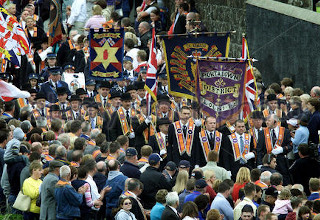
The Drumcree conflict or Drumcree standoff is a dispute over yearly Orange Order parades in the town of Portadown, County Armagh, Northern Ireland. The town is mainly Protestant and hosts numerous Protestant/loyalists marches each summer but has a significant Catholic minority. The Orange Order, a Protestant unionist organization, insists that it should be allowed to march its traditional route to and from Drumcree Church on the Sunday before The Twelfth. However, most of the route is through the mainly Catholic/Irish nationalist section of town. The residents, who see the march as sectarian, triumphalist and supremacist, seek to ban it from their area. The Orangemen see this as an attack on their traditions as they have marched the route since 1807, when the area was mostly farmland.
In 1995 and 1996, residents succeed in stopping the march. This leads to a standoff at Drumcree between the security forces and thousands of Orangemen/loyalists. Following a wave of loyalist violence, police allow the march through. In 1997, security forces lock down the Catholic area and let the march through, citing loyalist threats to kill Catholics if they are stopped. This sparks widespread protests and violence by Irish nationalists. From 1998 onward, the march is banned from Garvaghy Road and the army seals off the Catholic area with large steel, concrete and barbed wire barricades. Each year there is a major standoff at Drumcree and widespread loyalist violence. Since 2001 things have been relatively calm but moves to get the two sides into face-to-face talks have failed.
Early in 1998 the Public Processions (Northern Ireland) Act 1998 is passed, establishing the Parades Commission. The Commission is responsible for deciding what route contentious marches should take. On June 29, 1998, the Parades Commission decides to ban the march from Garvaghy Road.
On Friday, July 3, about 1,000 soldiers and 1,000 police are deployed in Portadown. The soldiers build large barricades made of steel, concrete and barbed wire across all roads leading into the nationalist area. In the fields between Drumcree Church and the nationalist area they dig a trench, fourteen feet wide, which is then lined with rows of barbed wire. Soldiers also occupy the Catholic Drumcree College, St. John the Baptist Primary School and some properties near the barricades.
On Sunday, July 5, the Orangemen march to Drumcree Church and state that they will remain there until they are allowed to proceed. About 10,000 Orangemen and loyalists arrive at Drumcree from across Northern Ireland. A loyalist group calling itself “Portadown Action Command” issues a statement which reads, “As from midnight on Friday 10 July 1998, any driver of any vehicle supplying any goods of any kind to the Gavaghy Road will be summarily executed.”
Over the next ten days, there are loyalist protests and violence across Northern Ireland in response to the ban. Loyalists block roads and attack the security forces as well as Catholic homes, businesses, schools and churches. On July 7, the mainly Catholic village of Dunloy is “besieged” by over 1,000 Orangemen. The County Antrim Grand Lodge says that its members have “taken up positions” and “held” the village. On July 8, eight blast bombs are thrown at Catholic homes in the Collingwood area of Lurgan. There are also sustained attacks on the security forces at Drumcree and attempts to break through the blockade. On July 9, the security forces at Drumcree are attacked with gunfire and blast bombs. They respond with plastic bullets. The police recorded 2,561 “public order incidents” throughout Northern Ireland.
On Sunday, July 12, brothers Jason (aged 8), Mark (aged 9) and Richard Quinn (aged 10) are burned to death when their home is petrol bombed by loyalists. The boys’ mother is a Catholic and their home is in a mainly-Protestant section of Ballymoney. Following the murders, William Bingham, County Grand Chaplain of Armagh and member of the Orange Order negotiating team, says that “walking down the Garvaghy Road would be a hollow victory, because it would be in the shadow of three coffins of little boys who wouldn’t even know what the Orange Order is about.” He says that the Order has lost control of the situation and that “no road is worth a life.” However, he later apologizes for implying that the Order is responsible for the deaths. The murders provoke widespread anger and calls for the Order to end its protest at Drumcree. Although the number of protesters at Drumcree drops considerably, the Portadown lodges vote unanimously to continue their standoff.
On Wednesday, July 15, the police begin a search operation in the fields at Drumcree. A number of loyalist weapons are found, including a homemade machine gun, spent and live ammunition, explosive devices, and two crossbows with more than a dozen homemade explosive arrows.




 seamus dubhghaill