seamus dubhghaill

Promoting Irish Culture and History from Little Rock, Arkansas, USA


Leave a comment

Birth of Edward Flanagan, Founder of Boys Town

Edward Joseph Flanagan, Irish-born priest of the Catholic Church in the United States, is born on July 13, 1886, in the townland of Leabeg, County Roscommon, near the village of Ballymoe, County Galway. He founds the orphanage known as Boys Town located in Boys Town, Douglas County, Nebraska, which now also serves as a center for troubled youth.

Flanagan is born to John and Honoria Flanagan. He attends Summerhill College, Sligo.

In 1904, Flanagan emigrates to the United States and becomes a U.S. citizen in 1919. He attends Mount St. Mary’s University in Emmitsburg, Maryland, where he receives a Bachelor of Arts degree in 1906 and a Master of Arts degree in 1908. He studies at Saint Joseph’s Seminary in Dunwoodie, Yonkers, New York. He continues his studies in Italy and at the University of Innsbruck in Austria where he is ordained a priest on July 26, 1912. His first parish is in O’Neill, Nebraska, where from 1912 he serves as an assistant pastor at St. Patrick’s Catholic Church. He then moves to Omaha, Nebraska, to serve as an assistant pastor at St. Patrick’s Church and later at St. Philomena’s Church.

In 1917, Flanagan founds a home for homeless boys in Omaha. Bishop Jeremiah James Harty of the Diocese of Omaha has misgivings but endorses Flanagan’s experiment. Because the downtown facilities are inadequate, he establishes Boys Town, ten miles west of Omaha in 1921. Under his direction, Boys Town grows to be a large community with its own boy-mayor, schools, chapel, post office, cottages, gymnasium, and other facilities where boys between the ages of 10 and 16 can receive an education and learn a trade.

Boys Town, a 1938 film starring Spencer Tracy based on Flanagan’s life, wins Tracy an Academy Award for Best Actor for his performance. Mickey Rooney also stars as one of the residents. Tracy spends his entire Oscar acceptance speech talking about Flanagan. Without confirming it with Tracy, an overzealous MGM publicity representative announces incorrectly that Tracy is donating his Oscar to Flanagan. The Academy of Motion Picture Arts and Sciences hastily strikes another inscription so Tracy keeps his statuette and Boys Town gets one as well. A sequel also starring Tracy and Rooney, Men of Boys Town, is released in 1941.

Flanagan himself appears in a separate 1938 MGM short, The City of Little Men, promoting Boys Town and giving a tour of its facilities. The actor Stephen McNally plays Flanagan in a 1957 episode of the ABC religion anthology series, Crossroads.

Flanagan receives many awards for his work with the delinquent and homeless boys. Pope Pius XI names him a Domestic Prelate with the title Right Reverend Monsignor in 1937. He serves on several committees and boards dealing with the welfare of children and is the author of articles on child welfare. Internationally known, he travels to the Republic of Ireland in 1946, where he is appalled by the children’s institutions there, calling them “a national disgrace.” When his observations are published after returning to Omaha, instead of improving the horrid conditions, vicious attacks are leveled against him in the Irish print media and the Oireachtas. He is invited by General Douglas MacArthur to Japan and Korea in 1947 to advise on child welfare, as well as to Austria and Germany in 1948. While in Berlin, Germany, he dies of a heart attack on May 15, 1948. He is interred at Dowd Memorial Chapel of the Immaculate Conception Parish in Boys Town, Nebraska.

In 1986, the United States Postal Service issues a 4¢ Great Americans series postage stamp honoring Flanagan. He is a member of the Nebraska Hall of Fame.

On February 25, 2012, the Catholic Archdiocese of Omaha, Nebraska opens the canonization process of Flanagan. At a March 17, 2012 prayer service at Boys Town’s Immaculate Conception Church, he is given the title “Servant of God,” the first of three titles bestowed before canonization as a Catholic saint. The investigation is completed in June 2015 and the results forwarded to the Vatican. If the Vatican approves the local findings, Flanagan will be declared venerable. The next steps will be beatification and canonization.

There is a portrait statue dedicated to Fr. Edward J. Flanagan in Ballymoe, County Galway.


Leave a comment

Birth of Andrew Cooney, Irish Republican & Medical Doctor

Andrew Cooney, Irish republican and medical doctor, is born on April 22, 1897, in Ballyphillip, Nenagh, County Tipperary.

Cooney is the second of three children of John Cooney and Mary Ann Cooney (née Gleeson), middling farmers. While his grandfather, Patrick Cooney, from nearby Garrykennedy, is reputed to have been a member of the Irish Republican Brotherhood (IRB) and an Irish National Land League activist, his father does not have any inclination towards radical politics. He is educated at Lissenhall national school and St. Joseph’s CBS, Nenagh. In October 1916, he commences studies in medicine at University College Dublin (UCD) just as the Irish War of Independence is getting underway. He plays briefly with the College’s hurling club.

In 1917, Cooney joins the Third Battalion of the Dublin Brigade of the Irish Republican Army (IRA). A year later he is jailed for two months in Mountjoy Prison and Crumlin Road Gaol, Belfast, for illegal drilling. Joining the IRB at the end of 1918, he assists in the December 1918 election by protecting candidates and acts as a guard at sittings of the First Dáil. On June 26, 1920, he plays a major role in the attack on Borrisokane Royal Irish Constabulary (RIC) barracks. He takes part in the Bloody Sunday operations of November 21, 1920, at 28 Upper Pembroke Street where a number of British agents are killed and attends Croke Park afterwards. He then goes on the run as a full-time Volunteer and serves with the Dublin Brigade active service unit (ASU).

After the Anglo-Irish truce of July 1921, Cooney is appointed Officer Commanding (O/C) of the 1st Kerry Brigade, IRA, reorganising it and forming a flying column. Opposing the Anglo-Irish Treaty of 1921, he does not immediately break with GHQ, who sends him to organise the 1st Eastern Division. Later in January 1922, the Chief of Staff, Eoin O’Duffy, asks him to become O/C of the 3rd Eastern Division, but later rescinds the appointment. In March 1922 he is appointed O/C of the 1st Eastern Division of the anti-Treaty IRA during the Irish Civil War.

That same year he is captured by Free State forces and interned in Mountjoy Prison, where he becomes O/C of the prisoners in C Wing. He accepts responsibility for an attempted escape bid on October 10, 1922, in which a fellow prisoner, Peadar Breslin, is killed and another man is wounded. After sojourns in Newbridge and Arbour Hill Prison, he is moved with the other leaders to Kilmainham Gaol, where he spends forty-one days on hunger strike. Removed to Harepark Camp, the Curragh, on January 1, 1924, he is among the last to be released on May 29, 1924.

Cooney succeeds Frank Aiken as Chief of Staff of the IRA on November 18, 1925. Central to the reorganisation scheme he puts in place is the need to secure American funds for the IRA and to combat Frank Aiken’s fundraising work in the United States since December 1925 on behalf of the embryo Fianna Fáil organisation. Receiving permission on April 21, 1926, he departs on a fund-raising trip to the United States but returns to Ireland in October. He resigns as chief of staff in favour of Maurice Twomey but retains his position as chairman of the IRA executive until November 21, 1927, when he obtains leave to complete his medical studies.

After internship in the Mater Hospital, Dublin, Cooney finds temporary employment in London, but remains in touch with GHQ. On September 27, 1929, he marries the German-educated Frances (‘Frank’) Brady, daughter of a wealthy Belfast linen family and former Cumann na mBan activist and hunger-striker. The marriage is not a success. Failing to secure employment due to police harassment and the loyalty test then in force, he and his wife are obliged to emigrate to London, where he practises as a GP, still maintaining his IRA links. Their only child, Seán, is born there in 1931. He returns to Ireland in August 1932, after Fianna Fáil’s accession to power.

An intimate friend of Maurice Twomey, who is still Chief of Staff, Cooney remains in the upper echelons of the IRA and attends its conventions. Signifying his standing in republican circles, he is chosen to unveil, inter alia, the Fenian memorial in Glasnevin Cemetery and the Seán Treacy plaque in Talbot Street, Dublin, and is a regular speaker at commemorations. In March 1940, he attempts to intercede with Éamon de Valera on behalf of hunger-striking republicans, and is later arrested, but released.

After the discovery of a German spy ring in the hospitals commission’s subsidiary, the Dublin Hospitals Bureau, Cooney is forced to resign in April 1942 on refusing to take a loyalty pledge to the state. He returns to private practice. He becomes active in the unsuccessful campaign to save Charlie Kerins, Chief of Staff, from being hanged in 1944. In anticipation of emigrating, he finally resigns from the IRA in 1944, though military and police surveillance continue until March 1945.

In August 1945, Cooney joins the United Nations Relief and Rehabilitation Administration, working with displaced persons in the American zone in Germany, and gains rapid promotion. After joining the International Refugee Organisation (UNRRA’s successor) on July 1, 1947, he becomes the chief medical officer of an area including the American sector of Berlin and containing 150,000 displaced persons. He later holds a similar post in Bavaria.

Appointed a part-time member of the hospitals commission by the inter-party government in September 1949 and in severe financial straits, Cooney emigrates alone to the United States on December 2, 1950, and never returns. While employed in a tuberculosis sanatorium in New Jersey, he obtains by examination his licence to practise medicine in Maryland on January 14, 1954. Admitted a member of the American College of Chest Physicians, again by examination, on November 23, 1954, he secures, at the age of 57, his first ever permanent post in medicine, in a similar hospital in Pikesville, Maryland. His republican activities continue through Clan na Gael during his U.S. years, and he is a frequent speaker at commemorative events.

Cooney suffers a stroke in December 1961 that confines him to a wheelchair. He dies at the age of 71 on August 4, 1968, at Carroll County General Hospital, Carroll County, Maryland. He is buried in Youghalarra, Nenagh, County Tipperary.

(Pictured: Liam Lynch with some of his Divisional Staff and Officers of the Brigades, including the 1st Southern Division, who attend as delegates to the Army Convention at the Mansion House, Dublin, on April 9, 1922. Cooney is first on the right in the 3rd row back.)


Leave a comment

Baptism of Mary Harris “Mother” Jones, Union Organizer & Activist

Mary G. Harris Jones, known as Mother Jones, an Irish-born American schoolteacher and dressmaker who becomes a prominent union organiser, community organiser, and activist, is baptised on August 1, 1837, in Cork, County Cork. Her exact date of birth is uncertain. She is once deemed “the most dangerous woman in America” because of her union activities.

Jones is the daughter of Richard Harris, a Roman Catholic tenant farmer and railway labourer, and Ellen (née Cotter) Harris. She and her family are victims of the Great Famine, as are many other Irish families of the time. The famine forces more than a million families, including the Harrises, to immigrate to North America when she is ten years old. She lives in the United States and Canada, where she attends and later teaches in a Roman Catholic normal school in Toronto. In the United States she teaches in a convent school in Monroe, Michigan and works as a seamstress. In 1861 she marries George Jones, an iron-moulder and labour union member in Memphis, Tennessee. After the death of her husband and their four children in a yellow fever epidemic in 1867, she relocates to Chicago, Illinois, where she becomes involved with an early industrial union, the Knights of Labor. Her seamstress shop is destroyed in the Great Chicago Fire of 1871.

In the 1890s Jones becomes known as ‘Mother’ Jones and begins a long association with socialist causes and the United Mine Workers of America. She attends the founding convention of Social Democracy of America, later known as the Cooperative Brotherhood, in 1897 and in the same year organises support and publicity for striking bituminous coal miners in West Virginia, including a children’s march and parades of farmers delivering food to the miners’ camp. These types of defiant mass action become her trademark. Notable activities include organising women in support of an 1899 anthracite coal strike in eastern Pennsylvania, directing strikes of young women working in textile mills, a 1903 ‘children’s crusade’ against child labour which includes a ninety-mile march from Philadelphia to New York City, participating in 1905 in the founding convention of the Industrial Workers of the World, a radical labour union committed to the organisation of unskilled workers, campaigning for the release of Mexican revolutionaries imprisoned in American jails, and testifying in 1915 in congressional hearings against the abuse of corporate power by Rockefeller interests.

Jones reportedly meets with James Connolly, Irish socialist and labour organiser, in New York City in 1910. She is arrested for the first time for violating a federal injunction during a miners’ strike in West Virginia in 1902. In 1904, during a Colorado miners’ campaign, she has to avoid the authorities to escape possible deportation. During a 1914 strike in Ludlow, Colorado, she is imprisoned without trial for nine weeks. In 1919 she is arrested in Pennsylvania during a steelworkers’ strike for defending freedom of speech and the right of workers to organise unions. She remains active in the labour movement and radical causes into her nineties.

During her later years, Jones lives with her friends Walter and Lillie May Burgess on their farm in what is now Adelphi, Maryland. She celebrates her self-proclaimed 100th birthday there on May 1, 1930, and is filmed making a statement for a newsreel.

Jones dies on November 30, 1930, at the Burgess farm then in Silver Spring, Maryland, though now part of Adelphi. There is a funeral Mass at St. Gabriel’s in Washington, D.C. She is buried in the Union Miners Cemetery in Mount Olive, Illinois, alongside miners who died in the 1898 Battle of Virden.

In 1932, about 15,000 Illinois mine workers gather in Mount Olive to protest against the United Mine Workers, which soon becomes the Progressive Mine Workers of America. Convinced that they have acted in the spirit of Mother Jones, the miners decide to place a proper headstone on her grave. By 1936, the miners have saved up more than $16,000 and are able to purchase “eighty tons of Minnesota pink granite, with bronze statues of two miners flanking a twenty-foot shaft featuring a bas-relief of Mother Jones at its center.” On October 11, 1936, also known as Miners’ Day, an estimated 50,000 people arrive at Mother Jones’s grave to see the new gravestone and memorial. Since then, October 11 is not only known as Miners’ Day but is also referred to and celebrated in Mount Olive as “Mother Jones’s Day.”

The farm where she died begins to advertise itself as the “Mother Jones Rest Home” in 1932, before being sold to a Baptist church in 1956. The site is now marked with a Maryland Historical Trust marker, and a nearby elementary school is named in her honor.


Leave a comment

Birth of Michael Kelly Lawler, United States Army Officer

Michael Kelly Lawler, a volunteer militia soldier in the Black Hawk War (1831–32), an officer in the United States Army in both the Mexican–American War and the American Civil War, is born on November 16, 1814, in Monasterevin, County Kildare. As a brigadier general in the American Civil War, he commands a brigade of infantry in the Western Theater and serves in several battles.

Born to John Lawler and Elizabeth Kelly, they move to the United States four years later and settle initially in Frederick County, Maryland. In 1819, they move to rural Gallatin County, Illinois. On December 20, 1837, Lawler marries Elizabeth Crenshaw. He receives an appointment as a captain in the Mexican-American War and commands two companies in separate deployments to Mexico. He first leads a company from Shawneetown, Illinois that guards the supply route from Veracruz to General Winfield Scott‘s army. After the fall of Veracruz his company is discharged. He makes a visit to Washington after which he is asked by Illinois Governor Thomas Ford to organize a company of riflemen. He serves in the campaign to take Matamoros, Tamaulipas.

Lawler then returns to his farm in Illinois, where he is residing at the outbreak of the American Civil War. He establishes a thriving mercantile business, dealing in hardware, dry goods, and shoes. He studies law, passes his bar exam, and uses his legal license to help the claims of Mexican War veterans.

In May 1861 Lawler recruits the 18th Illinois Volunteer Infantry Regiment and is appointed as its first colonel. His time in command of the regiment in Kentucky and Tennessee is controversial and an “ordeal.” He is wounded during the Battle of Fort Donelson. In November 1862 he is commissioned as a brigadier general, and commands a brigade in the Second Division of the XIII Corps. He fights with distinction in the Vicksburg campaign in 1863. He leads his men in the battles of Port Gibson, Champion Hill, Big Black River Bridge, and the May 22, 1863, general assault on Vicksburg, Mississippi, where troops under his command are the only Union forces to enter the Confederate works at the Railroad Redoubt where they plant the United States flag.

Following the surrender of Jackson, Mississippi, the XIII Corps is split up and divided among other operations in the Western Theater. For the rest of the war, Lawler serves as commander of the 1st Division, XIII Corps in Louisiana in the Department of the Gulf, taking command of the division during the disastrous Red River campaign and leading it on an expedition in June 1864 to secure a crossing of the Atchafalaya River used by Confederate forces.

In the omnibus promotions at the end of the American Civil War, Lawler receives a promotion for distinguished service to major general in the Union army backdated from March 13, 1865. After mustering out of the army in 1866, he returns home and resumes his legal practice and farming near Shawneetown, Illinois.

Lawler dies in Shawneetown on July 22, 1882, and is buried in the Lawler Family Cemetery near Equality, Illinois, at the rear of the Old Slave House property.

A memorial to Lawler stands in Equality, Illinois. He also is honored with a marble bust in Vicksburg National Military Park in Vicksburg, Mississippi. Chicago renames a street to Lawler Avenue in his memory.


Leave a comment

Birth of Novelist F. Scott Fitzgerald

Francis Scott Key Fitzgerald, American novelist, essayist, short story and screenwriter, is born into an Irish Catholic family on September 24, 1896, in Saint Paul, Minnesota. He is best known for his novels depicting the flamboyance and excess of the Jazz Age, a term he popularized. During his lifetime, he publishes four novels, four collections of short stories, and 164 short stories. Although he achieves temporary popular success and fortune in the 1920s, he receives critical acclaim only after his death and is now widely regarded as one of the greatest American writers of the 20th century.

The son of middle-class Irish Catholics Edward and Mary McQuillan Fitzgerald, Fitzgerald is raised primarily in New York. He attends Princeton University but owing to a failed relationship with socialite Ginevra King and a preoccupation with writing, he drops out in 1917 to join the United States Army. While stationed in Alabama, he romances Zelda Sayre, a Southern debutante who belongs to Montgomery‘s exclusive country-club set. Although she rejects Fitzgerald initially, because of his lack of financial prospects, she agrees to marry him after he publishes the commercially successful This Side of Paradise (1920). The novel becomes a cultural sensation and cements his reputation as one of the eminent writers of the decade.

Fitzgerald’s second novel, The Beautiful and Damned (1922), propels him further into the cultural elite. To maintain his affluent lifestyle, he writes numerous stories for popular magazines such as The Saturday Evening Post, Collier’s: The National Weekly, and Esquire. During this period, he frequents Europe, where he befriends modernist writers and artists of the “Lost Generation” expatriate community, including Ernest Hemingway. His third novel, The Great Gatsby (1925), receives generally favorable reviews but is a commercial failure, selling fewer than 23,000 copies in its first year. Despite its lackluster debut, The Great Gatsby is now widely praised, with some labeling it the “Great American Novel.” Following the deterioration of his wife’s mental health and her placement in a mental institute for schizophrenia, he completes his final novel, Tender Is the Night (1934).

Struggling financially because of the declining popularity of his works amid the Great Depression, Fitzgerald turns to Hollywood, writing and revising screenplays. While living in Hollywood, he cohabits with columnist Sheilah Graham, his final companion before his death. After a long struggle with alcoholism, he attains sobriety only to die of a heart attack on December 21, 1940, at the age of 44. His friend Edmund Wilson completes and publishes an unfinished fifth novel, The Last Tycoon (1941), after Fitzgerald’s death.

At the time of his death, the Roman Catholic Church denies the family’s request that Fitzgerald, a non-practicing Catholic, be buried in the family plot in the Catholic St. Mary’s Cemetery in Rockville, Maryland. He is buried instead with a simple Protestant service at Rockville Union Cemetery. When Zelda Fitzgerald dies in a fire at the Highland Mental Hospital in 1948, she is originally buried next to him at Rockville Union. In 1975, Fitzgerald’s daughter Scottie successfully petitions to have the earlier decision revisited, and her parents’ remains are moved to the family plot in Saint Mary’s.


Leave a comment

Death of Oliver Bond, Member of the Society of United Irishmen

Oliver Bond, Irish merchant and a member of the Leinster directorate of the Society of United Irishmen, dies in prison in Dublin on September 6, 1798 following the Irish Rebellion of 1798.

Born in St. Johnston, County Donegal around 1760, Bond is the son of a dissenting minister and is connected with several respectable families. In his early years, he works as an apprentice haberdasher in Derry before relocating to Dublin.

In the capital, Bond is in business as a merchant in the woollen trade, and becomes wealthy. Initially, he is based in Pill Lane (now Chancery Street), before moving to 9 Lower Bridge Street in 1786. In 1791, he marries Eleanor ‘Lucy’ Jackson, daughter of the iron founder Henry Jackson, who like Bond is to become a leading United Irishman.

Bond is an early member in the movement planning for a union in Ireland across religious lines to press for reform of the Parliament of Ireland and for an accountable government independent of the Privy Council of the United Kingdom and cabinet. When, following the Belfast example, the Society of United Irishmen forms in Dublin in November 1791, Bond becomes a member.

Bond is secretary of the meeting, with the barrister Simon Butler presiding, when in February 1793 the society passes resolutions which, in addition to the call for Catholic emancipation and parliamentary reform, condemn as unconstitutional the repressive measures of the government, and deplore war against the new French Republic. A result is a summons to appear before the bar of the Irish House of Lords in Dublin where, in consequence of the their defiant performance, Bond and Butler are charged and convicted of libel, fined and confined for six months in Newgate Prison.

Despairing of their efforts to secure full emancipation and advance parliamentary reform, and in anticipation of French assistance, the United Irishmen resolve on an insurrection to depose the Crown‘s Dublin Castle executive and the Protestant Ascendancy Lords and Commons, and to establish Ireland as an independent republic. Bond becomes a member of the United Irishmen’s northern executive committee and of the Leinster directorate, the meetings of which are generally held at his house on Lower Bridge Street.

There, on February 19, 1798, the famous resolution is passed: “We will pay no attention to any measure which the Parliament of this kingdom may adopt, to divert the public mind from the grand object we have in view; as nothing short of the entire and complete regeneration of our country can satisfy us.”

Through the treachery of Thomas Reynolds, Bond’s house is surrounded by military on the morning of March 12, 1798, and fourteen members of the Leinster Directory are seized. The insurrection goes forward in their absence to defeat in the early summer. Following suppression of the rebellion, Bond goes to trial. The efforts of his defence counsel, John Philpot Curran, to discredit Reynold’s testimony are unavailing. On July 27, 1798, Bond is convicted of treason and sentenced to hang.

It is mainly to prevent Bond’s execution that Thomas Addis Emmet and other state prisoners enter a compact with government whereby (without incriminating further individuals) they agree to testify on the activities of Union Irishmen before a parliamentary committee, and to accept permanent exile. With the endorsement of Charles Cornwallis, 1st Marquess Cornwallis, the Commander-in-Chief, Ireland, Bond’s sentence is commuted. He survives, however, but five weeks, dying in prison of apoplexy at the age of 36 on September 6, 1798.

Bond is buried in the cemetery of St. Michan’s Church, Dublin. The “enlightened republican” principles of Bond are eulogised by his political associate and fellow-prisoner, William James MacNeven. Bond’s widow Lucy moves with her family from Ireland to the United States, and dies in Baltimore, Maryland in 1843.

The Oliver Bond flats in The Liberties area of Dublin are named after him.


Leave a comment

Death of Frank Harte, Traditional Irish Singer

Frank Harte, traditional Irish singer, music collector, architect and lecturer, dies of a heart attack on June 27, 2005.

Harte is born in Chapelizod, County Dublin on May 14, 1933. He emigrates to the United States for a short period, but later returns to Ireland where he works as an architect, lecturer at Dublin Institute of Technology in Rathmines, Dublin and in later life fully engages in songs in many ways.

Harte’s introduction to Irish traditional singing comes from a chance listening to an itinerant who is selling ballad sheets at a fair in Boyle, County Roscommon. He begins collecting early in life and by the end of his life has assembled a database of over 15,500 recordings.

Harte becomes a great exponent of the Dublin street ballad, which he prefers to sing unaccompanied. He is widely known for his distinctive singing, his Dublin accent having a rich nasal quality complementing his often high register. His voice mellows considerably by the time of his later recordings, allowing for an expressive interpretation of many love songs such as “Bonny Light Horseman” on the album My Name is Napoleon Bonaparte. This is contrasted sublimely by his cogent interpretation of the popular “Molly Malone.” He also becomes more accustomed to singing with accompaniment which is not strictly part of the Irish singing tradition and does not come naturally to him.

Though Irish Republican in his politics, Harte believes that the Irish song tradition need not be a sectarian or nationalist preserve. He believes that songs are a key to understanding the past often saying, “those in power write the history, while those who suffer write the songs, and, given our history, we have an awful lot of songs.” Though considered a stalwart of traditional Irish singing and well aware of it, he does not consider himself to be a sean-nós singer.

Harte wins the All-Ireland Fleadh Cheoil singing competition on a number of occasions and in 2003 receives the Traditional Singer of the Year award from the Irish-language television channel TG4.

Harte records several albums and makes numerous television and radio appearances, most notably the Singing Voices series he writes and presents for RTÉ Radio, which is produced by Peter Browne in 1987. He is a regular at the Sunday morning sessions at The Brazen Head pub, along with Liam Weldon who runs the session. He is also an enthusiastic supporter of An Góilín Traditional Singer’s Club.

Harte appears at many American festivals including The Blarney Star in New York City, Gaelic Roots in Boston College, The Catskills Irish Arts Week, The Greater Washington Ceili Club Festival in Maryland and the Milwaukee Irish Fest and for seventeen years he is a veritable staple at the Irish Week every July in the Augusta Heritage Festival in Elkins, West Virginia where he often performs with Mick Moloney.

Frank Harte dies of a heart attack, aged 72, on June 27, 2005. His influence is still evident in singers such as Karan Casey and he continues to be remembered fondly in sessions and folk clubs on both sides of the Irish Sea.


Leave a comment

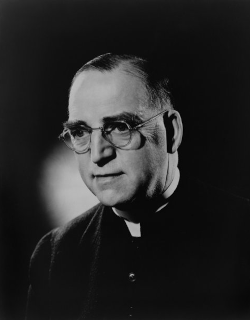
Death of Fr. Edward J. Flanagan, Founder of Boys Town

Edward Joseph Flanagan, Irish-born priest of the Catholic Church in the United States, dies in Berlin, Germany on May 15, 1948. He founds the orphanage known as Boys Town located in Boys Town, Douglas County, Nebraska, which now also serves as a center for troubled youth.

Flanagan is born to John and Honoria Flanagan in the townland of Leabeg, County Roscommon, near the village of Ballymoe, County Galway, on July 13, 1886. He attends Summerhill College, Sligo.

In 1904, Flanagan emigrates to the United States and becomes a US citizen in 1919. He attends Mount St. Mary’s University in Emmitsburg, Maryland, where he receives a Bachelor of Arts degree in 1906 and a Master of Arts degree in 1908. He studies at Saint Joseph’s Seminary in Dunwoodie, Yonkers, New York. He continues his studies in Italy and at the University of Innsbruck in Austria where he is ordained a priest on July 26, 1912. His first parish is in O’Neill, Nebraska, where from 1912 he serves as an assistant pastor at St. Patrick’s Catholic Church. He then moves to Omaha, Nebraska, to serve as an assistant pastor at St. Patrick’s Church and later at St. Philomena’s Church.

In 1917, Flanagan founds a home for homeless boys in Omaha. Bishop Jeremiah James Harty of the Diocese of Omaha has misgivings but endorses Flanagan’s experiment. Because the downtown facilities are inadequate, he establishes Boys Town, ten miles west of Omaha in 1921. Under his direction, Boys Town grows to be a large community with its own boy-mayor, schools, chapel, post office, cottages, gymnasium, and other facilities where boys between the ages of 10 and 16 can receive an education and learn a trade.

Boys Town, a 1938 film starring Spencer Tracy based on Flanagan’s life, wins Tracy an Academy Award for Best Actor for his performance. Mickey Rooney also stars as one of the residents. Tracy spends his entire Oscar acceptance speech talking about Flanagan. Without confirming it with Tracy, an overzealous MGM publicity representative announces incorrectly that Tracy is donating his Oscar to Flanagan. The Academy of Motion Picture Arts and Sciences hastily strikes another inscription, so Tracy keeps his statuette and Boys Town gets one as well. A sequel also starring Tracy and Rooney, Men of Boys Town, is released in 1941.

Flanagan himself appears in a separate 1938 MGM short, The City of Little Men, promoting Boys Town and giving a tour of its facilities. The actor Stephen McNally plays Flanagan in a 1957 episode of the ABC religion anthology series, Crossroads.

Flanagan receives many awards for his work with the delinquent and homeless boys. Pope Pius XI names him a Domestic Prelate with the title Right Reverend Monsignor in 1937. He serves on several committees and boards dealing with the welfare of children and is the author of articles on child welfare. Internationally known, he travels to the Republic of Ireland in 1946, where he is appalled by the children’s institutions there, calling them “a national disgrace.” When his observations are published after returning to Omaha, instead of improving the horrid conditions, vicious attacks are leveled against him in the Irish print media and the Oireachtas. He is invited by General Douglas MacArthur to Japan and Korea in 1947 to advise on child welfare, as well as to Austria and Germany in 1948. While in Germany, he dies of a heart attack on May 15, 1948. He is interred at Dowd Memorial Chapel of the Immaculate Conception Parish in Boys Town, Nebraska.

In 1986, the United States Postal Service issues a 4¢ Great Americans series postage stamp honoring Flanagan. He is a member of the Nebraska Hall of Fame.

On February 25, 2012, the Catholic Archdiocese of Omaha, Nebraska opens the canonization process of Flanagan. At a March 17, 2012 prayer service at Boys Town’s Immaculate Conception Church, he is given the title “Servant of God,” the first of three titles bestowed before canonization as a Catholic saint. The investigation is completed in June 2015 and the results forwarded to the Vatican. If the Vatican approves the local findings, Flanagan will be declared venerable. The next steps will be beatification and canonization.

There is a portrait statue dedicated to Fr. Edward J. Flanagan in Ballymoe, County Galway.

Leave a comment

Death of Fr. Abram Joseph Ryan, Poet & Priest

Abram Joseph Ryan, Irish American poet, active proponent of the Confederate States of America, and a Catholic priest, dies in Louisville, Kentucky on April 22, 1886. He has been called the “Poet-Priest of the South” and, less frequently, the “Poet Laureate of the Confederacy.”

Ryan is born Matthew Abraham Ryan in Hagerstown, Maryland on February 5, 1838, the fourth child of Irish immigrants Matthew Ryan and his wife, Mary Coughlin, both of Clogheen, County Tipperary, and their first to be born in the United States.

In 1840 the family relocates to Ralls County, Missouri, and then, in 1846, to St. Louis, where the father opens a general store. Ryan is educated at St. Joseph’s Academy, run by the De La Salle Brothers. Showing a strong inclination to piety, he is encouraged by his mother and teachers to consider becoming a priest. He decides to test a calling to the priesthood and on September 16, 1851, at the age of 13, enters the College of St. Mary’s of the Barrens, near Perryville, Missouri, a minor seminary for young candidates for the priesthood. By the time of his graduation in 1855, he has decided to pursue Holy Orders.

Ryan then enters the Vincentians, taking the oath of obedience to the Congregation. He does three more years of study at the college during the course of which, on June 19, 1857, he receives minor orders. In 1858, shortly after the death of his father, he is sent to the Seminary of Our Lady of the Angels near Niagara Falls, New York.

As a Southerner, Ryan feels out of place at the seminary, and soon begins to express his opposition to the abolitionist movement then gaining popularity in the Northeastern United States. He then joins in the sentiment expressed by the Catholic bishops and editors of the nation in that period, who feel threatened by the anti-Catholic opinions expressed by the leadership of the Abolitionists. His writings in that period begin to express suspicion of Northern goals. Possibly for that reason, he is sent back to St. Mary of the Barrens.

During the winter of 1860, Ryan gives a lecture series through which he starts to gain notice as a speaker. His abilities as a preacher gain wide approval, and his superiors decide to have him ordained a priest earlier than is the normal age under church law. On September 12, 1860, he is ordained a priest at his home parish in St. Louis, with the ordination being performed by the Bishop of St. Louis, Peter Richard Kenrick.

In the Fall of 1861, soon after the start of the American Civil War, Ryan is transferred back to the Seminary of Our Lady of the Angels in New York. After a couple of bouts of illness, he declares himself fit to teach again in April 1862, but his superiors instead transfer him to parish duties in LaSalle, Illinois. After arriving there, he realizes that he will not be able to express his strong views in support of the Confederacy. Frustrated, and feeling ignored by his immediate superior, he requests his release from his oath of obedience. Upon his release he returns home, where he and his brother David intend to enlist in the Confederate States Army.

Ryan makes sporadic early appearances as a freelance chaplain among Confederate troops from Louisiana and begins making appearances in Tennessee in 1862. He begins full-time pastoral duties in Tennessee in late 1863 or early 1864. Though he never formally joins the Confederate Army, he clearly is serving as a freelance chaplain by the last two years of the conflict, with possible appearances at the Battle of Lookout Mountain and the Battle of Missionary Ridge near Chattanooga, and well-authenticated service at the Battle of Franklin and the subsequent Battle of Nashville. Some of his most moving poems —”In Memoriam” and “In Memory of My Brother”— come in response to his brother’s death, who died while serving in uniform for the Confederacy in April 1863, likely from injuries suffered during fighting near Mount Sterling, Kentucky.

On June 24, 1865, Ryan’s most famous poem, “The Conquered Banner,” appears in the pages of the New York Freeman’s Journal over his early penname “Moina.” Starting in 1865, he moves from parish to parish throughout the South. Beginning in November 1881 he spends a year in semi-retirement at Biloxi, Mississippi while completing his second book, A Crown for Our Queen. In Augusta, Georgia, he founds The Banner of the South, a religious and political weekly in which he republishes much of his early poetry, along with poetry by fellow-southerners James Ryder Randall, Paul Hamilton Hayne, and Sidney Lanier, as well as an early story by Mark Twain.

In 1879, Ryan’s work is gathered into a collected volume of verse, first titled Father Ryan’s Poems and subsequently republished in 1880 as Poems: Patriotic, Religious, Miscellaneous. His collection sells remarkably well for the next half-century. His work also finds a popular following in his family’s ancestral home of Ireland. An article about his work appears in Irish Monthly during his life, and a decade after his death, yet another collection of his poetry is published in Dublin by The Talbot Press under the title Selected Poems of Father Abram Ryan.

In 1880 Ryan’s old restlessness returns, and he heads north for the twofold object of publishing his poems and lecturing. He dies April 22, 1886, at a Franciscan friary in Louisville, Kentucky, but his body is returned to St. Mary’s in Mobile, Alabama for burial. He is interred in Mobile’s Catholic Cemetery. In recognition of his loyal service to the Confederacy, a stained-glass window is placed in the Confederate Memorial Hall in New Orleans in his memory. In 1912 a local newspaper launches a drive to erect a statue to him. Dedicated in July 1913, it includes a stanza from “The Conquered Banner” below an inscription that reads: “Poet, Patriot, and Priest.”


Leave a comment

Death of Thomas Fitzsimons, U.S. Merchant & Statesman

thomas-fitzsimons

Thomas Fitzsimons, American merchant and statesman of Philadelphia, Pennsylvania, dies in Philadelphia on August 26, 1811. He represents Pennsylvania in the Continental Congress, the Constitutional Convention and the United States House of Representatives.

Fitzsimons is born in Ireland in 1741. In the mid-1750s his family immigrates to Philadelphia, where his father dies soon thereafter. He has enough education that he begins work as a clerk in a mercantile house. He marries Catherine Meade on November 23, 1761 and forms a business partnership with her brother George. Their firm, which specializes in the West Indies trade, operates successfully for over 41 years.

The firm is soon hit by the new revenue measures created to help support the finances of the British Empire, including the much reviled Stamp Act of 1765. Concerned with these ideas, Fitzsimons becomes active in the Irish merchant community in Philadelphia. He is a founding member of the Friendly Sons of St. Patrick in 1771 and later, in 1774, a steering committee organized to protest the Coercive Acts.

When Pennsylvania begins mobilizing and organizing a militia to fight the British, Fitzsimons is soon involved. He serves as captain of a company of home guards under the command of Colonel John Caldwalader. Initially his company serves as part of the soldiers who man posts along the New Jersey coast. His unit later serves as part of the reserve at the Battle of Trenton in 1776. Later in the war, he serves on the Pennsylvania Council of Safety and heads a board to oversee the newly formed Pennsylvania Navy.

Fitzsimons enters active politics as a delegate to the Continental Congress in 1782 and 1783. He is a member of the Pennsylvania House of Representatives from 1786 until 1795. He is also a delegate to the U.S. Constitutional Convention in 1787. Although not a leading member of that convention, he supports a strong national government, the end of slavery, the United States Congress‘s powers to impose a tariff on imports and exports, the granting the House of Representatives, and power in equal to the United States Senate in making treaties. He is one of only two Catholic signers of the Constitution of the United States, the other being Daniel Carroll of Maryland.

After the Constitution is established, Fitzsimons serves in the first three sessions of the House of Representatives as a Federalist, where he favors protective tariffs and a strong navy, co-drafting the Naval Act of 1794 authorizing the original six frigates of the United States Navy. He fails to win re-election in 1794. This was partially attributed to public opinion turning against the Federalist Party over the forceful suppression of the Whiskey Rebellion. Although he never holds elective office again, he serves in 1798 as head of the committee of merchants overseeing the subscription-loan to build a warship at private expense for use in the Quasi-War.

In 1796, Fitzsimons, along with James Innes of Virginia, is appointed by President John Adams to serve as one of two American members on the five-man debt commission charged under Article VI of the Jay Treaty with examining the claims of British subjects unable to collect debts incurred by Americans prior to the American Revolution. Fitzsimons, Innes and Samuel Sitgreaves, who replaces Innes upon the latter’s death, become annoyed with the arguments used by their British counterparts to inflate the claims total. Fitzsimons and Sitgreaves angrily and permanently secede from the board in July 1799. The claims are eventually disposed of by a lump-sum payment, agreed upon by United States Minister to Britain Rufus King with British Foreign Secretary Robert Banks Jenkinson and approved by President Thomas Jefferson and the Senate in 1802.

While withdrawing from politics, Fitzsimons remains active in civic and business affairs. He serves as president of Philadelphia’s Chamber of Commerce, as a trustee of the University of Pennsylvania, Director of the Delaware Insurance Company and a director of the Bank of North America from 1781–1803. He is a founder of the bank and supports efforts to found Georgetown College. He also helps found the Insurance Company of North America.

Fitzsimons dies on August 26, 1811, in Philadelphia, where he is buried in the cemetery of St. Mary’s Roman Catholic Church, which is in present-day Independence National Historical Park.