seamus dubhghaill

Promoting Irish Culture and History from Little Rock, Arkansas, USA


Leave a comment

Birth of Engineer John Philip Holland

john-philip-holland

John Philip Holland, Irish engineer who develops the first submarine to be formally commissioned by the U.S. Navy, and the first Royal Navy submarine, HMS Holland 1, is born on February 24, 1841.

Holland, the second of four siblings, all boys, is born in a coastguard cottage in Liscannor, County Clare, where his father, John Philip Holland, Sr., is a member of the British Coastguard Service. His mother, a native Irish speaker from Liscannor, Máire Ní Scannláin, is John Holland’s second wife. His first wife, Anne Foley Holland, believed to be a native of Kilkee, dies in 1835. The area is heavily Irish-speaking and Holland learns English properly only when he attends the local English-speaking St. Macreehy’s National School, and from 1858, in the Christian Brothers in Ennistymon.

Holland joins the Irish Christian Brothers in Limerick and teaches in CBS Sexton Street in Limerick and many other centres in the country, including North Monastery CBS in Cork, St. Joseph’s CBS in Drogheda, and as the first Mathematics teacher in Coláiste Rís in Dundalk. Due to ill health, he leaves the Christian Brothers in 1873 and emigrates to the United States. Initially working for an engineering firm, he returns to teaching again for an additional six years in St. John’s Catholic school in Paterson, New Jersey.

While a teacher in Cork, Holland reads an account of the battle between the ironclads USS Monitor and USS Merrimack in the Battle of Hampton Roads during the American Civil War. He realizes that the best way to attack such ships would be through an attack beneath the waterline. He draws a design, but when he attempts to obtain funding, he is turned away. After his arrival in the United States, Holland slips and falls on an icy Boston street and breaks a leg. While recuperating from the injury in a hospital, he uses his time to refine his submarine designs and is encouraged by a priest, Isaac Whelan.

In 1875, his first submarine designs are submitted for consideration by the U.S. Navy, but are turned down as unworkable. The Fenians, however, continue to fund Holland’s research and development expenses at a level that allows him to resign from his teaching post. In 1881, Fenian Ram is launched, but soon after, Holland and the Fenians part company on bad terms over the issue of payment within the Fenian organization, and between the Fenians and Holland. The submarine is now preserved at Paterson Museum in New Jersey.

Holland continues to improve his designs and works on several experimental boats, prior to his successful efforts with a privately built type, launched on May 17, 1897. This is the first submarine having power to run submerged for any considerable distance, and the first to combine electric motors for submerged travel and gasoline engines for use on the surface. The submarine is purchased by the U.S. Navy on April 11, 1900, after rigorous tests and is commissioned on October 12, 1900 as USS Holland (SS-1). Six more of her type are ordered and built at the Crescent Shipyard in Elizabeth, New Jersey. The company that emerges from under these developments is called The Electric Boat Company, founded on February 7, 1899. Isaac Leopold Rice becomes the company’s first President with Elihu B. Frost acting as vice president and chief financial officer. The company eventually evolves into the major defense contractor General Dynamics.

The USS Holland design is also adopted by others, including the Royal Navy in developing the Holland-class submarine. The Imperial Japanese Navy employs a modified version of the basic design for their first five submarines, although these submarines are at least 10 feet longer at about 63 feet. These submarines are also developed at the Fore River Ship and Engine Company in Quincy, Massachusetts. Holland also designs the Holland II and Holland III prototypes. The Royal Navy ‘Holland 1’ is on display at the Submarine Museum in Gosport, England.

After spending 56 of his 73 years working with submersibles, John Philip Holland dies on August 12, 1914 in Newark, New Jersey. He is interred at the Holy Sepulchre Cemetery in Totowa, New Jersey.


Leave a comment

Evacuation of the Blasket Islands

blasket-islandsThe remaining human inhabitants of the Blasket Islands, a group of islands off the west coast of Ireland forming part of County Kerry, are evacuated to the mainland on November 17, 1953.
The Blasket Islands are inhabited until 1953 by a completely Irish-speaking population, and today are part of the Gaeltacht. Sadly, the Blasket Island community declines as a result of the persistent emigration of its young people. The last twenty-two inhabitants are forcefully evacuated by the government to the mainland on November 17, 1953, after the Irish government decides that it can no longer guarantee the safety of the remaining population. Many of the descendants currently live in Springfield, Massachusetts, and some former residents still live on the Dingle Peninsula, within sight of their former home.

The islanders are the subject of much anthropological and linguistic study around the end of the 19th and beginning of the 20th centuries particularly from writers and linguists such as Robin Flower, George Derwent Thomson, and Kenneth H. Jackson. Thanks to their encouragement and that of others, a number of books are written by islanders that record much of the islands’ traditions and way of life. These include An tOileánach (The Islandman) by Tomás Ó Criomhthain, Peig by Peig Sayers, and Fiche Blian ag Fás (Twenty Years A-Growing) by Muiris Ó Súilleabháin.

The Great Blasket Island, the principal island of the Blaskets, remains uninhabited today, but visitors can travel by ferry over to this remote and wildly beautiful place and spend several hours or all day marvelling at its natural beauty and what remains of years of human endeavour.

The Blasket Islands have been called Next Parish America, based on the erroneous idea that the next parish west of the islands would be the United States. The actual next parish west of the Blasket Island would be located in Newfoundland and Labrador, Canada.


Leave a comment

Accused Witch Ann Glover is Hanged in Boston

ann-glover

Goodwife “Goody” Ann Glover is hanged by the Puritans in Boston on November 16, 1688. She is the last person to be hanged in Boston as a witch, although the Salem witch trials in nearby Salem, Massachusetts, occur primarily in 1692.

Glover is born in Ireland as a Roman Catholic although her birth date and much of her background information is unknown. During Oliver Cromwell‘s invasion of Ireland where he rounds up thousands of Irish and Scots, Glover and her husband are transported as indentured servants to Barbados to work on the sugar plantations. Her husband is executed in Barbados for refusing to renounce his Catholic faith. Historians do not know the context but, at his death, he says that his wife is a witch.

By 1680, Glover and her daughter are living in Boston where they work as housekeepers for John Goodwin. In the summer of 1688, 13-year-old Martha Goodwin accuses Glover’s daughter of stealing laundry. This causes Glover to have a fierce argument with Martha and the Goodwin children which then supposedly causes them to become ill and start acting strange. The doctor that is called suggests it is caused by witchcraft because he could not diagnose or heal the children.

Glover is arrested and tried for witchcraft. It is unclear whether she cannot speak English or just refuses to speak it. It is more likely that she simply does not know English. Instead, she speaks her native language, Irish, and Latin. Reverend Cotton Mather writes that Glover is “a scandalous old Irishwoman, very poor, a Roman Catholic and obstinate in idolatry.” At her trial it is demanded of her to say the Lord’s Prayer. She recites it in Irish and broken Latin, but since she has never learned it in English, she cannot recite it in English. There is a belief that if someone cannot recite the Lord’s Prayer then they are a witch. Her house is searched and “small images” or doll-like figures are found. When Mather is interrogating her, she supposedly says that she prays to a host of spirits and Mather takes this to mean that these spirits are demons. Two Puritan men who supposedly speak Irish say that she confessed to using them for witchcraft. The identity of these men and whether they actually speak Irish is unknown. Many of the accusations against Glover use spectral evidence, which cannot be proven. Cotton Mather visits Glover in prison where he says she supposedly engages in nighttime trysts with the devil and other evil spirits. It is considered that Glover might not be of sound mind and could possibly be mentally ill. Five of six physicians examine her and find her to be competent, so she is then pronounced guilty and put to death by hanging.

On November 16, 1688, Glover is hanged in Boston amid mocking shouts from the crowd. When she is taken out to be hanged, she says that her death will not relieve the children of their malady. There are several testaments of what her final words are. According to some, she says that the children will keep suffering because there are other witches besides her who have been involved with bewitching the children and when asked to name the other witches, she refuses. Another account says that Glover says that killing her will be useless because it is someone else that has bewitched the children. Either way, Ann Glover does believe in witches. A Boston merchant who knows her, Robert Calef, says that “Goody Glover was a despised, crazy, poor old woman, an Irish Catholic who was tried for afflicting the Goodwin children. Her behavior at her trial was like that of one distracted. They did her cruel. The proof against her was wholly deficient. The jury brought her guilty. She was hung. She died a Catholic.”

Three hundred years later in 1988, the Boston City Council proclaims November 16 as Goody Glover Day. She is the only victim of the witchcraft hysteria in the Massachusetts Bay Colony to receive such a tribute. Although Ann Glover’s accusations and death take place before the commonly known Salem Witch Trials, she is the first Catholic martyr in Massachusetts and becomes the basis for many of the cases in the 1692 Salem witch trials.


Leave a comment

Seamus Heaney Awarded Nobel Prize in Literature

seamus-heaney

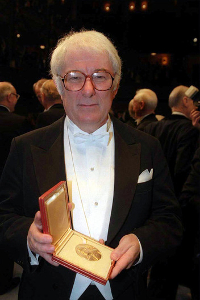
Seamus Heaney, poet, playwright, translator, and lecturer, is awarded the Nobel Prize in Literature on October 15, 1995.

Heaney is born in April 1939 near Castledawson, County Derry, Northern Ireland, where his family engages in farming and selling cattle. His education includes studies at Queen’s University Belfast, where he also serves as a lecturer in the late 1960s. He makes his debut as a poet then, but continues to divide his time between his own writing and academia. He works at Carysforth College in Dublin, at Harvard University in Cambridge, Massachusetts, and at Oxford University.

Heaney’s poetry is often down-to-earth. For him, poetry is like the earth – something that must be plowed and turned. Often he paints the gray and damp landscape from the British Isles. Peat moss has a special place in his poetry. The poems often are connected with daily experiences, but they also derive motifs from history, all the way back to prehistoric times. Heany’s profound interest in the Celtic and the pre-Christian as well as in Catholic literary tradition has found expression in a number of essays and translations.

Heaney is awarded the Nobel Prize in Literature in 1995 for what the Nobel committee describes as “works of lyrical beauty and ethical depth, which exalt everyday miracles and the living past.” He is on holiday in Greece with his wife, Marie, when the news breaks. No one, not even journalists or his own children, can locate him until he appears at Dublin Airport two days later, though an Irish television camera traces him to Kalamata. Asked how it feels having his name added to the Irish Nobel pantheon featuring William Butler Yeats, George Bernard Shaw, and Samuel Beckett, Heaney responds, “It’s like being a little foothill at the bottom of a mountain range. You hope you just live up to it. It’s extraordinary.” He and Marie are immediately whisked straight from the airport to Áras an Uachtaráin for champagne with President Mary Robinson.


Leave a comment

Death of Patrick Sarsfield Gilmore, Composer & Bandmaster

patrick-sarsfield-gilmore

Patrick Sarsfield Gilmore, Irish-born American composer and bandmaster, dies in St. Louis, Missouri, on September 24, 1892. He lives and works in the United States after 1848. While serving in the Union Army during the American Civil War, Gilmore writes the lyrics to the song When Johnny Comes Marching Home, the tune taken from the old Irish antiwar folk song, Johnny I Hardly Knew Ye. This is published under the name Louis Lambert.

Gilmore is born in Ballygar, County Galway, on December 25, 1829. He starts his music career at age fifteen and spends time in Canada with an English band. Already a fine cornet player, he settles in Boston, Massachusetts in 1848, becoming leader of the Suffolk, Boston Brigade, and Salem bands in swift succession. He also works in the Boston music store of John P. Ordway and founds Ordway’s Aeolians, a group of blackface minstrels. With the Salem Band, Gilmore performs at the 1857 inauguration of President James Buchanan.

In 1858, Gilmore founds “Gilmore’s Band,” and at the outset of the American Civil War the band enlists with the 24th Massachusetts Volunteers, accompanying General Ambrose Burnside to North Carolina. After the temporary discharge of bands from the field, Governor John Albion Andrew of Massachusetts entrusts Gilmore with the task of re-organizing military music-making. General Nathaniel P. Banks creates him Bandmaster-general.

When the war ends, Gilmore is asked to organize a celebration, which takes place in New Orleans. That success emboldens him to undertake two major music festivals in Boston, the National Peace Jubilee in 1869 and the World’s Peace Jubilee and International Musical Festival in 1872. These feature monster orchestras of massed bands with the finest singers and instrumentalists, including the only American appearance by “waltz king” Johann Strauss II, and cements Gilmore’s reputation as the leading musical figure of the age. Coliseums are erected for the occasions, holding 60- and 120,000 persons. Grateful Bostonians present Gilmore with medals and cash, but in 1873 he moves to New York City, as bandmaster of the 22nd Regiment. Gilmore takes this band on acclaimed tours of Europe.

On September 24, 1892, back in the United States preparing an 1892 musical celebration of the quadricentennial anniversary of Christopher Columbus‘ voyage of discovery, Gilmore collapses and dies in St. Louis. He is buried in Calvary Cemetery, Queens, New York, where his wife is later interred.

In many ways Gilmore can be seen as the principal figure in 19th-century American music. He holds the first “Promenade Concert in America” in 1855, the forerunner to today’s Boston Pops. He sets up “Gilmore’s Concert Garden,” which becomes Madison Square Garden. He is the Musical Director of the Nation in effect, leading the festivities for the 1876 Centennial celebrations in Philadelphia and the dedication of the Statue of Liberty in 1886. In 1888 he starts the tradition of seeing in the New Year in Times Square.

Patrick Sarsfield Gilmore is inducted into the Songwriters Hall of Fame in 1970.


Leave a comment

Death of General Philip Henry Sheridan

philip-sheridan

Irish American General Philip Henry Sheridan, career United States Army officer and a Union general in the American Civil War, dies of heart disease in Dartmouth, Massachusetts, on August 5, 1888.

Sheridan is born in Albany, New York, the third child of six by John and Mary Meenagh Sheridan, immigrants from the parish of Killinkere, County Cavan. Fully grown, he reaches only 5 feet 5 inches in height, a stature that leads to the nickname “Little Phil.” Abraham Lincoln describes his appearance in a famous anecdote, “A brown, chunky little chap, with a long body, short legs, not enough neck to hang him, and such long arms that if his ankles itch, he can scratch them without stooping.”

Sheridan’s career is noted for his rapid rise to major general and his close association with General-in-chief Ulysses S. Grant, who transfers Sheridan from command of an infantry division in the Western Theater to lead the Cavalry Corps of the Army of the Potomac in the East. In 1864, he defeats Confederate forces in the Shenandoah Valley and his destruction of the economic infrastructure of the Valley, called “The Burning” by residents, is one of the first uses of scorched earth tactics in the war. In 1865, his cavalry pursues General Robert E. Lee and is instrumental in forcing his surrender at Appomattox Court House.

In later years, Sheridan fights in the Indian Wars of the Great Plains. Comanche Chief Tosahwi reputedly tells Sheridan in 1869, “Me, Tosahwi; me good Injun,” to which Sheridan supposedly replies, “The only good Indians I ever saw were dead.” Sheridan denies he had ever made the statement. Biographer Roy Morris Jr. states that, nevertheless, popular history credits Sheridan with saying “The only good Indian is a dead Indian.” This variation “has been used by friends and enemies ever since to characterize and castigate his Indian-fighting career.” In Bury My Heart at Wounded Knee, Dee Brown attributes the quote to Sheridan but does not provide documentation to support his contention, so the quote may be more apocryphal than real.

Both as a soldier and private citizen, Sheridan is instrumental in the development and protection of Yellowstone National Park. The protection of the Yellowstone area is Sheridan’s personal crusade. He authorizes Lieutenant Gustavus Doane to escort the Washburn Expedition in 1870 and for Captain John W. Barlow to escort the Hayden Expedition in 1871. Barlow names Mount Sheridan, a peak overlooking Heart Lake in Yellowstone, for the general in 1871. As early as 1875, Sheridan promotes military control of the area to prevent the destruction of natural formations and wildlife.

In 1883, Sheridan is appointed general-in-chief of the U.S. Army, and in 1888 he is promoted to the rank of General of the Army during the term of President Grover Cleveland. Sheridan serves as the ninth president of the National Rifle Association.

Sheridan suffers a series of massive heart attacks two months after sending his memoirs to the publisher. After his first heart attack, the U.S. Congress quickly passes legislation to promote him to general and he receives the news from a congressional delegation with joy, despite his pain. His family moves him from the heat of Washington, D.C. and he dies of heart failure in his summer cottage in the Nonquitt section of Dartmouth, Massachusetts.

His body is returned to Washington, and he is buried on a hillside facing the capital city near Arlington House in Arlington National Cemetery. The burial helps elevate Arlington to national prominence.


Leave a comment

John Joseph “Jack” Doyle Becomes First Major League Pinch Hitter

jack-doyle

John Joseph “Jack” Doyle, Irish-American first baseman of the Cleveland Spiders in Major League Baseball, becomes the first to pinch hitter in a baseball game on June 7, 1892. He comes through with a game-winning single against the Brooklyn Dodgers.

Doyle is born in Killorglin, County Kerry, on October 25, 1869, and emigrates with his family to the United States when he is a child, settling in Holyoke, Massachusetts. After attending Fordham University, Doyle embarks on a baseball career that lasts 70 years. He makes his first appearance at the major league level by signing and playing two years for the Columbus Solons of the American Association. Doyle plays for ten clubs between 1889 and 1905, batting .299 in 1,564 games with 516 stolen bases. He begins as a catcher–outfielder and becomes a first baseman in 1894. His best years are in 1894, when he bats .367 for the New York Giants, and in 1897, when he hits .354 with 62 stolen bases for the Baltimore Orioles.

Because of his aggressive playing style, Doyle is known as “Dirty Jack”, often feuding with umpires, fans, opposing players, and even at times, his own teammates. He carries on a lengthy feud with John McGraw that starts when they are teammates in Baltimore. McGraw, of course, has to have the last word. In 1902, McGraw is appointed manager of the Giants and his first act is to release Doyle, even though he is batting .301 and fielding .991 at the time. Even with these seemingly out-of-control traits, Doyle is deemed a natural leader and is selected as team captain in New York, Brooklyn and Chicago, and serves as an interim manager for the Giants in 1895 and Washington Senators in 1898.

In 1905, after playing one game with the New York Highlanders, Doyle becomes manager of Toledo of the Western Association. One year later, he is named the manager of the Des Moines Champions, so named because they won the league championship the previous year, and they win it again under Doyle’s helm. Following his championship season at Des Moines, he manages Milwaukee in 1907.

In 1908–1909, the only years of his adult life spent outside of baseball, Doyle serves as police commissioner of his hometown of Holyoke. He returns to baseball as an umpire and works in the National League for 42 games in 1911. He later joins the Chicago Cubs as a scout in 1920. He remains in that capacity until his death at age 89 on New Year’s Eve 1958. Doyle is buried at St. Jerome Cemetery in Holyoke.


Leave a comment

Hugh O’Brien – First Irish Mayor of Boston

hugh-obrien

Hugh O’Brien is sworn in as Boston’s 31st mayor and first Irish mayor on January 5, 1885, marking the beginning of a new era in Boston politics.

Born in Ireland on July 13, 1827, O’Brien moves with his family to Boston when he is five years old, well before the potato famine sends waves of impoverished Irish men and women to Boston. He spends seven years in the Boston public schools and is apprenticed to a printer at the age of 12.

Working first for the newspaper Boston Courier and then for a Boston printer, O’Brien excels at the printing business, making foreman when he is only fifteen. He starts his own publication, Shipping and Commercial List, and is soon successful enough to become a respected member of the Boston business elite.

O’Brien’s business success draws the attention of Patrick Maguire, publisher of The Republic newspaper and the unofficial head of Irish politics in Boston. He orchestrates O’Brien’s election to the city’s Board of Aldermen.

Boston has long been controlled by native-born Protestants, generally called “Yankees,” most of whom have a stereotypical view of Irish immigrants as poor, ignorant, undisciplined, and under the thumb of the Catholic Church. But the Irish-born population of Boston is exploding, making up over 40% of the city’s population by 1885.

By 1883, Maguire decides that the time has come for Boston to elect an Irish-born mayor. He devises a two-part strategy. O’Brien will be the public face of the campaign, an able public official who criticizes the previous administration for increasing taxes. O’Brien’s pledge to reduce the tax rate without cutting city services appeals to the Yankee tradition of frugality. Meanwhile, behind the scenes, Maguire develops a system of Irish ward bosses who visit each household in the neighborhood and make sure that every eligible Irishman votes for O’Brien. O’Brien sweeps 15 of Boston’s 25 wards and, on December 10, 1884, becomes the first Irish Catholic to be elected Mayor of Boston.

O’Brien surprises the opposition by governing the city in a conservative and honest way during his four terms in office. He cuts tax rates as promised. He also widens streets, establishes the commission that hires Frederick Law Olmsted to design the Emerald Necklace park system, and builds the new Boston Public Library in Copley Square. He disarms his critics by enlisting Yankee and Republican businessmen to serve on the committees overseeing these projects.

Hugh O’Brien dies on August 1, 1895, and is buried at Holyhood Cemetery in Brookline, Massachusetts.