seamus dubhghaill

Promoting Irish Culture and History from Little Rock, Arkansas, USA


Leave a comment

The Second Siege of Athlone

Godert de Ginkel, the commanding general of William III‘s army, begins a ten-day siege of Athlone on June 20, 1691. Athlone is besieged twice during the Williamite War in Ireland (1689–91). The town is situated in the centre of Ireland on the River Shannon and commands the bridge crossing the river into the Jacobite-held province of Connacht. For this reason, it is of key strategic importance.

The army of William III first besieges Athlone in 1690, shortly after their defeat of the main Jacobite army at the Battle of the Boyne. James Douglas and about 7,500 troops attempt to take the town, but the Jacobite garrison’s commander, Colonel Richard Grace, refuses to surrender. Lacking siege artillery, Douglas is forced to withdraw after a week.

In the summer of the following year, the Williamite army, having regrouped at Mullingar under the command of Dutch general Godert de Ginkel, marches via Ballymore to make a second attempt on Athlone.

The Jacobite commander, Charles Chalmot de Saint-Ruhe, marches his main field army from its winter quarters in Limerick to meet the threat. He draws up his force to the west of the town. Other Jacobite troops man fortifications in the ruins of the “English Town,” the eastern half of Athlone, along with a garrison in the “Irish Town” on the western bank. This arrangement is intended to allow the Jacobites to fight a staggered, drawn-out defence, though the advantage is reduced by high ground on the Leinster bank of the Shannon and the fact that the river is running exceptionally low at the time.

Jacobite defences are also hampered by disagreements between James’s Viceroy, Richard Talbot, 1st Earl of Tyrconnell, Saint-Ruhe, and Jacobite general Patrick Sarsfield. When Talbot asserts his seniority and offers advice on the defences to Saint-Ruhe, the latter refuses to recognise Talbot’s command, while Sarsfield sends him a message that his pavilion ropes will be cut if he does not leave immediately. Though Talbot surmises that a large number of the best Jacobite troops will side with him, he chooses to depart for Limerick rather than split the army.

Ginkel opens an assault on the eastern part of Athlone on June 20, which causes the Jacobites to retreat to the west bank of the river, dismantling the bridge in the process. Colonel Grace, who had been superseded as garrison commander by the French officer d’Usson, is killed in a bombardment at the western end of the bridge on the same day.

The Jacobite forces in the western half of Athlone, led by Major-General Thomas Maxwell, a Scottish Catholic, initially hold off the Williamite assault. There is fierce fighting centred on the bridge over the Shannon. The Williamites try to lay planks over the partially wrecked structure, which the Irish Jacobite troops manage to destroy despite coming under intense fire. One such Jacobite sortie, by a small group of volunteers from Maxwell’s dragoon regiment led by a Sergeant Custume or Costy, all of whom are killed, later passes into Irish folklore as an example of bravery. Several attempts by the Williamites to storm the bridge are repulsed with heavy losses.

The Williamite bombardment of the western, Connacht, side of the town is intense, with over 12,000 cannonballs and 600 bombs or mortars fired into the town. John Stevens, serving in the Grand Prior’s Regiment, records that “with the balls and bombs flying so thick, that spot was hell on earth.” During the ten-day bombardment, 32 heavy cannon and mortars fire one shot every minute. Athlone suffers the heaviest bombardment of any city in Britain and Ireland up to this point.

While developing a plan to storm the bridge, Ginkel identifies another potential crossing point at a ford to the south. To test the crossing, on the morning of June 29 he orders a Danish quartermaster and two privates, under sentence of death for cowardice, to ford the river while troops fire over their heads to give the impression they are deserting. All three ford to the western bank and return safely, whereupon Ginkel sends a force of grenadiers, 2,000 strong, to cross there and attack the Jacobite positions from the rear.

Following an argument between Saint-Ruhe and the garrison commander d’Usson, the fortifications on the western side of the city have not been levelled, as Talbot had suggested some days earlier. Saint-Ruhe does not issue an order to demolish them until June 29, apparently believing it impossible that a city could be taken with a relieving army so close by. They remain standing a day later, and a party of Ginkel’s grenadiers hurry to occupy them and raise the drawbridge there, holding off counterattacks from Saint-Ruhe’s army until the main Williamite force can be brought up. Saint-Ruhe detaches two brigades under Major-General John Hamilton to dislodge the Williamites, but after approximately an hour and a half of intense fighting, the Jacobites retreat.

The breakthrough of the Williamites forces the remains of the Jacobite garrison, who have been awaiting reinforcement from the main Jacobite force under Saint-Ruhe, to hastily abandon their positions in Athlone. Maxwell is captured. Accusations of treachery are later levelled at him, partly as he had been a supporter of Talbot’s faction. Saint-Ruhe withdraws into County Galway, passing through Ballinasloe. The Jacobites lose around 1,000 men at Athlone, though the highest estimates suggest losses of over 2,000, including colonels McGuinness, McMahon and O’Gara, in addition to Grace.

Ginkel continues to march toward Limerick, unaware of the position of Saint-Ruhe. On the morning of July 12, the Williamites are confronted by the main Jacobite army drawn up in a strong defensive position at Aughrim. In the ensuing Battle of Aughrim, Ginkel inflicts a crushing defeat on them, effectively ending Jacobite resistance in Ireland.

(Pictured: The powerful Williamites army attack, illustration by Victor Ambrus)


2 Comments

Death of Thomas Mulvany, Roman Catholic Bishop of Meath

Thomas Mulvany, the Roman Catholic Bishop of Meath from 1929 until his death, dies on June 16, 1943, in Mullingar, County Westmeath.

Mulvany is born in MoynaltyCounty Meath, 8 km (5 mi) north of Kells, on March 1, 1864, to James Mulvany and Mary Monaghan. He is ordained a priest of the Diocese of Meath on March 6, 1892.

Following his predecessors death, Pope Pius XI names him Bishop of Meath on April 12, 1929, and he is consecrated on June 30, with Cardinal Joseph MacRory being the principal consecrator. He retains that position until his death.

At the time of his appointment, Mulvaney becomes involved with plans for a new cathedral for Mullingar and the Diocese of Meath to replace the aging Cathedral of the Immaculate Conception (1836–1936). He takes the plans to Pope Pius XI, who is supportive and requests that the new building be dedicated as the Cathedral of Christ the King. Construction begins in 1932 and the building is completed in 1936.

Mulvany opens St. Patrick’s Classical School in Navan, County Meath, in the former study hall of St. Finian’s College, Navan, which moved to Mullingar at the beginning of the twentieth century.

Mulvany dies at the age of 75 as a result of hypertension and cerebral hemorrhage, in the Bishops Palace, Mullingar, on June 16, 1943. His death is registered on June 24, 1943, by Margaret Walsh, a nurse who is present at his death. He is buried in the grounds of the Cathedral of Christ the King, Mullingar.


Leave a comment

Birth of Patrick Sarsfield Donegan, Fine Gael Politician

Patrick “Paddy” Sarsfield Donegan, Irish Fine Gael politician, is born on October 29, 1923, in Monasterboice, County Louth. He serves as a Senator for the Agricultural Panel from 1957 to 1961, a Teachta Dála (TD) from 1954 to 1957 and 1961 to 1981 and a government minister from 1973 to 1977

Donegan is the son of Thomas Francis Donegan, a publican and farmer, and Rose Ann Donegan (née Butterly). He is educated at Fieldstown and Tenure national schools, a Christian Brothers school in Drogheda, County Louth, and Castleknock College, a voluntary Vincentian secondary school for boys in Castleknock, County Dublin. After working as a buyer of malting barley for Guinness, he purchases and successfully develops a seed merchant’s and milling company. His extensive farming interests include the breeding of Belgian Blue and Limousin cattle, at a time when continental breeds are new to Ireland.

Bypassing the customary apprenticeship on local government bodies prior to a career in national politics, Donegan is elected as a Fine Gael TD for the Louth constituency at the 1954 Irish general election. He loses his seat at the 1957 Irish general election but is elected to Seanad Éireann as a Senator for the Agricultural Panel. He regains his Dáil seat at the 1961 Irish general election.

In the Fine Gael–Labour Party coalition government which takes office after the 1973 Irish general election, Donegan is appointed as Minister for Defence. In October 1976, he makes a speech on an official visit to the opening of new kitchen facilities in an army barracks at Mullingar, County Westmeath in which he describes as a “thundering disgrace” President Cearbhall Ó Dálaigh‘s refusal to sign the Emergency Powers Bill 1976. Ó Dálaigh had instead exercised his powers under Article 26 of the Constitution of Ireland to refer it to the Supreme Court. The Taoiseach, Liam Cosgrave, refuses Donegan’s resignation. On October 21, Fianna Fáil proposes a motion in the Dáil calling on the minister to resign, which is defeated. Ó Dálaigh views the refusal to remove the minister as an affront to his office by the government and resigns on October 22, 1976.

In December 1976, Donegan is appointed as Minister for Lands. In February 1977, this office is restructured as the Minister for Fisheries. He serves in cabinet until the government loses office after the 1977 Irish general election.

Donegan retires from politics at the 1981 Irish general election. He dies at his home in County Louth on November 26,2000, following a long illness. Tributes in the Dáil are led by John Bruton as Fine Gael leader. He is buried in his hometown of Monasterboice, County Louth.


Leave a comment

Death of Christopher Nolan, Irish Poet & Author

Christopher Nolan, Irish poet and author, dies of asphyxiation in Dublin on February 20, 2009.

Nolan is born to parents Joseph and Bernadette Nolan in Mullingar, County Westmeath on September 6, 1965. Due to asphyxiation at birth, he is born with permanent impairment of his nerve-signaling system, a condition now labelled dystonia. Because of these complications, he is born with cerebral palsy and can only move his head and eyes. Due to the severity of the cerebral palsy, he uses a wheelchair. In an interview, his father, Joseph, explains how, at the age of 10, he is placed on medication that “relaxed him so he could use a pointer attached to his head to type.” To write, he uses a special computer and keyboard. In order to help him type, his mother holds his head in her cupped hands while he painstakingly picks out each word, letter by letter, with a pointer attached to his forehead.

Nolan communicates with others by moving his eyes, using a signal system. When he is young, his father tells him stories and reads passages from James Joyce, Samuel Beckett and D. H. Lawrence to keep his mind stimulated. His mother strings up letters of the alphabet in the kitchen, where she keeps up a stream of conversation. His sister, Yvonne, sings songs and acts out skits. His mother states that “he wrote extensively since the age of 11 and went on to write many poems, short stories and two plays, many of which were published.” Many of the writings are compiled for his first publication, the chapbook Dam-Burst of Dreams.

Upon becoming a teenager, Nolan receives his education from the Central Remedial Clinic School, Mount Temple Comprehensive School and at Trinity College, Dublin. His first book is published at the age of fifteen. He is also awarded an Honorary Doctorate of Letters in the UK, the medal of excellence from the United Nations Society of Writers, and a Person of the Year award in Ireland. He writes an account of his childhood, Under the Eye of the Clock, published by St. Martin’s Press, which wins him the UK’s Whitbread Book of the Year Award in 1987 at the age of 21. He soon drops out of Trinity College to write a novel entitled The Banyan Tree (1999).

Nolan spends more than a decade writing The Banyan Tree. According to The New York Times, the book is a multigenerational story of a dairy-farming family in Nolan’s native county of Westmeath. The story is seen through the eyes of the aging mother. It is inspired, he tells Publishers Weekly, by the image of “an old woman holding up her skirts as she made ready to jump a rut in a field.” A review of the book is done in The New York Times by Meghan O’Rourke. She reviews the book and relates it to James Joyce’s A Portrait of the Artist as a Young Man; in the story the protagonist leaves his mother in Ireland while he moves on to travel the world. Nolan, however, gives the reader a version of the mother’s story. “And so, in the end, one suspects that he wants Minnie’s good-natured, commonplace ways to stand as their own achievement, reminding us that life continues in the places left behind.”

At the age of 43, while working on a new novel, Nolan dies in Beaumont Hospital in Dublin at 2:30 a.m. on February 20, 2009. His death is the result of a piece of salmon becoming trapped in his airway. Nothing from the novel he was working on has been released since his death.

Upon hearing the news of Nolan’s death, President of Ireland Mary McAleese says, “Christopher Nolan was a gifted writer who attained deserved success and acclaim throughout the world for his work, his achievements all the more remarkable given his daily battle with cerebral palsy.”


Leave a comment

Death of Major General William Hickie, Irish-Born British Army Officer

Major General Sir William Bernard Hickie, KCB, Irish-born senior British Army officer and Irish nationalist politician dies in Dublin on November 3, 1950. He sees active service in the Second Boer War from 1899 to 1902, is Assistant Quartermaster General in the Irish Command from 1912 to 1914 and serves in World War I from 1914 to 1918. He commands a brigade of the British Expeditionary Force in 1914 and is commander of the 16th (Irish) Division from 1915 on the Western Front.

Hickie is born on May 21, 1865, at Slevoir, Terryglass, near Borrisokane, County Tipperary, the eldest of the eight children of Colonel James Francis Hickie and his wife Lucila Larios y Tashara, originally of Castile. He is educated at St. Mary’s College, Oscott, Birmingham, England, a renowned seminary for training youths of prosperous Roman Catholic families.

Hickie attends the Royal Military College, Sandhurst, from 1882 to 1885. He is commissioned into his father’s regiment, the Royal Fusiliers at Gibraltar, in 1885 and serves with them for thirteen years in the Mediterranean, Egypt, and India, during which time he is promoted to captain on November 18, 1892. In 1899 he graduates as captain at the Staff College, Camberley, and is selected when the Second Boer War breaks out as a Special Service Officer in which capacity he acts in various positions of authority and command. He leaves Southampton for South Africa on board the SS Canada in early February 1900 and is promoted from captain of mounted infantry to battalion command as major on March 17, 1900. He is subsequently in command of a corps until eventually at the end of 1900 he is given command of an independent column of all arms. He holds this position for eighteen months. He serves with distinction at the Battle of Bothaville in November 1900 and receives the brevet promotion to lieutenant colonel on November 29, 1900. He serves in South Africa throughout the war, which ends with the Treaty of Vereeniging in June 1902. Four months later he leaves Cape Town on the SS Salamis with other officers and men of the 2nd battalion Royal Fusiliers, arriving at Southampton in late October, when the battalion is posted to Aldershot Garrison. In December 1902 he is elected a Fellow of the Royal Geographical Society (FRGS).

After the end of the war in South Africa there follows various staff appointments, the first from December 1902 as deputy-assistant adjutant general for district staff in the Cork district. In 1907 Hickie is back in regimental service in Dublin and Mullingar with the 1st Royal Fusiliers, where he is in command of the regiment for the last two years. From 1909 to 1912 is appointed to the Staff of the 8th Infantry Division in Cork where for four years he is well known in the hunting field and on the polo ground. In May 1912, he is promoted to colonel and becomes Quartermaster General of the Irish Command at Royal Hospital Kilmainham for which he is appointed a Companion of the Order of the Bath.

When war is declared, the Staff of the Irish Command becomes automatically the staff of the II Army Corps and accordingly with the outbreak of World War I in August 1914, Hickie is promoted to brigadier general and, as part of the British Expeditionary Force in France, takes charge of the Adjutant and Quartermaster-General’s Department during the retreat of the II Corps after the Battle of Mons, to Paris, and during the First Battle of the Marne. In mid-September 1914, he relieves one of the brigadiers in the fighting line as commander of the 13th Brigade (5th Infantry Division) and then commands the 53rd Brigade (18th Infantry Division) until December 1915, when he is ordered home to assume command of the 16th (Irish) Division at Blackburn.

Promoted to major general, Hickie takes over from Lieutenant General Sir Lawrence Parsons. It is politically a highly sensitive appointment which requires the professionalism and political awareness he, fortunately, possesses as the division is formed around a core of Irish National Volunteers in response to Edward Carson‘s Ulster Volunteers. He is much more diplomatic and tactful than his predecessors and speaks of the pride which his new command gives him but does not hesitate to make sweeping changes amongst the senior officers of the Irish Division. After putting the division through intensive training, it leaves under Irish command of which each man takes personal pride. It arrives in December 1915.

In the next two years and four months during which Hickie commands the 16th (Irish) Division, it earns a reputation for aggression and élan and wins many memorials and mentions for bravery in the engagements during the 1916 Battle of Guillemont and the capture of Ginchy, both of which form part of the Battle of the Somme, then during the Battle of Messines, the Third Battle of Ypres and in attacks near Bullecourt in the Battle of Cambrai offensive in November 1917.

During this period the Division makes considerable progress in developing its operational techniques but at a price in losses. The growing shortage of Irish replacement recruits, due to nationalist disenchantment with the war and the absence of conscription in Ireland, is successfully met by Hickie by integrating non-Irish soldiers into the division.

In February 1918, Hickie is invalided home on temporary sick leave, but when in the hospital the German spring offensive begins on March 21, with the result that after his division moves under the command of General Hubert Gough it is practically wiped out and ceases to exist as a division. Although promised a new command, this does not happen before the Armistice in November. He typifies the army’s better divisional commanders, is articulate, intelligent and is competent and resourceful during the BEF’s difficult period 1916–17, laying the foundations for its full tactical success in 1918. He is advanced to Knight Commander of the Order of the Bath in 1918.

Hickie retires from the army in 1922, when the six Irish line infantry regiments that have their traditional recruiting grounds in the counties of the new Irish Free State are all disbanded. He identifies himself strongly with the Home Rule Act and says that its scrapping is a disaster and is equally outspoken in condemning the activities of the Black and Tans. In 1925, he is elected as a member of Seanad Éireann, the Irish Free State Senate.

Hickie holds his seat until the Seanad is dissolved in 1936, to be replaced by Seanad Éireann in 1937. He is President of the Area Council (Southern Ireland) of the Royal British Legion from 1925 to 1948. He never marries.

Hickie dies on November 3, 1950, in Dublin and is buried in Terryglass, County Tipperary.


Leave a comment

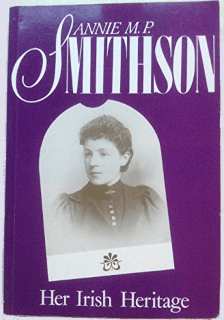
Birth of Novelist & Poet Annie M. P. Smithson

Annie Mary Patricia Smithson, Irish novelist, poet and Nationalist, is born into a Protestant family in Sandymount, Dublin, on September 26, 1873.

Smithson is christened Margaret Anne Jane but takes the names Anne Mary Patricia on her conversion to Catholicism. Her mother and father are first cousins, and her father dies when she is young. About 1881 her mother marries her second husband, Peter Longshaw, who owns a chemical factory in Warrington, Lancashire, England. She dislikes her stepfather and refers to him always as Mr. Longshaw. There are five children of the second marriage.

Smithson abandons her ambition to become a journalist in order to train as a nurse and a midwife. She trains in London and Edinburgh, before returning to Dublin in 1900. In 1901 she takes up a post as district nurse in Millton, County Down. There she falls in love with her colleague Dr. James Manton, a married man. Deciding that a relationship is impossible, she leaves Millton in 1906. They keep up a correspondence until her conversion, when she burns his letters.

Smithson converts to Catholicism in March 1907 and becomes a fervent Republican and Nationalist. She becomes a member of Cumann na mBan and campaigns for Sinn Féin in the 1918 Irish general election.

Smithson takes the Republican side in the Irish Civil War and nurses participants in the siege at Moran’s Hotel. In 1922 she is imprisoned by Irish Free State forces and is rescued from Mullingar prison by Linda Kearns McWhinney and Muriel MacSwiney, posing as a Red Cross delegation. Her political views lead to her resignation from the Queen’s Nurses Committee and a move into private nursing. In 1924 she writes a series of articles on child welfare work for the Evening Mail newspaper, based on her work in tenements in the Dublin Liberties, one of the poorest areas of the city, where she continues to work until 1929.

Smithson is Secretary and Organiser of the Irish Nurse Organisation from 1929 to 1942. She writes for the Irish Nurses’ Magazine and edits the Irish Nurses Union Gazette.

In 1917 Smithson publishes her first novel, Her Irish Heritage, which becomes a best-seller. It is dedicated to those who died in the Easter Rising of 1916. In all, she publishes twenty novels and two short story collections. Other successful novels include By Strange Paths and The Walk of a Queen. Many of her works are highly romantic and draw on her own life experiences, with nationalism and Catholicism featured as recurrent themes. In 1944 she publishes her autobiography, Myself – and Others.

From 1932 onwards Smithson shares a house in Rathmines, Dublin, with her stepsister and her stepsister’s family. She dies of heart failure on February 21, 1948, at 12 Richmond Hill, Dublin, and is buried in Whitechurch, Dublin.

Smithson’s novels are featured in Brian Friel‘s 1990 play Dancing at Lughnasa. Between 1989 and 1990 the Mercier Press reprints several of her works.


Leave a comment

Birth of J. P. Donleavy, American Irish Novelist & Playwright

James Patrick Donleavy, American Irish novelist, short story writer and playwright, is born to Irish immigrants Margaret and Patrick Donleavy in the New York City borough of Brooklyn on April 23, 1926. His best-known work is the novel The Ginger Man, which is initially banned for obscenity.

Donleavy grows up in the Bronx. His father is a firefighter, and his mother comes from a wealthy background. He has a sister, Mary Rita, and a younger brother. He declares himself to be an atheist at the age of fourteen. He receives his education at various schools in the United States, then serves in the United States Navy during World War II. After the war ends, he moves to Ireland and becomes an Irish citizen. In 1946 he begins studying bacteriology at Trinity College Dublin but leaves in 1949 before taking a degree.

Donleavy’s first published work is a short story entitled A Party on Saturday Afternoon, which appears in the Dublin literary periodical Envoy, A Review of Literature and Art in 1950. He gains critical acclaim with his first novel, The Ginger Man (1955), which is one of the Modern Library 100 best novels. The novel, of which his friend and fellow writer Brendan Behan is the first person to read the completed manuscript, is banned in Ireland and the United States by reason of obscenity. The lead character, Sebastian Dangerfield, is in part based on Trinity College companion Gainor Crist, an American Navy veteran also studying at Trinity College on the G.I. Bill, whom Donleavy once describes in an interview as a “saint,” though of a Rabelaisian kind.

Correctly or incorrectly, Donleavy’s initial works are sometimes grouped with the kitchen sink artists as well as the “angry young men.” Another novel, A Fairy Tale of New York, provides the title of the song “Fairytale of New York.”

In March 2007, Donleavy is the castaway on BBC Radio 4‘s Desert Island Discs.

In 2015, Donleavy is the recipient of the Bob Hughes Lifetime Achievement Award at the Bord Gáis Energy Irish Book Awards. In 2016, Trinity College Dublin awards him with an honorary doctorate.

In 1946, Donleavy marries Valerie Heron. The couple has two children: Philip (born in 1951) and Karen (born in 1955). They divorce in 1969, and he remarries in 1970 to Mary Wilson Price. That union ends in divorce in 1989. In 2011, it is reported that he had not fathered his two children with Price. A DNA test in the early 1990s confirms that Rebecca is the daughter of brewing scion Kieran Guinness, and Rory is the son of Kieran’s older brother Finn, whom Price marries after her divorce from Donleavy. “My interest is only to look after the welfare of the child,” Donleavy tells The Times, “and after a certain stage, you can’t worry about their parentage.”

Donleavy lives at Levington Park, a country house on 200 acres directly on Lough Owel, near Mullingar, County Westmeath, from 1972. Throughout much of his life, he is known as Mike by close friends, though the origins of this nickname are unclear.

Donleavy dies in Mullingar at the age of 91 on September 11, 2017.


Leave a comment

Death of Cearbhall Ó Dálaigh, the Fifth President of Ireland

Cearbhall Ó Dálaigh, Fianna Fáil politician, judge and barrister who serves as the fifth president of Ireland from December 1974 to October 1976, dies on March 21, 1978, in Sneem, County Kerry. He serves as Attorney General of Ireland from 1946 to 1948 and from 1951 to 1953, a Judge of the Supreme Court of Ireland from 1953 to 1973, Chief Justice of Ireland from 1961 to 1973 and a Judge of the European Court of Justice from 1973 to 1974.

Ó Dálaigh, one of four children, is born on February 12, 1911, in Bray, County Wicklow. His father, Richard O’Daly, is a fishmonger with little interest in politics. His mother is Una Thornton. His birth name is registered in English as Carroll O’Daly, which he uses during his legal career, and which is recorded by some publications.

Ó Dálaigh has an elder brother, Aonghus, and two younger sisters, Úna and Nuala. He goes to Saint Cronan’s Boys’ National School in Bray, and later to Synge Street CBS in Dublin. While attending University College Dublin (UCD), he becomes auditor of An Cumann Gaelach and of the Literary and Historical Society. He also becomes Irish language editor of The Irish Press.

Ó Dálaigh is a committed Fianna Fáil supporter who serves on the party’s National Executive in the 1930s. He becomes Ireland’s youngest Attorney General in 1946, under Taoiseach Éamon de Valera, serving until 1948. Unsuccessful in Dáil and Seanad elections in 1948 and 1951, he is re-appointed as Attorney General of Ireland in 1951. In 1953, he is nominated as the youngest-ever member of the Supreme Court by his mentor, de Valera. Less than a decade later, he becomes Chief Justice of Ireland, on the nomination of Taoiseach Seán Lemass. He is a keen actor in his early years and becomes a close friend of actor Cyril Cusack. It is commonly stated that Ó Dálaigh and Cusack picketed the Dublin launch of Disney‘s Darby O’Gill and the Little People in 1959, for what they felt was the film’s stereotyping of Irish people. However, there is no known contemporary reference to this having occurred.

Ó Dálaigh is an opponent of the United States bombing of North Vietnam.

In 1972, Taoiseach Jack Lynch suggests to the opposition parties that they agree to nominate Ó Dálaigh to become President of Ireland when President de Valera’s second term ends in June of the following year. Fine Gael, confident that its prospective candidate, Tom O’Higgins, will win the 1973 presidential election, having almost defeated de Valera in 1966, turn down the offer. Fianna Fáil’s Erskine H. Childers goes on to win the election that follows.

When Ireland joins the European Economic Community (EEC), Lynch appoints Ó Dálaigh as Ireland’s judge on the European Court of Justice. When President Childers dies suddenly in 1974, all parties agree to nominate Ó Dálaigh to replace him.

Ó Dálaigh’s tenure as president proves to be contentious. While popular with Irish language speakers and with artists, and respected by many republicans, he has a strained relationship with the Government of the 20th Dáil, particularly with Minister Conor Cruise O’Brien and Taoiseach Liam Cosgrave.

Ó Dálaigh’s decision in 1976 to exercise his power to refer a bill to the Supreme Court to test its constitutionality brings him into conflict with the Fine Gael-Labour National Coalition. Following the assassination of the British Ambassador to Ireland, Christopher Ewart-Biggs, by the Provisional Irish Republican Army (IRA), on July 23, 1976, the government announces its intention to introduce legislation extending the maximum period of detention without charge from two to seven days.

Ó Dálaigh refers the resulting bill, the Emergency Powers Bill, to the Supreme Court. When the court rules that the bill is constitutional, he signs the bill into law on October 16, 1976. On the same day, an IRA bomb in Mountmellick, County Laois, kills Michael Clerkin, a member of the Garda Síochána, the country’s police force. Ó Dálaigh’s actions are seen by government ministers to have contributed to the killing of this Garda. On the following day, Minister for Defence Paddy Donegan, visiting a barracks in Mullingar, County Westmeath, to open a canteen, attacks the President for sending the bill to the Supreme Court, calling him a “thundering disgrace.”

Ó Dálaigh’s private papers show that he considered the relationship between the President (as Commander-in-Chief of the Defence Forces) and the Minister for Defence had been “irrevocably broken” by the comments of the Minister in front of the army Chief of Staff and other high-ranking officers. Donegan offers his resignation, but Taoiseach Liam Cosgrave refuses to accept it. This proves the last straw for Ó Dálaigh, who believes that Cosgrave had additionally failed to meet his constitutional obligation to regularly brief the President. He resigns from the presidency on October 22, 1976, “to protect the dignity and independence of the presidency as an institution.” He is succeeded as President of Ireland by Patrick Hillery.

Ó Dálaigh dies of a heart attack on March 21, 1978, less than two years after resigning the presidency. He is buried in Sneem, County Kerry.


Leave a comment

Death of Paddy O’Byrne, Radio Broadcaster & Actor

Paddy O’Byrne, Irish radio broadcaster and actor who becomes one of the best-known radio personalities in South Africa, dies on December 4, 2013, in Mullingar, County Westmeath.

O’Byrne is born on December 8, 1929, in Killiney, a suburb of Dublin, the son of John O’Byrne, KC, and Marjorie (née McGuire). He attends St. Mary’s College, Dublin, Castleknock College and University College Dublin (UCD), where he earns a degree in Legal and Political Science. In 1952, he is called to the King’s Inns. In 1954, he abandons a legal career in favour of the performing arts, joining the George Mitchell Singers in London but has a “day job” working for an insurance company. During the summer season in Llandudno, Wales, he meets and later marries a singer and dancer from Dublin named Vicky Fitzpatrick. They have three children, Jane, John, and Dominic.

O’Byrne emigrates to the Union of South Africa in 1958. In 1961, he wins a competition called The Voice of South Africa, thereby gaining a contract with the South African Broadcasting Corporation and a new career. As is commonly the case at the time, both among Irish actors abroad as well as many South Africans in the theatre and broadcast media, he uses Received Pronunciation for his professional speaking voice.

In 1980, when the radio station Talk Radio 702 is launched in Johannesburg, O’Byrne is the first announcer heard on it. He also works for Radio Today and Radio Veritas, a Roman Catholic station, in Johannesburg and for Fine Music Radio in Cape Town. He also works for the BBC on Radio 2 and Capital Radio in the United Kingdom, during the 1970s and 1980s.

O’Byrne is also an actor, and narrates five films, while in South Africa. He is one of a series of actors who play the science-fiction character Mark Saxon in the original radio drama No Place to Hide, originally created by South African author Monty Doyle.

O’Byrne and his family move to Mullingar in 2001, but he continues to do broadcasts for Irish classical-music radio station RTÉ lyric fm, and his programmes for Fine Music Radio are recorded there and transmitted to South Africa for broadcast. He retires in 2004.

In 2010, at the MTN Radio Awards Gala, in Johannesburg, O’Byrne is honoured for his contribution to South African broadcasting, being named one of the inaugural inductees into the Radio Hall of Fame.

O’Byrne narrates two movies from The Gods Must Be Crazy film series, as well as Animals Are Beautiful People.

O’Byrne dies in Mullingar at the age of 83 on December 4, 2013.


Leave a comment

Birth of Muriel Frances Murphy MacSwiney

Muriel Frances Murphy MacSwiney, Irish nationalist and left-wing activist, and the first woman to be given the Freedom of New York City, is born Muriel Frances Murphy into a wealthy family on June 8, 1892, in Cork, County Cork. She is the wife of Terence MacSwiney, mother of Máire MacSwiney Brugha and sister-in-law of Mary MacSwiney.

Murphy’s father is Nicholas Murphy and her mother Mary Gertrude Purcell of Carrigmore, in Montenotte, Cork. She is sent away to school, to a convent in Sussex, England.

At Christmas 1915 Murphy attends an evening at the Fleischmann home where she meets Terence MacSwiney. Her family does not want the couple involved and does not approve of her growing interest in nationalism and socialism. In 1917 she marries MacSwiney in St. Joseph’s Church, Bromyard, Herefordshire, while he is interned due to his involvement in the Easter Rising of 1916. Her bridesmaid is Geraldine O’Sullivan, and his best man is Richard Mulcahy. The couple had waited until she had come of age at 25 so that she is financially independent of her parents. They have a daughter, Máire MacSwiney Brugha.

MacSwiney sees very little of her husband during their married life as he is often arrested. He dies due to his hunger strike on October 25, 1920, as Lord Mayor of Cork. Her husband’s death has a huge impact on her life, being a public event as well as a personal loss. She completes a lecture and interview tour of the United States, over nine months, with his sister Mary. She is the first woman to be given the Freedom of New York City, in 1922.

MacSwiney is part of a group posing as a Red Cross delegation who breaks Annie M. P. Smithson out of Mullingar prison with the help of Linda Kearns MacWhinney.

MacSwiney begins to suffer from depression and takes her daughter to Germany, leaving her there while she travels Europe. She eventually loses custody of her child and by 1934 she no longer has any involvement in her daughter’s life.

MacSwiney spends a lot of time in Paris, where she continues to be engaged with politics, typically those of left-wing, including communist, groups. She becomes involved with Pierre Kaan and they have a daughter, Alix, who is born on May 5, 1926, in Germany. Kaan is sent to a concentration camp by the Gestapo and dies on May 18, 1945, as a result of his treatment there.

MacSwiney is critical of American foreign policy on Vietnam, calling the United States a “world imperialist power.”

MacSwiney never resolves her relationships with either her own daughter or her family. She is paid a pension as the widow of Terence MacSwiney from 1950. She is living in Tonbridge in Kent with her daughter near the end of her life. She dies on October 26, 1982, at Oakwood Hospital in Barming Heath near Maidstone.