seamus dubhghaill

Promoting Irish Culture and History from Little Rock, Arkansas, USA


1 Comment

Death of Myles Walter Keogh, Last Man Killed at the Battle of Little Big Horn

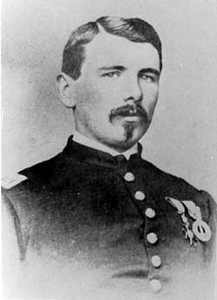
Myles Walter Keogh, soldier in the United States Army, is the last man killed at the Battle of Little Big Horn on June 25, 1876, according to the Sioux. His horse is the only U.S. survivor.

Keogh is born in Orchard House in Leighlinbridge, County Carlow, on March 25, 1840. He attends the National School in Leighlinbridge and is long thought to have attended St. Patrick’s College in Carlow but that college has no record of his attendance. It is possible that he attends St. Mary’s Knockbeg College.

By 1860, a twenty-year-old Keogh volunteers, along with over one thousand of his countrymen, to rally to the defence of Pope Pius IX following a call to arms by the Catholic clergy in Ireland. By August 1860, Keogh is appointed second lieutenant of his unit in the Battalion of St. Patrick, Papal Army under the command of General Christophe Léon Louis Juchault de Lamoricière. Once the fighting is over and duties of the Pontifical Swiss Guard become more mundane, Keogh sees little purpose in remaining in Rome. In March 1862, with civil war raging in America, he resigns his commission in the Company of St. Patrick and sets out for New York City, arriving on April 2.

Keogh actively participates in several prominent American Civil War battles including the Shenandoah Valley, the Battle of Antietam, the Battle of Fredericksburg, and the Battle of Gettysburg.

Perhaps the strongest testimony to Keogh’s bravery and leadership ability comes at the Battle of the Little Bighorn, also known as Custer’s Last Stand, on June 25, 1876. The senior captain among the five companies wiped out with General George Armstrong Custer that day, and commanding one of two squadrons within the Custer detachment, Keogh dies in a “last stand” of his own, surrounded by the men of Company I. When the sun-blackened and dismembered dead are buried three days later, Keogh’s body is found at the center of a group of troopers. The slain officer is stripped but not mutilated, perhaps because of the “medicine” the Indians see in the Agnus Dei (“Lamb of God”) he wears on a chain about his neck or because many of Sitting Bull‘s warriors are believed to be Catholic. Keogh’s left knee has been shattered by a bullet that corresponds to a wound through the chest and flank of his horse, indicating that horse and rider may have fallen together prior to the last rally.

The badly injured animal is found on the fatal battlefield and nursed back to health as the 7th Cavalry’s regimental mascot, which he remains until his death in 1890. This horse, Comanche, is considered the only U.S. military survivor of the battle, though several other badly wounded horses are found and destroyed at the scene. Keogh’s bloody gauntlet and the guidon of his Company I are recovered by the army three months after Little Bighorn at the Battle of Slim Buttes.

Originally buried on the battlefield, Keogh’s remains are disinterred and taken to Auburn, New York as he had requested in his will. He is buried at Fort Hill Cemetery on October 26, 1877, an occasion marked by citywide official mourning and an impressive military procession to the cemetery.

Tongue River Cantonment in southeastern Montana is renamed after him to be Fort Keogh. The fort is first commanded by Nelson A. Miles. The 55,000-acre fort is today an agricultural experiment station. Miles City, Montana is located two miles from the old fort.

Leave a comment

Death of Fr. Edward J. Flanagan, Founder of Boys Town

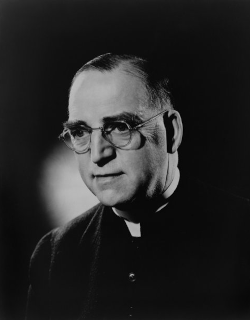
Edward Joseph Flanagan, Irish-born priest of the Catholic Church in the United States, dies in Berlin, Germany on May 15, 1948. He founds the orphanage known as Boys Town located in Boys Town, Douglas County, Nebraska, which now also serves as a center for troubled youth.

Flanagan is born to John and Honoria Flanagan in the townland of Leabeg, County Roscommon, near the village of Ballymoe, County Galway, on July 13, 1886. He attends Summerhill College, Sligo.

In 1904, Flanagan emigrates to the United States and becomes a US citizen in 1919. He attends Mount St. Mary’s University in Emmitsburg, Maryland, where he receives a Bachelor of Arts degree in 1906 and a Master of Arts degree in 1908. He studies at Saint Joseph’s Seminary in Dunwoodie, Yonkers, New York. He continues his studies in Italy and at the University of Innsbruck in Austria where he is ordained a priest on July 26, 1912. His first parish is in O’Neill, Nebraska, where from 1912 he serves as an assistant pastor at St. Patrick’s Catholic Church. He then moves to Omaha, Nebraska, to serve as an assistant pastor at St. Patrick’s Church and later at St. Philomena’s Church.

In 1917, Flanagan founds a home for homeless boys in Omaha. Bishop Jeremiah James Harty of the Diocese of Omaha has misgivings but endorses Flanagan’s experiment. Because the downtown facilities are inadequate, he establishes Boys Town, ten miles west of Omaha in 1921. Under his direction, Boys Town grows to be a large community with its own boy-mayor, schools, chapel, post office, cottages, gymnasium, and other facilities where boys between the ages of 10 and 16 can receive an education and learn a trade.

Boys Town, a 1938 film starring Spencer Tracy based on Flanagan’s life, wins Tracy an Academy Award for Best Actor for his performance. Mickey Rooney also stars as one of the residents. Tracy spends his entire Oscar acceptance speech talking about Flanagan. Without confirming it with Tracy, an overzealous MGM publicity representative announces incorrectly that Tracy is donating his Oscar to Flanagan. The Academy of Motion Picture Arts and Sciences hastily strikes another inscription, so Tracy keeps his statuette and Boys Town gets one as well. A sequel also starring Tracy and Rooney, Men of Boys Town, is released in 1941.

Flanagan himself appears in a separate 1938 MGM short, The City of Little Men, promoting Boys Town and giving a tour of its facilities. The actor Stephen McNally plays Flanagan in a 1957 episode of the ABC religion anthology series, Crossroads.

Flanagan receives many awards for his work with the delinquent and homeless boys. Pope Pius XI names him a Domestic Prelate with the title Right Reverend Monsignor in 1937. He serves on several committees and boards dealing with the welfare of children and is the author of articles on child welfare. Internationally known, he travels to the Republic of Ireland in 1946, where he is appalled by the children’s institutions there, calling them “a national disgrace.” When his observations are published after returning to Omaha, instead of improving the horrid conditions, vicious attacks are leveled against him in the Irish print media and the Oireachtas. He is invited by General Douglas MacArthur to Japan and Korea in 1947 to advise on child welfare, as well as to Austria and Germany in 1948. While in Germany, he dies of a heart attack on May 15, 1948. He is interred at Dowd Memorial Chapel of the Immaculate Conception Parish in Boys Town, Nebraska.

In 1986, the United States Postal Service issues a 4¢ Great Americans series postage stamp honoring Flanagan. He is a member of the Nebraska Hall of Fame.

On February 25, 2012, the Catholic Archdiocese of Omaha, Nebraska opens the canonization process of Flanagan. At a March 17, 2012 prayer service at Boys Town’s Immaculate Conception Church, he is given the title “Servant of God,” the first of three titles bestowed before canonization as a Catholic saint. The investigation is completed in June 2015 and the results forwarded to the Vatican. If the Vatican approves the local findings, Flanagan will be declared venerable. The next steps will be beatification and canonization.

There is a portrait statue dedicated to Fr. Edward J. Flanagan in Ballymoe, County Galway.


Leave a comment

Commissioning of the Second USS The Sullivans

The United States Navy commissions USS The Sullivans (DDG-68), an Arleigh Burke-class Aegis guided-missile destroyer, on April 19, 1997. She is the second ship to be named for the five Sullivan brothers who perished on the USS Juneau (CL-52) when it was sunk by a Japanese submarine in the Naval Battle of Guadalcanal in November 1942. This is the greatest military loss by any one American family during World War II. The Sullivans are descendants of Irish immigrants.

The first ship named for the brothers is the Fletcher-class destroyer USS The Sullivans (DD-537), now a museum ship in Buffalo, New York.

The contract to build USS The Sullivans is awarded to Bath Iron Works in Bath, Maine on April 8, 1992, and her keel is laid down on July 27, 1994. She is launched on August 12, 1995, and sponsored by Kelly Ann Sullivan Loughren, granddaughter of Albert Sullivan. The ship is commissioned on April 19, 1997, with Commander Gerard D. Roncolato in command. Upon her commissioning, the ship is given the motto that is thought to have been spoken by the brothers when asked to separate during World War II, “We Stick Together.”

On April 26, 1997, USS The Sullivans departs New York City for Norfolk, Virginia, where, after arriving on April 27, the crew completes underway replenishment qualifications with USS Platte (AO-186). The warship then sails for Naval Station Mayport in Jacksonville, Florida, on April 29 and arrives in her new homeport on May 2. After completing two days of gunnery trials in mid-May, USS The Sullivans embarks upon her shakedown deployment to the West Indies on May 27.

Members of al-Qaeda attempt an attack on USS The Sullivans while in port at Aden, Yemen on January 3, 2000, as a part of the 2000 millennium attack plots. The plan is to load a boat full of explosives and detonate it near USS The Sullivans; however, the boat is so overladen that it sinks. Later, al-Qaeda attempts the same type of attack a second time, successfully bombing USS Cole (DDG-67) on October 12, 2000.

While underway and sailing for Composite Unit Training Exercise 01-2 USS The Sullivans receives word of the September 11 attacks. USS The Sullivans, as part of the USS John F. Kennedy (CV-67) Battle Group, takes part in Operation Noble Eagle. The destroyer provides air-space security along the mid-Atlantic seaboard.

In February 2002 USS The Sullivans deploys with the USS John F. Kennedy carrier battle group to the Arabian Sea in support of Operation Enduring Freedom.

On September 14, 2020, it is announced that USS The Sullivans will be part of HMS Queen Elizabeth‘s Task Group for the GROUPEX and Joint Warrior exercises. On January 19, 2021, a declaration confirms that USS The Sullivans will form part of the escort for HMS Queen Elizabeth during her first active deployment as part of the UK Carrier Strike Group in 2021.

(Photo: U.S. Navy photo of USS The Sullivans on the Mediterranean Sea in July 2002 by Photographer’s Mate 1st Class Jim Hampshire)


Leave a comment

Birth of Richard Busteed, Union Army General & U.S. Federal Judge

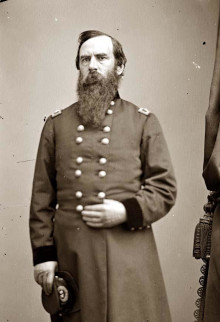
Richard Busteed, Union Army general during the American Civil War and United States federal judge, is born in County Cavan on February 16, 1822. Busteed comes first to Canada, then the United States with his family while a child. They settle in New York City.

Busteed reads law in 1846. He enters private practice in New York City from 1846 to 1856 and is Corporation Counsel for New York City from 1856 to 1859. He serves as a Captain in the United States Army in 1861, and a Brigadier General from 1862 to 1863, during the American Civil War.

Once when confronted with black men being thrown out of a white railroad car by the conductor, Busteed pulls his pistol and defends the black men allowing them to stay.

Busteed receives a recess appointment from President Abraham Lincoln on November 17, 1863, to a joint seat on the United States District Court for the Middle District of Alabama, the United States District Court for the Northern District of Alabama and the United States District Court for the Southern District of Alabama vacated by Judge George Washington Lane. He is nominated to the same position by President Lincoln on January 5, 1864. He is confirmed by the United States Senate on January 20, 1864, and receives his commission the same day. His service terminates on October 20, 1874, due to his resignation.

Alabamians generally consider Busteed corrupt and pro-Northern. In December 1867, he is shot on the street in Mobile, Alabama by United States Attorney Lucien V. B. Martin, who fires two more shots into him after he falls. Martin goes to Texas and is never prosecuted, while Busteed recovers rapidly.

Busteed is nominated by President Ulysses S. Grant to the Supreme Court of the District of Columbia (now the United States District Court for the District of Columbia) on January 13, 1873. At the same time, President Grant nominates Judge David Campbell Humphreys, an Alabama native serving on the Supreme Court of the District of Columbia, to assume Busteed’s seat, each nomination made contingent on the other’s resignation. The Senate returns the nominations to the President as irregular in form on February 13, 1873.

In 1873, Busteed is the subject of an impeachment inquiry by the United States House of Representatives Judiciary Committee. The Committee recommends his impeachment on charges of failing to maintain a residence in his judicial district, failing to hold scheduled terms of court, and using his official position to promote his personal interests, specifically, by remitting a fine due to the Federal government in order to obtain release from a personal judgment against him in a State court. He resigns before the full House can vote on the recommendation.

Following his resignation from the federal bench, Busteed resumes private practice in New York City starting in 1874. He dies on September 14, 1898, in New York City and is interred in Woodlawn Cemetery in the Bronx, New York.


Leave a comment

Birth of Sir Alfred Chester Beatty, First Honorary Citizen of Ireland

Sir Alfred Chester Beatty, mining engineer, philanthropist, art collector, and the first honorary citizen of Ireland (1957), is born in New York, New York, United States on February 7, 1875, on the site of what is now Rockefeller Center. He plays an important role in the development of copper deposits in Central Africa.

Beatty is the youngest of three sons born to Hetty and John Beatty, a banker and stockbroker. After studying engineering at the Columbia School of Mines and Princeton University, he helps to develop porphyry copper ores in the United States, first as a consulting engineer and later as a director on the boards of several copper-mining firms. In 1913 he relinquishes his mining interests in the United States and settles in Great Britain, becoming a naturalized British subject in 1933. In 1921 he forms a prospecting company that initiates the development of the Copperbelt region of Northern Rhodesia (now Zambia). For this, he becomes known as the “King of Copper.”

An early family anecdote recalls that, as a young boy, Beatty catches the collection bug, bidding at auction for mining samples. In 1931 an announcement in London‘s The Times casts him as a great collector. Between 1939 and 1949 he acquires over 140 nineteenth-century paintings to display in the Picture Gallery of his London home. These are now part of the collection of the National Gallery of Ireland.

Beatty supports the war effort, contributing a large number of raw materials to the Allies. He receives a belated knighthood by Queen Elizabeth II in the 1954 Birthday Honours list for his contribution to the wartime effort. By the late 1940s, however, he has become disillusioned with Britain. Political deviations from his free-market values, coupled with increased foreign exchange restrictions impacted both his personal and collecting interests in Britain.

In 1950, at the age of 75, Beattys over the reins of Selection Trust to his son Chester Jr. and relocates to Dublin. He purchases a large townhouse for himself on Ailesbury Road, in the Ballsbridge area of Dublin and a site on Shrewsbury Road for the construction of the Chester Beatty Library, which houses the collection, opening on August 8, 1953. The library is moved to its current location at Dublin Castle in 2000.

Beatty spends the remainder of his life between Dublin and the south of France. He is made a Freeman of the City of Dublin in 1954 and is the first person granted honorary citizenship of Ireland in 1957. He continues to collect in the 1950s and 1960s, acquiring important Ethiopian manuscripts and Japanese printed material during that period.

Beatty dies in Monte Carlo in Monaco on January 19, 1968. His Irish estate is valued at £7 million. He is accorded a state funeral by the Irish government, the first private citizen in Irish history to receive such an honour. He is buried in Glasnevin Cemetery in Dublin.


Leave a comment

Death of Thomas Dongan, Governor of the Province of New York

Thomas Dongan, 2nd Earl of Limerick, a member of the Irish Parliament, Royalist military officer during the English Civil War, and Governor of the Province of New York, dies in London on December 14, 1715. He is noted for having called the first representative legislature in New York and for granting the province’s Charter of Liberties.

Dongan is born in 1634 into an old Gaelic Norman (Irish Catholic) family in Castletown Kildrought (now Celbridge), County Kildare. He is the seventh and youngest son of Sir John Dongan, Baronet, Member of the Irish Parliament, and his wife Mary Talbot, daughter of Sir William Talbot, 1st Baronet and Alison Netterville. As Stuart supporters, following the overthrow of King Charles I, the family goes to King Louis XIV‘s France, although they manage to hold onto at least part of their Irish estates. His family gives their name to the Dongan Dragoons, a premier military regiment.

While in France, Dongan serves in an Irish regiment with Henri de La Tour d’Auvergne, Viscount of Turenne. He stays in France after the Restoration and achieves the rank of colonel in 1674.

After the Treaty of Nijmegen ends the Franco-Dutch War in 1678, Dongan returns to England in obedience to the order that recalls all English subjects fighting in service to France. Fellow officer James, Duke of York, arranges to have him granted a high-ranking commission in the army designated for service in Flanders and a pension. That same year, he is appointed Lieutenant-Governor of English Tangier, which had been granted to England as part of the dowry of Catherine of Braganza. He serves as part of the Tangier Garrison which defends the settlement.

In September 1682, James, Lord Proprietor of the Province of New York, appoints Dongan as Vice-admiral in the Navy and provincial governor (1683–1688) to replace Edmund Andros. James also grants him an estate on Staten Island. The estate eventually becomes the town of Castleton. Later, another section of the island is named Dongan Hills in honour of Dongan.

Dongan lands in Boston on August 10, 1683, crosses Long Island Sound, and passes through the small settlements in the eastern part of the island as he makes his way to Fort James, arriving on August 25.

At the time of Dongan’s appointment, the province is bankrupt and in a state of rebellion. He is able to restore order and stability. On October 14, 1683, he convenes the first-ever representative assembly in New York history at Fort James. The New York General Assembly, under the wise supervision of Dongan, passes an act entitled “A Charter of Liberties.” It decrees that the supreme legislative power under the Duke of York shall reside in a governor, council, and the people convened in general assembly; confers upon the members of the assembly rights and privileges making them a body coequal to and independent of the British Parliament; establishes town, county, and general courts of justice; solemnly proclaims the right of religious liberty; and passes acts enunciating certain constitutional liberties; right of suffrage; and no martial law or quartering of the soldiers without the consent of the inhabitants.

Dongan soon incurs the ill will of William Penn who is negotiating with the Iroquois for the purchase of the upper Susquehanna Valley. Dongan goes to Albany and declares that the sale would be “prejudicial to His Highness’s interests.” The Cayugas sell the property to New York with the consent of the Mohawk. Years later, when back in England and in favor at the Court of James, Penn uses his influence to prejudice the king against Dongan.

On July 22, 1686, Governor Dongan grants Albany a municipal charter. Almost identical in form to the charter awarded to New York City just three months earlier, the Albany charter is the result of negotiations conducted between royal officials and Robert Livingston and Pieter Schuyler. The charter incorporates the city of Albany, establishing a separate municipal entity in the midst of the Van Rensselaer Manor.

Dongan establishes the boundary lines of the province by settling disputes with Connecticut on the east, with the French Governor of Canada on the north, and with Pennsylvania on the south, thus marking out the present limits of New York State.

James later consolidates the colonial governments of New York, New Jersey and the United Colonies of New England into the Dominion of New England and appoints Edmund Andros, the former Governor-General of New York, as Governor-General. Dongan transfers his governorship back to Andros on August 11, 1688.

Dongan executes land grants establishing several towns throughout New York State including the eastern Long Island communities of East Hampton and Southampton. These grants, called the Dongan Patents, set up Town Trustees as the governing bodies with a mission of managing common land for common good. The Dongan Patents still hold force of law and have been upheld by the Supreme Court of the United States with the Trustees—rather than town boards, city councils or even the State Legislature—still managing much of the common land in the state.

Dongan lives in London for the last years of his life and dies on December 14, 1715. He is buried in the St. Pancras Old Church churchyard, London.

(Pictured: Portrait of Thomas Dongan, 2nd Earl of Limerick, from Castleton Manor, Staten Island licensed under the Creative Commons Attribution-Share Alike 4.0 International license)


Leave a comment

Birth of Richard Croker, Leader of New York’s Tammany Hall

Richard Welstead Croker, American politician who is a leader of New York City‘s Tammany Hall and a political boss also known as “Boss Croker, is born in the townland of Ballyva, in the parish of Ardfield, County Cork on November 24, 1843.

Croker is the son of Eyre Coote Croker (1800–1881) and Frances Laura Welsted (1807–1894). He is taken to the United States by his parents when he is just two years old. There are significant differences between this family and the typical family leaving Ireland at the time. They are Protestant and are not land tenants. Upon arrival in the United States, his father is without a profession but has a general knowledge of horses and soon becomes a veterinary surgeon. During the American Civil War, he serves in that same capacity under General Daniel Sickles.

Croker is educated in New York public schools but drops out at age twelve or thirteen to become an apprentice machinist in the New York and Harlem Railroad machine shops. Not long after, he becomes a valued member of the Fourth Avenue Tunnel Gang, a street gang that attacks teamsters and other workers that gather around the Harlem line’s freight depot. He eventually becomes the gang’s leader. He joins one of the Volunteer Fire Departments in 1863, becoming an engineer of one of the engine companies. That is his gateway into public life.

James O’Brien, a Tammany associate, takes notice of Croker after he wins a boxing match against Dick Lynch whereby, he knocks out all of Lynch’s teeth. He becomes a member of Tammany Hall and active in its politics. In the 1860s he is well known for being a “repeater” at elections, voting multiple times at the polls. He is an alderman from 1868–1870 and Coroner of New York City from 1873–1876. He is charged with the murder of John McKenna, a lieutenant of James O’Brien, who is running for United States Congress against the Tammany-backed Abram S. Hewitt. John Kelly, the new Tammany Hall boss, attends the trial and Croker is freed after the jury is undecided. He moves to Harrison, New York by 1880. He is appointed the New York City Fire Commissioner in 1883 and 1887 and city Chamberlain from 1889-1890.

After the death of Kelly, Croker becomes the leader of Tammany Hall and almost completely controls the organization. As head of Tammany, he receives bribe money from the owners of brothels, saloons and illegal gambling dens. He is chairman of Tammany’s Finance Committee but receives no salary for his position. He also becomes a partner in the real estate firm Meyer and Croker with Peter F. Meyer, from which he makes substantial money, often derived from sales under the control of the city through city judges. Other income comes by way of gifts of stock from street railway and transit companies, for example. At the time, the city police are largely still under the control of Tammany Hall, and payoffs from vice protection operations also contribute to Tammany income.

Croker survives Charles Henry Parkhurst‘s attacks on Tammany Hall’s corruption and becomes a wealthy man. Several committees are established in the 1890s, largely at the behest of Thomas C. Platt and other Republicans, to investigate Tammany and Croker, including the 1890 Fassett Committee, the 1894 Lexow Committee, during which Croker leaves the United States for his European residences for three years, and the Mazet Investigation of 1899.

Croker’s greatest political success is his bringing about the 1897 election of Robert Anderson Van Wyck as first mayor of the five-borough “greater” New York. During Van Wyck’s administration Croker completely dominates the government of the city.

In 1899, Croker has a disagreement with Jay Gould‘s son, George Jay Gould, president of the Manhattan Elevated Railroad Company, when Gould refuses his attempt to attach compressed-air pipes to the Elevated company’s structures. He owns many shares of the New York Auto-Truck Company, a company which would benefit from the arrangement. In response to the refusal, he uses Tammany influence to create new city laws requiring drip pans under structures in Manhattan at every street crossing and the requirement that the railroad run trains every five minutes with a $100 fine for every violation. He also holds 2,500 shares of the American Ice Company, worth approximately $250,000, which comes under scrutiny in 1900 when the company attempts to raise the price of ice in the city.

After Croker’s failure to carry the city in the 1900 United States presidential election and the defeat of his mayoralty candidate, Edward M. Shepard, in 1901, he resigns from his position of leadership in Tammany and is succeeded by Lewis Nixon. He departs the United States in 1905.

Croker operates a stable of thoroughbred racehorses during his time in the United States in partnership with Michael F. Dwyer. In January 1895, they send a stable of horses to England under the care of trainer Hardy Campbell, Jr. and jockey Willie Simms. Following a dispute, the partnership is dissolved in May but Croker continues to race in England. In 1907, his horse Orby wins Britain’s most prestigious race, The Derby. Orby is ridden by American jockey John Reiff whose brother Lester had won the race in 1901. Croker is also the breeder of Orby’s son, Grand Parade, who wins the Derby in 1919.

Croker returns to Ireland in 1905 and dies on April 29, 1922, at Glencairn House, his home in Stillorgan outside Dublin. His funeral, celebrated by South African bishop William Miller, draws some of Dublin’s most eminent citizens. The pallbearers are Arthur Griffith, the President of Dáil Éireann; Laurence O’Neill, the Lord Mayor of Dublin; Oliver St. John Gogarty; Joseph MacDonagh; A.H. Flauley, of Chicago; and J.E. Tierney. Michael Collins, Chairman of the Provisional Government of the Irish Free State, is represented by Kevin O’Shiel; the Lord Lieutenant of Ireland, Edmund Bernard FitzAlan-Howard, 1st Viscount FitzAlan of Derwent, is represented by his under-secretary, James MacMahon.

In 1927, J. J. Walsh claims that just before his death Croker had accepted the Provisional Government’s invitation to stand in Dublin County in the imminent 1922 Irish general election.


Leave a comment

Gerry Adams & David Trimble Meet at Stormont

On November 4, 2002, Ulster Unionist leader David Trimble and Sinn Féin president Gerry Adams meet face-to-face for the first time since the suspension of Northern Ireland‘s power-sharing government in an attempt to break the deadlock in the peace process. They meet at Stormont as Secretary of State for Northern Ireland, Paul Murphy, continues his round of meetings with the political parties in an attempt to find a way to end the deadlock.

The province’s institutions are suspended on October 14 following a row over allegations of Irish Republican Army (IRA) activity, including alleged spying within the Northern Ireland Office (NIO).

Speaking after a 40-minute meeting with Trimble, Adams says they had had a “useful exchange of views.” But he adds, as expected, “there were very few conclusions in terms of the big picture….I asked Mr. Trimble how he thought things could be sorted out and Mr. Trimble had no particular suggestion to offer. But it was a good meeting.”

The Sinn Féin president says he had suggested to Trimble that each leader could address the executive of the opposite’s party. “He declined. But I hope he will think about the suggestion.”

Trimble says no significant developments came out of the meeting. He adds that the onus is on the republican movement to move the process forward. He dismisses Adams’s suggestion that they should address each other’s parties as a “stunt.”

Elsewhere on this date, Minister for Foreign Affairs Brian Cowen and Northern Secretary Paul Murphy also hold talks with a Social Democratic and Labour Party (SDLP) delegation in Dublin. Among the items on the agenda are how to restore the North’s devolved political institutions and whether or not the next Northern Ireland Assembly elections will be held as planned the following May.

Adams leaves for Washington, D.C. the following day, where he is expected to brief President George W. Bush‘s Special Envoy for Northern Ireland, Richard N. Haass. He also plans to visit New York, New Jersey and Canada for fund-raising events during his six-day trip.

(From: “Trimble Adams meeting ‘useful'”, BBC News, news.bbc.co.uk, November 5, 2002)


Leave a comment

Birth of Irish Tenor Frank Patterson

Frank Patterson, internationally renowned Irish tenor following in the tradition of singers such as Count John McCormack and Josef Locke, is born on October 5, 1938, in Clonmel, County Tipperary. He is known as “Ireland’s Golden Tenor.”

As a boy Patterson performs with his local parish choir and is involved in maintaining the annual tradition of singing with the “Wrenboys.” He sings in the local St. Mary’s Choral Society and at a production of The Pirates of Penzance performed with both his parents. His interests extend beyond music and as a boy he represents Marlfield GAA hurling club, plays tennis at Hillview and golf at the Mountain Road course. He quits school at an early stage to work in the printing business of his mother’s family. He moves to Dublin in 1961 to enroll at the National Academy of Theatre and Allied Arts where he studies acting while at the same time receiving vocal training from Hans Waldemar Rosen. In 1964, he enters the Feis Ceoil, a nationwide music competition, in which he wins several sections including oratorio, lieder and the German Gold Cup.

Patterson gives classical recitals around Ireland and wins scholarships to study in London, Paris and in the Netherlands. While in Paris, he signs a contract with Philips Records and releases his first record, My Dear Native Land. He works with conductors and some of the most prestigious orchestras in Europe including the London Symphony Orchestra and Orchestre de Paris. He also gains a reputation as a singer of Handel, Mozart, and Bach oratorios and German, Italian and French song. He has a long-running programme on RTÉ titled For Your Pleasure.

In the early 1980s Patterson moves to the United States, making his home in rural Westchester County, New York. A resurgence of interest in Irish culture encourages him to turn towards a more traditional Irish repertoire. He adds hymns, ballads, and traditional as well as more popular tunes to his catalogue. In March 1988 he is featured host in a St. Patrick’s Day celebration of music and dance at New York City‘s famous Radio City Music Hall. He also gives an outdoor performance before an audience of 60,000 on the steps of the United States Capitol in Washington, D.C. with the National Symphony Orchestra.

Patterson is equally at home in more intimate settings. His singing in the role of the Evangelist in Bach’s St. John Passion is given fine reviews. Further recordings follow, of Beethoven arrangements, Irish songs, Berlioz songs, Purcell songs and others, all on the Philips label.

Patterson performs sold-out concerts from London’s Royal Albert Hall to New York’s Carnegie Hall, and with his family he presents two concerts at the White House, for presidents Ronald Reagan in 1982 and Bill Clinton in 1995. He records over thirty albums in six languages, wins silver, gold and platinum discs and is the first Irish singer to host his own show in Radio City Music Hall in New York.

Rising to greater prominence with the new popularity of Celtic music in the 1990s, Patterson sees many of his past recordings reissued for American audiences, and in 1998 he stars in the PBS special Ireland in Song. His last album outsells Pavarotti.

In recognition of his musical achievements, he is awarded an honorary doctorate from Salve Regina University in Newport, Rhode Island in 1990, an honorary doctorate in fine arts from Manhattan College in 1996 and the Gold Medal of the Éire Society of Boston in 1998.

In 1999, Patterson learns he has a brain tumour. He has several operations in the following year and his condition appears to stabilise. He is diagnosed with a recurrence of his illness on May 7, 2000. He briefly recuperates and resumes performing. His last performance is on June 4, 2000, at Regis College in the Boston suburb of Weston, Massachusetts. Shortly thereafter he is admitted to the Memorial Sloan Kettering Cancer Center in New York where he lapses into a coma and dies on June 10, 2000, at the age of 61.

At his death accolades and tributes came from, among others, President of Ireland Mary McAleese, Taoiseach Bertie Ahern and Opposition leader John Bruton who said he had “the purest voice of his generation.”


Leave a comment

Birth of Musicologist Francis Llewellyn Harrison

Francis Llewellyn Harrison, better known as “Frank Harrison” or “Frank Ll. Harrison” and one of the leading musicologists of his time and a pioneering ethnomusicologist, is born in Dublin on September 29, 1905. Initially trained as an organist and composer, he turns to musicology in the early 1950s, first specialising in English and Irish music of the Middle Ages and increasingly turning to ethnomusicological subjects in the course of his career. His Music in Medieval Britain (1958) is still a standard work on the subject, and Time, Place and Music (1973) is a key textbook on ethnomusicology.

Harrison is the second son of Alfred Francis Harrison and Florence May (née Nash). He becomes a chorister at St. Patrick’s Cathedral, Dublin in 1912 and is educated at the cathedral grammar school and Mountjoy School. A competent organist, he is deputy organist at St. Patrick’s from 1925 to 1928. In 1920, he also begins musical studies at the Royal Irish Academy of Music, where he studies with John Francis Larchet (composition), George Hewson (organ) and Michele Esposito (piano). In 1926, he graduates Bachelor of Music at Trinity College Dublin and is awarded a doctorate (MusD) in 1929 for a musical setting of Psalm 19. He then works in Kilkenny for one year, serving as organist at St. Canice’s Cathedral and music teacher at Kilkenny College.

In 1930, Harrison emigrates to Canada to become organist at Westminster Presbyterian Church in New Glasgow, Nova Scotia. In 1933, he studies briefly with Marcel Dupré in France but returns to Canada in 1934 to become organist at Knox Presbyterian Church in Ottawa. In 1935, he takes a position as organist and choirmaster at St. George’s Cathedral in Kingston, Ontario, as well as taking up the newly created post of “resident musician” at Queen’s University at Kingston. His duties include giving lectures, running a choir and an orchestra, and conducting concerts himself. His course in the history and appreciation of music is the first music course to be given for full credit at Queen’s. He resigns from St. George’s in 1941 to become assistant professor of music at Queen’s in 1942. During his years in Canada, he still pursues the idea of remaining a performing musician and composer, winning three national composition competitions: for Winter’s Poem (1931), Baroque Suite (1943) and Night Hymns on Lake Nipigon (1945).

On a year’s leave of absence from Queen’s, Harrison studies composition with Paul Hindemith at Yale University, also taking courses in musicology with Leo Schrade. In 1946, he takes up a position at Colgate University in Hamilton, New York, and then moves on to Washington University in St. Louis as head of the new Department of Music (1947–1950).

In 1951, Harrison takes the degrees of Master of Arts (M.A.) and Doctor of Music (DMus) at Jesus College, Oxford, and becomes lecturer (1952), senior lecturer (1956), and reader in the history of music (1962–1970) there. In 1965, he is elected Fellow the British Academy and Senior Research Fellow at Oxford. From 1970 to 1980, he is Professor of Ethnomusicology at the University of Amsterdam in the Netherlands, retiring to part-time teaching in 1976.

Harrison also holds Visiting Professorships in musicology at Yale University (1958–1959), Princeton University (spring 1961 and 1968–1969), and Dartmouth College (winter 1968 and spring 1972). He also briefly returns to Queen’s University at Kingston as Queen’s Quest Visiting Professor in the fall of 1980 and is Visiting Andrew W. Mellon Professor of Music at the University of Pittsburgh for the calendar year 1981.

Harrison’s honorary titles also include Doctor of Laws at Queen’s University, Kingston (1974), Corresponding Member of the American Musicological Society (1981), and Vice President and Chairman of the Plainsong and Medieval Music Society (1985). At Queen’s also, the new Harrison-LeCaine Hall (1974) is partly named in his honour.

Harrison dies in Canterbury, England on December 29, 1987.

In 1989, Harry White appreciates Harrison as “an Irish musicologist of international standing and of seminal influence, whose scholarly achievement, astonishingly, encompassed virtually the complete scope of the discipline which he espoused.” David F. L. Chadd writes of him “He was above all things an explorer, tirelessly curious and boyishly delighted in the pursuit of knowledge, experience and ideas, and totally heedless of artificially imposed constraints and boundaries.”

Since 2004, the Society for Musicology in Ireland (SMI) awards a bi-annual Irish Research Council Harrison Medal in his honour to distinguished international musicologists.