Kavanagh’s mother insists that he be brought up and have opportunities like any other child and places him in the care of the doctor Francis Boxwell, who believes that an armless and legless child can live a productive life. Kavanagh learns to ride horses at the age of three by being strapped to a special saddle and managing the horse with the stumps of his arms. With the help of the surgeon Sir Philip Crampton, Lady Harriet has a mechanical wheelchair constructed for her son, and encourages him to ride horses and engage in other outdoor activities. He also goes fishing, hunting, draws pictures and writes stories, using mechanical devices supplementing his physical capacities. His mother teaches him how to write and paint holding pens and brushes in his mouth.
In 1846, Lady Harriet takes three of her children, Thomas, Harriet and Arthur, traveling to the Middle East for two years. Kavanagh nearly drowns in the Nile when he falls in while fishing and is rescued by a local antiquities salesman who dives in to pull him out.
In 1849, Kavanagh’s mother discovers that he has been having affairs with girls on the family estate, so she sends him into exile to Uppsala, and then to Moscow with his brother and a clergyman, whom he comes to hate. He travels extensively in Egypt, Anatolia, Persia, and India between 1846 and 1853. In India, his letter of credit from his mother is cancelled when she discovers that he has spent two weeks in a harem, so he persuades the East India Company to hire him as a despatch rider. Other sources say that this is due to the death of his eldest brother, Charles, of tuberculosis in December 1851, which leaves him with only 30 shillings.
Kavanagh dies of pneumonia in London at the age of 58 on December 25, 1889. He is buried in Ballicopagan cemetery. He is succeeded in the title of The MacMurrough by his son, Walter MacMurrough Kavanagh, who also serves as MP for County Carlow from 1908 to 1910. The 1901 novel The History of Sir Richard Calmady, written by Lucas Malet (pseudonym of Mary St. Leger Kingsley), is based on his life.
Kavanagh marries his cousin, Mary Frances Forde-Leathley, in 1855. Assisted by his wife, he is a philanthropic landlord, active county magistrate, and chairman of the board of guardians. Together, they have seven children.
Duffy is born on April 12, 1816, in Dublin Street, Monaghan, County Monaghan. Both of his parents die while he is still a child and his uncle, Fr. James Duffy, who is the Catholic parish priest of Castleblayney, becomes his guardian for a number of years. He is educated at St. Malachy’s College in Belfast and is admitted to the Irish Bar in 1845. He becomes a leading figure in Irish literary circles.
In August 1850, Duffy forms the Tenant Right League to bring about reforms in the Irish land system and protect tenants’ rights, and in 1852 is elected to the House of Commons for New Ross. By 1855, the cause of Irish tenants seems more hopeless than ever. Broken in health and spirit, Duffy publishes a farewell address to his constituency, declaring that he has resolved to retire from parliament, as it is no longer possible to accomplish the task for which he has solicited their votes.
In 1871, Duffy leads the opposition to Premier Sir James McCulloch‘s plan to introduce a land tax, on the grounds that it unfairly penalised small farmers. When McCulloch’s government is defeated on this issue, he becomes Premier and Chief Secretary. The majority of the colony is Protestant, and he is accused of favouring Catholics in government appointments. In June 1872, his government is defeated in the Assembly on a confidence motion allegedly motivated by sectarianism.
When Graham Berry becomes Premier in 1877, he makes Duffy Speaker of the Legislative Assembly, a post he holds without much enthusiasm until 1880, when he quits politics and retires to the south of France. Duffy remains interested in both the politics of his adoptive country and of Ireland. He is knighted in 1873 and is made KCMG in 1877.
Duffy spends his last years in Nice and dies at the age of 86 on February 9, 1903, at his home there, 12 Boulevard Victor Hugo. He is buried at Glasnevin Cemetery, Glasnevin, Dublin on March 8. 1903. The length of his career, the breadth of his experience, and his voluminous labours as a chronicler make him an important figure in the history of Ireland and the Irish diaspora in the nineteenth century. He also deserves attention as the most prominent and articulate Ulster catholic nationalist of his time. There are Duffy papers in the Royal Irish Academy and National Library of Ireland.
Fuller is born on January 1, 1900, in Kilflynn, County Kerry. He is the son of Daniel Fuller and Ellie Quinlan. His family is from Fahavane, in the parish of Kilflynn.
Fuller serves in the Kilflynn Irish Republican Army (IRA) flying column during the Irish War of Independence. He is First Lieutenant in the Kerry No.1 Brigade, 2nd Battalion. He opposes the Anglo-Irish Treaty and continues to fight with the anti-Treaty IRA during the Irish Civil War. Military records from the 1930s show, in his own hand, that he is in communication with Dublin regarding confirmation of membership in July 1922 and therefore eligible for war pensions. He becomes the most senior Kilflynn member upon the death of Captain George O’Shea.
In 1923, Fuller is captured by Free State troops and imprisoned in Ballymullen Barracks in Tralee by the Dublin Guard who had landed in County Kerry shortly before. On March 6, 1923, five Free State soldiers are blown up by a booby-trapped bomb at Baranarigh Wood, Knocknagoshel, north Kerry, including long-standing colleagues of Major General Paddy Daly, GOC Kerry Command. Prisoners receive beatings after the killings and Daly orders that republican prisoners be used to remove mines.
On March 7, nine prisoners from Ballymullen Barracks, six from the jail and three from the workhouse, are chosen with a broad geographical provenance and no well-known connections. They are taken lying down in a lorry to Ballyseedy Cross. There they are secured by the hands and legs and to each other in a circle around a land mine. Fuller is among them. His Kilflynn parish comrade Tim Tuomey is initially stopped from praying until all prisoners are tied up. As he and other prisoners then say their prayers and goodbyes, Fuller continues to watch the retreating Dublin Guard soldiers, an act which he later says saved him. The mine is detonated, and he lands in a ditch, suffering burns and scars. He crosses the River Lee and hides in Ballyseedy woods. He is missed amongst the carnage as disabled survivors are bombed and shot dead with automatic fire. Most collected body parts are distributed between nine coffins that had been prepared. The explosions and gunfire are witnessed by Rita O’Donnell who lives nearby and who sees human remains spread about the next day. Similar reprisal killings by the Dublin Guard follow soon after Ballyseedy.
Fuller crawls away to the friendly home of the Currans nearby. They take him to the home of Charlie Daly the following day. His injuries are treated by a local doctor, Edmond Shanahan, who finds him in a dugout. He moves often in the coming months, including to the Burke and Boyle families, and stays in a dugout that had been prepared at the Herlihys for seven months.
A cover-up begins almost immediately. Paddy Daly’s communication to Dublin about returning the bodies to relatives differs significantly from Cumann na mBan statements, which Daly complains about as simple propaganda, and later that of Bill Bailey, a local who had joined the Dublin Guard, who tells Ernie O’Malley that the bodies were handed over in condemned coffins as a band played jolly music. Fuller is named amongst the dead in newspaper reports before it is realised that he had escaped. Daly then sends a communication to GHQ that Fuller is reported as having become “insane.” The Dublin Guard scours the countryside for Fuller. The official investigation into the killings is presided over by Daly himself, with Major General Eamon Price of GHQ and Colonel J. McGuinness of Kerry Command. It blames Irregulars for planting the explosives and exonerates the Irish Army soldiers, and this is read out in the Dáil by the Minister for Defence, Richard Mulcahy.
Contrary statements to the Irish Army’s submissions are effectively ignored. Lieutenant Niall Harrington of the Dublin Guard, describes the evidence to the court and the findings as “totally untrue,” explaining that the actions were devised and executed by officers of the Dublin Guard. He contacts Kevin O’Higgins, Minister for Justice and Vice-President, a family friend, to deplore the findings. O’Higgins speaks to Richard Mulcahy, who does nothing. In a separate incident, Free State Lieutenant W.McCarthy, who had been in charge of about twenty prisoners, says that five of them had been removed in the night. They were reportedly shot in the legs then blown up by, in his words, “…a Free State mine, laid by themselves.” He resigns in protest. A Garda Síochána report into the events is also dismissed and is not made public for over 80 years.
Fuller leaves the IRA after the Civil War and follows a career as a farmer in Kerry. He joins Fianna Fáil, the political party founded by Republican leader Éamon de Valera in 1926 after a split from Sinn Féin. He is elected to the 9th Dáil on his first attempt, representing Fianna Fáil at the 1937 Irish general election, as the last of three Fianna Fáil TDs to be elected to the four seat Kerry North constituency. He is re-elected to the 10th Dáil at the 1938 Irish general election, when Fianna Fáil again wins three out of four seats, but loses his seat at the 1943 Irish general election to the independent candidate Patrick Finucane. He returns to farming thereafter.
Fuller never once mentions the Ballyseedy incident from a political platform and states later that he bore no ill-will towards his captors or those who were involved in his attempted extrajudicial killing. He does not want the ill feeling passed on to the next generation. He speaks publicly about the events in 1980, a few years before his death, on Robert Kee‘s groundbreaking BBC series Ireland: A Television History.
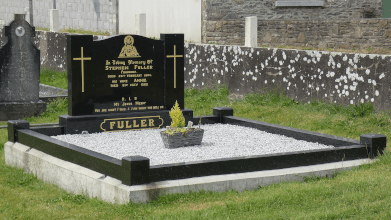
Fuller dies in Edenburn Nursing Home, Tralee, on February 23, 1984. He is buried near the Republican plot in Kilflynn where colleagues O’Shea, Tuomey and Timothy ‘Aero’ Lyons are buried.
Fuller’s son Paudie establishes the Stephen Fuller Memorial Cup for dogs of all ages, contested annually on the family farm.
Fuller’s fame largely rests on one night at Ballyseedy. To trace him through the rural society from which he and his fellow Volunteers originated and in which his life was spent, however, gives a fuller understanding of the devastating effects of the conflicts of 1916–23 on a tightly knit rural and small-town society, dominated by extended families of farmers and their service-industry relatives, and of how that society remembered and forgot those traumas.
(Pictured: Stephen Fuller’s grave in Kilflynn, by St. Columba’s Heritage Centre)
Sir Rory O’Moore (Irish: Ruaidhrí Ó Mórdha), Irish politician and landowner also known Sir Roger O’Moore or O’More or Sir Roger Moore, dies in obscurity on February 16, 1655. He is most notable for being one of the four principal organizers of the Irish Rebellion of 1641.
O’Moore’s uncle, Rory O’More, Lord of Laois, had fought against the English during the Tudor conquest of Ireland. In 1556, Queen Mary I confiscates the O’Mores’ lands and creates “Queens County” (modern-day County Laois). Over 180 family members, who are peaceful and have taken no part in any rebellion, are murdered with virtually all of the leaders of Laois and Offaly by the English at a feast at Mullaghmast, County Kildare, in 1577. Rory Óg and his wife Maighréad O’Byrne, sister of Fiach MacHugh O’Byrne, are hunted down and killed soon afterwards. This leads to the political downfall of the O’Moore family as their estates are given to English settlers.
Given the causes of the rebellion and the Crown’s weakness during the Bishops’ Wars into 1641, O’Moore plans a bloodless coup to overthrow the English government in Ireland. With Connor Maguire, 2nd Baron of Enniskillen, he plans to seize Dublin Castle, which is held by a small garrison, on October 23, 1641. Allies in Ulster led by Sir Phelim O’Neill are to seize forts and towns there. The leaders are to assume the governing of their own country and with this provision offer allegiance to King Charles. They are betrayed, and the plan is discovered on October 22 and the rising fails in its first objective. O’Neill has some success, and O’Moore quickly succeeds in creating an alliance between the Ulster Gaelic clans and the Old English gentry in Leinster.
In November 1641, the Irish forces besiege Drogheda, and a royalist force comes north from Dublin to oppose them. O’Moore is one of the leaders of the rebel army that intercepts and defeats the relief force at the Battle of Julianstown on November 29.
The Irish historian Charles Gavan Duffy writes: “Then a private gentleman, with no resources beyond his intellect and his courage, this Rory, when Ireland was weakened by defeat and confiscation, and guarded with a jealous care constantly increasing in strictness and severity, conceived the vast design of rescuing the country from England, and even accomplished it; for, in three years, England did not retain a city in Ireland but Dublin and Drogheda, and for eight years the land was possessed and the supreme authority exercised by the Confederation created by O’Moore. History contains no stricter instance of the influence of an individual mind.”
Bishop Michael Comerford writes that after O’Moore’s defeat at the Battle of Kilrush in April 1642 he retires and dies in Kilkenny city in the winter of 1642–43, having co-founded the Irish Catholic Confederation there a few months earlier. However, this ignores his contacts with Inchiquin and Ormonde in 1647–48.
In 1652, O’Moore goes to Inishbofin off the coast of Galway, one of the last Catholic strongholds, but as the parliamentary forces approach, he makes arrangements to flee. Walter Lynch, Bishop of Clonfert, sails in the last ship to leave the island without waiting for O’Moore, who is forced to make his own way. He finally escapes into Ulster but dies in obscurity on February 16, 1655. He is buried at Steryne churchyard, in the parish of Magilligan, County Londonderry.
St. Colman’s Church on the island once bears a tablet with the inscription: “In memory of many valiant Irishmen who were exiled to this Holy Island and in particular Rory O’More a brave chieftain of Leix, who after fighting for Faith and Fatherland, disguised as a fisherman escaped from his island to a place of safety. He died shortly afterwards, a martyr to his Religion and his County, about 1653. He was esteemed and loved by his countrymen, who celebrated his many deeds of valour and kindness in their songs and reverenced his memory, so that it was a common expression among them; ‘God and Our Lady be our help and Rory O’More’.”
The Balyna estate is inherited from Calvagh O’More by Rory’s brother Lewis. Balyna is passed down to Lewis’s last surviving O’More descendant, Letitia, who is also descended from Rory O’More because her grandfather married a second cousin. Letitia marries a Richard Farrell in 1751. This Farrell family henceforth takes the surname More O’Ferrall.
Reynolds is educated at Summerhill College in Sligo, County Sligo and works for a state transport company before succeeding at a variety of entrepreneurial ventures, including promoting dances and owning ballrooms, a pet-food factory, and newspapers. In 1974 he is elected to the Longford County Council as a member of Fianna Fáil. He enters Dáil Éireann, lower house of the Oireachtas, the Irish parliament, in 1977 as a member representing the Longford-Westmeath parliamentary constituency and becomes Minister for Posts and Telegraphs in Haughey’s Fianna Fáil government (1979–81). He is subsequently Minister of Industry and Commerce (1987–88) and Minister for Finance (1988–91) in Haughey’s third and fourth governments. He breaks with Haughey in December 1991. On January 30, 1992, Haughey retires as leader of Fianna Fáil at a parliamentary party meeting. Reynolds easily defeats his rivals Mary O’Rourke and Michael Woods in the party leadership election and succeeds Haughey as Taoiseach on February 11, 1992.
The Fianna Fáil–Progressive Democratscoalition that Reynolds inherits breaks up in November 1992 but, after the general election later that month, he surprises many observers by forming a new coalition government with the Labour Party in January 1993. He plays a significant part in bringing about a ceasefire between the Irish Republican Army (IRA) and unionist paramilitary groups in Northern Ireland in 1994, but he is less effective in maintaining his governing coalition. When this government founders in November 1994, he resigns as Taoiseach and as leader of Fianna Fáil, though he remains acting prime minister until a new government is formed the following month. He unsuccessfully seeks his party’s nomination as a candidate for the presidency of Ireland in 1997. He retires from public life in 2002.
On February 21, 1910, Carson accepts the parliamentary leadership of the anti-Home Rule Irish Unionists and, forfeiting his chance to lead the British Conservative Party, devotes himself entirely to the Ulster cause. His dislike of southern Irish separatism is reinforced by his belief that the heavy industry of Belfast is necessary to the economic survival of Ireland. The Liberal government (1908–16) under H. H. Asquith, which in 1912 decides to prepare a Home Rule bill, cannot overcome the effect of his extra-parliamentary opposition. The Solemn League and Covenant of resistance to Home Rule, signed by Carson and other leaders in Belfast on September 28, 1912, and afterward by thousands of Ulstermen, is followed by his establishment of a provisional government in Belfast in September 1913. Early in that year he recruits a private Ulster army, the Ulster Volunteer Force, that openly drills for fighting in the event that the Home Rule Bill is enacted. In preparation for a full-scale civil war, he successfully organizes the landing of a large supply of weapons from Germany at Larne, County Antrim, on April 24, 1914. The British government, however, begins to make concessions to Ulster unionists, and on the outbreak of World War I he agrees to a compromise whereby the Home Rule Bill is enacted but its operation suspended until the end of the war on the understanding that Ulster’s exclusion will then be reconsidered.
Appointed Attorney General for England in Asquith’s wartime coalition ministry on May 25, 1915, Carson resigns on October 19 because of his dissatisfaction with the conduct of the war. In David Lloyd George’s coalition ministry (1916–22) he is First Lord of the Admiralty from December 10, 1916, to July 17, 1917, and then a member of the war cabinet as minister without portfolio until January 21, 1918.
Carson retires in October 1929. In July 1932, during his last visit to Northern Ireland, he witnesses the unveiling of a large statue of himself in front of Parliament Buildings at Stormont. The statue is sculpted by Leonard Stanford Merrifield, cast in bronze and placed upon a plinth. The inscription on the base reads “By the loyalists of Ulster as an expression of their love and admiration for its subject.” It is unveiled by James Craig, 1st Viscount Craigavon, in the presence of more than 40,000 people.
Carson lives at Cleve Court, a Queen Anne house near Minster-in-Thanet in the Isle of Thanet, Kent, bought in 1921. It is here that he dies peacefully on October 22, 1935. A warship brings his body to Belfast for the funeral. Thousands of shipworkers stop work and bow their heads as HMS Broke steams slowly up Belfast Lough, with his flag-draped coffin sitting on the quarterdeck. Britain gives him a state funeral on Saturday, October 26, 1935, which takes place in Belfast’s St. Anne’s Cathedral. He remains the only person to have been buried there. From a silver bowl, soil from each of the six counties of Northern Ireland is scattered onto his coffin, which had earlier been covered by the Union Jack. At his funeral service the choir sings his own favourite hymn, “I Vow to Thee, My Country.”
A notable aspect of McGahon’s political career is his stand against the Provisional IRA when that organisation’s campaign of violence is at its height. At great personal risk, he refuses to close his newsagents shop in Dundalk during the funerals of the hunger strikers in 1981. He takes another huge risk a few years later when he gives evidence in the High Court in support of The Sunday Times, which is being sued for libel by Thomas Murphy for accusing him of directing an IRA bombing campaign in Britain. Local Gardaí are ordered not to get involved in the case, but McGahon is not deterred from giving evidence that helps the newspaper to defend the claims being made against it by Murphy.
A maverick and outspoken TD, McGahon is known to speak his mind on many issues including divorce, crime, and single mothers. He once advocates that pedophiles should be castrated as part of their prison sentence and is the only TD to oppose the referendum to abolish the death penalty from the Constitution. He also argues that those under 21 years of age should not be able to drive or drink. He is a member of the World Anti-Communist League and opposes the decriminalisation of homosexuality. In 1993, he is the only TD to oppose the decriminalisation of homosexuality and says in the Dáil that:
“I regard homosexuals as being in a sad category, but I believe homosexuality to be an abnormality, some type of psycho-sexual problem that has defied explanation over the years. I do not believe that the Irish people desire this normalisation of what is clearly an abnormality. Homosexuality is a departure from normality and while homosexuals deserve our compassion, they do not deserve our tolerance. That is how the man in the street thinks. I know of no homosexual who has been discriminated against. Such people have a persecution complex because they know they are different from the masses or normal society. They endure inner torment, and it is not a question of the way others view them. The lord provided us with sexual organs for a specific purpose. Homosexuals are like left-hand drivers driving on the right-hand side of the road.”
On the other hand, McGahon speaks out strongly against the influence of the drink industry and defies his own party whip to vote with his left-wing friend Tony Gregory in favour of banning of hare coursing. He is also on good personal terms with members of the Oireachtas such as Michael D. Higgins and David Norris despite holding fundamentally opposed views to them.
McGahon does not contest the 2002 Irish general election and retires from politics.
McGahon lives in Ravensdale, County Louth. His son Conor is a Louth County Councillor from 1991 to 1999 and his brother Johnny is a Louth County Councillor from 1995 to 2004. Johnny’s nephew, John McGahon, is elected to Louth County Council at the 2014 Irish local elections and to Seanad Éireann in 2020.
McGahon dies at the age of 80 on February 8, 2017, following a short illness. Following a Mass at St. Patrick’s Cathedral on February 11, he is buried afterwards in St. Patrick’s Cemetery.
Logue grows up outside the village of Claudy in County Londonderry, the eldest of nine children born to Denis Logue, a bricklayer, and Kathleen (née Devine). He gains a scholarship to St. Columb’s College which he attends from 1961 to 1967. In 1967, he commences at St. Joseph’s Teacher Training college (Queen’s University) in Belfast from which he qualifies as a teacher of Mathematics in 1970. He first comes to prominence as a member of the executive of the Northern Ireland Civil Rights Association (NICRA), the only SDLP member of the executive. He stands as a candidate in elections to the new Northern Ireland Assembly in 1973 and is elected for Londonderry, at the age of 24, the youngest candidate elected that year. With John Hume and Ivan Cooper, he is arrested by the British Army during a peaceful demonstration in Londonderry in August 1971. Their conviction is ultimately overturned by the Law LordsR. (Hume) v Londonderry Justices (972, N.I.91) requiring the then British Government to introduce retrospective legislation to render legal previous British Army actions in Northern Ireland.
The Northern Ireland State Papers of 1980 show that together with John Hume and Austin Currie, Logue plays a key role in presenting the SDLP’S ‘Three Strands’ approach to the Thatcher Government’s Secretary of State for Northern IrelandHumphrey Atkins in April 1980. The “Three Strands” approach eventually becomes the basis for the Good Friday Agreement. The Irish State papers from 1980 reveal that he is a confidante of the Irish Government of that time, briefing it regularly on the SDLP’s outlook.
Logue is also known for his controversial comments at Trinity College Dublin at the time of the power sharingSunningdale Agreement, which many blame for helping to contribute to the Agreement’s defeat, to wit, that: [Sunningdale was] “the vehicle that would trundle Unionists into a united Ireland.” The next line of the controversial speech says, “the speed the vehicle moved at was dependent on the Unionist community.” In an article in The Irish Times in 1997 he claims that this implies that unity is always based on consent and acknowledged by Unionist Spokesman John Laird in the NI Assembly in 1973.
Logue unsuccessfully contests the Londonderry seat in the February 1974 and 1979 Westminster Elections. He is elected to the 1975 Northern Ireland Constitutional Convention and the 1982 Northern Ireland Assembly. He is a member of the New Ireland Forum in 1983. In the 1980s he is a member of the Irish Commission for Justice and Peace and plays a prominent part in its efforts to resolve the 1981 Irish hunger strike. His role is credited in Ten Men Dead: The Story of the 1981 Irish Hunger Strike by David Beresford, Biting the Grave by P. O’Malley and, more recently, in Blanketmen: An Untold Story of the H-block Hunger Strike (New Island Books, 2016) and Afterlives: The Hunger Strike and the Secret Offer that Changed Irish History (Lilliput Press, 2011) by former Provisional Irish Republican ArmyvolunteerRichard O’Rawe. Following the New Ireland Forum in 1984 and John Hume’s decision to represent the redrawn Londonderry constituency as Foyle and a safe seat, Logue leaves the Dublin-based, National Board for Science and Technology and joins the European Commission in 1984 in Brussels.
Following the 1994 Irish Republican Army (IRA) ceasefire, Logue, along with two EU colleagues, is asked by EU President Jacques Delors to consult widely throughout Northern Ireland and the Border regions and prepare recommendations for a Peace and Reconciliation Fund to underpin the peace process. Their community-based approach becomes the blueprint for the Peace Programme. In 1997, then EU President Jacques Santer asks the team, led by Logue, to return to review the programme and advise for a renewed Peace II programme. Papers published by National University Galway in 2016 from Logue’s archives indicate that he is the originator of the Peace Fund concept within the European Commission.
At the European Commission from 1984 to 1998, Logue creates Science and Technology for Regional Innovation and Development in Europe (STRIDE). In 1992, he is joint author with Giovanni de Gaetano, of RTD potential in the Mezzogiorno of Italy: the role of science parks in a European perspective and, with A. Zabaniotou and University of Thessaloniki, Structural Support For RTD.
Further publications by Logue follow: Research and Rural Regions (1996) and RTD potential in the Objective 1 regions (1997). With the fall of the Berlin Wall, his attention turns to Eastern Europe and in March 1998 publishes a set of studies Impact of the enlargement of the European Union towards central central and Eastern European countries on RTD- Innovation and Structural policies.
Logue convenes the first EU seminar on “Women in Science” in 1993 and jointly publishes with LM Telapessy Women in Scientific and Technological Research in the European Community, highlighting the barriers to women’s advancement in the Research world.
As the former vice-chairman of the North Derry Civil Rights Association, Logue gives evidence at the Saville Inquiry into Bloody Sunday. He is special adviser to the Office of First and Deputy First Minister from 1998 to 2002 and as an official of the European Commission. In 2002–03, he is a fellow of the Institute for British – Irish Studies at University College Dublin (UCD). In July 2006, he is appointed as a board member of the Irish Peace Institute, based at the University of Limerick and in 2009 is appointed Vice Chairman. He is a Life Member of the Institute of International and European Affairs.
On December 17, 2007, Logue is appointed as a director to InterTradeIreland (ITI), the North-South Body established under the Good Friday Agreement to promote economic development in Ireland. There he chairs the ITI’s Fusion programme, bringing north–south industrial development in Innovation and Research. Integrating Ireland economically is a theme of his writing throughout his career, most recently in The Irish Times and in earlier publications as economic spokesman for the SDLP. He is economist at the Dublin-based National Board for Science and Technology from 1981 to 1984.
Logue, after leaving the European Commission in 2005, becomes involved in Renewable Energy and is chairman of Priority Resources as well as a director of two companies, one in solar energy, the other in wind energy. In November 2011, he is elected to the main board of European Association of Energy (EAE).
In November 2023, Logue is awarded an honorary doctorate by the University of Galway in recognition of “a lifetime dedicated to civil rights, human rights, equality and peace in Northern Ireland, Ireland and Europe.” He donates an archive of material, more than 20 boxes of manuscripts, documents, photographs and political ephemera, on the development of the SDLP from the early 1970s to the University of Galway.
After the death of Brendan Doris in 2006, Martin McGuinness pays tribute to the Doris family as “a well-known and respected republican family [who] have played a significant role in the republican struggle for many years.”
O’Neill becomes involved in republican politics in her teens, assisting her father with constituency work in his role as a Dungannon councillor. She joins Sinn Féin after the Good Friday Agreement in 1998, at the age of 21, and starts working as an advisor to Francie Molloy in the Northern Ireland Assembly, holding this role until 2005.
O’Neill automatically relinquishes her office following Paul Givan‘s resignation as first minister on February 3, 2022. Sinn Féin becomes the largest party after the 2022 Northern Ireland Assembly election, putting O’Neill in line to become the First Minister of Northern Ireland, and the Democratic Unionist Party (DUP) leader to become the deputy First Minister of Northern Ireland. However, she remains to be officially sworn in as First Minister because, as part of its opposition to the Northern Ireland Protocol, the DUP has refused to nominate a deputy First minister and there is therefore no functioning executive of Northern Ireland.
In August 2022, O’Neill is asked in a BBC interview whether it was right during the Troubles for the Provisional IRA “to engage in violent resistance to British rule.” She is criticised for her response, “I think at the time there was no alternative, but now thankfully we have an alternative to conflict, and that is the Good Friday Agreement – that is why it’s so precious to us all.”
In May 2023, O’Neill attends the coronation of King Charles, saying, “Well obviously I wanted to be here. We live in changing times, and it was the respectful thing to do, to show respect and to be here for all those people at home, who I had said I would be a first minister for all. Attendance here is about honouring that and fulfilling my promise.”
Cohalan graduates from Manhattan College in 1885, takes a master’s degree in 1894, and is given an honorary LL.D. in 1911. He is admitted to the bar in 1888, and practices law in New York City. In September 1889, he removes to the Bronx, practices law there, and enters politics, joining Tammany Hall, becoming an adviser to party boss Charles F. Murphy and later to John F. Curry. He is Grand Sachem of the Tammany Society from 1908 to 1911.
Cohalan is active in Democratic Party politics by 1900, drafting state party platforms and serving as a delegate to the national conventions in 1904 and 1908.
On May 18, 1911, Cohalan is appointed by Gov. John Alden Dix to the New York Supreme Court, to fill the vacancy caused by the election of James Aloysius O’Gorman as U.S. Senator from New York. In November 1911, he is elected to succeed himself. On December 28, 1923, he tenders his resignation, to become effective on January 12, 1924, claiming that the annual salary of $17,500 is not enough to provide for his large family.
Cohalan is a close associate of Irish revolutionary leader John Devoy and is influential in many Irish American societies including Clan na Gael. He helps to form the Sinn Féin League in 1907 and is a key organiser of the Irish Race Convention and the Friends of Irish Freedom (FOIF) on March 4-5, 1916. He is involved with the financing and planning of the Easter Rising in Dublin and is instrumental in sending Roger Casement to Germany in 1914. He is Chairman of the Irish Race Convention held in Philadelphia on February 22-23, 1919, and active in the Friends of Irish Freedom (1916–34).
When the United States enters World War I, Cohalan’s earlier work to obtain German assistance for Ireland becomes a liability, but he urges Irish Americans to support the war effort and to insist that self-determination for Ireland be included among the war aims. He opposes the peace treaty and the League of Nations and leads an Irish American delegation to the United States Senate Committee on Foreign Relations hearings, contributing to the defeat of the treaty in the Senate.
State Senator John P. Cohalan (1873–1950) is one of Cohalan’s eleven siblings, and church historian Monsignor Florence Daniel Cohalan (1908–2001) is one of his nine children.





 seamus dubhghaill