seamus dubhghaill

Promoting Irish Culture and History from Little Rock, Arkansas, USA


Leave a comment

The Loughinisland Massacre

CREATOR: gd-jpeg v1.0 (using IJG JPEG v80), quality = 90

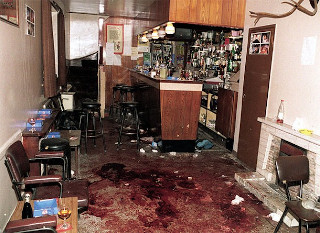
The Loughinisland massacre takes place on June 18, 1994, in the small village of Loughinisland, County Down, Northern Ireland. Members of the Ulster Volunteer Force (UVF), a loyalist paramilitary group, burst into a pub with assault rifles and fire on the customers, killing six civilians and wounding five. The pub is targeted because it is frequented mainly by Catholics. The UVF claims the attack is retaliation for the killing of three UVF members by the Irish National Liberation Army (INLA) two days earlier.

About 24 people are gathered in The Heights Bar, also known as O’Toole’s Pub, watching the Republic of Ireland vs. Italy in the 1994 FIFA World Cup. It is thus sometimes referred to as the “World Cup massacre.”

At 10:10 PM, two UVF members wearing boilersuits and balaclavas walk into the bar. One shouts “Fenian bastards!” and opens fire on the crowd with a vz. 58 assault rifle, spraying the small room with more than sixty bullets. Six men are killed outright, and five other people are wounded. Witnesses say the gunmen then run to a getaway car, “laughing.” One witness describes “bodies … lying piled on top of each other on the floor.” The dead were Adrian Rogan (34), Malcolm Jenkinson (52), Barney Green (87), Daniel McCreanor (59), Patrick O’Hare (35) and Eamon Byrne (39), all Catholic civilians. O’Hare is the brother-in-law of Eamon Byrne and Green is one of the oldest people to be killed during the Troubles.

The UVF claims responsibility within hours of the attack. It claims that an Irish republican meeting was being held in the pub and that the shooting was retaliation for the INLA attack. Police say there is no evidence the pub had links to republican paramilitary activity and say the attack is purely sectarian. Journalist Peter Taylor writes in his book Loyalists that the attack may not have been sanctioned by the UVF leadership. Police intelligence indicates that the order to retaliate came from the UVF leadership and that its ‘Military Commander’ had supplied the rifle used. Police believe the attack was carried out by a local UVF unit under the command of a senior member who reported to the leadership in Belfast.

The attack receives international media coverage and is widely condemned. Among those who send messages of sympathy are Pope John Paul II, Queen Elizabeth II and United States President Bill Clinton. Local Protestant families visit their wounded neighbours in the hospital, expressing their shock and disgust.

There have been allegations that police (Royal Ulster Constabulary) double agents or informants in the UVF were linked to the massacre and that police protected those informers by destroying evidence and failing to carry out a proper investigation. At the request of the victims’ families, the Police Ombudsman for Northern Ireland investigate the police. In 2011 the Ombudsman concludes that there were major failings in the police investigation, but no evidence that police colluded with the UVF. The Ombudsman does not investigate the role of informers and the report is branded a whitewash. The Ombudsman’s own investigators demand to be disassociated from it. The report is quashed, the Ombudsman replaced, and a new inquiry ordered.

In 2016, a new Ombudsman report concludes that there had been collusion between the police and the UVF, and that the investigation was undermined by the wish to protect informers but found no evidence police had foreknowledge of the attack. A documentary film about the massacre, No Stone Unturned, is released in 2017. It names the main suspects, one of whom is a member of the British Army and claims that one of the killers was an informer.


Leave a comment

Michael D. Higgins Meets Pope Francis in Rome

michael-higgins-and-pope-francis

President Michael D. Higgins discusses a range of issues including climate change, migration and the need to achieve social cohesion during a meeting with Pope Francis in Rome on May 22, 2017.

The meeting comes two days before Pope Francis is scheduled to meet with U.S. President Donald Trump, where the potential for disagreement is high as Trump has clashed with the pontiff on migrants and expressed skepticism about man-made impact on the environment. The meeting with President Higgins, however, is much more congenial as both leaders are very much on the same page.

Higgins is given the traditional welcome for visiting heads of state to the Vatican. He is walked through the frescoed rooms of the Vatican’s Apostolic Palace by men dressed in white tie and is then introduced to Pope Francis for their meeting, which lasts fifteen minutes.

Higgins’ visit comes six months after outgoing Irish Taoiseach Enda Kenny had a papal audience after which he confirmed the Pope would be coming to Ireland in 2018. While their discussions take place behind closed doors, it is likely that Higgins once again extends the invitation for Pope Francis to visit the country. The Pope ultimately visits Ireland August 25-26 as part of the World Meeting of Families 2018.

At the end of a seemingly warm and friendly encounter, Higgins presents the Pope a “climate bell” designed by renowned citizen-artist Vivienne Roche and is meant to represent a call to action on protecting the planet. “This is a very important symbol” the president tells the Pope before briefly ringing the bell.

For his part, the Pope presents Higgins with his landmark encyclical on climate change, Laudato si’, and his two apostolic exhortations, Evangelii gaudium and Amoris laetitia. He also presents the President with a medallion designed to represent the saying from Isaiah 32:15 which states “the desert will become a fertile ground.”

The audience takes place inside the Vatican Library with the use of an interpreter. Higgins, who has spent some time living in Latin America, concludes the meeting in the Pope’s native language, saying “muchos gracias.”


Leave a comment

Bill Clinton Begins Four Day Irish Visit

clinton-guildhall-square

Former U.S. president Bill Clinton begins a four-day visit to the Republic of Ireland and Northern Ireland on May 20, 2001 to try to advance the peace process. He spends time both north and south of the border, fulfilling engagements in Belfast, Derry, Enniskillen and Dublin.

Clinton’s goal is to use his influence to try to enhance the electoral fortunes of the parties that support the Good Friday Agreement, particularly David Trimble‘s Ulster Unionist Party, who are under pressure from Ian Paisley‘s anti-agreement Democratic Unionist Party (DUP).

Clinton arrives at Farranfore Airport, County Kerry, before heading to a round of golf at Ballybunion Golf Club with the former Irish deputy prime minister and Labour Party leader Dick Spring. He spends the night at Dromoland Castle, County Clare, before two days of public engagements in Dublin.

Trimble has vowed to quit as head of the Stormont Executive, where his party shares power with Sinn Féin, if the Irish Republican Party (IRA) has not started to get rid of its guns by July 1. Paisley, however, has accused Trimble and British Prime Minister Tony Blair of breaking their promises to the people of Northern Ireland by allowing into government a party linked to a terrorist group, without prior arms decommissioning.

While Clinton is no longer the most powerful man in the world, his charisma and his past efforts to keep the peace process moving are still appreciated by many. He receives Northern Ireland political leaders countless times at the White House and gives support and encouragement by phone during difficult periods of the peace talks.

Clinton delivers a lecture at Trinity College Dublin and attends a gala for peace and reconciliation at Dublin Castle, before travelling to Derry and then on to Belfast, where he receives an honorary degree from the former peace talks chairman George Mitchell, now chancellor of Queen’s University Belfast.

The leader of the Social Democratic and Labour Party (SDLP), John Hume, who welcomes Clinton to Derry, says the former president has done a great deal of good for all the people of Ireland. But the Democratic Unionist Party (DUP) deputy leader, Peter Robinson, claims that Clinton and Blair could have a negative effect on Trimble’s campaign. “As a unionist, I wouldn’t like to be sitting next to either of them just before an election,” he said. “Blair’s name is associated with the now-broken pledges he wrote on a board here just before the [Good Friday agreement] referendum, so for him to come over and moralise now won’t do much good. And Clinton is so disgraced and powerless that, while he might prop up the nationalist SDLP and Sinn Féin vote, he’ll have no impact on unionists voters.”

(Pictured: Bill Clinton and SDLP leader John Hume at public address at Guildhall Square in Derry. Sinn Féin leader Gerry Adams and Chelsea Clinton are in the second row.)


Leave a comment

Birth of Norman Whiteside, Northern Ireland Footballer

norman-whiteside

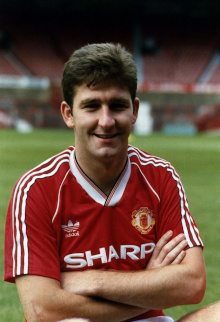
Norman Whiteside, former Northern Ireland international footballer who played in two World Cups, is born in Belfast, Northern Ireland on May 7, 1965. He plays both as a midfielder and as a striker.

Whiteside grows up on Shankill Road, and because of his aggressive, physical playing style he is later nicknamed the “Shankill Skinhead” by Manchester United supporters. The family later moves to 10 Danube Street. He remains relatively unscathed by The Troubles as his Protestant parents keep a firm watch on their children to ensure that they do not stray far from home and that none of them become involved with Ulster loyalism. At around seven years of age, he joins the Boys’ Brigade, and quickly shows his natural talent for football, scoring ten goals in a game against boys almost twice his age. He is educated at Cairnmartin High School and becomes famous in the Shankill area as a footballing prodigy by the age of eleven.

Whiteside is said to have been discovered by Ipswich Town scout Jim Rodgers, who is told by manager Bobby Robson to wait until Whiteside grows older. Instead, it is Manchester United’s 80-year-old Ulster scout Bob Bishop, who previously unearthed Belfast-born George Best and Sammy McIlroy for the club, who first offers him a trial at an English club. He finds that he has been offered schoolboy terms at the club during a school trip to the United States, on which he and his classmates meet President Jimmy Carter in the Oval Office, a rare and extraordinary occasion for children from a disadvantaged background.

Whiteside signs professional forms in 1982 at the age of 17 and quickly becomes a key member of the Manchester United club. He scores 68 goals in 278 league and cup appearances for the club over the next seven years, picking up two FA Cup winners medals in 1983 and 1985, as well as playing in the 1982 FA Youth Cup final, the 1983 League Cup final, and the FA Charity Shield in 1983.

Whiteside remains with United until July 1989, when he is sold to Everton F.C. for £600,000. However intense running sessions run by coach Mick Lyons take their toll on his right knee, and on September 20, 1990, he takes a knock in a practice match, which requires him to have another operation on his right knee. After the return of Howard Kendall as manager in November 1990, he manages to appear in a few reserve team games, but this only delays the inevitable, and he is forced to retire from the game at the age of 26 in June 1991.

Upon retirement, Whiteside studies to become a podiatrist, graduating with a degree from the University of Salford, and serves Northwich Victoria F.C. as their assistant manager/physio from October 1991 until March 1992. He quits the role as he does not enjoy the amount of time spent travelling between games. He instead became an after-dinner speaker and also works for the Professional Footballers’ Association, while taking a postgraduate course at Manchester Metropolitan University. He later takes up private practice as a podiatrist in Manchester. Since 1994, he has also worked at the corporate hospitality department at Old Trafford. In 2003, he releases a book entitled My Memories of Manchester United. With the help of writer Rob Bagchi, he releases his autobiography entitled Determined in August 2007, published by Headline Publishing Group, and with a foreword by actor James Nesbitt.

Whiteside holds records as the youngest player to take part in a World Cup, the youngest player to score in a League Cup and FA Cup final, and the youngest player to score a senior goal for Manchester United. Winning 38 caps for Northern Ireland, he plays at the 1982 and 1986 World Cups and also helps his country to win the last ever British Home Championship in 1983–1984.


Leave a comment

Inauguration of John Fitzgerald Kennedy

jfk-inauguration

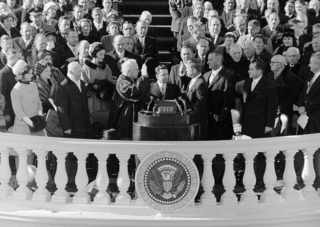
John Fitzgerald Kennedy is inaugurated as the 35th President of the United States on Friday, January 20, 1961, at the eastern portico of the United States Capitol in Washington, D.C., becoming the first Irish Catholic to be elected to the office. The inauguration marks the commencement of Kennedy’s only term as President and of Lyndon B. Johnson‘s only term as Vice President. Kennedy is assassinated 2 years, 306 days into this term, and Johnson succeeds to the presidency.

Kennedy takes office following the November 1960 presidential election, in which he narrowly defeats Richard Nixon, the then–incumbent Vice President. In addition to being the first Catholic to become President, he also becomes the youngest person elected to the office.

His inaugural address encompasses the major themes of his campaign and defines his presidency during a time of economic prosperity, emerging social changes, and diplomatic challenges. This inauguration is the first in which a poet, Robert Frost, participates in the program. Frost, then 86 years old, recites his poem “The Gift Outright” at Kennedy’s request as an act of gratitude towards Frost for his help during the campaign.

The oath of office for the President is administered to Kennedy by Chief Justice of the United States Earl Warren using a closed family Bible at 12:51 (ET) although he officially became president at the stroke of noon as defined by the 20th Amendment to the United States Constitution. He does not wear an overcoat when taking the oath of office and delivering the inaugural address, despite the cold conditions of 22 °F (−6 °C) with windchill at 7 °F (−14 °C) at noon.

Kennedy’s 1366-word inaugural address, the first delivered to a televised audience in color, is considered among the best presidential inaugural speeches in American history. It includes the iconic line “And so, my fellow Americans: ask not what your country can do for you—ask what you can do for your country.”

Five First Ladies, Edith Wilson, Eleanor Roosevelt, Bess Truman, Mamie Eisenhower and Jacqueline Kennedy attend the event, as does future First Ladies Lady Bird Johnson, Pat Nixon, and Betty Ford. Former President Harry S. Truman joins Presidents Dwight D. Eisenhower and Kennedy on the platform, as does future Presidents Lyndon B. Johnson, Richard M. Nixon and Gerald Ford, making this, retroactively, the largest conclave of the “presidential fraternity” prior to the opening of the Ronald Reagan Presidential Library and Museum in the 1990s.

Presidential inaugurations are organized by the Joint Committee on Inaugural Ceremonies. For Kennedy’s inauguration, this committee is chaired by Senator John Sparkman, and includes Senators Carl Hayden and Styles Bridges, and Representatives Sam Rayburn, John W. McCormack, and Charles A. Halleck.


Leave a comment

Birth of David Fulton, 4th Mayor of the Town of Little Rock

david-fulton

David Fulton, the fourth and final mayor of the Town of Little Rock, Arkansas, before it is incorporated, is born in the Parish of Templemore, County Donegal on January 2, 1771. He serves as mayor from January 1835 through November 1835, his term cut short by the transition of Little Rock from town to city status. Once that occurs in November 1835, a new election has to be held.

Fulton is also proprietor of the Tan Yard, a tanning operation in Little Rock. He later serves as a judge and is appointed as Surveyor General of Public Lands in Arkansas by U.S. President Martin Van Buren in 1838.

Fulton marries Elizabeth Savin in June 1795 in Maryland. She dies in November 1829, while they reside in Alabama. One of their children, William Savin Fulton (for whom Fulton County, Arkansas is named), serves as the fourth Territorial Governor of Arkansas in 1835 and 1836 and is one of Arkansas’ first United States Senators upon statehood in 1836. Fulton is serving as Mayor at the same time his son is Governor.

Fulton comes to Little Rock in 1833. His daughter, Jane Juliet Shall, and her four children come to Little Rock as well. The family makes the move to be nearer to the future governor. The Fultons and Shalls rent the Hinderliter House, now part of Historic Arkansas Museum, in 1834. One of his descendants, Louise Loughborough, is the person who saves the Hinderliter House from destruction and is founder of what is now Historic Arkansas Museum.

In addition to serving as Mayor, Fulton is president of the Anti-Gambling Society and a Pulaski County Justice of the Peace. From 1836 until 1838, he is County Judge of Pulaski County.

David Fulton dies in Little Rock on August 7, 1843 and is buried at Mount Holly Cemetery as are several other members of his family.

(From: “Little Rock Look Back: David Fulton, LR’s 4th Mayor” by Scott Whiteley Carter, Little Rock Culture Vulture blog, January 2, 2019)


Leave a comment

Birth of Brigadier General Thomas Alfred Smyth

thomas-alfred-smyth

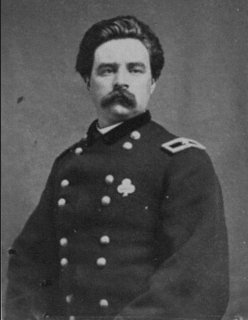
Thomas Alfred Smyth, brigadier general in the Union Army during the American Civil War, is born in Ballyhooly, County Cork on December 25, 1832. He is the last Union general killed in the war. In March 1867, he is nominated and confirmed a brevet major general of volunteers posthumously to rank from April 7, 1865.

Smyth works on his father’s farm in Ireland as a youth. He emigrates to the United States in 1854, settling in Philadelphia, Pennsylvania. He participates in William Walker‘s expedition to Nicaragua. He is employed as a wood carver and coach and carriage maker. In 1858, he moves to Wilmington, Delaware.

In 1861 Smyth enlists in the Union army in an Irish American three-months regiment, the 24th Pennsylvania, and is quickly made a captain. He is later commissioned as a major of the 1st Delaware Infantry, a three-years regiment. He serves at the battles of Chancellorsville and Fredericksburg, following which he is promoted to lieutenant colonel and then to colonel. During the Gettysburg campaign, he commands the 2nd Brigade, 3rd Division of the II Corps. During the Battle of Gettysburg, his men help defend Cemetery Ridge and advance to the area of the Bliss farm to oust enemy sharpshooters. He is wounded on the third day of the battle and relinquishes command briefly.

Smyth retains brigade command during the reorganization of II Corps before Ulysses S. Grant‘s Overland Campaign. He leads the second brigade of the first division from March 25 to May 17, 1864. When Colonel Samuel S. Carroll is wounded, Smyth is transferred to his command, the third brigade of second division, the Gibraltar Brigade. In October 1864, he is promoted to brigadier general during the Siege of Petersburg. He retains command of his brigade throughout the siege.

Between July 31, 1864, and August 22, 1864, and between December 23, 1864, and February 25, 1865, Smyth commands the 2nd division of the corps. In April 1865 near Farmville, Virginia, he is shot through the mouth by a sniper, with the bullet shattering his cervical vertebra and paralyzing him. He dies two days later at Burke’s Tavern, concurrent with the surrender of Robert E. Lee and his Confederate States Army at Appomattox Court House.

On March 18, 1867, President Andrew Johnson nominates Smyth for posthumous appointment to the grade of brevet major general of volunteers to rank from April 7, 1865, the date he was mortally wounded, and the United States Senate confirms the appointment on March 26, 1867. He is the last Union general killed or mortally wounded during the war and is buried in Wilmington and Brandywine Cemetery in Wilmington, Delaware.


Leave a comment

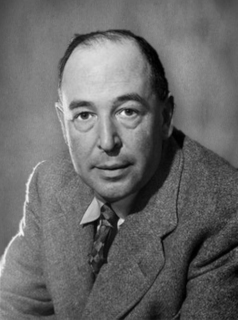
Birth of C.S. Lewis, Poet & Novelist

clive-staples-lewis

Clive Staples Lewis, novelist, poet, academic, medievalist, literary critic, essayist, lay theologian, and Christian apologist, is born in Belfast on November 29, 1898. He is best known for his works of fiction, especially The Screwtape Letters, The Chronicles of Narnia, and The Space Trilogy, and for his non-fiction Christian apologetics, such as Mere Christianity, Miracles, and The Problem of Pain.

Lewis is schooled by private tutors until age nine when his mother dies in 1908 from cancer. His father then sends him to live and study at Wynyard School in Watford, Hertfordshire. After the school is closed soon afterward, he attends Campbell College in the east of Belfast about a mile from his home, but leaves after a few months due to respiratory problems. He is then sent to the health-resort town of Malvern, Worcestershire, where he attends the preparatory school Cherbourg House. It is during this time that he abandons his childhood Christian faith and becomes an atheist. In September 1913, he enrolls at Malvern College. After leaving Malvern, he studies privately with William T. Kirkpatrick, his father’s old tutor and former headmaster of Lurgan College.

Lewis holds academic positions in English literature at both the University of Oxford (Magdalen College, 1925–1954) and the University of  Cambridge (Magdalene College, 1954–1963).

Lewis and fellow novelist J. R. R. Tolkien are close friends. They both serve on the English faculty at Oxford University and are active in the informal Oxford literary group known as the Inklings. He returns to Anglicanism at the age of 32, owing to the influence of Tolkien and other friends, and he becomes an “ordinary layman of the Church of England.” His faith profoundly affects his work, and his wartime radio broadcasts on the subject of Christianity bring him wide acclaim.

Lewis writes more than 30 books which have been translated into more than 30 languages and have sold millions of copies. The books that make up The Chronicles of Narnia have sold the most and have been popularised on stage, television, radio and cinema. His philosophical writings are widely cited by Christian apologists from many denominations.

In early June 1961, Lewis begins suffering from nephritis, which results in blood poisoning. He recovers but on July 15 of that year he falls ill and is admitted to the hospital where he suffers a heart attack the following day, lapses into a coma and awakens the next day. After he is discharged from the hospital his condition continues to decline. He is diagnosed with end-stage renal failure in mid-November. He collapses and dies in his bedroom on November 22. He is buried in the churchyard of Holy Trinity Church, Headington, Oxford.

Media coverage of Lewis’s death is almost completely overshadowed by news of the assassination of United States President John F. Kennedy, which takes place approximately 55 minutes after Lewis’s collapse.

In 2013, on the 50th anniversary of his death, Lewis is honoured with a memorial in Poets’ Corner in Westminster Abbey.


Leave a comment

Mary Robinson Elected Chancellor of the University of Dublin

File written by Adobe Photoshop? 4.0

United Nations High Commissioner for Human Rights, Mary Robinson, is elected Chancellor of the University of Dublin by the Trinity College Dublin senate on November 19, 1998. The University is the degree awarding body for Trinity College.

Robinson becomes the first woman in the university’s 406-year history to be elected to the position, making her the titular head of the University of Dublin of which Trinity College is the sole constituent, and represents it on ceremonial occasions. She is installed as Chancellor on December 17, 1998, replacing Dr. Francis Joseph Charles O’Reilly.

Born Mary Bourke in Ballina, County Mayo in 1944, the daughter of two physicians, she is educated at the University of Dublin (Trinity College), King’s Inns in Dublin and Harvard Law School to which she wins a fellowship in 1967. She graduates with a first class TCD law degree in 1967. She is Reid Professor of Constitutional and Criminal Law from 1969 to 1975, and lectures in European law from 1972 to 1990. She represents the university in Seanad Éireann from 1969 to 1989. She serves as the seventh (and first female) President of Ireland from 1990 to 1997.

The recipient of numerous honours and awards throughout the world including the Presidential Medal of Freedom from United States President Barack Obama, Robinson is a member of The Elders, former Chair of the Council of Women World Leaders and a member of the Club of Madrid. She is chair of the GAVI Alliance Board and President of the International Commission of Jurists.

She serves on several boards including the United Nations Global Compact, the Mo Ibrahim Foundation, is a member of the Royal Irish Academy and the American Philosophical Society and serves as President of the Mary Robinson Foundation – Climate Justice.


Leave a comment

Adoption of the Articles of Confederation

articles-of-confederation

The Articles of Confederation and Perpetual Union, the first written constitution of the United States is adopted by the Second Continental Congress on November 15, 1777. A number of the members of the Congress hail from Ireland including Secretary of the Congress Charles Thomson who is born in Maghera, County Derry in 1729. Thomson is the permanent Secretary of the Continental Congress for more than fifteen years. At least three signatories to the Declaration of Independence are Irish – James Smith, George Taylor, and Matthew Thornton.

The Articles of Confederation is approved, after much debate between July 1776 and November 1777, by the Second Continental Congress and sent to the states for ratification. The Articles come into force on March 1, 1781, after being ratified by all thirteen states. A guiding principle of the Articles is to preserve the independence and sovereignty of the states. The weak central government established by the Articles receives only those powers which the former colonies had recognized as belonging to king and parliament.

The document provides clearly written rules for how the states’ “league of friendship” is to be organized. During the ratification process, the Congress looks to the Articles for guidance as it conducts business, directs the war effort, conducts diplomacy with foreign nations, addresses territorial issues and deals with Native American relations. Little changes politically once the Articles of Confederation go into effect, as ratification does little more than legalize what the Continental Congress had already been doing. That body is renamed the Congress of the Confederation however most Americans continue to call it the Continental Congress, since its organization remains the same.

As the Confederation Congress attempts to govern the continually growing American states, delegates discover that the limitations placed upon the central government render it ineffective at doing so. As the government’s weaknesses become apparent, especially after Shays’ Rebellion, some prominent political thinkers in the fledgling nation begin asking for changes to the Articles. Their hope is to create a stronger national government.

Initially, some states meet to deal with their trade and economic problems. However, as more states become interested in meeting to change the Articles, a meeting is set in Philadelphia on May 25, 1787. This becomes the Constitutional Convention. It is quickly agreed that changes will not work, and instead the entire Articles needs to be replaced. On March 4, 1789, the government under the Articles is replaced with the federal government under the Constitution of the United States. The new Constitution provides for a much stronger federal government by establishing a chief executive (the President), courts, and taxing powers.