Newly widowed, Ceannt continues her republican activism, serving as Vice-President of Cumann na mBan and as a member of the Sinn Féin Standing Committee. She also plays a role in the development of the Sinn Féin Courts, a parallel legal system designed to offer an alternative to the British courts.
Ceannt is ardently opposed to the signature of the Anglo-Irish Treaty in December 1921. She is imprisoned by the Irish Free State government during the Irish Civil War in Mountjoy Prison for her anti-Treaty activity. Throughout the war, she serves at the highest levels within anti-Treaty Sinn Féin. In the years that follow, she spearheads efforts to secure state compensation for the widows and the children of those who had died in 1916 and in the Irish War of Independence. She serves as the head of the Children’s Fund of the Irish White Cross, an American-funded humanitarian organisation founded to assist victims of unrest in Ireland. She is a member of the Executive Committee of the Irish Red Cross.
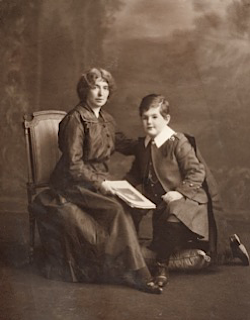
(Pictured: Photograph, circa 1917, of Áine and Ronan Ceannt, the family of Éamonn Ceannt, who is executed for his participation in the 1916 Easter Rising)
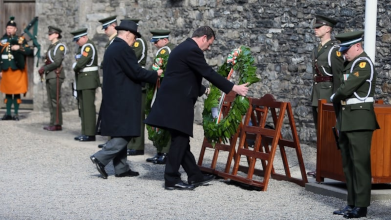
On Tuesday, May 3, 2016, ceremonies to mark the 100th anniversary of the executions of Tom Clarke, Patrick Pearse and Thomas MacDonagh are held in the Stonebreakers’ Yard in Kilmainham Gaol, the first executions of the leaders of the Easter Rising. Pearse, Clarke and MacDonagh are remembered in similar but distinct commemorations which take place on the spot where they died on May 3, 1916.
The transcripts of the short courts-martial are read aloud. In the case of Tom Clarke, who offered no defence and made no statement prior to his execution, the proceedings take only a few minutes to recount.
The presence of Capuchin friars from Church Street lends a sense of continuity to proceedings. Their predecessors had been there for the men in their final hours and their testimony is read aloud by their contemporaries.
Capuchin friar Adrian Kearns recalls the testimony of Fr. Columbus Murphy, who ministered to Pearse in his final hours. He did not “quail before the possibility of death . . . but faced his last moments with dignity and with grace.” Fr. Murphy remembered Pearse being a “sad, forlorn figure weighed down by the sense of responsibility” who lamented the loss of life and hoped it would not be in vain.
A wreath is laid on behalf of the Pearse family by his namesake Patrick Pearse, a great grandnephew.
Brother Peter Rogers recalls that Clarke was defiant rather than melancholic in his last hours. Fr. Murphy visited him as well. Clarke, the friar recalls, was “relieved that he was to be executed. His one dread was that he would be sent to prison again.” There is no member of Clarke’s family present to represent him at the commemorations, so a wreath is laid on behalf of the family by the staff of Kilmainham Gaol.
Several of MacDonagh’s surviving grandchildren are present. His granddaughter, Barbara Cashin, lays a wreath on behalf of the family. Her father Donagh and her aunt Barbara are left orphans a year after the Easter Rising when MacDonagh’s wife Muriel drowns off the coast of Skerries in July 1917. Cashin says her father had mixed feelings about the Rising, given the double tragedy that befell him and his sister a short time afterwards. “He had a horrendous childhood. He had a strange upbringing and hated to talk about it,” she says. “He had a split mind about it. I remember asking him as a child about it and saying he must be proud. Weren’t they wonderful. He said, ‘they may have been fools as well.’”
The commemorations are repeated the following day for the next four to have been executed: Joseph Plunkett, Edward Daly, Michael O’Hanrahan and Willie Pearse. Similar events are scheduled through May 12 to mark the exact centenary of the executions of the remaining eight men killed by a British Armyfiring squad at the Stonebreakers’ Yard.
In a letter to his family written on April 30, 1916, Thomas MacDonagh recalls “I was astonished to receive by a messenger from P.H. Pearse, Commandant General of the Army of the Irish Republic, an order to surrender unconditionality to the British General. I did not obey the order as it came from a prisoner. I as then in supreme command of the Irish Army, consulted with my second in command and decided to confirm the order. I knew that it would involve my death and the deaths of other leaders. I hoped that it would save many true men among our followers, good lives for Ireland. God grant it has done so and God approve our deed. For my self I have no regret. The one bitterness that death has for me is the separation it brings from my beloved wife Muriel, and my beloved children, Donagh and Barbara. My country will then treat them as wards, I hope. I have devoted myself too much to National work and too little to the making of money to leave them a competence. God help them and support them, and give them a happy and prosperous life. Never was there a better, truer, purer woman than my wife Muriel, or more adorable children than Don and Barbara. It breaks my heart that I shall never see my children again, but I have not wept or murmured. I counted the cost of this and am ready to pay it. Muriel has been sent for here. I do not know if she can come. She may have no one to take the children while she is coming. If she does.”
MacDonagh and Pearse are contemporaries of one another: poets, progressive educators, Gaelic revivalists. They are men who gird for battle “with a revolver in one hand and a copy of Sophocles in the other.” Each man commands a unit of Irish Volunteers during the Easter Rising, which takes place the week of April 24-30,1916. MacDonagh occupies Jacob’s biscuit factory and Pearse the General Post Office (GPO), from which he issues the surrender at the end of the week.
McDonagh and Pearse are signatories of the Proclamation of the Irish Republic, a document issued by the Irish Volunteers and the Irish Citizen Army at the beginning of the Easter Rising, proclaiming Ireland’s independence from the United Kingdom. The reading of the proclamation by Pearse outside the General Post Office (GPO) on Sackville Street (now O’Connell Street), Dublin‘s main thoroughfare, marks the beginning of the Rising.
Pearse’s and MacDonagh’s signatures on the Proclamation are a fatal endorsement for them and for each of the other five men to lend it their signatures. After being court-martialed, both Pearse and MacDonagh, along with Thomas Clarke, are executed by firing squad at Kilmainham Gaol in Dublin on May 3, 1916, the first of the rebels to be executed.
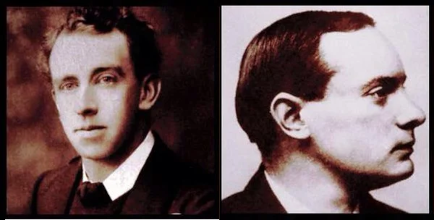
(Pictured: Thomas McDonagh (left) and Patrick Pearse)
Moving to Dublin by September 1916, MacDonagh is headmaster for a time of Patrick Pearse‘s St. Enda’s School, the bilingual school where his brother Thomas had formerly served on the staff under Pearse, which had reopened after the rising in Cullenswood House, Oakley Road, Rathmines. By 1918 he is in private practice as an income tax recovery expert. He later quips that by recovering thousands of pounds annually for clients, he has done greater harm to the British government than any other Irishman. He is also partner by 1919 in an insurance brokerage with fellow Sinn FéinTDWilliam Cosgrave. Following Cosgrave’s departure, the firm trades from 1920 as MacDonagh & Boland, with offices first on Dame Street, and latterly on College Green.
MacDonagh’s prominence in the post-1916 reorganisation of Sinn Féin commences at the April 19, 1917, convention of advanced nationalists summoned by George Noble Plunkett after his parliamentary by-election victory. MacDonagh makes a resounding speech ratifying Plunkett’s determination not only to abstain from attendance at Westminster, but also to affirm the principles of the republican Easter Week proclamation rather than the dual-monarchy programme of Sinn Féin under Arthur Griffith. After campaigning vigorously on behalf of the successful by-election candidacy of Éamon de Valera in East Clare, he is arrested on August 30 and sentenced to six-months’ imprisonment for making a seditious speech. He joins in the hunger strike of republican prisoners seeking prisoner-of-war status in Mountjoy Gaol, on which Thomas Ashe dies on September 25 after enduring forcible feeding. Released with the other surviving strikers, he is a principal witness at the emotional inquest into the circumstances of Ashe’s death.
Elected to the Sinn Féin executive at the October 1917 ardfheis, at which the party adopts a republican constitution, MacDonagh is alternately rearrested and released on several occasions under the “cat-and-mouse act,” enduring further hunger strikes in both Belfast and Dundalk jails, before serving out in its entirety the original six-month sentence (1917–18). After deportation to England and while incarcerated in Reading Gaol, he is returned unopposed in the 1918 United Kingdom general election in Ireland as Sinn Féin candidate in North Tipperary and is released in time to attend the second session of the first Dáil Éireann on April 10, 1919. With the Dáil driven underground in September 1919 after its proscription, he protests against the infrequency of sessions, querying whether “private members [were] to abstain from Dublin as well as Westminster.”
Elected in January 1920 to both Dublin Corporation and Rathmines town council, MacDonagh concentrates his political energies on local government until appointment in January 1921 as acting Dáil Minister for Labour, and director of the Belfast boycott. Exercising effective authority over the labour department because of the imprisonment of the minister, Constance Markievicz, he seeks to define a comprehensive industrial and economic strategy and establishes a labour commission to formulate proposals. The resultant radical plan for supplanting capitalist ownership by developing cooperative and distributive industrial structures is ignored by his cabinet colleagues. His organisation and enforcement of the Belfast boycott – a response to the anti-Catholic rioting of July 1920, and expulsion of workers from jobs and families from homes – is relentless and efficient. He appoints a team of boycott organisers and local boycott committees empowered to impose fines and to seize goods, and blacklists firms that are facilitating circumvention of the boycott by trans-shipment of Belfast goods through non-boycotted northern towns or through British ports.
Throughout the Irish War of Independence MacDonagh is constantly on the run, usually under disguise as a priest, and is imprisoned for a time in Mountjoy Gaol in 1920. One of four Sinn Féin candidates returned unopposed to the Second Dáil for Tipperary Mid, North, and South, after a cabinet reorganisation in August 1921 following the truce, he remains as boycott director but is removed from the Labour Department. Bitterly opposed to the Anglo–Irish Treaty, in the Dáil debates he responds to Griffith’s assertion that the agreement is indeed a treaty concluded between two sovereign nations by asking why the pro-Treatyites are conducting the sovereign Irish nation into the British empire, and whether they are doing so “with their heads up or their hands up.”
Manager of the anti-Treaty bulletin Poblacht na hÉireann, in the 1922 Irish general election MacDonagh is returned on the first count to the third seat in his constituency. Arrested soon after the outbreak of the Irish Civil War, he escapes from Portobello military barracks. Rearrested on September 30 and imprisoned in Mountjoy Gaol, he falls seriously ill with acute appendicitis but refuses to sign the required form to secure release for medical treatment because it implicitly recognises the legitimacy of the Free State government. Transferred at length to the Mater Misericordiae private nursing home, he undergoes an operation, but two days later, having developed peritonitis, he dies on December 25, 1922. He is buried in Glasnevin Cemetery.
A small, supple man with alert blue eyes, MacDonagh wielded a swift and stinging tongue in debate. It is said that he indulged his caustic wit more for the delight in the bon mot than for the bitterness of the invective. Genial in company, with a store of amusing anecdote, he was celebrated for hearty humour even in the face of hardship and danger. On a prison sickbed days before his death, he referred to another inmate, bald-headed like himself, “who wears his hair like mine.” In 1913, he married Margaret O’Toole of Dublin. They had one daughter and two sons. They resided in Rathmines, first at 86 Moyne Road, before moving during 1922 to 9 Palmerston Road.
(From: “MacDonagh, Joseph” by Lawrence William White, Dictionary of Irish Biography, http://www.dib.ie, October 2009)
De Bhaldraithe’s stance on standard forms and spellings is supported by Éamon de Valera despite opposition from traditionalists in the Department of Education, and the work is widely seen as an important benchmark in Irish scholarship.
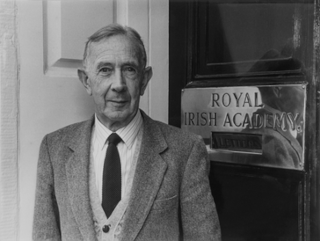
In 1942, de Bhaldraithe is appointed a professor at the Dublin Institute for Advanced Studies (DIAS) in the department of Celtic Studies. In 1960 he is appointed professor of modern Irish language and literature at University College Dublin (UCD), where he develops an impressive archive of material on Irish dialects. Much of the material in this archive is later used as the basis of Niall Ó Dónaill‘s Foclóir Gaeilge-Béarla, published in 1978, for which he is consulting editor. Also, during the 1970s, de Bhaldraithe translates the Irish language diary of Amhlaoibh Ó Súilleabháin, Cín Lae Amhlaoibh, into English. It is then published by Mercier Press as The Diary of an Irish Countryman.
The language laboratory which de Bhaldraithe sets up in UCD is the first of its kind in any university in Ireland. His interest in seanchas (folklore) leads to his publication of Seanchas Thomáis Laighléis in 1977, while his earlier work includes the ground-breaking study of the Cois Fharraige dialect (a variety of Connacht Irish), Gaeilge Chois Fharraige: Deilbhíocht. In later years he works extensively on the definitive Irish dictionary, Foclóir Stairiúil na Nua-Ghaeilge, which remains unfinished at the time of his death, but which is still in progress today.
De Bhaldraithe dies in Dublin on April 24, 1996, after launching a collection of a friend’s writings entitled The words we use. He marries Vivienne Ní Thoirdhealbhaigh in 1943 and they have nine children.
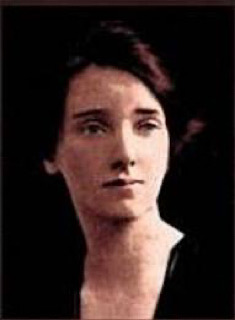
Muriel Enid Gifford is born at 12 Cowper Road, Rathmines, on December 18, 1884. She is the fourth daughter and eighth child of twelve of Frederick and Isabella Gifford. As a child, she suffers at different times from rheumatic fever and phlebitis. She attends Alexandra College and spends a brief time in England training to as a poultry instructor. Returning to Ireland, she trains at Sir Patrick Dun’s Hospital, Dublin, as a student nurse, but her health suffers from the work.
Along with her sisters, MacDonagh is active in the Irish Women’s Franchise League and Inghinidhe na hÉireann, a nationalist organisation. She is involved in the school meals programme of 1910 to 1911, takes part in a 1914 Women’s Franchise League fundraiser, appearing in a tableau vivant as Maeve, the Warrior Queen. Less ardently feminist than her sisters, she takes delight in inviting home activists and artists for a “proper meal.” In an outgoing family, she is shy and reserved, known for her gentle manner. In 1908, she is introduced to Thomas MacDonagh by suffragette journalist Nannie Dryhurst along with her sisters, Grace and Sidney, on a visit to St. Enda’s School. Dryhurst advises Thomas to “fall in love with one of these girls and marry her,” to which he replies laughingly, “That would be easy; the only difficulty would be to decide which one.” The Gifford sisters remain acquaintances with Thomas until the autumn of 1911, when the couple has a short and intense courtship. They meet secretly in galleries and museums and have copious correspondence. When he is appointed assistant lecturer to University College Dublin (UCD) in December 1911, they marry on January 3, 1912. They have one son, Donagh MacDonagh, and one daughter, Barbara MacDonagh Redmond. The family lives first at 32 Baggot Street, and later at 29 Oakley Road, Rathmines.
MacDonagh suffers with poor health and depression, which leads to periods of convalescence and confinement. When her husband is arrested after the Easter Rising, she is unable to see him before his execution on May 3, 1916, which heightens the intensity of her bereavement. Devastated by his death and estranged from her parents due to their disapproval of his involvement in the Rising, she briefly lives with the Plunketts at Larkfield, Kimmage, and then with relatives of her husband in Thurles, County Tipperary. She later returns to Dublin to rent rooms in a Plunkett family property, 50 Marlborough Road. With two young children to support, she is nearly destitute, but like the other widows and orphans of the executed leaders of the Rising, they are aided by the Irish Volunteers Dependents’ Fund, in her case with £250. She also serves as an officer and committee member on this aid association. Her husband had named her as his literary executor, and she prepares a collected edition of his poetry that is published in October 1916. The success of this volume, and his bestselling Literature in Ireland, published at the time he is executed, ease her financial difficulties somewhat.
MacDonagh dies while swimming in the sea during a holiday with other 1916 widows and orphans in Skerries, County Dublin, on July 9, 1917. She almost does not attend the holiday, as her son is in hospital having been injured in a fall. It is believed that she is attempting to swim to Shenick Island from Skerries, possibly to place a tricolour flag on the island’s Martello tower. Her body is found near Loughshinny Beach and, as there is no water in her lungs, it is concluded that she died of heart failure and not drowning. As there is great interest in the 1916 widows and their families, her funeral at Glasnevin Cemetery attracts a large crowd of mourners estimated at 5,000 in the funeral procession.
Following MacDonagh’s death, there is a legal custody battle between the Giffords and the MacDonaghs over Donagh and Barbara. Their aunt Mary MacDonagh, a nun known as Sister Francesca and with whom MacDonagh had grown close, wins custody. Even though several of her siblings offer to take the children, she places them in a foster home.
On the centenary of MacDonagh’s death, a festival takes place in Skerries in her memory.
Hackett is born into a working-class family in Dublin on July 25, 1893, the daughter of John Hackett, a hairdresser, and Roseanna Dunne. According to the 1901 census, she is living with her widowed mother and five other family members in a tenement building on Bolton Street in Dublin. The available documents suggest that her father dies when she is still very young. She joins the Irish Transport and General Workers’ Union (ITGWU) when it is established in 1909 by James Larkin, which marks the beginning of her lifelong activity in trade unionism. By 1911 she is living with her family in a cottage on Old Abbey Street, and her mother has remarried to Patrick Gray.
Hackett fights for many decades for the rights of workers. Through her affiliation and work with the ITGWU, the IWWU and the Irish Citizen Army, she helps carve out and secure modern-day working conditions. Her career begins as a packer in a paper store, then becoming a messenger for Jacob’s biscuits. At that time the working conditions in the factory are poor.
On August 22, 1911, Hackett helps organise the withdrawal of women’s labour in Jacob’s factory to support their male colleagues who are already on strike. With the women’s help, the men secure better working conditions and a pay rise. Two weeks later, at the age of eighteen, she co-founds the IWWU with Delia Larkin. During the 1913 lock-out she helps mobilise the Jacob’s workers to come out in solidarity with other workers. They, in turn, are locked out by their own employers. This does not stop her work to help others, and she, along with several of her IWWU colleagues, set up soup kitchens in Liberty Hall to help feed the strikers. However, in 1914 her Jacob’s employers sack her over her role in the lock-out.
Hackett begins work as a clerk in the printshop in Liberty Hall, and it is here she becomes involved with the Irish Citizen Army. She is involved in preparations for the 1916 Rising, working in a union shop, helping with printers, and making first-aid kits and knap-sacks.
If other members of the ITGWU were looking for James Connolly, Hackett aids in bringing them to him. She “worked as canvasser and traveler and was called on to carry out many confidential jobs.”
Hackett takes up first aid training provided by Dr. Kathleen Lynn for six months before the Rising and attends night marches organised by the Irish Citizen Army. According to her own account, she says, “A week before Easter, I took part in the ceremony of hoisting the challenge flag over Hall.” Like other girls and women who are involved in the Rising, she carries messages and guns and prepares uniforms and food for Irish Republican Army (IRA) members “and sometimes risky work.”
Three weeks before the Easter Rising, the Royal Irish Constabulary (RIC) raid a shop where Hackett is working. She is alone when they come, and they are looking for a copy of “Gael.” She says to them, “wait until I get the head” and she calls for Connolly. The police are stopped by Connolly and Helena Molony who are armed, and Hackett immediately hides everything, so that when the police come back, they cannot get anything.
Through her experience of working in the printshop, Hackett helps to print the Proclamation of the Irish Republic. She is in the printing room in Liberty Hall as a trusted messenger in 1916 when the Proclamation is printed, and it is the first time she is allowed in. Three men are there when she enters the room and one comes over to her, shakes her hand and congratulates her. It makes her very proud, especially since no one else is allowed to get in. She subsequently tells family members of handing it still wet to James Connolly before it is read by Patrick Pearse outside the entrance to the General Post Office (GPO).
Hackett is an active member of the Irish Citizen Army. On Easter Tuesday, under the command of Constance Markievicz, she takes part in the 1916 Rising and is located in the area of St. Stephen’s Green and the Royal College of Surgeons in Ireland. This position is heavily attacked with guns, short of first aid and “looked like a death trap.” However, after moving from an initially overlooked position in St. Stephen’s Green, it is one of the last positions to surrender. In the Royal College, as a first-aid practitioner, she is allowed entry to the lecture room sanctioned to the Red Cross only. Another first-aider, Aider Nora O’Daily, later reports that during those days, “I have a very kind remembrance of Little Rosie Hackett of the Citizen Army, always cheerful and always willing; to see her face about the place was a tonic itself.”
After surrendering, the rebels are taken to Dublin Castle. Hackett is imprisoned in Kilmainham Gaol for ten days.
In 1917, on the anniversary of Connolly’s death, Hackett, together with Helena Molony, Jennie Shanahan and Brigid Davis, print and hang a poster detailing the anniversary. After the first poster displayed by the ITGWU members is taken down by the police, they work to ensure that their poster will stay on Liberty Hall much longer by staying on top of the roof to defend it. They barricade the door using a ton of coal and nails on the windows. The poster is hanging there until 6:00 p.m. and thousands of people can see it.
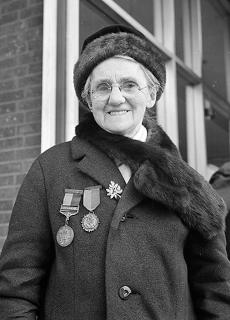
After the Rising, Hackett returns to the IWWU which, at its strongest, organises over 70,000 women. After the 1945 laundry strike, they win an extra week of paid holidays for the workers. She attends many important labour union events such as the opening of the new Liberty Hall on May 2, 1965, and Arbour Hill memorial services. Until her retirement, she runs the trade union shops resulting in over five decades of active participation in the Irish trades union movement work to improve conditions for Irish workers. In 1970 she is awarded a gold medal for fifty years of ITGWU membership.
In the 1970s, Walter McFarlane, then branch secretary of the ITGWU, awards an honorary badge for Hackett’s fifty years contribution to the union.
Hackett never marries and lives in Fairview, Dublin, with her brother Tommy until her death on May 4, 1976. She is buried at St. Paul’s plot in Glasnevin Cemetery next to her mother and stepfather. At her burial, she is honoured with a military salute and her coffin is covered with the Irish flag. After her passing, her legacy is remembered in the union’s newspaper, a tale of the strife of Hackett together with the rest of Dublin’s working class, for which she fought to change.
In May 2014, the Rosie Hackett Bridge is officially opened by the Lord Mayor of Dublin. The Hackett Bridge Campaign began in October 2012, led by three women Angelina Cox, an active member of Labour Youth, Jeni Gartland and Lisa Connell. The final shortlist of contending names for the new bridge were Rosie Hackett, Kathleen Mills, Willie Bermingham, Bram Stoker and Frank Duff.
In April 2015, a plaque is unveiled on Foley Street by the North Inner City Folklore Project to commemorate the women of the Irish Citizen Army. The plaque lists Hackett as a member of the St. Stephen’s Green/College of Surgeons garrison during the 1916 Easter Rising.
Among those to welcome the new organisation is Sinn Féin President, Éamon de Valera, who promises all the support he can offer. CardinalMichael Logue, CatholicPrimate of Ireland, also offers his assistance: “Even if peace were restored, of which there seems little prospect at present, all the help which can be obtained shall be necessary, to restore the country from the wreck to which it has been reduced, and to help those who have been left destitute by the murder of those on whom they depended, or ruined by the destruction of their property.”
The Irish White Cross is managed by the Quaker businessman, and later Irish Free Statesenator, James G. Douglas. The organisation continues to operate until the Irish Civil War and its books are officially closed in 1928. From 1922, its activities are essentially wound down and remaining funds divested to subsidiary organisations. The longest running of these aid committees is the Children’s Relief Association which distributes aid to child victims of this troubled period, north and south of the border, until 1947. The head of the Children’s Relief Association is Áine Ceannt, the widow of Éamonn Ceannt who is perhaps one of the least known signatories of the 1916 Proclamation of the Irish Republic.
Rosanna “Rosie” Hackett, Irish insurgent and trade union leader, is born into a working-class family in Dublin on July 25, 1893. She is a founder-member of the Irish Women Workers’ Union (IWWU) and supports strikers during the 1913 Dublin lock-out. She later becomes a member of the Irish Citizen Army and is involved in the 1916 Easter Rising. In the 1970s, the labour movement awards her a gold medal for decades of service, and in 2014 a Dublin city bridge is named in her memory.
Hackett is the daughter of John Hackett, a hairdresser, and Roseanna Dunne. According to the 1901 census, she is living with her widowed mother and five other family members in a tenement building on Bolton Street in Dublin. The available documents suggest that her father dies when she is still very young. She joins the Irish Transport and General Workers’ Union (ITGWU) when it is established in 1909 by James Larkin, which marks the beginning of her lifelong activity in trade unionism. By 1911 she is living with her family in a cottage on Old Abbey Street, and her mother has remarried to Patrick Gray.
Hackett fights for many decades for the rights of workers. Through her affiliation and work with the ITGWU, the IWWU and the Irish Citizen Army, she helps carve out and secure modern-day working conditions. Her career begins as a packer in a paper store, then becoming a messenger for Jacob’s biscuits. At that time the working conditions in the factory are poor.
On August 22, 1911, Hackett helps organise the withdrawal of women’s labour in Jacob’s factory to support their male colleagues who are already on strike. With the women’s help, the men secure better working conditions and a pay rise. Two weeks later, at the age of eighteen, she co-founds the IWWU with Delia Larkin. During the 1913 lock-out she helps mobilise the Jacob’s workers to come out in solidarity with other workers. They, in turn, are locked out by their own employers. This does not stop her work to help others, and she, along with several of her IWWU colleagues, set up soup kitchens in Liberty Hall to help feed the strikers. However, in 1914 her Jacob’s employers sack her over her role in the lock-out.
Hackett begins work as a clerk in the printshop in Liberty Hall, and it is here she becomes involved with the Irish Citizen Army. She is involved in preparations for the 1916 Rising, working in a union shop, helping with printers, and making first-aid kits and knap-sacks.
If other members of the ITGWU were looking for James Connolly, Hackett aids in bringing them to him. She “worked as canvasser and traveller and was called on to carry out many confidential jobs.”
Hackett takes up first aid training provided by Dr. Kathleen Lynn for six months before the Rising and attends night marches organised by the Irish Citizen Army. According to her own account, she says, “A week before Easter, I took part in the ceremony of hoisting the challenge flag over Hall.” Like other girls and women who are involved in the Rising, she carries messages and guns and prepares uniforms and food for Irish Republican Army (IRA) members “and sometimes risky work.”
Three weeks before the Easter Rising, the Royal Irish Constabulary (RIC) raid a shop where Hackett is working. She is alone when they come, and they are looking for a copy of “Gael.” She says to them, “wait until I get the head” and she calls for Connolly. The police are stopped by Connolly and Helena Molony who are armed, and Hackett immediately hides everything, so that when the police come back, they cannot get anything.
Through her experience of working in the printshop, Hackett helps to print the Proclamation of the Irish Republic. She is in the printing room in Liberty Hall as a trusted messenger in 1916 when the Proclamation is printed, and it is the first time she is allowed in. Three men are there when she enters the room and one comes over to her, shakes her hand and congratulates her. It makes her very proud, especially since no one else is allowed to get in. She subsequently tells family members of handing it still wet to James Connolly before it is read by Patrick Pearse outside the entrance to the General Post Office (GPO).
Hackett is an active member of the Irish Citizen Army. On Easter Tuesday, under the command of Constance Markievicz, she takes part in the 1916 Rising and is located in the area of St. Stephen’s Green and the Royal College of Surgeons in Ireland. This position is heavily attacked with guns, short of first aid and “looked like a death trap.” However, after moving from an initially overlooked position in St. Stephen’s Green, it is one of the last positions to surrender. In the Royal College, as a first-aid practitioner, she is allowed entry to the lecture room sanctioned to the Red Cross only. Another first-aider, Aider Nora O’Daily, later reports that during those days, “I have a very kind remembrance of Little Rosie Hackett of the Citizen Army, always cheerful and always willing; to see her face about the place was a tonic itself.”
After surrendering, the rebels are taken to Dublin Castle. Hackett is imprisoned in Kilmainham Gaol for ten days.
In 1917, on the anniversary of Connolly’s death, Hackett, together with Helena Molony, Jennie Shanahan and Brigid Davis, print and hang a poster detailing the anniversary. After the first poster displayed by the ITGWU members is taken down by the police, they work to ensure that their poster will stay on Liberty Hall much longer by staying on top of the roof to defend it. They barricade the door using a ton of coal and nails on the windows. The poster is hanging there until 6:00 p.m. and thousands of people can see it.
After the Rising, Hackett returns to the IWWU which, at its strongest, organises over 70,000 women. After the 1945 laundry strike, they win an extra week of paid holidays for the workers. She attends many important labour union events such as the opening of the new Liberty Hall on May 2, 1965, and Arbour Hill memorial services. Until her retirement, she runs the trade union shops resulting in over five decades of active participation in the Irish trades union movement work to improve conditions for Irish workers. In 1970 she is awarded a gold medal for fifty years of ITGWU membership.
In the 1970s, Walter McFarlane, then branch secretary of the ITGWU, awards an honorary badge for Hackett’s fifty years contribution to the union.
Hackett never marries and lives in Fairview, Dublin, with her brother Tommy until her death on July 4, 1976. She is buried at St. Paul’s plot in Glasnevin Cemetery next to her mother and stepfather. At her burial, she is honoured with a military salute and her coffin is covered with the Irish flag. After her passing, her legacy is remembered in the union’s newspaper, a tale of the strife of Hackett together with the rest of Dublin’s working class, for which she fought to change.
In May 2014, the Rosie Hackett Bridge is officially opened by the Lord Mayor of Dublin. The Hackett Bridge Campaign began in October 2012, led by three women Angelina Cox, an active member of Labour Youth, Jeni Gartland and Lisa Connell. The final shortlist of contending names for the new bridge were Rosie Hackett, Kathleen Mills, Willie Bermingham, Bram Stoker and Frank Duff.
In April 2015, a plaque is unveiled on Foley Street by the North Inner City Folklore Project to commemorate the women of the Irish Citizen Army. The plaque lists Hackett as a member of the St. Stephens Green/College of Surgeons garrison during the 1916 Easter Rising.
James Stephens formally establishes the Irish Republican Brotherhood (IRB) in Peter Lanigan’s timber yard, Lombard Street, Dublin, on Saint Patrick’s Day, March 17, 1858. It is originally named the Irish Revolutionary Brotherhood, but soon comes to be known as the Irish Republican Brotherhood. At the same time, John O’Mahoney is founding the American branch of the revolutionary group. O’Mahoney gives the organization the better-known name Fenians, in honor of the Fianna, the soldiers led by Fionn mac Cumhaill, the heroic warrior of Irish legend.
The IRB is a small, secret, revolutionary body whose sole object is to “establish and maintain a free and independent Republican Government in Ireland.” Stephens is a Young Irelander and is a lieutenant to William Smith O’Brien at the Battle of Widow McCormack’s Cabbage Patch in Ballingary, County Tipperary, in August 1848. He is wounded three times and is smuggled onto a ship to England and then to France, where he spends the next eight years. Upon his return to Dublin in 1856, he determines to organise a revolutionary movement and that leads to the founding of the IRB.
The IRB becomes known as the Fenian movement in the 1850s and 1860s and is committed to the use of force to establish an independent Irish republic. After organising an abortive rising in March 1867, it suffers deep internal divisions over its leadership and strategy in both the United States and Ireland—whether it is best to strike at England, in Ireland or in Canada. The issue is resolved after a series of failed interventions in Canada in 1866, 1867 and 1871, and after bombings in England that do not lead Ireland closer to independence. The IRB is unable to exploit the weaknesses and divisions in the constitutional movement following Charles Stewart Parnell’s divorce scandal (1890–91).
The IRB is eventually rejuvenated in Ireland about 1907, led by Bulmer Hobson and Tom Clarke, thus preparing the way for all that follows.The governing body is the Supreme Council. Before 1916 this consists of eleven members, and after the 1917 reorganisation it contains fifteen members. When not in session, all powers of the Supreme Council, except for declaring war, devolve onto an executive of three: the president, secretary and treasurer.
The constitution provides for the establishment of a military council, subordinate to the Supreme Council. The seven signatories of the 1916 Proclamation of the Irish Republic constitute the entire military council at the time. The constitution is dedicated to the use of force against England at any favourable opportunity, but this is to be a democratic decision: “The IRB shall await the decision of the Irish Nation as expressed by a majority of the Irish people as to the fit hour of inaugurating a war against England and shall, pending such an emergency, lend its support to every movement calculated to advance the cause of Irish independence, consistent with the preservation of its own integrity,” a clause adopted in 1873 in response to the controversies arising from the 1867 Fenian Rising.
The IRB plans the 1916 Easter Rising but the Irish Volunteers and the Irish Citizen Army make it possible. The establishment of the Irish Volunteers gives the IRB the great opportunity to train and equip its members as a military body for the purpose of securing independence for Ireland by force of arms and securing the cooperation of all Irish military bodies in the accomplishment of its objectives. Numerically the IRB probably never exceeds 2,000 members, but they are all extremely loyal and well trained, and there is very tight security. The executions of 1916 just about wipe out the Supreme Council, and after the prisoners are released, the IRB has to reconstitute itself.
Following the Easter Rising some republicans—notably Éamon de Valera and Cathal Brugha—leave the organization, which they view as no longer necessary, since the Irish Volunteers now perform its function. The IRB, during the Irish War of Independence (1919-21), is under the control of Michael Collins, who is secretary, and subsequently president, of the Supreme Council. Volunteers such as Séumas Robinson say afterwards that the IRB by then is “moribund where not already dead,” but there is evidence that it is an important force during the war.
When the Anglo-Irish Treaty is signed on December 6, 1921, it is debated by the Supreme Council, which votes to accept it by eleven votes to four. Those on the Supreme Council who oppose the Treaty include former leader Harry Boland, Austin Stack and Liam Lynch. Anti-Treaty republicans like Ernie O’Malley, who fought during the Irish Civil War against the Treaty, sees the IRB as being used to undermine the Irish Republic. The IRB becomes quiescent during the Irish Civil War, which ends in May 1923, but it emerges again later that year as a faction within the National Army that supports Minister for Defence Richard Mulcahy against the “Old IRA,” which fought against the recruitment of ex-British Army personnel and the demobilization of old IRA men. This comes to a head with the Irish Army Mutiny of 1924, in the wake of which Mulcahy resigns and other IRB members of the army are dismissed by acting President of the Executive CouncilKevin O’Higgins. The IRB subsequently dissolves itself, although it is not known whether a formal decision is taken, or it simply ceases to function.