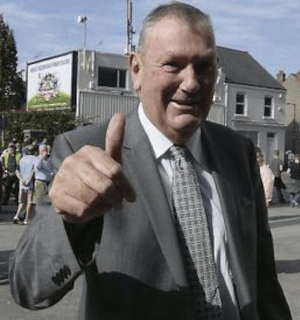
Ben Dunne, an Irish businessman, is kidnapped by the Provisional Irish Republican Army (IRA) on October 16, 1981. Former director of his family firm, Dunnes Stores, one of the largest chains of department stores in Ireland, he now owns a chain of fitness centres established by his company Barkisland Developments Limited.
Dunne is born in Cork, County Cork on March 3, 1949 to Nora Maloney and Ben Dunne, a business man who founded Dunnes Stores. He is the last of six children.
In 1981, he is kidnapped by the IRA and held for seven days. He is released unharmed after his friend and fellow businessman, Patrick Gallagher, pays his £1 million ransom.
In 1992, Dunne is arrested for cocaine possession and soliciting while on a golf holiday in Florida. His arrest triggers the end of his leadership of Dunnes Stores, as family turmoil leads to control falling to his sister Margaret Heffernan and the company paying IR£100 million for his share of the business.
Dunne is again embroiled in scandal in the mid-1990s when it emerges he had given large amounts of money to a number of Irish politicians, mainly from the Fianna Fáil party including the then Taoiseach, Charles Haughey. He also gave money to Michael Lowry of Fine Gael. Justice Brian McCracken, sole member of The McCracken Tribunal which is established by the Irish Government in 1997, finds that Dunne knowingly assisted Lowry in evading his tax obligations. On March 22, 2011, the Moriarty Tribunal concludes of Ben Dunne’s dealings with Michael Lowry that “What was contemplated and attempted on the part of Mr. Dunne and Mr. Lowry was profoundly corrupt to a degree that was nothing short of breathtaking.” The report refers to its finding Lowry sought to influence a rent review of a building part-owned by Dunne.
Dunne now owns a chain of fitness centres called Ben Dunne Gyms located in Dublin and Liverpool, which he personally promotes on radio, using recent Irish advertising legislation which allows direct comparisons to named competitors. He was working on a new health club, to open in Dún Laoghaire in Dublin, but abandons the project due to complaints from local residents.
In April 2005 Dunne pays £3,000,000 for a 21-acre site in Motspur Park, New Malden (South London), former home of BBC Football Club and other BBC sports facilities. His intent is to apply for planning permission to build a leisure and fitness centre, but he does not do so. Instead, in February 2008, his company Barkisland Developments Limited submits a planning application to the Kingston upon Thames London Borough Council for change of use of the sports ground to a cemetery. The application to change the former BBC Sports Ground into a cemetery is withdrawn on October 3, 2008 after it had become clear that planning permission was likely to be refused. Objections are lodged by many local residents, sports clubs, Sport England and the Mayor of London.
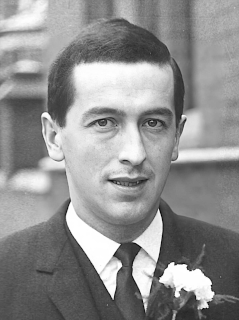
Stagg is the seventh child in a family of thirteen children. His father, Henry, and his uncle had both fought in the Irish War of Independence and Irish Civil War. His brother, Emmet Stagg, becomes a Labour Party politician and a Teachta Dála (TD) for Kildare North. He is educated to primary level at Newbrook Primary School and at CBS Ballinrobe to secondary level. After finishing his schooling, he works as an assistant gamekeeper with his uncle prior to emigrating to England in search of work. Once in England, he gains employment as a bus conductor in North London and later becomes a bus driver. While in England he meets and marries fellow Mayo native, Bridie Armstrong from Carnacon in 1970.
In 1972, Stagg joins the Lutoncumann of Sinn Féin and soon after becomes a volunteer in the Provisional Irish Republican Army (IRA).
In April 1973, Stagg is arrested with six others alleged to comprise an IRA unit planning bombing attacks in Coventry. He is tried at BirminghamCrown Court. The jury finds three of the seven not guilty. The remaining four are all found guilty of criminal damage and conspiracy to commit arson. Stagg and English-born priest, Father Patrick Fell, are found to be the unit’s commanding officers. Stagg is given a ten-year sentence and Fell is given twelve years. Thomas Gerald Rush is given seven years and Anthony Roland Lynch, who is also found guilty of possessing articles with intent to destroy property, namely nitric acid, balloons, wax and sodium chlorate, is given ten years.
Following the hunger strike that results in the death of Michael Gaughan, the Price sisters, Feeney and Kelly are granted repatriation to Ireland. Stagg is denied repatriation and is transferred to Long Lartin Prison. During his time there he is subject to solitary confinement for refusing to do prison work and is also subjected, along with his wife and sisters during visits, to humiliating body searches. In protest against this, he begins a second hunger strike that lasts for thirty-four days. This ends when the prison governor agrees to an end of the strip-searches on Stagg and his visitors. He is bed-ridden for the rest of his incarceration in Long Lartin, due to a kidney complaint.
In 1975 Stagg is transferred to Wakefield Prison, where it is demanded that he again do prison work. He refuses and is placed in solitary confinement. On December 14, 1975, he embarks on a hunger strike in Wakefield, along with a number of other republican prisoners, after being refused repatriation to Ireland during the IRA/British truce. His demands are an end to solitary confinement, no prison work and repatriation to prison in Ireland. The British government refuses to meet any of these demands and Stagg dies on February 12, 1976, after 62 days on hunger strike.
Stagg’s burial causes considerable controversy. Republicans and two of his brothers seek to have him buried in the republican plot in Ballina beside the grave of Michael Gaughan, in accordance with his wishes. His widow, his brother Emmet Stagg and the Irish government wish to have him buried in the family plot in the same cemetery and to avoid republican involvement in the funeral.
In order to prevent the body from being disinterred and reburied by republicans, the grave is covered with concrete. Local Gardaí keep an armed guard by the grave for six months. However, unknown to them, the plot beside the grave is available for purchase. Stagg’s brother George purchases the plot and places a headstone over it, with it declaring that the “pro-British Irish government” had stolen Frank’s body. In November 1977, a group of republicans dig down into the plot that George had purchased, then dig sideways and recover Stagg’s coffin from the adjacent plot under cover of darkness, before reburying it in the republican plot beside the body of Michael Gaughan. The Republicans hold their own version of a funeral ceremony before disappearing back into the night.
The IRA swears revenge over Stagg’s death, warning the British public it is going to attack indiscriminately. They explode about 13 bombs throughout England within a month after his death.
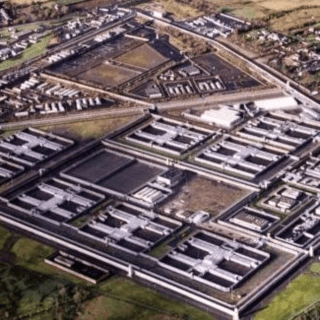
The Maze Prison escape, known to Irish republicans as the Great Escape, takes place on September 25, 1983, in County Antrim, Northern Ireland. HM Prison Maze, also known as Long Kesh, is a maximum-security prison considered to be one of the most escape-proof prisons in Europe, and holds prisoners suspected of taking part in armed paramilitary campaigns during the Troubles. In the biggest prison escape in UK history, 38 Provisional Irish Republican Army (IRA) prisoners escaped from H-Block 7 (H7) of the prison. One prison officer dies of a heart attack during the escape and twenty others are injured, including two who are shot with guns that had been smuggled into the prison. The escape is a propaganda coup for the IRA, and a British government minister faces calls to resign. The official inquiry into the escape places most of the blame onto prison staff, who in turn blame the escape on political interference in the running of the prison.
IRA volunteers regard themselves as prisoners of war with a duty to escape. During the Troubles, Irish republican prisoners escape from custody en masse on several occasions between 1971 and 1981.
Prisoners had been planning the 1983 escape for several months. Bobby Storey and Gerry Kelly start working as orderlies in H7, which allows them to identify weaknesses in the security systems. Six handguns are also smuggled into the prison. Shortly after 2:30 PM on September 25, prisoners seize control of H7 by simultaneously taking the prison officers hostage at gunpoint in order to prevent them from triggering an alarm. One officer is stabbed with a craft knife, and another is knocked down by a blow to the back of the head. One officer who attempts to prevent the escape is shot in the head by Gerry Kelly but survives. By 2:50 PM the prisoners are in control of H7 without an alarm being raised. A dozen prisoners also take uniforms from the officers, and the officers are forced to hand over their car keys and details of where their cars are, for possible later use during the escape. A rearguard is left behind to watch over hostages and keep the alarm from being raised until they believe the escapees are clear of the prison, at which time they return to their cells. At 3:25 PM, a lorry delivering food supplies arrives at the entrance to H7, whereupon Brendan McFarlane and other prisoners take the occupants hostage at gunpoint and move them inside H7. The lorry driver is told the lorry is being used in the escape, and he is instructed what route to take and how to react if challenged.
At 3:50 PM the prisoners leave H7, and the driver and a prison orderly are taken back to the lorry. Thirty-seven prisoners climb into the back of the lorry, while Gerry Kelly lay on the floor of the cab with a gun pointed at the driver, who is also told the cab has been booby trapped with a hand grenade. At nearly 4:00 PM the lorry drives toward the main gate of the prison, where the prisoners intend to take over the gatehouse. Ten prisoners dressed in guards’ uniforms and armed with guns and chisels dismount from the lorry and enter the gatehouse, where they take the officers hostage.
At 4:05 PM the officers begin to resist, and an officer presses an alarm button. When other staff respond via an intercom, a senior officer says while being held at gunpoint that the alarm had been triggered accidentally. By this time the prisoners are struggling to maintain control in the gatehouse due to the number of hostages. Officers arriving for work are entering the gatehouse from outside the prison, and each is ordered at gunpoint to join the other hostages. Officer James Ferris runs from the gatehouse toward the pedestrian gate attempting to raise the alarm, pursued by Dermot Finucane. Ferris had already been stabbed three times in the chest, and before he can raise the alarm he collapses.
Finucane continues to the pedestrian gate where he stabs the officer controlling the gate, and two officers who had just entered the prison. This incident is seen by a soldier on duty in a watchtower, who reports to the British Army operations room that he has seen prison officers fighting. The operations room telephones the prison’s Emergency Control Room (ECR), which replies that everything is all right and that an alarm had been accidentally triggered earlier.
At 4:12 PM the alarm is raised when an officer in the gatehouse pushes the prisoner holding him hostage out of the room and telephones the ECR. However, this is not done soon enough to prevent the escape. After several attempts the prisoners open the main gate and are waiting for the prisoners still in the gatehouse to rejoin them in the lorry. At this time two prison officers block the exit with their cars, forcing the prisoners to abandon the lorry and make their way to the outer fence which is 25 yards away.
Four prisoners attack one of the officers and hijack his car, which they drive toward the external gate. They crash into another car near the gate and abandon the car. Two escape through the gate, one is captured exiting the car, and another is captured after being chased by a soldier. At the main gate, a prison officer is shot in the leg while chasing the only two prisoners who have not yet reached the outer fence. The prisoner who fires the shot is captured after being shot and wounded by a soldier in a watch tower, and the other prisoner is captured after falling. The other prisoners escape over the fence, and by 4:18 PM the main gate is closed and the prison secured, after 35 prisoners had breached the prison perimeter. The escape is the biggest in British history, and the biggest in Europe since World War II.
Outside the prison the IRA has planned a logistical support operation involving 100 armed members, but due to a miscalculation of five minutes, the prisoners find no transport waiting for them and are forced to flee across fields or hijack vehicles. The British Army and Royal Ulster Constabulary immediately activate a contingency plan and by 4:25 PM a cordon of vehicle checkpoints are in place around the prison, and others are later in place in strategic positions across Northern Ireland, resulting in the recapture of one prisoner at 11:00 PM. Twenty prison officers are injured during the escape, thirteen are kicked and beaten, four stabbed, and two shot. One prison officer, James Ferris, who had been stabbed, dies after suffering a heart attack during the escape.
The escape is a propaganda coup and morale boost for the IRA, with Irish republicans dubbing it the “Great Escape.” Leading unionist politician Ian Paisley calls on Nicholas Scott, the Parliamentary Under-Secretary of State for Northern Ireland, to resign. The British Prime MinisterMargaret Thatcher makes a statement in Ottawa during a visit to Canada, saying “It is the gravest [breakout] in our present history, and there must be a very deep inquiry.” The day after the escape, Secretary of State for Northern IrelandJames Prior announces an inquiry to be headed by Her Majesty’s Chief Inspector of Prisons, James Hennessy. The Hennessy Report is published on January 26, 1984, placing most of the blame for the escape on prison staff, and making a series of recommendations to improve security at the prison. The report also places blame with the designers of the prison, the Northern Ireland Office and successive prison governors who had failed to improve security. Prior announces that the prison’s governor has resigned, and that there will be no ministerial resignations as a result of the report’s findings. Four days after the Hennessy Report is published, the Minister for Prisons Nicholas Scott dismisses allegations from the Prison Governors Association and the Prison Officers Association that the escape is due to political interference in the running of the prison.
Fifteen escapees are captured on the day, including four who are discovered hiding underwater in a river near the prison using reeds to breathe. Four more escapees are captured over the next two days, including Hugh Corey and Patrick McIntyre who are captured following a two-hour siege at an isolated farmhouse. Out of the remaining 19 escapees, 18 end up in the republican stronghold of South Armagh where two members of the IRA’s South Armagh Brigade are in charge of transporting them to safehouses and given the option of either returning to active service in the IRA’s armed campaign or a job and new identity in the United States.
On October 25, 1984, nineteen prisoners appear in court on charges relating to the death of prison officer James Ferris, sixteen charged with his murder. A pathologist determines that the stab wounds Ferris suffered would not have killed a healthy man. The judge acquits all sixteen as he cannot correlate the stabbing to the heart attack.
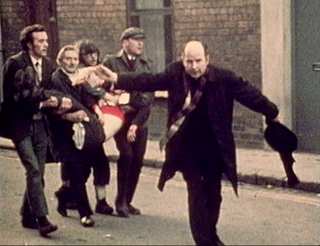
During his time in Derry, Daly takes part in the civil rights marches. He has first-hand experience of the Battle of the Bogside in 1969, the early years of the Troubles, internment, and the events of Bloody Sunday, in which British soldiers fire on unarmed protesters on January 30, 1972, killing 14 people. He becomes a public figure after he is witnessed using a blood-stained handkerchief as a white flag in an attempt to escort 17-year-old Jackie Duddy, a wounded protester, to safety. Duddy dies of his injuries soon after and Daly administers the last rites. He later describes the events as “a young fella who was posing no threat to anybody being shot dead unjustifiably.”
Daly gives an interview to the BBC in which he insists, contrary to official reports, that the protesters were unarmed. He testifies as such to the Widgery Tribunal, though he also testifies that he had seen a man with a gun on the day, to the anger of some of those involved. The Widgery Report largely exonerates the British Army, perpetuating the controversy. Years later, he says that the events of Bloody Sunday were a significant catalyst to the violence in Northern Ireland, and that the shootings served to greatly increase recruitment to the Irish Republican Army (IRA).
Prior to Bloody Sunday, Daly is sympathetic to the “old” IRA, of which his father was a member, but the events of Bloody Sunday leave him of the opinion that “violence is completely unacceptable as a means to a political end,” which leads to tension with the Provisional Irish Republican Army throughout his career.
Daly is appointed Bishop of Derry in 1974, a position he holds until he is forced to retire in October 1993 after suffering a stroke. He continues in the role of chaplain to Derry’s Foyle Hospice until February 2016.
Daly makes headlines in 2011 when he says there needs to be a place in the modern Catholic Church for married priests. He addresses the controversial issue in his book about his life in the Church, A Troubled See. Allowing clergymen to marry would ease the church’s problems, he says.
Daly is awarded the Freedom of the City by Derry City Council in 2015 in a joint ceremony with Bishop James Mehaffey, with whom he had worked closely while the two were in office. He is “hugely pleased to accept [the award], particularly when it is being shared with my friend and brother, Bishop James.” The city’s mayor, Brenda Stevenson, announces that the joint award is in recognition of the two bishops’ efforts towards peace and community cohesion.
Daly dies on August 8, 2016, at Altnagelvin Area Hospital in Derry, having been admitted after a fall several weeks previously. He had also been diagnosed with cancer. He is surrounded by family and local priests.
Daly’s remains are taken to St. Eugene’s Cathedral, where he lay in state with mourners able to file past. His coffin is sealed at midday on August 11, 2016, and buried after Requiem Mass in the grounds of St. Eugene’s Cathedral alongside his predecessor as Bishop of Derry, Neil Farren. The bells of the cathedral toll for one hour on the morning of Daly’s death while many local people arrived to pay tribute. The mayor of Derry, Hilary McClintock, opens a book of condolence in the city’s guildhall for members of the public to sign. The funeral, conducted by the incumbent Bishop of Derry Donal McKeown, is attended by multiple religious and political leaders from across Ireland and retired leaders from throughout his career. A message from Pope Francis is read aloud at the beginning of the service. Hundreds of members of the public also attend the funeral, some lining the route from the cathedral to the gravesite. His coffin is greeted with applause as it is carried out of the cathedral for burial.
(Pictured: Father Edward Daly, waving a blood-stained white handkerchief as he escorts a mortally-wounded protester to safety during the events of Bloody Sunday (1972) in Derry, Northern Ireland, an image which becomes one of the most recognisable moments of the Troubles)
Doherty is the third son in a family of six. He is born on October 16, 1955, in the Andersonstown area of Belfast and is educated at St. Theresa’s Primary School and Glen Road Christian Brothers School (CBS). The Doherty brothers are known cyclists and sportsmen in the Andersontown area. He wins an AntrimGaelic football medal at minor level in 1971.
Doherty joins Fianna Éireann in 1971 and is interned by the British Government between February 1973 and November 1975. His brothers Michael and Terence are interned between 1972 and 1974.
Doherty works as an apprentice heating engineer. His girlfriend is Geraldine Scheiss and, although they never become formally engaged, they become very close toward the end of his life. Before his arrest, she had not known that he is in the IRA.
In August 1976, while he is out to set a bomb, the van in which he is riding is chased by the Royal Ulster Constabulary (RUC). During the chase Doherty manages to leave the van and hijack a car. He later ditches the car and is found one mile away from the car. He is convicted and sentenced to 18 years for possession of firearms and explosives, with another four years for the hijack.
Doherty starts his hunger strike on May 22, 1981. While on hunger strike, he is elected as an Anti H-Block TD for the Cavan–Monaghan constituency at the 1981 Irish general election, which is held on June 11. He receives 9,121 (15.1%) first preference votes and is elected on the fourth count. The two seats gained by Anti H-Block candidates denies TaoiseachCharles Haughey the chance to form a government, and the 22nd Dáil Éireann sees a Fine Gael–Labour Party coalition government come to office, with Garret FitzGerald as Taoiseach.
Doherty dies at the age of 25 on August 2, 1981. He lasts 73 days on hunger strike, the longest of the 1981 hunger strikers, and only one day short of Terence MacSwiney. He is the shortest-serving Dáil deputy ever, serving as a TD for only two months.
Leading up to the attack, on April 9, 1990 four Ulster Defence Regiment (UDR) soldiers (Michael Adams, John Birch, John Bradley, Steven Smart) are killed in a similar attack when the IRA detonates a land mine under their patrol vehicle on Ballydugan Road, Downpatrick, County Down. The land mine contains over 1,000 lbs. of explosives.
On the afternoon of July 24, 1990, 37-year-old nun Catherine Dunne is driving an Austin Metro car with a passenger, Cathy McCann, a 25-year-old social worker. Some hours previously, members of the IRA take over a house close to Killylea Road, two miles outside Armagh, County Armagh, holding its occupants, a married couple and their children, at gunpoint.
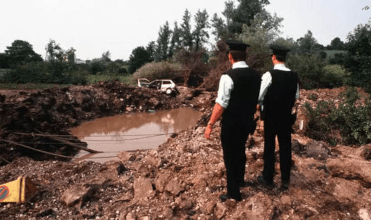
A detonating wire is placed from the house to a 1,000 lb. bomb, placed in a culvert under Killylea Road. At approximately 2:00 PM, as Dunne’s car is driving to Armagh, a Royal Ulster Constabulary patrol car is traveling in the opposite direction. Dunne’s car passes by the patrol car just as the police drive over the culvert, at which point the IRA detonate the bomb. Constable William James Hanson (37), and reserve officers Joshua Cyril Willis (35) and David Sterritt (34), are all killed instantly. Their car is blown into the air and lands upside down. Dunne and McCann are both severely injured with Dunne later dying of her injuries.
Witness Paul Corr, owner of a petrol filling station nearby, says, “The ground shook beneath us and it was accompanied by a very large explosion. At first we did not see the police car. The whole place was a terrible mess. Then we saw two young girls in the [Austin Metro]. They were unconscious and looked in a pretty bad way. There was nothing we could do for the policemen. Nobody could have come out of that car alive. It was dreadful.”
The bomb leaves a 20-foot-diameter crater in the two-lane road.
TaoiseachCharles Haughey is quoted as saying, “I know all the people of Ireland join me in my condemnation of this atrocity.”
The IRA releases a message claiming responsibility for the attack, and calls Dunne a victim of “unforeseen and fluke circumstances.” The statement is rejected in advance by political and Catholic and Protestant leaders alike and politicians in Ireland and Great Britain.
Sinn Féin‘s Martin McGuinness says, “Our sorrow at these deaths is genuine and profound, but will be abused by our political opponents who will cynically exploit yesterday’s events for their own political purpose.”
Pope John Paul II sends a message to be read at Dunne’s funeral in which he condemns the “grievous injustice and futility” of the murders that leave him “deeply shocked and saddened.” He implores “the men and women who espouse violence to recognise the grievous injustice and futility of terrorism.”
Two men, Henry McCartney (26) and Tarlac Connolly (29), are charged with the killings. They are later given life sentences but are released in 2000 under the terms of the Good Friday Agreement.
Article 38 of the Constitution of Ireland empowers Dáil Éireann to establish “special courts” with wide-ranging powers when the “ordinary courts are inadequate to secure the effective administration of justice.” The Offences against the State Act 1939 leads to the establishment of the Special Criminal Court for the trial of certain offences. The scope of a “scheduled offence” is set out in the Offences Against the State (Scheduled Offences) Order 1972.
On May 26, 1972, the Government of Ireland exercises its power to make a proclamation pursuant to Section 35(2) of the Offences against the State Act 1939 which leads to the establishment of the Special Criminal Court for the trial of certain offences. The current court is first established by the Dáil under the Offences against the State Act 1939 to prevent the Irish Republican Army (IRA) from subverting Ireland’s neutrality during World War II and the Emergency. The current incarnation of the Special Criminal Court dates from 1972, just after the Troubles in Northern Ireland began.
Although the court is initially set up to handle terrorism-related crime, its remit has been extended and it has been handling more organised crime cases after the Provisional Irish Republican Armyceasefire in the 1990s. For instance, members of the drugs gang which murdered journalistVeronica Guerin were tried in the Special Criminal Court.
Section 35(4) and (5) of the Offences against the State Act 1939 provide that if at any time the Government or the Parliament is satisfied that the ordinary courts are again adequate to secure the effective administration of justice and the preservation of public peace and order, a rescinding proclamation or resolution, respectively, shall be made terminating the Special Criminal Court regime. To date, no such rescinding proclamation or resolution has been promulgated. Following the introduction of a regular Government review and assessment procedure on January 14, 1997, reviews taking into account the views of the relevant State agencies are carried out on February 11, 1997, March 24, 1998, and April 14, 1999, and conclude that the continuance of the Court is necessary, not only in view of the continuing threat to State security posed by instances of violence, but also of the particular threat to the administration of justice, including jury intimidation, from the rise of organised and ruthless criminal gangs, principally involved in drug-related and violent crime.
The Special Criminal Court has been criticised by the Irish Council for Civil Liberties, Amnesty International and the United Nations Commission on Human Rights for its procedures and for being a special court, which ordinarily should not be used against civilians. Among the criticisms are the lack of a jury and the increasing use of the court to try organised “ordinary” crimes rather than the terrorist cases it was originally set up to handle. Critics also argue that the court is now obsolete since there is no longer a serious terrorist threat to the State, although others disagree and cite the continuing violence from dissident republican terrorism, international terrorism and serious gangland crime.
Under the law, the court is authorised to accept the opinion of a Garda Síochána chief-superintendent as evidence that a suspect is a member of an illegal organisation. However, the court has been reluctant to convict on the word of a garda alone, without any corroborating evidence.
The Sinn Féin political party in the past has stated that it is their intention to abolish the Special Criminal Court as they believed it was used to convict political prisoners in a juryless court, however Sinn Féin are no longer in favour of its abolition. Some prominent Sinn Féin members, including Martin Ferris and Martin McGuinness, have been convicted of offences by it. In 1973 McGuinness was tried at the SCC, which he refused to recognise, after being arrested near a car containing 250 pounds (110 kg) of explosives and nearly 5,000 rounds of ammunition. He was convicted and sentenced to six months imprisonment.
(Pictured: The Criminal Courts of Justice complex in Dublin where Special Criminal Court (SCC) sittings are usually held)
A farmer’s son, Kelly is raised amid the horror of the Irish Civil War. The family is burned out when he is five and, penniless, goes north to take a worker’s house near the Harland & Wolff shipyard in Belfast. Even though they are Protestant the Kellys are met with a cold welcome. To counter that, his mother starts a bakery while he and his father sell the hot rolls to the area pubs.
Kelly initially attends a shipyard workers’ school, sometimes without shoes, and then goes on to Methodist College Belfast, where only boys prepared to work hard are welcome. His mother, who had taught him to play the piano by marking out the keyboard on the kitchen table, is so cross when she hears that he has been playing football in the street that she tells the headmaster that he does not have enough homework.
On a visit to an elder sister at Trinity College, Dublin, Kelly is so impressed by her smoking and her painted nails that he decides to follow her to the university, where he reads legal science. After being called to the Bar of Northern Ireland in 1944, he has the usual slow start, traveling up to 100 miles to earn a five-guinea fee. However, aided by a photographic memory and the patronage of Catholicsolicitors, he gradually builds up a large practice, concentrating on crime and workers’ compensation while earning a reputation as the finest cross-examiner in the province.
Kelly first makes a mark by his successful defence of an aircraftman accused of killing a judge’s daughter. The man is found guilty but insane, though the complications involved bring it back to court 20 years later. After appointment as Queen’s Counsel in 1958 he skillfully conducts two cases which go to the House of Lords. One involves the liability of a drunken psychopath, the other the question of automatism where a person, acting like a sleepwalker, does not know what he is doing.
In 1973, Kelly is appointed as a judge of the High Court of Northern Ireland, and then as a Lord Justice of Appeal of Northern Ireland in 1984, when he is also knighted and appointed to the Privy Council of the United Kingdom. On the bench he proves a model of fairness and courtesy with a mastery of facts, but his role often puts him in danger.
A Provisional Irish Republican Army (IRA) gang once targets him with a bomb-laden milk van, intending to drive it through his gates. But the police are alerted and immediately take him to Stormont, where he lives for the next two months.
For a year Kelly presides alone over a non-jury Diplock court, protected by armed police and wearing a bulletproof vest before writing his judgment under Special Air Service (SAS) guard in England. He convicts dozens of people on “supergrass” evidence, though there are subsequently doubts about the informant and some of his judgments are overturned.
One of the accused, Kevin Mulgrew, is sentenced to 963 years in prison, with Kelly telling him, “I do not expect that any words of mine will ever raise in you a twinge of remorse.” While the IRA grumbles about the jail terms he dispenses, and he is often portrayed as an unthinking legal hardliner by Sinn Féin, he is a more subtle figure and is often merciful towards those caught up in events or those whom he considers too young for prison.
Kelly retires in 1995 and moves to England, where he dies at the age of 88 at his home in Berkshire on December 5, 2008, following a short illness. He is survived by his wife, Pamela Colmer.
(From: “Basil Kelly,” Independent.ie (www.independent.ie), January 4, 2009)
The IRA’s East Tyrone Brigade is active mainly in eastern County Tyrone and neighbouring parts of County Armagh. By the mid-1980s it had become one of the IRA’s most aggressive formations. The British security forces receive intelligence of the IRA’s plan weeks prior to the attack and learn the target at least 10 days before the attack. It has been alleged that the security forces had a double agent inside the IRA unit, and that he was killed by the British Army‘s Special Air Service (SAS) during the ambush. Other sources claim that the security forces had instead learned of the ambush through other surveillance methods.
Three local RUC officers work at the station, which is only open part-time, from 9:00 AM to 11:00 AM, and from 5:00 PM to 7:00 PM daily.The IRA’s attack involves two teams. One team is to drive a digger with a bomb in its bucket through the base’s perimeter fence and light the fuse. At the same time, another team is to arrive in a van and open fire on the base, with the intent of killing the three RUC officers as they come off duty.
The IRA unit arrives in Loughgall from the northeast shortly after 7:00 PM, when the station is scheduled to close for the night. They are armed and wearing bulletproof vests, boilersuits, gloves and balaclavas. The digger drives past the police station, turns around and drives back again with the Toyota van carrying the main IRA assault party doing the same. Not seeing any activity in the station, members of the IRA unit feel that something is amiss and debate whether to continue, but decide to go ahead with the attack. Tony Gormley and Gerard O’Callaghan get out of the van and join Declan Arthurs on the digger. At about 7:15 PM Arthurs drives the digger towards the station with the front bucket containing 300–400 lbs. of Semtex inside an oil drum, partially hidden by rubble and wired to two 40-second fuses. The other five members of the unit follow in the van with Eugene Kelly driving, unit commander Patrick Kelly in the passenger seat, with unit commander Jim Lynagh, Pádraig McKearney, and Seamus Donnelly in the back seat.
The digger crashes through the light security fence and the fuses are lit. The van stops a short distance ahead and, according to the British security forces, three of the team jump out and fire on the building with automatic weapons. At the same time, the bomb detonates, the blast destroying the digger and badly damaging the building.
Within seconds the SAS opens fire on the IRA attackers from the station and from hidden positions outside. All eight IRA members are killed in the hail of gunfire, each with multiple wounds to their bodies. Declan Arthurs is shot in a lane-way opposite Loughgall F.C. premises. Three of the IRA members are shot at close range as they lay either dead or wounded on the ground. Three other IRA members in the scout cars escape from the scene, managing to pass through British Army and RUC checkpoints set up after the ambush had been sprung. The two RUC Headquarters Mobile Support Unit (HMSU) officers are injured in the explosion and an SAS soldier receives a facial injury from glass after a window is broken by gunfire.
Two civilians, brothers Anthony and Oliver Hughes, traveling in a car that happens to drive into the scene of the ambush while it is underway are also fired upon by the British forces. Oliver is wearing overalls similar to those being worn by the IRA unit. About 130 yards from the police station, British soldiers open fire on their car from behind, killing Anthony and badly wounding Oliver. The villagers had not been told of the operation and no attempt had been made to evacuate anyone or to seal off the ambush zone, as this might have alerted the IRA.
The security forces recover eight IRA firearms from the scene. The RUC links the weapons to seven known murders and twelve attempted murders in the Mid-Ulster region. On of the weapons, a Ruger Security-Six, had been stolen from Reserve RUC officer William Clement, killed two years earlier in the IRA attack on Ballygawley RUC base. It is found that another of the guns had been used in the murder of Harold Henry, a builder employed by the British Army and RUC in facilities construction in Northern Ireland.
(Pictured: Mural commemorating the IRA members killed in the ambush)
At the start of the twentieth century, the people of Ireland are divided into two mutually hostile factions. The much larger group (nationalists) are mostly Roman Catholic, identified primarily as Irish, and want some form of Irish home rule or independence from Britain. The smaller group (unionists), concentrated primarily in the province of Ulster, are mostly Protestant, identified primarily as British and are committed to remaining within the United Kingdom. In the years before World War I, both groups establish armed militias intended to enforce their aims and protect their communities from the other side’s militias. The British government resolves to partition Ireland in an effort to alleviate unionists and nationalists, with the six most Protestant counties of Ulster forming Northern Ireland while the rest of Ireland achieves self-rule. This is accepted by most unionists as the best deal they are likely to get, but bitterly disappoints many nationalists, especially those who live in the six counties which become Northern Ireland. Many nationalists on both sides of the border feel that their country has been unjustly divided, and for many decades the Irish government claims that Northern Ireland is rightfully its territory.
Partition is formally established with the Government of Ireland Act 1920. This also establishes the Parliament of Northern Ireland, which comes into being the following year. Partition is followed by high levels of inter-communal violence, especially in Belfast. The Irish Republican Army (IRA), although it spends most of these years fighting in the Irish Civil War, aims to use armed force to end partition and compel the United Kingdom to withdraw sovereignty from Northern Ireland.
The Special Powers Act is presented as being necessary to re-establish peace and law and order in Northern Ireland and enable the government to “take all such steps and issue all such orders as may be necessary for preserving the peace and maintaining order,” although it is specified that the ordinary course of law should be interfered with as little as possible. The Minister of Home Affairs is empowered to make any regulation felt necessary to preserve law and order in Northern Ireland. Anyone who breaks these regulations can be sentenced to up to a year in prison with hard labour, and in the case of some crimes, whipping. A special summary jurisdiction is enabled to hear cases involving such crimes. The Minister of Home Affairs is also permitted to forbid the holding of inquests if he feels this is required to preserve order and peace.
The Schedule to the Act specifies actions which the government can take in order to preserve peace, although the body of the Act enables the government to take any steps at all which it thinks necessary. Actions specified in the Schedule include the closing of licensed premises, the banning in any area of meetings and parades in public places, the closing of roads, the taking of any land or property, and the destruction of any building. The Schedule also forbids the spreading by word of mouth or text any “reports or…statements intended or likely to cause disaffection to subjects of His Majesty.”
Because it is presented as emergency legislation, the Special Powers Act is initially current for only one year and has to be renewed annually. In 1928, however, it is renewed for five years and when this period expires in 1933 the Act is made permanent. According to John Whyte, this happens because, from 1925, nationalist MPs begin sitting in the Stormont parliament which they had initially boycotted. Unsurprisingly, they object strenuously to the renewal of the Act, and it is felt by the Ulster Unionist Party Minister of Home Affairs that it would be better to make the Act permanent than for Parliament annually to “wrangle” over it.
Initially, regulations under the Act are used mostly to curb immediate violence and disorder. One of the most controversial of these is internment without trial, outlined in Paragraph 23 of the Schedule. In the period from May 1922 to December 1924, 700 republicans are interned under the Act.
Political violence declines dramatically by 1925, and the government gradually shifts its emphasis from broad measures designed to return civil order to the province to more preventative regulations aimed at suppressing the threat posed by republican aspirations. Regulations banning meetings and parades and restrictions on the flying of the Irish tricolour become more common. Between 1922 and 1950, the government bans nearly 100 parades and meetings, the vast majority of which are nationalist or republican. No loyalist gathering is ever directly banned under the Act, although a few are caught in blanket bans against parades or meetings in a particular area. From 1922 until 1972, 140 publications are banned, the vast majority of which express republican viewpoints.
After the troubles of the early 1920s has died down, the provision for internment is not used until the IRA’s border campaign of the 1950s, in which several hundred republicans are interned. Following the outbreak of the Troubles in 1968, many within the Protestant community call for the reintroduction of internment. This occurs in 1971 and authorises internment of those suspected to be involved in terrorism. Although there is loyalist as well as republican terrorists at this time, of the 1,981 men interned, only 107 are loyalists.
Internment ends in 1975 but is credited with increasing support and sympathy for the Provisional Irish Republican Army amongst the Catholic community and outside of Northern Ireland. It helps to create political tensions which culminate in the 1981 Irish Hunger Strike and the death of MP Bobby Sands. Imprisonment under anti-terrorism laws specific to Northern Ireland continue until the 1998 Good Friday Agreement, but these laws require the right to a fair trial be respected.
The Act encounters further controversy in the 1970s due to the deployment of the British Army in Northern Ireland and its role in maintaining order and similar policing-style duties. In 1972, the government is forced to amend the Act in order to legalise the detention of internees arrested by soldiers. Martin Meehan had been arrested after escaping from Crumlin Road Gaol and charged with escaping from lawful custody. At his trial he successfully argues that under the Special Powers Act a soldier has no power of arrest and, as such, he has the legal right to escape. He is awarded £800 in compensation for being illegally detained for twenty-three days.




 seamus dubhghaill