On May 14, 2009, Byrne is a substitute for a Liverpool F.C. Legends XI that plays against an All Star XI in a Hillsborough Memorial match to mark the 20th anniversary of the Hillsborough disaster. He represented the Republic of Ireland at U15, U16 and U18 levels.
In June 1998, Byrne attends an audition for new Irish boyband, where Boyzone manager Louis Walsh approaches him to join his new venture, Westlife. He joins Westlife along with Kian Egan, Mark Feehily, Shane Filan and Brian McFadden. With Westlife, he has had 25 top ten UK singles, fourteen of which are number one, seven number one albums and has sold in excess of over 45 million records worldwide. He also has a number one single in Ireland in 2002, alongside the Republic of Ireland national football team and Dustin the Turkey with the Irish 2002 FIFA World Cup anthem, “Here Come the Good Times (Ireland).” He also co-writes many of Westlife’s songs.
On September 7, 2012, it is announced that Byrne will be a contestant for the tenth series of Strictly Come Dancing. He is the ninth contestant to be eliminated. He is ranked number two on Ireland’s Sexiest Man of 2014.
In early January 2016, it is rumored that RTÉ had internally chosen Byrne to represent Ireland in the Eurovision Song Contest 2016. On January 13, he is confirmed to be the Irish singer for the 2016 contest in Stockholm with the song, “Sunlight.” He performs it in the second semi-final but fails to advance to the final.
Byrne’s wife Georgina is the daughter of former TaoiseachBertie Ahern, and they have twin sons, Rocco Bertie Byrne and Jay Nicky Byrne, and a daughter, Gia.
Keating studies drawing at the Limerick Technical School before a scholarship arranged by William Orpen allows him to go study at the Metropolitan School of Art in Dublin at the age of twenty. Over the next few years, he spends two weeks or so during the late summer on the Aran Islands and his many portraits of island people depict them as rugged heroic figures.
In 1914 he wins the RDS Taylor award with a painting titled The Reconciliation. The prize includes £50.00 which allows him to go to London to work as Orpen’s studio assistant in 1915. In late 1915 or early 1916, he returns to Ireland where he documents the Irish War of Independence and the subsequent Irish Civil War. Examples include Men of the South (1921–22) which shows a group of Irish Republican Army (IRA) men ready to ambush a military vehicle and An Allegory (first exhibited in 1924), in which the two opposing sides in the Irish Civil War are seen to bury the tri-colour covered coffin amid the roots of an ancient tree. The painting includes a self-portrait of the artist.
Keating is elected an Associate of the Royal Hibernian Academy (RHA) in 1918, and a full member in 1923. One of the cardinal achievements of the Irish Free State in the 1920s is the building, in partnership with Siemens, of a hydro-electric power generator at Ardnacrusha, near Limerick. Between 1926 and 1927, at his own volition, he produces a considerable number of paintings related to this scheme. He exhibits several examples of the paintings in the RHA exhibitions in 1927 and 1928. Most of the paintings are now in the collection of ESB Group.
In 1936 group of prominent Limerick politicians, artists and patrons establish the first Limerick City Collection of Art from various donations and bequests. Keating is part of this artist-led initiative to form a municipal art gallery in Limerick similar to those already in Dublin and Cork. The collection is formed primarily out of donations and bequests. As a pivotal member of the committee, Keating himself donates many works to the collection which is first exhibited as a municipal collection in the Savoy Cinema, Limerick City on November 23, 1937. It is not until 1948 that an extension to the rear of Limerick Free Library and Museum becomes the home to the City Collection as the Limerick Free Art Gallery. In 1985 the Library and Museum are transferred to larger buildings.
In 1939 Keating is commissioned to paint a mural for the Irish pavilion at the New York World’s Fair. He is President of the RHA from 1950 to 1962, and shows at the annual exhibition for 61 years from 1914. Although he is an intellectual painter in the sense that he consciously sets out to explore the visual identity of the Irish nation, and his paintings show a very idealised realism, he fears that the modern movement will bring back a decline in artistic standards. Throughout his career, he exhibits nearly 300 works at the RHA and also shows at the Oireachtas.
Seán Keating dies on December 21, 1977 at the Adelaide Hospital in Dublin and is buried at Cruagh Cemetery, Rathfarnham. The 1978 RHA Exhibition features a small memorial collection of his work.
Posthumous exhibitions of his work are mounted by The Grafton Gallery, Dublin (1986) and the Electricity Supply Board (1987). Sean Keating – The Pilgrim Soul, a documentary presented and written by his son Justin Keating, airs on RTÉ in 1996.
(Pictured: Photograph of Keating’s “An Allegory” painted between 1922 and 1924. The painting represents Keating’s own disillusionment and loss of idealism resulting from the outbreak of the Irish Civil War. The only figure of the group addressing the observer is a self-portrait of the artist.)
O’Riordan is the youngest of nine children, two of whom die in infancy. Her father, Terence Patrick “Terry” O’Riordan (1937–2011), is a farm labourer who is left unable to work due to brain damage caused by a motorbike accident in 1968. Her mother, Eileen, is a school caterer. She attends Laurel Hill Coláiste FCJ school in Limerick. She leaves school without any qualifications.
In 1989, brothers Mike and Noel Hogan form The Cranberry Saw Us with drummer Fergal Lawler and singer Niall Quinn, in Limerick. Less than a year later, Quinn leaves the band. The remaining band members then place an advertisement for a female singer. O’Riordan responds to the advertisement and auditions by writing lyrics and melodies to some existing demos. When she returns with a rough version of “Linger,” she is hired, and they record Nothing Left At All, a three-track EP released on tape by local record label Xeric Records, which sells 300 copies. The group changes their name to “The Cranberries.” The owner of Xeric Studios, Pearse Gilmore, becomes their manager and provides the group with studio time to complete another demo tape, which he produces. It features early versions of “Linger” and “Dreams,” which are sent to record companies throughout the United Kingdom (UK).
Are You Listening? is released in Ireland on May 4, 2007, in Europe on May 7, and in North America on May 15. In 2008, O’Riordan wins a European Border Breakers Award (EBBA) which is presented annually to recognize the success of ten emerging artists or groups who reach audiences outside their own countries with their first internationally released album in the past year. Her second album, No Baggage, featuring eleven tracks, is released in August 2009.
In January 2009, the University Philosophical Society at Trinity College, Dublin invites The Cranberries to reunite for a concert celebrating O’Riordan’s appointment as an honorary member of the Society, which leads the band members to consider reuniting for a tour and a recording session. On August 25, 2009, while promoting her solo album No Baggage in New York City on 101.9 RXP radio, O’Riordan announces the reunion of the Cranberries for a world tour. The tour begins in North America in mid-November, followed by South America in mid-January 2010 and Europe in March 2010. She remains in the band until her unexpected death.
She appears as a judge on RTÉ‘s The Voice of Ireland during the 2013–2014 season. In April 2014, O’Riordan joins and begins recording new material with the trio D.A.R.K.
On January 15, 2018, at the age of 46, while in London for a recording session, O’Riordan dies suddenly at the London Hilton on Park Lane hotel in Mayfair. The cause of death is not immediately made public. Police say it is not being treated as suspicious. The coroner’s office says the results of its inquiry would not be released until April 3 at the earliest. On April 3 the inquest is cancelled with no new date announced.
A three-day memorial in her hometown, with O’Riordan lying in repose, lasts from January 20-22 at St. Joseph’s church. On January 23, she is buried after a service at Saint Ailbe’s Roman Catholic Church, Ballybricken, County Limerick. It begins with the studio recording of “Ave Maria” as sung by O’Riordan and Luciano Pavarotti. She is buried alongside her father.
Michael “Mick” Lally, Irish stage, film and television actor, dies in Dublin on August 31, 2010. He departs from a teaching career for acting during the 1970s. Though best known in Ireland for his role as Miley Byrne in the television soap Glenroe, his stage career spans several decades, and he is involved in feature films such as Alexander and the Academy Award-nominated The Secret of Kells. Many reports cite him as one of Ireland’s finest and most recognisable actors.
In 1982, Lally stars in the TV series The Ballroom of Romance alongside Brenda Fricker. From 1983 he plays the role of Miley Byrne in the RTÉ soap Glenroe, reprising the character that he played earlier in Bracken in 1978. In 1979, he wins a Jacob’s Award for his performance as Miley in Bracken. He also has some musical success when “The By-road to Glenroe” goes to the top of the Irish charts in 1990. He is also involved in voice-over work, including a noted advertisement for Kilmeaden Cheese during the 1990s. Other TV appearances include roles in Tales of Kinvarna, The Year of the French and Ballykissangel.
In 1994, Lally plays the character Hugh in The Secret of Roan Inish, and in 1995 portrays Dan Hogan in the film adaptation of Maeve Binchy‘s Circle of Friends. Other film roles included Poitín, Our Boys, The Outcasts, A Man of No Importance and others. In later years, he provides the voice of Brother Aidan in the Academy Award-nominated The Secret of Kells, an animated film directed by Tomm Moore.
Lally appears in several TV advertisements encouraging elderly people to “release the equity tied up in their homes” during the Celtic Tiger.
Mick Lally dies on the morning of August 31, 2010, after a short stay in the hospital. The cause of death is reported as heart failure, arising from an underlying emphysema condition. His funeral takes place in Dublin on September 2, 2010. The Irish Examiner comments that the “nation has lost one of its favourite uncles.” Personalities from TV, film, theatre and politics attend, while President of IrelandMary McAleese sends a letter and Lally receives a standing ovation at the end.
Though most widely remembered for playing rugby union, Fitzgerald is an accomplished sportsman, winning two All-Ireland boxing championships. He also plays minor hurling for Galway GAA with his team reaching the minor final against Cork GAA in 1970.
Fitzgerald rises to prominence in the game of rugby, making his test debut for Ireland against Australia on June 3, 1979, during an Irish tour of Australia. His last test comes against Scotland on March 15, 1986, in the 1986 Five Nations Championship. In total, Fitzgerald receives 22 competitive and three friendly caps for Ireland. He scores once, a try against Wales, in the 1980 Five Nations Championship. He also captains the British and Irish Lions team on their 1983 tour, when the team travels to New Zealand and is beaten in each test against the All Blacks.
Following his retirement from playing, Fitzgerald continues to be involved in the game. He serves as head coach of Ireland from 1990 to 1992, leading the team to the 1991 Rugby World Cup, where they reach the quarterfinals. He also had a career in media, appearing on Setanta Sports and RTÉ, the Irish national TV and radio service, as a rugby pundit.
Actors from every genre of stage and screen show come together in the chapel at Terenure College in Dublin on February 4, 2000, for the funeral of Irish television and film actor Tony Doyle.
Brian Quigley, Doyle’s Ballykissangel character, is written out of the show after Doyle’s death in the first episode of the final series where Quigley fakes his own suicide and flees to Brazil.
The Tony Doyle Bursary for New Writing is launched by the BBC following his death. Judges include his friend and Ballykissangel co-star Lorcan Cranitch. Cranitch subsequently stars in the BBC detective series McCready and Daughter, which had been written with Doyle in mind.
Patrick Gerard Spillane, retired Gaelic footballer and current sports broadcaster better known as Pat Spillane, is born in Templenoe, County Kerry, on December 1, 1955. His league and championship career with the Kerry GAA senior team spans seventeen years from 1974 to 1991. Spillane is widely regarded as one of the greatest players in the history of the game.
Spillane is born into a strong Gaelic football family. His father, Tom, and his uncle, Jerome, both play with Kerry and win All-Ireland Junior Football Championship medals. His maternal uncles, Jackie, Dinny, Mickey, and Teddy Lyne, all win All-Ireland medals at various grades with Kerry throughout the 1940s and 1950s.
Spillane makes his debut on the inter-county scene at the age of sixteen when he is picked on the Kerry minor team. He enjoys two championship seasons with the minor team, however, he is a Munster Minor Football Championship runner-up on both occasions. He subsequently joins the Kerry under-21 team, winning back-to-back All-Ireland Under-21 Football Championship medals in 1975 and 1976. By this stage he has also joined the Kerry senior team, making his debut during the 1973-74 league. Over the course of the next seventeen years, he wins eight All-Ireland Senior Football Championship medals, beginning with a lone triumph in 1975, a record-equalling four championships in-a-row from 1978 to 1981 and three championships in-a-row from 1984 to 1986. He also wins twelve Munster medals, two National Football League medals and is named Footballer of the Year in 1978 and 1986. He plays his last game for Kerry in August 1991. He is joined on the Kerry team by his two brothers, Mick and Tom, and together win a total of 19 All-Ireland medals, a record for a set of brothers.
After being chosen on the Munster GAA inter-provincial team for the first time in 1976, Spillane is an automatic choice on the starting fifteen for the following six years. During that time he wins four Railway Cup medals.
In retirement from playing Spillane combines his teaching career with a new position as a sports broadcaster. His media career begins with RTÉ in 1992, where he starts as a co-commentator before progressing to the role of studio analyst with the flagship programme The Sunday Game. He also enjoys a four-year tenure as host of the evening highlights edition of the programme. He also writes a weekly column for the Sunday World.
Even during his playing days Spillane comes to be recognised as one of the greatest players of all time. After fighting his way back from a potentially career-ending anterior cruciate ligament injury, he is named in the right wing-forward position on the Football Team of the Century in 1984. He is one of only two players from the modern era to be named on that team. He switches to the left-wing forward position when he is named on the Football Team of the Millennium in 1999. His collection of nine GAA GPA All Stars Awards is a record for a Gaelic footballer, while his tally of eight All-Ireland medals is also a record which he shares with fellow Kerry players Páidí Ó Sé, Mikey Sheehy, Denis “Ógie” Moran and Ger Power.
The Gaiety is extended by theatre architect Frank Matcham in 1883, and, despite several improvements to public spaces and stage changes, it retains several Victorian era features and remains Dublin’s longest-established, continuously producing theatre.
Patrick Wall and Louis Elliman purchase the theatre in 1936 and run it for several decades with local actors and actresses. They sell it in 1965, and in the 1960s and the 1970s the theatre is run by Fred O’Donovan and the Eamonn Andrews Studios, until Joe Dowling, former artistic director of the Abbey Theatre, becomes director of the Gaiety in the 1980s. In the 1990s Groundwork Productions take on the lease and the theatre is eventually bought by the Break for the Border Group. The Gaiety is purchased by music promoter Denis Desmond and his wife Caroline in the late 1990s, who undertake a refit of the theatre. The Department of Arts, Sport and Tourism also contributes to this restoration fund.
The theatre plays host to the 1971 Eurovision Song Contest, the first to be staged in Ireland, during the Gaiety’s centenary year. Clodagh Rodgers, a contestant in that particular contest, later presents her RTÉ television series The Clodagh Rodgers Show from the theatre in the late 1970s.
Niall Tóibín, Irish comedian and actor, is born into an Irish speaking family in Cork, County Cork, on November 21, 1929. He is the sixth of seven children born to Siobhán (née Ní Shúileabháin) and Seán Tóibín.
Tóibín’s father is born in Passage West, County Cork, and his parents come from Waterford and West Cork. His father is a teacher in the School of Commerce in Cork city and the author of two books, Blátha an Bhóithrín and Troscán na mBánta, on wayside and meadowland flowers, both written in the Irish language. His mother comes from Beaufort, County Kerry.
Tóibín is born on the south side of Cork city in Friars’ Walk. He is raised with Irish and uses the language in his professional career, notably in the film Poitín. As a child he sings in the cathedral choir and the Opera House in Cork. In his teens he joins a drama society attached to the Keating Branch of the Gaelic League. He is educated by the Irish Christian Brothers at the North Monastery after which he leaves Cork in January 1947 for a job in the Civil Service in Dublin.
Tóibín plays Dr. Paul O’Callaghan in the first series of the Irish TV programme The Clinic. He also plays Judge Ballaugh, alongside Cate Blanchett, in Jerry Bruckheimer‘s film Veronica Guerin. He also acts for the radio, such as his guest appearance in the BBC Radio 4 series Baldi.
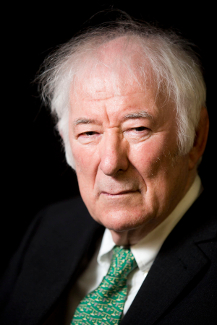
Heaney is born near Castledawson, County Londonderry, in Northern Ireland. The family moves to nearby Bellaghy when he is a boy. After attending Queen’s University Belfast, Heaney becomes a lecturer at St. Joseph’s College in Belfast in the early 1960s and begins to publish poetry. He lives in Sandymount, Dublin from 1976 until his death. He also lives part-time in the United States from 1981 to 2006. Heaney is recognised as one of the principal contributors to poetry during his lifetime.
American poet Robert Lowell describes Heaney as “the most important Irish poet since Yeats,” and many others, including the academic John Sutherland, have said that he is “the greatest poet of our age.” Robert Pinsky has stated that “with his wonderful gift of eye and ear Heaney has the gift of the storyteller.” Upon his death in 2013, The Independent describes him as “probably the best-known poet in the world.” One of his best-known works is Death of a Naturalist, published in 1966.
Seamus Heaney dies in the Blackrock Clinic in Dublin on August 30, 2013, aged 74, following a short illness. After a fall outside a restaurant in Dublin, he enters the hospital for a medical procedure, but dies at 7:30 the following morning before it takes place. His funeral is held in Donnybrook, Dublin, on the morning of September 2, 2013, and he is buried in the evening in the Cemetery of St. Mary’s Church, Bellaghy, County Londonderry, Northern Ireland, in the same graveyard as his parents, young brother, and other family members. His son Michael reveals at the funeral mass that his father texted his final words, “Noli timere” (Latin: “Do not be afraid”), to his wife, Marie, minutes before he died. Shortly after Heaney’s death, graffiti artist Maser paints a mural in Dublin referencing this message.
On September 1, the day after his death, a crowd of 81,553 spectators applaud Heaney for three minutes at a semi-final match of the 2013 All-Ireland Senior Football Championship. His funeral is broadcast live the following day on RTÉ television and radio and is streamed internationally at RTÉ’s website. RTÉ Radio 1 Extra transmits a continuous broadcast, from 8:00 AM until 9:15 PM on the day of the funeral, of his Collected Poems album, recorded in 2009. His poetry collections sell out rapidly in Irish bookshops immediately following his death.






 seamus dubhghaill