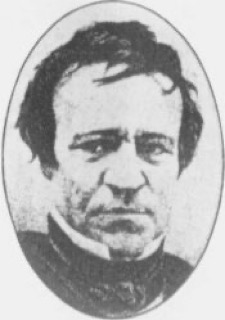
In 1849, O’Donoghue, together with William Smith O’Brien, Terence MacManus, Thomas Francis Meagher and many others, are on board the prisoner transport ship The Swift for a six-month, 14,000-mile journey under difficult conditions on which some fellow prisoners do not survive.
On January 26, 1850, “Using materials he had begged and borrowed” as one account gives it, O’Donoghue starts publishing in Hobart a weekly newspaper named The Irish Exile, aimed mainly at fellow Irish prisoners and deportees and considered to be the first Irish Nationalist paper to be published in Australia.
The paper features Irish ballads and poetry, articles about Irish history, and a regular column by John Martin reporting on the situation of the Repeal Movement, a campaign to repeal the Acts of Union 1800 under which the Irish Parliament had been abolished. There is also local news of the Irish deportee community, then numbering in the thousands, and of Hobart daily life in general.
O’Donoghue uses The Irish Exile to publish excerpts of his journal aboard The Swift, which are reprinted in Australian, British and Irish newspapers. Brisbane‘s The Moreton Bay Courier, reprinted from Dublin’s The Nation, finds that the journal “will show how severely the tyrannical government of England visited the offences of the Ballingarry cabbage-tree heroes. The studies of Messrs. O’Brien, Meagher (afterwards O’), and O’Donoghoe, will amuse the reader”. While in Van Diemen’s Land, The Examiner, the daily newspaper of Launceston, Tasmania, reprints London‘s The Examiner‘s view that “a singularly large amount of mercy has been shown to those grown-up children who made the escapade from Dublin to raise the standard of Irish rebellion at Ballingarry. One of the worthies, Mr. Patrick O’Donoghue, has published an account of his deportation; and certainly a more pleasureable [sic] voyage could not have been under taken at the expanse of government. A roomy cabin, a capital library, a fair dinner, with a couple of glasses of wine, and cigars upon deck, from the dietary and the entertainment of the political exiles.”
Publication of the paper is not in itself illegal, but is highly displeasing to the Governor, Sir William Denison, who finds that the paper can be suppressed by arresting O’Donoghue and charging him with having “left his allocated district.” He is sentenced to one year’s work in a chain gang – a time spent at hard labour, living in a convict station and wearing a convict uniform, mainly in the company of non-political prisoners such as “rapists, muggers and thieves.”
In March 1851, O’Donoghue is released and taken back to Hobart. Undeterred, he immediately restarts his paper, prominently featuring an extensive personal account of his year with the chain gang. The governor reacts by sending him again to a chain gang, at a more distant location this time – the Cascades Penal Station. Three months later the governor orders him released from there and sent to Launceston.
On the way there, O’Donoghue succeeds in escaping from his guards with the help of fellow-prisoners, who manage to smuggle him on board the ship Yarra Yara, on its way to Melbourne. There, he successfully hides from the British authorities and, with further help from Irish sympathisers, manages to get to San Francisco, where some of his fellows such as MacManus and Meagher have also ended up.
O’Donoghue dies in New York City on January 22, 1854, shortly before the arrival of his wife on a ship from Ireland. The time spent in the chain gang may have contributed to undermining his health. The other escaped state prisoners do not attend his funeral, although Michael Doheny and Michael Cavanagh, fellow Young Irelanders who are living in New York City at the time, are in attendance.
The local Sinn Féin branch in Carlow is named after O’Donoghue.
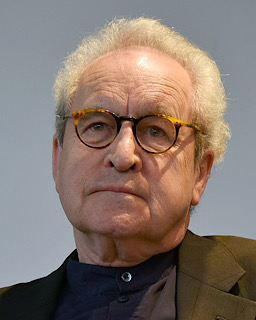
Banville is born to Agnes (née Doran) and Martin Banville, a garage clerk, in Wexford. He is the youngest of three siblings. He is educated at CBS Primary, Wexford, a Christian Brothers school, and at St. Peter’s College, Wexford. Despite having intentions of being a painter and an architect, he does not attend university. After school, he works as a clerk at Aer Lingus, which allows him to travel at deeply discounted rates. He takes advantage of these rates to travel to Greece and Italy. He begins working as a sub-editor at The Irish Press in 1969.
Banville publishes his first book, a collection of short stories titled Long Lankin, in 1970. His first novel, Nightspawn, appears in 1971, followed by his second, Birchwood, two years later. His The Revolutions Trilogy, published between 1976 and 1982, comprises works named after renowned scientists: Doctor Copernicus, Kepler and The Newton Letter. His next work, Mefisto, has a mathematical theme, and, in combination with the three books from The Revolutions Trilogy, is the fourth book from the “Scientific Tetralogy.” His 1989 novel, The Book of Evidence, begins The Frames Trilogy, dealing with the work of art. It is completed by Ghosts and Athena. His thirteenth novel, The Sea, wins the Booker Prize in 2005. In addition, he publishes crime novels as Benjamin Black, most of which feature the character of Quirke, an Irish pathologist based in 1950s Dublin. His alternative history novel, The Secret Guests (2020), is published under the name B. W. Black.
In 1969, Banville marries the American textile artist Janet Dunham, whom he met in San Francisco the previous year while she is a student at the University of California, Berkeley. The couple has two sons together. The marriage breaks down after Banville has an affair with a neighbour, Patricia Quinn, who subsequently becomes director of the Arts Council of Ireland. Banville has two daughters with Quinn, born around 1990 and 1997. Despite separating, Banville and Dunham never divorce and he describes them as remaining “on good terms.” Dunham dies at Blackrock Clinic on November 22, 2021, after which Banville states that he experienced “brain fog” due to grief and is unable to write for six months. In a 2024 interview, he expresses regret over his relationship history, saying, “I caused Janet such anguish. I have caused Patricia Quinn such anguish. I wasn’t good with my children. I was not a good parent. I am not a good person. I am selfish. But I have to have responsibility.”
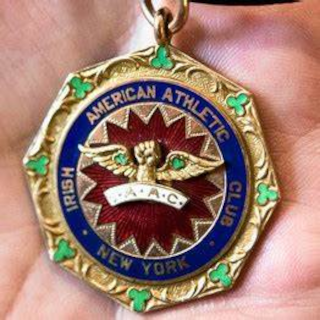
The Irish American Athletic Club, an amateur athletic organization based in Queens, New York, is established on January 30, 1898, originally as the Greater New York Irish Athletic Association. They shorten the name to the Irish American Athletic Club a few years later. They purchase a plot of land in what is then called Laurel Hill, Long Island, near Calvary Cemetery, Queens, and build a state-of-the-art athletic facility on what is farmland. The stadium, called Celtic Park, formally reopens after renovations on May 9, 1901, and until the facility is sold for housing in 1930, some of the greatest American athletes train or compete on Celtic Park’s track and field. The Irish American Athletic Club adopts a winged fist adorned with American flags and shamrocks as their emblem, with the Irish Gaelic motto “Láim Láidir Abú” or “A strong hand will be victorious,” and are often referred to as the “Winged Fists.” At one time they have clubs in Boston, Chicago, San Francisco and Yonkers, New York.
The Irish American Athletic Club is predominantly composed of Irish-born and first generation Irish American athletes, but many of the athletes who compete for the Winged Fist organization are neither.
The Irish American Athletic Club wins the Amateur Athletic Union national outdoor track and field team championship titles in 1904, 1906, 1907, 1908, 1910, 1911, 1912, 1913, 1914 and 1916. They also win the national indoor track and field team championship titles in 1906, 1908, 1909, 1911, 1913, 1914 and 1915. Individual athletes of the IAAC win 81 national outdoor championships titles and 36 individual national indoor championship titles.
In 1912–13, 1913–14, 1914–15 and 1916–17 the Irish American Athletic Club has a team, the New York Irish-Americans, represented in the American Amateur Hockey League. The team is coached by James C. “Jimmy” O’Brien and has on its roster for various seasons future NHL players Tom McCarthy and Moylan McDonnell. John McGrath and Patsy Séguin also play for the club.
Before the largest crowd that has ever assembled to see a track meet in the United States, on September 9, 1916, the Irish American Athletic Club defeats the New York Athletic Club at the Amateur Athletic Union’s National Championships, by a score of 38 to 27. Before a crowd of 30,000 spectators at Newark, New Jersey‘s Weequahic Park, the Irish American Athletic Club wins what is to be their last national championship title. The club disbands a year later when the United States becomes a combatant in World War I.
In June 1919, de Valera arrives in the United States for what is to be an 18-month visit. He has recently escaped from Lincoln Gaol in England in sensational fashion, after a duplicate key is smuggled into the jail in a cake and he escapes dressed as a woman. A few months later he is a stowaway aboard the SS Lapland from Liverpool bound for America.
De Valera’s plan is to secure recognition for the emerging Irish nation, tap into the huge Irish American community for funds, and to pressurize the U.S. government to take a stance on Irish independence. Playing on his mind is the upcoming Versailles conference where the nascent League of Nations is preparing to guarantee “existing international borders” – a provision that will imply Ireland remaining within the United Kingdom.
De Valera also has a challenge in winning over PresidentWoodrow Wilson, who is less than sympathetic to Ireland’s cause.
De Valera’s interest in America is of course personal. He is born in New York City on October 14, 1882, and his U.S. citizenship is one of the reasons he is spared execution after the 1916 Easter Rising.
At first de Valera keeps a low profile in America. Though he is greeted by Harry Boland and others when he docks in New York City, he first goes to Philadelphia and stays with Joseph McGarrity, the County Tyrone-born leader of Clan na Gael and a well-known figure in Irish America. He also quietly pays a visit to his mother in Rochester, New York.
De Valera’s first major engagement is on June 23, 1919, when he is unveiled to the American public at a press conference in the Waldorf-Astoria hotel in New York City. Crowds throng the streets around the hotel, and de Valera proclaims, “I am in America as the official head of the Republic established by the will of the Irish people in accordance with the principle of self-determination.”
De Valera then embarks upon a tour across America. Vast crowds turn out to see the self-proclaimed “president of the Irish republic.” In Boston an estimated crowd of 70,000 people hear him talk in Fenway Park. In San Francisco he unveils a statute of Irish revolutionary hero Robert Emmet in Golden Gate Park.
Later in the year, de Valera holds a huge rally in Philadelphia, where he is welcomed by the mayor at Independence Hall. He also visits smaller towns and cities across the United States, and his trip garners huge press coverage – an invaluable boon for his campaign to heighten awareness of the Irish issue in America.
But difficulties soon emerged during de Valera’s visit. He becomes embroiled in a bitter split among Irish Americans. He finds himself at odds with Judge Daniel Cohalan and John Devoy, central figures in the Friends of Irish Freedom (FOIF) association. Part of the dispute centers around money. De Valera had settled on an idea for a bond sale as a way of raising money for the cause – investors would be given bond certificates that would be exchangeable for bonds of the Irish Republic once it gets international recognition. But Cohalan and Devoy, who have already raised thousands through the Friends of Irish Freedom, are opposed, concerned about the scheme’s legality for one.
De Valera’s claim in an interview that Irish-British relations can be analogous to the relationship between Cuba and America also enrages the Cohalan-Devoy camp, who accuse him of surrendering the idea of full Irish sovereignty.
De Valera’s increasingly acrimonious relationship with Cohalan and Devoy spills over into the 1920 Republican and Democratic conventions. Against the advice of Cohalan and Devoy, he advances a resolution about Irish independence which is rejected 12-1 at the Republican convention in June of that year. A rival resolution by Cohalan squeezes through but ultimately is overturned. Similarly, he fails to secure the inclusion of the Irish issue in the Democratic Party’s policy platform during the Democrats’ convention in San Francisco.
De Valera leaves the United States in December 1920 with mixed results. Though he has raised millions of dollars through the bond sale, he has made little progress in co-opting official America to Ireland’s cause. Much as division is to characterise the next chapter of his political career in Ireland, de Valera’s sojourn in America leaves Irish America more divided than it has ever been.
(From: “Éamon de Valera’s US trip that left Irish America divided” by Suzanne Lynch, The Irish Times, http://www.irishtimes.com, June 1, 2019 | Pictured: Éamon de Valera (center) in New York with Friends of Irish Freedom’s Judge Daniel Cohalan and John Devoy in July 1919, Topical Press Agency/Getty)
De Valera’s eventful 1919 begins in Lincoln Jail and ends in New York City’s Waldorf Astoria, the largest and most luxurious hotel in the world. Smuggled aboard the SS Lapland in Liverpool in June, he sails for the United States during the closing stages of the Paris Peace Conference. As London’s Sunday Express complains in August 1919, “there is more Irish blood in America than in Ireland,” making the United States the obvious destination for a sustained propaganda and fundraising mission.
After his highly-publicised American debut at New York’s Waldorf Astoria, the self-styled “President of the Irish Republic” embarks on the first leg of what is to be an eighteen-month tour of the United States. The purpose of his mission is twofold: to gain formal recognition of the Irish Republic and to raise funds via a bond issue to support the independence movement and the newly established Dáil Éireann.
Between July and August 1919, de Valera and his entourage travel over 6,000 miles from New York to San Francisco, addressing enormous crowds at dozens of venues. He fills Madison Square Garden to capacity and receives a thirty-minute standing ovation from 25,000 people in Chicago’s Wrigley Field. Twice as many people fill Boston’s Fenway Park on June 29, cheering the arrival of the “Irish Lincoln.” The Sinn Féin envoys also visit less obvious Irish communities of the period, such as Scranton, Savannah, New Orleans and Kansas City. For de Valera’s personal secretary, Seán Nunan, the public meeting in Butte, Montana is like “an election meeting at home – there were so many first-generation Irishmen working on the mines – mainly from around Allihies in West Cork.” In San Francisco de Valera dedicates a statue of Robert Emmet by Irish-born sculptor Jerome Connor in Golden Gate Park, a replica of which stands sentinel in St. Stephen’s Green in Dublin. This is one of many symbolic gestures linking the American and Irish struggles for independence played out before the flashing bulbs of the ubiquitous press photographers. On August 15, The Cork Examiner notes that the enthusiastic American exchanges “indicate that few public missionaries from other lands – possibly only Mr. Parnell – have ever had such receptions as were accorded to the Sinn Féin leader.”
De Valera’s team deserves credit for the incredible logistical triumph that is the U.S. tour. As chief organiser, Liam Mellows travels ahead to each city, ensuring a suitable reception is prepared and a venue secured for a mass meeting. Seán Nunan is de Valera’s fastidious personal secretary and Harry Boland, Sinn Féin TD for South Roscommon and Irish Republican Brotherhood (IRB) envoy, is at his side troubleshooting, speechmaking and shaking hands. As the tour progresses, de Valera’s supporting cast expands to include Kerry-born Kathleen O’Connell who becomes de Valera’s full-time personal secretary from 1919.
The next stage of de Valera’s American odyssey begins on October 1, 1919, in Philadelphia, a city with a rich Irish heritage and rife with symbolism of America’s struggle for independence. Over the next three weeks, de Valera and his team travel from the Atlantic to the Pacific seaboard and back again, delivering seventeen major public speeches and a host of smaller ones to aggregate crowds of over half a million.
The pace is relentless as the Irish team makes its way through middle America. De Valera is received as a visiting dignitary at multiple state legislatures and presented with honorary degrees from six American universities. In line with his secondary objective to foster the interest of “wealthy men of the race in the industrial development of Ireland,” he addresses the Chambers of Commerce in a number of cities and arranges a personal meeting with Henry Ford, the son of an Irish emigrant, during his visit to Detroit in October. In the same month in Wisconsin, he is made a Chief of the Chippewa Nation, an honour he later says meant more to him than all the freedoms of all the cites he was ever given. It is not surprising that by the time they reach Denver on October 30, The Irish World reports that “the President looked tired.” Still, he musters the energy to make high profile visits to Portland, Los Angeles and San Diego before beginning the return journey to New York at the end of November.
After a short break for Christmas, the Irish team prepares for the launch of the Bond Certificate Drive. A week-long frenzy of publicity kicks off on January 17 at New York City Hall where Mayor John F. Hylan presents de Valera with the Freedom of the City. During the spring of 1920, de Valera addresses the Maryland General Assembly at Annapolis before making the swing through the southern states of America.
It is not all plain sailing for the Sinn Féin representatives in America. The tour of the west coast in late 1919 sees increasing tensions with American patriotic bodies who are critical of de Valera’s perceived pro-German stance during World War I. He is heckled during a speech in Seattle and a tricolour is ripped from his car in Portland by members of the American Legion. The trip through the southern states in the spring of 1920 coincides with rising American anti-immigration and anti-Catholic nativism. A small number of counter demonstrations are organised by right-wing Americans. Most notably, members of the Ku Klux Klan make unwelcome appearances at several rallies in the American south, making clear their opposition to de Valera’s presence.
The Irish envoys also contend with antagonism from the leaders of Friends of Irish Freedom (FOIF), the broad-based popular front of Clan na Gael headed by veteran FenianJohn Devoy and Judge Daniel Cohalan. The FOIF uses its significant resources to finance de Valera’s tour and facilitate the Bond Certificate Drive, but behind the scenes there are significant personality clashes and tensions over tactics.
The increasingly public dispute comes to a head in a row over strategies at the Republican National Convention in Chicago in June 1920. Drawing on his influential political contacts, Cohalan persuades the Republican Party to include Irish self-determination in their election platform. However, much to Cohalan’s fury, de Valera leads a separate delegation to the Convention and insists on a resolution calling for recognition of the Irish Republic. The result is that two resolutions are submitted to the Platform Committee, which indicates dissension in the Irish ranks and gives the Committee the excuse to include neither in the final platform. After de Valera also fails to secure the endorsement of the Democratic convention in San Francisco in June, it is clear that the Irish question will not be a significant factor in the ensuing presidential election. Relations between the FOIF and de Valera reach a new low. In November 1920, de Valera makes the final break with the FOIF and sets up a new organisation, the American Association for the Recognition of the Irish Republic.
De Valera is in Washington, D.C. on October 25 when Terence MacSwiney dies after 74 days on hunger strike. Six days later, at the last great meeting of the American tour, 40,000 people fill New York’s Polo Grounds to commemorate MacSwiney’s death. By late November, de Valera knows that it is time to return to Ireland. Smuggled aboard SS Celtic in New York harbour on December 10, he prepares for the nine-day journey home. He had failed to obtain the recognition of the United States Government for the Republic, but his cross-continental tour and associated press coverage raised international awareness and over $5 million for the Irish cause.
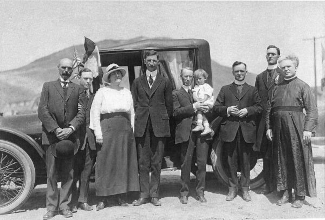
(From: An article by Helene O’Keeffe that was first published in the Irish Examiner on March 24, 2020 | Photo: Eamon de Valera, center, president of the Provisional Government of the Irish Republic, in Butte, Montana, in 1919 to encourage support for Ireland’s fight for independence. Courtesy of Butte-Silver Bow Public Archives)
In 1888, Connor emigrates to Holyoke, Massachusetts. His father is a stonemason, which leads to Connor’s jobs in New York as a sign painter, stonecutter, bronze founder and machinist. Inspired by his father’s work and his own experience, he would steal his father’s chisels as a child and carve figures into rocks.
Connor joins the Roycroft arts community in 1899 where he assists with blacksmithing and later starts creating terracotta busts and reliefs. Eventually he is recognized as Roycroft’s sculptor-in-residence.
After four years at Roycroft, Connor then works with Gustav Stickley and becomes well known as a sculptor being commissioned to create civic commissions in bronze for placement in Washington, D.C., Syracuse, East Aurora, New York, San Francisco, and in his native Ireland. In 1910, he establishes his own studio in Washington, D.C. From 1902 until his death, he produces scores of designs ranging from small portrait heads to relief panels to large civic commissions realized in bronze.
Connor is a self-taught artist who is highly regarded in the United States where most of his public works can be seen. He appears to be heavily influenced by the work of Irish American sculptor Augustus Saint-Gaudens. He uses the human figure to give expression to emotions, values and ideals. Many of the commissions he receives are for civic memorials and secular figures which he casts in bronze, a pronounced departure from the Irish tradition of stone carved, church sponsored works.
Connor’s best-known work is Nuns of the Battlefield located at the intersection of Rhode Island Avenue NW, M Street and Connecticut Avenue NW in Washington, D.C. It serves as a tribute to the over six hundred nuns who nursed soldiers of both armies during the American Civil War and is one of two monuments in the District that represent women’s roles in the Civil War. The sculpture is authorized by the United States Congress on March 29, 1918, with the agreement that the government will not fund it. The Ancient Order of Hibernians raises $50,000 for the project and Connor is selected since he focuses on Irish Catholic themes, being one himself. Connor, however, ends up suing the Order for nonpayment.
Connor works in the United States until 1925 at which time he moves to Dublin and opens his own studio but suffers from lack of financial support and patrons. In 1926 he is contacted by Roycroft and asked to design and cast a statue of Elbert Hubbard who, with his wife Alice, had died in the sinking of the RMS Lusitania. It is unveiled in 1930 and today stands on the lawn of East Aurora’s Middle School across the street from the Roycroft Chapel building.
While working on the Hubbard statue, Connor receives a commission to create a memorial for all the RMS Lusitania victims. It is to be erected in Cobh, County Cork where many of the victims are buried. The project is initiated by the New York Memorial Committee, headed by William Henry Vanderbilt whose father, Alfred Gwynne Vanderbilt, perished on the RMS Lusitania. He dies before the memorial is completed and based on Connor’s design its installation falls to another Irish artist.
Jerome Connor dies on August 21, 1943, of heart failure and reputably in poverty. There is a now a “Jerome Connor Place” in Dublin and around the corner there is a plaque in his honour on Infirmary Road, overlooking Dublin’s Phoenix Park, his favourite place.
Tibble sees Quinn fleeing from the police after he has been noticed acting suspiciously near a house in which Quinn and fellow members of the Balcombe Street Gang are later found to have been preparing bombs. Tibble chases Quinn on his motorbike and, while attempting to stop him, is fatally shot twice in the chest.
Quinn escapes to Dublin in the aftermath of the shooting and serves a short prison sentence after his arrest for assaulting a police officer there. After his release in 1978 he returns to his hometown of San Francisco but is arrested in 1981 and later extradited to England in February 1988 where he is convicted of murder and jailed for life with a recommended minimum term of 35 years.
Quinn serves eleven years before he is released in April 1999, aged 51, along with the rest of the Balcombe Street Gang, under the terms of the Good Friday Agreement. While with the IRA, Quinn adopts an Irish accent and is tagged with the nickname “Yankee Joe” because of his American origins.
Cashman is born in Midleton, County Cork, one of two daughters of Patrick and Frances “Fanny” (Cronin) Cashman. Along with her sister, she is brought to the United States around 1850 by her mother, first settling in Boston. As an adolescent, she works as a bellhop in a Boston hotel. In 1865 she and her family migrate to San Francisco, California.
Of the thousands lured by the gold rush fever of the 19th century, few had the staying power or generous spirit of Cashman. She follows gold miners into British Columbia, where, during the early 1870s, she operates a boarding house while learning elementary mining techniques and geology. For the next 50 years, the precious metal leads her to Arizona, Nevada, Mexico, the Canadian Yukon, and north of the Arctic Circle in Alaska. In addition to successfully prospecting and running mines, one time owning 11 mines in the Koyukuk District of Alaska, she operates boarding houses, restaurants, and supply depots.
The quality that truly establishes Cashman’s place in mining lore is her charity, which earns her the titles “Angel of Tombstone” and “Saint of the Sourdoughs” while sometimes obscuring her career as a successful miner. As early as 1874, while visiting Victoria, she leads a dangerous rescue effort to free a group of miners trapped by a severe winter storm. Later, during the glory days of Tombstone, Arizona, she helps establish the town’s first hospital and Sacred Heart Church, its first Roman Catholic church. Although she is known to be tough and aggressive in defending her claims, she is also big-hearted. Upon the deaths of her sister and brother-in-law, she takes in her nieces and nephews and raises them as her own.
Around 1889, Cashman is active in the gold camp at Harqua Hala, Arizona, and comes close to marrying Mike Sullivan, one of the original discoverers of gold in that area. Along with mining, she contributes a number of excellent articles to Tucson‘s Arizona Daily Star, in which she discusses history, techniques, types of claims, and personalities in the field.
Cashman spends the last 20 years of her life on Nolan Creek, in the Koyukuk River Basin of Alaska, then the farthest north of any mining camp in the world. She is among about eight women who join a group of approximately 200 miners to brave the harsh environment and isolation in hopes of striking the “big bonanza.” Once a year, she leaves for supplies and equipment, traveling hundreds of miles to Fairbanks, by sled, boat, or wagon. Her spirit of adventure apparently never dies. In 1921, during one of her trips to the outside, she is interviewed for Sunset, a California publication. Then 76, Cashman tells the writer that, although she loves Alaska, she is not so tied to it that she would not pull up stakes if something turned up elsewhere.
Nellie Cashman dies on January 4, 1925, in Sisters of St. Anne hospital in Victoria, one of the hospitals she had helped fund some 40 years earlier. The United States Postal Service honors her with a stamp on October 18, 1994, as part of its “Legends of the West” series.
Born in what is now Northern Ireland in 1831 to Scotch-Irish parents, Fair immigrates with his family to the United States when he is a boy and grows up on a farm in Illinois. Following the 1849 California Gold Rush, he travels to California. He earns a reputation for understanding ore bodies, inspiring his eventual employment as superintendent of various mines.
The 1859 discovery of the Comstock Lode in Nevada provides Fair with new opportunities. In 1865, he becomes superintendent of the prestigious Ophir Mine. Two years later, the Hale and Norcross Mine in Virginia City hire him as assistant superintendent, but the owners dismiss him within a year for unclear reasons.
While at the Hale and Norcross, Fair meets John William Mackay, whose success at the Kentuck Mine made him a millionaire. The two Irish immigrants recognize common interests and form an alliance. Mackay gives Fair the position of superintendent of the Rising Star Mine in Idaho, a property he had recently acquired. The venture proves unsuccessful, but it solidifies a working relationship between the two.
Fair works quietly with Mackay and investors James C. Flood and William S. O’Brien to obtain control of the Hale and Norcross Mine. Fair turns it to profit with better management. He and Mackay combine their expertise to acquire and explore other claims. In 1873, largely through Fair’s persistent search in the Consolidated California and Virginia Mine, the partnership discovers the famed Big Bonanza, one of the richest ore bodies in history. Fair and the others become extremely wealthy. He uses his assets to defeat the incumbent William Sharon for a seat in the United States Senate, which he holds in an undistinguished way from 1881-1887 as a Democrat.
Fair develops real estate in San Francisco and acquires mining property outside Nevada. Theresa Fair, his wife, is respected in Virginia City for donations to causes including those of the Catholic Church and the Daughters of Charity. When she divorces her husband in 1883 for habitual adultery, national public opinion turns against the senator. During his bid for reelection, he finds little support. Even Mackay fails to come to his aid, and he easily loses his seat to William Morris Stewart in 1887. He then moves back to San Francisco.
Wilde is born on October 16, 1854, at 21 Westland Row, Dublin (now home of the Oscar Wilde Centre, Trinity College), the second of three children born to Anglo-Irish Sir William Wilde and Jane Wilde, two years behind his brother William. His parents are successful Anglo-Irish intellectuals in Dublin. He learns to speak fluent French and German. At university, he reads Greats. He demonstrates himself to be an exceptional classicist, first at Trinity College Dublin, then at Magdalen College, Oxford. He becomes associated with the emerging philosophy of aestheticism, led by two of his tutors, Walter Pater and John Ruskin. After university, he moves to London into fashionable cultural and social circles.
As a spokesman for aestheticism, Wilde tries his hand at various literary activities: he publishes a book of poems, lectures in the United States and Canada on the new “English Renaissance in Art” and interior decoration, and then returns to London where he works prolifically as a journalist. Known for his biting wit, flamboyant dress and glittering conversational skill, he becomes one of the best-known personalities of his day.
At the turn of the 1890s, Wilde refines his ideas about the supremacy of art in a series of dialogues and essays, and incorporates themes of decadence, duplicity, and beauty into what would be his only novel, The Picture of Dorian Gray (1890). The opportunity to construct aesthetic details precisely, and combine them with larger social themes, draw him to write drama. He writes Salome (1891) in French while in Paris, but it is refused a licence for England due to an absolute prohibition on the portrayal of Biblical subjects on the English stage. Unperturbed, he produces four society comedies in the early 1890s, which make him one of the most successful playwrights of late-Victorian London.
At the height of his fame and success, while The Importance of Being Earnest (1895) is still being performed in London, Wilde has John Douglas, 9th Marquess of Queensberry prosecuted for criminal libel. The Marquess is the father of Wilde’s lover, Lord Alfred Douglas. The libel trial unearths evidence that causes him to drop his charges and leads to his own arrest and trial for gross indecency with men. After two more trials he is convicted and sentenced to two years of hard labour, the maximum penalty, and is jailed from 1895 to 1897. During his last year in prison, he writes De Profundis, published posthumously in 1905, a long letter which discusses his spiritual journey through his trials, forming a dark counterpoint to his earlier philosophy of pleasure. On his release, he leaves immediately for France, never to return to Ireland or Britain. There he writes his last work, The Ballad of Reading Gaol (1898), a long poem commemorating the harsh rhythms of prison life.
By November 25, 1900, Wilde has developed meningitis, then called “cerebral meningitis”. On November 29, he is conditionally baptised into the Catholic Church by Fr. Cuthbert Dunne, a Passionist priest from Dublin. He dies of meningitis on November 30, 1900. Different opinions are given as to the cause of the disease. Richard Ellmann claims it is syphilitic. Merlin Holland, Wilde’s grandson, believes this to be a misconception, noting that Wilde’s meningitis followed a surgical intervention, perhaps a mastoidectomy. Wilde’s physicians, Dr. Paul Cleiss and A’Court Tucker, report that the condition stems from an old suppuration of the right ear treated for several years and makes no allusion to syphilis.
Wilde is initially buried in the Cimetière parisien de Bagneux outside Paris. In 1909 his remains are disinterred and transferred to Père Lachaise Cemetery, inside the city. In 2011, the tomb is cleaned of the many lipstick marks left there by admirers and a glass barrier is installed to prevent further marks or damage.
In 2017, Wilde is among an estimated 50,000 men who are pardoned for homosexual acts that are no longer considered offences under the Policing and Crime Act 2017. The Act is known informally as the Alan Turing law.




 seamus dubhghaill