seamus dubhghaill

Promoting Irish Culture and History from Little Rock, Arkansas, USA


Leave a comment

20th Anniversary of the 1981 IRA Hunger Strikes

hunger-strike-20th-anniversary

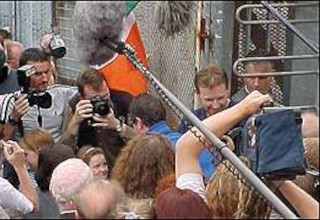
On August 12, 2001, loyalist protesters block a main road in north Belfast to prevent the republican Wolfe Tone Flute band from joining a parade in the Ardoyne district commemorating the 20th anniversary of the 1981 Irish Republican Army (IRA) hunger strikes.

The 20-minute blockade of the Ligoniel Road is in response to the local branch of the loyalist Apprentice Boys of Derry organisation being refused permission to drive their bus past the nationalist Ardoyne the previous day.

Billy Hutchinson, the Progressive Unionist Party Assembly member for Belfast North says, “Nationalists are saying that the Apprentice Boys can’t come down the Crumlin Road on a bus because it is seen to be a parade.” He adds further, “I think loyalists are saying if the Apprentice Boys can’t go down on a bus why should the Wolfe Tone band be allowed to go down on a bus?”

On August 11, police officers prevent the Ligoniel Walker Club of the Apprentice Boys of Derry from driving their bus down the Crumlin Road past the Ardoyne shops because it constitutes a parade and breaches a ruling by the Parades Commission. The club is prevented by the Commission from marching through the area and tries in vain to broker a last minute compromise to use their bus.

Gerry Kelly, Sinn Féin Assembly member for Belfast North, describes the loyalist protest as a “nonsense,” adding he does not believe that nationalist residents had objected to the organisation using their bus. “That is a decision the RUC (Royal Ulster Constabulary) took on the ground. I don’t think there would have been a problem from the people of Ardoyne,” he adds.

The Apprentice Boys vow to seek a judicial review into the decision to prevent them from traveling through the area to get to their main parade in Derry.

After a six and a half hour stand-off, Apprentice Boys representative Tommy Cheevers brands the Parades Commission a “farce.”

(From: “Hunger strike march blocked by loyalists” from The Irish Times, Sunday, August 12, 2001 | Photo credit: PA:Press Association)


Leave a comment

Death of John Dillon, Irish Parliamentary Party Leader

john-dillon

John Dillon, a Member of Parliament (MP) for over 35 years and the last leader of the Irish Parliamentary Party in the struggle to secure Home Rule by parliamentary means, dies in a London nursing home on August 4, 1927. Through the 1880s he is perhaps the most important ally of the greatest 19th-century Irish nationalist, Charles Stewart Parnell, but, following Parnell’s involvement as co-respondent in a divorce case, he repudiates Parnell for reasons of political prudence.

Dillon is born in Blackrock, Dublin, a son of the former “Young IrelanderJohn Blake Dillon (1814–1866). Following the premature death of both his parents, he is partly raised by his father’s niece, Anne Deane. He is educated at Catholic University School, at Trinity College, Dublin and at the Catholic University of Leuven in Belgium. He afterwards studies medicine at the Royal College of Surgeons in Dublin, then ceases active involvement in medicine after he joins Isaac Butt‘s Home Rule League in 1873

Dillon is a member of the British House of Commons during 1880–1883 and 1885–1918. For his vigorous work in the Irish National Land League, which seeks fixed tenure, fair rents, and free sale of Irish land, he is imprisoned twice between May 1881 and May 1882. He is Parnell’s fellow inmate in Kilmainham Gaol in Dublin from October 1881. For six months in 1888 he is imprisoned for aiding William O’Brien, author of the “plan of campaign” against high rent charges by English absentee landlords in Irish farming districts.

When Parnell is named co-respondent in Captain William Henry O’Shea’s divorce suit in 1890, Dillon and O’Brien at first affirm their support of him, but they finally decide that he will thenceforth be a liability as party leader. The party then splits, the anti-Parnellite majority forming the Irish National Federation, of which Dillon serves as chairman from 1896. In 1900, however, he agrees to join a reunited party under the Parnellite John Redmond.

During the prime ministry of Arthur James Balfour (1902–1905), Dillon comes to believe that the British Conservative government intends to grant Irish reforms without independence, thereby “killing Home Rule by kindness.” In 1905 he advises Irishmen to vote for Liberal Party candidates for Parliament, and, after the Liberals had taken office that year, he supports their reform program.

Throughout World War I Dillon vehemently opposes the extension of British military conscription to Ireland, both because that measure would strengthen the agitation by the more extreme nationalist Sinn Féin party and because he never accepted the view that British imperial interests necessarily coincided with those of Ireland. After the Easter Rising in Dublin in 1916, he protests against the harsh measures that ensue and, in the House of Commons, makes a passionate speech in defense of the Irish rebels.

Upon Redmond’s death on March 6, 1918, Dillon, who had broken with him over Irish support for the British war effort, succeeds him as Irish Parliamentary Party leader. By that time, however, the party has been discredited and in the 1918 Irish general election Sinn Féin wins easily. On losing his House of Commons seat to Éamon de Valera, the future president of the Republic of Ireland, he retires from politics.

Dillon dies in a London nursing home at the age of 76, on August 4, 1927. He is buried four days later in Glasnevin Cemetery in Dublin. There is a street named after him in Dublin’s Liberties area, beside the old Iveagh Markets. One of his six children is James Mathew Dillon (1902–1986), a prominent Irish politician and leader of the National Centre Party and of Fine Gael (1957–1966) and also serves as Minister for Agriculture (1954-1957).


Leave a comment

Final Republican & Loyalist Prisoners Released from Maze Prison

maze-prison-release

The final seventy-eight republican and loyalist prisoners are released from the Maze Prison in Northern Ireland on July 28, 2000 as the final phase of the Good Friday peace accord scheme to release 428 inmates early.

Some of the most prolific bombers and gunmen involved in the Troubles have been imprisoned in the Maze, originally called Long Kesh, since it opened in 1971.

One of the freed republicans, Seán Lynch, describes what he saw as the real and symbolic importance of the Maze. “We had achieved the status of political prisoners even if the British Government never admitted it. The prison struggle was a microcosm of the larger struggle.”

Founder member of the Ulster Defence Association, Thomas McKeown, released in 1990 is one of over 10,000 loyalists sent to the prison. He reflects, “We had it pretty easy. We made replica weapons and instruments from wood and conducted military parades and drill every morning. There were also political classes and other sorts of education.”

After the H-block hunger strikes of the 1980s there are numerous escape attempts and by 1994 the authorities have given in to many of the prisoners’ demands for freedom of association and high levels of autonomy. A total of 2,700 incidents of officers being threatened or attacked are reported. A granite memorial outside the gates bears the names of the 29 prison guards murdered since the prison opened in 1971.

On September 29, 2000, the remaining four prisoners at the Maze are transferred to other prisons in Northern Ireland and the Maze Prison is closed. Redundancy packages are arranged for staff. These are accepted by 300 who left in June 2000.

The future of the buildings is uncertain, but some republicans want it to be turned into a museum to commemorate their struggle.

A monitoring group is set up on January 14, 2003 to debate the future of the 360-acre site. There are many proposals, including a museum, a multi-purpose sports stadium and an office, hotel and leisure village. In January 2006, the government unveils a masterplan for the site incorporating many of these proposals, including a 45,000 seat national multi-sport stadium for association football, rugby and Gaelic games. In October 2006, demolition work begins in preparation for construction on the site, however, in January 2009 plans to build the new multi-purpose stadium are cancelled, with Minister of Culture, Arts and Leisure Gregory Campbell citing a lack of support and concerns for a net loss to the economy.

Discussion is still ongoing as to the listed status of sections of the old prison. The hospital and part of the H-Blocks are currently listed buildings, and will remain as part of the proposed site redevelopment as a “conflict transformation centre” with support from republicans such as Martin McGuinness and opposition from unionists, who consider that this risks creating “a shrine to the IRA.”

In January 2013, plans are approved by the Northern Ireland Minister of the Environment, Alex Attwood, for the site to be redeveloped as showgrounds as the result of an application by the Royal Ulster Agricultural Society with the objective of relocating Balmoral Show from its current location in Belfast. The site is now known as Balmoral Park.

In October 2019, the European Union withdraws £18m that had been approved to develop a peace centre, due to disagreements between Sinn Féin and the Democratic Unionist Party.

(Pictured: IRA prisoners walk out through the Maze turnstile, BBC News Online, July 28, 2000)


Leave a comment

The Irish Convention

irish-convention-1917

The Irish Convention, an attempt by David Lloyd George, Prime Minister of the United Kingdom, to arrive at a political settlement, meets at Regent House, Trinity College Dublin beginning on July 25, 1917. The opposition of Sinn Féin and the Ulster unionists ultimately render it irrelevant.

The Irish Convention is an assembly which sits in Dublin from July 1917 until March 1918 to address the Irish question and other constitutional problems relating to an early enactment of self-government for Ireland, to debate its wider future, discuss and come to an understanding on recommendations as to the best manner and means this goal can be achieved. It is a response to the dramatically altered Irish political climate after the 1916 Easter rebellion and is proposed by Lloyd George in May 1917 to John Redmond, leader of the Irish Parliamentary Party, announcing that “Ireland should try her hand at hammering out an instrument of government for her own people.”

The Convention is publicly called in June 1917, to be composed of representative Irishmen from different political parties and spheres of interest. After months of deliberations, the Convention’s final report, which had been agreed upon in March 1918, is seriously undermined. With the urgent need for military manpower on the Western Front following the German Spring Offensive, the government decides in April 1918 to simultaneously introduce Home Rule and apply conscription to Ireland. This “dual policy” of conscription and devolution heralds the end of a political era.

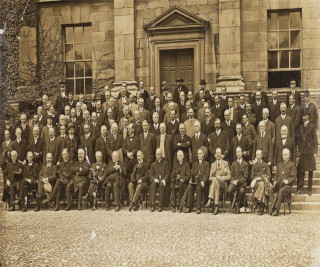
(Pictured: Group portrait of the members of the Irish Convention at Trinity College, taken on August 21, 1917 | National Library of Ireland, NPA Conv.)


Leave a comment

Trimble Rejects Power Sharing Compromise

blair-ahern-stormont-castle-1999On July 14, 1999, Ulster Unionists under David Trimble reject a compromise for the creation of a power sharing government placing the Northern Ireland peace process in grave trouble. The proposals would have seen inclusive self-government introduced in Northern Ireland on Sunday, July 18, 1999.

Early in the day the government rushes legislation through the House of Commons providing for the suspension of the Executive if the Irish Republican Army (IRA) fails to decommission all its arms by May 2000 in line with a timetable, yet to be drawn up. It refuses to accept any Ulster Unionist amendments. But within 12 hours, British Prime Minister Tony Blair signals that three new amendments will be included to tighten the so-called failsafe mechanism when the bill is debated in the House of Lords in the evening.

The first amendment makes clear that decommissioning must proceed in line with a timetable to be drawn up by General John de Chastelain. The second provides for the automatic suspension of the Executive, while the third provides for the party in default to be clearly identified.

They fail to sway Trimble, who criticises The Way Forward as a hastily concocted scheme. However, he does leave the door open for further negotiations to save the agreement. “If there was a clear watertight scheme, in which there was at the outset an unequivocal commitment to change and a process that genuinely guaranteed to deliver that change, we would have to consider whether a scruple over a period of days could be justified.”

Sinn Féin is furious with party president Gerry Adams saying, “Those who may genuinely want to deal with the issue of guns are going about it in absolutely the worst and wrong way.” The party wants the assembly to be wound up immediately, and all members’ wages to be stopped. It wants the British and Irish governments to continue to implement all aspects of the agreement which are within their control. Adams is enraged by Blair’s move to amend the failsafe legislation. His party says it will consider applying for judicial review of the amended bill, believing it to compromise the International Commission on Decommissioning and unlawfully conflict with the agreement.

Blair and Taoiseach Bertie Ahern announce on the following day that the 15-month-old and ailing Good Friday Agreement will go into a review procedure involving all the political parties and be effectively parked over the summer.

Trimble, leader of the Ulster Unionists, resists intense government pressure as he refuses to back the British and Irish governments’ blueprint providing for a power-sharing executive the following week and IRA decommissioning in the summer. He repeats his party’s view that Sinn Féin can only join his cabinet once the IRA has started to hand over its weapons.

The outcome is a bitter personal setback for Blair. In a last-minute televised appeal to the Unionists not to “close the door’ on an agreement, he appears to acknowledge that they will have to try to find another way forward. “I believe in the end we will get an agreement on this. Whether we manage it by tomorrow morning, that is more difficult,” he says.

Trimble complains he had too little time to secure backing within his split party for The Way Forward, which the governments issued twelve days earlier after a week of intense negotiations at Stormont Castle. Blair’s handling of the affair is questioned.

Trimble’s problem with the legislative failsafe is that it punishes all parties for an IRA transgression of a decommissioning timetable, yet to be drawn up. It provides for the executive to be suspended, rather than carry on with Sinn Féin’s two ministerial posts allocated to other parties. The nationalist Social Democratic and Labour Party (SDLP), which could have given Trimble cover on the issue of expulsion, declines to say whether it will vote for Sinn Féin’s expulsion, which infuriates Ulster Unionists.

Negotiations to save the Good Friday Agreement have gone through four deadlines during the year. There are fears that the latest delay might lead to Sinn Féin withdrawing its declaration on IRA arms.

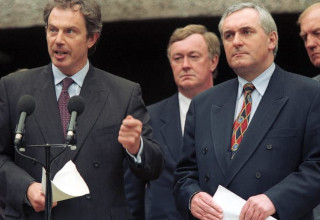
(Pictured: British Prime Minister Tony Blair and Taoiseach Bertie Ahern present a joint British-Irish blueprint for implementation of the Good Friday Agreement at Stormont Castle in Belfast, June 2, 1999 | Sean Gallup | Getty Images)


Leave a comment

The Ballygawley Land Mine Attack

ballygawley-land-mine-attack

The Ballygawley land mine attack is a bomb attack carried out by the Provisional Irish Republican Army (IRA) on July 13, 1983. The IRA explodes a land mine under an Ulster Defence Regiment‘s (UDR) mobile patrol at Ballygawley Road, near Dungannon, County Tyrone, Northern Ireland. Four UDR soldiers are killed in the incident.

After the 1981 Irish hunger strike, floods of recruits sign up to join the IRA. Republicans in County Tyrone are especially angry over the death of Martin Hurson who was from the small Tyrone village of Cappagh and was one of Cappagh’s most famous sons. Cappagh becomes a Republican stronghold in the 1980s. Many young men flock to join the East Tyrone Brigade to avenge Hurson’s death. Some of those who join after being radicalized by the Hunger Strike go onto become famous IRA Volunteers like Declan Arthurs and Martin McCaughey who were both small children when the conflict broke out in 1969.

Sinn Féin member Francie Molloy said the following on Hurson’s funeral and the effect his death had on the young people of Cappagh:

“There was people everywhere. The village was black with them. It was the first sign in Tyrone of thousands and thousands of people assembling to honor the remains of a native son coming home. Martin was young when he went to jail and young when died on hunger strike. His death just made young people more determined that they were going to replace him. They saw ten men dead as the British government taking people out of the struggle. I think the young people of Cappagh and surrounding areas decided there and then that they were going to replace every one of them and replace them tenfold. And that is what they did. The number of young people who joined up in response was massive.”

On July 13, 1983, four British Army (Ulster Defence Regiment) soldiers (Ronald Alexander, Thomas Harron, John Roxborough, and Oswald Neely), all Protestant members of the 6th Battalion UDR, are travelling in their mobile patrol along a road in Tyrone close to the small town of Ballygawley. IRA Volunteers from the East Tyrone Brigade plant a 500 lb. land mine along the road the UDR patrol is traveling. The IRA unit notices the UDR takes a similar route every so often and has spotted weakness in the patrol. The IRA Volunteers are watching the UDR patrol while being well hidden. Once the UDR patrol is close to the land mine the IRA Volunteers detonate the land mine by remote control killing the four UDR soldiers almost immediately. This is the highest casualty rate suffered by the UDR in a single incident during The Troubles and worst attack suffered by the security forces since 1981. The attack is carried out by an Active Service Unit (ASU) of the IRA’s East Tyrone Brigade which is one of the most active and successful Brigade areas in the IRA during the 1980s.

Within five years the IRA’s East Tyrone Brigade launches two more high-profile attacks in Ballygawley. In 1985, during the Attack on Ballygawley barracks, an IRA unit led by Patrick Joseph Kelly and Jim Lynagh attacks the Ballygawley RUC barracks, shooting dead two RUC officers who are at the front of the station. A 200 lb. bomb destroys the entire barracks and injures three more RUC officers. In 1988, the IRA kills eight British soldiers and injures twenty-eight others during the Ballygawley bus bombing. Many Republicans see this as revenge for the Loughgall ambush the year before when the Special Air Service (SAS) shot dead eight IRA Volunteers.


Leave a comment

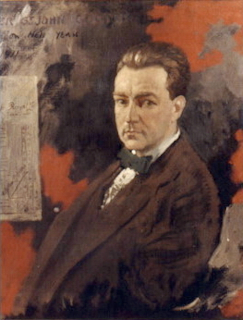
Death of Cathal Brugha, Revolutionary & Politician

cathal-brugha-1

Cathal Brugha, Irish revolutionary and republican politician, dies in Dublin on July 7, 1922, from injuries received two day earlier when shot by Irish Free State forces on O’Connell Street.

Brugha is born Charles William St. John Burgess of mixed Roman Catholic and Protestant parentage in Dublin on July 18, 1874. He attends Colmkille Schools until 1888 when he is admitted to Belvedere College. He intends to study medicine, but this does not come to fruition after his father’s business fails in 1890. He is seen as an austere figure, not very different from Éamon de Valera, and is known not to smoke cigarettes, swear or drink alcohol.

In 1899, Brugha joins the Gaelic League, and he subsequently changes his name from Charles Burgess to Cathal Brugha. He meets his future wife, Caitlín Kingston, at an Irish class in Birr, County Offaly, and they marry in 1912. The marriage produces six children. He becomes actively involved in the Irish Republican Brotherhood (IRB) and in 1913 he becomes a lieutenant in the Irish Volunteers. He leads a group of twenty Volunteers to receive the arms smuggled into Ireland in the Howth gun-running of 1914.

Brugha is second-in-command at the South Dublin Union under Commandant Éamonn Ceannt in the Easter Rising of 1916. On the Thursday of Easter Week, being badly wounded, he is unable to leave when the retreat is ordered. Brugha, weak from loss of blood, continues to fire upon the enemy and is found by Eamonn Ceannt singing “God Save Ireland” with his pistol still in his hands. He recovers over the next year but is left with a permanent limp.

Brugha proposes a Republican constitution at the 1917 Sinn Féin convention, which is unanimously accepted. In October 1917, he becomes Chief of Staff of the Irish Republican Army and holds that post until March 1919.

Brugha is elected as a Sinn Féin MP for the County Waterford constituency at the 1918 Irish general election. In January 1919, Sinn Féin MPs refuse to recognise the Parliament of the United Kingdom and instead assemble at the Mansion House in Dublin as a revolutionary parliament called Dáil Éireann. Owing to the absence of Éamon de Valera and Arthur Griffith, he presides over the first meeting of Dáil Éireann on January 21, 1919.

Brugha is elected Ceann Comhairle of Dáil Éireann at its first meeting on January 21, 1919, and he reads out the Declaration of Independence in Irish, which ratifies “the establishment of the Irish Republic.” On the following day he is appointed president of the ministry pro tempore. He retains this position until April 1, 1919, when Éamon de Valera takes his place.

Brugha has differences with Michael Collins, who, although nominally only the Irish Republican Army‘s (IRA) Director of Intelligence, has far more influence in the organisation as a result of his position as a high-ranking member of the IRB, an organisation that Brugha sees as undermining the power of the Dáil and especially the Ministry for Defence. He opposes the oath of allegiance required for membership of the IRB. In 1919, his proposition that all Volunteers should swear allegiance to the Irish Republic and the Dáil is adopted.

At a top-level IRA meeting in August 1920, Brugha argues against ambushes of Crown forces unless there is first a call to surrender, but it is dismissed as unrealistic by the brigade commanders present. He also has the idea of moving the front line of the war to England but is opposed by Collins.

On January 7, 1922, Brugha votes against the Anglo-Irish Treaty. During the Treaty debates, he points out that Collins has only a middling rank in the Department for Defence, which supervises the IRA, even though Griffith hails him as “the man who had won the war.” It is argued that, by turning the issue into a vote on Collins’ popularity, Brugha swings the majority against his own side. Frank O’Connor, in his biography of Collins, states that two delegates who had intended to vote against the Treaty changed sides in sympathy with Collins. Brugha leaves the Dáil and is replaced as Minister for Defence by Richard Mulcahy.

In the months between the Treaty debates and the outbreak of Irish Civil War, Brugha attempts to dissuade his fellow anti-treaty army leaders, including Rory O’Connor, Liam Mellows and Joe McKelvey, from taking up arms against the Free State. When the IRA occupies the Four Courts, he and Oscar Traynor call on them to abandon their position. When they refuse, Traynor orders the occupation of the area around O’Connell Street in the hope of easing the pressure on the Four Courts and of forcing the Free State to negotiate.

On June 28, 1922, Brugha is appointed commandant of the forces in O’Connell Street. The outbreak of the Irish Civil War ensues in the first week of July when Free State forces commence shelling of the anti-treaty positions.

Most of the anti-Treaty fighters under Traynor escape from O’Connell Street when the buildings they are holding catch fire, leaving Brugha in command of a small rearguard. On July 5, he orders his men to surrender, but refuses to do so himself. He then approaches the Free State troops, brandishing a revolver. He sustains a bullet wound to the leg which “severed a major artery causing him to bleed to death.” He dies on July 7, 1922, eleven days before his 48th birthday. He had been re-elected as an anti-Treaty TD at the 1922 Irish general election but dies before the Dáil assembles. He is buried in Glasnevin Cemetery in Dublin.


Leave a comment

Sinn Féin, Cumann na mBan & Others Declared Illegal Organizations

sinn-fein-cartoon

Sinn Féin, the Irish Volunteers, Cumann na mBan and the Gaelic League are proclaimed as illegal organisations by the Lord Lieutenant of Ireland, John French, 1st Earl of Ypres on July 4, 1919.

The proclamation states that the proscribed organisations are dangerous, and a “grave menace” designed to “terrorise the peaceful and law-abiding subjects of His Majesty in Ireland.” It goes on to say that these associations “encourage and aid persons to commit crimes and promote and incite to acts of violence and intimidation and interfere with the administration of the law and disturb the maintenance of law and order.”

The Irish Times, no supporter of any of the banned organisations, welcomes the development as a sign that the government has decided that sedition will “no longer be preached and practised with impunity in Ireland.” The paper also says that this new policy “furnishes final proof of the gravity of the Irish problem.”

In the immediate aftermath of the proclamation, business continues as usual at the Sinn Féin headquarters at 6 Harcourt Street and at the Gaelic League’s head offices at 25 Parnell Square. Both organisations claim that they have not received any direct communication, let alone any visits, from the police or military.

Speaking to a representative of the Evening Telegraph, Eoin MacNeill, President of the Gaelic League, strikes a defiant note, declaring that the organisation will “not allow itself to be driven underground” and will continue to “have the support of the nation and of Irishmen abroad.”

MacNeill points out that the Gaelic League is approaching its 25th anniversary, on July 23, and that throughout its lifetime it has always been “non-political – that is to say has never interfered in the controversy with regard to the form of the Irish Government and left all its members absolutely free to hold whatever political opinions they pleased. Of course, it is a new situation now. The Government itself has taken the initiative in making the neutrality of the Gaelic League impossible.”

Apparently, the banning of the Gaelic League spurs interest in the language movement as several booksellers refer to being “inundated with orders” for booklets and manuals of instruction and conversations in the Irish language. The casual use of Irish on the streets also reportedly increases.

Cumann na mBan expresses surprise at the actions of the government and takes it as a sign that “conscription is now a certainty.” All of the organisation’s public work up to this point has been geared towards the campaign to oppose conscription.

The Lord Lieutenant makes his proclamation under the Criminal Law and Procedure (Ireland) Act of 1887 which gives the authorities the power to outlaw any organisation it believes to be involved in criminal activities.

(From: “BANNED: Sinn Féin, Irish Volunteers, Cumann na mBan and the Gaelic League,” RTÉ.ie, the website of Raidió Teilifís Éireann | Photo: The government trying to douse the flames of Sinn Féin, from “The Republic,” April 11, 1907, DigitalLibrary@Villanova University)


2 Comments

Founding of Clan na Gael in New York City

CREATOR: gd-jpeg v1.0 (using IJG JPEG v62), quality = 90

The Clan na Gael, an Irish republican organization in the United States in the late 19th and 20th centuries, is founded by John Devoy, Daniel Cohalan, and Joseph McGarrity in New York City on June 20, 1867. It is the successor to the Fenian Brotherhood and a sister organization to the Irish Republican Brotherhood (IRB). It has shrunk to a small fraction of its former size in the 21st century.

As Irish immigration to the United States begins to increase in the 18th century many Irish organizations are formed. In the later part of the 1780s, a strong Irish patriot character begins to grow in these organizations and amongst recently arrived Irish immigrants.

In 1858, the IRB is founded in Dublin by James Stephens. In response to the establishment of the IRB in Dublin, a sister organization is founded in New York City, the Fenian Brotherhood, led by John O’Mahony. This arm of Fenian activity in America produces a surge in radicalism among groups of Irish immigrants, many of whom had recently emigrated from Ireland during and after the Great Famine.

In October 1865, the Fenian Philadelphia Congress meets and appoints the Irish Republican Government in the United States. Meanwhile in Ireland, the IRB newspaper The Irish People is raided by the police and the IRB leadership is imprisoned. Another abortive uprising occurs in 1867, but the British remain in control.

After the 1865 crackdown in Ireland, the American organization begins to fracture over what to do next. Made up of veterans of the American Civil War, a Fenian army is formed. While O’Mahony and his supporters want to remain focused on supporting rebellions in Ireland, a competing faction, called the Roberts, or senate wing, wants this Fenian Army to attack British bases in Canada. The resulting Fenian raids strain U.S.–British relations. The level of American support for the Fenian cause begins to diminish as the Fenians are seen as a threat to stability in the region.

After 1867, the Irish Republican Brotherhood headquarters in Manchester chooses to support neither of the existing feuding factions, but instead promotes a renewed Irish republican organization in America, to be named Clan na Gael.

According to John Devoy in 1924, Jerome James Collins founds what is then called the Napper Tandy Club in New York on June 20, 1867, Wolfe Tone‘s birthday. This club expands into others and at one point at a picnic in 1870 is named the Clan na Gael by Sam Cavanagh. This is the same Cavanagh who killed the informer George Clark, who had exposed a Fenian pike-making operation in Dublin to the police.

Collins, who dies in 1881 on the disastrous Jeannette Expedition to the North Pole, is a science editor on the New York Herald, who had left England in 1866 when a plot he was involved in to free the Fenian prisoners at Pentonville Prison was uncovered by the police. Collins believes at the time of the founding in 1867 that the two feuding Fenians branches should patch things up.

The objective of Clan na Gael is to secure an independent Ireland and to assist the Irish Republican Brotherhood in achieving this aim. It becomes the largest single financier of both the Easter Rising and the Irish War of Independence.

Clan na Gael continues to provide support and aid to the Irish Republican Army (IRA) after it is outlawed in Ireland by Éamon de Valera in 1936 but becomes less active in the 1940s and 1950s. However, the organization grows in the 1970s. The organization plays a key part in the Irish Northern Aid Committee (NORAID) and is a prominent source of finance and weapons for the Provisional Irish Republican Army during the Troubles in Northern Ireland in 1969–1998.

The Clan na Gael still exists today, much changed from the days of the Catalpa rescue. In 1987 the policy of abstentionism is abandoned. As recently as 1997 another internal split occurs as a result of the IRA shift away from the use of physical force as a result of the 1998 Good Friday Agreement. The two factions are known to insiders as Provisional Clan na Gael (allied to Provisional Sinn Féin/IRA) and Republican Clan na Gael (associated with both Republican Sinn Féin/Continuity IRA and 32 County Sovereignty Movement/Real IRA, though primarily the former). These have been listed as terrorist organizations at various times by the UK Government.

(Pictured: Clan na Gael marching in the 1970 St. Patrick’s Day Parade in Philadelphia, photograph by John Hamilton)


4 Comments

The Gough Barracks Raid

gough-barracks

The Irish Republican Army (IRA) makes an audacious raid on Gough Barracks in Armagh, County Armagh, Northern Ireland on June 12, 1954. It marks the re-awakening of IRA activity in Northern Ireland and a re-arming that leads eventually to the 1956-1962 border campaign.

In January 1954, Leo McCormick, the Training Officer for the Dublin Brigade of the IRA, is on a visit to Armagh. As he passes Gough Barracks, the home of the Royal Irish Fusiliers, he notices that the guard on duty outside the barracks is armed with a Sten gun without a magazine. He concludes rightly that Gough Barracks is in effect being guarded by an unarmed guard.

On his return to Dublin, McCormick informs the Dublin Brigade of his chance observation. Alas, he does not see the end result of his information, as he is arrested soon after and receives four years for possession of a document.

By April, the General Head Quarters decides that they will raid Gough Barracks for arms. But first, they need more information. Eamonn Boyce, the Intelligence Officer of the Dublin Brigade, is asked to travel to Armagh and check out the barracks. He makes several trips to Armagh and soon has a detailed account of life outside the barracks. But GHQ wants more inside details. Charlie Murphy gets over this problem by asking Seán Garland to go to Armagh and enlist in the British Army. Not long after Garland’s enlistment, a stream of maps, documents, time schedules and photographs flow into GHQ for processing.

Finally, a last intelligence coup is arranged. Using Garland’s information, the IRA gets inside the barracks to have a look around. On a Saturday night in May, Boyce and Murphy slip into the barracks as “guests” at a weekly dance. With them they bring a girl, Mae Smith, who is later to become chairperson of Sinn Féin. After a few dances, Garland takes Mae outside for what his fellow soldiers assume is an hour of light passion but is in fact a detailed tour of the entire barracks.

The operation is launched on June 12, 1954, from a farm just outside Dundalk. A large red cattle truck is commandeered at the last moment and nineteen IRA men, about half of the Dublin Brigade, climb in and are informed as to what their target is. It is almost 3:00 on a busy Saturday afternoon when the cattle truck and a car drive into Armagh.

Paddy Ford gets out of the car and walks over to the sentry and asks him about enlisting in the British Army. While the sentry is dissuading Ford of what he considers a foolish course of action, he looks down into the barrel of a .45 caliber Colt revolver in the perspective recruit’s hand. As the sentry is held at gunpoint, three IRA men pass him into the guardhouse. The sentry is then brought in after them. While the sentry is being tied up, a new IRA sentry, complete with British uniform, white webbing belt, regimental cap and sten gun with magazine steps out to stand guard over Gough Barracks.

As soon as the IRA sentry appears, the cattle truck drives through the gate and comes to a halt outside the arsenal door. After fumbling through 200 keys, Eamonn Boyce finds the right one and opens the armoury. Murphy races up the stairs and in the first room two British soldiers demand to know what a civilian wants inside the barracks. Murphy has some trouble getting his revolver out of his pocket and is further embarrassed when the two soldiers refuse to put up their hands. However, another IRA man arrives carrying a Thompson submachine gun, which quickly convinces them to do as they are told. Posting a Bren gun at the armoury window to command the barracks square, the IRA begins stripping the armoury.

During the course of the raid a woman, noticing something is wrong, stops a British officer in the street and urges him into the barracks to investigate. Once inside the gate the officer is taken under control and, protesting that he is an officer and a gentleman, refuses to be tied until a gun is put to his head.

An NCO then notices what is happening, gets into a lorry and drives for the gate, intending to block the exit. An IRA man stands at the gate brandishing a revolver and shouts “Back.” He forces the NCO to reverse the lorry. The NCO is placed under arrest in the guard room. By the end of the raid, the IRA has tied up 19 British soldiers and one civilian.

In less than 20 minutes the job is done. The truck carrying 340 rifles, 50 Sten guns, 12 Bren guns, and a number of small arms drives out of the barrack gates and rumbles through Armagh in the direction of the border. Eamonn Boyce and the group in the car follow after locking every gate and door for which they can find keys. At 3:25 PM the first alarm in the barracks is given but it is not until 5:00 that the general alarm is given and by that time the big red truck is long gone.

The raid for arms in Gough Barracks gains international attention. The IRA, which has been described by some as moribund since the ’40s campaign, has once more risen from its slumber to strike a blow against the forces of occupation. The raid awakes a calling in many to join the IRA and take part in the Border Campaign, which keeps alive the flame of republicanism through to the present time.

(From: “The Gough Barracks raid – Remembering the Past” by Shane Mac Thomáis, anphoblacht.com, June 9, 2005)